Transmission by Zoophagic Mosquitoes
Samson S. Kiware1,2*, Nakul Chitnis3,4, Sarah J. Moore1,5, Gregor J. Devine1,6, Silas Majambere1,6, Stephen Merrill2, Gerry F. Killeen1,6
1Biomedical and Environmental Thematic Group, Ifakara Health Institute, Ifakara, Tanzania,2Department of Mathematics, Statistics, and Computer Science, Marquette University, Milwaukee, Wisconsin, United States of America,3Department of Epidemiology and Public Health, Swiss Tropical and Public Health Institute, Basel, Switzerland,4University of Basel, Basel, Switzerland,5London School of Hygiene and Tropical Medicine, London, United Kingdom,6Vector Group, Liverpool School of Tropical Medicine, Liverpool, United Kingdom
Abstract
Background:High coverage of personal protection measures that kill mosquitoes dramatically reduce malaria transmission where vector populations depend upon human blood. However, most primary malaria vectors outside of sub-Saharan Africa can be classified as ‘‘very zoophagic,’’ meaning they feed occasionally (,10% of blood meals) upon humans, so personal protection interventions have negligible impact upon their survival.
Methods and Findings: We extended a published malaria transmission model to examine the relationship between transmission, control, and the baseline proportion of bloodmeals obtained from humans (human blood index). The lower limit of the human blood index enables derivation of simplified models for zoophagic vectors that (1) Rely on only three field-measurable parameters. (2) Predict immediate and delayed (with and without assuming reduced human infectivity, respectively) impacts of personal protection measures upon transmission. (3) Illustrate how appreciable indirect communal-level protection for non-users can be accrued through direct personal protection of users. (4) Suggest the coverage and efficacy thresholds required to attain epidemiological impact. The findings suggest that immediate, indirect, community-wide protection of users and non-users alike may linearly relate to the efficacy of a user’s direct personal protection, regardless of whether that is achieved by killing or repelling mosquitoes. High protective coverage and efficacy ($80%) are important to achieve epidemiologically meaningful impact. Non-users are indirectly protected because the two most common species of human malaria are strict anthroponoses. Therefore, the small proportion of mosquitoes that are killed or diverted while attacking humans can represent a large proportion of those actually transmitting malaria.
Conclusions:Simplified models of malaria transmission by very zoophagic vectors may be used by control practitioners to predict intervention impact interventions using three field-measurable parameters; the proportion of human exposure to mosquitoes occurring when an intervention can be practically used, its protective efficacy when used, and the proportion of people using it.
Citation:Kiware SS, Chitnis N, Moore SJ, Devine GJ, Majambere S, et al. (2012) Simplified Models of Vector Control Impact upon Malaria Transmission by Zoophagic Mosquitoes. PLoS ONE 7(5): e37661. doi:10.1371/journal.pone.0037661
Editor:Hiroshi Nishiura, University of Hong Kong, Hong Kong
ReceivedOctober 17, 2011;AcceptedApril 23, 2012;PublishedMay 31, 2012
Copyright:ß2012 Kiware et al. This is an open-access article distributed under the terms of the Creative Commons Attribution License, which permits unrestricted use, distribution, and reproduction in any medium, provided the original author and source are credited.
Funding:This work was funded in part by the Bill & Melinda Gates Foundation through award numbers 45114 (Malaria Transmission Consortium), 51431 (Replacing DDT: Rigorous Evaluation of Spatial Repellents for the Control of Vector Borne Diseases), 52644 (Control of Anophelines by the auto-dissemination of insecticides) and 39777.01 (A stochastic simulation platform for predicting the effects of different malaria intervention strategies). The funders had no role in study design, data collection and analysis, decision to publish, or preparation of the manuscript. No additional external funding was received for this study.
Competing Interests:While this study was independently funded by the Bill & Melinda Gates Foundation, two of the authors have received funding support for other research projects from manufacturers of insecticidal public health products: Vestergaard Frandsen SA (GFK), Syngenta (SJM), Pinnacle Development (SJM) and SC Johnson (SJM). This does not alter the authors’ adherence to all the PLoS ONE policies on sharing data and materials.
* E-mail: [email protected]
Introduction
Indoor residual spraying (IRS) and long-lasting insecticidal nets (LLIN) dramatically reduce malaria transmission [1]. Both approaches exceed the benefits of personal protection and provide even greater levels of community-wide protection for users and non-users alike once reasonably high coverage is achieved (30%– 60%) [2–3]. High demographic coverage of humans (Ch) can dramatically reduce the density, longevity and infection prevalence of mosquito species that primarily feed indoors (endophagic) upon humans (anthropophagic) such asAnopheles gambiaeandAn. funestus from sub-Saharan Africa [4–6] orAn. punctulatusand An. koliensis
However, mosquitoes which feed upon animals (zoophagic) are primary malaria vectors in many tropical countries [17–18] and can dominate residual transmission in settings where high demographic coverage of LLIN or IRS has successfully suppressed previously predominant, anthropophagic species [4–5,10,12–13].
While LLINs confer personal protection against any mosquitoes attempting to bite while they are in use, it remains unclear whether they confer community-level protection against zoophagic vectors that feed only occasionally upon humans. We therefore extended a previously published static malaria transmission model [6] and applied it to explain how immediate and delayed impacts of personal protection measures can be predicted using three potentially field measurable parameters. In addition, we simplified this model formulation by expressing malaria transmission and control in terms of a baseline human blood index [19]. Also, the model was used to assess the likely extent and mechanism of the community-level impact of such personal protection measures upon human malaria exposure for the zoophagic vectors that are primary vectors in many parts of the world [4,10,18] and will increasingly dominate transmission in the future [12,20]. We also contrast these impacts and underlying mode of action with those of the anthropophagic species that have been the overwhelming focus of malaria research and control to date.
Methods
Model Description
We extended a static malaria transmission model [6] to explore the dependence of malaria transmission and control upon baseline human blood index before any intervention is introduced. Specifically, the impact of personal protection measures such as LLINs, IRS, insecticide-treated clothing or repellents upon the baseline malaria transmission intensity was compared in a range of vector behaviour scenarios.
Simulating Malaria Transmission and Control as a Function of Mosquito Host Preference
Before describing how the model simulations were performed, we first present the basic input parameters and their definitions, equations and derived parameters, output from the model, description of simplified models for very zoophagic vectors, and the expression of malaria transmission and control as a function of baseline human blood index.
Model Basic Input Parameters and Definitions
Several subscripts are used in this model; V denotes an intervention package scenario consisting of a specific coverage, 0 for a baseline condition with no intervention,pfor protected oru for unprotected humans ð Þ, andh c for cattle or other animals. Demographic or crude coverage is defined as a proportion of people using a personal protection measure as estimated in a standardized malaria indicator surveys(Ch)[6]. Another impor-tant input is the proportion of daily exposure that a non-user would typically experience at times when a user would normally use such a personal protection measure(p). In other words, this is the maximum proportion of human exposure to mosquitoes that can be directly prevented through a personal protection by using a given measure. This is a broader definition than used previously when the term was described as the proportion of human exposure that occurs indoors while asleep at times when LLINs can be used
pi
ð Þ[21]. This more generalized definition allows the incorpora-tion of other personal protecincorpora-tion intervenincorpora-tions such as insecticide-treated clothing and repellents which can also be used outdoors. Recently, several authors [21–23] have described and discussed
the importance and measurement ofpi, but the concept was also discussed during the GMEP era [24–25] when the difficulty of controlling exophagic or exophilic vectors was described in Africa [21,26], Asia [27], and the Americas [25]. We also introduce host-encounter rate(e)which is the rate at which a single host-seeking mosquito encounters a given single host. The notations,ch,p,ch,u, and cc represent probability of attacking encountered protected humans, unprotected humans and cattle, respectively. Where-as,wh,p,wh,u, and wc represent mosquito feeding probability upon protected humans, unprotected and cattle respectively. The mean attack availability of individual cattleð Þac is the rate at which a single mosquito encounters and then attacks a single cow whereas the mean attack availability of an individual unprotected (ah,u) human, is the rate at which a single mosquito encounters and then attacks a such single person of either protection status [6]. Mortality probability upon attacking a protected or an unprotect-ed human or cow are denotunprotect-ed bymh,p,mh,u, andmc, respectively. Pov denotes the survival probabilities during host-seeking and ovipisition site-seeking, which are assumed to be equal.Nh,uand
Nc are the population sizes of unprotected humans and cattle, respectively. The subscripts and the basic parameters presented here are also defined in table 1 with their dimensions listed for a quick reference.
Model Equations for Derived Parameters
We present equations from previous model [6] that are of important to this paper relating all derived parameters in terms of the basic parameters or other already derived parameters. Though these derived parameters are defined here, their definitions and dimensions are also presented in table 2.
Protective Coverage and Baseline Human Blood Index As previously [6], we define de facto protective coverage of humans(Ch,p)as being the product of crude coverage (Ch), and the maximum proportion of human exposure to mosquitoes that can be directly prevented through personal protection by using a given intervention(p);
Ch,p~pCh: ð1Þ
The mean availability (a) of any host of any species (s) for mosquitoes to attack is the product of the rate at which individual vectors encounter that host(es)and the probability that, after this encounter, they will attack the host (cs);as~escs [28]. Thus,
ah,p~ehch,p,ah,u~ehch,u,andac~ecccare mean attack availability of protected, unprotected human and cattle respectively. The mean availability of host blood(z)from a host of any species(s)is the product of the rate at which individual vectors encounter this host(es)and the feeding probability upon that particular hostð Þws ;
zs~esws [28]. Thus, zh,p~ehwh,p,zh,u~ehwh,u, and zc~ecwc represent mean availability of blood from individual protected, unprotected human and cattle respectively.
The total availability of all hosts(A), protected humans (Ah,p~ehch,pNhCh,p), unprotected humans Ah,u~ehch,uNh
1{Ch,p
Þ, and all cattle ðAc~ecccNcÞ, respectively, are the
rates at which a single mosquito encounters, attacks upon these host sets [6]. These total availability parameters are related to each other and calculated in terms of basic individual availability and host population size parameters as follows [6];
Similarly, the total availability of blood from all hosts, Z
ð Þ, protected Zh,p~ehwh,pNhCh,p
or unprotected ðZh,u~
ehwh,uNh 1{Ch,p
Þhumans and all cattleðZc~ecwcNcÞ,
respec-tively is the rate at which a single mosquito encounters, attacks and successfully feeds upon these host sets [6] given by;
Z~Zh,pzZh,uzZc: ð3Þ
The human blood index is the proportion of all blood meals obtained from both protected and unprotect humans [19], and is calculated as a function of the total availability of blood from both categories of humans and the availability of alternative blood sources such as cattle and other animals [6]:
Qh~
Zh,pzZh,u
Zh,pzZh,uzZc
: ð4Þ
Changing the mean availabilities of protected humans ah,p
or unprotected humans (ah,u) and cattle ð Þac correspondingly change,Zh,u,Zh,p and Zc, and therefore the the human blood index ðQhÞ,because Zh is directly related to ah whereas Zc is directly related toac: The baseline human blood index in the absence of any protection measureðQh,0Þcan be used to identify
vector populations which are zoophagic in terms of both their innate host preferences and their ability to exploit locally common animal hosts. This is because low values represent mosquitoes that primarily feed on animals (zoophagic) while high values represent those that primarily feed on humans (anthropophagic). So, when Ch~0,the baseline human blood indexðQh,0Þcan be derived in
terms of basic parameters as;
Qh,0~
ehwh,uNh
ehwh,uNhzecwcNc
: ð5Þ
For predominantly animal-feeding mosquito [29], we assume that the mean encounter rate for humansð Þeh approaches zero, so that the same is correspondingly true of the mean attack availability of humans(ah) and the mean availability of human blood per se (zh): Therefore, the total attack availability of all humans(Ah) and the total availability of all human bloodper se
(Zh)also approaches zero.
In equation 5, baseline human blood index goes to zero Qh,0?0
when either the denominator goes to infinity or the numerator goes to zero. The numerator can go to zero in three different ways; either when eh?0 or Nh?0 or wh,u?0: It is
unrealistic that the denominator will go to infinity, or thatwh,uwill go to 0, and it is of no interest to model malaria transmission in the situation where Nh goes to zero. So, in the situations that are realistic and interesting, Qh,0?0
if and only if eh?0:Hence, when we are interested in the situation Qh,0?0
,we can take the limit as eh?0,which biologically means a situation where mosquitoes are not attracted to human blood so the attractiveness or availability of human blood is close to zero. Therefore, the mean availability of individual humans (ah) and the mean availability of blood from individual humans (zh), the total availability of all humans(Ah),and the total availability of all humans blood(Zh),including both the protected and unprotected, all approach zero as well.
Model Outputs
Malaria transmission intensity is often expressed in terms of the entomologic inoculation rate (EIR) which is a direct,
field-Table 1.Definition of basic parameters.
Symbol Definition and explanation Dimension
e Host-encounter rate: rate at which a single host-seeking mosquito encounters a given single hosts.
One
eh,ec Human and cattle encounter rate respectively. Per Time
Qh,u Probability that a mosquito which attacks an unprotected human will successfully feed upon that host.
One
Qh,p Probability that a mosquito which attacks protected human will successfully feed upon that host. One
ch,p,ch,u,cc represent probability of encountering protected, unprotected human and cattle respectively.
Nh, Nh,p, Nh,u Number of people, protected and unprotected Human
Nc Number of cattle Animal
Ch Demographic or crude coverage: Proportion of people using a personal protection measure as estimated in a standardized malaria indicator surveys.
One
mh,u Mortality probability upon attacking an unprotected human. One
mh,p Mortality probability upon attacking an protected human One
mc Mortality probability upon attacking a cattle One
pi The proportion of normal exposure to mosquito bites upon humans lacking LLINs, which occurs indoors at times when nets would normally be in use.
One
p The maximum proportion of human exposure to mosquitoes that can be directly prevented through personal protection by using a given intervention
One
Pov The survival probabilities during host seeking and ovipisition site-seeking assumed to be equal
1/exp(Time)
The subscripts used are given in bracket; human (h), protected (p), unprotected (u), cattle (c), a baseline condition with no personal protection coverage (0), intervention package scenarios consisting of a specific coverage (V).
measurable indicator of human exposure to bites of mosquitoes infected with transmissible sporozoite stage malaria parasites [30– 31]. Thus, the primary outputs from the model were the absolute EIR for an average community member(EIRh,V)and the relative
exposure for non-users to the baseline condition yh,u,V
both in a given intervention scenario. To help understand how the impact of a personal protection measure mediated in a given scenario(V), the impact upon vector population parameters, the survival rate per feeding cycle Pf,V
, human blood index ðQh,VÞ, feeding cycle lengthð Þ,fV and emergence rate of adult mosquitoesEV are
plotted against ðQh,0Þ, as intermediate secondary outputs that
underlie EIR and changes in this primary outcomes.
We present equations fromKilleen et al[6] necessary to define primary and secondary outputs in terms of basic or already derived parameters. The probability of surviving host attack per feeding cycle Pc
is a function of the probability of surviving one complete feeding cycle Pf
: The oviposition site-seeking inter-valð Þgo and the vertebrate host-seeking intervalð Þgv are both a function of feeding cycle lengthð Þf andPf,where bothPf,and
fare functions of emergence rate of adult mosquitoesð ÞE [6]. So,
Table 2.Definitions of the derived parameters.
Symbol Definition and explanation Units
Ch,p Protective coverage One
ac Mean availability of individual cow for attack: rate at which a single mosquito encounters and then attacks a cow or pseudo-host.
Per time per animal
ah Mean availability of individual human for attack: rate at which a single mosquito encounters and then attacks a human or pseudo-host.
Per time per human
ah,p Availability of individual protected human Per time per protected human
ah,u Availability of individual unprotected human Per time per unprotected human
A, Ah, Ac Total availability of all hosts, all humans and all cattle, respectively: rate at which a single mosquito encounters, attacks upon these host sets
Per time
z, zh, zc Mean availability of blood from all hosts, all humans and all cattle, respectively: rate at which a single mosquito encounters, attacks and successfully feeds upon these host sets.
Per time
Z, Zh, Zc Total availability of blood from all hosts, all humans and all cattle, respectively: rate at which a single mosquito encounters, attacks and successfully feeds upon these host sets.
Per time
Qh Human blood index: the proportion of all blood meals from all hosts which are obtained from humans. One
Qh,0 The baseline human blood index in the absence of any protection measure One
Pc Probability of surviving host attack per feeding cycle One
g0 Oviposition site-seeking interval; number of days a mosquito takes to find an oviposition site once it starts searching for it
Time
gv Host seeking interval: number of days a mosquito takes to find and attack a vertebrate host Time
Pf The survival rate per feeding cycle Per time
f Feeding cycle length: measured as the number of days it takes a single mosquito to get from one blood feed to the next.
Time
E Emergence rate of mosquito vector Per time
bh The total number of infectious bites on all humans One
b The total number of sporozoite infected bites in all hosts per mosquito lifetime One EIR Entomological inoculation rate (mean number of infectious bites that
an average individual human receives per year).
Per time
EIRh,V absolute EIR for an average community member in a given intervention scenario Per time
EIRh,u EIR for non-users Per time
yh,u The immediately relative exposure of non-users benefiting only from communal protection One g Gestation interval: number of days a mosquito takes to digest a blood meal
and return to searching for oviposition site.
Time
Pg Combined probability that a vector survives gestation One
x Mosquito age Time
Sx The sporozoite infection prevalence of mosquitoes at each age One
x Human infectiousness to mosquitoes: probability of a vector becoming infected per human bite. One r Overall proportion of personal protection against mosquito bites provide by using a given
protective measure.
One
yqh,u,V The immediate impact on vector population assuming a reduction of human infectivity. One
Pfx/f Estimation of daily cycle and cumulative survival of mosquitoes up to each age (x). One
The subscripts used are given in bracket; human (h), protected (p), unprotected (u), animals (c), a baseline condition with no personal protection coverage (0), intevention package scenarios consisting of a specific coverage (V).
we first present equations ofPcand the combinedgoandgv:
Pc~1{
mh,pAh,pzmh,uAh,uzmcAc
Ah,pzAh,uzAc
: ð6Þ
gozgv~ 1 Az
1 Z~
1 AhzAc
z 1
ZhzZc
: ð7Þ
Hence,Pf,f,andE [6] are given as follows:
Pf~PgPgovozgvPc: ð8Þ
gz1
Az 1 Z~gz
1 AhzAc
z 1
ZhzZc
: ð9Þ
E~X
?
x~1
Pxf=f
f : ð10Þ
Whereð Þg is gestation period andPis the mean daily survival,Pgis the probability that a vector survives a single gestation, andPovis the survival probability for the combined host seeking and ovipisition site-seeking intervals. Whereas,Pxf=f is the cumulative survival of mosquitoes up to a given age ð Þ, as previouslyx described [6]. In all cases, impact is assessed in terms of changes in the parameters under a given scenario ð ÞV relative to a baseline
with no protection measure (0):Pf,V Pf,0,
Qh,V Qh,0,
fV f0,and
EV
E0,respectively. The number of infectious bites on humansð Þbh per mosquito life time is given by the product of human blood index and the sum of the products of the probabilities of surving and being infectious at each age [6];
bh~
Qh
f X
?
x~1
SxPxf=f: ð11Þ
Whereas,Sxis the sporozoite infection prevalence of mosquitoes at each agex,Sx~Sx{1zðkQh(1{Sx{1)Þ=f,forxwnotherwise
Sx~0 where, n is the extrinsic incubation period, and k is population mean human infectiousness to mosquitoes; defined as the mean probability of a vector becoming infected per human bite.
Thus, absolute EIR for an average community member in a given intervention scenarioðEIRh,VÞis given by [6];
EIRh,V~bhE
Nh
: ð12Þ
The relative exposure for non-users yh,u,V
,humans who are unprotectedð Þu by the physical and chemical barrier of personal protection measure but may benefit from communal protection, in a given interventionð ÞV scenario is calculated as their predicted exposure (EIRh,u,V) divided by their baseline exposure with no
protection (0) measure(EIRh,u,0)as;
yh,u,V~ EIRh,u,V EIRh,u,0
~zh,ubVEV
ZV
7zh,ub0E0
Z0
~Z0bVEV
ZVb0E0
:
ð13Þ
Whereas,bis the number of sporozoite infected bites in all hosts
per mosquito lifetime b~ P
?
x~1
SxPxf=f
=f
calculated as
equation 11 but ignoringQhterm [6].
Simplified Models for Very Zoophagic Vectors
Initial simulations suggested closer examination of the under-lying mechanisms through which personal protection mediates community-level protection against malaria transmission by very zoophagic mosquitoes. We specifically define very zoophagic vectors as those which are not merely zoophagic, such as An. arabiensis which readily feeds on both humans and cattle [32], but rather those which have a strong preference for animals and normally obtain 90% or more of their blood meals from animalsðQh,0ƒ0:1Þ. A useful example of such a vector species
that can be considered very zoophagic isAnopheles epiroticusin the Mekong delta of Vietnam. This mosquito population has a. 11-fold preference for cattle over humans [27], which allows us to simulate transmission by this species by adjusting the mean encounter rate for humansð Þeh in proportion to this relative attack rate of cattle compared with humans [6,28,33], but which are otherwise equivalent to those described above for An. arabiensis [6]. It illustrates how mosquitoes exhibiting very high levels of zoophagy at population level(Qh,0~0:08)can mediate
transmis-sion intensities(EIR~3:1infectious bites per person per year) that are compatible with this mosquito’s status as a primary malaria vector in the region [34].
Expressing Malaria Transmission and Control as a Simplified Function of Baseline Human Blood Index
We express the primary and secondary outputs in terms of human blood indexðQh,0Þ, because it is one of the most important
deter-minants of overall malaria transmission locally and globally [17,19, 35–37]. For very zoophagic mosquito populations with low human blood indices(0vQhv0:1)that are nevertheless sufficient to stably transmit malaria(0vEIRv1infectious bite per year per person); we are interested in a situation whereQh,0?0to illustrate the impact of a
personal protection measure onPf,V Pf,0
,fV f0
,EV E0
, andQh,V Qh,0
.
SincePovis constant, using equation 6 and 8 we can compute
Pf,V Pf,0
as Qh,0?0 by taking the limit as eh?0, (so
Ah,p?0,Ah,u?0, Zh,p?0, Zh,u?0) terms only with subscript
c(for cattle) remain cancelling to 1;
lim
Qh,0?0 Pf,V
Pf,0 ~
PgP
1
Ah,uzAh
,pzAcz 1 Zh,uzZh,pzZc
ov 1{
mh,p Ah,pzmh,u Ah,uzmc Ac Ah,pzAh,uzAc
PgP
1
Ah,uzAh,pzAczZh,uzZh,p1 zZc
ov 1{ mh,u Ah,u
zmh,u Ah,uzmc Ac Ah,pzAh,uzAc
~ Pov
1
AczZc1
1{mc Ac Ac
Pov
1
Acz1
Zc
1{mc Ac Ac
~1:
Using equation 9 the same approach can be applied forfV f0
to get;
lim
Qh,0?0
fV f0
~
gz 1
Ah,uzAh,pzAczZh,pzZh,u1 zZc
gz 1
Ah,uzAh,pzAcz
1 Zh,pzZh,uzZc
~g
z 1
AczZc1
gz 1
Acz 1 Zc
~1:
ð15Þ
We use equation 10 to driveEV E0
in the limiteh?0by rearranging
equation 10 and then substitutingPf,V,Pf,0,fV, and f0 from
equations 14 and 15 as follows;
lim
Qh,0?0
EV E0
~
P?
x~1
Px=fV f,V
fV
P?
x~1
Px=f0 f,0
f0
~
P?
x~1P
x=fV f,V
P?
x~1P
x=f0 f,0
|f0
fV
~
P?
x~1ðPov(1{mc)Þ x gz1
Zc
P?
x~1ðPov(1{mc)Þ x gz1
Zc
|
gz 1
Zc
gz 1
Zc
~1:
ð16Þ
The interpretation of equation 14, 15 and 16 is given in the result section. However, the limit for the other vector population parameter does not go to 1, indicating that human blood index is affected by personal protection measures against very zoophagic vectors that are nevertheless fractionally but sufficiently anthro-pophagic to put a lot of people at risk of malaria transmission. This allows much simpler models for both immediate impacts upon malaria transmission, with and without an assumed reduction of human infectivity in the longer term, to be derived that rationalize the reduced, but nevertheless useful, impacts of insecticidal personal protective measures upon zoophagic vectors. The explanation and interpretation of what happens to the overall
impact on Qh,V
Qh,0 as Qh,0 approaches zero for very zoophagic
Qh,0ƒ0:1
ð Þvectors, is provided in the results section.
Simulated Scenarios
The full possible range of host preference for mosquitoes was simulated by modifying field estimates for cattle and human encounter rate,(ec)and(eh)respectively, by beginning with values typical of a mosquito such as An. Arabiensis, which is both anthropophagic and zoophagic [33,35,38–39]. The value for ec was tuned down to zero to mimic highly anthropophagic African vectors likeAn.gambiae[33], whileehwas tuned down towards zero to mimic zoophagic mosquitoes likeAn.quadriannulatus[38,40] and other Anophelines that only occasionally feed on humans [38,41– 42]. WhileAn.gambiae, An.arabiensis and An.quadriannulatuscome from a single African species complex (An.gambiae sensu lato); they span the full range of host choice preferences exhibited by anophelines world-wide. AlthoughAn.gambiaetypically feeds almost exclusively upon humans, and has historically been the most important vector of malaria in the world [43],An.arabiensisis as likely to attack cattle as humans and is a correspondingly less potent but nevertheless significant primary vector [43–45]. By comparison,
An.quadriannu-latusis thought to rarely feed upon humans and transmit little, if any malaria, despite being readily infected byPlasmodium falciparum [46]. An.arabiensis is a useful intermediate example because this species has been well studied, feeds readily upon both humans and animals [32,47], and has proven relatively resilient to control with IRS and LLINs [40].
The first scenario was simulated with no intervention by setting Chto 0, whereas, the intervention scenariosð ÞV were simulated by settingCh for an unspecified personal protection measure to the assumed high coverage levels of 0.8, equivalent to the Roll Back Malaria targets for LLIN coverage of all age groups, with a very high proportion of human exposure to mosquitoes occurring when that protection measure can practically be usedðp~0:9Þ:
The model was implemented with a range of values of eh ranging from a maximum of 1.761023and then decreasing to 1.161024 encounters per day per host-seeking vector per unprotected human, with ec increasing from 0 up to 1.761023 encounters per day per host-seeking vector per cow. The default value of 1.761023encounters per day per host-seeking vector per unprotected human, at which these two ranges coincide, is used because it is an intermediate value between field measures forehof 1.361023 and for ec of 2.161023encounters per day per host-seeking forAn. arabiensis[2].NhandNcwere assumed equal (1000 for each) in all simulations, leading toQh,0 values ranging from
0.03 to 1.00.
Results
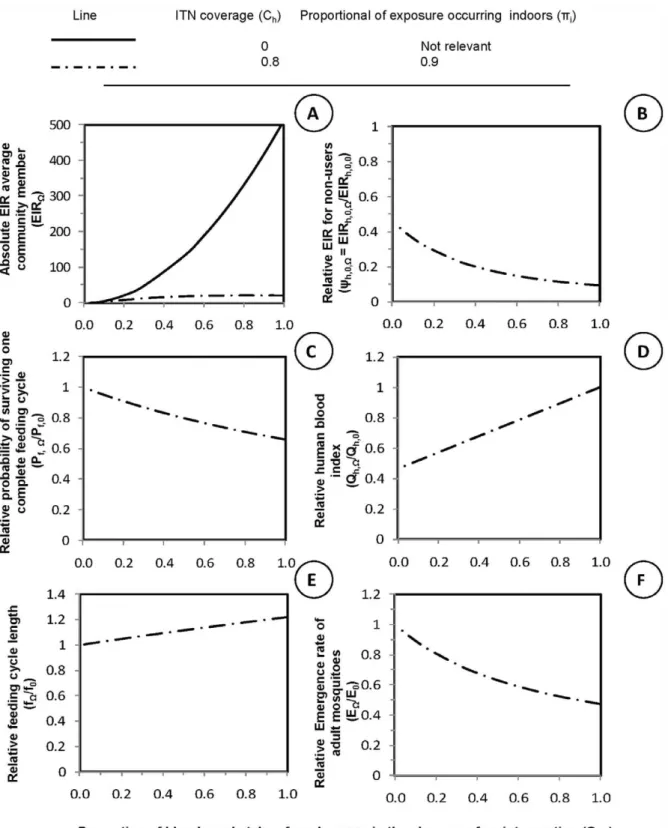
For all panels in figure 1, equation 5 was used to plot independent x-axis values representing simulated values of the proportion of blood meals taken from humans in the absence of an intervention(Qh,0). Low values ofQh,0 represent mosquitoes that
primarily feed on animals while high values represent mosquitoes that prefer to feed on humans. The y-axis for panelArepresents the absolute entomological inoculation rate (EIR) for average community member in which the dependent values were plotted using equation 12. The y-axes for all other panels were plotted using equations given in brackets representing relative values for mosquito population parameters when compared with those expected in the absence of LLINs:B: Relative exposure for
non-users yV,u,0~
EIRh,u,V EIRh,u,0
, equation 13C: Relative probability of
surviving one complete feeding cycle Pf,V Pf,0
(equation 14), D:
Relative proportion of blood-meals taken from human Qh,V Qh,0
,
(equations 4 and 5) E: Relative feeding cycle length fV f0
,
equation 15, andF: Relative emergence rate of adult mosquitoes EV
E0
equation 16.
Consistent with field observations [4–5,10,12,21,48–51] and previous simulations, high coverage with an insecticidal personal protection interventions is predicted to have huge immediate impact on malaria transmission where mosquitoes primarily feed indoors upon humans (Figures 1 A and B). Insecticidal personal protection is most effective against human-feeding mosquitoes (Qh,0?1) because the fraction of available blood resources that protected people represent is high so that survival per feeding cycle is reduced (Figure 1C), the length of feeding cycle is extended (Figure 1E), and the emergence rate for adult mosquitoes is reduced (Figure 1F) [6,48,50–51].
Figure 1. The impact of long lasting insecticide treated nets (LLINs) upon malaria vector population parameters.Malaria vector population parameters, transmission intensity, and the impact of personal protection interventions upon them under a range of values for the proportion of blood meals obtained from humans(Qh,0). In all panels, the x-axis is the proportion of all blood meals the vector population would obtain from humans in the absence of nets(Qh,0). Low values ofQh,0represent mosquitoes that primarily feed on animals while high values represent mosquitoes that prefer to feed on humans. The y-axis for panelArepresents the absolute entomological inoculation rate (EIR) for an average community member in a given scenarioðEIRh,VÞ. The y-axes for all other panels represents relative values for mosquito population parameters,
compared with those expected in the absence of LLINs:B: Relative exposure for non-users, yV,0~EIRh,u,V EIRh,u,0
C: Relative proportion of blood-meals
taken from human Qh,V Qh,0
,D: Relative probability of surviving one complete feeding cycle Pf,V Pf,0
,E: Relative feeding cycle length fV f0
, andF:
Relative emergence rate of adult mosquitoes EV E0
. In all cases the intervention scenario(V)crude demographic coverage specified high levels of coverage(Ch~0:8)and use at times when transmission would otherwise occur(pi~0:9).
animals are not protected and remain available to feed on. Therefore, negligible impact is expected upon mosquito survival equation 14, Figure 1C or upon feeding cycle length equation 15 Figure 1E, or upon reproduction rates equation 16, Figure 1F. Human blood index is the only parameter affected for very zoophagic vectors (Figure 1D) so it is important to explore what happens toQh,V
Qh,0
asQh,0approaches zero.
Personal protection measures can deliver appreciable commu-nal protection against transmission by zoophagic vectors (Figure 1B) because they can lower the proportion of bloodmeals obtained from humans (Figure 1D). Thus, further reducing already-low proportions of blood meals taken from humans (Qh,0), can have a corresponding immediate impact on the
exposure of non-users lacking any personal protection against malaria transmission by zoophagic mosquitoes (Figure 1D). This is because the tiny proportion of a zoophagic mosquitos population that are killed may be a large proportion of those that actually transmit human parasites such asPlasmodium falciparumandP. vivax.
Calculating Immediate Impact of Personal Protection Upon Transmission by Very Zoophagic Vectors using only Three Input Parameters
Next, we illustrate how the dependence of transmission and control enables derivation of much simpler models for both immediate and delayed impacts (with and without assuming reduced human infectivity, respectively) upon malaria transmis-sion, to be derived that rationalize the reduced, but nevertheless useful, impacts of a personal protection measure upon zoophagic vector systems that are illustrated by the intercepts on the left hand side of Figures 1B and D.
So, asQh,0 approaches zero, the immediately relative exposure
of non-users benefiting only from communal protection (yh,u,V)
(Figure 2B), compared to their pre-intervention exposure can be computed as follows; If we substitute equation for b and Sx~Sx{1zðkQh(1{Sx{1)Þ=f, into equation 13 we get;
yh,u,V~ EIRh,u,V EIRh,u,0
~
Z0EV 1 fV
X?
x~1
kVQh,VP x=fV fV fV 0 @ 1 A
ZVE0
1 f0
X?
x~1
k0Qh,0P
x=f0 f0 f0 0 @ 1 A :
By assuming thatSx*kQh=f on the basis that sporozoite rates are proportional toQhand therefore very low for very zoophagic vectors so a mosquito only gets one chance to get infected, and if we take out all terms not affected by x out of summation and rearrange then;
yh,u,V~ EIRh,u,V EIRh,u,0
~ð Þf0
2
Qh,VkVZ0EV fV
ð Þ2Qh,0k0ZVE0
P?
x~1P
x=fV fV
P?
x~1P
x=f0 f0
:
We assume thatkV=k0~1in the short term because substantive
changes in human infection prevalence take months or years [52–
53]. We know that by taking a limit aseh?0,f0 fV
~1equation 15, mathopP
?
x~1
Px=fV
f,V~
P ?
x~1
Px=f0
f,0 ~1 (see steps in equation (16)),
EV=E0~1andZV=Z0~1,sinceZh?0aseh?0, thenyh,u,V is
given by;
yh,u,V~ lim Qh,0?0
EIRh,u,V EIRh,u,0
~Qh,V
Qh,0
ð17Þ
Now, if we substitute the definition of Qh from equation 4, rearrange and substitutezh,u~ehwh,uandzh,p~ehwh,pwhereehis human encounter rate [6], relative exposure of non-users (yh,u,V) is
intuitively calculated as the mean of the feeding probabilities for protected(wh,p)and unprotected humans(wh,u), weighted accord-ing to the protective(Ch,p)rather than simple demographic(Ch) coverage:
yh,u,V~ lim
Qh,0?0
EIRh,u,V EIRh,u,0
~Qh,V
Qh,0
~zh,uNh 1 {Ch,p
zzh,pNhCh,p
zh,uNh
~wh,u 1 {Ch,p
zwh,pCh,p
wh,u
:
ð18Þ
In simple terms, the level of indirect communal protection afforded to all community members is equivalent to the coverage-weighted mean of feeding probabilities (equation 18). This is, in turn, equivalent to the community-wide mean level of person protection obtained as a coverage-weighted mean of personal protection. Relative exposure can also be expressed in terms of personal protection(r), where [6];
r~1{wh,p wh,u
: ð19Þ
So, by substituting equations 1 and 19 into rearranged equation 18, the impact upon transmission by very zoophagic vector can be expressed in terms of only three field-measurable parameters: the proportion of human exposure to mosquitoes occurring when an intervention can be practically used (p), its protective efficacy when usedð Þ, and the proportion of people using it (r Ch):
lim Qh,0?0
yh,u,V~1{rCh,p~1{r pCh: ð20Þ
Of course communal protection is complemented by personal protection so the overall mean level of protection immediately obtained across all users and non-users in the community is calculated as the square of equations 18 and 20. Consistent with previous models [6,8,36,50–51,54–56], the immediate relative exposure of the average community member (yh,V) is equivalent to
the ratio of the square of the pre and post intervention human blood index (Qh)values.
lim Qh,0?0
yh,V~ Qh,V
Qh,0
2
~ wh,u 1 {Ch,p
zwh,p Ch,p
wh,u
!2
~ð1{rpChÞ2:
In direct, intuitive terms, this is because a mosquito has to bite humans twice to transmit malaria parasites.
Delayed Impacts Including Reduced Human Infectiousness
The relatively low transmission intensities that very zoophagic mosquitoes mediate, also allow the reduction of infectiousness of the human population to mosquitoes to be approximated in a simplified manner. In addition to the direct and immediate impacts upon the vector population, reduction impacts upon infectiousness of human population to mosquitoes(k)may also be
achieved [31,52] but only if mosquito to human transmission can be reduced below saturating levels(EIRv10infectious bites per person per year) [57]. In holoendemic scenarios, with highly anthropophagic vectors, getting below this threshold will require high levels of coverage Ch§0:8 over long periods because re-equilibration of transmission and prevalence levels will take years rather than days, weeks or months [52,58]. At the expected intermediate levels of residual transmission (1vEIRv10 infec-tious bites per person per year) expected for anthropophagic vector populations exposed to high intervention coverage (Figure 1A), the eventual impact upon EIR, resulting from direct
Figure 2.Immediate and delayed impact of personal protection upon malaria transmission intensity.In all the four panels, x-axis is the proportion of human exposure to mosquito bites that would otherwise occur when the protective intervention is usedð Þp and y-axis represents the proportion of mosquito bites prevented by using that protective interventionð Þr. The z-axes reflects immediate (AandB) and delayed (CandD)
relative exposure lim
Qh?0 yh,u,V
experienced by non-users (A and C) and average community members (BandD).
immediate impact on the vector population parameters combined with feedback upon human infectiousness is complex to predict [57–59].
While human infectiousness is saturated at high transmission levels (EIR§10), at the much lower levels expected for most very zoophagic vectorsEIRƒ1, human infectiousness to mosquitoes is thought to be directly and approximately linearly related to mosquito to human transmission intensity in the previous few yearsk!EIR. While impacts upon the vector population have an immediate effect onEIR(Figure 2A), no immediate impact upon
infectiousness is expected (kk^V~k0)and it may take a long time for
a long-lived blood stage infection to be cleared from the human population and the feedback of EIR uponk and vice versa to
re-equilibrate [49–50]. Assuming a linear relationship exists between these two variables at low values approaching the origin of Figure 1A, and that further reductions will be achieved as a result of re-equilibration betweenkandEIR, then reduction of impact on human infectiousness to mosquitoes is expected to be greater than the immediate impact on EIR.
^
k kV k0
vyh,V~ Qh,V Qh,0
2
~ wh,u 1 {Ch,p
zwh,p Ch,p
wh,u
!2
~ð1{rpChÞ2
ð22Þ
The combination of effects mediated by the immediate impact on vector population, and delayed impact on malaria parasite prevalence and mean infectiousness in the human population, is therefore assumed to at least the same as the product of the two:
^
y yh,u,Vv
^
k kV k0
yh,u,V~ Qh,V Qh,0
4
~ wh,u 1 {Ch,p
zwh,p Ch,p
wh,u
!4
~ð1{rpChÞ4:
ð23Þ
The most obvious implication of these simplified models is captured directly in equations 18 and 20. For very zoophagic vectors, overall impact is directly related to efficacy of personal protection, regardless of whether that arises from deterrent or toxic models of action. The only other primary determinants are crude coverage ðChÞ and the proportion of non-user exposure occurring when the protective measure can practically be usedð Þ.p
Thresholds Necessary to Attain Epidemiological Impact In all the panels of figure 2, the x-axis is the proportion of human non-user exposure to mosquito bites that occurs at times when a user would actually use the protective interventionð Þ,p
which was plotted in values decreasing from 0.9 to 0.1 in the interval of 0.1. The y-axis represents the proportion of mosquito bites prevented while actually using protective intervention obtained by taking the product ofCh~0:8and the values from equation 19.The z-axes reflects immediate (AandB) and delayed (C and D) impact upon relative exposure experienced by non-users. While the latter assumes that delayed effects upon human-to-mosquito transmission occur if immediate reductions in the ability of mosquitoes to mediate transmission to humans are sustained over a long time [52]. Therefore, figure 2 is produced as
follows; the x-axis in all panel arepvalues decreasing from 0.9 to 0.1, the y-axis are calculated protectivervalues from the given expression. In other hand, a different equation was used for each panel to obtain values for z-axis by using corresponding p and protectiver values substituted into equation 20 (A), equation 21 (B), product of values from equations 20 and 21 (C) and equation 23 (D).
In figure 2, the reader can note that the values in z-axes only start dropping substantially at higher values of thex and yaxes. Thus, figure 2 illustrates how these simplified models indicate that personal protection measures will need to be practically applicable at most times of the day when exposure can occur(p§0:8), confer high levels of person protection to users(r§0:8), and be used by the majority of human population ðCh§0:8Þ, if they are to appreciably suppress malaria transmission by zoophagic vectors.
Discussion
Human blood index, defined as the proportion of a mosquito population that feeds upon humans, is clearly as important a determinant of malaria transmission and control (Figure 1) today [29] as it was half a century ago [19]. In simple terms, the more a vector depends upon human blood, the greater will be the impact of personal protection measures upon their population density, longevity and transmission potential, and the greater will be the advantage of pesticides which act exclusively through contact toxicity over those relying upon repellency (Figure 1). However, the more zoophagic a mosquito species is, the more personal protection can act simply by blocking host-vector contact (Figure 1) so that it becomes increasingly irrelevant whether protection is achieved through toxicity or repellency so that a wider variety of target product profiles may be considered [60].
The world’s malaria vectors span the full range of baseline human blood indices considered here [17,19] so this remains a critical parameter for national control programmes to evaluate and consider when planning vector control campaigns. The findings from the models presented apply specifically to very zoophagic vectors, mosquitoes with a strong preference for animals which normally obtain less than 10% of their blood meals from humans, but may still mediate malaria transmission. While the simplified models developed here only apply in settings where a purely anthroponotic pathogen is transmitted by a predominantly zoophagic vector, this counterintuitive situation is remarkably wide spread and important. Approximately 40% of all Plasmodium falciparuminfections [61] and 95% ofPlasmodium vivax infections [62] occur outside of sub-Saharan Africa, largely in parts of Asia where a wide diversity of primary vectors predominantly feed on animals rather than humans [17]. This extreme scenario contrasts starkly with the anthropophagic vectors, such asAn. gambiae,An funestusandAn koliensis, that have dominated the thinking behind global malaria control policy [8,63–64]. However, it is important to note many of the most important species in residual transmission systems, such as An. arabiensis Africa and An. farauti in the Pacific, are both zoophagic and anthropophagic so that they sit between these two extremes. Surveys of human blood indices, or underlying host preference indices such as relative availability [27,33], relative attack rates [65], or feeding indices [66–67] should therefore be considered as an important indicator in national entomological monitoring systems.
very simple models. These models use only three parameters which may potentially be measured in the field by National Malaria Control Programmes (NMCPs) and their supporting national institutional partners in developing countries: the maximum proportion of human exposure to mosquitoes that can be directly prevented through personal protection by using a given intervention, its protective efficacy when used, and the demo-graphic coverage of human users. The relationship between entomologic inoculation rate (EIR) which is a direct, field-measurable indicator of human exposure to bites of mosquitoes infected with transmissible sporozoite stage malaria parasites [30– 31] and the efficacy of a personal protection measure was derived through a model that logically describe the process of mosquito feeding cycle and malaria transmission.
The suggestion that the impact of personal protection upon malaria transmission by very zoophagic vectors may be indepen-dent of the mode of action of the product has substantial implications for manufacturers and NMCPs alike. Unlike trans-mission mediated by anthropophagic vectors [6,60], the impact upon malaria where zooophagic vectors predominate is a simple function of personal protective efficacy regardless of whether that arises from deterrent or toxic modes of action. Vapor-phase repellents [68–71] do not require direct physical contact with target insects. They can protect one or more individuals without comprehensively treating wall, roof, net, clothing or skin surfaces, so high levels of personal protection may be easier to achieve in practice [60] than with the contact toxins that are clearly superior for vectors that feed indoors upon humans [6]. Such spatial repellents may therefore be particularly applicable, and even preferable to contact toxins, where malaria transmission is predominantly mediated by very zoophagic vectors, especially where transmission primarily occurs outdoors. While we present
initial modeling results here, further empirical field testing of this model is essential to build solid evidence to guide malaria control programs.
Conclusion
We extended a published malaria transmission model to examine the relationship between transmission, control, and the baseline human blood index for very zoophagic vectors. The results from model is very simple and can be used by vector control practitioners to forecast the likely immediate and delayed impacts of personal protection measures using three parameters that may potentially be measured in the field: the proportion of human exposure to mosquitoes occurring when a intervention can be practically used, its protective efficacy when used, and demographic coverage of human users. High levels ($80%) of protective coverage and efficacy are important to achieve an epidemiologically meaningful impact.
Acknowledgments
We thank Dr. Heather Ferguson, Dr. Tom Burkot, Dr. Nicodem Govella, Dr. George Corliss, Mr. Prosper Chaki, Mr. Dickson W. Lweitoijera, Mr. Peter Sangoro, and Mr. Sambo Maganga for their critical review of the manuscript. We also thank the anonymous reviewers for their careful review of the manuscript and their very helpful comments.
Author Contributions
Conceived and designed the experiments: SSK NC GFK. Performed the experiments: SSK GFK. Analyzed the data: SSK NC GFK. Contributed reagents/materials/analysis tools: SSK NC GFK. Wrote the paper: SSK NC SJM GJD S. Majambere S. Merrill GFK.
References
1. Lengeler C, Sharp B (2003) Indoor Residual Spraying and Insecticide-Treated Nets: Reducing Malaria’s Burden, Evidence of effectiveness for Decision makers. Global Health Council, Washington, DC. pp 17–24.
2. Killeen GF, Smith TA, Ferguson HM, Mshinda H, Abdulla S, et al. (2007) Preventing childhood malaria in Africa by protecting adults from mosquitoes with insecticide-treated nets. PLoS Med 4: e229.
3. Hawley WA, Phillips-Howard PA, ter Kuile FO, Terlouw DJ, Vulule JM, et al. (2003) Community-wide effects of permethrin-treated bed nets on child mortality and malaria morbidity in western Kenya. Am J Trop Med Hyg 68: 121.
4. Bayoh MN, Mathias DK, Odiere MR, Mutuku FM, Kamau L, et al. (2010) Anopheles gambiae: historical population decline associated with regional distribution of insecticide-treated bed nets in western Nyanza Province, Kenya. Malar J 9: 62.
5. Russell T, Lwetoijera D, Maliti D, Chipwaza B, Kihonda J, et al. (2010) Impact of promoting longer-lasting insecticide treatment of bed nets upon malaria transmission in a rural Tanzanian setting with pre-existing high coverage of untreated nets. Malar J 9: 62.
6. Killeen GF, Chitnis N, Moore SJ, Okumu FO (2011) Target product profile choices for intra-domiciliary malaria vector control pesticide products: repel or kill? Malar J 10: 207.
7. Sinka ME, Bangs MJ, Manguin S, Chareonviriyaphap T, Patil AP, et al. (2011) The dominant Anopheles vectors of human malaria in the Asia-Pacific region: occurrence data, distribution maps and bionomic pre´cis. Parasit Vectors 4: 89. 8. Macdonald G (1957) The epidemiology and control of malaria. London: Oxford
University Press.
9. WHO (2007) Insecticide treated mosquito nets: A position statement. In Geneva: World Health Organization.
10. Bugoro H, Cooper R, Butafa C, Iro’ofa C, Mackenzie D, et al. (2011) Bionomics of the malaria vector Anopheles farauti in Temotu Province, Solomon Islands: issues for malaria elimination. Malar J 10: 133.
11. Reddy MR, Overgaard HJ, Abaga S, Reddy VP, Caccone A, et al. (2011) Outdoor host seeking behaviour of Anopheles gambiae mosquitoes following initiation of malaria vector control on Bioko Island, Equatorial Guinea. Malar J 10: 184.
12. Russell T, Govella N, Azizi S, Drakeley C, Kachur SP, et al. (2011) Increased proportions of outdoor feeding among residual malaria vector populations following increased use of insecticide-treated nets in rural Tanzania. Malar J 10: 80.
13. Gillies M, Smith A (1960) Effect of a residual house-spraying campagn on species balance in the Anopheles funestus group: The replacement of Anopheles gambiae Giles with Anopheles rivulorum Leeson. Bull Entomol Res 51: 248–252.
14. Gillies M, Furlong M (1964) An investigation into the behaviour of Anopheles parensis Gillies at Malindi on the Kenya coast. Bull Entomol Res 55: 1–16. 15. Gillies M (1962) A new species of the Anopheles funestus complex (Diptera:
Culicidae) from East Africa; Wiley Online Library. pp 81–86.
16. Gillies M, Coetzee M (1987) A supplement to the Anophelinae of Africa South of the Sahara (Afrotropical Region): South African Institute for Medical Research.
17. Kiszewski A, Mellinger A, Spielman A, Malaney P, Sachs SE, et al. (2004) A global index representing the stability of malaria transmission. Am J Trop Med Hyg 70: 486.
18. Balkew M, Ibrahim M, Koekemoer LL, Brooke BD, Engers H, et al. (2010) Research Insecticide resistance in Anopheles arabiensis (Diptera: Culicidae) from villages in central, northern and south west Ethiopia and detection of kdr mutation.
19. Garrett-Jones C (1964) The human blood index of malaria vectors in relation to epidemiological assessment. Bulletin of the World Health Organization 30: 241. 20. Griffin J, Hollingsworth T, Okell L, Churcher T, White M, et al. (2010) Strategies towards Plasmodium falciparum malaria elimination in Africa using currently available tools. PLoS Med 7: e1000324.
21. Govella NJ, Okumu FO, Killeen GF (2010) Insecticide-treated nets can reduce malaria transmission by mosquitoes which feed outdoors. Am J Trop Med Hyg 82: 415.
22. Geissbu¨hler Y, Chaki P, Emidi B, Govella N, Shirima R, et al. (2007) Interdependence of domestic malaria prevention measures and mosquito-human interactions in urban Dar es Salaam, Tanzania. Malar J 6: 126.
23. Killeen GF, Kihonda J, Lyimo E, Oketch FR, Kotas ME, et al. (2006) Quantifying behavioural interactions between humans and mosquitoes: evaluating the protective efficacy of insecticidal nets against malaria transmission in rural Tanzania. BMC Infect Dis 6: 161.
24. Garrett-Jones C, Shidrawi G (1969) Malaria vectorial capacity of a population of Anopheles gambiae: an exercise in epidemiological entomology. Bulletin of the World Health Organization 40: 531.
26. Antonio-nkondjio C, Kerah CH, Simard F, Awono-ambene P, Chouaibou M, et al. (2006) Complexity of the malaria vectorial system in Cameroon: contribution of secondary vectors to malaria transmission. J Med Entomol 43: 1215–1221. 27. Trung HD, Bortel WV, Sochantha T, Keokenchanh K, Brie¨t OJT, et al. (2005)
Behavioural heterogeneity of Anopheles species in ecologically different localities in Southeast Asia: a challenge for vector control. Trop Med Int Health 10: 251–262.
28. Okumu FO, Govella NJ, Moore SJ, Chitnis N, Killeen GF (2010) Potential benefits, limitations and target product-profiles of odor-baited mosquito traps for malaria control in Africa. PLoS One 5: e11573.
29. Lyimo IN, Ferguson HM (2009) Ecological and evolutionary determinants of host species choice in mosquito vectors. Trends Parasitol 25: 189–196. 30. Beier JC, Killeen GF, Githure JI (1999) Short report: entomologic inoculation
rates and Plasmodium falciparum malaria prevalence in Africa. Am J Trop Med Hyg 61: 109.
31. Smith D, Dushoff J, Snow R, Hay S (2005) The entomological inoculation rate and Plasmodium falciparum infection in African children. Nature 438: 492. 32. Prior A, Torr S (2002) Host selection by Anopheles arabiensis and An.
quadriannulatus feeding on cattle in Zimbabwe. Med Vet Entomol 16: 207–213. 33. Killeen GF, McKenzie FE, Foy BD, Bøgh C, Beier JC (2001) The availability of potential hosts as a determinant of feeding behaviours and malaria transmission by African mosquito populations. Trans R Soc of Trop Med Hyg 95: 469–476. 34. Gerry K, Fredros O, N’Guessan Raphael CM, Adedapo A, Sam A, et al. (2011) The importance of considering community-level effects when selecting insecticidal malaria vector products. Parasit Vectors 4.
35. White G (1974) Anopheles gambiae complex and disease transmission in Africa. Trans R Soc Trop Med Hyg 68: 278–298.
36. Saul A (2003) Zooprophylaxis or zoopotentiation: the outcome of introducing animals on vector transmission is highly dependent on the mosquito mortality while searching. Malar J 2: 32.
37. White G, Magayuka S, Boreham P (1972) Comparative studies on sibling species of the Anopheles gambiae Giles complex (Dipt., Culicidae): bionomics and vectorial activity of species A and species B at Segera, Tanzania. Bull Entomol Res 62: 295–317.
38. Coetzee M, Craig M, Le Sueur D (2000) Distribution of African malaria mosquitoes belonging to the Anopheles gambiae complex. Parasitology today 16: 74–77.
39. Githeko A (1994) Origin of blood meals in indoor and outdoor resting malaria vectors in western Kenya. Acta Tropica 58: 307–316.
40. Hargreaves K, Hunt R, Brooke B, Mthembu J, Weeto M, et al. (2003) Anopheles arabiensis and An. quadriannulatus resistance to DDT in South Africa. Med Vet Entomol 17: 417–422.
41. Shalaby A (1969) Host-Preference Observations on Anopheles culicifacies (Diptera: Culicidae) in Gujarat State, India. Annals of the Entomological Society of America 62: 1270–1273.
42. Tempelis C (1975) Host-feeding patterns of mosquitoes, with a review of advances in analysis of blood meals by serology. J Med Entomol 11: 635–653. 43. Besansky NJ, Hill CA, Costantini C (2004) No accounting for taste: host
preference in malaria vectors. Trends in parasitol 20: 249–251.
44. Lwetoijera DW, Sumaye RD, Madumla EP, Kavishe DR, Mnyone LL, et al. (2010) An extra-domiciliary method of delivering entomopathogenic fungus, Metharizium anisopliae IP 46 for controlling adult populations of the malaria vector, Anopheles arabiensis. Parasit Vectors 3: 18.
45. Kent RJ, Thuma PE, Mharakurwa S, Norris DE (2007) Seasonality, blood feeding behavior, and transmission of Plasmodium falciparum by Anopheles arabiensis after an extended drought in southern Zambia. Am J Trop Med Hyg 76: 267.
46. Takken W, Eling W, Hooghof J, Dekker T, Hunt R, et al. (1999) Susceptibility of Anopheles quadriannulatus theobald (Diptera: Culicidae) to Plasmodium falciparum. Trans R Soc Trop Med Hyg 93: 578–580.
47. Bogh C, Clarke SE, Pinder M, Sanyang F, Lindsay SW (2001) Effect of passive zooprophylaxis on malaria transmission in The Gambia. J Med Entomol 38: 822–828.
48. Chitnis N, Schapira A, Smith T, Steketee R (2010) Comparing the effectiveness of malaria vector-control interventions through a mathematical model. Am J Trop Med Hyg 83: 230.
49. Yakob L, Dunning R, Yan G (2011) Indoor residual spray and insecticide-treated bednets for malaria control: theoretical synergisms and antagonisms. Journal of The Royal Society Interface 8: 799.
50. Saul A (1996) Transmission dynamics of Plasmodium falciparum. Parasitology today 12: 74–79.
51. Le Menach A, Takala S, McKenzie FE, Perisse A, Harris A, et al. (2007) An elaborated feeding cycle model for reductions in vectorial capacity of night-biting mosquitoes by insecticide-treated nets. Malaria Journal 6: 10. 52. Sama W, Killeen G, Smith T (2004) Estimating the duration of Plasmodium
falciparum infection from trials of indoor residual spraying. Am J Trop Med Hyg 70: 625–634.
53. Smith T, Maire N, Dietz K, Killeen GF, Vounatsou P, et al. (2006) Relationship between the entomologic inoculation rate and the force of infection for Plasmodium falciparum malaria. Am J Trop Med Hyg 75: 11–18.
54. Killeen GF, McKenzie FE, Foy BD, Schieffelin C, Billingsley PF, et al. (2000) A simplified model for predicting malaria entomologic inoculation rates based on entomologic and parasitologic parameters relevant to control. Am J Trop Med Hyg 62: 535–544.
55. Sota T, Mogi M (1989) Effectiveness of zooprophylaxis in malaria control: a theoretical inquiry, with a model for mosquito populations with two bloodmeal hosts. Med Vet Entomol 3: 337–345.
56. Anderson RM, May R (1991) Infectious diseases of humans: dynamics and control. New York. 757 p.
57. Ross A, Killeen G, Smith T (2006) Relationships between host infectivity to mosquitoes and asexual parasite density in Plasmodium falciparum. Am J Trop Med Hyg 75: 32–37.
58. Smith D, Hay S (2009) Endemicity response timelines for Plasmodium falciparum elimination. Malar J 8: 87.
59. Griffin JT, Hollingsworth TD, Okell LC, Churcher TS, White M, et al. (2010) Reducing Plasmodium falciparum malaria transmission in Africa: a model-based evaluation of intervention strategies. PLoS Med 7: e1000324.
60. Killeen GF, Moore SJ (2012) Target product profiles for protecting against outdoor malaria transmission. Mal J 11: 17.
61. Hay SI, Okiro EA, Gething PW, Patil AP, Tatem AJ, et al. (2010) Estimating the global clinical burden of Plasmodium falciparum malaria in 2007. PLoS Med 7: e1000290.
62. Guerra CA, Howes RE, Patil AP, Gething PW, Van Boeckel TP, et al. (2010) The international limits and population at risk of Plasmodium vivax transmission in 2009. PLoS Negl Trop Dis 4: e774.
63. Killeen GF, Tami A, Kihonda J, Okumu FO, Kotas ME, et al. (2007) Cost-sharing strategies combining targeted public subsidies with private-sector delivery achieve high bednet coverage and reduced malaria transmission in Kilombero Valley, southern Tanzania. BMC Infect Dis 7: 121.
64. Garrett-Jones C, Boreham P, Pant C (1980) Feeding habits of anophelines (Diptera: Culicidae) in 1971–78, with reference to the human blood index: a review. Bull Entomol Res 70: 165–185.
65. Torr SJ, Della Torre A, Calzetta M, Costantini C, Vale G (2008) Towards a fuller understanding of mosquito behaviour: use of electrocuting grids to compare the odour orientated responses of Anopheles arabiensis and An. quadriannulatus in the field. Med Vet Entomol 22: 93–108.
66. Simpson JE, Hurtado PJ, Medlock J, Molaei G, Andreadis TG, et al. (2011) Vector host-feeding preferences drive transmission of multi-host pathogens: West Nile virus as a model system. Proc R Soc B.
67. Kay B, Boreham P, Edman J (1979) Application of the ‘‘feeding index’’ concept to studies of mosquito host-feeding patterns [to understand the epidemiology of diseases transmitted by arthropods]. Mosq News (USA).
68. Hoffmann EJ, Miller JR (2002) Reduction of mosquito (Diptera: Culicidae) attacks on a human subject by combination of wind and vapor-phase DEET repellent. J Med Entomol 39: 935–938.
69. Kawada H, Temu EA, Minjas JN, Matsumoto O, Iwasaki T, et al. (2008) Field evaluation of spatial repellency of metofluthrin-impregnated plastic strips against Anopheles gambiae complex in Bagamoyo, coastal Tanzania. Journal of the American Mosquito Control Association 24: 404–409.
70. Kawada H, Maekawa Y, Takagi M (2005) Field trial on the spatial repellency of metofluthrin-impregnated plastic strips for mosquitoes in shelters without walls (beruga) in Lombok, Indonesia. J Vector Ecol 30: 181–185.