RADIATION CHEMICAL CONVERSION OF OIL DERIVED
FROM OIL-BITUMEN ROCK
Lala Jabbarova
a, Islam Mustafaev
a,
Rauf Rzayev
a*,
Zarqalam Nabizade
a,
Navoi Ibadov
a, Saida Akhmedbekova
baInstitute of Radiation Problems, National Academy of Sciences of Azerbaijan, 121, H. Javid ave., Baku AZ 1143, Azerbaijan
bInstitute of Petrochemical Processes, National Academy of Sciences of Azerbaijan, 30, N. Rafi ev str.,
Baku AZ 1025, Azerbaijan
*e-mail: [email protected]; [email protected]
Abstract. The results of research in the radiation processing of synthetic oil derived from oil–bitumen rock of the Balakhany deposit in Azerbaijan are presented. The study has been conducted on a 60Co gamma-source at a dose rate of P = 0.5 Gy/s and various absorbed doses of D = 43–216 kGy. Samples of synthetic oil from natural bitumen rocks have been analyzed by chromatography, gas chromatography–mass spectrometry, and IR-spectroscopy, and their radiation resistance has been evaluated. The results of the study allow for both assessment of the feasibility of manufacturing petrochemicals for various applications by radiation processing and use of these materials for isolating radioactive sources to preclude their impact on the environment.
Keywords: oil–bitumen rock, synthetic oil, oxygen, hydrocarbon gases, radiation.
Introduction
Oil–bitumen rock (OBR) is a natural material formed from crude oil in the upper layers of the Earth crust as a result of the slow evaporation of light fractions from the oil, natural oil deasphalting, and the processes of interaction of its components with oxygen and sulfur. According to United Nations estimates, the world’s geological reserves of OBR amount to ~360 billion tons on the hydrocarbon (HC) basis and are an alternative source of HC feedstock [1].
Large OBR accumulations were found in Canada, the United States, and the CIS countries. The reserves in Azerbaijan make 200 million tons in 11 deposits [2, 3].
In Russia there are 400 OBR deposits with total reserves of 7.2 billion tons. The total world production of oil from OBR is about 84 mb/d (million barrels per day). In Canada, there are plants for oil extraction from oil sands, one of which has a daily output of more than 140 thousand barrels of oil [4].
Experimental
The object of investigation was the synthetic oil derived from OBR of the Balakhany fi eld of Azerbaijan. Experiments were carried out on an MRKh γ-30 60Co gamma-ray source at a dose rate of 0.5 Gy/s. By distillation in a
Retort Heating Jacket apparatus at a temperature of 950 F (510°C), 50 mL of synthetic crude was obtained from 375 g. The rock composition (%) was as follows: oil 22, water 6, sand 72.
Samples of synthetic oil were irradiated to different absorbed doses in the range of 43–216 kGy in air or vacuum to follow the kinetics of the processes and to reveal the role of oxygen in the radiation resistance of the OBR. The samples of the synthetic oil intended for chromatographic analysis were dried with anhydrous sodium sulfate (Na2SO4) and diluted with dichloromethane (СН2Cl2); mass chromatograms in the m/z range of 35–400 (m/z is the ion mass to charge ratio) were recorded on a GCMS Trace DSQ instrument (Thermo Electron, Finnigan USA, 2005).
The sample notation was as follows: 12169, the initial synthetic oil; 12170, the synthetic oil irradiated for 96 h in air; and 12171, the synthetic oil irradiated for 96 h in a vacuum.
IR spectra of the samples were recorded on an M-80 spectrophotometer in the wave number range of 700–4000 cm–1. The gaseous products were analyzed by gas chromatography.
Results and discussion
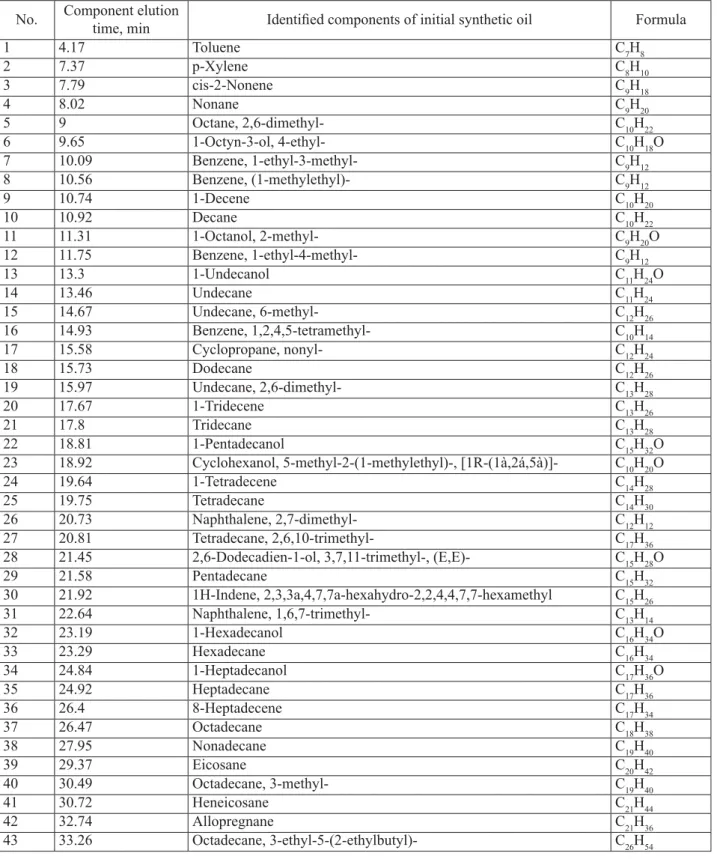
The components identifi ed in the unirradiated synthetic oil are shown in Table 1.
The unirradiated oil samples predominately contain relatively light hydrocarbons, such as undecane, dodecane, tridecane, tetradecane, and hexadecane. After irradiation, an increase of the peak heights of heavier hydrocarbons, such as eicosane, allopregnane, and octadecane, is observed. This is due to the occurrence of complex radiation induced processes of polycondensation and rearrangement in the molecular structure of the synthetic oil.
Table 1 Liquid full scan.
No. Component elution
time, min Identifi ed components of initial synthetic oil Formula
1 4.17 Toluene C7H8
2 7.37 p-Xylene C8H10
3 7.79 cis-2-Nonene C9H18
4 8.02 Nonane C9H20
5 9 Octane, 2,6-dimethyl- C10H22
6 9.65 1-Octyn-3-ol, 4-ethyl- C10H18O
7 10.09 Benzene, 1-ethyl-3-methyl- C9H12
8 10.56 Benzene, (1-methylethyl)- C9H12
9 10.74 1-Decene C10H20
10 10.92 Decane C10H22
11 11.31 1-Octanol, 2-methyl- C9H20O
12 11.75 Benzene, 1-ethyl-4-methyl- C9H12
13 13.3 1-Undecanol C11H24O
14 13.46 Undecane C11H24
15 14.67 Undecane, 6-methyl- C12H26
16 14.93 Benzene, 1,2,4,5-tetramethyl- C10H14
17 15.58 Cyclopropane, nonyl- C12H24
18 15.73 Dodecane C12H26
19 15.97 Undecane, 2,6-dimethyl- C13H28
20 17.67 1-Tridecene C13H26
21 17.8 Tridecane C13H28
22 18.81 1-Pentadecanol C15H32O
23 18.92 Cyclohexanol, 5-methyl-2-(1-methylethyl)-, [1R-(1à,2á,5à)]- C10H20O
24 19.64 1-Tetradecene C14H28
25 19.75 Tetradecane C14H30
26 20.73 Naphthalene, 2,7-dimethyl- C12H12
27 20.81 Tetradecane, 2,6,10-trimethyl- C17H36
28 21.45 2,6-Dodecadien-1-ol, 3,7,11-trimethyl-, (E,E)- C15H28O
29 21.58 Pentadecane C15H32
30 21.92 1H-Indene, 2,3,3a,4,7,7a-hexahydro-2,2,4,4,7,7-hexamethyl C15H26
31 22.64 Naphthalene, 1,6,7-trimethyl- C13H14
32 23.19 1-Hexadecanol C16H34O
33 23.29 Hexadecane C16H34
34 24.84 1-Heptadecanol C17H36O
35 24.92 Heptadecane C17H36
36 26.4 8-Heptadecene C17H34
37 26.47 Octadecane C18H38
38 27.95 Nonadecane C19H40
39 29.37 Eicosane C20H42
40 30.49 Octadecane, 3-methyl- C19H40
41 30.72 Heneicosane C21H44
42 32.74 Allopregnane C21H36
43 33.26 Octadecane, 3-ethyl-5-(2-ethylbutyl)- C26H54
The IR spectrum of the synthetic oil (initial) displayed an absorption band at 740 cm–1 due to rocking vibration
of the –СН2 group and the 1380 cm–1 bending and 2860 and 2960 cm–1 stretching bands characteristic of the methyl group
СН3. The spectrum also contains bands characteristic of the =СН2 group and the C=C bond of unsaturated hydrocarbons,
corresponding to out-of-plane bending vibrations of the substituted benzene ring. The absorption band at 1720 cm–1
corresponds to the carbonyl group C=O. In addition, there are absorption bands in the region of 1020–1160 cm–1 with
maxima at 1025, 1070, 1120, and 1160 cm–1 corresponding to oxygen containing groups (C–O–, C–O–O, O–H). Owing
The presence of these reactive groups determines a higher adhesive strength of the binding components with the rock (adhesive properties) as compared with manmade compositions based on petroleum refi ning products; however, they are easily cleaved by irradiation. Irradiation reduces the concentration of oxygen containing groups as a result of their transfer to the heavier fractions.
The IR spectra of the synthetic oil derived from the bitumen rock are given in Figure 1. A comparison of the IR spectra of the samples (irradiated in air for 72 and 120 h) with the spectrum of the initial material shows that the intensities of the absorption bands of paraffi nic, unsaturated, and aromatic hydrocarbons and oxygenated compounds are signifi cantly reduced in the following order: unirradiated oil > oil irradiated in air for 72 h > oil irradiated in air for 120 h. As the absorbed dose increases, the optical density at the absorption bands of functional groups in the samples also decreases. The spectroscopic analysis data are presented in Figure 2.
To study the radiation resistance of BR, the samples of the synthetic oil were irradiated with absorbed doses of 43–216 kGy at a 60Co γ-ray dose rate of P = 0.5 Gy/s. The rate curves of gas buildup during the γ-radiolysis of synthetic
oil recovered from natural oil–bitumen rocks are given below in Figure 3.
For all the gases, oxygen enhances the radiation-chemical degradation of the synthetic oil, an effect that is associated with oxidative degradation reactions involving radiolytic radicals. This oil is characterized by a high concentration of cyclic structures, particularly aromatics, concentrated in middle distillates.
The average values of the radiation-chemical yield (molecule/100 eV) of gases from the synthetic bituminous oil are listed in Table 2.
(а) ν cm-1
(b) ν cm-1
(c) ν cm-1
(а)
(b)
Figure 2. Dependence of the absorbance of samples of the synthetic oil recovered from the bituminous rock on the absorbed dose in (a) air and (b) vacuum.
Table 2 Average values of the radiation-chemical yield (molecule/100 eV) of gases from synthetic bituminous oil.
A
verage
radiation-chemical yield of gas from BR synthetic oil (molecule/100 eV)
H2 CO CO2 CH4 C2H6 C2H4 C3 C4 C5 C6 C7
air 0.31 0.85 0.66 0.06 0.05 0.024 0.13 0.33 0.32 0.16 0.04
vacuum 0.37 0.26 0.67 0.03 0.02 0.005 0.014 0.022 0.176 0.13 0.06
Conclusions
The relatively high radiation resistance of the synthetic oil, recovered from the OBR, in vacuum and air below 50°C is associated with the presence of paraffi ns, polynuclear aromatic hydrocarbons, and resin asphaltene substances in its composition. This makes it possible to use the synthetic oil as a feedstock for manufacturing a waterproof material applicable in radiation fi elds, including the disposal of radioactive waste. The organic matter of the OBR may serve as a promising source material for manufacturing various fuels, lubricating oils, coke, and asphalt. Hydrogen, hydrocarbon gases, and olefi n hydrocarbons can be produced from the synthetic oil by the joint ionizing radiation and heat treatment at consistent values of the temperature and the dose rate.
References
Golberg, I.S. Proceedings of All Union Meeting on Comprehensive Processing and Use of Bituminous Rocks, 1.
Alma-Ata: Nauka, 1982, pp. 48-54 (in Russian).
Oil Sands and Oil Shales of Azerbaijan: Collection of Articles of Institute of Geology, National Academy of 2.
Sciences of Azerbaijan, Baku: Elm, 1990, pp. 149-157 (in Russian).
Nadirov, S.G.; Aliev, G.M. Proceedings of All Union Meeting on Comprehensive Processing and Use of Bituminous 3.
Rocks, Alma-Ata: Nauka, 1982, 116 p. (in Russian). Devlikamova, V.V.; Khabibulin, Z.A
4. . Abnormal Crude Oils, Moscow: Nedra, 1975, 198 p. (in Russian).
Pikaev, A.K. Modern Radiation Chemistry. Radiolysis of Gases and Liquids, Moscow: Nauka, 1986, 440 p. (in 5.
Russian).
Jabbarova, L.Y. Radiation–thermal transformations of bituminous rocks, Ph.D. Thesis, Institute of Radiation 6.