Department of Informatics and Applied Mathematics (DIMAp)
Doctoral Thesis
Ernesto Cid Brasil de Matos
ENTITLED
BETA: a B Based Testing Approach
Advisor Dr. Anamaria Martins Moreira
Co-Advisor Dr. Michael Leuschel
BETA: a B Based Testing Approach
Thesis submitted to Coordenação do Programa de Pós-Graduação em Sistemas e Computação of Universidade Federal do Rio Grande do Norte as a requirement to obtain the degree of Doctor in Computer Science
Advisor: Dr. Anamaria Martins Moreira
Co-Advisor: Dr. Michael Leuschel
UNIVERSIDADE FEDERAL DO RIO GRANDE DO NORTE CENTRO DE CIÊNCIAS EXATAS E DA TERRA
DEPARTAMENTO DE INFORMÁTICA E MATEMÁTICA APLICADA PROGRAMA DE PÓS-GRADUAÇÃO EM SISTEMAS E COMPUTAÇÃO
Catalogação da Publicação na Fonte. UFRN / SISBI / Biblioteca Setorial Especializada do Centro de Ciências Exatas e da Terra – CCET.
Matos, Ernesto Cid Brasil de.
Beta: a B based testing approach / Ernesto Cid Brasil de Matos. – Natal, RN, 2016.
169 f. : il.
Advisor: Dra. Anamaria Martins Moreira. Co-advisor: Dr. Michael Leuschel.
Thesis (Ph.D) – Federal University of Rio Grande do Norte. Center of Exact Sciences and Earth. Departament of Informatics and Applied Mathematics. Graduate Program in Systems and Computation.
1. Software engineering – Thesis. 2. Formal methods – Thesis. 3. Software testing – Thesis. 4. B-method – Thesis. 5. Model-based testing – Thesis. I. Moreira, Anamaria Martins. II. Leuschel, Michael. III. Title.
BETA: uma Abordagem de Testes Baseada em B
Esta Tese foi julgada adequada para a obtenção do título de doutor em Ciência da Computação e aprovado em sua forma final pelo Programa de Pós-Graduação em Sistemas e Computação do Departamento de Informática e Matemática Aplicada da Universidade Federal do Rio Grande do Norte.
__________________________________________________________ Profa. Dra. Anamaria Martins Moreira – UFRN
Orientadora
__________________________________________________________ Prof. Dr. Uirá Kulesza – UFRN
Coordenador do Programa
Banca Examinadora
___________________________________________________________ Profa. Dra. Anamaria Martins Moreira – UFRN
Presidente
____________________________________________________________ Prof. Dr. Marcel Vinícius Medeiros Oliveira – UFRN
Examinador
____________________________________________________________ Prof. Dr. Alexandre Cabral Mota – UFPE
Examinador
____________________________________________________________ Prof. Dr. Michael Leuschel – HHU
Examinador
____________________________________________________________ Profa. Dra. Patrícia Duarte de Lima Machado – UFCG
Examinadora
and my sister, for their love and endless
First, I would like to thank God, the one who created, loved, cared for, and always inspired me. If it weren’t for Him, I would have no purpose in my life. I would like to show the
Resumo
Sistemas de software estão presentes em grande parte das nossas vidas atualmente e, mais do que nunca, eles requerem um alto nível de confiabilidade. Existem várias técnicas de
Ver-ificação e Validação (V&V) de software que se preocupam com controle de qualidade, segu-rança, robustez e confiabilidade; as mais conhecidas são Testes de Software e Métodos For-mais. Métodos formais e testes são técnicas que podem se complementar. Enquanto méto-dos formais provêem mecanismos confiáveis para raciocinar sobre o sistema em um nível mais abstrato, técnicas de teste ainda são necessárias para uma validação mais profunda e são frequentemente requeridas por orgãos de certificação. Levando isto em consideração, BETA provê uma abordagem de testes baseada em modelos para o Método B, suportada por uma ferramenta, que é capaz de gerar testes de unidade a partir de máquinas abstratas B. Nesta tese de doutorado apresentamos melhorias realizadas em BETA e novos estudos de caso realizados para avaliá-la. Dentre as melhorias, integramos critérios de cobertura lógicos à abordagem, revisamos os critérios de cobertura baseados em espaço de entrada que já eram suportados e aperfeiçoamos as últimas etapas do processo de geração de testes. A abordagem agora suporta a geração automática de dados para os oráculos e preâmbulos
para os casos de teste; ela também possui uma funcionalidade para concretização dos da-dos de teste e um módulo para gerar scripts de teste executáveis automaticamente. Outro objetivo desta tese foi realizar estudos de caso mais complexos utilizando BETA e avaliar a qualidade dos casos de teste que a abordagem produz. Estes estudos de caso foram os primeiros a avaliar o processo de geração de testes por completo, desde a especificação dos casos de teste até a sua implementação e execução. Em nossos últimos experimentos, analisamos a qualidade dos casos de teste gerados por BETA, considerando cada critério de cobertura suportado, utilizando métricas de cobertura de código como cobertura de in-struções e ramificações. Também utilizamos testes de mutação para avaliar a capacidade dos casos de teste de detectar faltas na implementação dos modelos. O resultados obtidos foram promissores mostrando que BETA é capaz de detectar faltas introduzidas por progra-madores ou geradores de código e que a abordagem pode obter bons resultados de cobertura para a implementação de um sistema baseado em modelos B.
Abstract
Software systems are a big part of our lives and, more than ever, they require a high level of reliability. There are many software Verification and Validation (V&V) techniques that are
concerned with quality control, security, robustness, and reliability; the most widely known are Software Testing and Formal Methods. Formal methods and testing are techniques that can complement each other. While formal methods provide sound mechanisms to reason about the system at a more abstract level, testing techniques are still necessary for a more in-depth validation of the system and are often required by certification standards. Taking this into consideration, BETA provides a tool-supported, model-based testing approach for the B Method that is capable of generating unit tests from abstract B machines. In this the-sis, we present improvements made in the BETA approach and tool, and new cases studies used to evaluate them. Among these improvements, we integrated logical coverage criteria into the approach, reviewed the input space criteria that was already supported, and en-hanced the final steps of the test generation process. The approach now has support for automatic generation of oracle data and test case preambles, it has a feature for test data concretization, and a module that automatically generates executable test scripts. Another
objective of this thesis was to perform more complex case studies using BETA and assess the quality of the test cases it produces. These case studies were the first to evaluate the test generation process as a whole, from test case design to implementation and execution. In our last experiments, we assessed the quality of the test cases generated by BETA, consid-ering each coverage criteria it supports, using code coverage metrics such as statement and branch coverage. We also used mutation testing to evaluate the ability of the generated test cases to identify faults in the model’s implementation. The results obtained were promis-ing, showing that BETA is capable of detecting faults introduced by a programmer or code generation tool and that it can achieve good coverage results for a system’s implementation based on a B model.
Contents
1 Introduction 10
1.1 Motivation . . . 13
1.2 Hypotheses and Research Questions . . . 16
1.3 Methodology . . . 19
1.4 Summary of the results . . . 20
1.5 Thesis Organization . . . 21
2 The B Method 22 2.1 Machines, Refinements and Implementations . . . 24
2.2 Generalized Substitutions . . . 24
2.3 B Notation Syntax . . . 26
2.4 Abstract Machines . . . 27
2.5 Proof Obligations . . . 31
2.5.1 Invariant Consistency . . . 31
2.5.2 Initialization Proof Obligation . . . 32
2.5.3 Operations Proof Obligation . . . 33
2.6 Tool Support . . . 34
2.6.1 AtelierB . . . 34
2.6.2 ProB . . . 34
2.6.3 Rodin . . . 35
3 Software Testing 36 3.1 Testing Levels . . . 37
3.2 Functional and Structural Testing . . . 39
3.3 Basic Terminology . . . 40
3.3.1 Fault, Error and Failure . . . 40
3.3.2 Testing, Test Failure and Debugging . . . 40
3.3.3 Test Cases . . . 41
3.3.4 Coverage Criteria . . . 43
3.4 Input Space Partitioning . . . 44
3.4.2 Criteria for block combination . . . 46
3.5 Logic Coverage . . . 48
3.5.1 Logic Expression Coverage Criteria . . . 50
3.5.2 Comments on MC/DC Coverage . . . 53
4 Related Work 55 4.1 History and state of the art . . . 55
4.1.1 Amla and Ammann . . . 56
4.1.2 Dick and Faivre . . . 56
4.1.3 Marinov and Khurshid . . . 57
4.1.4 Ambert et al. . . 58
4.1.5 Cheon and Leavens . . . 59
4.1.6 Satpathy et al. . . 60
4.1.7 Gupta et al. . . 62
4.1.8 Dinca et al. . . 63
4.1.9 Cristiá et al. . . 64
4.2 Final Discussions . . . 65
5 A B Based Testing Approach 68 5.1 The Approach . . . 68
5.1.1 B Abstract Machine . . . 69
5.1.2 Logical Coverage . . . 72
5.1.3 Input Space Partitioning . . . 79
5.1.4 Generating input data for test cases . . . 85
5.1.5 Obtaining oracle values . . . 86
5.1.6 Finding test case preambles . . . 88
5.1.7 Generating test case specifications . . . 95
5.1.8 Concretizing test data . . . 96
5.1.9 Generating test scripts . . . 103
5.2 The BETA Tool . . . 104
5.2.1 Implementation details and architecture . . . 105
5.3 Comments on the evolution of BETA . . . 106
6 Case Studies 109 6.1 Previous Case Studies . . . 111
6.2 Generating tests for the Lua API . . . 113
6.2.1 Results . . . 114
6.2.2 Final Remarks and Conclusions . . . 116
6.3 Testing two code generation tools: C4B and b2llvm . . . 118
6.3.2 Final Remarks and Conclusions . . . 122
6.4 Final Experiments . . . 123
6.4.1 Results . . . 125
6.4.2 Final Remarks and Conclusions . . . 128
7 Conclusions and Future Work 133 7.1 Future Work . . . 137
List of Figures
1.1 The B Method development process . . . 14
2.1 B-Method Development Process. . . 22
2.2 Train and metro lines around the world that employed the B-Method. . . 23
3.1 Usual software testing workflow. . . 37
3.2 Levels of Testing (the V model). . . 38
5.1 BETA approach overview . . . 69
5.2 Oracle strategy overview . . . 88
5.3 Test case forstudent_pass_or_failfromClassroommachine . . . 91
5.4 The CBC test case generator . . . 92
5.5 The preamble calculation process . . . 92
5.6 Example of BETA test case with preamble . . . 95
5.7 The process to create the test data concretization formula . . . 97
5.8 BETA User Interface . . . 104
5.9 BETA architecture overview . . . 105
6.1 Testing Strategy for C4B and b2llvm. . . 120
6.2 Amount of the test cases generated by BETA in theoriginalexperiment. The bar charts show the amount of infeasible test cases and negative and positive feasible test cases generated by BETA. . . 126
6.3 Amount of the test cases generated by BETA in theimprovedand randomiza-tion experiments. The bar charts show the amount of infeasible test cases and negative and positive feasible test cases generated by BETA. . . 126
6.4 Bar charts showing the average of the statement coverage results obtained with the tests generated by BETA in each each experiment. . . 127
6.5 Bar charts showing the average of the branch coverage results obtained with the tests generated by BETA in each experiment. . . 128
List of Tables
2.1 B Notation: Functions and Relations . . . 26
2.2 B Notation: Logical Operators . . . 27
2.3 B Notation: Set Operators . . . 27
2.4 B Notation: Arithmetic Operators . . . 28
4.1 Related Work Overview . . . 67
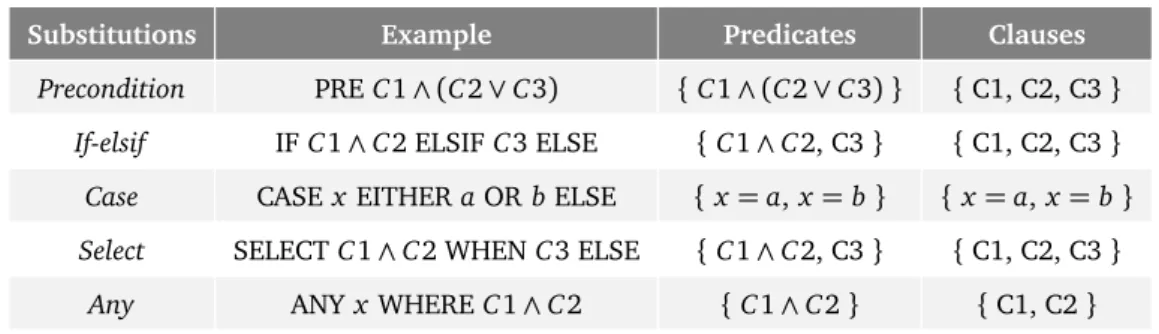
5.1 How predicates and clauses are extracted from substitutions . . . 72
5.2 Blocks created for the student_pass_or_fail example . . . 82
5.3 Blocks created for theg r ad e20..5 characteristic with Equivalence Classes . 82 5.4 Values representing the blocks created for the g r ad e 2 0..5 characteristic with Boundary Values . . . 83
5.5 Generated test data for student_pass_or_fail using IPS . . . 85
5.6 Values obtained after the evaluation of the test case formula . . . 102
5.7 Values obtained after the evaluation of the test data concretization formula . 103 6.1 BETA versions and corresponding features. . . 110
6.2 Code coverage for the functions in the Lua API. . . 116
6.3 Branch coverage for the functions in the Lua API. . . 117
6.4 Overview of the model-based tests generated by BETA. . . 121
6.5 Mutation Analysis Results . . . 129
1 Equivalence Classes Input Space Partition overview for non-typing character-istics . . . 141
2 Equivalence Classes Input Space Partition overview for typing characteristics 142 3 Equivalence Classes Input Space Partition overview for typing characteristics 143 4 Boundary Value Analysis Input Space Partition overview for non-typing char-acteristics . . . 144
5 Boundary Value Analysis Input Space Partition overview for typing character-istics . . . 145
Glossary
Abstract Test Case a test case generated from an abstract model, that uses abstractions from the said model to define some of its test data.
Concrete Test Case an executable test case implementation.
Logical Clause a predicate that does not contain any of the following logical operators: ¬, ^,_,⊕,)and ,. This is non-standard according to the terminology for predicate logic where aclauseis defined as adisjunction of literals.
Logical Predicate an expression that evaluates to a boolean value.
Chapter 1
Introduction
Software systems are a big part of our lives. They reside in all of our electronic devices; not only in our computers and smartphones but also in simple things, like our coffee machine, or in more complex ones, like the metro that we take every day to go to work.
There are many methods and processes to develop such systems. They usually involve activities like brainstorming requirements, modeling the system architecture, implementing the required code, deploying the system to be executed on hardware, etc. Among all these activities, there is a very important one that is usually called Verification and Validation (V&V). The main goal of V&V is to evaluate the quality of the system under development and answer questions like “Is the system correct according to functional requirements?”, “Is the system safe enough?”, “Can it recover from failures?”, and others.
The V&V process is known to consume a great part of the resources involved during the development of software systems. According to[Myers, 2011], almost 50% of the time and money required to develop a system is spent on V&V.
The task of ensuring that a system is safe, robust and error-free is a difficult one, espe-cially for safety-critical systems that have to comply with several security standards. There are many methods and techniques that can help with software V&V. One of the most widely
known areSoftware Testingtechniques, which try to evaluate a system by means of test cases that can reveal unknown faults. Another practice that is especially common in the devel-opment of safety-critical systems is the use ofFormal Methods. In general, formal methods are based on models that serve as a representation of the systems behavior. These mod-els are specified using logical and mathematical theories that can be used to prove their correctness.
Formal methods and testing are V&V techniques that can complement each other. While formal methods provide sound mechanisms to reason about the system at a more abstract level, testing techniques are still necessary for a more in-depth validation of the system and are often required by certification standards[Rushby, 2008]. For these reasons, there is an effort from both formal and testing communities to integrate these disciplines.
Set TheoryandInteger Arithmeticto specify abstract state machines that represent the behav-ior of system components. These specifications (or machines) can be verified using proofs that ensure their consistency. The method also provides a refinement mechanism in which machines go through a series of refinement steps until they reach an algorithmic level that can be automatically translated into code.
In the author’s master’s dissertation[Matos, 2012], a tool supported approach to gener-ate test cases from B Method abstract machines was developed. The approach is an improve-ment upon the work developed in[Souza, 2009]. It uses the properties specified in B models
and applies well-established software testing techniques to enumerate test requirements for the system implementation.
The main contributions of the work developed in [Matos, 2012] were: 1) a review of the test case generation process proposed by[Souza, 2009], which resulted in significant changes in the said process; 2) the first version of the BETA tool, which automated the process up to the generation of abstract test case specifications; 3) two case studies that evaluated the initial version of the BETA approach and tool.
More specifically, the following research questions were addressed in[Matos, 2012]:
Research Question 1 Can the approach proposed by [Souza, 2009] be performed by someone who is not familiar with the B Method?
During the master’s period, one of the first things that we did was to perform a case study to evaluate if the approach could be performed by someone who had no previous background in formal methods or the B Method. The author of this thesis, which had a profile that matched our requirements for this case study, used the test case generation approach proposed by[Souza, 2009]to generate tests from a B model. The model used in this experiment was a model of a metro’s door controlling system[Barbosa, 2010]. The case study showed us that the approach could be performed by someone who was not familiar with the B Method. It also showed us that the approach was very susceptible to errors when performed by hand. Therefore, it motivated the development of a tool to automate the test case generation process[Matos et al., 2010].
Research Question 2 How the approach proposed by[Souza, 2009]could be improved?
We evaluated the test generation approach proposed by [Souza, 2009] through two preliminary case studies, using models of industry systems. These case studies confirmed some problems and deficiencies in the test generation process, and provided the feedback that we needed to propose possible improvements. Some of the problems we tackled were:
approach so it could match the definitions of input space coverage criteria described in[Ammann and Offutt, 2010];
– The lack of support for modular specifications. The first version of the approach re-quired specifications to be contained in a single component. This kind of restriction cannot be imposed on models used in the industry since they usually use components to improve cohesion and maintainability. We improved this aspect by adding support to the different types of modularisation constructs supported by the B Method;
– The first version of the approach did not consider the behaviour of the operation when
partitioning the input space of the operation. In the initial proposal, the approach only took into consideration the precondition of the operation and the invariant of the machine when creating partitions. We improved the partition strategies so they could take into consideration conditional statements to create more interesting partitions for the test cases, exercising different execution paths specified by the operation.
Research Question 3 Can we develop a tool to automate the test generation process?
The case studies also revealed that, if we wanted to use the approach in an industry setting efficiently, we needed a tool to support it. So we developed a tool that partially automated the test case generation process. The tool was capable of generating test case specifications that could be manually translated into executable test scripts by a test engi-neer. The test case specifications consisted of simple input data for the test cases and values
for the state variables that had to be set before the test case was executed. All this data was generated based on a coverage criterion. The test cases generated still missed some fea-tures, such as a proper preamble that contained a sequence of operation calls that could put the system in the desired state for test case execution, and an automatic oracle evaluation process.
In this thesis we continued the work developed in [Matos, 2012]. Our objective with this thesis was to improve both the BETA approach and the tool that supports it, improving the test generation strategies, adding new features to the tool, and performing new case studies to evaluate both the approach and the tool.
Some of the improvements that were made in the approach are: a process to generate oracle data and different strategies for oracle evaluation that can be used to perform weaker or stronger verifications; a strategy to calculate preambles for the test cases, which defines sequences of operation calls that put the system in the desired state for test case execution;
Regarding the tool, we updated it so it could support the automation of the new afore-mentioned features. We also worked on the integration with ProB, using more features available on its kernel and adding more configuration parameters to the BETA tool. BETA now also integrates with the recently developed ProB Java API1. Another feature that was added to the tool was a new module that is capable of generating partial executable test scripts written in Java and C[Souza Neto, 2015]. We also redesigned its user interface.
Ultimately, we performed two new case studies to evaluate the whole test case genera-tion approach and did new experiments to assess the quality of the test cases generated by
BETA.
1.1
Motivation
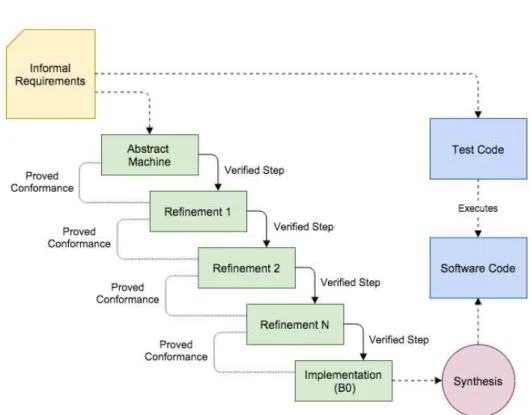
The B Method development process is presented in Figure 1.1. Beginning with an informal set of requirements, which is usually written using natural language, an abstract model is created. The B Method’s initial abstract model is calledMachine. A machine can be refined into one or moreRefinementmodules. A Refinement is derived from a Machine or another Refinement and the conformance between the two modules must be proved. Finally, from a Refinement, an Implementation module can be obtained. The Implementation uses an algorithmic representation of the initial model, which is written using a subset of the B notation called B0. The B0 representation serves as basis for translation of the model to programming language code, which can be done either manually or by code generation tools.
As seen on the image, all steps between the abstract machine and the refinement to B0 implementation are verified using static checking and proof obligations. Nevertheless, even with all the formal verification and proofs, the B Method alone is not enough to ensure that a system is error-free. In[Waeselynck and Boulanger, 1995]the authors present some limitations of the B Method – and formal methods in general – that should encourage engi-neers to perform some level of software testing during system development. Some of these limitations are:
– Non-functional requirements are not addressed by formal methods;
– There are some intrinsic problems related to the activity of modeling. First, the model
is necessarily an abstraction (and simplification) of the reality and has a limited scope. For example, the formal description takes into account neither the compiler used nor the operating system and the hardware on which it is executed. It also makes assump-tions about the behavior of any component interacting with the software;
Figure 1.1: The B Method development process and the usual testing procedure. Full line arrows represent formally verified steps and dashed line arrows represent steps that are not formally verified. Dotted lines show relationships between artifacts.
– The model can be wrong in respect to its informal requirements. In essence, there is no way to prove that the informal, possibly ill-defined, user needs are correctly addressed by the formal specification;
– Modeling is performed by a human that is liable to fail;
– Although refinements are a verified process, it will always require a certain degree of human input, admitting possibilities of human errors during the proofs;
– The formal system underlying the method may be wrong (the problem of validation of the validation mechanism);
– Ultimately, proofs may be faulty.
All these points make a case for the use of software testing to complement the formal development process, and we believe the last three can be addressed by a formal testing approach like BETA.
– The generation of tests from formal specifications can be particularly useful in sce-narios where formal methods are not strictly followed. Sometimes, due to time and budget restrictions, formal methods are only used at the beginning of the develop-ment process – just for modeling purposes – and the impledevelop-mentation of the system is done in an informal way. In this scenario, tests generated from formal specifica-tions could help to verify the coherence between specification and implementation, checking whether the implementation is in accordance with the specification or not.
– There is another problem related to the maintenance of the code base. Software code is always being refactored to improve readability and maintainability. Refactorings are usually made directly into the source code. So, tests generated from the specification can act as a safety net to ensure that the behaviour of the implementation did not change during code refactorings.
– It is also important to notice that the translation of B0 representation to code lacks formal verification. If done manually, the translation is obviously informal. The code generation tools for the B Method are also not formally verified. So, in the end, the translation to source code cannot be entirely trusted. The code generated still needs to be tested.
Given these limitations, software testing can complement a formal method like the B
Method, providing mechanisms to identify failures, exploiting possible defects introduced during refinement and implementation of the model, or during the maintenance of the code base.
Model-Based Testing(MBT) is a software testing technique to generate (and sometimes execute) tests based on models or specifications of the system. As formal specifications usually describe requirements in a rigorous and unambiguous way, they can be used as basis to create test cases using MBT. The automatic generation of test cases from formal models can also reduce testing costs.
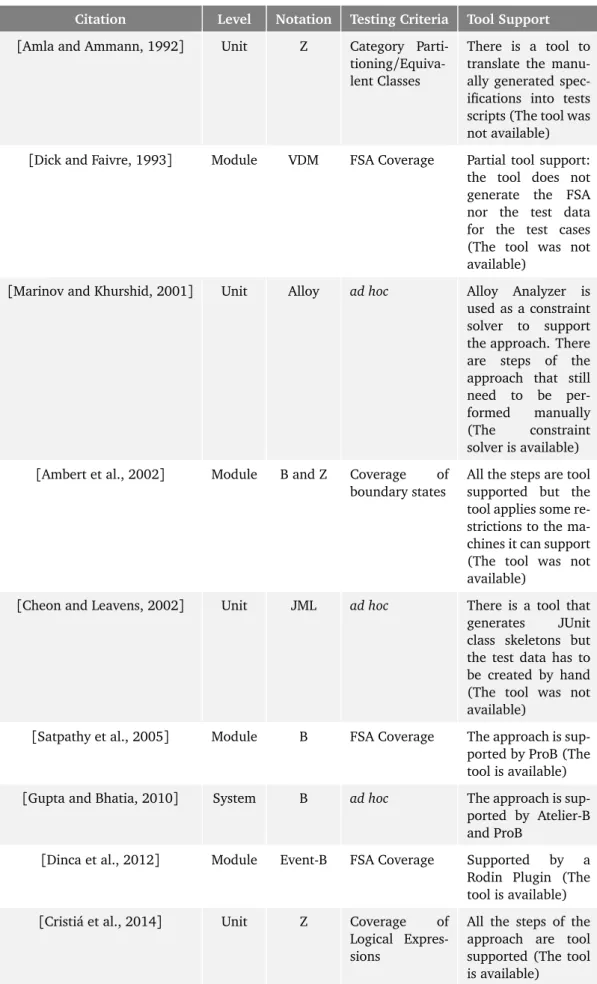
Different research groups have then been researching the integration of formal methods and software testing in different ways. In the current literature, there are many publications targeting different types of tests, using different formal input models, and with different levels of automation ([Ambert et al., 2002, Satpathy et al., 2007, Gupta and Bhatia, 2010, Singh et al., 1997, Huaikou and Ling, 2000, Mendes et al., 2010, Burton and York, 2000,
Marinov and Khurshid, 2001, Cheon and Leavens, 2002, Amla and Ammann, 1992, Dick and Faivre, 1993]).
Most of the current work in the field, specially in the B Method’s context, we believe, has a deficiency in one or more of the following points:
– They lack on automation and tool support, something essential for the applicability of the proposed approaches.
Another point that is not a deficiency but a different view on the subject is that there are a lot of work in the current state of the art that focus on finding problems in the model rather than on the respective implementation.
In this thesis, we build up on a previously proposed[Matos, 2012]model-based testing approach to complement the B Method development process. This approach is tool sup-ported and partially automates the generation of test cases for a software implementation based on B Method’s abstract state machines. The test cases generated by this approach try to check the conformance between the initial abstract model and the produced source code,
checking if the behavior specified in the model is actually present in the software implemen-tation. The tests generated are unit tests that test each operation in the model individually. They are generated using classic testing techniques that include input space partitioning and logical coverage.
In[Marinescu et al., 2015]the authors present a recent overview of the state of the art and a taxonomy for the classification of model-based testing tools for requirement-based specification languages. According to their taxonomy, which has six dimensions, BETA can be classified as a tool that:
– Uses astate-basedor pre/postnotation as amodeling notation;
– Generates test cases based onartifactsthat modelfunctional behavior;
– Relies onstructural model coverageas atest selection criteria;
– Usesconstraint solvingas atest generation method;
– Usesofflinetest cases (tests are created and executed in two different steps) as a test executiontechnology;
– Has amappingmechanism that translatesabstract test casesintoexecutable test cases;
1.2
Hypotheses and Research Questions
Given the proposal of this thesis, the following hypotheses need to be investigated:
2. The proposed test case generation approach and the tool that supports it are flexible enough to allow the integration of other software testing techniques and coverage criteria;
3. The test cases generated by BETA are efficient enough to detect problems introduced during the process of implementation of B models.
To evaluate these hypotheses, we need to answer the following research questions:
Research Question 1: How can we improve the test generation process, mainly the last steps of the approach?
The last experiments performed in[Matos, 2012]confirmed that both our approach and the tool still needed improvements in the last phases of the test generation process. The tool was only able to generate abstract test cases and still missed features like preamble calculation and automatic generation of oracle data. In this thesis, we worked on fixing these issues.
We added a test script generation module in the tool that is capable of generating partial test scripts written in Java and C. The test scripts still need some adaptations before they can
be executed, but they save some of the effort necessary to translate the abstract test cases into concrete test cases. This module was one of the contributions made by[Souza Neto, 2015].
Another issue that we worked on was the automatic generation of oracle data. In the past, we required the test engineer to manually define the oracles for the test cases. The oracle data could be obtained by animating the original model and checking what was the expected behaviour of the system for a particular test case according to the model. In this thesis, we made this process automatic. Thanks to the integration with ProB[Leuschel and Butler, 2003], an animator and model-checker for the B notation, BETA is now capable of animating the models to obtain the oracle data for its test cases automatically. Also on the subject of oracles, we defined and implemented new oracle strategies that can be used to perform different types of verifications during the execution of the test cases[Souza Neto,
2015].
Ultimately, we also worked on a test data concretization strategy for the approach. One of the big challenges of model-based testing is the gap between abstract test cases and concrete test cases[Utting and Legeard, 2007]. Usually, abstract test cases use abstract data structures that are different than the ones used by concrete test cases in the implementation level. So, it is necessary to concretize the test cases generated using model-based testing before they can be executed against the system’s implementation. To solve this problem, we developed a test data concretization strategy that uses the B method’s gluing invariant to find the relation between abstract test data and concrete test data.
Research Question 2: How the testing criteria supported by the approach can be improved?
Another aspect that we worked on was improving the software testing criteria supported by BETA. We refined the previously supported criteria and added support to new ones.
Initially, BETA only supported input space partitioning as a strategy to generate test cases. It supported both equivalence classes and boundary value analysis to generate partitions for its test cases. During this Ph.D., we worked on improvements for the partition strategies. We reviewed the old partition strategies and also added new strategies so that more interesting test cases could be generated.
We also added support to logical coverage criteria. Support to logical coverage is impor-tant for the approach because there is a demand from certification standards for this kind of criteria, particularly in the field of safety-critical systems. This work was also important to
evaluate the flexibility of the approach when it comes to adding new coverage criteria and modifying the ones it already supports.
Research Question 3: How can we measure the quality of the test cases generated by BETA?
In this thesis, we also evaluated the quality of the test cases generated by BETA. We performed more in-depth experiments to assess the properties and the effectiveness of the test cases generated using different types of coverage criteria. To evaluate the effectiveness of the test cases we did experiments using mutants. We used mutation tools to generate mutants of implementations derived from B models and checked if the test cases generated by BETA were able to detect the faults introduced by these mutants.
During this Ph.D., we also performed two new case studies that, for the first time,
Medeiros Jr., 2013]and C4B2.
1.3
Methodology
The chosen methodology to answer the questions from the previous section was to evaluate the approach and the tool through several case studies and experiments.
The first question we had to answer was how we could improve the test generation process that we already had. The approach and the tool developed in[Matos, 2012]were evaluated through some preliminary case studies. Unfortunately, these case studies were
not enough to evaluate the whole test case generation and execution process. These two initial case studies focused only on the generation of test case specifications, missing the implementation and execution of the concrete test cases. Because the test cases were not implemented and executed, it was not possible to assess the quality of the test cases regard-ing code coverage and capability to find bugs.
With that problem in mind, we designed a new case study to evaluate the whole test case generation process, from the generation of abstract test cases to the implementation and execution of the concrete test cases[Souza Neto and Moreira, 2014]. This case study used a model of the Lua programming language API specified by[Moreira and Ierusalim-schy, 2013]. The models of the Lua API were much more complex and challenging for the approach. This case study provided important feedback to improve many aspects of the approach and the tool and helped to identify limitations of our approach. Some of the as-pects that were improved after this case study were related to oracle evaluation and the
generation of test scripts. It also confirmed the need for better preambles in the test cases generated by BETA.
Regarding the third research question, the Lua API case study was also important to assess the quality of the test cases generated by BETA. Once the test cases were generated, they were subjected to a code coverage analysis. This analysis was important to assess the level of coverage provided by each coverage criterion supported by the approach. It also helped us to identify some execution paths that the tests generated by BETA could not cover. This case study was also a good example of a case where model and source code were developed separately, ignoring the B Method’s formal process. The model was created a posteriori, based on the documentation of the API, and the tests created were used to check the conformance of the model with the API’s code.
Another decision that we made during this Ph.D. was to improve the supported test criteria and add support to logical coverage to both the approach and the tool (addressing
second research question). This work helped us to evaluate their flexibility when it comes to adding new criteria and modifying the ones already implemented.
Once we improved the supported coverage criteria, we decided to perform a second case study where we generated tests for two code generators for the B Method. This case study also helped us to experiment with the capabilities of the approach to detect discrepancies between the models and their respective (automatically generated) source code.
In this case study, we used the test cases generated by BETA to check if the behavior of the code generated for several models was in accordance with their respective abstract models. This case study was also helpful to show the problems related to the generation of source code by non-verified code generators.
Ultimately, also regarding the third research question, we performed more experiments to evaluate the quality of the test cases generated by BETA. In these last experiments, we measured the statement and branch coverage achieved by test suites generated using differ-ent coverage criteria supported by BETA. Besides, we also evaluated the tests using muta-tion testing. We used mutamuta-tion tools to generate mutants of implementamuta-tions derived from B models and verified if the test cases generated by BETA were able to identify the bugs introduced by these mutants.
1.4
Summary of the results
In this thesis, we were able to improve many aspects of the BETA approach and tool. We enhanced old parts of the approach and features of the tool, and also implemented new ones such as the support for logical coverage, the test script generator, the automatic oracle data generation and preamble calculation features, new oracle strategies, and the test data
concretization strategy.
We were also able to evaluate both the approach and the tool through more in-depth case studies. The case studies were performed using more complex and challenging models and experimented with aspects that had not been evaluated before. For the first time, we were able to evaluate the approach as a whole from the design of the test cases to their implementation and execution. Besides, we assessed the quality of the test cases generated for the several case studies, measuring aspects such as statement and branch coverage. We also assessed the ability of the test cases to identify bugs using mutation testing.
The results obtained after these experiments were promising. The test cases generated by BETA were capable of identifying interesting problems in the targets of our case studies. The tests also achieved a reasonable percentage of code coverage (95% of the statements and 86.1% of the branches for the highest coverage achieved) and a fair mutation score (79.1% for the highest mutation score achieved). More details about these results are
pre-sented in Chapter 6.
formal notations. The tool developed during this Ph.D., and its source code is also available to the public so that it can be explored, extended and reused by other research projects.
1.5
Thesis Organization
The remainder of this thesis is organized as follows:
Chapter 2: The B Method This chapter gives a brief introduction to the B Method, pre-senting all the elements necessary to understand the thesis;
Chapter 3: Software Testing This chapter presents the software testing terminology used in this document and all the testing criteria and techniques used by our testing approach;
Chapter 4: Related Work This chapter presents a review of the current state of the art on model-based testing using formal models, and draws some comparisons between our work and the work of other researchers;
Chapter 5: A B Based Testing Approach This chapter presents an overview of our test case generation approach, explaining in details each step involved in the test generation process;
Chapter 6: Case Studies This chapter presents all the case studies and experiments that we have performed to evaluate the approach and the tool;
Chapter 2
The B Method
The B-Method is a formal method that can be used to model and develop safety-critical systems in a secure and robust way. It uses concepts of first order logic, set theory and integer arithmetic to specify abstract state machines that model the behaviour of the system.
The method is also strongly characterized by the idea of model refinements.
Figure 2.1: B-Method Development Process
may be used, these constructs are a subset of the B notation called B0. Such implementation is then translated to source code in a programming language, either manually or by code generation tools. More details about the machine, refinement and implementation modules are presented in the next section.
The consistency of the different modules is certified by proving that automatically gen-erated verification conditions (calledproof obligations) are valid. The refinement process is also subject to analysis through proof obligations. The proof obligations for the refinement process certify that a refinement is consistent with its abstraction.
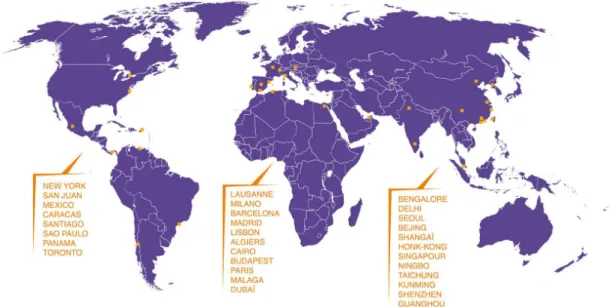
The B-Method is taught in many universities in formal method courses and has been successfully adopted in several industry projects. Its success in industry could be mainly attributed to good tool support for both writing models and proving their correctness. Most of the projects where it has been used in industry are related to rail transport. Figure 2.2, which was adapted from Clearsy’s1 website, presents some of the trains and metro lines around the world that have employed the B-Method during their development.
Figure 2.2: Train and metro lines around the world that employed the B-Method. Source: http://www.methode-b.com/en/b-method/
It is also important to mention that there is a variation of the B-Method called Event-B [Abrial, 2010]. The Event-B formal method might be considered as an evolution of the B notation, or Classical Bas some might call the original B Method notation. The Event-B notation is simpler and easier to learn and use.
The classical B Method and Event-B focus on different aspects of system modelling. While the focus of classical B is on the specification of software components and how they
work internally, the focus of Event-B is on system-level events. In some cases, projects can use both notations to model different aspects of the system. Event-B development is sup-ported by the Rodin2tool.
2.1
Machines, Refinements and Implementations
B models are specified and structured in modules. The B-Method has a single notation encompassing abstract constructs suitable for specification and classic imperative constructs for computer programming. The B notation supports three different types of modules that
are classified according to their level of abstraction. From the most abstract to the most concrete, they aremachine,refinementandimplementation.
A machine is an abstract state machine that has a set ofvariablesthat represent its state and a set ofoperationsthat can modify its state. Constraints on the state of the machine can be described in the machine’sinvariant. The method also has apreconditionmechanism for the machine’s operations. To ensure that an operation behaves as expected its precondition has to be respected.
A machine can also import other machines using one of the B-method modularization mechanisms. A machine can either use, see, import, extend or include another machine. These different types of modularization mechanisms provide different visibility of parts of the imported module.
A refinement is a module that refines a machine or another refinement. The idea of using this type of module is to refine the abstract model to something that is closer to the
actual implementation of the system. A refinement module must always refer to a machine or another refinement. The refinement process can use one or more refinement modules. Each refinement step must be verified to guarantee the consistency between the refinement and the module it refers to.
After one or more refinement steps, the specification can be refined to an implementa-tion module. The implementaimplementa-tion is the most concrete level of specificaimplementa-tion. It uses only a subset of the B notation called B0. The B0 notation consists of more concrete constructs that are similar to the ones available in most programming languages, so it makes the im-plementation more suitable for translation to a programming language.
2.2
Generalized Substitutions
Another concept used by the B Method is theGeneralized Substitution. Generalized substi-tutions are used to replace free variables in a predicate by expressions so the predicate can
be analyzed and verified using specific values.
The substitutions are written using the notation[E/x]P. This expression states that any free occurrence of x in the predicate P will be replaced by the expressionE. For example, a substitution[4/x](x+1> y)results in the predicate 4+1> y.
In this section, some of the B-Method substitutions are presented. The full list of substi-tutions can be found on[Clearsy, 2011].
Simple Attribution Substitution
[x:=E]P,[E/x]P (2.1) When this substitution is applied, all free occurrences of x in P will be replaced by the expressionE. In the machine context a predicate could be, for example, an invariant clause. This substitution is used to attribute values to state variables and return variables.
Multiple Attribution Substitution
[x:=E,y:=F]P,[E,F/x,y]P (2.2) The multiple attribution is a variation of the simple attribution. It works in the same way, and it is used to make attributions to two or more free variables simultaneously.
Conditional Substitution
[I F E T H EN S E LS E T EN D]P,(E)[S]P)^(¬E)[T]P) (2.3) The conditional substitutions provide a mechanism to model behaviors that are based on a condition. In other words, given a logical expression, depending on what its outcome is, a particular substitution will be applied. In the notation presented above, if the expressionE evaluates tot rue, the substitutionSwill be applied, ifEevaluates to f alse, the substitution T will be applied instead.
ANY Substitution
Parallel Substitution
S1kS2 (2.5)
A very frequently used substitution in the B Method is the parallel substitution. This sub-stitution is used to represent two subsub-stitutions that, in theory, should occur simultaneously. We do not present the exact substitution in the notation above becauseS1 andS2 could be replaced by any of the substitutions supported by the B Method.
2.3
B Notation Syntax
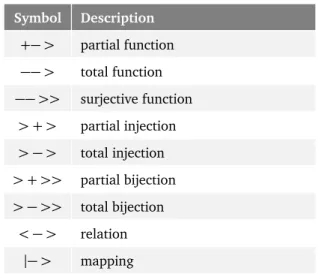
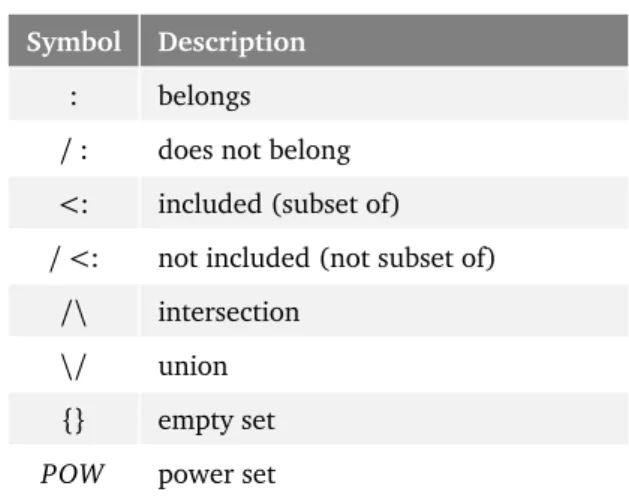
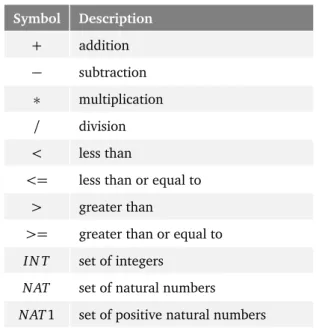
In this section part of the B notation syntax is presented. Tables 2.1, 2.2, 2.3 and 2.4 present the syntax for functions, relations, logical operators, set operators and arithmetical opera-tors.
Table 2.1: B Notation: Functions and Relations
Symbol Description
+−> partial function
−−> total function
−−>> surjective function
>+> partial injection
>−> total injection
>+>> partial bijection
>−>> total bijection
<−> relation
Table 2.2: B Notation: Logical Operators
Symbol Description
& and
or or
# exists
! for all
= equal
/= not equal
=> logical implication
<=> equivalence
not(P) negation
Table 2.3: B Notation: Set Operators
Symbol Description
: belongs
/: does not belong
<: included (subset of)
/ <: not included (not subset of)
/\ intersection
\/ union
{} empty set
POW power set
2.4
Abstract Machines
In the B-Method, an abstract machine specifies a system or one of its modules. It models the state of the system and also operations that can act on this state. An abstract machine has many other elements besides variables and operations; the example presented on Listing 2.1 will be used to present some of this elements. The example is a model of a system that controls the students in a classroom and their grades. The features of the system are:
– It allows students to be registered in the classroom;
– It allows to register grades for the students registered in the course;
– It allows to register if a particular student was present in a practical lab class or not;
Table 2.4: B Notation: Arithmetic Operators
Symbol Description
+ addition
− subtraction
⇤ multiplication
/ division
< less than
<= less than or equal to
> greater than
>= greater than or equal to
I N T set of integers
N AT set of natural numbers
N AT1 set of positive natural numbers
Listing 2.1: Example of B-Method machine
1 MACHINE Classroom
2
3 SETS
4 STUDENT; result = {pass, final_exam, fail}
5
6 PROPERTIES
7 card(STUDENT) = 15
8
9 VARIABLES
10 students,
11 grades,
12 has_taken_lab_classes
13
14 INVARIANT
15 students <: STUDENT &
16 grades : students +-> 0..5 &
17 has_taken_lab_classes : students +-> BOOL
18
19 INITIALISATION
20 grades := {} ||
21 students := {} ||
22 has_taken_lab_classes := {}
23
24 OPERATIONS
25 add_student(student) =
26 PRE
28 THEN
29 students := students \/ {student}
30 END;
31
32 add_grade(student, grade) =
33 PRE
34 student : students &
35 grade : 0..5
36 THEN
37 grades(student) := grade
38 END;
39
40 present_on_lab_classes(student, present) =
41 PRE
42 student : students &
43 present : BOOL
44 THEN
45 has_taken_lab_classes(student) := present
46 END;
47
48 rr <-- student_pass_or_fail(student) =
49 PRE
50 student : students &
51 student : dom(grades) &
52 student : dom(has_taken_lab_classes)
53 THEN
54 IF grades(student) > 3 & has_taken_lab_classes(student) = TRUE THEN rr := pass
55 ELSIF grades(student) > 2 & has_taken_lab_classes(student) = TRUE THEN rr := final_exam
56 ELSE rr := fail
57 END
58 END
59 END
The name of a B machine is defined by the clause MACHINE in the specification. In the
example presented the machine is namedClassroom(line 1).
A B machine may also have a list of variables to represent its state. These variables are defined in the VARIABLES clause (lines 9-12). TheClassroommachine has three variables: students,grades andhas_taken_lab_classes. The variablestudentsstores the set of students enrolled in the course, the variable grades stores their grades, and has_taken_lab_classes stores the information of whether or not they were present in the practical lab class.
set is a set which elements are stated as soon as it is declared. A deferred set is a set with unknown elements that can be specified with more details further in the modeling process. TheClassroom example has two sets, an enumerated set result which elements represent the possible results for the student in the course, and also a deferred setSTUDENT which is used to specify the students in the model. Using a deferred set to represent the students means that, in this level of abstraction, the engineer does not worry much about how a student will be represented in the system. In later refinements the student can be refined to be represented by a more concrete structure (e.g. integer identifier).
Constraints can be applied to sets using the PROPERTIES clause (lines 6-7). Properties can also be used to apply constraints to constants specified in the model. This particular example has no constants, but constants may be defined using the CONSTANTS clause.
The machine’s variables may be constrained by predicates specified in the INVARIANT clause (lines 14-17). The machine’s invariant is also used to define the types of its variables. The invariant must be satisfied in all of the machine’s states so the model can be considered consistent. In the given example, the invariant defines thatstudentis a subset of the deferred set STUDENT (line 15), thatgradesis a partial function that maps a student to an integer in the range between 0 and 5 (line 16), and thathas_taken_lab_classesis also a partial function that maps students to a boolean value.
The initial state of the machine is defined by the INITIALISATION clause (lines 19-22). A machine can have one or more valid initial states. If a machine has variables, it must have an initialization. It is used to attribute the initial values for the state variables. In the given
example, all the variables are initialized with theempty set.
A machine also needs a mechanism to modify its state. In the B-Methodthe only way to modify a machine’s state is through operations3. The machine’s operations are listed in the OPERATIONS clause (lines 24-59). The header of an operation specifies its name and can also define its parameters and return variables. An operation can also have a precondition. A precondition can be used to define types for the operation’s parameters and also other constraints that must be true so the operation can be executed correctly. The precondition acts as part of a contract for the operation. It can only guarantee that the operation behaves properly if the contract is respected. If the contract is broken, the method cannot foresee how the system will behave.
The Classroom example has four operations. The first three operations (add_student,
add_grade, and present_on_lab_classes) are very similar. The add_student operation regis-ters a student in the course, theadd_gradeoperation register a grade for a given student,
the present_on_lab_classesoperation registers if a given student was present or not in the practical lab class. All of these three operations have parameters and preconditions. Their preconditions define types and other restrictions for the parameters, and they specify the conditions under which the operations can be applied. In their body they just make simple
updates in one of the state variables.
The last operation is the most different one. It receives a student as a parameter and checks if he or she has passed or not in the course. The result is returned as an operation return variable (r r). The operation also has a conditional substitution on its body to check whether or not a student has passed the course. If a student’s grade is greater than three and he or she has attended the lab class, then the operation returns ‘pass’. If a student’s grade is greater than two and less than or equal to three, and if he or she has attended the lab class, then the operation returns ‘final_exam’. If a student does not fit in one of these
cases than the operation returns ‘fail’.
2.5
Proof Obligations
After the machine is specified, it has to be verified to certify coherence. In the B-Method, this verification is done using Proof Obligations. Proof obligations are logic expressions generated from the specification that should be validated to guarantee that the machine is coherent.
There are many types of proof obligations that can be generated from different elements of the model. Here, only some of the proof obligations are presented. The remainder of the proof obligations are found on [Abrial, 1996]. The proof obligations use the substitution notation presented on Section 2.2. The proof obligations presented in this section are: invariant consistency, initialization and operations proof obligations.
2.5.1
Invariant Consistency
The invariant consistency is proved by asserting that the machine has at least one valid state. It means that there should be at least one combination of values for the state variables that respect the machine’s invariant. The formula used to do this verification is the following:
9v.I (2.6)
Wherevrepresents the machine’s state variables and I represents its invariant.
9(stud ents,g r ad es,has_t aken_l a b_cl asses). (2.7)
(stud ents✓S T U DEN T^ (2.8)
g r ad es2stud ents!7 0..5^ (2.9)
has_t aken_l a b_cl asses2stud ents!7 BOO L) (2.10) If the free variables are instantiated respectively as stud ents={stud ent1}, g r ad es=
{stud ent1 7! 5} and has_t aken_l a b_cl asses = {stud ent1 7! t rue}, one can prove that there is at least one state where the machine’s invariant holds t rue.
2.5.2
Initialization Proof Obligation
The next proof obligation refers to the machine’s initialization. This proof obligation is used to prove that the initial states of the machine satisfy the invariant. The formula for this proof obligation is the following:
[T]I (2.11)
Where[T]is the substitution describing the initialization, andI is the machine’s invari-ant.
For theClassroomexample, one has to prove the following:
[stud ents:=;,g r ad es:=;,has_t aken_l a b_cl asses:=;] (2.12)
(stud ents✓S T U DEN T^ (2.13)
g r ad es2stud ents!7 0..5^ (2.14)
has_t aken_l a b_cl asses2stud ents!7 BOO L) (2.15) After the substitution, the following predicate would need to be true:
; ✓S T U DEN T^ ; 2stud ents!7 0..5^ ; 2stud ents!7 BOO L (2.16)
2.5.3
Operations Proof Obligation
The last type of proof obligation presented here refers to the machine’s operations. The objective of this proof obligation is to prove that during the execution of a given operation, the machine’s state changes to or remains at a valid state. The following formula defines this proof obligation:
I^P)[S]I (2.17)
WhereI is the machine’s invariant, Pis the operation’s precondition andSis the substi-tution used in the body of the operation.
This proof obligation states that, if the invariant and the precondition hold true before the execution of the operation, after the substitutionSis performed, the invariant will still hold true (which means the machine will still be in a valid state).
For the operationadd_studentin the Classroomexample the following proof obligation would be generated:
(stud ents✓S T U DEN T^g r ad es2stud ents!7 0..5^ (2.18) has_t aken_l a b_cl asses2stud ents!7 BOO L)^ (2.19)
(stud ent 2S T U DEN T)) (2.20)
[stud ents:=stud ents[ {stud ent}] (2.21)
(stud ents✓S T U DEN T^g r ad es2stud ents!7 0..5^ (2.22) has_t aken_l a b_cl asses2stud ents!7 BOO L) (2.23) After the substitution, the following predicate would need to be true:
(stud ents✓S T U DEN T ^g r ad es2stud ents!7 0..5^ (2.24) has_t aken_l a b_cl asses2stud ents!7 BOO L)^ (2.25)
(stud ent 2S T U DEN T)) (2.26)
2.6
Tool Support
The B Method is supported by some tools that make the process of specification and verifi-cation of the models easier. Among these tools, the most popular ones areAtelierB4,ProB5, andRodin6.
2.6.1
AtelierB
AtelierB is a tool for specification and verification of B models. The tool is developed by Clearsy7, a company specialized in developing safety-critical systems using the B-Method. The tool has many features that can help the engineer through the various steps that are involved when developing using the B-Method, such as:
– an editor for the specification of modules using the B notation
– automatic generation of proof obligations
– automatic provers for the proof obligations
– an interactive prover for proofs that cannot be performed automatically.
– an assistant to help the refinement process
– code generators that can translate B implementations into programming languages code
The tool also has some features to assist common practices in the software development world, such as, project management, distributed development and documentation.
AtelierB is free and has versions for Windows, Linux, and OS X. Also, some of its com-ponents are open source. It also has a more complete and robust paid version.
2.6.2
ProB
ProB is an animator and model checker for the B-Method. The tool allows models to be au-tomatically checked for inconsistencies such as invariant violations, deadlocks, and others. It can also be used to write and animate models. Animations make it easier to experiment with the model while writing it and may help to find possible flaws in the specification earlier.
4AtelierB’s website: http://www.atelierb.eu/en/
5ProB’s website: http://www.stups.uni-duesseldorf.de/ProB/index.php5/The_ProB_Animator_and_ Model_Checker
The tool also provides graphic visualizations for the models, has constraint solving ca-pabilities, and also has some testing capabilities. The later will be discussed with further details on Chapter 4.
ProB also supportsEvent-B[Abrial, 2010],Z[Spivey, 1992],TLA+[Lamport, 2002]and CSP-M[Roscoe, 1997] formalisms. It is free, open source and has versions for Windows, Linux and OS X.
2.6.3
Rodin
Chapter 3
Software Testing
When developing any product, there is always a need to ensure the quality of what is being developed. Usually, there are activities in the development process that should be performed to assure and measure the quality of the product. These activities are necessary to ensure
some level of safety and quality of the product for its users. The same concept is also present in software development. There are many techniques that can be used to assure and measure software quality. A formal method such as the B-Method presented in the last chapter is one example of a technique that can be used for this task. Another one is Software Testing. Software testing still is the primary technique used by the software industry to evaluate software. The current literature on software testing has many techniques that can be used to test software. This chapter presents some of these techniques.
The basic idea behind software testing is to execute the software under test with the intent of finding errors [Myers, 2011]. Typically, this is done with the assistance of a set of test cases (also called test suite). A test case has the objective of executing a particular functionality of the software under test with a given test input. Then, the behavior of the software is observed, and the produced output is compared with the expected correct output to give the test case a verdict. If the software presents an unexpected behavior or produces
an output that is different from the one expected, the test case fails. Usually, if a test case fails, it means that it found a problem in the software. A good test case has a high probability of finding hidden problems in the software.
The professional who performs testing activities is usually called aTest Engineer. Some of the test engineer responsibilities are: to document test requirements, design test cases, implement automated test scripts, execute test scripts, analyze test results and report them to developers and stakeholders.
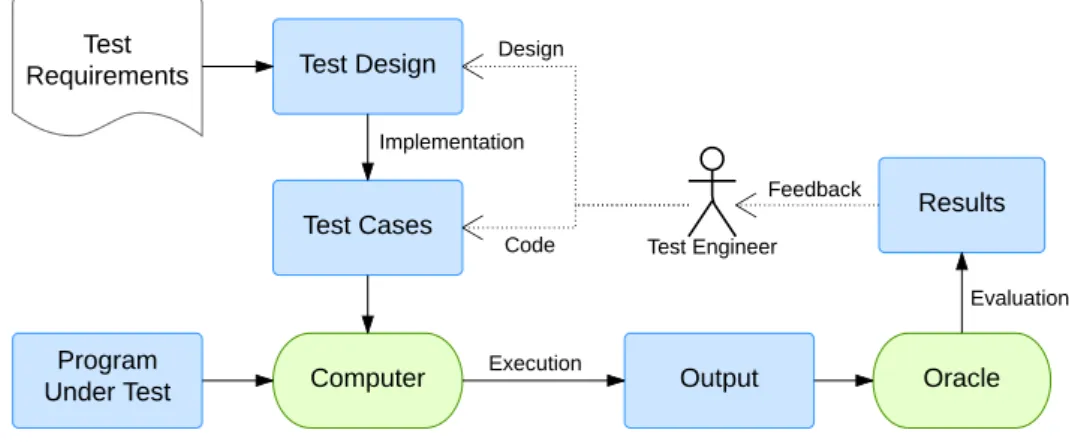
is evaluated by anoracle. The oracle has the responsibility of saying if a test case passed or failed, which, usually, is not a trivial task. After the execution of all test cases, a test report is produced to present the obtained results. These results provide feedback to the test engi-neer about the current state of the software, and can, hopefully, help the developers to find problems in the software that were previously unknown.
Test Design
Test Cases
Implementation
Program
Under Test Output
Results
Computer Execution Oracle
Evaluation Test Engineer
Feedback Design
Code
Test Requirements
Figure 3.1: Usual software testing workflow.
3.1
Testing Levels
The software development process is composed by different phases, such as defining the requirements and documenting them, planning and designing the software architecture and
actual coding of the software. Faults (or bugs) can be introduced in any of these phases. That is why it is necessary to perform testing on different levels of the development process. This section presents the definition and the different levels of testing.
Each testing level is related to a different activity in the software development process. The relationship between the levels and the development activities are presented in Figure 3.2. In the current literature, there are different classifications for testing levels. The one presented here is presented in[Ammann and Offutt, 2010] and it classifies the levels in acceptance,system,integration,moduleandunit.
Figure 3.2: Levels of Testing (the V model).
automatically, by tools that can simulate the user’s actions.
System tests are related to the activity of architecture design. Typically, computer sys-tems are composed by many software and hardware components that interact with each other and together provide a solution for the user’s needs. The objective of system testing is to verify if the chosen composition attends the software’s specification and to check for problems in the chosen architecture. System tests assume that each component was already tested individually and that they work properly.
The components used by the software architecture must communicate with one another
to perform tasks. The communication between these components is done by their interfaces. These interfaces can send and receive information that will be processed by the component. The objective of integration tests is to verify if the interfaces can communicate properly.
Module testing is related to the activity of detailed design of the software. The objective of this activity is to determine the structure of the modules in the implementation. It is important to notice here the difference betweenModulesand Units. Modules are files that combine sets of functions and variables. Units are named instructions or procedures that can be called at some point of the program by their name. Taking as an example the Java programming language, classes are modules and methods are units. The objective of module testing is to analyze a module in an isolated way, verifying how its units interact with each other.
Unit testing is related to the most concrete level in the software development process: the actual implementation of units (methods, functions etc.). The objective of unit testing