1
Estimating Lower Bound and Upper Bound of a Markov chain over a noisy
communication channel with Poisson distribution
Vinay Mahajan
1, Rajesh Nema
2, Puran Gour
3PG scholar in Department of Electronics & comm. Engineering, NIIST Bhopal1 Associate professor in Electronics & comm. Engineering NIIST Bhopal2, 3
Abstract
Under the assumption that the encoders’ observations are conditionally independent Markov chains given an unobserved time-invariant random variable, results on the structure of optimal real-time encoding and decoding functions are obtained. The problem with noiseless channels and perfect memory at the receiver is then considered. A new methodology to find the structure of optimal real-time encoders is employed. A sufficient statistic with a time-invariant domain is found for this problem. This methodology exploits the presence of common information between the encoders and the receiver when communication is over noiseless channels.In this paper we estimate the lower bond, upper bond and define the encoder. In the previous design approach they follow Markov Chain approach to estimating the upper bound and define the encoder. In this dissertation we follow poison distribution to finding the lower bound and upper bound. Poisson can be viewed as an approximation to the binomial distribution. The approximation is good enough to be useful even when the sample size (N) is only moderately large (say N > 50) and the probability (p) is only relatively small (p < .2) The advantage of the Poisson distribution, of course, is that if N is large you need only know p to determine the approximate distribution of events. With the binomial distribution you also need to know N.
Keywords
Poison distribution, markov chain, encoder, boundary values.
1.
Introduction
An information structure with noiseless, instantaneous feedback leads to a tractable problem, as the information at the controller is nested at the sensor on the plant side. For such a system, one can introduce an extended Markov chain where the state space is the space of conditional distributions on the real line with the topology of weak convergence.
Further, one can formulate an optimal control problem of choosing the quantize bin edges so as to minimize a long-term average cost function, as it has been done in [1], which provides existence results for optimal sensing and control. When noiseless feedback is present, the streaming coding schemes in [2] could be used, exploiting the nested structure. Along these lines, when the channel is Gaussian, [3] provided a comprehensive study on the optimality of linear coding (innovation) and control policies. Reference [4] considered time-varying channels.
In this paper we address some issues in multi terminal communication systems under the real-time constraint. Specifically, we look at problems with multiple senders/encoders communicating with a single receiver. We analyze systems with two encoders, although our results generalize to encoders and a single receiver. The two encoders make distinct partial observations of a discrete-time Markov source.
Each encoder must encode in real-time its observations into a sequence of discrete variables that are transmitted over separate noisy channels to a common receiver. The receiver must estimate, in real-time, a given function of the state of the Markov source. The main feature of this multi terminal problem that distinguishes it from a point to point communication problem is the presence of coupling between the encoders (that is, each encoder must take into account what other encoder is doing). This coupling arises because of the following reasons: 1)
the encoders’ observations are correlated with each
other. 2) The encoding problems are further coupled because the receiver wants to minimize a non-separable distortion metric. That is, the distortion metric cannot be simplified into two separate functions each one of which depends only on one
encoder’s observations. The nature of optimal
strategies strongly depends on the nature and extent of the coupling between the encoders.
2 a noiseless channel of finite rate. Lower bounds on the channel rates to achieve asymptotic stabilizability and asymptotic observability of the linear systems are studied. For certain information patterns, coding schemes are provided which achieve the bounds on performance. The finite rate link is replaced with a noisy channel in [6], and information theoretic tools, specifically rate-distortion theory, are used to compute bounds on the capacity of the noisy channel to guarantee asymptotic stabilizability and observability. In [7] studies the classical linear quadratic Gaussian (LQG) problem with a noisy channel connecting the sensor and the controller. In order to study the effect of delay on the squared error distortion, tools from sequential rate distortion theory are used, and it is proved that the LQG cost can be decomposed as the sum of full knowledge cost and partial knowledge cost. In [8], feedback anytime capacity above a threshold is shown to be necessary and sufficient for stabilizing a linear stochastic system.
The remaining of this paper is organized as follows. We discuss Information Theory and Markov Chain Section 2. In Section 3 we discuss about problem domain. The Evolution and recent scenario in section 4.In section 5 we discuss about proposed approach. The conclusions and future directions are given in Section 6. Finally references are given.
2.
Information Theory and Markov
Chain
Though information theory provides a fundamental bound on the rate at which reliable communication is possible on an unreliable channel, the bound is achieved by collecting incoming data into long blocks, and later encoding them into long code words. Clearly this approach is not tenable for a networked control system because of the delay involved in accumulating large blocks before processing them.
In a control system, the state of a plant must be communicated to the controller or the estimator in a timely manner; else its use is limited. Also, the communication channel must be used every time instant. It is not possible to accumulate channel bandwidth by not transmitting for a few time units, and later using the channel multiple times on a single day. A Markov chain, named after Andrey Markov, is a mathematical system that undergoes transitions from one state to another, between a finite or countable number of possible states. It is a random
process characterized as memory less: the next state depends only on the current state and not on the sequence of events that preceded it. This specific kind of "memorylessness" is called the Markov property. Markov chains have many applications as statistical models of real-world processes.
A Markov chain is a sequence of random variables X1, X2, X3, ... with the Markov property, namely that, given the present state, the future and past states are independent. Formally,
Pr (
)
The possible values of Xi form a countable set S called the state space of the chain. Markov chains are often described by a directed graph, where the edges are labeled by the probabilities of going from one state to the other states.
The probability of going from state i to state j in n time steps is
= Pr (Xn = j |X0 = i)
and the single-step transition is
For a time-homogeneous Markov chain:
)
And the n-step transition probabilities satisfy the chapman-kolmogorov equation, that for any k such that 0 < k < n,
∑
Where S is the state space of the Markov chain.
The marginal distribution Pr(Xn = x) is the distribution over states at time n. The initial distribution is Pr(X0 = x). The evolution of the process through one time step is described by
∑
∑
3.
Problem Domain
3 is not tenable for a networked control system because of the delay involved in accumulating large blocks before processing them. In a control system, the state of a plant must be communicated to the controller or the estimator in a timely manner; else its use is limited. Also, the communication channel must be used every time instant. It is not possible to accumulate channel bandwidth by not transmitting for a few time units, and later using the channel multiple times on a single day.
Previous approach can only found the upper bound estimation to maximize the mutual information, but they fail to record the posterior information which is used for the random information's. The Markov process approach does not require any a priori assumptions about the traffic model except possibly for the voice/data mix. From a network point of view, the distribution of traffic sources and sinks does not need to be known a priori either. It is therefore the most precise and introduces a higher level of fidelity (realism) with poison for recording the prior information.
4.
Evolution and Recent Scenario
In 2009, Jeebak Mitra et al. [9] concerned with the performance limits on communication over power line channels where the noise has memory and is modeled using a partitioned Markov chain (PMC) that has been found to be well suited to describe the burst nature of impulses of the low voltage PLC channel. In particular, expressions are derived for the cutoff rate and the bit error rate of a convolutional coded narrowband system. They are then verified by comparing with simulation results employing typical PLC parameters, proving the utility of the expressions as a design tool.
In 2009, Serdar Y¨uksel [10] observes a random time state-dependent drift result leading to various forms of stochastic stability for a Markov Chain is presented. Application to a network stabilization problem is studied. In particular, they observe that, for control over a discrete erasure channel with feedback, for recurrence or stochastic stability, it suffices to have the capacity being greater than the logarithm of the unstable eigenvalue. For the finiteness of a second moment, however, more stringent criteria are needed.
In 2010, Siu-Wai Ho et al. [11] determine confidence intervals for estimation of source entropy over discrete memory less channels with invertible
transition matrices. A lower bound is given for the minimum number of samples required to guarantee a desired confidence interval. All these results do not require any prior knowledge of the source distribution, other than the alphabet size. When the alphabet size is countable infinite or unknown, they illustrate an inherent difficulty in estimating the source entropy.
In 2011, Ashutosh Nayyar et al. [12] considered a real-time communication system with two encoders communicating with a single receiver over separate noisy channels. The two encoders make distinct partial observations of a Markov source. Each encoder must encode its observations into a sequence of discrete symbols. The symbols are transmitted over noisy channels to a finite memory receiver that attempts to reconstruct some function of the state of the Markov source. Encoding and decoding must be done in real-time, that is, the distortion measure does not tolerate delays. Under the assumption that the
encoders’ observations are conditionally independent
Markov chains given an unobserved time-invariant random variable, results on the structure of optimal real-time encoding and decoding functions are obtained. It is shown that there exist finite-dimensional sufficient statistics for the encoders. The problem with noiseless channels and perfect memory at the receiver is then considered.
In 2011, Serdar Yüksel et al. [13] consider the problem of remotely controlling a continuous-time linear time-invariant system driven by Brownian motion process, when communication takes place over noisy memory less discrete- or continuous-alphabet channels. What makes this class of remote control problems different from most of the previously studied models is the presence of noise in both the forward channel (connecting sensors to the controller) and the reverse channel (connecting the controller to the plant). For stability of the closed-loop system, we look for the existence of an invariant distribution for the state, for which they show that it is necessary that the entire control space and the state space be encoded, and that the reverse channel be at least as reliable as the forward channel. They obtain necessary conditions and sufficient conditions on the channels and the controllers for stabilizability.
4 where the transmitted message is the organism’s proteome encoded in the DNA. They compute the capacity and the rate distortion functions of the protein communication system for the three domains of life: Archaea, Bacteria, and Eukaryotes. The tradeoff between the transmission rate and the distortion in noisy protein communication channels is analyzed. As expected, comparison between the optimal transmission rate and the channel capacity indicates that the biological fidelity does not reach the Shannon optimal distortion. However, the relationship between the channel capacity and rate distortion achieved for different biological domains provides tremendous insight into the dynamics of the evolutionary processes of the three domains of life. We rely on these results to provide a model of genome sequence evolution based on the two major evolutionary driving forces: mutations and unequal crossovers.
5.
Proposed Approach
In this paper we estimate the boundary condition by poison distribution. We find the past value based on mutual information and find the similarities from the current value. Similarity matching is called estimation which is finding by upper and lower bound. This approximation can proof to be efficient by our experimental results. First we show that the information pattern of the encoder can be simplified to just the encoder but not ignore the past states. Then, we prove that by poison distribution which can be computed recursively as a function of n, and the coding scheme for time n. Finally, via dynamic programming we prove that the optimal policy at time n is a function of upper and lower bound. Next, we prove the optimality of an encoder that generates the channel input only as a function of the previous received signals and the current state. Hence the encoder cannot ignore the previous states.
In probability theory and statistics, the Poisson distribution is a discrete probability distribution that expresses the probability of a given number of events occurring in a fixed interval of time and/or space if these events occur with a known average rate and independently of the time since the last event. The Poisson distribution can also be used for the number of events in other specified intervals such as distance, area or volume.
P(x, λ) = for x = 0, 1, 2 ∙∙∙∙∙
The bound is based on simple information theoretic arguments.
First we show that the information pattern of the encoder can be simplified to just, the encoder not ignore the past states. So it helps in saving the random information from the past history.
Describe he initial and final state.
The Find the distribution based on Number of Sequences (0-40, 50, 100, 500, 1000, 2000).
Vector of zeros for length: M = mu;
n = 3000;
F = zeros (1, n+1); F (1) = 0; Get the distribution of W_1 to W_n
Calculate the random probability
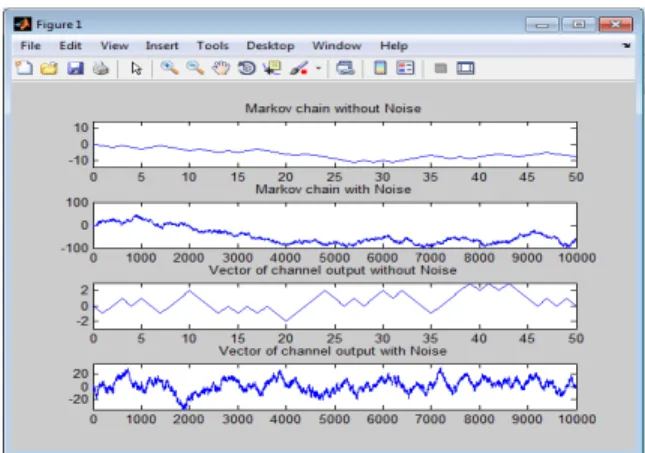
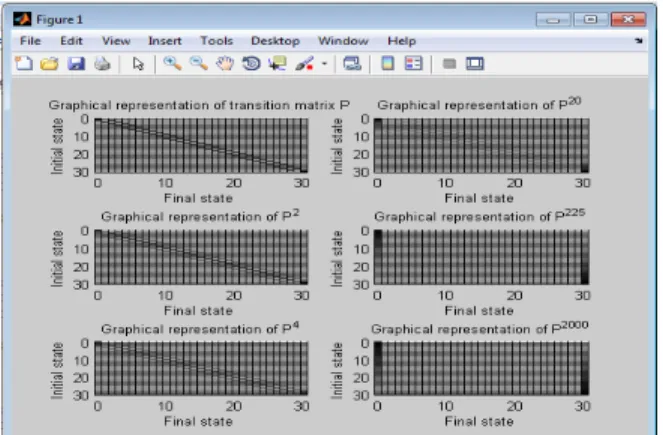
In summary, this work provides new mathematical results that can be useful for the implementation of new decoders taking advantage of already known noise processes.The results over the noisy communication channel are shown in Figure 1, Figure 2 Figure 3 and figure 4.
Figure 1: Markov Process with Noise and Without Noise
for i=2:N, let i take values 2, 3, 4, ..., N P(i,i-1)=q; wealth decreases by 1 P(i,i+1)=p; wealth increases by 1 End
for i=1:n M = M*P;
F(i+1) = M(1) + M(N+1); End
while T(i) < Tmax,
T(i+1)=T(i)+random('Exponential',1/lambda); i=i+1;
5
Figure 2: Transition Matrix
Figure 3: Cumulative Distribution
Figure 4: Poison Process
6.
Conclusion and Future Direction
In this paper we estimate the state of markov chain over noisy communication channel. For this we use upper bound and lower bound post/ priori information of an encoding policy to maximize the mutual information. For post information we took poison distribution for generating and storing vectors for post random information. This is useful in the case over noisy channel. We have proved an upper bound of the channel estimation AC, where C is the information theoretic capacity of the noisy channel connecting the encoder and the destination. We have proved that the optimal channel input at time n is only a function of the current state and the a-posteriori distribution of current state given all the channel outputs which is also generated by poison distribution. This is an efficient estimation of the state of a Markov chain over a noisy communication channel model.
References
[1] S. Yüksel, “Optimal LQG coding and control over communication channels: An existence and
an infeasibility result,” in Proc. IEEE Amer.
Contr. Conf., Seattle, WA, Jun. 2008, pp. 3114– 3119.
[2] A. Sahai, “Why do block length and delay behave
differently if feedback is present?,” IEEE Trans.
Inf. Theory, vol. 54, no. 5, pp. 1860–1886, May 2008.
[3] R. Bansal and T. Bas¸ar, “Simultaneous design of measurement and control strategies for stochastic
systems with feedback,” Automatica, vol. 25, no. 9, pp. 679–694, 1989.
[4] P. Minero, M. Franceschetti, S. Dey, and G.
Nair, “Data rate theorem for stabilization over
time-varying feedback channels,” IEEE Trans. Autom. Contr., vol. 54, no. 2, pp. 243–255, Feb. 2009.
[5] S. Tatikonda and S. Mitter, “Control under
communication constraints,” IEEE Transactions on Automatic Control, vol. 49, no. 7, pp. 1056– 1068, July 2004.
[6] S. Tatikonda and S. Mitter, “Control over noisy
channels,” IEEE Transactions on Automatic
Control, vol. 49, no. 7, pp. 1196-1201, July 2004. [7] S. Tatikonda, A. Sahai, and S. Mitter, “Stochastic
linear control over a communication channel,”
IEEE Transactions on Information Theory, vol. 49, no.9, pp. 1549–1560, Sept. 2004.
6
on Information Theory, vol. 52, no.8, pp. 3369– 3395, Aug. 2006.
[9] Jeebak Mitra and Lutz Lampe,” Coded Narrowband Transmission over Noisy Powerline
Channels”, IEEE 2009.
[10]Serdar Y¨uksel,” A Random Time Stochastic Drift Result and Application to Stochastic Stabilization over Noisy Channels”, IEEE 2009. [11]Siu-Wai Ho, Terence Chan and Alex Gran, “The
Confidence Interval of Entropy Estimation
through a Noisy Channel”, IEEE 2010.
[12]Ashutosh Nayyar and Demosthenis Teneketzis,
“On the Structure of Real-Time Encoding and Decoding Functions in a Multiterminal
Communication System”, IEEE 2011.
[13]Serdar Yüksel and Tamer Bas¸ar, “Control Over
Noisy Forward and Reverse Channels”, IEEE 2011.
[14]Gong, Liuling, Nidhal Bouaynaya, and Dan Schonfeld. "Information-theoretic model of evolution over protein communication channel." IEEE/ACM Transactions on Computational Biology and Bioinformatics (TCBB) 8, no. 1 (2011): 143-151.
Vinay Mahajan received the B.E degree in ECE from JIT (Jawaharlal Institute of Technology), Borawa, under RGPV University, Bhopal MP in 2005 and M.Tech (Digital Communication) from NRI, Bhopal, India of RGPV University, M.P India.