Artigo Original
Rosanna Mariangela Giaffredo Angrisani1 Marisa Frasson De Azevedo2 Renata Mota Mamede Carvallo3 Edna Maria de Albuquerque Diniz4 Carla Gentile Matas3
Descritores
Potenciais evocados auditivos do tronco encefálico
Audição Transtornos da audição Recém-nascido Recém-nascido pequeno para a idade
gestacional
Keywords
Evoked potentials, auditory brainstem Hearing Hearing disorders Infant, newborn Infant, small for gestational age
Correspondence address:
Rosanna Mariangela Giaffredo Angrisani R. Cipotânea, 51, Butantã, São Paulo (SP), Brasil, CEP: 05360-160. E-mail: [email protected]
Received: 12/16/2011
Accepted: 4/24/2012
Study conducted at the Graduate Program in Rehabilitation Sciences, Department of Physical Therapy, Speech-Language Pathology and Audiology, and Occupational Therapy, School of Medicine, Universidade de São Paulo – USP – São Paulo (SP), Brazil, and at the São Paulo Hospital, Universidade Federal de São Paulo –UNIFESP – São Paulo (SP), Brazil.
(1) Graduate Program (Masters degree) in Rehabilitation Sciences, Department of Physical Therapy, Speech-Language Pathology and Audiology, and Occupational Therapy, School of Medicine, Universidade de São Paulo – USP – São Paulo (SP), Brazil.
(2) Department of Speech-Language Pathology and Audiology, Escola Paulista de Medicina, Universidade Federal de São Paulo – UNIFESP – São Paulo (SP), Brazil.
(3) Department of Physical Therapy, Speech-Language Pathology and Audiology, and Occupational Therapy, School of Medicine, Universidade de São Paulo – USP – São Paulo (SP), Brazil.
(4) Discipline of Neonatal Pediatrics, Department of Pediatrics, School of Medicine, Universidade de São Paulo – USP – São Paulo (SP), Brazil.
Conflict of interests: None
for-gestational-age newborns
Estudo eletrofisiológico da audição em recém-nascidos a
termo pequenos para a idade gestacional
ABSTRACT
Purpose: To describe the Brainstem Auditory Evoked Potential (BAEP) results of full-term small-for-ges-tational-age newborns, comparing them to the results of full-term appropriate-for-gessmall-for-ges-tational-age newborns, in order to verify whether the small-for-gestational-age condition is a risk indicator for retrocochlear hearing impairment. Methods: This multicentric prospective cross-sectional study assessed 86 full-term newborns – 47 small- (Study Group) and 39 appropriate-for-gestational-age (Control Group – of both genders, with ages between 2 and 12 days. Newborns with presence of transient evoked otoacoustic emissions and type A tympanometry were included in the study. Quantitative analysis was based on the mean and standard deviation of the absolute latencies of waves I, III and V and interpeak intervals I-III, III-V and I-V, for each group. For qualitative analysis, the BAEP results were classified as normal or altered by analyzing these data considering the age range of the newborn at the time of testing. Results: In the Study Group, nine of the 18 (38%) subjects with altered BAEP results had the condition of small-for-gestational-age as the only risk factor for hearing impairments. In the Control Group, seven (18%) had altered results. Female subjects from the Study Group tended to present more central alterations. In the Control Group, the male group tended to have more altera-tions. Conclusion: Full-term children born small or appropriate for gestational age might present transitory or permanent central hearing impairments, regardless of the presence of risk indicators.
RESUMO
Objetivo: Caracterizar as respostas do Potencial Evocado Auditivo de Tronco Encefálico de recém-nascidos a termo pequenos para idade gestacional, comparando-as às de recém-nascidos a termo adequados para idade gestacional, verificando se a condição de pequeno para a idade gestacional é indicador de risco para alteração auditiva retrococlear. Métodos: Este estudo multicêntrico transversal prospectivo avaliou 86 recém-nascidos a termo, sendo 47 pequenos (Grupo Estudo) e 39 adequados para idade gestacional (Grupo Controle), de ambos os gêneros, com idades entre 2 e 12 dias de vida. Foram incluídos os recém-nascidos com presença de emissões otoacústicas evocadas por estímulo transiente e timpanometria tipo A. A análise quantitativa dos dados foi feita baseada na média e desvio-padrão das latências das ondas I, III, V e interpicos I-III, III-V, I-V para cada grupo. Para análise qualitativa, os resultados dos potenciais evocados auditivos foram classificados em alterados ou normais mediante essas análises, considerando-se a faixa etária do recém-nascido no momento do exame.
INTRODUCTION
The adequacy of birth weight is a predictive factor of morbidity and mortality in the first years of life. The newborn (NB) considered small for gestational age (SGA) is below the percentile 10 of a determined growth curve that relates birth weight and gestational age(1); the SGA condition might be an
indicator of intrauterine growth delay.
SGA newborns can also be classified into two subgroups, according to the time at which their intrauterine life was af-fected: asymmetric or disproportionate SGA NB, in which the weight is below the expected, but stature and cephalic perimeter are normal, and the likely injury occurred late in pregnancy, due to placental insufficiency; symmetric or proportionate SGA NB, in which weight, cephalic perimeter and stature are below the expected, suggesting that injuries occurred early in pregnancy, probably extending throughout the whole neonatal period, and causing greater impairments to the fetus(2). There
are several causes of intrauterine growth restriction, such as smoking, low maternal stature, congenital infections, among others. International literature data have reported that, when compared to infants born adequate for gestational age (AGA), SGA infants have neuropsychomotor and language develop-ment handicaps, among others(3-6).
Language and auditory abilities are developed in the first two years of life, especially in the first six months(2,7-10). The
Brainstem Auditory Evoked Potential (BAEP) is considered the “gold standard” test in the diagnosis of the integrity of auditory nerve and pathways of the central nervous system in neonates. Moreover, it allows the follow-up of the central nervous sys-tem maturation at brainssys-tem level, which occurs from the first months of life until around 18 months, when responses become similar to the adults’(11).
The purpose of this study was to characterize the BAEP responses of small-for-gestational-age (SGA) newborns, com-paring them to those of adequate-for-gestational-age (AGA) infants, in order to verify whether the SGA condition is a risk indicator for retrocochlear hearing impairments.
METHODS
This multicentric study was approved by the Committee for the Analysis of Research Protocols of the Universidade de São Paulo (CAPPesq HCFMUSP 372/10), the Research Ethics Committee of the University Hospital of the Universidade de São Paulo (CEP-HU/USP nº 1009-10 – SISNEP CAEE 0037.0.198.000-10), and the Research Ethics Committee of the Universidade Federal de São Paulo (UNIFESP 1235/11).
According to the ethical principles of research with human beings, mothers and/or legal guardians agreed with the partici-pation of the newborns in this study, and signed the Free and Informed Consent Term, which described all the procedures that would be carried out, in accordance with Resolution 196/96.
The sample comprised 86 full-term newborns (FTNB), with gestational age varying from 37 weeks and one day (37 1/7) to 41 weeks, assessed in the immediate post-natal period (between two and 12 days of life). Forty seven infants were
classified as SGA, and 39 as AGA, according to a study that normalized the percentiles for classification, considering weight and gestational age(12).
The Study Group (SG) comprised 47 SGA FTNB, 30 female and 17 male. The Control Group (CG) comprised 39 AGA FTNB, 20 female and 19 male.
It is worth emphasizing that the classification of proportio-nality for SGA FTNB can be obtained by Rohrer’s ponderal index (PI), which is defined by weight (in grams) divided by stature cubed (cm3), multiplied by 100. If PI≥2.49, the newborn
is considered symmetric or proportionate SGA; if PI<2.49, the newborn is asymmetric or disproportionate SGA.
The first procedure adopted was carefully reading the NB’s medical records, in order to collect data about the eligibility criteria of the sample (SGA and AGA FTNB), including the infant’s anthropometric measures and gestational age (based on the date of the mother’s last period, confirmed by ultrasonog-raphy). Bilateral presence of transient otoacoustic emissions (TOAE) and type A tympanometric curve were also adopted as eligibility criteria(10).
Newborns with history of encephalopathy, conductive and/ or cochlear malformations and alterations were excluded from the sample. These were referred to otorhinolaryngological evaluation and management, and later audiological follow-up.
All NB were prepared for the tests according to the follow-ing procedure: an inspection of the external auditory canal was initially performed, using a Welch Allyn® otoscope to visualize
the tympanic membrane. After that, infants were submitted to Transient Otoacoustic Emissions (TOAE) and acoustic imm-itance measures (tympanometry), in order to guarantee cochlea normality and absence of middle ear disorders.
To register the TOAE, we used either the ILO92 - Otodynamics® equipment with non-linear click stimulus, in an intensity level between 78 and 83 dB SPL (at the Research Center of the Department of Physical Therapy, Speech-Language Pathology and Audiology, and Occupational Therapy of the Universidade de São Paulo), or the portable automatic equipment AccuscreenPRO,from GN Otometrics®(at the São Paulo Hospital, Universidade Federal de São Paulo). In the last case, the equipment was calibrated by the manufacturer for automatic analysis of responses using the following parame-ters: evaluation method of binomial statistics; non-linear click stimuli in speed sequence of 60 Hz and intensity between 70 and 84 dB SPL (45-60 dB HL, with auto-calibration depending on the ear canal volume); frequency spectrum from 1.4 to 4 kHz; artifact lower than 20%. When these parameters were not obtained, the equipment registered “fail”, and when they were obtained, the result shown was “pass”.
Acoustic immitance measures included tympanometry with 1 kHz probe tone, carried out using the middle ear analyzer Interacoustics®, model AT 235.
electrodes Meditrace-200, from Kendal®, over the frontal region (Fpz) and right and left mastoids (M2 e M1),
accord-ing to the IES 10-20 rule (International Electrode System)(13).
Responses were elicited through acoustic stimuli presented using a pair of insert earphones, model 3A.
The acoustic stimulus used was the rarefaction polarity click, monoaurally presented at 80 dBnHL (for assessing audi-tory pathway integrity), 50 dBnHL, and 30 dBnHL, at presen-tation speed of 27.7 clicks per second, with 0.1 milliseconds (ms) duration, totalizing 2048 stimuli. The recording window used was of 12 ms. Absolute latencies of waves I, III and V and interpeak intervals I-III, III-V and I-V were analyzed. These parameters were used for being the assessment protocols used to register BAEP responses in NB at the institutions participat-ing in this study.
BAEP responses were qualitatively analyzed, and the results obtained were classified as normal or altered, according to the values of absolute latencies of waves I, III and V, and interpeak intervals I-III, III-V and I-V, as proposed by Cox(14), considering
the infant’s age range at the time of assessment.
Statistical analysis applied the Chi-square test, the Paired t test, and the Independent t test(15), adopting a significance level
of 5%, with confidence interval of 95%.
RESULTS
The Study Group, which comprised 47 FTNB, was divided into two subgroups for intra-subjects qualitative analysis of BAEP responses: 33 symmetric and 14 asymmetric SGA NB. There was no difference between groups (Table 1). Hence, further analyses of the SGA infants considered the group as a whole.
The comparative analysis of BAEP responses between Study (SGA) and Control (AGA) groups found alterations in 25 infants (29% of the sample) – 18 SGA NB (38%) and seven AGA NB (18%). No difference was found between groups (p=0.067), even though there was a higher tendency of altera-tions in the Study Group (Table 2).
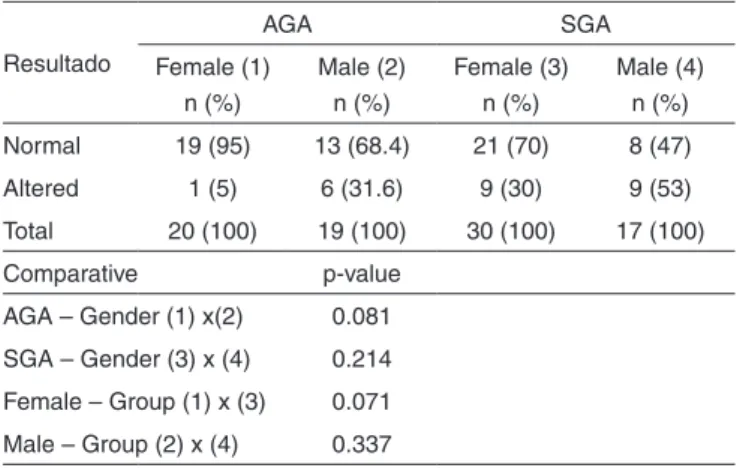
In the comparison between male and female subjects in the SGA group regarding BAEP results (normal or altered), no diffe-rence was evidenced for the distribution of alterations (p=0.214). The same comparison in the AGA group also did not show difference regarding the distribution of alterations (p=0.081). Nevertheless, the results suggest that, in the AGA group, male NB presented higher tendency to central auditory alterations (31.6%), when compared to female NB (5%) (Table 3).
In the comparative analysis between Study and Control groups for the male gender, nine SGA NB (53%) presented BAEP alterations, which were characterized by increase of the absolute latencies of waves III and/or V and of interpeaks I-III and/or I-V. No differences were found between SGA and AGA groups for male infants (p=0.337) (Table 3).
In the comparative analysis of BAEP responses obtained by Study and Control groups for the female gender, nine SGA NB (30%) presented altered results, which were characterized by increase of the absolute latencies of waves III and/or V and of interpeaks I-III and/or I-V. In the AGA group, only one infant (5%) presented increase of the absolute latencies of waves III and V. These results did not evidence difference between SGA and AGA groups for female infants (p=0.071), although the SGA group showed tendency to present more alterations (Table 3).
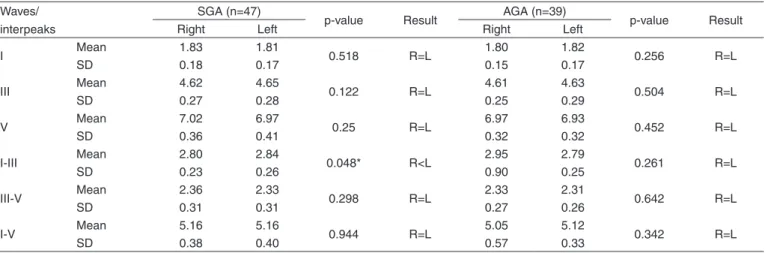
Preliminarily, the results obtained by group (SGA and AGA) for each BAEP parameter (absolute latencies of waves I, III and V, and interpeaks I-III, III-V and I-V) were separately analyzed for each ear, using the Paired t test (Table 4). It is noticed that, in the Study Group (SGA), there was difference between right and left ears only in the interpeak I-III (p=0.048). Having in mind that a single parameter presented difference, that this re-sult was very close to the significance level, and that the mean values of interpeaks I-III are very close between ears (2.80 ms in the right ear, and 2.84 in the left ear), the results obtained were considered clinically similar, allowing the values obtained in the right and left ears to be grouped. Hence, we analyzed
Table 1. BAEP responses obtained by symmetric and asymmetric SGA infants
SGA groups Normal
n (%)
Altered n (%)
Total n (%)
Symmetric Asymmetric Total
22 (66.7) 7 (50) 29 (62)
11 (33.3) 7 (50) 18 (38)
33 (100) 14 (100) 47 (100)
Chi-square test (p=0.455)
Note: SGA = small for gestational age
Table 2. Comparative study of BAEP responses
Groups Normal
(%)
Altered (%)
Total (%)
AGA SGA Total
32 (82) 29 (62) 61 (71)
7 (18) 18 (38) 25 (29)
39 (100) 47 (100) 86 (100)
Chi-square test (p=0.067)
Note: AGA = adequate for gestational age; SGA = small for gestational age
Table 3. Comparison of BAEP responses between SGA and AGA infants, between male and female genders
Resultado
AGA SGA
Female (1) n (%)
Male (2) n (%)
Female (3) n (%)
Male (4) n (%)
Normal 19 (95) 13 (68.4) 21 (70) 8 (47)
Altered 1 (5) 6 (31.6) 9 (30) 9 (53)
Total 20 (100) 19 (100) 30 (100) 17 (100)
Comparative p-value
AGA – Gender (1) x(2) 0.081
SGA – Gender (3) x (4) 0.214
Female – Group (1) x (3) 0.071
Male – Group (2) x (4) 0.337
Chi-square test (p≤0.05)
each BAEP parameter considering both ears together, while comparing Study (SGA) and Control (AGA) groups.
No differences were found between groups SGA and AGA regarding the absolute latencies of waves I, III and V. There were also no differences between groups in the comparative analysis of interpeaks I-II, III-V and I-V (Table 5).
We also analyzed the influence of risk indicators for hea-ring alterations, described by the Joint Committee on Infant Hearing (JCIH)(12) and added by those of Azevedo(16). From
the 47 SGA NB, 29 had normal BAEP results (62%), and 18 presented central alterations (38%). From these 18 NB, 16 had the fact of being born SGA as the only risk factor. From the 39 AGA NB, 32 presented normal BAEP results (82%), and seven (18%) presented alterations that suggested central alterations (from these, five did not present any risk indicator for hearing alterations). There was no difference between SGA and AGA groups regarding central alterations with and without associated risks.
The characterization of risk indicators in both studied
population (SGA and AGA) regarding normal and altered BAEP results is described in Chart 1.
DISCUSSION
There is consensus in international literature that SGA NB might present alterations in neuropsychomotor development, since they are an example of early malnutrition(3-6,17). Another
important aspect to be considered, according to literature, is the moment at which the child suffered restriction and for how long. In the present study, no significant differences were found between symmetric (restrictions in early pregnancy) and asymmetric (restrictions in late pregnancy) SGA NB regarding the BAEP results obtained.
A study that involved 47 normal full-term NB with adequate-for-gestational-age weight, who were submitted to BAEP assessment (alternate polarity stimulus and presentation speed of 10/s) at two days of life, considered the data obtained (mean absolute latencies of waves I, III and V, and mean inter-peaks I-III, III-V and I-V) as the normality standard for this population(18). Another recent study had the aim to establish
Table 4. Comparison of the absolute latencies of waves I, III, V and interpeak intervals I-III, III-V, I-V obtained in the BAEP between right and left ears
Waves/ interpeaks
SGA (n=47)
p-value Result AGA (n=39) p-value Result
Right Left Right Left
I Mean 1.83 1.81 0.518 R=L 1.80 1.82 0.256 R=L
SD 0.18 0.17 0.15 0.17
III Mean 4.62 4.65 0.122 R=L 4.61 4.63 0.504 R=L
SD 0.27 0.28 0.25 0.29
V Mean 7.02 6.97 0.25 R=L 6.97 6.93 0.452 R=L
SD 0.36 0.41 0.32 0.32
I-III Mean 2.80 2.84 0.048* R<L 2.95 2.79 0.261 R=L
SD 0.23 0.26 0.90 0.25
III-V Mean 2.36 2.33 0.298 R=L 2.33 2.31 0.642 R=L
SD 0.31 0.31 0.27 0.26
I-V Mean 5.16 5.16 0.944 R=L 5.05 5.12 0.342 R=L
SD 0.38 0.40 0.57 0.33
* Significant values (p≤0.05) – Paired t test
Note: SD = standard deviation; R = right ear; L = left ear; AGA = adequate for gestational age; SGA = small for gestational age
Table 5. Comparison of the absolute latencies of waves I, III, V and inter-peak intervals I-III, III-V, I-V in the BAEP between SGA and AGA groups
Waves/
Interpeaks SGA (n=47) AGA (n=39) p-value
I Mean 1.81 1.80 0.620
SD 0.17 0.16
III Mean 4.64 4.62 0.699
SD 0.273 0.268
V Mean 6.99 6.95 0.380
SD 0.384 0.319
I-III Mean 2.81 2.87 0.459
SD 0.244 0.663
III-V Mean 2.34 2.34 0.600
SD 0.306 0.264
I-V Mean 5.15 5.08 0.267
SD 0.389 0.463
Independent t test (p≤0.05)
Note: SD = standard deviation; AGA = adequate for gestational age; SGA = small for gestational age
Chart 1. Influence of risk indicators regarding BAEP responses in SGA and AGA groups
Indicators SGA AGA
Normal Altered Normal Altered
No risk 26 16 24 5
Familiar history 0 0 4 1
Ototoxic 1 0 0 0
Toxoplasmosis 0 0 2 0
HIV + 2 0 2 0
Rubella 0 0 0 0
ICU > 5 days 0 1 0 0
Hyperbilirubinemia 0 0 0 1
normal values of absolute latencies of waves I, III and V, and interpeaks I-III, III-V and I-V on the BAEP assessment (rare-faction polarity stimulus and presentation speed of 21.1/s) of 86 full-term infants divided into several groups, according to their gestational age. In the NB group (0 to 29 days of life), the means obtained were slightly lower than in the present study(19).
In this study, slightly higher absolute latencies were evi-denced for all the BAEP parameters analyzed, when compared to the studies mentioned above. In fact, this difference might be attributed to the different parameters used in obtaining the BAEP, agreeing with previous studies(18,20,21) that concluded that
increasing the presentation speed of acoustic stimuli causes slight increase in absolute latencies and interpeak intervals.
The comparative results of mean absolute latencies of waves I, III, V, and mean interpeaks I-III, III-V and I-V between the present study and those previously mentioned are described in Chart 2.
There was also no difference between ears regarding BAEP measures, which suggests that auditory pathways maturation occurs simultaneously in both ears, corroborating other data from literature(18,19,22,23). This fact also disagrees with studies that
have investigated possible asymmetry mechanisms in newborns using the BAEP, with better results in the right ear(24,25).
A research conducted in India compared the BAEP res-ponses of 25 FTNB SGA from undernourished mothers and 25 FTNB AGA from healthy mothers, paired by gender and gestational age. The study did not find significant differences between groups. According to the authors, the absolute latencies of wave V and interpeaks I-V were in the upper normal limit in the study group, when compared to the control group, and it was concluded that maternal malnutrition might have a small negative influence in the brainstem intrauterine development(26).
This research corroborates the findings of the present study.
We did not find literature data regarding the influence of risk indicators in the comparison between AGA and SGA FTNB. However, our findings indicate that, regardless the presence of these indicators, BAEP alterations suggestive of central impairment are more frequent (although without significant difference) in SGA FTNB, reinforcing literature data about the fact that these children are prone to greater risks for neurode-velopmental alterations, when compared to AGA FTNB(2,27,28).
Literature agrees that SGA children might suffer several impairments in neuropsychomotor development, which are carried on into adulthood(3-6,27-29). The SGA NB are a very
heterogeneous group, since they may have been affected at different moments of intrauterine life, with several possible causes. Their hearing behavior is also diversified, and, therefore, it is important to monitor their development until the end of the language acquisition and development process, since hearing and language are correlated interdependent functions(29). Hence,
when hearing impairments are evidenced through BAEP, it is indispensible to guide these children’s parents and teachers regarding hearing stimulation, in order to solve or avoid future difficulties.
It is also worth emphasizing that the central impairments found might be transitory, resulting from immaturity of the auditory system, as concluded in a research(30) that corroborates
this study. Thus, these children should be later reassessed in order to confirm the results.
CONCLUSION
Children born full-term adequate or small for gestational age might present central hearing impairments, transitory or permanent, regardless the presence or absence of risk indicators.
Chart 2. Characterization of absolute latencies of waves I, III, V and interpeak intervals I-III, III-V, I-V in the BAEP, in studies with full-term newborns
Study BAEP
parameters n
I Mean (SD)
III Mean (SD)
V Mean (SD)
I-III Mean (SD)
III-V Mean (SD)
I-V Mean (SD)
Guilhoto et al.(18)
alternate click rate=10/s i: 80 dBNA f: 100 Hz – 3 kHz
47 1.79 (0.20) 4.54 (0.31) 6.75 (0.38) 2.75 (0.36) 2.22 (0.22) 4.97 (0.43)
Mahajan et al.(26)
click – polarity not mentioned rate – not mentioned
i: 70 dBnNA f: 150 Hz – 3 kHz
SGA=25 1.92 (0.40) 4.26 (0.73) 6.44 (0.68) 2.37 (0.43) 2.20 (0.32) 4.55 (0.48)
AGA=25 1.82 (0.20) 4.04 (0.55) 6.09 (0.56) 2.27 (0.41) 2.02 (0.39) 4.30 (0.47)
Amorim et al.(19)
rarefaction click rate=21,1/s i: 80 dBnNA f: 30 Hz – 3 kHz
46 1.67 (0.28) 4.49 (0.47) 6.77 (0.54) 2.80 (0.49) 2.25 (0.50) 5.05 (0.75)
Present study
rarefaction click rate=27,7/s i: 80 dBnNA f: 100 Hz – 1,5 kHz
SGA=47 1.81 (0.17) 4.64 (0.27) 6.99 (0.38) 2.81 (0.24) 2.34 (0.30) 5.15 (0.39)
AGA=39 1.80 (0.16) 4.62 (0.26) 6.95 (0.32) 2.87 (0.66) 2.31 (0.26) 5.08 (0.46)
REFERENCES
1. Goulart AL. Caracterização da população neonatal. In: Kapelman BI, Santos AM, Goulart AL, Almeida MF. Myioshi MH, Guinsburg R. Diagnóstico e tratamento em neonatologia. São Paulo: Atheneu; 2004. p. 3-10.
2. Goto MM, Gonçalves VM, Netto AA, Morcillo AM, Moura-Ribeiro MV. Neurodesenvolvimento de lactentes nascidos a termo pequenos para a idade gestacional no segundo mês de vida. Arq Neuropsiquiatr. 2005;63(1):75-82.
3. Hokken-Koelega AC, De Ridder MA, Lemmen RJ, Den Hartog H, De Muinck Keizer-Schrama SM, Drop SL. Children born small for gestational age: do they catch up? Pediatr Res.1995,38(2):267-71. 4. de Oliveira LN, Lima MC, Gonçalves VM. Acompanhamento de
lactentes com baixo peso ao nascimento: aquisição de linguagem. Arq Neuropsiquiatr. 2003;61(3B):802-7.
5. Rooney R, Hay, D, Levy F. Small for gestational age as a predictor of behavioral and learning problems in twins. Twin Res. 2003;6(1):46-54. 6. Pereira MR, Funayama CA. Avaliação de alguns aspectos da aquisição
e desenvolvimento da linguagem de crianças nascidas pré-termo. Arq Neuropsiquiatr. 2004;62(3a):641-8.
7. Diefendorf AO. Assessment of hearing loss in children. In: Katz J. Handbook of clinical audiology. 6th ed. Baltimore: Williams & Wilkins; 2009. p.545-62.
8. Yoshinaga-Itano C, Sedey AL, Coulter DK, Mehl AL. Language of early-and later-identified children with hearing loss. Pediatrics. 1998;102(5):1161-71.
9. Isaac ML, Manfredi AK. Diagnóstico precoce da surdez na Infância. Medicina (Ribeirão Preto). 2005;38(3/4):235-44.
10. Northern JL, Downs MP. Audição na infância. 5a ed. Rio de Janeiro: Guanabara Koogan, 2005
11. American Academy of Pediatrics. Joint Committee on Infant Hearing. Year 2007 position statement: principles and guidelines for early hearing detection and intervention programs. Pediatrics. 2007;120(4):898-921. 12. Alexander GR, Himes JH, Kaufman RB, Mor J, Kogan M. A
United States national reference for fetal growth. Obstet Gynecol. 1996;87(2):163-8.
13. Klem GH, Lüders HO, Jasper HH, Elger C. The ten-twenty electrode system of the International Federation. The International Federation of Clinical Neurophysiology. Electroencephalogr Clin Neurophysiol Suppl. 1999;52:3-6.
14. Cox C, Hack M, Metz DA. Brainstem-evoked response audiometry: normative data from the preterm infant. Audiology. 1981;20(1):53-64. 15. Maxwell DL, Satake E. Research and statistical methods in
communication disorders. Baltimore: Williams & Wilkins; 1997.
16. Azevedo MF. Triagem auditiva neonatal. In: Fernandes FD, Mendes BC, Navas AL, organizadores. Tratado de fonoaudiologia. 2a ed. São Paulo: Roca; 2009. p.65-77.
17. Mello BB, Gonçalves VM, Souza EA. Comportamento de lactentes nascidos a termo pequenos para a idade gestacional no primeiro trimestre de vida. Arq Neuropsiquiatr. 2004;62(4):1046-51.
18. Guilhoto LM, Quintal VS, da Costa MT. Brainstem auditory evoked response in normal term neonates. Arq Neuropsiquiatr. 2003;61(4):906-8. 19. Amorim RB, Agostinho-Pesse RS, Alvarenga KF. The maturational process of the auditory system in the first year of life characterized by brainstem auditory evoked potentials.J Appl Oral Sci. 2009;17 Suppl:57-62.
20. Pedriali IV, Kozlowski L. Influência da intensidade e velocidade do clique no PEATE de ouvintes normais. Arq Int Otorrinolaringol. 2006;10(2):105-13.
21. Burkard RF, Sims D. The human auditory brainstem response to high click rates: aging effects. Am J Audiol. 2001;10(2):53-61.
22. Sleifer P, da Costa SS, Cóser PL, Goldani MZ, Dornelles C, Weiss K. Auditory brainstem response in premature e full-term children. Int J Pediatr Otorhinolaryngol.2007;71(9):1449-56.
23. F i c h i n o S N , L ew i s D R , Fáve r o M L . E s t u d o d o s l i m i a r e s eletrofisiológicos das vias aérea e óssea em crianças com até 2 meses de idade. Rev Bras Otorrinolaringol. 2007;73(2):251-6.
24. Sininger YS, Cone-Wesson B. Lateral asymmetry in the ABR of neonates: evidence and mechanisms. Hear Res. 2006;212(1-2):203-11. 25. Eldredge L, Salamy A. Functional auditory development in preterm and
full term infants. Early Hum Dev. 1996;45(3):215-28.
26. Mahajan V, Gupta P, Tandon O, Aggarwal A. Brainstem auditory evoked responses in term small for gestational age newborn infants Born to undernourished mothers. Eur J Paediatr Neurol. 2003;7(2):67-72. 27. Monset-Couchard M, Bethmann O, Relier JP. Long term outcome of
small versus appropriate size for gestational age co-twins/triplets. Arch Dis Child Fetal Neonatal Ed. 2004;89(4):F310-4.
28. Barreñas ML, Jonsson B, Tuvemo T, Hellström PA, Lundgren M. High risk of sensorineural hearing loss in men born small for gestational age with and without obesity or height catch-up growth: a prospective longitudinal register study on birth size in 245,000 Swedish conscripts. J Clin Endocrinol Metab.2005;90(8):4452-6.
29. Gatto CI, Tochetto TM. Deficiência auditiva infantil: implicações e soluções. Rev CEFAC. 2007;9(1):110-5.