___________________________
Corresponding author:Miroslav Bukan, University of Zagreb, Faculty of Agriculture, Zagreb,
Croatia
UDC 575:633.15 DOI: 10.2298/GENSR1303921B
Original scientific paper
STALK ROT RESISTANCE IN MAKSIMIR 3 SYNTHETIC MAIZE POPULATION AFTER FOUR CYCLES OF RECURRENT SELECTION
Miroslav BUKAN1, Hrvoje ŠAR EVI 1, Ivica BUHINI EK2, Branko PALAVERŠI 2,
Ramsey S. LEWIS3, Vinko KOZUMPLIK1
1
University of Zagreb, Faculty of Agriculture, Zagreb, Croatia; 2Bc Institute for Breeding and Production of Field Crops, Rugvica, Croatia, 3Department of Crop Science, North Carolina State
University, Raleigh, NC 27695, USA
Bukan M., H. Šar evi , I. Buhini ek, B. Palaverši , R. Lewis, and V. Kozumplik (2013): Stalk rot resistance in maksimir 3 synthetic maize population after four cycles of recurrent selection. Genetika, Vol 45, No. 3, 921-928
Fusarium stalk rot (FSR) and anthracnose stalk rot (ASR), caused by Fusarium spp. and Colletotrichum graminicola (Ces.) G.W. Wils. respectively, are the two most important stalk diseases in maize which increase the incidence of stalk lodging and reduce grain yield.The aim of the present study was to (1) evaluate the effect of four cycles of recurrent selection in the Maksimir 3 Synthetic (M3S) maize population on ASR and FSR resistance and (2) to investigate the correlation among the different disease rating methods. The experiment included six M3S cycle populations per se and their test-crosses with a single cross hybrid. ASR resistance was estimated on artificially inoculated plant rows using three ratings (the number of infected internodes, the number of internodes rotten more than 75% and evaluation of outer stalk discoloration) whereas FSR resistance was estimated in artificially inoculated rows as well as in naturally inoculated rows by rating severity of disease symptoms on longitudinally cut stalks using the standard resistance scale. The results of the present study showed that four cycles of selection in the M3S maize population, conducted primarily for grain yield improvement, did not significantly affect its resistance to both ASR and FSR. Among the disease ratings a moderate positive correlation was found only between two ASR resistance ratings (the number of infected internodes and the number of internodes rotted more than 75%) in both population per se (r=0.49**) and population test-crosses (r=0.56**).
Key words: Colletotrichum graminicola (Ces.) G.W. Wils., Fusarium graminicola Schwabe, maize, recurrent selection, stalk rot
INTRODUCTION
responsible for maize stalk rot in Croatia (LEDEN AN, 2002) which increase the incidence of stalk lodging and reduce grain yield. In addition, fungi from Fusarium spp. produce mycotoxins, which lower the quality of kernel and silage of infected maize (WHITE, 1999). Both diseasesare managed by cultivation of resistant hybrids. Thus, breeding for resistance is the most effective way to control stalk rot. Both resistance to FSR and ASR are quantitatively inherited traits, and could be improved through recurrent selection (RS) (GROMBACHERet al., 1989; NYHUSet al., 1989; HALLAUER, 1992; LAMBERT and WHITE, 1997; BUHINI EKet al., 2005). A population with improved yield potential and disease resistance would provide a source of lines combining both characteristics (MILES et al., 1980).
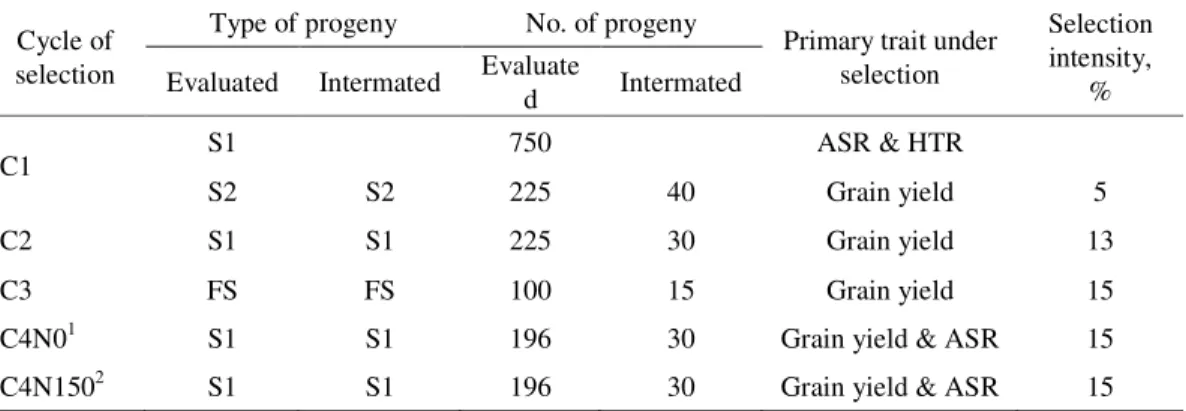
M3S maize population underwent four cycles of recurrent selection for grain yield. In addition, in the first cycle of selection resistances to ASR as well as resistance to Helminhosporium turcicum Pass and in the fourth cycle of selection resistance to ASR were also assessed (Table 1).
In the second and third cycle of selection artificial infection was not performed, but general criteria was to select the highest yielding healthy plants. Details of the experimental procedures used in population synthesis and in the four cycles of selection have been described earlier (ŠAR EVI et al., 2004; SABLJOet al., 2008; and BUKAN et al., 2011). BUKANet al. (2011) found a significant increase in grain yield after four cycles of RS in the M3S population as well as indication of specific adaptation of C4N0 to the nitrogen deficient environments. The aim of the present study was to (1) evaluate the effect of four cycles of selection in the M3S maize population on ASR and FSR resistance and (2) to investigate the correlation among the different disease rating methods.
Table 1. Selection protocols for the four cycles of selection conducted in the M3S maize population
Cycle of selection
Type of progeny No. of progeny
Primary trait under selection
Selection intensity,
% Evaluated Intermated Evaluated Intermated
C1 S1 750 ASR & HTR
S2 S2 225 40 Grain yield 5
C2 S1 S1 225 30 Grain yield 13
C3 FS FS 100 15 Grain yield 15
C4N01 S1 S1 196 30 Grain yield & ASR 15
C4N1502 S1 S1 196 30 Grain yield & ASR 15
ASR-antrachnse stalk rot resistance, HTR- resistance to Helminthosporium turcicum 1 Selection performed with 0 kg N ha-1 fertilization
2 Selection performed with 150 kg N ha-1 fertilization
MATERIALS AND METHODS
locations in north-west Croatia, Zagreb and Rugvica, respectively. Both experiments included six M3S cycle populations (C0, C1, C2, C3, C4N0 and C4N150) per se and their six test-crosses with hybrid A619 x A632 as a tester. The experimental design was a RCBD with four replications. The experimental plot consisted of four 4 m long rows with 20 plants per row. Spacing was 0.7 m between and 0.2 m within rows.
At the location Zagreb resistance to ASR was evaluated after artificial inoculation of all plants in a plot. The plants were inoculated using pistol grip syringe by delivering 1ml of C. graminicola inoculum, dissolved in ddH2O to a concentration of 1.5 x 10⁶ spores ml-1,into the
first elongated internode 7±1 days after 50% silking. First evaluation of resistance to ASR was performed according to WHITE et al. (1979). Seven weeks after infection we simultaneously counted the number of infected internodes (ASR1) and the number of internodes rotten more than 75% (ASR2). Second evaluation of resistance to ASR was performed before harvesting (ASR3). From stalks of 10 normally developed plants of the right outside row leaves were peeled off and, the most severe colored stalk internode was rated using the scale from 1 (healthy) to 9 (completely black) according to BREKALO (1991).
At the location Rugvica resistance to FSR was evaluated after artificial inoculation of plants in the first left middle row of each experimental plot. The plants were inoculated using pistol grip syringe by delivering 1 ml of inoculum of Fusarium graminearum Schwabe in the concentration of about 5x10⁴ conidia ml-1 into the first elongated internode 7±1 days after 50% silking. First evaluation of resistance to FSR (FSR1) was performed seven weeks after inoculation on the inoculated row only. Stalks of inoculated plants were longitudinally cut in halve with a knife and resistance was evaluated using the scale from 1 (healthy) to 6 (death of plant), according to Hooker (CHRISTENSEN and WILCOXSON, 1966). Second evaluation of FSR
resistance (FSR2), was performed on the right non infected middle row at harvesting, using the scale from 1 (healthy) to 9 (death of plant) (PALAVERŠI , 1983).
Experimental data were analyzed using the GLM procedure for populations per se and for test cross populations separately. The differences among the populations were determined using the Bonferroni-Dunn multiple comparison test at P<0.05. Among all the resistance ratings, for populations per se and their testcrosses separately, Pearson correlation coefficients were calculated. Statistical analyzes were performed in SAS Release 9.00 (SAS Institute Inc., 2002).
RESULTS
Table 2. ASR and FSR ratings of cycle populations per se
Table 3. ASR and FSR ratings of cycle population test-crosses
Among the six population test-crosses (Table 3), differences were observed only in resistance to FSR under conditions of artificial inoculation (FSR1). The observed differences were inconsistent with the cycles of selection, but generally, lower values of FSR rates were observed in populations of advanced selection cycles (C3 and C4), than in the C0 or C1.
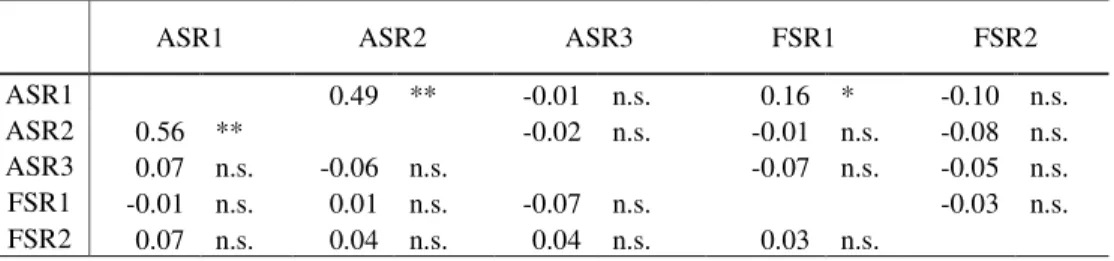
Between the number of ASR infected internodes (ASR1) and the number of ASR infected internodes rotten more than 75% (ASR2) moderate and positive correlation coefficients (Table 4) were determined for populations per se (r=0.49**) and their test-crosses (r=0.56**). Significant, although weak correlation was observed among the number of ASR infected internodes (ASR1) and the resistance to FSR under conditions of artificial inoculation (FSR1) (r=0.16*) for populations per se. Among the other disease resistance ratings and for both population types correlations were nonsignificant.
Cycle population ASR1 ASR2 ASR3 FSR1 FSR2
C0 4.15 b 1.97 a 2.75 a 2.89 b 2.12 ab C1 2.97 a 2.02 a 2.05 a 2.38 ab 2.94 b C2 3.42 ab 1.95 a 2.62 a 2.76 ab 1.97 ab C3 3.52 ab 2.18 a 2.75 a 2.26 ab 2.12 ab C4N0 3.60 ab 1.67 a 1.93 a 2.22 ab 1.87 ab C4N150 3.69 b 1.96 a 2.42 a 2.06 a 1.42 a ASR1- number of internodes infected with ASR, ASR2- number of ASR infected internodes rotten more than 75%, ASR3- rate of ASR stalk discoloration, FSR1- resistance to FSR under conditions of artificial infection, FSR2- resistance to FSR under conditions of natural infection; *Means followed by the same letter are not statistically different according to a Bonferroni-Dunn multiple comparison test (P<0.05).
Cycle population ASR1 ASR2 ASR3 FSR1 FSR2
C0TC 3.63 a1 1.95 a 3.05 a 2.06 ab 1.57 a
C1TC 3.32 a 1.68 a 2.83 a 2.37 b 1.51 a
C2TC 3.73 a 1.83 a 2.98 a 2.14 ab 1.72 a
C3TC 3.65 a 1.76 a 2.70 a 1.58 a 1.54 a
C4N0TC 3.53 a 1.83 a 2.35 a 1.74 a 1.76 a
C4N150TC 3.57 a 1.43 a 3.10 a 1.80 ab 2.05 a
ASR1- number of internodes infected with ASR, ASR2- number of ASR infected internodes rotten more than 75%, ASR3- rate of ASR stalk discoloration, FSR1- resistance to FSR under conditions of artificial infection, FSR2- resistance to FSR under conditions of natural infection; 1Means followed by the same letter are not statistically
Table 4. Correlation coefficients among the ASR and FSR ratings for cycle populations per se (above) and testcrosses (below diagonal)
ASR1 ASR2 ASR3 FSR1 FSR2
ASR1 0.49 ** -0.01 n.s. 0.16 * -0.10 n.s.
ASR2 0.56 ** -0.02 n.s. -0.01 n.s. -0.08 n.s.
ASR3 0.07 n.s. -0.06 n.s. -0.07 n.s. -0.05 n.s.
FSR1 -0.01 n.s. 0.01 n.s. -0.07 n.s. -0.03 n.s.
FSR2 0.07 n.s. 0.04 n.s. 0.04 n.s. 0.03 n.s.
** - significant at P<0.01; * - significant at P<0.05; n.s. – not significant
DISCUSSION
The results of the present study showed that in the population per se the level of resistance to ASR remained at the level of the base population, C0. In the case of FSR resistance an increasing trend from the first to the fourth cycle of selection was observed. Among the six M3S population test-crosses differences in resistance to both diseases were not significant, except for resistance to FSR under conditions of artificial inoculation, where an increasing trend with cycles of selection was observed. Using the same tester BUKANet al. (2011) concluded that M3S population after four cycles of RS maintained good combining ability for grain yield to both BSSS and LSC. Similar conclusion seems to be valid for the resistance of the M3S population to the FSR and ASR.
For simultaneous improvement of grain yield and resistance to pests or diseases several adjustments of RS methods were proposed (HALLAUER, 1992; WEYHRICHet al., 1998; CARENA
and HALLAUER, 2001; BUHINI EK et al., 2005). HALLAUER (1992) proposed a two stage (S1-S2)
RS method as appropriate for simultaneous improvement of disease resistance and grain yield. This approach was used in the first cycle of RS in the M3S population and resulted with C1 population, which had lower values of anthracnose stalk rot grades (ASR1) as compared to the base population (C0). However, at the same time two stage selection had negative effect on grain yield, which was lower in C1 as compared to other cycle populations (BUKANet al., 2011). In the second and third selection cycle, artificial inoculation was not performed and selection was for performed for improvement of grain yield only. In the fourth cycle of selection, artificial inoculation with C. graminicola was performed at one out of three selection trials, and the % of rotten and lodged plants was considered in selecting parents for the next cycle of selection. Two populations of the fourth cycle, C4N0 and C4N150, showed further increase of grain yield (BUKANet al., 2011) with maintained resistance to ASR as it was shown in the present study. Maintained resistance to FSR across cycles of selection in the M3S population can be considered as a correlated response to selection for ASR resistance since inoculation with Fusariumspp. was not performed during selection trials.
In the present study a moderate positive correlation was found only between two ASR resistance ratings (the number of infected internodes and the number of internodes rotten more than 75%) in both population per se (r=0.49**) and population test-crosses (r=0.56**).
observed under conditions of artificial infection. Relationship between the disease ratings might therefore be influenced not only by genetic control of the resistance but also by the material under study.
MILES et al. (1980) considered the possibility of simultaneous improvement of yield potential and disease resistance, and stated that selection for resistance to one disease should effect at least some improvement in resistance to others. The same authors pointed out that selection for disease resistance with artificial inoculation could be practiced for two to three cycles to produce disease resistant populations for subsequent yield selection and at the same time the frequency of favorable alleles for yield should not change if adequate effective population size was maintained. The conclusion of LAMBERT and WHITE (1997) also supports the
concept that selection for increased resistance to multiple leaf blights and stalk rots in maize can enhance the level of resistance to several diseases simultaneously and make populations more useful for inbred development. The applied RS methods for simultaneous improvement of grain yield and disease resistance in the M3S population resulted in significant improvement of grain yield (BUKAN et al., 2011) while preserving resistance to stalk rot diseases. Although in the present study no correlation was observed among ASR and FSR ratings, selection favoring ASR resistance resulted in improved cycle populations with satisfying level of resistance to both diseases.
ACKNOWLEDGEMENT
Financial support for this study was provided by the Croatian Ministry of Science, Education, and Sports research grant No. 178-1780691-0690.
. Received July 09h, 2013
Accepted October 05th, 2013
REFERENCES
BREKALO, J. (1991): Colletotrichum graminicola (Ces) G.W. Wilson kao uzro nik truleži stabljike kukuruza (Zea mays L.). Magistarski rad, Sveu ilište u Zagrebu, Fakultet poljoprivrednih znanosti.
BUHINI EK, I., B. PALAVERŠI , A. VRAGOLOVI , D. ŠIMI , H. ŠAR EVI , V. KOZUMPLIK (2005): Improvement of stalk rot resistance and grain yield in the maize synthetic FAO SYNFR1B by recurrent selection. Cereal Research Communications, 33, 517-524.
BUKAN, M., H. ŠAR EVI , J. GUNJA A, I. BUHINI EK, B. PALAVERŠI , A. SABLJO, A. JAMBROVI , R.S. LEWIS, V. KOZUMPLIK (2011): Evaluation of nitrogen use efficiency in the Maksimir 3 Synthetic maize population. Maydica, 56, 67-75.
CARENA, M.J., A.R. HALLAUER (2001): Response to inbred progeny selection in Leaming and Midland Yellow Dent maize populations. Maydica, 46, 1-10.
CHRISTENSEN, J.J., R.D. WILCOXON (1966): Stalk rot of corn. Monograph No. 3. Am. Phythopathological Soc. St. Paul Minn.
GROMBACHER A.W., W.A. RUSSELL, W.D. GUTHRIE (1989): Effects of recurrent selection in two maize synthetics on agronomic traits of S1 lines. Maydica 34, 343-352.
HALLAUER, A.R. (1992): Recurrent selection in maize. Plant Breeding Review. 9, 115-179.
LEDEN AN, T. (2002): OMaize lins and hybrids resistence to Fusarium stem rot. PhD thesis, University Josipa Jurja Štrosmajera in Osijek, Faculty of agriculture. (in Croatian: Doktorski rad, Sveu ilište Josipa Jurja Štrosmajera u Osijeku, Agronomski fakultet).
MILES, J.W., J.W. DUDLEY, D.G. WHITE, R.J. LAMBERT (1980): Improving corn population for grain yield and resistance to leaf blight and stalk rot. Crop Science. 20, 247-251.
NYHUS, K.A., W.A. RUSSELL, W.D. GUTHRIE (1989): Changes in agronomic traits associated with recurrent selection in two synthetics. Crop Science. 29, 269-275.
PALAVERŠI B., M. JUKI , I. BUHINI EK, A. VRAGOLOVI , Z. KOZI (2009): Breeding maize for resistance to stalk anthracnose. Maydica, 54, 229-232.
SABLJO A., H. ŠAR EVI , B. PALAVERŠI , I. BUHINI EK, V. KOZUMPLIK, M. BUKAN, J. GUNJA A, J. BELJO, S. TOMASOVI , I. IKI (2008): Improvement of grain yield and Fusarium stalk rot resistance in the M3S maize population by recurrent selection. Cereal Research Communications, 36: Suppl. C, 159-160.
SAS 9.00 (2002): SAS Institute Inc., Cary, NC, USA.
ŠAR EVI H., I. PEJI , M. BARI , V. KOZUMPLIK (2004): Performance and Inbreeding depression of an exotic maize population under selfed recurrent selection. Die Bodenkultur, 55, 21-24.
WEYHRICH, R.A., K.R. LAMKEY, A.R. HALLAUER (1998): Responses to seven methods of recurrent selection in the BS11 maize population. Crop Science, 38, 308-321.
OTPORNOST MAKSIMIR 3 SINTETIK POPULACIJE KUKURUZA NA TRULEŽ STABLJIKE NAKON ETIRI CIKLUSA REKURNTNE SELEKCIJE
Miroslav BUKAN1, Hrvoje ŠAR EVI 1, Ivica BUHINI EK2, Branko PALAVERŠI 2,
Ramsey S. LEWIS3, Vinko KOZUMPLIK1
1Sveu ilište u Zagrebu, Agronomski fakultet, Zagreb, Hrvatska; 2Bc Institut za Oplemenjivanje i proizvodnju bilja d.d., Rugvica, Hrvatska
3Zavod za Biljne znanosti, Državno Sveu ilište Sjeverne Karoline, Raleigh, NC 27695, SAD
Izvod
Fuzarijska (FSR) i antraknozna (ASR) trulež stabljike, uzrokovana gljivama iz roda Fusarium spp. i Colletotrichum graminicola (Ces.) G.W. Wils., su dvije najvažnije bolesti stabljike kukuruza. Bolesti uzrokuju poljeganje stabljike kukuruza i pad prinosa. Ciljevi ovog rada bili su (1) ocijeniti u inak etiri ciklusa rekurentne selekcije na otpornost sinteti ke populacije kukuruza Maksimir 3 sintetik (M3S) na FSR i ASR te, (2) ispitati korelacijsku povezanost izme u razli itih ocjena otpornosti na ove bolesti. Poljski pokus inilo je šest M3S ciklus populacija per se i njihovi test križanci sa jednostrukim hibridom kao testerom. Otpornost na ASR ocijenjena je u uvjetima umjetne infekcije pomo u tri ocjene otpornosti (brojem inficiranih internodija stabljike, brojem internodija trulih više od 75% i ocjenom vanjskog obojenja stabljike). Otpornost na FSR ocijenjena je u uvjetima prirodne i umjetne infekcije, ocjenom oboljenja na uzdužno razrezanim stabljikama pomo u standardnih skala otpornosti. Rezultati istraživanja pokazali su da etiri ciklusa rekurentne selekcije, provedene prvenstveno za pove anje prinosa, nisu negativno utjecala na otpornost M3S populacije na obje bolesti stabljike kukuruza. Izme u ocjena otpornosti umjerena pozitivna korelacija na ena je jedino izme u dviju ocjena otpornosti na ASR (broja zaraženih internodija i broja internodija trulih više od 75%) i kod populacija per se (r=0.49**) i populacijskih test križanaca (r=0.56**).
Primljeno 09. VII 2013.