BIOINFORMATICS
UDC 618.36 + 547.436
Mathematical modeling of folate-related processes
in human placenta
V. A. Dotsenko, M. Yu. Obolenskaya
Institute of Molecular Biology and Genetics, NAS of Ukraine 150, Akademika Zabolotnoho Str., Kyiv, Ukraine, 03680 [email protected]
Aim. Description the folate-related processes in the human placenta using the stoichiometric model and investi-gation the system’s behavior under various conditions.Methods. The model is based on the stoichiometry of the reactions of the folate-related processes at steady state conditions and constructed using CellNetAnalyzer. Beha-vior of the system is described by elementary flux modes and control-effective fluxes depending on the activity of methylenetetrahydrofolate reductase and methionine synthase and input methionine flux.Results. Change in me-thylenetetrahydrofolate reductase activity causes a decrease in fluxes through the main routes of homocysteine elimination and increases the need for 5-methyltetrahydrofolate. Methionine synthase inactivation reduces 5-me-thyltetrahydrofolate consumption and increases the flux through the taurine syn-thesis. Lack of methionine leads to increased 5-methyltetrahydrofolate consumption, reduced homocysteine concentration and reduces the fluxes through the methionine cycle.Conclusions. Analysis of model functioning has shown the compliance of system’s functioning changes with the clinic parameters. There is evidence that the homocysteine level as a marker of fo-late-related processes functioning of is not sufficient to justify the therapy.
Keywords: folate-related processes, stoichiometric model, elementary flux mode, control-effective fluxes.
Introduction. The problem of pregnancy failure is the issue of utmost significance. For instance, according to some data the frequency of complications in Ukraine is up to 60 % or even 90 % [1]. The threatened miscarria-ge is a complication of about 40 % of pregnancies, the early termination of pregnancy is remarkable for 20–25 %, and the preeclampsia is present in 10 % of pregnancies [2]. The pathogenesis of a number of obstetric complica-tions is yet to be defined in details, and the contribution of a genetic component into their development is insuffici-ently described in many cases. At present, barrenness and miscarriage are considered to be the results of a common action of the genetic and environment factors [3].
The research, described in this article, was based on two propositions. According to the first one a vital role in the pathogenesis of diseases is attributed to the pla-cental metabolism [4], as the placenta is not only trans-porting nutrients and metabolism products from the
fe-tus to the mother, but is also actively metabolizing them. The placenta is a final barrier between the mother and the fetus, and placental metabolism disorder is the main factor of many pregnancy failures. According to the se-cond proposition a vital role in the functioning of the placenta cells and the developing cells is attributed to the folate-dependent processes (FDP) [3]. Therefore, wo-men are recomwo-mended to use the folic acid prior to the conception and especially in the first three months of pregnancy in order to prevent any pregnancy complica-tions, in particular, the fetal neural tube defects.
actions, commonly known from the classic chemistry. They are used to build a stoichiometry model, descri-bing the distribution of stationary metabolic fluxes (the metabolic flux is the rate of transformation of metabo-lites) in the metabolic pathway (the metabolic pathway is the sequence of chemical transformations of a certain substance) in different conditions, but it does not take into consideration the regulation, implemented in it.
The term «folate-dependent processes» is used to determine a group of biochemical reactions, in which the derivatives of folic acid, folates, are cofactors. The center of FDP is formed by two related cycles – folate and methionine cycles [5, 6]. FDPs in liver have been studied the most extensively [7]. The folate cycle is re-presented by the derivatives of the folic acid with diffe-rent degrees of oxidation. The main functions of folates are the transfer of one-carbon units in the biosynthesis reactions of nucleobases and the metabolism of amino acids as well as the transfer of a methyl group into the methionine cycle. All the methylation processes in the cell are related to the transformation of components in the methionine cycle, in particular, these are DNA me-thylation, the synthesis of amino acids – methionine and cysteine, and indirectly – the synthesis of glutathione and taurine. The most active FDPs are in the cytosol, less active ones – in mitochondria and nucleus [8].
A special role in the FDP system is attributed to the enzymes 5,10-methylenetetrahydrofolate reductase (MTHFR, EC 1.5.1.20), methionine synthase (MS, EC 2.1.1.13), as well as the introduction of methionine (Met) into the system. MTHFR – is a NADP-dependent enzy-me, catalyzing the transformation of 5,10-methylene-tetrahydrofolate (5,10-CH2-THF) into
5-methyltetra-hydrofolate (5MTHF). The latter is a donor of the me-thyl group in the reaction of homocysteine (Hcy) methy-lation, resulting in the formation of Met with MS invol-ved. It is known that the decrease in the enzymatic acti-vity of the abovementioned enzymes due to mutations or the deficiency of group B vitamins, which are cofac-tors, as well as considerable fluctuations in the Met in-put lead to the significant disorders in the fetal develop-ment at the early stages of embryogenesis and even to the fetal death [9].
Taking the aforesaid into consideration, this work was aimed at the elaboration of a stoichiometry model of the FDP in human placenta, the simulation of the
de-crease in the activity of the enzymes MTHFR, MS and the Met input and the analysis of the behavior of the sys-tem in these conditions.
Materials and methods. The mathematical descrip-tion and the analysis of metabolic fluxes involved the Flux Balance Analysis (FBA) which is based on the as-sumption of the balance of metabolites and the linear programming.
The elaboration of the stoichiometry model and the conducted calculations included the following stages:
The mathematical description of folate-dependent processes. The mat hematical model of the process, com-posed ofnreactions, is a system of differential equations
dS dt
n describing the dynamics of the metabolite
concent-ration (S). FBA is used for systems in a steady state,
whendS
dt
n =0.
Therefore, the system of differential equations trans-forms into the system of algebraic equations, which may be presented in the form of a matrix [10].
The elaboration of a stoichiometry matrix based on the system of algebraic equations. The stoichiometry matrix is the matrixm×q, where each elementnij is a
stoi-chiometric coefficient, related to the metaboliteiin the reactionjwith the corresponding sign: a negative sign for the metabolite consumption, a positive sign – for its formation;q– reactions (matrix columns);m– metabo-lites (matrix rows) [11]. The matrix was created in Cell NetAnalyser software 6.2.
The calculation of control-effective fluxes. The signi-ficance of each reaction for the efficient and flexible work of the whole metabolic system was determined using the control-effective fluxes (CEF) via this reaction in diffe-rent EFM [12]. The analysis started with the assignment
of the efficiency value to each EFM(ej, CELLOBJ).
ej CELLOBJ CELLOBJ j
i j i
r
r
, = ,
å
where rCELLOBJj is the objective function of the system;
rij
i
å
– the sum of participation coefficients of eachre-action in a certain EFM;j– EFM index;i– the index of a flux via a specific reaction in a given EFM [13].
Then CEF (ui) was defined for a certain reaction (rj
i
) as an average flux via this reaction in all EFM, where the flux in each mode is balanced relative to its efficiency [13].
u
e
e
i
CELLOBJ
j j CELLOBJ i j
j j CELLOBJ CELLOBJ r
r
=
å
å
å
max1, ,
,
where rCELLOBJmax is the maximal participation coefficient in EFM for reactions, involved in the objective func-tions of the cell;
å
j ej CELLOBJ rij, is the sum of the
products of participation coefficients for a certain reaction for all EFM and the corresponding calculated values of efficiency;
å
j e j CELLOBJ, is the total value of efficiency of all the modes.To determine the behavior of the whole metabolic system in the conditions of deficiency of any enzyme, the participation coefficients for reactions in EFM, in-volving a deficiency enzyme, were multiplied by the constantdj, which reflects the degree of the enzyme
in-activation and takes the value from 1 to 0. The efficien-cy values of these modes were also multiplied by dj.
The code for calculations was written in WolframMa-tematica software 7.0. The example of calculations is presented in Addendum 1.
Results and discussion. The first attempts to create a stoichiometry model of the FDP metabolic network for placenta on the basis of general data and the specifi-cities of the relative genes expression in human placen-ta [14] were made in the work [15]. In this work the sche-me of the sche-metabolic network was extended, in
particu-lar, we added the reactions of transformation of the glu-tamic acid as well as the reactions of input and output of metabolites [16] (Fig. 1).
The stoichiometry model is composed of 42 reac-tions, including the following: 4 reactions of the methio-nine cycle, 9 reactions of the tetrahydrofolate cycle, 2 transsulfuration reactions, 2 reactions of the glutathione synthesis, 3 reactions of the taurine synthesis, 2 reactions of the glutamic acid transformation and 20 reactions of the input and output of metabolites (Addendum 2).
Elementary flux modes. Fifty-three EFMs were calculated and isolated for FDP model in the cytosol of placental cells (Addendum 3). All the modes are irre-versible. Most EFMs involve the participation of the following: the input flux Ser (37 EFM), the enzyme SHMT (33 EFM), the output flux GSH (29 EFM), the reaction of glutathione synthesis (28 EFM). Serine is used in the SHMT and CBS reactions for the synthesis of folates and Hcy transsulfuration. Glutathione is im-portant to maintain the redox status of cells and to deto-xify xenobiotics [17].
Other modes are responsible for the production of taurine, aminoacids (Met, Gly, Ser, Hcy), dTMP, 5MT HF and the methylation processes. There are also seven modes, wherein the metabolites are not synthesized. These are futile cycles, which occur when two metabo-lic pathways run simultaneously in opposite directions, use each other’s products and, as a result, do not have other products, other than energy dissipation in the form of heat and transport of some metabolites through the placenta.
The EFM analysis demonstrates that there are no indispensable enzymes in the created metabolic net-work,i. e. the ones to take part in all the EFMs. This is the evidence to the network flexibility.
CEF for the initial state. Seven most frequent reac-tions in all the EFMs and thus the most significant re-actions for the functioning of the system were selected as the objective functions: Ser_in, SHMT, GSH_out, CBS, MTHFR, DNMT, TS (Addendum 4).
The highest value of the control-effective flux is for the serine input flux Ser_in, which is used in the synthe-sis of cystathionine and is a donor of CH2group in the
5,10-CH2-THF synthesis reactions. The lowest values of
as well as the fluxes of input/output of some metaboli-tes: Hcy_out, Fol_in, Taur_in, Gln_out (Addendum 5).
CEF in the simulation conditions. The mutations of the MTHFR gene have been studied the most extensi-vely. Almost 50 % of the Caucasian population in Eu-rope have the polymorphism of MTHFR gene in posi-tion 677 [18]. The homozygotes of T677T retain only 30 % of the activity, whereas the heterozygotes retain 65 % relative to the wild type [19]. MTHFR is the only enzyme, capable of synthesizing 5MTHF, which is the donor of the methyl group for the methionine cycle, the-refore even its partial inactivation has a considerable effect on the work of the whole network. The decrease in the activity of MTHFR affects not only 5MTHF syn-thesis and Hcy remethylation, but also the glutathione
synthesis and methylation processes. Fig. 2 presents the dependence of CEF change on the inactivation de-gree for this enzyme.
In Fig. 2 it is evident that the 0.5 inactivation degree of the enzyme is a «breaking point, prior to which the network is still attempting to «cope with» the increased number of Hcy, gradually increasing the fluxes via the reactions of its elimination – the reactions of synthesis and removal of Cys and Taur, and the fluxes of 5MTHF input for the Hcy remethylation processes. The reduc-tion of fluxes via the reacreduc-tions of the methionine cycle is gradual. In case of the MTHFR inactivation over 0.5, the Hcy output flux, the 5MTHF input flux, the synthe-sis reaction fluxes (CDO, SADC, HTD), and the remo-val of Cys and Taur reach the plateau. Therewith the
DHF THF
5,10-CH2-THF 5mTHF
10f-THF 5,10-CH=THF
Met
Hcy
SAM
Cyst
Cys Ser
Gly
TS
DHFR
SHMT
MTHFR
MTD MTCH
FTS
AICART
PGT
MS
MAT II
SAHH DNMT
CBS
CTGL Met in
5mTHF out
AICAR Pur
GAR dUMP
dTMP
Glut-Cys
GCL
Glu
GSH GS
Gly
SulfAla
CDO SADC hTaurHTD Taur
Cys out
GSH out Taur out
Gln GLS NH3
Glu in Gln out
Taur in
Met out Hcy out THF in
Cys in Hcy in
Gly out Ser in
Ser in
5mTHF in GSH in Gln in Glu out
Mo
th
er
F
etu
s
P
lacen
ta
SAH
fluxes via the reactions of the methionine cycle and Met input are reduced as well.
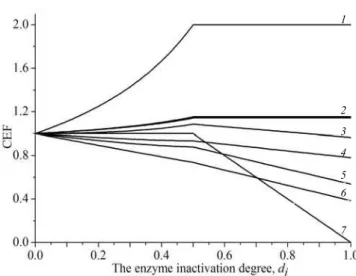
For instance, 30 % activity of MTHFR (677TT ge-notype, 0.7 inactivation degree) leads to the reduction of the flux via the reactions of the methionine cycle by 20 %, via MS – by 40 %, the reduction of the Met input flux by 7 % with the increase in the flux of output Hcy and input 5MTHF by 100 % and the output fluxes of Cys and Taur – by 14 %. This correlation of fluxes in the placental tissue facilitates the Hcy accumulation. The change in MTHFR activity does not reflect on the CEF of folate cycle fluxes – FTS, MTCH, MTD, DHFR.
The results of calculations are in agreement with the scientific literature data. In the clinical practice the carriage of MTHFR mutant forms in human placenta prevails in case of a complicated pregnancy and is rela-ted to the reduction in Hcy remethylation in favor of the synthesis of nucleotides [20–22]. The simulation results demonstrate that the presence of MTHFR mutant forms leads to a considerable reduction in the flux via the re-action, catalyzed by MS, due to the reduction in 5MTHF production. The decreased intake of the folic acid and group B vitamins (coenzymes for MS and CBS) with food may lead to the failure of the compensation proces-ses and the development of homocysteinemia.
Therefore, it was the first simulated behavior of all the FDP reactions in conditions of reduced MTHFR ac-tivity which promoted a better understanding of the lo-gics of the system functioning. The MS-catalyzed reac-tions as well as the Hcy output and the 5MTHFR input demonstrated the highest sensitivity to the change in the MTHFR activity. The reduction of the flux via the Hcy remethylation reaction and the disproportional increase in the transsulfuration promote the Hcy accumulation in the system.
Another vital enzyme in the FDP network is the vita-min B12-dependent MS. There are over 13 mutations of
theMSgene [23], which, depending on their localiza-tion, may lead to the decrease in the enzyme activity. Three metabolic pathways cross in MS: the exchange of folates, vitamin B12 and sulfur-containing
amino-acids. Therefore the decreased activity of this enzyme will result in the decreased or completely absent syn-thesis of methylcobalamin (one of the vitamin B12forms),
hyperhomocysteinemia and hypomethioninemia [24]. Fig. 3 presents the dependence of CEF change on the inactivation degree of the enzyme. According to the obtained data, the MS deficiency leads to a sharp decli-ne in the 5MTHF flux, coming from outside. There is also a sharp reduction in the 5MTHF production in the
1
2
3
4 5
6
Fig. 2. The change of control-effective fluxes (CEF) depending on the inactivation degree of MTHFR enzyme:1– Hcy input flux, 5MTHF output flux;2– Taur, Cys output flux, CDO, SADC, HTD;3– Met in-put flux;4– the methionine cycle reactions;5– MS;6– THF input flux and Met, 5MTHF output flux.Y-axis contains CEF, scaled to the same index with a completely functional enzyme;X-axis reads as follows: 0 – a completely functional enzyme; 1 – complete inactivation of the en-zyme. The change of CEF was introduced in the figure for the most relevant reactions
1
2
3
4
5
6
7
MTHFR-catalyzed reaction. The flux via the methioni-ne cycle decreases. The flux via the reactions of trans-sulfuration and the taurine synthesis increases by 15 %. There is a significant, up to two-fold increase in the flux of output Hcy.
Therefore, the increase in the output Hcy flux and an insufficient increase in the fluxes via the main ways of its utilization will result in its accumulation in the system.
In this case the increased consumption of folates will not result in the normalization of the Hcy level in the plasma, as MS is the only enzyme, capable of metaboli-zing 5MTHF. The relevance of the normal work of the methionine cycle, MS in particular, for the fetal deve-lopment is proven by the data of Swansonet al., accor-ding to which the homozygous MS-deficient mice had high embryonic mortality, regardless of the high content of folates in the diet, whereas the heterozygotes had the increased Hcy level [25].
As for humans, the defects inMSgene lead to me-thylcobalamin deficiency G (cblG) [MIM:250940], al-so known as homocystinuriamegaloblastic anemia, G complementation type [26]. Less apparent MS activity deficiency may be associated with moderate hyperho-mocysteinemia, be a risk factor for the fetal neural tube
defects [27] and other pathologies of the cardiovascular and nervous systems.
Due to the relevance of the MS enzyme for the Hcy utilization, it is reasonable to prescribe vitamin B12to
pregnant women as it is the cofactor for MS [28]. The diets with poor Met level also affect the redistri-bution of fluxes in the FDP system (Fig. 4). There is a sharply growing need of 5MTHF, but the flux via the MS reaction is increasing insignificantly (up to 5%) and the activity of the methionine cycle processes is decreased not much (< 10 %). The Hcy level remains stable for still some time. The increase in the Met defi-ciency (less than a half of the initial state) leads to the decrease in the fluxes via the methionine cycle reac-tions, the transsulfuration reactions and the output Hcy flux is also greatly decreased.
The low Met concentration in the plasma will pro-mote the prevalent Hcy remethylation [29]. The trials in-volving volunteers demonstrated contradicting results: both increased Hcy concentration in people who fol-lowed a vegetarian diet or a diet with decreased Met consumption [30, 31] and the absence of this dependen-ce [29]. The vegetarians had the increased content of folates in the plasma along with the low content of vitamin B12, which may lead to MS deficiency and the
increase in the Hcy concentration [30].
Conclusions. The elaborated stoichiometry model of FDPs in human placenta has been applied for the analysis of the system behavior in conditions of the de-creased activity of MTHFR and MS as well as the input of Met into the system. The model utilizes the literature data and may be used to investigate the FDP network functioning and to predict its behavior in previously un-studied situations.
It has been demonstrated that the decrease in the MTHFR activity triggers the imbalance in the FDP net-work in human placenta, increases the 5MTHF consum-ption and promotes the Hcy accumulation. The results demonstrate that the reduction of fluxes via the main pathways of Hcy elimination (MS, the methionine cyc-le reactions, the reactions of cysteine and taurine syn-thesis) leads to its accumulation in the system. In addi-tion, we have shown the effect of the decreased MTHFR activity on the processes of transsulfuration and Taur synthesis as well as the connection between MTHFR and MS – the decrease in the activity of one of them
1
2
3
4
5
leads to the reduction of flux via the other, the deficien-cy of both promotes the accumulation of homodeficien-cysteine.
The MS inactivation also has a considerable effect on the redistribution of fluxes in the network, especi-ally on the pool of the folic acid, thus decreasing the 5MTHF consumption by the network and promoting the Hcy accumulation. Likewise the decrease in the MS activity affects directly related processes and also in-creases the synthesis and removal of Taur – an amino acid, required for the fetal development.
The insufficient consumption of Met leads to the in-crease in the 5MTHF consumption, the dein-crease in the Hcy content and the reduction of fluxes via the methio-nine cycle. The simulation results demonstrate relevant consequences of the Met consumption, which is half as large as the initial one.
The stoichiometry model has proven to be a conve-nient instrument in the research on how the change of different parts of the system affects the whole system. The simulation allows tracing the change of all the sys-tem components and their interrelations as well as esti-mating the change of which fluxes leads to the final re-sults (the increase in the content of Hcy, Cys, Taur, the decrease in the content of folates), which are observed in the clinical practice. This fact testifies to the possibili-ty of using this model to predict changes in the FDP system with different rates of the system com-ponents. The consideration of the content of folates, methionine and group B vitamins as a prerequisite of the functional activity of enzymes, and not merely the Hcy level as the main marker of FDP functioning, is required for the pur-poses of prescribing any well-grounded therapy.
Ìàòeìàòè÷íå ìîäåëþâàííÿ ôîëàò-çàëåæíèõ ïðîöåñ³â ó ïëàöåíò³ ëþäèíè
Â. À. Äîöåíêî, Ì. Þ. Îáîëåíñüêà Ðåçþìå
Ìåòà. Îïèñàòè ôîëàò-çàëåæí³ ïðîöåñè â ïëàöåíò³ ëþäèíè çà äî-ïîìîãîþ ñòåõ³îìåòðè÷íî¿ ìîäåë³ ³ äîñë³äèòè ïîâåä³íêó ñèñòåìè çà ð³çíèõ óìîâ.Ìåòîäè. Ìîäåëü ñòâîðåíî íà îñíîâ³ ñòåõ³îìåò𳿠ðåàêö³é ôîëàò-çàëåæíèõ ïðîöåñ³â, ùî ïåðåáóâàþòü ó ñòàö³îíàð-íîìó ñòàí³, ç âèêîðèñòàííÿì ïðîãðàìè CellNetAnalyzer. Ïîâåä³í-êó ñèñòåìè îõàðàêòåðèçîâàíî ÷åðåç åëåìåíòàðí³ ìîäè ³ êîåô³ö³ºí-òè êîíòðîëþ çà ïîòîêàìè çàëåæíî â³ä àêêîåô³ö³ºí-òèâíîñò³ ìåêîåô³ö³ºí-òèëåíòåò- ìåòèëåíòåò-ðàã³äðîôîëàò-ðåäóêòàçè ³ ìåò³îí³íñèíòàçè ³ íàäõîäæåííÿ ìå-ò³îí³íó.Ðåçóëüòàòè. Çì³íà àêòèâíîñò³ ìåòèëåíòåòðàã³äðîôî-ëàò-ðåäóêòàçè ñïðè÷èíÿº çíèæåííÿ ïîòîê³â ÷åðåç îñíîâí³ øëÿõè åë³ì³íàö³¿ ãîìîöèñòå¿íó òà çá³ëüøåííÿ ïîòðåáè ó
5-ìåòèëòåòðà-ã³äðîôîëàò³. ²íàêòèâàö³ÿ ìåò³îí³íñèíòàçè çìåíøóº ñïîæèâàííÿ 5-ìåòèëòåòðàã³äðîôîëàòó ³ çá³ëüøóº ïîòîêè ÷åðåç ðåàêö³¿ ñèí-òåçó òàóðèíó. Áðàê ìåò³îí³íó ïðèçâîäèòü äî çðîñòàííÿ ñïîæè-âàííÿ 5-ìåòèëòåòðàã³äðîôîëàòó, çìåíøåííÿ âì³ñòó ãîìîöèñòå¿-íó òà çíèæåííÿ ïîòîê³â ÷åðåç ðåàêö³¿ ìåò³îí³íîâîãî öèêëó. Âèñ-íîâêè. Àíàë³ç ôóíêö³îíóâàííÿ ìîäåë³ âèÿâèâ â³äïîâ³äí³ñòü çì³í ó ôóíêö³îíóâàíí³ ñèñòåìè êë³í³÷íèì ïîêàçíèêàì. Àëå º ñâ³äîöòâà òîãî, ùî ð³âåíü ãîìîöèñòå¿íó ÿê ìàðêåðà ôóíêö³îíóâàííÿ ôîëàò-çàëåæíèõ ïðîöåñ³â º íåäîñòàòí³ì äëÿ ïðèçíà÷åííÿ îáãðóíòîâà-íî¿ òåðàﳿ.
Êëþ÷îâ³ ñëîâà: ôîëàò-çàëåæí³ ïðîöåñè, ñòåõ³îìåòðè÷íà ìî-äåëü, åëåìåíòàðíà ìîäà, êîåô³ö³ºíòè êîíòðîëþ çà ïîòîêàìè.
Ìàòeìàòè÷åñêîå ìîäåëèðîâàíèå ôîëàò-çàâèñèìûõ ïðîöåññîâ â ïëàöåíòå ÷åëîâåêà
Â. À. Äîöåíêî, Ì. Þ. Îáîëåíñêàÿ Ðåçþìå
Öåëü. Îïèñàòü ôîëàò-çàâèñèìûå ïðîöåññû â ïëàöåíòå ÷åëîâåêà ñ ïîìîùüþ ñòåõèîìåòðè÷åñêîé ìîäåëè è èññëåäîâàòü ïîâåäåíèå ñèñòåìû â ðàçëè÷íûõ óñëîâèÿõ.Ìåòîäû. Ìîäåëü ñîçäàíà íà îñíî-âå ñòåõèîìåòðèè ðåàêöèé ôîëàò-çàâèñèìûõ ïðîöåññîâ, íàõîäÿ-ùèõñÿ â ñòàöèîíàðíîì ñîñòîÿíèè, ñ èñïîëüçîâàíèåì ïðîãðàììû CellNetAnalyzer. Ïîâåäåíèå ñèñòåìû îõàðàêòåðèçîâàíî ñ ïðèìå-íåíèåì ýëåìåíòàðíûõ ìîä è êîýôôèöèåíòîâ êîíòðîëÿ çà ïîòîêà-ìè â çàâèñèìîñòè îò àêòèâíîñòè ìåòèëåíòåòðàãèäðîôî-ëàò-ðåäóêòàçû è ìåòèîíèíñèíòàçû è ïîñòóïëåíèÿ ìåòèîíèíà. Ðå-çóëüòàòû. Èçìåíåíèå àêòèâíîñòè ìåòèëåíòåòðàãèäðîôîëàò-ðå-äóêòàçû âûçûâàåò ñíèæåíèå ïîòîêîâ ÷åðåç îñíîâíûå ïóòè ýëè-ìèíàöèè ãîìîöèñòåèíà è óâåëè÷èâàåò ïîòðåáíîñòü â 5-ìåòèë-òåòðàãèäðîôîëàòå. Èíàêòèâàöèÿ ìåòèîíèíñèíòàçû óìåíüøàåò ïîòðåáëåíèå 5-ìåòèëòåòðàãèäðîôîëàòà è óâåëè÷èâàåò ïîòîêè ÷åðåç ðåàêöèè ñèíòåçà òàóðèíà. Íåäîñòàòîê ìåòèîíèíà ïðèâî-äèò ê ðîñòó ïîòðåáëåíèÿ 5-ìåòèëòåòðàãèäðîôîëàòà, óìåíüøå-íèþ ñîäåðæàíèÿ ãîìîöèñòåèíà è ñíèæåóìåíüøå-íèþ ïîòîêîâ ÷åðåç ðåàê-öèè ìåòèîíèíîâîãî öèêëà.Âûâîäû. Àíàëèç ôóíêöèîíèðîâàíèÿ ìî-äåëè âûÿâèë ñîîòâåòñòâèå èçìåíåíèé â ôóíêöèîíèðîâàíèè ñèñ-òåìû êëèíè÷åñêèì ïîêàçàòåëÿì. Íî åñòü ñâèäåòåëüñòâà òîãî, ÷òî óðîâåíü ãîìîöèñòåèíà êàê ìàðêåðà ôóíêöèîíèðîâàíèÿ ôîëàò-çàâèñèìûõ ïðîöåññîâ ÿâëÿåòñÿ íåäîñòàòî÷íûì äëÿ íàçíà÷åíèÿ îáîñíîâàííîé òåðàïèè.
Êëþ÷åâûå ñëîâà: ôîëàò-çàâèñèìûå ïðîöåññû, ñòåõèîìåòðè-÷åñêàÿ ìîäåëü, ýëåìåíòàðíàÿ ìîäà, êîýôôèöèåíò êîíòðîëÿ çà ïîòîêàìè.
REFERENCES
1.Mykytenko DO, Tymchenko OI. Prevalence of polymorphism of methylentetrahydropholatreductase gene among parturients of Kiev region.Medical Perspectives. 2009.14(3):100–104. 2.Tymchenko OI, Lynchak OV, Mykytenko DO, Pol’ka OO,
Poka-nevych TM. Nervous system congenital pathology: the preva-lence of nervous tube defects and possibilities of folic acid in pre-vention of its development.J. Pediatrics, Obstetrics and Gyne-cology. 2010;72(1):18–24.
3.Kalhan SC, Marczewski SE. Methionine, homocysteine, one carbon metabolism and fetal growth.Rev Endocr Metab Disord. 2012;13(2):109–19.
5.Nijhout HF, Reed MC, Budu P, Ulrich CM.A mathematical model of the folate cycle: new insights into folate homeostasis.J Biol Chem. 2004;279(53):55008–16.
6.Ulrich CM, Neuhouser M, Liu AY, Boynton A, Gregory JF 3rd, Shane B, James SJ, Reed MC, Nijhout HF. Mathematical mode-ling of folate metabolism: predicted effects of genetic polymor-phisms on mechanisms and biomarkers relevant to carcinoge-nesis.Cancer Epidemiol Biomarkers Prev. 2008;17(7):1822–31. 7.Finkelstein JD, Martin JJ, Harris BJ.Methionine metabolism in mammals. The methionine-sparing effect of cystine. J Biol Chem. 1988;263(24):11750–4.
8.Tibbetts AS, Appling DR. Compartmentalization of Mammalian folate-mediated one-carbon metabolism.Annu Rev Nutr. 2010; 30:57–81.
9.Engel SM, Olshan AF, Siega-Riz AM, Savitz DA, Chanock SJ. Polymorphisms in folate metabolizing genes and risk for spon-taneous preterm and small-for-gestational age birth.Am J Obstet Gynecol. 2006;195(5):1231.e1–11.
10.Schuster S, Fell DA, Dandekar T.A general definition of meta-bolic pathways useful for systematic organization and analysis of complex metabolic networks.Nat Biotechnol. 2000;18(3): 326–32.
11.Gagneur J, Klamt S. Computation of elementary modes: a unify-ing framework and the new binary approach.BMC Bioinforma-tics. 2004;5:175.
12.Cakir T, Tacer CS, Ulgen KO. Metabolic pathway analysis of en-zyme-deficient human red blood cells. Biosystems. 2004;78 (1–3):49–67.
13.Stelling J, Klamt S, Bettenbrock K, Schuster S, Gilles ED. Me-tabolic network structure determines key aspects of functiona-lity and regulation.Nature. 2002;420(6912):190–3.
14. Obolenskaya MYu, Rodriges RR, Martsenyuk OP. Folate-re-lated processes in human placenta: gene expression, aminothiols, proliferation and apoptosis.Ukr Biokhim Zh. 2011.83(1): 5–17. 15.Rodriguez RR, Lushchyk IS, Obolenska MYu. Stoichiometric mo-del of folate-dependent metabolism of one-carbon units in hu-man placenta.Ukr Biokhim Zh. 2012;84(4): 20–31.
16.Battaglia FC, Regnault TR.Placental transport and metabolism of amino acids.Placenta. 2001;22(2–3): 145–61.
17.Sastre J, Pallardo FV, Vina J.Glutathione.The Handbook of En-vironmental Chemistry. Springer, 2005; Vol. 20: 91–108. 18.Gasparovic J, Raslova K, Basistova Z, Zacharova M, Wsolova
L, Avdicova M, Blazicek P, Lietava J, Sivakova D. Effect of C677T methylenetetrahydrofolate reductase gene polymorphism on plasma homocysteine levels in ethnic groups.Physiol Res. 2004; 53(2):215–8.
19.Frosst P, Blom HJ, Milos R, Goyette P, Sheppard CA, Matthews RG, Boers GJ, den Heijer M, Kluijtmans LA, van den Heuvel LP, Rozen R.A candidate genetic risk factor for vascular disea-se: a common mutation in methylenetetrahydrofolate reductase. Nat Genet.1995;10(1): 111–3.
20.Martseniuk OP, Mishlanova Sh, Romanets’ KL, Tepliuk NM, Obolens’ka MYu. The level of low molecular thiols and folate in human placenta.Ukr Biokhim Zh. 2009;81(4): 94–104. 21. Bailey LB, Gregory JF 3rd. Polymorphisms of
methylene-tetrahydrofolate reductase and other enzymes: metabolic signifi-cance, risks and impact on folate requirement.J Nutr.1999;129 (5):919–22.
22.Mislanova C, Martsenyuk O, Huppertz B, Obolenskaya M. Pla-cental markers of folate-related metabolism in preeclampsia. Reproduction. 2011;142(3):467–76.
23.Watkins D, Ru M, Hwang HY, Kim CD, Murray A, Philip NS, Kim W, Legakis H, Wai T, Hilton JF, Ge B, Dore C, Hosack A, Wilson A, Gravel RA, Shane B, Hudson TJ, Rosenblatt DS. Hyperhomo-cysteinemia due to methionine synthase deficiency, cblG: structu-re of theMTRgene, genotype diversity, and recognition of a com-mon mutation, P1173L.Am J Hum Genet. 2002;71(1):143–53. 24.Rosenblatt D, Fenton W. The metabolic and molecular bases of
inherited disease. New York: McGraw-Hill, 2001; 3933 p. 25.Swanson DA, Liu ML, Baker PJ, Garrett L, Stitzel M, Wu J,
Harris M, Banerjee R, Shane B, Brody LC. Targeted disruption of the methionine synthase gene in mice.Mol Cell Biol. 2001; 21(4):1058–65.
26.Gulati S, Baker P, Li YN, Fowler B, Kruger W, Brody LC, Baner-jee R. Defects in human methionine synthase in cblG patients. Hum Mol Genet. 1996;5(12):1859–65.
27.O’Leary VB, Mills JL, Pangilinan F, Kirke PN, Cox C, Conley M, Weiler A, Peng K, Shane B, Scott JM, Parle-McDermott A, Mol-loy AM, Brody LC; Members of the Birth Defects Research Group. Analysis of methionine synthase reductase polymorphisms for neural tube defects risk association.Mol Genet Metab. 2005;85 (3):220–7.
28.Mykytenko DO, Tymchenko OI, Mykytenko OP. Association of methlylentetrahydrofolate reductase polymorphisms with patho-logy of pregnant and fetus at the kyiv region.Collection of sci-entific works of staff members of NMAPE named after P. L. Shupyk. 2009;18(4): 21–31.
29.Huang YC, Chang SJ, Chiu YT, Chang HH, Cheng CH. The sta-tus of plasma homocysteine and related B-vitamins in healthy young vegetarians and nonvegetarians.Eur J Nutr. 2003;42(2): 84–90.
30.Hung CJ, Huang PC, Lu SC, Li YH, Huang HB, Lin BF, Chang SJ, Chou HF. Plasma homocysteine levels in Taiwanese vegeta-rians are higher than those of omnivores.J Nutr. 2002;132(2): 152–8.
31.Mann NJ, Li D, Sinclair AJ, Dudman NP, Guo XW, Elsworth GR, Wilson AK, Kelly FD.The effect of diet on plasma homocystei-ne concentrations in healthy male subjects.Eur J Clin Nutr.1999; 53(11):895–9.