Abstract— Disaster like terrorist attack, earthquake, and hurricane, often affect a high number of people. In this case, hospitals must be able to receive injured persons for medical and surgical treatments. A disaster situation is characterized by different disruptions which perturb largely the execution of the established plans. In hospital and more precisely in operating theatres, the decision-makers have to manage these disruptions in time. In this setting, we propose a reactive approach in order to optimize the operating rooms scheduling taking into account disruptions. In this paper we focus on the insertion of unexpected new victim in the pre-established operating schedule. So, we develop an algorithm consists of several integer linear programs. Empirical study shows that a substantial aid is obtained by using the proposed approach in case of disaster.
Index Terms— Integer programming, Disaster response, Disruptions, Reactive schedule.
I. INTRODUCTION
According to the International Federation of Red Cross and Red Crescent Societies, a disaster is defined as an exceptional event which suddenly kills or injures a large number of people. The Centre of Research on the Epidemiology of Disasters in Brussels, Belgium, uses the following definition: “A disaster is a situation or event which overwhelms local capacity, necessitating a request to a national or international level for external assistance”. In fact, in such situation, the need for medical and surgical treatments overwhelms hospitals’ capabilities. For that reason, different countries impose that their hospitals have plans for emergency preparation and disaster preparedness. For example, in the USA, the Joint Commission on the Accreditation of Healthcare Organizations requires US hospitals to have a disaster management plan (DMP). In other countries, like in France and in Tunisia, state requirements or laws impose each hospital to have a disaster plan so called white plan [13] [14]. In case of a disaster, this plan is sets in motion (response phase) [11].
Hospital has to treat all victims in time. However, in such situation, disruptions can take place, perturbing so the execution of the established plans [16]. The challenge of the operating rooms scheduling in a disaster situation is to take
Manuscript received March 1, 2010. This work was supported by the Nord Pas-de-Calais region, the European Regional Development Fund (ERDF) and The European Doctoral College.
I. Nouaouri, J-C. Nicolas and D. Jolly are with Univ Lille Nord deFrance, F-59000 Lille, France, UArtois, LGI2A, F-62400Béthune, France (phone: +33-0321637112; fax: +33-0321611780; e-mail:
[email protected], [email protected],
into account disruptions which occur during scheduling time horizon. In fact, some unexpected victims can arrive to the admitting hospital at any time without being even spent by the advanced medical point (example: AZF disaster in Toulouse, France [15]). Furthermore, state of victims can deteriorate or improve, thus reducing or lengthening the latest start date of their surgical care. These unforeseen events disrupt the established scheduling and need to be considered in a reactive way.
In this paper, we handle only the arrival of a new victim to the hospital.
Some studies published in the literature address emergency problems in hospitals in normal working times. Most of them focus on operating theaters [6] [10] [12] [19] which are considered as a bottleneck in the hospital system.
These last years, some works were interested in disaster situations [5] [8] [9] [17] [18]. The optimization of operating theatres has become an important issue. However, all these works do not consider operating schedule in a reactive way.
Several works treating emergency problem, using reactive approach [6] [7], are inspired from studies achieved on reactive problems in industrial application. Such as (1) the insertion of one or several jobs [20] [22], in the pre-established planning, and (2) the scheduling of activities with uncertain length [1] [23].
Our problem is considered as a flow-shop problem already treated in industrial context [2] [3].
Decision-makers have to be able to react quickly and efficiently in order to take into account a new victim who needs surgical treatments. In this paper, we deal with reactive operating schedule in case of a disaster. Our purpose here is to insert a new victim in the operating schedule. To achieve this, we propose a several-stage model in order to minimize disruption effect caused by the arrival of unexpected victim.
In the rest of this paper we first describe the reactive schedule we address. In Section 3 and 4 we present the proposed approach and the problem modelling. In section 5 we discuss implementation and evaluation issues, while in Section 6 we present our conclusions and possible extensions of this work.
II. PROBLEM DESCRIPTION
In case of a disaster, victims are evacuated to an immediate established pre-hospital triage and dispatching structure which is set up near to the damaged zone. This structure guarantees the first aid emergency cares and routes victims to the available hospitals. The triage allows classifying victims according to the urgency of the medical and/or surgical cares they need.
Reactive Operating Schedule in Case of a
Disaster: Arrival of Unexpected Victims
In this paper, we consider victims that require surgical cares with predefined processing times and different ready dates in the operating theatre. Each victim is characterized by an emergency level which is defined by the latest start date of its surgical care. Therefore, the surgical care must be planned before the vital prognosis of the victim is being overtaken [4] [14]. The extreme emergencies require some immediate emergency cares in the pre-hospital structure. The victims who have first, second and third emergency level, they are evacuated to the nearby admitting hospital. These emergency cases must be treated in the respective delays: 6 hours, 18 hours and 36 hours.
Pre-hospital and triage structure communicates to the hospital via information system [14] [21]; surgical processing time, ready date and emergency level of each victim before its arrival to the hospital.
In hospital, some human and material resources are available. We consider critical resources: surgeons and operating rooms. Surgeons, their number, and ready dates in the operating theatre are detailed in a pre-established emergency planning. Each surgeon is assigned to an operating room. In such situation, all operating rooms are considered to be polyvalent.
Basing on these data, the admitting hospital achieves its predictive program (operating schedule) at t = t0. However,
some disruptions can occur at any moment during the execution of this program.
In reaction to a disturbance at t = tp, hospital must be able to
respond quickly and efficiently, in order to minimize the involved consequences.
In case of a disaster, time of arrival of victims is widely variable and depends on type, location, transport capacities and site organization [11]. Furthermore, some victims may arrive at hospitals at any time without passing by the pre-hospital, triage and dispatching structure [15]. In this context, we handle the scheduling operating rooms problem while taking into account the arriving of new victim requiring surgical cares. So, we propose a reactive approach.
III. PROPOSED APPROACH
We define P0 pre-established operating schedule at t = t0
(the predictive program). At t = tp (date of disruption) a new
victim is announced by the pre-hospital, triage and dispatching structure or, arrives directly to the hospital.
In order to minimize disruption effect on P0, we proceed in
several stages.
The first one, model (P1) is stated as follows: given an
operating schedule (P0), tries to insert the new victim in an
untapped (vacant) range. (P1) has to satisfy some constraints
such as ready dates of surgeons and latest start date of its surgical care. Surgical processing time of the new victim has to be lower or more equal to one untapped range.
If the new victim cannot be inserted by (P1), we compute
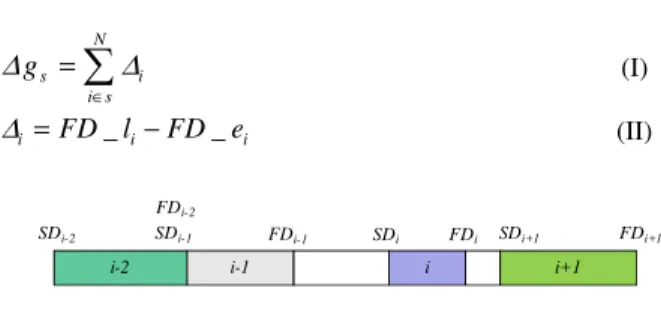
for every operating room s a free margin gs from elementary
margins for each victim i, ∆i.
We define:
N Number of victims;
SDi the start date of surgical care of victim i, FDi the finish date of surgical care of victim i.
N
s i
i s
g ∈
=
∑
∆ ∆ (I)
= −
i FD _ li FD _ ei
∆ (II)
i+1 i-1
i-2 i
SDi-2 SDi-1
FDi-2
FDi-1 SDi FDi SDi+1 FDi+1
Fig.1. Pre-established schedule.
The latest finish date of surgical care of victim i is given by the equation (III).
1
( +)
= +
i i i i
FD _ l min dl d ,SD (III)
The earliest finish date (date as soon as possible) of surgical care of victim i is given by the equation (IV).
1
−
= +
i i i
FD _ e FD d (IV)
If the new victim cannot be inserted by (P1), the model (P2)
tries to reschedule, from disruption date, the victims belonging to the operating room which possesses the biggest gs. Current surgical cares won't be interrupted. If the new
victim has not been inserted, the model (P3) tries to
reschedule, from disruption date, all surgical cares in all operating rooms. If no solution is found (the new victim has not been inserted) the victim will be reoriented to another hospital.
We present in figure 2, the proposed reactive approach in case of insertion of a new victim in the operating schedule.
Start
P1: insert the new victim in an untapped range.
Is the victim inserted?
Calculate for every operating room the free margin ∆gs
P2: Reschedule surgical cares in the operating room who possesses the biggest ∆gs.
Is the victim inserted?
P3: Reschedule surgical cares in all operating rooms
End
Is the victim inserted ? Victim reoriented to another hospital yes
yes
non
no
yes yes
P0: pre-established schedule (t= t0)
Arrtval of a new victim at t= tp
IV. PROBLEM MODELLING
We propose a three-stage mathematical model. For each stage, an integer linear programming model is developed using Cplex 6.1 Studio.
Before presenting our models, we will first introduce the following notations:
S Number of operating rooms;
N Number of victims;
H Number of surgeons; T Time horizon;
i
d Processing time of surgical care of victim i; i
dl Latest start date of surgical care of victim i; i
rv Ready date of victim i; h
rc Ready date of surgeons h with respect to the hospital emergency planning;
M Very big positive number;
We consider in this section, that the number of rooms is equal to the number of surgeons (H=S) and each surgeon is affected to only one operating room.
According to the pre-established schedule, we define: tis the start date of surgical care of the victim i in the
operating rooms s.
yijs = 1 if the surgical care of the victim j follows the
surgical care of the victim i in the same operating room s, 0 otherwise.
tp Disruption date. It is generated in stochastic way. NR Number of victims to insert in the operating schedule. In our case, we consider NR = 1.
Besides, we define the following decision variables: Zkts = 1 if the new victim k is assigned to an operating room s at time t, 0 otherwise.
k
t Start date of surgical care of victim k;
A. Model 1: Insertion of the new victim in an untapped range
In the first stage, we address the optimization problem (P1).
Thus, using the notations listed above, we propose the following integer linear programming:
•The objective function (1) maximizes the number of new victims inserted it in the operating schedule.
∑∑∑
p NR T S
kts k t s
Maximize Z (1)
•Constraints (2) ensure that each victim is treated only once during the horizon T.
1
p T S
kts t s
Z ≤
∑∑
{1 }
k ..NR
∀ ∈ (2)
•Constraints (3) grantee, for every untapped range, one victim is assigned at most at time t.
js is i p
t
kts ijs t t d / t t
Z y
= + ≥
≤
∑
{ }1
s ..S
∀ ∈ ∀ ∈i, j { }1..N ∀ ∈k {1..NR} (3)
•Constraints (4) impose to satisfy the emergency level of each new victim.
(1 ) 0
p p
T S T S k k kts kts
t s t s
t −dl
∑∑
Z −M −∑∑
Z ≤
{1 }
k ..NR
∀ ∈
(4)
•(5) ensures that the duration of surgical care of a new victim is lower or equal to the duration of the untapped range.
( )
p T js ijs is i ijs k kts
t
t y − t +d y ≥d
∑
Z ∀ ∈s { }1..S ∀ ∈i, j { }1..N {1 }k ..NR
∀ ∈
(5)
•(6) and (7) verify that surgical care can be realized only when victim and surgeon are present in the hospital.
(1 )
p T S
k kts k t s
t +M −
∑∑
Z ≥rv
{1 }
k ..NR
∀ ∈ (6)
1 0
p p
T T
k s k t s k t s
t t t t
t r c Z M ( Z )
= =
−
∑
− −∑
≥ ∀ ∈s { }1..S{1 }
k ..NR
∀ ∈
(7)
•(8) ensures that surgical care of the new victim cannot be inserted before disruption date tp.
(1 )
p T S k kts p
t s
t +M −
∑∑
Z ≥t
{1 }
k ..NR
∀ ∈
(8) •Constraints (9) ensure that every victim k is assigned to an untapped range.
p p
T T
is i ijs kts k js ijs kts
t t
( t +d )y
∑
Z ≤ ≤t t y∑
Z ∀ ∈s { }1..S{1 }
k ..NR
∀ ∈ ∀ ∈i, j { }1..N (9)
•Contraints (10) give the start dates of surgical cares.
(1 )
p p
T S T S
k kts kts
t s t s
t =
∑∑
t.Z + −∑∑
Z M
{1 }
k ..NR
∀ ∈
(10)
•Constraints (11) ensure the integrality of the variables.
{ }
0 1kts
Z = ,
{1 }
k ..NR
∀ ∈ ∀ ∈t
{ }
t ..Tp ∀ ∈s { }1..S (11)If the new victim has not been inserted, we go to the model (P2).
B. Model 2: Reschedule surgical cares in the operating room which possesses the biggest free margin gs
Before solving this problem, we have to compute As the date
from which operating room s (surgeon h) is available after tp.
So it is possible to compute the next availability date of operating room possessing the biggest margin. The room s as well as the surgeon h are known.
The mathematical formulation of this combinatorial optimization problem (P2) is given by the following linear 0-1
integer program.
W set of waiting victims (including the new victim) for surgical cares.
The decision variables are defined as follow:
Xits = 1 if the victim i is assigned to an operating room s at time t, 0 otherwise.
i
• The objective function (12) maximizes the number of treated victims in the operating room s after the disruption date tp.
=
∑ ∑
p
W T
its i t t
Maximize X (12)
•Constraints (13) ensure that each victim is treated only once during the horizon T
1
p
T
i t s t t
X
=
≤
∑
∀ ∈i W (13)•Constraints (14) grantee that one victim at most is assigned at date t in the operating room s.
1
W its i
X ≤
∑
{ }
pt t ..T ∀ ∈
(14)
•Constraints (15) impose to satisfy the emergency level of each victim.
1 0
p p
T T
i i i t s i t s
t t t t
t d l X M ( X )
= =
−
∑
− −∑
≤ ∀ ∈i W (15)•(16) and (17) verify that surgical care are realized only when victim and surgeon are present in the hospital.
(1 )
p T
i its i t
t +M −
∑
X ≥rv ∀ ∈i W (16)(1 ) 0
= =
−
∑
− −∑
≥p p
T T
i s i t s i t s
t t t t
t r c X M X ∀ ∈i W
(17)
•Constraints (18) verify the availability of the operating room s after the disruption date.
(1 )
p
T
i s i ts i t s
t
t ≥ A . X − M −
∑
X ∀ ∈i W (18)•Constraints (19a), (19b) and (20) are disjunctive precedence constraints.
1
W
i j s j i
y
≠
≤
∑
∀ ∈i W (19a)1
W
ji s j i
y
≠
≤
∑
∀ ∈i W (19b)1
p
W W W T
j i s i t s
i j i i t t
y X
≠ =
= −
∑ ∑
∑ ∑
(20)•Equations (21) give the start dates of surgical cares.
(1 )
=
∑
+ −∑
p p
T T
i its its
t t
t t .X t .X M ∀ ∈i W (21)
•Constraints (22) impose no overlapping between two successive cares made in same operating room.
(1 )
≥ + − −
j i ijs i ijs
t t y d M y
∀i, j∈W (22) •Constraints (23) and (24) ensure the integrality of the variables.
{ }0 1
its
X = ,
∀ ∈i W
{ }
pt t ..T ∀ ∈
(23)
{ }
0 1ijs
y = ,
i, j W
∀ ∈
(24)
If the new victim has not been inserted, we go to the model (P3).
C. Model 3: Reschedule surgical cares in all operating rooms
The objective function (25) maximizes the number of treated victims in all operating rooms.
=
∑ ∑ ∑
p
W T S
its i t t s
Maximize X (25)
Under the same constraints used for model 2 taking into account all operating rooms.
For example constraints (2) and (3) become (26) and (27):
1
T S
i t s t t p s
X
=
≤
∑ ∑
∀ ∈i W
(26)
1
W its i
X ≤
∑
{ }
pt t ..T ∀ ∈
{ }1
s ..S
∀ ∈
(27)
V. COMPUTATIONAL EXPERIMENTS
In this section, we present the realized computational experiments using the Cplex solver. We run programs on a Cluster composed of 6 workstations Bixeon® of 3.00 GHz processor and 2-4 Go RAM. We evaluate the performances of the proposed reactive models with different scenarios described on the following.
A. Problem tests
When we consider different scenarios, we take into account uncertain events [6].
Different disaster situations are considered by varying the number of victims (N=25, 50 and 70) and the duration of surgical cares (given between 30 minutes and 2 hours). Moreover 10 staffs are available with different ready dates (R = (r1,…rC), C = 10) according to the hospital emergency
Tab. 1. Ready dates of surgical staffs according to hospital emergency planning
For example P70.10.R3 denotes a problem of 70 victims
and 10 staffs which ready dates in minutes (mn) are given by R3, thus rc1 = 0, rc2 = 0, rc3 = 0, rc4 = 30, rc5 = 30, rc6 = 60, rc7
= 60, rc8 = 60, rc9 = 120, rc10 = 120. In this paper we consider
the following instances (table 2).
Tab. 2. Proposed instances
N Instances
25
P25.4.R1
P25.6.R3
P25.6.R5
50
P50.4.R1
P50.6.R3
P50.8.R3
70
P70.4.R1
P70.6.R3
P70.10.R
For each instance, we generate a predictive program P0
(pre-established operating schedule) [16]. We apply for every instance 20 scenarios by inserting a new victim requiring surgical cares in the operating schedule. One scenario is characterized by the ready date, the processing time and the emergency level of the new victim. The computational experiments are performed while fixing the time
horizon
(
)
1
=
= i + i
i ,...,N
T m ax dl d .
Indeed, after this date, no victim can be treated. T is composed of elementary periods.
B. Results
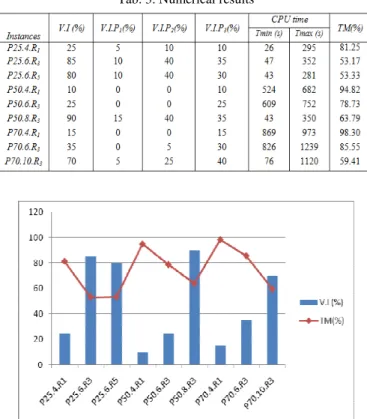
In order to assess the performance of the proposed approach, we compute for each scenario, the rate of insertion of new victims in the operating schedule (V.I (%)).We also compute, the percentage of cases for which disruptions are treated and resolute by the program Pk (V.I.Pk (%)).
=
∑
∑
j
i
Inserted victim j
V .I(%)
New victim i
(V)
=
∑
∑
k j
k
i
New victim j inserted by the model p V .I .P (%)
New victim i
(VI)
Scenarios are generated in a stochastic way. We note Scj the
scenario j.
The results presented in Tables 3 are obtained by solving Model 1 (P1), Model 2 (P2) and Model 3 (P3). We report for
each instance the rate of insertion of new victims in the operating schedule (V.I (%)), the percentage of cases for which disruptions are treated and resolved by the program Pk
(V.I.Pk (%)), the minimum CPU time (Tmin) and the
maximum CPU time (Tmax). For each instance, we compute TM (%) the mean occupancy rate of operating rooms for pre-established operating schedule.
1
=
=
∑
N
i i
max
d TM (%)
C .S
(VII)
Cmax is the Makespan given by the pre-established
operating schedule.
Tab. 3. Numerical results
Fig. 3. Percentage of treated cases per instance
The proposed approach has allowed inserting new victims in 48% of cases. The solution is obtained between 26 seconds (minimum) and 21 minutes (maximum).
Table 3 shows that the rate of insertion of new victims varies according to the rate of the mean occupancy rate of operating rooms for pre-established operating schedule (TM (%)) (example: V.I (%) = 25 for TM (%) =81.25 (P25.4.R1)
beside V.I (%) = 85 for TM (%) =53.17 (P25.6.R3)). In most
cases, new victims are inserted by using rescheduling model ((P2) and (P3)) (example: in case of P70.10.R3, V.I.P2(%) = 25
and V.I.P3(%) =40). In fact, reschedule models give good
results.
Figure 3 shows when the capacity increases (the mean occupancy rate is low) the rate of insertion of new victims is much important.
VI. CONCLUSION
scheduling taking into account disruptions: insertion of a new victim in the established operating schedule. The proposed approach is based on a three-stage integer linear programming model.
The first model tries to insert the new victim in an untapped range. If the victim cannot be inserted, the second model reschedules, from disruption date, the victims belonging to the operating room that possesses the biggest free margin. If the new victim has not been inserted, the third model reschedules all surgical cares in all operating rooms. If no solution is founded the victim will be reoriented to another hospital.
The proposed Heuristic allows hospital to decide in a short time how to take into account a new victim in the operating rooms scheduling, and so to treat a maximum of victims (save the maximum of human life). Another interesting advantage of this approach is that it tries to resolve the problem in three stages in order to minimize disruption effect on operating schedule.
The execution time is relatively long in several cases, which reduces the chance for some victims to be treated in time.
This approach has been tested on different disaster situations with various scenarios. Further research works should focus on decreasing execution time e by improving the proposed approach and dealing with auxiliary services such as hospital beds and analysis laboratory.
ACKNOWLEDGMENT
The authors thank the university group and medical partners of the project ARC-IR (France) as well as professionals of the university hospital Charles Nicole (Tunisia) and the General Direction of the military health (Tunisia). We are particularly grateful to Dr. Mondher Gabouj, Dr. Naoufel Somrani, Dr Henda Chebbi, Pr. Eric Wiel and Dr. Cédric Gozé.
REFERENCES
[1] A. Bonfill, A. Espuna and L. Puigjaner. “Proactive approach to address the uncetainty in short-term scheduling”, Computers and Chemical Engineering,doi:10.1016/j.compche eng. 2007. 08. 014. [2] J. Carlier and E. Neron. “An exact method for solving the
multiprocessor FlowShop”. RAIRO – Recherche Operationnelle, 2000; vol.34, pp.1, 125.
[3] R. Conway, W. Maxwell and L. Miller. “Theory of scheduling”, 1967, AddisonWesley.
[4] M.A. Dhahri. “Organisation des secours médicaux dans les situations d’exception en Tunisie”, 1999, D.E.S.S de médecine d’urgence et de catastrophe, Département d’Anesthésie et de réanimation, Hôpital Militaire de Tunis.
[5] B. Glaa, “Contribution à la conception et l’optimisation d’un système d’aide à la gestion des urgences.” Thèse de doctorat. L’Ecole Centrale de Lille, France, 2008.
[6] S. Hammami, “Aide a la décision dans le pilotage des flux matériels et patients d’un plateau médico-technique”. Thèse de doctorat. Institut National Polytechnique de Grenoble, France, 2004.
[7] S. Hammami, “Comment gérer l’urgence dans les services de soins”. DEA de Génie Industriel, Institut polytechnique de Grenoble, France, 2002.
[8] H. Jia, F. Ordonez, M. M.Dessouky. “Solution approches for facility location of medical supplies for large-scale emergencies”, 2007, vol.52, pp. 257-276.
[9] J. Sheu, “An emergency logistics distribution approach for quick response to urgent relief demand in disasters”. Transportation Research Part E., 2007, vol. 43, pp. 687-709.
[10] P.C. Kuo, R.A Schroeder, S. Mahaffey and R. Bollinger. “Optimization of operating room allocation using linear programming techniques”. The American College of Surgeons, Elsevier, 2003. [11] A. Kimberly, R.N. Cyganik, “Disaster Preparedness in Virginia
Hospital Center-Arlington after Sept 11, 2001”. Disaster Management & Response/Cyganik, Section Editor: Ted Cieslak, MD, 2003, vol. 1, pp.80-86.
[12] M. Lamiri, X. Xie, A. Dolgui and F. Grimaud, “A stochastic model for operating room planning with elective and emergency demand for surgery”. European Journal of Operational Research, 2008, vol.185, pp.1026-1037.
[13] Ministère de la santé publique, “Guide de mise en place d’une stratégie d’accueil dans les hôpitaux en cas d’afflux massif des victimes”, Circulaire 2002/50, 2002, Tunisie.
[14] Ministère de la santé et de la solidarité, “Plan blanc et gestion de crise”. Edition 2006, annexe à la circulaire n°DHOS/ CGR / 2006 / 401. France.
[15] Ministère de la santé, de la famille et des personnes handicapées, France, “Explosion de l’usine AZF de Toulouse le 21 septembre 2001”, Rapport de mission, Enseignements et propositions sur l’organisation de soins, 2002, France.
[16] I. Nouaouri, S. Hajri-Gabouj, N. Dridi, J.Ch. Nicolas, D. Jolly and Dr. M. Gabouj, “Programmation des interventions de stabilisation dans les salles opératoires : cas d’une catastrophe à effet limité”, 7ème Conférence Internationale de MOdélisation et de SIMulation MOSIM’08, Paris, 2008, France.
[17] I. Nouaouri, J.Ch. Nicolas, D. Jolly, S. Hajri-Gabouj, N. Dridi, “La programmation opératoire en situation d’exception avec chirurgiens nomades et interventions multi-actes chirurgicaux”. 4ème Conférence Internationale en Gestion et Ingénierie des Systèmes Hospitaliers GISEH-2008, 2008, Lausanne, Suisse.
[18] I. Nouaouri, J.Ch. Nicolas, D. Jolly, “Scheduling of stabilization surgical cares in case of a disaster”. The IEEE International Conference on Industrial Engineering and Engineering Management (IEEM), 2009, Hong Kong.
[19] B. Roland, J-P. Cordier, J-S. Tancrez, F. Riane, “Recovery beds and blocking in stochastic operating theatres” Conference on Industrial Engineering and Systems Management (IESM), 2009, Montreal, Canada.
[20] J. Sun and D. Xue, “A dynamic reactive scheduling mechanism or responding to changes of production orders and manufacturing resources”. Computers in industry, 2001, vol.46, pp.189-207. [21] S. Hasegawa, K. Sato, S. Matsunuma, M. Miyao and K. Okamoto,
“Multilingual disaster information system: information delivery using graphic text for mobile phones”. AI & Society, 2005, vol.19, Number 3.
[22] S. Tadeuz, Integer programming approach to reactive scheduling in make-to-order manufacturing, Mathematical and Computer Modeling, 2007, vol.46, pp.1373-1387.