www.hydrol-earth-syst-sci.net/20/1103/2016/ doi:10.5194/hess-20-1103-2016
© Author(s) 2016. CC Attribution 3.0 License.
Influence of climate variability on water partitioning and effective
energy and mass transfer in a semi-arid critical zone
Xavier Zapata-Rios1,a, Paul D. Brooks2,1, Peter A. Troch1, Jennifer McIntosh1, and Craig Rasmussen3
1Department of Hydrology and Water Resources, The University of Arizona, Tucson, Arizona, USA 2Department of Geology and Geophysics, University of Utah, Salt Lake City, Utah, USA
3Soil, Water and Environmental Science, The University of Arizona, Tucson, Arizona, USA
aFacultad de Ingeniería en Ciencias Agropecuarias y Ambientales, Universidad Técnica del Norte, Ibarra, Ecuador
Correspondence to:Xavier Zapata-Rios ([email protected])
Received: 25 June 2015 – Published in Hydrol. Earth Syst. Sci. Discuss.: 17 August 2015 Revised: 3 February 2016 – Accepted: 19 February 2016 – Published: 15 March 2016
Abstract.The critical zone (CZ) is the heterogeneous, near-surface layer of the planet that regulates life-sustaining re-sources. Previous research has demonstrated that a quantifi-cation of the influxes of effective energy and mass trans-fer (EEMT) to the CZ can predict its structure and func-tion. In this study, we quantify how climate variability in the last 3 decades (1984–2012) has affected water avail-ability and the temporal trends in EEMT. This study takes place in the 1200 km2 upper Jemez River basin in north-ern New Mexico. The analysis of climate, water avail-ability, and EEMT was based on records from two high-elevation SNOTEL stations, PRISM data, catchment-scale discharge, and satellite-derived net primary productivity (MODIS). Results from this study indicated a decreasing trend in water availability, a reduction in forest productiv-ity (4 g C m−2per 10 mm of reduction in precipitation), and
decreasing EEMT (1.2–1.3 MJ m2decade−1). Although we
do not know the timescales of CZ change, these results suggest an upward migration of CZ/ecosystem structure on the order of 100 m decade−1, and that decadal-scale
differ-ences in EEMT are similar to the differdiffer-ences between con-vergent/hydrologically subsidized and planar/divergent land-scapes, which have been shown to be very different in vege-tation and CZ structure.
1 Introduction
EEMT is a variable that quantifies energy and mass trans-fer to the CZ (Rasmussen et al., 2011). EEMT integrates within a single variable the energy and mass associated with water that percolates into the CZ (Eppt), and reduced carbon
compounds resulting from primary production (Ebio)
(Ras-mussen et al., 2011). It has been demonstrated that other pos-sible energy fluxes to the CZ, such as potential energy from transport of sediments, geochemical potential of chemical weathering, external inputs of dust, heat exchange between soil and atmosphere, and other sources of energy coming from anthropogenic sources, are orders of magnitude smaller (Phillips, 2009; Smil, 1991; Rasmussen et al., 2011; Ras-mussen, 2012). Therefore the two dominant terms embodied in EEMT areEpptandEbio, and only the energy associated with water and carbon is considered in the EEMT quantifi-cation. Energy from both water and net primary productivity is essential for CZ processes altering soil genesis, mineral dissolution, solute chemistry, and weathering rates (among others) (Birkeland, 1974; Neilson, 2003).
Previous research has shown that EEMT can become a tool to predict regolith depth, rate of soil production, and soil properties (Rasmussen et al., 2005, 2011; Pelletier and Rasmussen, 2009a, b; Rasmussen and Tabor, 2007). For instance, strong correlations were found between EEMT, soil carbon, and clay content in soils on igneous parent materials from California and Oregon (Rasmussen et al., 2005). Furthermore, transfer functions were successfully de-termined between EEMT and pedogenic indices, including pedon depth, clay content, and chemical indices of soil alter-ation along an environmental gradient on residual igneous parent material (Rasmussen and Tabor, 2007). EEMT has also been incorporated in geomorphic and pedogenic mod-els on granitic rocks to describe landscape attributes and re-golith thickness (Pelletier and Rasmussen, 2009a, b). Ras-mussen and Tabor (2007) demonstrated that regolith depth on stable low-gradient slopes increased exponentially with increasing EEMT. Similarly, Pelletier et al. (2013) found that high EEMT values are associated with large above-ground biomass, deeper soils, and longer distance to the valley bot-toms across hillslopes in the Santa Catalina Mountains in southern Arizona. More recently, EEMT estimations have been strongly correlated with water transit times, water so-lute concentrations, and dissolution of silicates on a rhyolitic terrain in northern New Mexico (Zapata-Rios et al., 2015a). In these studies, the main constituents of EEMT (Epptand
Ebio)were quantified as an average value, based on climate
records from long-term regional databases as these variables exert first-order controls on photosynthesis and effective pre-cipitation (Rasmussen et al., 2011; Chorover et al., 2011).
It is still uncertain how climate variability influences CZ structure, function, and the timescales of these changes (Chorover et al., 2011; Brooks et al., 2015). Climate vari-ability might directly influence changes in the transfer of mass and energy to the CZ as climate has a direct control on bothEpptandEbio. In the mountains of the southwestern
United States, a large percentage of annual precipitation falls as snow, which is stored during the winter and released as snowmelt during the spring (Clow, 2010). The water from the winter snowpack constitutes the main source of regional wa-ter supplies and the largest component of runoff (Bales et al., 2006; Nayak et al., 2010). The regional snowpack has been documented to be declining in the southwestern US (Mote et al., 2005; Clow, 2010) and alterations to the snowpack are likely to produce changes in vegetation, impact water avail-ability (Bales et al., 2006; Harpold et al., 2012; Trujillo et al., 2012), and influence inputs of EEMT. For instance, sig-nificant increasing trends in air temperature and decreasing trends in winter precipitation in the last decades have been documented in the upper Rio Grande region in northern New Mexico (Harpold et al., 2012).
The objective of this study was to evaluate climate vari-ability and its influence on the temporal changes of water par-titioning and EEMT at the catchment scale in a semi-arid CZ over the last few decades. This investigation took place in the upper part of the JRB in northern New Mexico, a basin dom-inated by a forest cover and limited human infrastructure. Micro-climate variability was studied based on daily records from two SNOTEL stations using records from 1984 through 2012. Water availability and EEMT were estimated during the same time period, based on precipitation and tempera-ture from the Parameter-elevation Regressions on Indepen-dent Slopes Model (PRISM), empirical daily observations of catchment-scale discharge, and satellite-derived net primary productivity (MODIS).
2 Methods 2.1 Study site
The Jemez River is a tributary of the upper reach of the Rio Grande and is located between Jemez and the Sierra Nacimiento mountains in northern New Mexico (Fig. 1a). Its headwaters originate within the 360 km2 Valles Caldera National Preserve which contains 30 % of the total basin surface (Fig. 1b). The upper JRB is located at the southern margin of the Rocky Mountain ecoregion between latitudes 35.6 and 36.1◦
N and longitudes−106.3 and−106.9 W. The basin is characterized by a mean elevation of 2591 m and a gradient in elevation ranging from 1712 to 3435 m. Based on a 10 m digital elevation model, the catchment drains 1218 km2 above the US Geological Survey (USGS) gauge “Jemez River near Jemez” (35.66◦
N and 106.74◦
W; USGS 08324000), located at an elevation of 1712 m. The basin has a predominant south aspect and a mean catchment slope of 13.7◦
Figure 1. (a)Relative location of study area within the northwestern state of New Mexico,(b)upper JRB,∼1200 km2, delimited above the USGS gauge station “Jemez River near Jemez” (USGS 08324000) based on a 10 m digital elevation model (DEM).
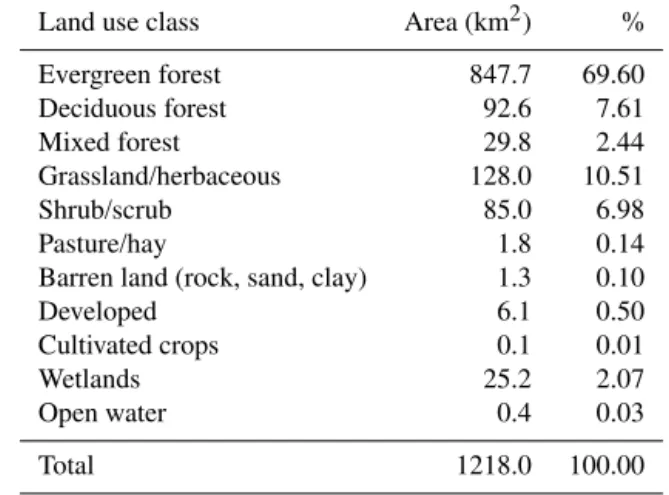
Inceptisols (Allen et al., 1991, 2002). Precipitation has a bi-modal pattern with 50 % of annual precipitation occurring during the winter months (primarily as snow) from October to April and originates from westerly frontal systems. The remaining 50 % of precipitation falls as convectional rain-fall during the monsoon season between July and Septem-ber (Sheppard, 2002). According to the National Land Cover Database (NLCD), the basin is a forested catchment with 79 % under evergreen, deciduous, and mixed forest cover and only 0.5 % of area covered by development and agriculture (http://www.mrlc.gov/nlcd06_leg.php) (Table 1).
2.2 Climatological stations
There are two Natural Resources Conservation Service snow telemetry (SNOTEL) stations within the study area with long-term records since 1980 (http://www.wcc.nrcs.usda. gov/snow/; Fig. 1b). The Quemazon station is located at an elevation of 2896 m (35.92◦
N and 106.39◦
W) and the Señorita Divide no. 2 station is located at an elevation of 2622 m (36.00◦
N and 106.83◦
W). The stations collect real-time precipitation, snow water equivalent (SWE), air temper-ature, soil moisture and tempertemper-ature, and wind speed and di-rection. Air temperature records began at the Señorita Divide no. 2 in 1988 and at the Quemazon station in 1989. There are no stations with long-term records for the lower part of the basin.
Table 1.Land use classification of the JRB area. 79.7 % of the total basin is covered by forest, according to the National Land Cover Database (NLCD; http://www.mrlc.gov/nlcd06_leg.php).
Land use class Area (km2) %
Evergreen forest 847.7 69.60
Deciduous forest 92.6 7.61
Mixed forest 29.8 2.44
Grassland/herbaceous 128.0 10.51
Shrub/scrub 85.0 6.98
Pasture/hay 1.8 0.14
Barren land (rock, sand, clay) 1.3 0.10
Developed 6.1 0.50
Cultivated crops 0.1 0.01
Wetlands 25.2 2.07
Open water 0.4 0.03
Total 1218.0 100.00
2.3 Climate variability
Climate variability was studied based on 13 variables from the two SNOTEL stations, derived from daily air tempera-ture, precipitation, and maximum SWE, following a similar methodology and data processing procedure as in Harpold et al. (2012). The variables analyzed were winter, summer, and annual air temperature (◦
(water year day); last day snow cover (water year day); length of snow on the ground (number of days); and SM50, which is the day of the year in which half of the snowpack melts (number of days). Climate records for data analysis were ag-gregated by water year (from 1 October to 30 September). Winter season was considered to be between October and April and summer season between May and September. The analysis of climate was conducted from 1984 as a starting year to avoid the anomalous wet years recorded at the begin-ning of 1980s that were caused by the Pacific Decadal Os-cillation (PDO) and El Niño–Southern OsOs-cillation (ENSO) (Harpold et al., 2012; and references therein). The presence of a monotonic increasing or decreasing trend in the 13 cli-mate variables recorded at the two individual stations was evaluated from 1984 through 2012 by applying the nonpara-metric Mann–Kendall test (MKT) with a α=0.10 level of significance and the nonparametric Sen’s slope estimator of a linear trend (Yue et al., 2012; Sen, 1968).
2.4 EEMT estimation
Energy from both water and net primary productivity are essential on CZ processes altering soil genesis, mineral dissolution, solute chemistry, and weathering rates (among others) (Birkeland, 1974; Neilson, 2003; Anderson et al., 2007). In this investigation EEMT was calculated as the sum of Eppt and Ebio (Eq. 1). We applied two different
methods to estimate Eppt and Ebio. Following a similar methodology described in Rasmussen and Gallo (2013), the term EEMTempwas empirically estimated at the
catch-ment scale based on baseflow estimations and average basin-scale net primary productivity (NPP) derived from MODIS satellite data. In comparison, EEMTmodel was
es-timated at the catchment scale based on long-term cli-mate records from PRISM, developed by the clicli-mate group at Oregon State University (http://www.wcc.nrcs.usda.gov/ ftpref/support/climate/prism/) and described in Rasmussen et al. (2005, 2011). PRISM is a weighted regression tech-nique that accounts for physiographic factors affecting cli-mate variables, and it has been extensively used in the US (Daly et al., 1994, 2002). The assumption of this study is that the 800 m PRISM data will provide a reasonable spatial estimation of basin-scale precipitation.
EEMT=Eppt+Ebio
J m−2s−1
(1) 2.4.1 EEMTemp
Upper JRB precipitation and air temperature from 1984 through 2012 was obtained using PRISM data at an 800 m spatial resolution (Daly et al., 1994, 2002). Daily discharge data were available from 1984 through 2012 from the USGS Jemez River near Jemez gauge station (http://waterdata.usgs. gov/nwis). The upper Jemez River has not been subjected to flow regulation, and almost 60 % of the annual discharge oc-curs during the snowmelt period between March and May.
Daily discharge records were normalized by catchment area, and mean daily discharge was aggregated into water years.
Precipitation (P) on the land surface was partitioned be-tween quickflow (S) and catchment wetting (W). S repre-sents water that directly contributes to streamflow discharge as a response to precipitation events; thus this amount of wa-ter is not transferred to the CZ.Wis the total amount of water that infiltrates the soil, of which a portion is available for va-porization (V) including vegetation uptake. The remaining portion ofW flows though the CZ and contributes to base-flow (U).V was estimated at the annual scale as the differ-ence betweenPand discharge (Q).Qwas separated between
SandUusing a one-parameter low-pass filter (Lyne and Hol-lick, 1979; Arnold and Allen, 1999; Eckhardt, 2005; Troch et al., 2009) (Eq. 2).
Uk=aUk−1+
1−a
2 (Qk−Qk−1) (2)
Uk≤Qk,
wherea is a filter parameter set to 0.925. This filter was passed twice, backward and forward in time, to improve the partitioning ofU andS at the beginning of the time series. After this, daily values ofQ,U, andSwere integrated to an-nual timescales. Alterations in snowmelt timing were eval-uated with Q50, which indicates the day of the water year
when 50 % of the total annual discharge is recorded at the catchment outlet (Clow, 2010; Stewart et al., 2004).
The term Eppt_emp (energy input through precipitation) was calculated as stated in Eq. (3) based on estimations ofU
and mean PRISM-derived air temperature at the catchment scale (Rasmussen et al., 2011; Rasmussen and Gallo, 2013).
Eppt=U·Cw·1T (J m−2s−1) (3)
In Eq. (3),Cwis the specific heat of water (4187 J kg−1K−1)
and 1T is the difference in temperature between am-bient temperature and 0◦
C, calculated as Tambient−Tref
(273.15◦
K).
Net primary productivity
Mean annual NPP at the catchment scale was estimated at a 1 km spatial resolution for the years 2000–2012 using data MOD17A3 from MODIS (Zhao and Running, 2010) (http: //modis-land.gsfc.nasa.gov/npp.html).Ebiowas calculated as
indicated in Eq. (4) and presented in Rasmussen et al. (2011) and Rasmussen and Gallo (2013).
Ebio=NPP·hbio
J m−2s−1, (4)
wherehbio is the specific biomass enthalpy and equivalent
to 22 kJ m−2s−1 (Lieth, 1975; Phillips, 2009). As MODIS
Table 2.Site and meteorological information for the SNOTEL Quemazon and Señorita Divide no. 2 stations located at high elevations in the upper part of the JRB.
Mean air Mean
temperature (◦C) precipitation (mm)
Station Station Elevation Latitude Longitude Active Year1 Winter2 Year1 Winter2 Max
ID name (m) (◦N) (◦W) since SWE (mm)
708 Quemazon 2896 35.92 −106.39 1980 3.98 −0.87 700.78 347.45 242.53
744 Senorita Divide no. 2 2622 36.00 −106.83 1980 4.23 −0.90 685.98 422.87 239.20
Note: The analysis of precipitation since water year (WY) 1984.1Water Year: 1 October–30 September;2Winter: 1 October–31 March. Temperature data availability since 1989 for the Quemazon and 1988 for the Senorita Divide no. 2 station
Ebio_emprecords back to 1984. Using a similar approach as
Rasmussen and Tabor (2007), linear regressions were used between Ebio_emp and climate variables from the SNOTEL
stations and the entire basin.
2.5 EEMTmodel
Eppt_model was calculated based on estimations of effective
precipitation (Peff) which is defined as the amount of
wa-ter that enwa-ters the CZ in excess of evapotranspiration and is available to flow through the CZ (Rasmussen et al., 2005; Eq. 5).
Eppt_model(i)=Peff(i)·Cw·1T , (5) where Peff(i) is the monthly effective precipitation calcu-lated as the difference between monthly PRISM precipitation and monthly potential evapotranspiration, calculated using the Thornthwaite equation (Rasmussen et al., 2005; Thorn-thwaite, 1948). Peff, calculated as the difference between
monthly precipitation and potential evapotranspiration, has been traditionally used in soil water balances (Arkley, 1963).
Cw and1T are the same parameters described in Eq. (3). Eppt(i)model was calculated on a monthly basis only for the months when precipitation is larger than evapotranspiration (Peff(i)>0), and these values were integrated in water years. Ebio_model was estimated as indicated in Eq. (4), and NPP
was calculated following an empirical relationship based on air temperature (Eq. 6; Lieth, 1975).
NPP(i)= 3000
1+e1.315−0.119Ta · days(i)
365daysyear (6)
NPP(i) is the monthly NPP in g m−2yr−1, and Ta is the
monthly air temperature. Days(i)over the number of days in a year is an NPP time correction. Similar to Eq. (5),Ebio_model
was calculated only for the months where Peff(i)>0. For a detailed description of EEMT, see Rasmussen et al. (2005, 2011, 2015), Rasmussen and Tabor (2007), and Rasmussen and Gallo (2013).
The EEMTmodel quantification presented in Chorover et
al. (2011) has a relative mean prediction error of∼25 % rel-ative to the predicted value. However, we are using mean
trends in EEMT at this catchment-scale study, so we believe that even though the EEMT calculation may have errors, the mean trends presented in this investigation are close to the true values.
2.6 Water availability, water partitioning, and climate controls on water availability
A trend analysis was conducted using data from 1984 through 2012 on each component of the water partitioning analysis (P,Q, U, S, V, W, Q50), and EEMT using the nonparametric MKT and the Sen’s slope estimator of a lin-ear trend with aα=0.10 level of significance (Yue et al., 2012; Sen, 1968). Relationships between climate, hydrologi-cal variables, and EEMT were examined by simple and mul-tiple linear regression analysis with parameters fit through a least-square iterative process (Haan, 1997).
3 Results
3.1 Climate variability
Records from the Quemazon SNOTEL station from 1984 to 2012 indicated a mean annual precipitation of 701 mm, of which 50 % fell during the winter months with a mean max-imum SWE of 242.5 mm. The mean annual and winter tem-peratures at this site were 3.98 and−0.87◦
C, respectively. During the same time period, Señorita Divide no. 2 station had a mean annual precipitation of 686 mm, of which 61 % fell during the winter, with a mean maximum SWE recorded of 239.2 mm. The mean annual and winter temperatures at the Señorita Divide no. 2 site were 4.23 and−0.90◦C,
re-spectively (Table 2).
During the 3 decades of analysis, 7 out of the 13 climate variables in both stations showed a statistically significant trend (Table 3). Mean winter, summer, and annual air tem-peratures at the Quemazon station increased significantly by 1.3◦
C (p <0.001), 1.0◦
C (p <0.01) and 1.4◦
C decade−1
(p <0.001), respectively. Similarly, the same variables at the Señorita Divide no. 2 station increased 1.0◦
C (p <0.05), 1.0◦
C (p <0.01), and 1.2◦
respec-Table 3.Climatic time series trends for the Quemazon and Señorita Divide no. 2 SNOTEL stations from 1984–2012. A trend in the precip-itation time series was evaluated with the MKT and Sen’s slope estimator. Trends were considered statistically significant atp≤ 0.1. The results showed an increasing trend in winter, summer, and annual temperature in the two stations. Annual and winter precipitation, maximum SWE, and 1 April SWE decreased in both stations during the 29 years analyzed. The last day of snow cover decreases significantly only at the Quemazon station. No significant trend was observed for the SWE : winter P ratio, duration of snowmelt SM50, and length of snow on the ground.
Quemazon Señorita Divide no. 2
Variable QSen’s slope Siga QSen’s slope Siga
estimator estimator
Winter temp. 0.13 ∗∗∗∗ 0.10 ∗∗
Summer temp. 0.10 ∗∗∗ 0.10 ∗∗∗
Annual temp. 0.14 ∗∗∗∗ 0.12 ∗∗∗∗
Annual precip. (mm) −6.98 ∗∗∗ −7.32 ∗∗
Winter precip. (mm) −4.16 * −5.94 ∗∗
Max SWE (mm) −3.31 ∗ −3.47 ∗
SWE : winterP ratio −0.005 −0.002
1 April SWE −6.05 ∗∗ −5.44 ∗
Max SWE (day) −0.57 ∗∗ −0.33
SM50 (days) −0.02 0.12
First day snow cover (day) −0.50 0.17
Last day snow cover (day) −0.65 ∗∗ −0.31
Snow on ground (days) −0.12 −0.60
aStatistical significance;∗P <0.1;∗∗P <0.05;∗∗∗P <0.01;∗∗∗∗P <0.001.
tively. The rates of increase in winter and annual air tem-peratures were larger in Quemazon, which was the higher elevation station. Annual precipitation decreased in both sta-tions at similar rates per decade. Quemazon station annual precipitation decreased 69.8 mm decade−1 (p ≤ 0.01) and
Señorita Divide no. 2 decreased 73.2 mm decade−1 (p ≤
0.05). Winter precipitation decreased faster at the Señorita Divide no. 2, the lower elevation station (59.4 mm decade−1; p ≤ 0.05) than at the Quemazon station (41.6 mm decade−1; p ≤ 0.1). Maximum SWE decreased in both stations at similar rates, −34.7 mm decade−1 at Señorita Divide no.
2 and −33.1 mm decade−1 at the Quemazon station (p ≤
0.1). There was no significant trend in the ratio between SWE to winter precipitation at either station. Observed 1 April SWE also decreased −60.5 mm decade−1 (p ≤
0.05) and−54.4 mm decade−1(p ≤ 0.1) at the Quemazon
and Señorita Divide no. 2 stations, respectively. The day of occurrence of maximum SWE recorded at the Quemazon station showed a significant trend, indicating that maximum SWE is occurring 5.7 days earlier every decade (p ≤ 0.05). However, this same trend was not observed at the Señorita Divide no. 2 station. Variables such as SM50, initiation of snow cover, and snow cover duration did not indicate any trend of change in either station at the 90 % confidence level. In contrast, there is a decreasing trend in the last day of snow cover, which is happening about 6 days sooner per decade in the Quemazon station (p <0.05). Last day of snow cover at the Señorita Divide no. 2 station did not show a significant trend (Table 3).
4 Water partitioning
Mean precipitation in the JRB from 1984 to 2012 was 617 mm, with observed extreme values of 845 mm in 1985 and 336 mm in 2002. During the analysis period, winter precipitation represented 54 % of total annual precipitation. Mean annual precipitation at the catchment scale correlated significantly with the mean annual precipitation recorded at the Quemazon (R2=0.45;p <0.0001) and Señorita Divide no. 2 stations (R2=0.73; p <0.0001). In this same time-frame average, minimum and maximum basin-scale temper-atures were 6.1, −1.5, and 13.6◦
C, respectively. In gen-eral, January was the coldest and July was the warmest month. Basscale mean annual and winter temperatures in-dicated a statistically significant increasing trend of 0.5 and 0.4◦C decade−1 (not shown). Mean annual temperature in
the JRB significantly correlated with the mean annual tem-perature recorded at the Quemazon (R2=0.29;p <0.006) and Señorita Divide no. 2 stations (R2=0.67;p <0.0001) (not shown).
Mean river basin discharge during the study period was 0.15 mm day−1, and the maximum and minimum historical
streamflow discharges were 2.97 and 0.008 mm day−1,
re-spectively. In the 29 years of daily discharge records, 90 % of the time discharge surpassed 0.03 mm day−1and 10 % of
the time exceeded 0.38 mm day−1. Peak discharge occurred
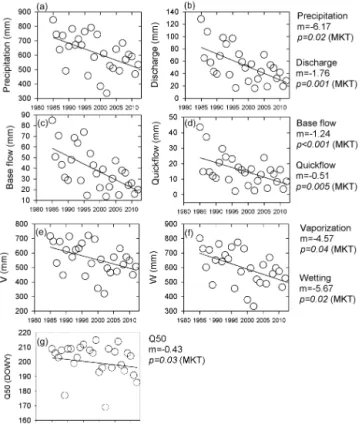
Figure 2.Precipitation and water partitioning at the upper Jemez River catchment scale. There was a significant decreasing trend quantified by the Mann–Kendall test (MKT) in the JRB precip-itation and all the components of the water partitioning. For in-stance, precipitation at the catchment scale decreased during the last 3 decades at a rate of 6.17 mm per year and discharge at 1.76 mm yr−1.Q
50 indicated that discharge is occurring 4.3 days earlier per decade.
From 1984 to 2012, 3 % of annual precipitation became quickflow and contributed directly to the streamflow dis-charge (3 %P; standard deviation SD=1.2 %P). As a re-sult, 97 % of the annual precipitation (SD=1.2 %P) infil-trated and was available for vegetation uptake. This 97 % of annual precipitation is further partitioned between vapor-ization and baseflow. The amount of water vaporized into the atmosphere represented 91 % of the annual precipitation (SD=3.4 %P). Baseflow corresponded to 6.1 % of the an-nual precipitation (SD=2.2 %P) and represented the largest component of discharge (73.2 %Q; SD=5.4 %Q). Quick-flow represented the remaining 26.8 % of annual discharge (SD=5.4 %Q).
There was a significant decreasing trend in precipita-tion and all the water partiprecipita-tioning components in the up-per JRB, as quantified by the MKT (Fig. 2). Precipita-tion in the basin decreased at a rate of−61.7 mm decade−1
(p=0.02) (Fig. 2a), while discharge decreased at a rate of −17.6 mm decade−1 (p=0.001) (Fig. 2b). The two
components of discharge, baseflow and quickflow, de-creased at a rate of −12.4 mm (p <0.001) and −5.1 mm
Figure 3. (a)Positive linear correlation between precipitation in the upper JRB and annual NPP in the upper JRB-derived from MODIS; (b)linear correlation between baseflow and annual NPP in the upper JRB. Forest productivity is water limited in the upper JRB. Other variables such as annual, winter, and summer air temperature did not correlate with NPP.
(p=0.005) decade−1, respectively (Fig. 2c, d). Water
loss by vaporization decreased −45.7 mm decade−1 (p=
0.04; Fig. 2e) and wetting decreased −56.7 mm decade−1
(p <0.02; Fig. 2f). In addition to the decreasing trend in the amount of basin-scale discharge,Q50showed that 50 %
of annual discharge is occurring 4.3 days earlier per decade (p=0.03).
4.1 EEMT 4.1.1 EEMTemp
Using the available 2000–2012 remote-sensing data, mean MODIS NPP was found to be 450 g C m−2
(SD=57.1 g C m−2). Using these 13 years of data, no trend
in the mean annual NPP for the upper JRB was found. However, mean annual NPP was positively correlated with basin-scale precipitation (R2=0.56; p=0.003) and base-flow (R2=0.41;p=0.02) (Fig. 3). These results indicated that forest productivity in the upper JRB is primarily limited by water availability, since other climate variables recorded at the two SNOTEL stations were not good predictors of NPP. As with any spatial and temporal regression between climate and MODIS data, there are potential errors associ-ated with forest disturbance, interannual lag effects, and in-terseason variability of water availability and other factors. We also note that the significant relationship, albeit with variability and error, likely captures these effects on this timescale of the study when no large-scale disturbance oc-curred.
From 1984 through 2012, mean Eppt_emp was
1.03 MJ m2yr−1(SD=0.49 MJ m2yr−1)and meanE bio_emp
was 9.89 MJ m2yr−1 (SD=1.26 MJ m2yr−1). Multivariate
regression analysis indicated that precipitation at the Que-mazon station and the upper JRB were the best predictors of Ebio_emp (R2=0.66; p=0.06). Using this multivariate
linear regression model, Ebio_emp data were extrapolated
Figure 4. (a)EEMTempand EEMTmodelshowed similar significant decreasing trends from 1984 to 2012 of 1.2 and 1.3 MJ m−2yr−1;
(b)EEMTempand EEMTmodelshowed a significant linear correla-tion.
from extrapolated and measured Ebio_emp the mean annual Ebio_emp was 10.8 MJ m2yr−1 (SD=1.37 MJ m2yr−1)
for the period from 1984 to 2012. Mean EEMTemp was
11.83 MJ m2yr−1 (SD=1.74 MJ m2yr−1) and E bio_emp
represented 92 % (SD=0.03 %) of the total EEMTemp
during the study period. 4.1.2 EEMTmodel
From 1984 through 2012 mean Eppt_model was
0.1 MJ m2yr−1(SD=0.07 MJ m2yr−1)and meanE bio_model
was 6.72 MJ m2yr−1 (SD=2.33 MJ m2yr−1). During this
same period, mean EEMTmodel was 6.82 MJ m2yr−1
(SD=2.38 MJ m2yr−1) and Ebio_model represented 99 %
(SD=1.2 %) of the total EEMTmodel.
EEMTemp was, on average, 1.7 times larger than
EEMTmodel. Both EEMTempand EEMTmodelshowed a
sig-nificant linear correlation (R2=0.42; p=0.0002) and a similar decreasing trend of 1.2 MJ m2decade−1 (p ≤ 0.01)
and 1.3 MJ m2decade−1 (p≤ 0.05), respectively (Fig. 4).
Detailed estimations of EEMTempand EEMTmodeland their
components can be found in Table S1 (in the Supplement). Figure 5 highlights changes of EEMT in the upper JRB in relation to water availability from 1984 to 2012. EEMT was positively correlated to annual baseflow, increasing during wet years and decreasing during dry years.
5 Discussion
5.1 Climate variability
Global climate is changing and the instrumental records in the southwestern US for the last 3 decades indicate a de-cline in precipitation and increasing air temperatures in the region (Hughes and Diaz, 2008; Folland et al., 2001). Global climate models further predict drier conditions and a more
Figure 5.Relationship between water availability and EEMT. Base-flow and EEMT showed a positive linear correlation. As water avail-ability in the JRB decreases, indicated by baseflow, EEMT also de-creases.
arid climate for the 21st century in this region (Seager et al., 2007). For instance, according to low- and high-emission scenarios, global climate models indicate a substantial in-crease in air temperature between 0.6 and 2.2◦
C and 1.3 and 5.0◦
C for the period 2021–2050 and by end of the 21st cen-tury, respectively (Barnett et al., 2004; Cayan et al., 2013). An increase in winter temperature of about 0.6◦
C decade−1
was reported from 1984 to 2012 at a regional level in the upper Rio Grande basin (Harpold et al., 2012). In line with these other studies, we found that mean annual and win-ter air temperature in the upper JRB have increased 0.5 and 0.4◦
C decade−1, respectively.
Changes in climate have been found to be a predomi-nant influence in snowpack decline as opposed to changes in land use, forest canopy, or other factors (Hamlet et al., 2005; Boisvenue and Running, 2006). There are high-confidence predictions that snowpacks will continue to decline in north-ern New Mexico through the year 2100, and projections of snowpack accumulation for mid-century (2041–2070) show a marked reduction for SWE of about 40 % (Cayan et al., 2013). Harpold et al. (2012) found a decrease in an-nual precipitation and maximum SWE for the upper Rio Grande basin of−33 and −40 mm decade−1, respectively.
In this study, a clear decreasing trend in annual, winter precipitation, and maximum SWE was observed in records from 1984 to 2012 in the two high-elevation SNOTEL sta-tions. Records in this study showed approximately twice the rate of decrease in annual precipitation and a smaller de-crease in maximum SWE of about 7 mm decade−1,
com-pared to the regional results from Harpold et al. (2012). Har-pold et al. (2012) report that SM50 (−2 days decade−1),
snow cover length (−4.2 days decade−1), day of maximum
(−3.45 days decade−1) for the Rio Grande basin showed
sta-tistically significant trends. However, based on our analysis from the individual SNOTEL stations, these variables did not show any statistically significant trends.
5.2 Changes in discharge and evapotranspiration Decreasing trends in discharge ranging from 10 to 30 % are expected during the 21st century for the western US (Milly et al., 2005), and maximum peak streamflow is expected to happen 1 month earlier by 2050 (Barnett et al., 2005). Fur-thermore, it has been reported that streamflow in snowmelt-dominated river basins is more sensitive to wintertime in-creases in temperature (Barnett et al., 2005). In this study, we have found that 50.5 % of annual streamflow occurred between (April) and beginning of the summer (June). This result is congruent with other studies in snowmelt-dominated systems in the region (Clow, 2010). Previous research in the southwest has found that the timing of snowmelt is shifting to early times ranging from a few days to weeks (Stewart et al., 2004; Mote et al., 2005; McCabe and Clark, 2005). For instance, Clow (2010) reports that in southern Colorado rivers, there is a trend toward earlier snowmelt that var-ied from 4.0 to 5.9 days decade−1 and 1 April SWE
de-creased between 51 and 95 mm per decade. In this study, it was found that snowmelt timing in the upper JRB occurred 4.3 days decade−1 earlier and 1 April SWE decreased
be-tween 54 and 60 mm decade−1.
The spatial and temporal variability in total evapotranspi-ration may exhibit significant variability (Tague and Peng, 2013), and contrasting evapotranspiration trends’ directions have been reported in different studies around the world (Barnett et al., 2005). In the JRB, a snow-dominated sys-tem, the decrease in vaporization (45 mm decade−1) is likely
a result of the mismatch of the timing of energy and wa-ter fluxes. While plant wawa-ter demand remains relatively low, earlier snowmelt may reduce evapotranspiration by reducing plant/atmospherically available water later during the grow-ing season when demand is higher (Barnett et al., 2005). The decrease in vegetation biomass related to water availability, indicated from the MODIS data at this basin, can also sig-nificantly contribute to alter transpiration water losses. An increase in forest water-use efficiency (ratio of water loss to carbon gain) with increasing concentrations of carbon diox-ide can also contribute as another cause to the decrease of evapotranspiration fluxes (Keenan et al., 2013). Modeling studies conducted over 100 years support our finding that evapotranspiration has been decreasing in the west arid area of the US (Liu et al., 2013). However, evapotranspiration may increase with temperature in some snow-dominated sys-tems if stored soil or groundwater remains available to plants, either locally or at downslope locations (Goulden et al., 2012; Brooks et al., 2015).
5.3 Forest productivity
Reduced carbon compounds resulting from primary produc-tion are a fundamental energy component of EEMT (Ras-mussen et al., 2011). Modeling and empirical studies indicate that mountain forest productivity in the southwest is sensi-tive to water and energy limitations (Christensen et al., 2008; Tague et al., 2009; Anderson-Teixeira et al., 2011; Zapata-Rios et al., 2015b; Zapata-Zapata-Rios, 2015). Trujillo et al. (2012) found that the satellite derived Normalized Difference Vege-tation Index (NDVI) greening increased and decreased pro-portionally to the changes in snowpack accumulation along a gradient in elevation in the Sierra Nevada, while Zapata-Rios et al. (2015b) and Zapata-Zapata-Rios (2015) found similar results across a gradient of energy created by aspect dif-ferences at higher elevations in the Jemez Mountains. Fur-thermore, energy limitations to productivity have been ob-served in colder sites at high elevations (Trujillo et al., 2012; Anderson-Teixeira et al., 2011; Zapata-Rios et al., 2015b; Zapata-Rios, 2015). Since the mid-1980s increases have been documented in wildfires and tree mortality rates in high-elevation forests due to an increase in spring and summer temperatures and decrease in water availability (Westerling et al., 2006; Van Mantgem et al., 2009). Results from this study indicated that in the upper JRB, forest productivity was primarily responding to water availability (Fig. 3).
5.4 EEMT variability
All of the above results indicate that the JRB is highly susceptible to changes in climate that can affect wa-ter availability and ecosystem productivity which impacts EEMT. Rasmussen et al. (2005) estimated low rates of EEMTmodel<15 MJ m−2yr−1 for the majority of the
con-tinental US and demonstrated that Ebio was the dominant
component of EEMT, with contributions above 50 % of to-tal EEMT in soil orders associated with arid and semi-arid regions. Regions dominated byEbiocorresponded to regions
facing water limitation and whereEbioaccounted for up to
93 % of the total energy and carbon flux to the CZ (Ras-mussen et al., 2011; Ras(Ras-mussen and Gallo, 2013). In semi-arid regions vaporization represents over 90 % loss of an-nual precipitation (Newman et al., 2006), while groundwater recharge accounts for less than 10 % of annual precipitation (Scanlon et al., 2006). Under these conditions, little water remains for CZ processes in semi-arid regions. Other studies have found that the contributions ofEbiocan be 3–7 orders
of magnitude larger than other sources of energy influxes to the CZ (Phillips, 2009; Amundson et al., 2007). In this study, we confirmed that for the upper JRB,Ebio was the
domi-nant term from the total EEMT, andEpptcontributions were
small.
A comparison of EEMTmodeland EEMTempin 86
were strongly linearly correlated (R2=0.75; p <0.0001) and EEMTmodel values were larger than EEMTemp
(Ras-mussen and Gallo, 2013). One limitation of the EEMTmodel
method is that it calculates energy during the months when air temperature is above 0 only and assumes no energy as-sociated with precipitation falling as snow. In a snowmelt-dominated system like the upper JRB, where snowmelt is the main source of water availability to ecosystems (Bales et al., 2006), EEMT estimations based only on cli-mate data will likely underesticli-mate the energy transfer to the CZ. Therefore, using EEMTemp methodology may
be more suitable for snowmelt-dominated systems. In this study, we found the expected linear correlation between EEMTmodel and EEMTemp (R2=0.42; p <0.001);
how-ever, EEMTmodel values were smaller than EEMTemp
val-ues. Although the two methods used in this study to calcu-late EEMT indicated different absolute values of EEMT, the rates of decrease of EEMT per decade are congruent with each other (EEMTemp=1.2 MJ m2decade−1; EEMTmodel=
1.3 MJ m2decade−1)(Fig. 5).
While the correlation between EEMT and CZ landscape structure does not necessitate causation, previous work has shown that these correlations are widespread and strong, and thus, EEMT has significant predictive ability (Pelletier and Rasmussen, 2009a, b; Rasmussen and Tabor, 2007; Ras-mussen et al., 2005, 2011; Pelletier et al., 2013; Zapata-Rios et al., 2015a). Although we do not know the exact timescale of CZ change (Brooks et al., 2015), we believe the rates of EEMT change found in the upper JRB between 1.2 and 1.3 MJ m2decade−1can be significant for CZ processes.
These rates of EEMT change could represent an upward movement of more arid, lower EEMT systems to higher ele-vations. For instance, in a study conducted in a similar semi-arid region in the Santa Catalina Mountains located in south-ern Arizona, Rasmussen et al. (2015) estimated differences in EEMT of about 25 MJ m2yr−1between the upper elevation
(2800 m) covered by mixed conifer forest and low elevation (800 m) covered by a dry semi-arid desert scrub ecosystem. These changes in EEMT along the 2000 m elevation gradient in the SCM are equivalent to a difference of 1.25 MJ m2yr−1
per 100 m in elevation change. The rates of EEMT change, every 100 m along the SCM elevation gradient, are similar to observed rates of EEMT change per decade for the en-tire JRB. Along this elevation gradient contrasting vegeta-tion, soil characteristics, regolith development, chemical de-pletion, and mineral transformation have been observed be-tween lower and high elevations on similar granitic parent material (Whittaker et al., 1968; Lybrand et al., 2011; Ly-brand and Rasmussen, 2014; Holleran et al., 2015). Mollisols and carbon-rich soils have been characterized in convergent areas of higher EEMT versus weakly developed Entisols in lower EEMT landscape positions (Lybrand et al., 2011; Holleran et al., 2015). Furthermore, Rasmussen et al. (2015) determined differences of 3.9 MJ m2yr−1between
contrast-ing north- and south-faccontrast-ing slopes at a similar elevation. In
areas with similar EEMT, north-facing slopes have soils char-acterized by greater clay and carbon accumulation (Holleran et al., 2015). According to topographic wetness, differences of 0.9 MJ m2yr−1 were determined between water-gaining
and water-losing portions of the landscape (Rasmussen et al., 2015).
It is still uncertain how the CZ evolves over time and how climate, lithology, and biota influence the function of the CZ (Chorover et al., 2011). We postulated that a measure of the energy inputs into the CZ drive CZ evolution, and their quan-tification can be related to functions and processes within the CZ. The energy inputs and mass transfer have been in-tegrated in a single and transferable metric (EEMT), quanti-fied as water and carbon fluxes that can be easily transferred and quantified in different ecosystems and regions around the world (Rasmussen and Tabor, 2007; Rasmussen et al., 2011). This allows the comparison of energy inputs to the CZ in a broad range of sites, climates, and ecosystems. EEMT can be used as a tool to provide an initial identification of land-scape locations subjected to higher energy influx (as a re-sult of water and reduced carbon throughputs) or locations where EEMT is changing over time, as it has been indicated in the present study. Consistent changes in EEMT can be indicators of alteration in the function of the CZ, such as weathering process, hydrochemical, and hydrologic response (among others). In regions where temperature, precipitation, water availability, and vegetation are changing, a quantifica-tion of EEMT can provide an initial assessment and a metric to evaluate changes in the CZ. The EEMT model has a limi-tation in that it does not provide information on how energy is distributed within the CZ and does not provide mechanistic insight into CZ processes. However, it can be used to iden-tify research sites for further instrumentation and measuring of CZ processes. Although the quantification of EEMT using the methodologies applied in this study is suitable for large spatial scales, it is limited in that it does not take into account small-scale variabilities induced by topography in solar en-ergy, effective precipitation, NPP, and redistribution of water by differences in microtopography. Therefore, EEMT esti-mations at small scales (pedon to hillslopes) need to follow a different approach, as indicated in Rasmussen et al. (2015).
6 Summary
We investigated how changes in climate in the southwest af-fect the trends in water availability, vegetation productivity, and the annual influxes of EEMT to the CZ. This investi-gation took place in the 1200 km2 upper JRB, a semi-arid basin in northern New Mexico, using records from 1984 to 2012. Results at the two SNOTEL stations indicated clear in-creasing trends in temperature and dein-creasing trends in pre-cipitation and maximum SWE. Temperature changes include warmer winters (+1.0–1.3◦
C decade−1), and generally
warmer year-round temperatures (+1.2–1.4◦
Precipitation changes include a decreasing trend in pre-cipitation during the winter (−41.6–51.4 mm decade−1),
during the year (−69.8–73.2 mm decade−1), and
max-imum SWE (−33.1–34.7 mm decade−1). At the upper
JRB, all the water-partitioning components showed statis-tical significant decreasing trends including precipitation (−61.7 mm decade−1), discharge (−17.6 mm decade−1), and
vaporization (−45.7 mm decade−1). Similarly,Q
50, an
indi-cator of snowmelt timing, is occurring −4.3 days decade−1
earlier. Basin-scale precipitation (R2=0.56;p=0.003) and baseflow (R2=0.41; p=0.02) were the strongest con-trols on NPP variability, indicating that forest productivity in the upper JRB is water limited. This study showed a positive correlation between water availability and EEMT. For every 10 mm of change in baseflow, EEMT varies pro-portionally in 0.6–0.7 MJ m−2yr−1. From 1984 to 2012,
changes in climate, water availability, and NPP have influ-enced EEMT in the upper JRB. A decreasing trend in EEMT of 1.2–1.3 MJ m−2decade−1 was calculated in this same
time frame. Although we cannot determine the timescales of change, these results suggest an upward migration of CZ/ecosystem structure on the order of 100 m decade−1, and
that decadal-scale differences in EEMT are similar to the dif-ferences between convergent/hydrologically subsidized and planar/divergent landscapes, which have been shown to be very different in vegetation and CZ structure. As the land-scape moves towards a drier and hotter climate, changes in EEMT of this magnitude are likely to influence CZ pro-cesses.
Author contributions. All authors contributed extensively to this re-search. All authors discussed the methodology, results, and com-mented on the manuscript at all stages. Xavier Zapata-Rios ana-lyzed data and prepared the manuscript with contributions from all co-authors.
Acknowledgements. We thank the funding provided by the NSF-supported Jemez River basin and Santa Catalina Mountains Critical Zone Observatory EAR-0724958 and EAR-1331408).
Edited by: P. Saco
References
Allen, C., Savage, M., Falk, D., Suckling, K., Swetnam, T., Schulke, T., Stacey, P., Morgan, P., Hoffman, M., and Klingel, J.: Ecological restoration of Southwestern ponderosa pine ecosys-tems: a broad perspective, Ecol. Appl., 12, 1418–1433, 2002. Allen, R., Peet, R., and Baker, W.: Gradient analysis of latitudinal
variation in Southern Rocky-Mountain Forests, J. Biogeogr., 18, 123–139, 1991.
Amundson, R., Richter, D. D., Humphreys, G. S., Jobbagy, E. G., and Gaillardet, J.: Coupling between biota and earth materials in the critical zone, Elements, 3, 327–332, 2007.
Anderson, S. P., von Blanckenburg, F., and White, A. F.: Physical and chemical controls on the critical zone, Elements, 3, 315–319, 2007.
Anderson-Teixeira, K. J., Delong, J. P., Fox, A. M., Brese, D. A., and Litvak, M. E.: Differential responses of production and res-piration to temperature and moisture drive the carbon balance across a climatic gradient in New Mexico, Glob. Change Biol., 17, 410–424, 2011.
Arkley, R. J.: Calculation of carbonate and water movement in soil from climate data, Soil Sci., 96, 239–248, 1963.
Arnold, J. and Allen, P.: Automated methods for estimating base-flow and ground water recharge from streambase-flow records, J. Am. Water Resour. As., 35, 411–424, 1999.
Bales, R. C., Molotch, N. P., Painter, T. H., Dettinger, M. D., Rice, R., and Dozier, J.: Mountain hydrology of the western United States, Water Resour. Res., 42, W08432, 2006.
Barnett, T., Malone, R., Pennell, W., Stammer, D., Semtner, B., and Washington, W.: The effects of climate change on water re-sources in the west: introduction and overview, Climatic Change, 62, 1–11, 2004.
Barnett, T., Adam, J., and Lettenmaier, D.: Potential impacts of a warming climate on water availability in snow-dominated re-gions, Nature, 438, 303–309, 2005.
Betts, R. A., Boucher, O., Collins, M., Cox, P. M., Falloon, P. D., Gedney, N., Hemming, D. L., Huntingford, C., Jones, C. D., Sex-ton, D. M. H., and Webb, M. J.: Projected increase in continental runoff due to plant responses to increasing carbon dioxide, Na-ture, 448, 1037, 2007.
Birkeland, P. W.: Pedology, weathering and geomorphological re-search, Oxford University Press, London, 1974.
Boisvenue, C. and Running, S.: Impacts of climate change on nat-ural forest productivity – evidence since the middle of the 20th century, Glob. Change Biol., 12, 862–882, 2006.
Brantley, S. L., Goldhaber, M. B., and Ragnarsdottir, K. V.: Cross-ing disciplines and scales to understand the Critical Zone, Ele-ments, 3, 307–314, 2007.
Brooks, P. D., Troch, P. A., Durcik, M., Gallo, E., and Schlegel, M.: Quantifying regional scale ecosystem response to changes in pre-cipitation: not all rain is created equal, Water Resour. Res., 47, W00J08, doi:10.1029/2010WR009762, 2011.
Chorover, J., Troch, P. A., Rasmussen, C., Brooks, P. D., Pel-letier, J. D., Breshears, D. D., Huxman, T. E., Kurc, S. A., Lohse, K. A., McIntosh, J. C., Meixner, T., Schaap, M. G., Lit-vak, M. E., Perdrial, J., Harpold, A., and Durcik, M.: How water, carbon, and energy drive critical zone evolution: the Jemez-Santa Catalina critical zone observatory, Vadose Zone J., 10, 884–899, 2011.
Christensen, L., Tague, C. L., and Baron, J. S.: Spatial patterns of simulated transpiration response to climate variability in a snow dominated mountain ecosystem, Hydrol. Process., 22, 3576– 3588, 2008.
Clow, D. W.: Changes in the timing of snowmelt and streamflow in Colorado: a response to recent warming, J. Climate, 23, 2293– 2306, 2010.
Daly, C., Neilson, R. P., and Phillips, D. L.: A statistical-topographic model for mapping climatological precipitation over mountainous terrain, J. Appl. Meteorol., 33, 140–158, 1994. Daly, C., Gibson, W., Taylor, G., Johnson, G., and Pasteris, P.:
A knowledge-based approach to the statistical mapping of cli-mate, Clim. Res., 22, 99–113, 2002.
Eckhardt, K.: How to construct recursive digital filters for baseflow separation, Hydrol. Process., 19, 507–515, 2005.
Folland, C. K., Karl, T. R., Christy, J. R., Clarke, R. A., Gruza, G. V., Jouzel, J., Mann, M. E., Oerlemans, J., Salinger, M. J. and Wange, S. W.: Observe climate variability and change, in: Cli-mate Change 2001: the Scientific Basis, Contribution of working group I to the third Assessment Report of the Intergovernmental Panel on Climate Change, edited by: Houghton, J. T., Ding, Y., Griggs, D. J., Noguer, M., van der Linden, P. J., Dai, X., Maskell, K., and Johnson, C. A., Cambridge University Press, Cambridge, UK, 99–181, 2001.
Goulden, M. L., Anderson, R. G., Bales, R. C., Kelly, A. E., Mead-ows, M., and Winston, G. C.: Evapotranspiration along an ele-vation gradient in California’s Sierra Nevada, J. Geophys. Res., 117, G03028, doi:10.1029/2012JG002027, 2012.
Haan, C. T.: Statistical Methods in Hydrology, The Iowa State Uni-versity Press, Ames, Iowa, 378 pp., 1977.
Hamlet, A., Mote, P., Clark, M., and Lettenmaier, D.: Effects of temperature and precipitation variability on snowpack trends in the western United States, J. Climate, 18, 4545–4561, 2005. Harpold, A., Brooks, P., Rajagopal, S., Heidbuchel, I., Jardine, A.,
and Stielstra, C.: Changes in snowpack accumulation and abla-tion in the intermountain west, Water Resour. Res., 48, W11501, doi:10.1029/2012WR011949, 2012.
Holleran, M., Levi, M., and Rasmussen, C.: Quantifying soil and critical zone variability in a forested catchment through digital soil mapping, Soil, 1, 47–64, doi:10.5194/soil-1-47-2015, 2015. Hughes, M. K. and Diaz, H. F.: Climate variability and change in the drylands of Western North America, Global Planet. Change, 64, 111–118, 2008.
Keenan, T. F., Hollinger, D. Y., Bohrer, G. B., Dragoni, D., Munger, J. W., Schmid, H. P., and Richardson, A. D.: Increase in forest water-use efficiency as atmospheric carbon dioxide concentra-tions rise, Nature, 499, 324–327, 2013.
Lieth, H.: Modeling the primary productivity of the world, in: Pri-mary Productivity of the Biosphere, edited by: Lieth, H. and Whittaker, R. H., Springer-Verlag, New York, 237–263, 1975. Liu, M., Tian, H., Yang, Q., Yang, J., Song, X., Lohrenz, S. E.,
and Cai, W. J.: Long-term trends in evapotranspiration and runoff
over the drainage basins of the Gulf of Mexico during 1901– 2008, Water Resour. Res., 49, 1988–2012, 2013.
Lybrand, R. A. and C. Rasmussen.: Linking soil element-mass-transfer to microscale mineral weathering across a semiarid en-vironmental gradient, Chem. Geol., 381, 26–39, 2014.
Lybrand, R. A., Rasmussen, C., Jardine, A., Troch, P. A., and Chorover, J.: The effects of climate and landscape position on chemical denudation and mineral transformation in the Santa Catalina mountain critical zone observatory, Appl. Geochem., 26, S80–S84, 2011.
Lyne, V. and Hollick, M.: Stochastic time-variable rainfall–runoff modelling, in: Hydrol. And Water Resources. Syp., publ. 79/10, Inst. Eng. Austr. Natl. Conf., Perth, Australia, 89–92, 1979. McCabe, G. and Clark, M.: Trends and variability in snowmelt
runoff in the western United States, J. Hydrometeorol., 6, 476– 482, 2005.
Milly, P., Dunne, K., and Vecchia, A.: Global pattern of trends in streamflow and water availability in a changing climate, Nature, 438, 347–350, 2005.
Mote, P., Hamlet, A., Clark, M., and Lettenmaier, D.: Declining mountain snowpack in western north America, B. Am. Meteo-rol. Soc., 86, doi:10.1175/BAMS-86-1-39, 2005.
Nayak, A., Marks, D., Chandler, D. G., and Seyfried, M.: Long-term snow, climate, and streamflow trends at the Reynolds Creek Ex-perimental Watershed, Owyhee Mountains, Idaho, United States, Water Resour. Res., 46, W06519, doi:10.1029/2008WR007525, 2010.
Neilson, R. P.: The importance of precipitation seasonality in controlling vegetation distribution, in: Changing precipitation regimes and terrestrial ecosystems – A North American Perspec-tive, edited by: Weltzin, J. F. and McPerson, G. R., University of Arizona Press, Tucson, 47–71, 2003.
Newman, B. D., Wilcox, B. P., Archer, S. R., Breshears, D. D., Dahm, C. N., Duffy, C. J., McDowell, N. G., Phillips, F. M., Scanlon, B. R., and Vivoni, E. R.: Ecohydrology of water-limited environments: a scientific vision, Water Resour. Res., 42, W06302, doi:10.1029/2005WR004141, 2006.
Ohmura, A. and Wild, M.: Is the hydrological cycle accelerating?, Science, 298, 1345–1346, 2002.
Pelletier, J. D. and Rasmussen, C.: Geomorphically based predictive mapping of soil thickness in upland watersheds, Water Resour. Res., 45, W09417, doi:10.1029/2008WR007319, 2009a. Pelletier, J. D. and Rasmussen, C.: Quantifying the climatic and
tectonic controls on hillslope steepness and erosion rate, Litho-sphere, 1, 73–80, 2009b.
Pelletier, J. D., Barron-Gafford, G. A., Breshears, D. D., Brooks, P. D., Chorover, J., Durcik, M., Harman, C. J., Hux-man, T. E., Lohse, K. A., Lybrand, R., Meixner, T., McIn-tosh, J. C., Papuga, S. A., Rasmussen, C., Schaap, M., Swet-nam, T. L., and Troch, P. A.: Coevolution of nonlinear trends in vegetation, soils, and topography with elevation and slope aspect: a case study in the sky islands of southern Arizona, J. Geophys. Res.-Earth, 118, 741–758, 2013.
Phillips, J. D.: Biological energy in landscape evolution, Am. J. Sci., 309, 271–289, 2009.
Rasmussen, C. and Gallo, E. L.: Technical Note: A comparison of model and empirical measures of catchment-scale effective en-ergy and mass transfer, Hydrol. Earth Syst. Sci., 17, 3389–3395, doi:10.5194/hess-17-3389-2013, 2013.
Rasmussen, C. and Tabor, N. J.: Applying a quantitative pedogenic energy model across a range of environmental gradients, Soil Sci. Soc. Am. J., 71, 1719–1729, 2007.
Rasmussen, C., Southard, R., and Horwath, W.: Modeling energy inputs to predict pedogenic environments using regional environ-mental databases, Soil Sci. Soc. Am. J., 69, 1266–1274, 2005. Rasmussen, C., Troch, P. A., Chorover, J., Brooks, P., Pelletier, J.,
and Huxman, T. E.: An open system framework for integrating critical zone structure and function, Biogeochemistry, 102, 15– 29, 2011.
Rasmussen, C., Pelletier, J. D., Troch, P. A., Swetnam, T. L., and Chorover, J..: Quantifying topographic and vegetation effects on the transfer of energy and mass to the critical zone, Vadose Zone J., doi:10.2136/vzj2014.07.0102, 2015.
Scanlon, B. R., Keese, K. E., Flint, A. L., Flint, L. E., Gaye, C. B., Edmunds, W. M., and Simmers, I.: Global synthesis of ground-water recharge in semiarid and arid regions, Hydrol. Process., 20, 3335–3370, 2006.
Seager, R., Ting, M., Held, I., Kushnir, Y., Lu, J., Vecchi, G., Huang, H., Harnik, N., Leetmaa, A., Lau, N., Li, C., Velez, J., and Naik, N.: Model projections of an imminent transition to a more arid climate in southwestern North America, Science, 316, 1181– 1184, 2007.
Sen, P. K.: Estimates of the regression coefficient based on Kendall’s tau, J. Am. Stat. Assoc., 63, 1379–1389, 1968. Sheppard, P., Comrie, A., Packin, G., Angersbach, K., and
Hughes, M.: The climate of the US Southwest, Clim. Res., 21, 219–238, 2002.
Shevenell, L., Goff, F., Vuataz, F., Trujillo, P. E., Counce, D., Janik, C. and Evans, W.: Hydrogeochemical data for thermal and nonthermal waters and gases of the Valles Caldera – South-ern Jemez Mountains Region, New Mexico, Technical report, Los Alamos National Lab, Los Alamos, New Mexico, N M.LA-10923-OBES, 1987.
Smil, V.: General energetics: energy in the biosphere and civiliza-tion, Wiley Interscience, New York, 1991.
Steffen, W., Crutzen, P. J., and McNeill, J. R.: The anthropocene: are humans now overwhelming the great forces of nature, Ambio, 36, 614–621, 2007.
Stewart, I., Cayan, D., and Dettinger, M.: Changes in snowmelt runoff timing in western North America under a “business as usual” climate change scenario, Climatic Change, 62, 217–232, 2004.
Tague, C. and Peng, H.: The sensitivity of forest water use to the timing of precipitation and snowmelt recharge in the Califor-nia Sierra: Implications for a warming climate, J. Geophys. Res., 118, 875–887, 2013.
Tague, C., Heyn, K., and Christensen, L.: Topographic controls on spatial patterns of conifer transpiration and net primary produc-tivity under climate warming in mountain ecosystems, Ecohy-drology, 2, 541–554, 2009.
Thornthwaite, C. W.: An approach toward a rational classification of climate, Geogr. Rev., 38, 55–94, 1948.
Troch, P. A., Martinez, G. F., Pauwels, V. R. N., Durcik, M., Siva-palan, M., Harman, C., Brooks, P. D., Gupta, H., and Huxman, T.: Climate and vegetation water use efficiency at catchment scales, Hydrol. Process., 23, 2409–2414, 2009.
Trujillo, E., Molotch, N. P., Goulden, M. L., Kelly, A. E., and Bales, R. C.: Elevation-dependent influence of snow accumula-tion on forest greening, Nat. Geosci., 5, 705–709, 2012. van Mantgem, P. J., Stephenson, N. L., Byrne, J. C., Daniels, L. D.,
Franklin, J. F., Fule, P. Z., Harmon, M. E., Larson, A. J., Smith, J. M., Taylor, A. H., and Veblen, T. T.: Widespread in-crease of tree mortality rates in the western united states, Science, 323, 521–524, 2009.
Voepel, H., Ruddell, B., Schumer, R., Troch, P. A., Brooks, P. D., Neal, A., Durcik, M., and Sivapalan, M.: Quantifying the role of climate and landscape characteristics on hydrologic partition-ing and vegetation response, Water Resour. Res., 47, W00J09, doi:10.1029/2010WR009944, 2011.
Westerling, A. L., Hidalgo, H. G., Cayan, D. R., and Swet-nam, T. W.: Warming and earlier spring increase western US for-est wildfire activity, Science, 313, 940–943, 2006.
Whittaker, R. H., Buol, S. W., Niering, W. A., and Havens, Y. H.: A soil and vegetation pattern in the Santa Catalina Mountains, Arizona, Soil Science, 105, 440–450, 1968.
Yue, S., Pilon, P., and Cavadias, G.: Power of the Mann–Kendall and Spearman’s rho tests for detecting monotonic trends in hy-drological series, J. Hydrol., 259, 254–271, 2002.
Zapata-Rios, X.: The influence of climate and landscape on hydro-logical processes, vegetation dynamics, biogeochemistry and the transfer of effective energy and mass to the critical zone, PhD Dissertation, Univ. of Ariz., Tucson, Arizona., 192 pp., 2015. Zapata-Rios, X., McIntosh, J. Rademacher, L., Troch, P. A.,
Brooks, P. D., Rasmussen, C., and Chorover J.: Climatic and landscape controls on water transit times and silicate min-eral weathering in the critical zone, Water Resour. Res., 51, doi:10.1002/2015WR017018, 2015a.
Zapata-Rios, X., Troch, P. A., Brooks, P. D., and McIntosh, J.: Influ-ence of terrain aspect on water partitioning, vegetation structure, and vegetation greening in high elevation catchments in northern New Mexico, Ecohydrology, doi:10.1002/eco.1674, 2015b. Zhao, M. and Running, S. W.: Drought-induced reduction in global