Submitted20 June 2016 Accepted 7 November 2016 Published14 December 2016
Corresponding author
Zhen Hu, [email protected]
Academic editor Yu Liu
Additional Information and Declarations can be found on page 10
DOI10.7717/peerj.2766
Copyright 2016 Hu and Ma
Distributed under
Creative Commons CC-BY 4.0
OPEN ACCESS
Distribution and characteristic of
nitrite-dependent anaerobic methane
oxidation bacteria by comparative
analysis of wastewater treatment plants
and agriculture fields in northern China
Zhen Hu and Ru Ma
School of Environmental Science and Engineering, Shandong University, Jinan, China
ABSTRACT
Nitrite-dependent anaerobic methane oxidation (n-damo) is a recently discovered biological process which has been arousing global attention because of its potential in minimizing greenhouse gases emissions. In this study, molecular biological techniques and potential n-damo activity batch experiments were conducted to investigate the presence and diversity ofM. oxyferabacteria in paddy field, corn field, and wastewater treatment plant (WWTP) sites in northern China, as well as lab-scale n-damo enrichment culture. N-damo enrichment culture showed the highest abundance of
M. oxyferabacteria, and positive correlation was observed between potential n-damo
rate and abundance ofM. oxyferabacteria. Both paddy field and corn field sites were believed to be better inoculum than WWTP for the enrichment ofM. oxyferabacteria due to their higher abundance and the diversity ofM. oxyfera bacteria. Comparative analysis revealed that long biomass retention time, low NH+4 and high NO−2 content were suitable for the growth ofM. oxyferabacteria.
SubjectsAgricultural Science, Bioengineering, Environmental Sciences, Soil Science Keywords Nitrite-dependent anaerobic methane oxidation, Greenhouse gas, Comparative analysis, Distribution, Northern China
INTRODUCTION
Methane (CH4) and nitrous oxide (N2O) are important greenhouse gases, accounting
for about 20% and 7% of global warming respectively (Griggs & Noguer, 2002;Knittel & Boetius, 2009).Cai (2012)reported that anthropogenic activities, rather than natural sources, are the major sources of CH4 and N2O emissions. It is widely accepted that
wastewater treatment plants (WWTPs) and agricultural fields are two of the most important anthropogenic GHGs sources (Foley et al., 2011;Liu et al., 2014a). In WWTPs, enormous amount of CH4 andN2O would be produced during the biological transformation
of carbohydrates and nitrogenous compounds, respectively. Our previous on-site investigation showed that about 4.48–9.68 ×10⁹ g of CH4 and 0.93–1.28×10⁹ g of N2O would be emitted from WWTPs of China per year (Wang et al., 2011a;Wang et al.,
productivity (IPCC, 2001). It is reported that agriculture field would contribute to 60% of N2O and 50% of CH4emissions on a global scale (Montzka, Dlugokencky & Butler, 2011;
Syakila & Kroeze, 2011).
Anaerobic methane oxidation (AMO) is a recently discovered sink of methane on Earth, with a consumption rate of approximately 70–300 Tg CH4year−1globally (Cui et al., 2015;
Hu et al., 2011). Besides AMO coupled to reduction of sulfate (Timmers et al., 2015;Bian et al., 2001), humic compound (Smemo & Yavitt, 2007), iron (Beal, House & Orphan, 2009; Segarra et al., 2013) and manganese (Egger et al., 2015), the coupling of AOM to nitrite reduction process, named as nitrite-dependent anaerobic methane oxidation (n-damo), has also been demonstrated (Raghoebarsing et al., 2006) N-damo process is performed by ‘‘CandidatusMethylomirabilis oxyfera’’ (M. oxyfera) bacteria, which is affiliated with the NC10 phylum (Ettwig et al., 2010). N-damo process established a unique relationship between carbon cycle and nitrogen cycle (Raghoebarsing et al., 2006) and it was believed to be a promising method to minimize greenhouse gases emissions through converting CH4
and N2O to CO2and N2respectively (Raghoebarsing et al., 2006;Shen et al., 2015).
Presently, many studies have focused on the distributionof M. oxyfera bacteria in natural environments, e.g., freshwater lakes (Liu et al., 2014b) paddy soil (Wang et al., 2012) marine sediments (Chen, Jiang & Gu, 2014), wetlands (Hu et al., 2014) and so on. However, to date, information about distribution ofM. oxyferabacteria in northern China is still lacking. In addition, various inoculums have been reported to be able to enrichM. oxyfera bacteria successfully, including freshwater sediment (Raghoebarsing et al., 2006) sewage treatment sludge (Luesken et al., 2011a) ditch sediments (Ettwig et al., 2009) and paddy soil (Shen et al., 2014; Wang et al., 2012).He et al. (2014)found that inoculum sources had significant effect on enrichment ofM. oxyferabacteria, and claimed that paddy soil was the optimal inoculum. However, intensive study on inoculum sources from the perspective of microorganism is absence.
In this study, the presence and diversity of M. oxyferabacteria in four different sites of northern China (paddy field, corn field, wastewater treatment plant (WWTP) and n-damo enrichment culture) were investigated through molecular biological techniques and potential n-damo activity batch experiments. Comparative analysis of environmental features andM. oxyferabacteria activity was conducted to reveal the characteristics ofM. oxyferabacteria, as well as its optimal growth conditions.
MATERIALS AND METHODS
Site description and sample collectionTable 1 Environmental characteristics of the sample sites. Sample sites Geographic coordinates Temperature (◦) pH Ammonium
(mg N/kg dry sed)
Nitrite
(mg N/kg dry sed)
Nitrate
(mg N/kg dry sed)
Salinity (h)
PF N36◦41′,
E116◦
54′
17 7.3 10.34 0.75 26.97 1.8
CF N37◦44′,
E115◦40′
15 7.0 2.627 0.37 46.44 1.1
EC N36◦40′,
E117◦03′
32 7.0 0.125 14117.65 941.18 1.2
WS N36◦
42′
, E117◦02′
22 7.6 815.88 127.19 735.29 2.1
were selected as WWTP samples. The sample collection was conducted in October, 2015, and the environmental characteristics of each sample site are listed inTable 1.
All collected samples were placed in hermetic containers and immediately transported to the laboratory within 4 h. Subsequently, the collected samples were equally divided into three parts. The first part was placed in the incubator to measure the potential n-damo activity, the second parts was stored in refrigerator at 4 ◦
C for analysis of physicochemical parameters, and the last part was stored in refrigerator at−20◦C for further microbiological analysis.
Physicochemical parameters analysis
Soil samples were extracted with 1M KCl and the concentrations of ammonium, nitrite and nitrate were measured as described byRyan, Estefan & Rashid (2007). Soil pH was measured at soil/water ratio of 1:2.5 using a pH analyzer (HQ30d 53LEDTM, HACH, USA) (Wang et al., 2012). Temperature and salinity of soil was measuredin situusing HI98331 soil electrical conductivity meter (HI98331, HANNA, Shanghai).
Concentrations of ammonium, nitrite and nitrate in water samples were analyzed according to the standard method (APHA, 2005). Water temperature, pH and salinity were measured insituusing pH and salinity analyzer (DDBJ-350; Leici, Shanghai). The CH4
concentration in the gas phase was analyzed using a gas chromatograph equipped with a flame ionization detector (FID–GC) (7890B; Agilent Technologies, Santa Clara, CA, USA).
Potential n-damo activity batch experiment
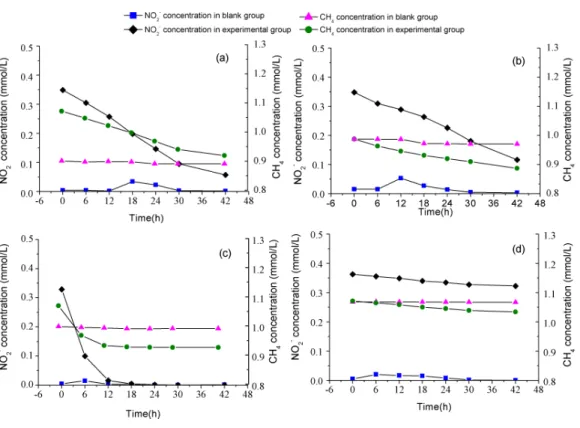
All the samples were washed three times with anaerobic water to remove the residual NO− x (NO−2 and NO−3) an dorganic compounds, and were then transferred to 1L Ar-flushed glass bottles. The slurries were pre-incubated under anoxic conditions at 32±1◦C for at least 48 h, in order to let the microbes adapt to the new environment. The bottle was flushed with Ar gas again before the measurement of potential n-damo activity. Two treatment groups were conducted subsequently: (a) CH4(blank group), (b) CH4+NO−2
(experimental group). The initial CH4 concentrations in both blank and experimental
groups were 1.02 ± 0.06 mmol L−1 and the initial concentrations of NO−2 in the experimental groups were 0.35±0.01 mmol NO−
2 L
−1. The variation of CH
4and NO−2
and the ratio of CH4/NO−2 were evaluated by linear regression of CH4and NO2decrease
in the experimental groups.
Fluorescencein situ hybridization (FISH)
Approximately 0.3 g of collected samples were washed in phosphate-buffered saline (PBS; 10 mM Na2HPO4/NaH2PO4pH 7.5 and 130 mM NaCl) and fixed with 4% (w/v)
paraformaldehyde in PBS for 3h under 4◦
. After incubation, the sediment (fixed biomass) was washed with PBS and then stored in mixture (1 ml) of ethanol and PBS (1×) at −20◦C until analysis.
Bacterial probe S-*-DBACT-1027-a-A-18 (5′-TCTCCACGCTCCCTTGCG-3′) (Cy3, red), specific for bacteria affiliated with the NC10 phylum, were used in this study (Raghoebarsing et al., 2006) and a mixture of EUB I-III (FITC, green) was used for the detection of total bacteria (Daims et al., 1999). Fixed biomass (10µl) was spotted on
microscopic slides circles and then dehydrated subsequently with 50%, 80%, and 98% of ethanol for 3 min each. The probes were hybridized for 2 h at 46 ◦
C in hybridization buffer (5M NaCl, 1M Tris/HCl pH 8.0, 10% sodium dodecyl sulfate) and 40% formamide. Hybridized samples were washed with hybridization leachate at 48◦
C and then added with the fluorescence decay resistance agent. A fluorescence microscope (BX53; Olympus, Tokyo, Japan) was used to observe the prepared slides and the picture was disposed with Image-Pro Plus 6.0.
DNA extraction and PCR amplification
Total DNA was extracted using a Power Soil DNA Isolation kit (Mo Bio Laboratories, Carlsbad, CA, USA) according to the manufacturer’s protocols. The DNA concentration was measured at 260 nm with a NanoDrop spectrophotometer (NanoDrop 1000; Nano-Drop Technologies, USA).
To understand the biodiversity ofM. oxyfera bacteria, 16S rRNA gene ofM. oxyfera
bacteria was amplified using nested PCR protocols, as previously described (Hu et al., 2014). In nested PCR, products of the first round PCR were then used as the DNA templates in the following round PCR. For 16S rRNA gene amplification, the specific forward primer 202F (Ettwig et al., 2009) and general bacterial reverse primer 1545R (Juretschko et al., 1998) were used for the first round PCR, and NC10 specific primers qP1F and qP2R (Ettwig et al., 2009) were performed for the second round PCR. The detailed information of nested PCR is shown inTable S1.
Quantitative real-time PCR (qPCR)
The quantitative PCR of M. oxyfera bacteria 16S rRNA gene were performed on LightCycler480 with Sequence Detection Software v1.4 (Applied Biosystems, Life Technologies Corporation, USA). The abundance of 16S rRNA gene was determined using the primers qp1R-qp1F (Ettwig et al., 2009) with 10µL of Power SYBR Green PCR
Master Mix, 1µL of template DNA (5–20 ngµL−1), 0.4µL of each primer and 8.2µL of
ddH2O. Detailed information is exhibited inTable S1. Negative-control reactions in which
qPCR analyses were performed for each sample. The standard curve was constructed from purified plasmid DNA with the concentrations ranging from 1.0×101to 1.0×10⁷copies
µL−1, and it showed correlation between the DNA template concentration and the crossing
point with coefficients of determination (R2>0.97). The qPCR amplification efficiency of
the standard curve and reactions were both greater than 85%.
High-throughput pyrosequencing and data analysis
After amplification, the purified nested PCR products of 16S rRNA gene were used for pyrosequencing on the Roche 454 GS-FLX Titanium sequencer (Roche 454 Life Sciences, Branford, CT, USA) at Personalbio (Shanghai Personal Biotechnology, Co., Ltd., Shanghai, China).
After pyrosequencing, all the raw reads were analyzed using QIIME standard pipeline (Shu et al., 2015) to trim off the low quality reads, adaptors, barcodes and primers. Then, sequences containing ambiguous base calls (Ns) and sequences shorter than 150 bp were also removed. The remaining sequences were clustered into operational taxonomic unites (OTUs) by UCLUST, with identity of 97% (Edgar et al., 2011). The sequences with highest relative abundance in each OUT were annotated with NCBI taxonomy using BLASTN and the Green genes database. Chao1 richness estimator, ACE estimator, Simpson diversity and Good’s coverage were calculated in Mothur analysis (http://www.mothur.org). Beta diversity statistics, including cluster analysis, weighted UniFrac distance metrics, and Principal coordinate analysis (PCoA), were conducted based on UniFrac metric (Zhang, Shao & Ye , 2011).
Ethical StatementThis article does not contain any studies with human participants or animals performed by any of the authors.
RESULTS
Physicochemical characteristics of the sample sites
Significant differences in physicochemical characteristics among different environmental samples were observed in the present study. The peak NH+4-N content (815.88 mg N kg−1 dry sediment) was detected in WS, which was over 80-folds higher than that in the other three sample sites. And the highest NO−2-N content (14,120 mg N kg−1dry sediment)
was observed in EC, while NO−2-N content in the other three sample site varied form 0.37–127.19 mg N kg−1dry sediment. Mainly because of its high NO−
2 content, the highest
NO−
x-N content was also observed in EC, which was beyond 17-folds higher than that of
the other three sample sites. In addition, compared with published researches conducted in paddy fields, where NO−x-N content was around 1.4–3.3 mg N kg
−1dry sediment (Shen et
al., 2014;Zhou et al., 2014;Ding et al., 2015) higher NO−
x-N content in the agriculture field
(PF and CF) of northern China was observed in this study, mainly caused by difference in farming methods.
Abundance of M.oxyfera bacteria
Figure 1 FISH image of the collected samples.TheM. oxyferabacteria was hybridized with probe S-*-DBACT-1027-a-A-18(Cy3, red) and total bacteria was hybridized with probes EUB I-III (FITC, green). A & E, PF; B & F, CF; C & G, EC, D & H, WS. The scale bar indicates 100µm.
(represented by red color) were observed in all four sample sites, and the proportion of
M. oxyferabacteria to total bacteria followed the order of EC > PF > CF > WS. Notably, compared with total bacteria,M.oxyferabacteria in the enrichment culture took up over 50%, indicating the predominance ofM.oxyferabacteria.
To further accurately quantify the abundance ofM. oxyferabacteria, qPCR analysis was conducted and significant difference was also observed in different sampling sites. The abundance of M. oxyferabacteria were 7.28±0.8×10⁷, 1.55±0.3×10⁷, 1.07 ±0.3×10¹⁰, 2.61±0.1×10⁶copies per gram of dry sediment in PF, CF, EC and WS, respectively (Fig. 2). This order was in consistence with results of FISH analysis.
Potential rates of n-damo activity
In order to estimate the activity ofM. oxyferabacteria, batch experiments were conducted using the collected samples, and the results are shown inFig. 3. In experimental groups amended with CH4 and NO2, dramatic decline in CH4 concentration were observed
compared with the blank groups, indicating that CH4 oxidation was propelled by NO−2
reduction under anoxic conditions. The detected anaerobic methane oxidizing rates were 3.90±0.05, 2.58±0.08, 22.31±0.02 and 1.61±0.01µmol CH4g−1d−1in PF, CF, EC
and WS, respectively. The stoichiometric ratio for methane to nitrite, calculated through the curve fitting method, were 3:5.7 for PF, 3:4.6 for CF, 3:6.9 for EC, and 3:3.2 for WS. The value of n-damo enrichment culture was the closest to the theoretical stoichiometric ratio, which was 3:8 (Ettwig et al., 2010).
Microbial community structure analysis
Figure 2 Q-PCR Image ofM. oxyferabacteria. The abundance ofM. oxyfera bacteria 16S rRNA gene copy numbers of collected samples.
Figure 4 Composition of microbial community at phylum level in different samples.
from 86.48% to 94.70% (Table S2), indicating that these sequences were enough to analyze the microbial community structures. Chao1 estimator, ACE estimator, Shannon index and the numbers of OTUs in four samples followed the same order, which was PF >CF >EC >WS (Table S2).
To show the diversity of species among different samples, rarefaction curves were drawn in this study (Fig. S1). Results showed that the rarefaction curves of all samples didn’t reach a saturation stage, indicating that these samples had highly diverse microbial communities. PCoA was conducted to investigate the differences in microbial community between different samples, based on unweighted UniFrac distance metrics. Results showed that PF and CF tended to cluster together, while EC and WS were obviously different. The results with maximum variation of 87.59% (PC1) and 8.37% (PC2) were shown inFig. S2.
Figure 5 Richness heat map of the 25 most abundant genera.
DISCUSSION
In present study, PF, CF, EC and WS in northern China, as previously overlooked sites, were selected to investigate the presence and characteristics of n-damo process. Results showed that EC had the highest potential n-damo activity, as well as the highest abundance ofM. oxyferabacteria. Correlation analysis showed that the potential n-damo rates and the abundance ofM. oxyferabacteria followed the same descending order, i.e., EC > PF > CF > WS, indicating positive correlation between the two indexes. Moreover, the potential n-damo rate (22.31±0.02µmol CH4 g−1d−1) of EC was higher than that reported in other n-damo enrichment culture (He et al., 2014). This was attributed to the relative higher abundance ofM. oxyferabacteria in the present study. The abundance ofM. oxyfera
which further verified the positive correlation between the potential n-damo rates and the abundance ofM. oxyferabacteria.
WWTP showed lower abundance of M. oxyferabacteria than the other three sample sites, mainly because of its short biomass retention time (13 days), while biomass retention time of other three sample sites was years or even decades of years (Kampman et al., 2014;Weiland, 2006). With the doubling time of 12 weeks (Ettwig et al., 2009), the growth rate ofM. oxyferabacteria is much lower than heterotrophic bacteria, indicating thatM.
oxyferabacteria might be washed out in WWTP and resulted in lower abundance ofM.
oxyferabacteria. Another possible reason was that high NH+4 content in WWTP, which
was unfavorable for the growth of M. oxyferabacteria.Winkler et al. (2015)found that anammox bacteria had advantage over M. oxyferabacteria for nitrite in the presence of excess ammonium. What is more interesting, although WS was used as initial inoculum for EC in this study, the abundance ofM. oxyferabacteria in EC was over 4×10³times higher than that in WS. This was mainly attributed to a combination of low NH+4 content and high NO2content during the enrichment period of EC. It was reported that the nitrite
affinity constant ofM .oxyferabacteria was 0.6 g NO2–Nm−3, indicating that high NO−2
content was more beneficial for the growth ofM .oxyferabacteria (Winkler et al., 2015). The distribution and composition of NC10 phylum was determined by 16S rRNA gene sequencing analysis. NC10 phylum detected from PF, CF and EC were significant higher than that in WS, which was mainly attributed to short biomass retention time of WWTP In addition, it can be seen from the heat map that the abundance ofM. oxyferabacteria in different samples followed the order of EC > PF > CF > WS, which was consistence with the result of qPCR. What’s more, PF and CF had much higher OTU numbers than WS. Thus, it was believed that PF and CF could be favorable inoculum for the enrichment ofM.
oxyferabacteria, due to their higher abundance and diversity ofM. oxyferabacteria. And
it’s worth to notice that significant difference existed in microbial community between EC and WS, EC has six more OTUs than WS, although WS was used as initial inoculum for EC. This might be caused by the optimum enrichment culture forM. oxyferabacteria in EC, i.e., low NH+4 and high NO−2contents. Besides, the increase in diversity ofM. oxyfera
bacteria would also be attributed to the longer biomass retention time of EC.
In conclusion, the present study further expanded our knowledge on distribution and characteristic ofM. oxyferabacteria in northern China. Comparative analysis found that positive correlation existed between abundance ofM. oxyferabacteria and potential n-damo activity rate. In addition, PF and CF were identified as suitable inocula to enrichM.
oxyferabacteria. Moreover, long biomass retention time, low NH+4 and high NO2contents
would benefit the growth ofM. oxyferabacteria.
ADDITIONAL INFORMATION AND DECLARATIONS
Funding
and the Seventh Framework Programme FP7-PEOPLE-2011-IRSES. The funders had no role in study design, data collection and analysis, decision to publish, or preparation of the manuscript.
Grant Disclosures
The following grant information was disclosed by the authors: National Natural Science Foundation of China: 21307076.
Fundamental Research Funds of Shandong University: 2014TB003. Seventh Framework Programme: FP7-PEOPLE-2011-IRSES.
Competing Interests
The authors declare there are no competing interests.
Author Contributions
• Zhen Hu conceived and designed the experiments, analyzed the data, contributed
reagents/materials/analysis tools, wrote the paper, reviewed drafts of the paper. • Ru Ma performed the experiments, analyzed the data, contributed
reagents/material-s/analysis tools, wrote the paper, prepared figures and/or tables, reviewed drafts of the paper.
DNA Deposition
The following information was supplied regarding the deposition of DNA sequences: Sequences obtained from these samples divided into 16S rRNA and pmoA of M. oxyfera were submitted to GenBank under accession numbersKX153190–KX153201and KX153202–KX153210respectively.
Data Availability
The following information was supplied regarding data availability: The raw data has been supplied asSupplementary Files.
Supplemental Information
Supplemental information for this article can be found online athttp://dx.doi.org/10.7717/ peerj.2766#supplemental-information.
REFERENCES
APHA. 2005.Standard methods for the examination of water and wastewater. Washing-ton, D.C.: American Public Health Association (APHA).
Beal EJ, House CH, OrphanVJ. 2009.Manganese- and iron-dependent marine methane oxidation.Science325:184–187DOI 10.1126/science.1169984.
Bian L, Hinrichs K-U, Xie T, Brassell SC, Iversen N, Fossing H, Jørgensen BB, Hayes JM. 2001.Algal and archaeal polyisoprenoids in a recent marine sediment: molecular isotopic evidence for anaerobic oxidation of methane.Geochemistry, Geophysics,
Cai Z. 2012.Greenhouse gas budget for terrestrial ecosystems in China.Science China
Earth Sciences55:173–182DOI 10.1007/s11430-011-4309-8.
Chen J, Jiang X-W, Gu J-D. 2014.Existence of novel phylotypes of nitrite-dependent anaerobic methane-oxidizing bacteria in surface and subsurface sediments of the South China Sea.Geomicrobiology Journal32:1–10
DOI 10.1080/01490451.2014.917742.
Cui M, Ma A, Qi H, Zhuang X, Zhuang G. 2015.Anaerobic oxidation of methane: an ‘‘active’’ microbial process.MicrobiologyOpen4:1–11DOI 10.1002/mbo3.232. Daims H, Brühl A, Amann R, Schleifer K-H, Wagner M. 1999.The domain-specific
Probe EUB338 is insufficient for the detection of all bacteria: development and evaluation of a more comprehensive probe set.Systematic and Applied Microbiology 22:434–444DOI 10.1016/S0723-2020(99)80053-8.
Ding J, Fu L, Ding ZW, Lu YZ, Cheng SH, Zeng RJ. 2015.Environmental evaluation of coexistence of denitrifying anaerobic methane-oxidizing archaea and bac-teria in a paddy field.Applied Microbiology and Biotechnology100(1):439–446 DOI 10.1007/s00253-015-6986-2.
Edgar RC, Haas BJ, Clemente JC, Quince C, Knight R. 2011.UCHIME improves sensitivity and speed of chimera detection.Bioinformatics27:2194–2200 DOI 10.1093/bioinformatics/btr381.
Egger M, Rasigraf O, Sapart CJ, Jilbert T, Jetten MSM, Röckmann T, Van der Veen C, Bândă N, Kartal B, Ettwig KF, Slomp CP. 2015.Iron-Mediated Anaerobic Oxidation of Methane in Brackish Coastal Sediments.Environmental Science &
Technology49:277–283DOI 10.1021/es503663z.
Ettwig KF, Butler MK, Le Paslier D, Pelletier E, Mangenot S, Kuypers MM, Schreiber F, Dutilh BE, Zedelius J, De Beer D, Gloerich J, Wessels HJ, Van Alen T, Luesken F, Wu ML, Van de Pas-Schoonen KT, Op den Camp HJ, Janssen-Megens EM, Francoijs KJ, Stunnenberg H, Weissenbach J, Jetten MS, Strous M. 2010. Nitrite-driven anaerobic methane oxidation by oxygenic bacteria.Nature 464:543–548 DOI 10.1038/nature08883.
Ettwig KF, Van Alen T, Van de Pas-Schoonen KT, Jetten MSM, Strous M. 2009. Enrichment and molecular detection of denitrifying methanotrophic bacteria of the NC10 phylum.Applied and Environmental Microbiology75:3656–3662 DOI 10.1128/AEM.00067-09.
Foley JA, Ramankutty N, Brauman KA, Cassidy ES, Gerber JS, Johnston M, Mueller ND, O’Connell C, Ray DK, West PC, Balzer C, Bennett EM, Carpenter SR, Hill J, Monfreda C, Polasky S, Rockstrom J, Sheehan J, Siebert S, Tilman D, Zaks DP. 2011.Solutions for a cultivated planet.Nature478:337–342 DOI 10.1038/nature10452.
He Z, Cai C, Shen L, Lou L, Zheng P, Xu X, Hu B. 2014.Effect of inoculum sources on the enrichment of nitrite-dependent anaerobic methane-oxidizing bacteria.Applied
Microbiology and Biotechnology 99:939–946DOI 10.1007/s00253-014-6033-8.
Hu BL, Shen LD, Lian X, Zhu Q, Liu S, Huang Q, He ZF, Geng S, Cheng DQ, Lou LP, Xu XY, Zheng P, He YF. 2014.Evidence for nitrite-dependent anaerobic methane oxidation as a previously overlooked microbial methane sink in wetlands.
Proceedings of the National Academy of Sciences of the United States of America 111:4495–4500DOI 10.1073/pnas.1318393111.
Hu S, Zeng RJ, Keller J, Lant PA, Yuan Z. 2011.Effect of nitrate and nitrite on the selec-tion of microorganisms in the denitrifying anaerobic methane oxidaselec-tion process.
En-vironmental Microbiology Reports3:315–319DOI 10.1111/j.1758-2229.2010.00227.x.
Intergovernmental Panel on Climate Change (IPCC). 2001.Third assessment report.
Working Group I. New York: Cambridge Univ. Press.
Juretschko S, Timmermann G, Schmid M, Schleifer K-H, Pommerening-Röser A, Koops H-P, Wagner M. 1998.Combined molecular and conventional analyses of nitrifying bacterium diversity in activated sludge: nitrosococcus mobilis and nitrospira-like bacteria as dominant populations.Applied and Environmental
Microbiology64:3042–3051.
Kampman C, Temmink H, Hendrickx TLG, Zeeman G, Buisman CJN. 2014. Enrich-ment of denitrifying methanotrophic bacteria from municipal wastewater sludge in a membrane bioreactor at 20◦
C.Journal of Hazardous Materials274:428–435
DOI 10.1016/j.jhazmat.2014.04.031.
Knittel K, Boetius A. 2009.Anaerobic oxidation of methane: progress with an unknown process.Annual Review of Microbiology 63:311–334
DOI 10.1146/annurev.micro.61.080706.093130.
Liu Y, Cheng X, Lun X, Sun D. 2014a.CH4 emission and conversion from A2O and SBR processes in full-scale wastewater treatment plants.Journal of Environmental Sciences 26:224–230DOI 10.1016/S1001-0742(13)60401-5.
Liu Y, Zhang J, Zhao L, Li Y, Yang Y, Xie S. 2014b.Aerobic and nitrite-dependent methane-oxidizing microorganisms in sediments of freshwater lakes on the Yunnan Plateau.Applied Microbiology and Biotechnology99:2371–2381
DOI 10.1007/s00253-014-6141-5.
Luesken FA, Van Alen TA, Van der Biezen E, Frijters C, Toonen G, Kampman C, Hendrickx TLG, Zeeman G, Temmink H, Strous M, Op den Camp HJM, Jetten MSM. 2011a.Diversity and enrichment of nitrite-dependent anaerobic methane oxidizing bacteria from wastewater sludge.Applied Microbiology and Biotechnology 92:845–854DOI 10.1007/s00253-011-3361-9.
Montzka SA, Dlugokencky EJ, Butler JH. 2011.Non-CO2 greenhouse gases and climate change.Nature476:43–50DOI 10.1038/nature10322.
Raghoebarsing AA, Pol A, Van de Pas-Schoonen KT, Smolders AJ, Ettwig KF, Rijpstra WI, Schouten S, Damste JS, Op den Camp HJ, Jetten MS, Strous M. 2006.A microbial consortium couples anaerobic methane oxidation to denitrification.
Ryan J, Estefan G, Rashid A. 2007.Soil and plant analysis laboratory manual. Aleppo: Internation Center for Agricultural Research in the Dry Areas (ICARDA) and the National Agricultural Research Center (NARC).
Segarra KEA, Comerford C, Slaughter J, Joye SB. 2013.Impact of electron accep-tor availability on the anaerobic oxidation of methane in coastal freshwater and brackish wetland sediments.Geochimica et Cosmochimica Acta115:15–30 DOI 10.1016/j.gca.2013.03.029.
Shen L-D, Liu S, He Z-F, Lian X, Huang Q, He Y-F, Lou L-P, Xu X-Y, Zheng P, Hu B-L. 2015.Depth-specific distribution and importance of nitrite-dependent anaerobic ammonium and methane-oxidising bacteria in an urban wetland.Soil Biology and
Biochemistry83:43–51DOI 10.1016/j.soilbio.2015.01.010.
Shen L-D, Liu S, Huang Q, Lian X, He Y-F, Geng S, Jin R-C, He Y-F, Lou L-P, Xu X-Y. 2014.Evidence for the cooccurrence of nitrite-dependent anaerobic ammonium and methane oxidation processes in a flooded paddy field.Applied and Environmental
Microbiology80:7611–7619DOI 10.1128/AEM.02379-14.
Shu D, He Y, Yue H, Zhu L, Wang Q. 2015.Metagenomic insights into the effects of volatile fatty acids on microbial community structures and functional genes in organotrophic anammox process.Bioresource Technology196:621–633 DOI 10.1016/j.biortech.2015.07.107.
Smemo KA, Yavitt JB. 2007.Evidence for anaerobic CH4 oxidation in freshwater peatlands.Geomicrobiology Journal24:583–597DOI 10.1080/01490450701672083. Syakila A, Kroeze C. 2011.The global nitrous oxide budget revisited.Greenhouse Gas
Measurement and Management1:17–26DOI 10.3763/ghgmm.2010.0007.
Timmers PHA, Suarez-Zuluaga DA, Van Rossem M, Diender M, Stams AJM, Plugge CM. 2015.Anaerobic oxidation of methane associated with sulfate re-duction in a natural freshwater gas source.The ISME Journal10:1400–1412 DOI 10.1038/ismej.2015.213.
Wang J, Zhang J, Wang J, Qi P, Ren Y, Hu Z. 2011a.Nitrous oxide emissions from a typical northern Chinese municipal wastewater treatment plant.Desalination and
Water Treatment 32:145–152DOI 10.5004/dwt.2011.2691.
Wang J, Zhang J, Xie H, Qi P, Ren Y, Hu Z. 2011b.Methane emissions from a full-scale A/A/O wastewater treatment plant.Bioresource Technology102:5479–5485 DOI 10.1016/j.biortech.2010.10.090.
Wang Y, Zhu G, Harhangi HR, Zhu B, Jetten MSM, Yin C, Op den Camp HJM. 2012. Co-occurrence and distribution of nitrite-dependent anaerobic ammonium and methane-oxidizing bacteria in a paddy soil.FEMS Microbiology Letters336:79–88 DOI 10.1111/j.1574-6968.2012.02654.x.
Winkler MKH, Ettwig KF, Vannecke TPW, Stultiens K, Bogdan A, Kartal B, Volcke EIP. 2015.Modelling simultaneous anaerobic methane and am-monium removal in a granular sludge reactor.Water Research73:323–331 DOI 10.1016/j.watres.2015.01.039.
Zhang T, Shao M-F, Ye L. 2011.454 Pyrosequencing reveals bacterial diversity of activated sludge from 14 sewage treatment plants.ISME Journal6:1137–1147 DOI 10.1038/ismej.2011.188.
Zhou LL, Wang Y, Long XE, Guo JH, Zhu GB. 2014.High abundance and diversity of nitrite-dependent anaerobic methane-oxidizing bacteria in a paddy field profile.