Strand Analysis, a free online program for the computational identification
of the best RNA interference (RNAi) targets based on Gibbs free energy
Tiago Campos Pereira
1, Vinícius D’Ávila Pascoal Bittencourt
1, Rodrigo Secolin
1,
Cristiane de Souza Rocha
1, Ivan de Godoy Maia
2and Iscia Lopes-Cendes
1 1Departamento de Genética Médica, Faculdade de Ciências Médicas,
Universidade Estadual de Campinas, Campinas, SP, Brazil.
2
Departamento de Genética, Instituto de Biologia, Universidade Estadual Paulista, Botucatu, SP, Brazil.
Abstract
The RNA interference (RNAi) technique is a recent technology that uses double-stranded RNA molecules to promote potent and specific gene silencing. The application of this technique to molecular biology has increased consider-ably, from gene function identification to disease treatment. However, not all small interfering RNAs (siRNAs) are equally efficient, making target selection an essential procedure. Here we present Strand Analysis (SA), a free online software tool able to identify and classify the best RNAi targets based on Gibbs free energy (∆G). Furthermore, par-ticular features of the software, such as the free energy landscape and∆G gradient, may be used to shed light on RNA-induced silencing complex (RISC) activity and RNAi mechanisms, which makes the SA software a distinct and innovative tool.
Key words:RNAi, siRNA, siRNA design, software. Received: October 23, 2006; Accepted: January 31, 2007.
The RNA interference (RNAi) gene silencing tech-nique is a recently developed technology that allows potent and specific gene silencing through the use of double-stranded RNA molecules (dsRNAs; Fireet al., 1998). The RNAi technique is widely used for identification of gene function (reverse genetics), functional genomics (Fraseret al., 2000), to combat pathogens (Gitlin et al., 2002; Mohmmed et al., 2003), as a therapeutic tool in cancer (Brummelkampet al., 2002) and some specific genetic dis-orders (Xiaet al., 2004), in the generation of biotechnologi-cal products (Ogitaet al., 2003) and for the construction of model animals (Fedoriwet al., 2004).
In mammals, however, dsRNAs trigger antiviral re-sponses and cell death ensues, so in these models small inter-fering RNAs (siRNAs) are the molecules of choice for RNAi studies because they are too small to trigger such responses. Molecules of siRNA possess a well defined structurei.e.a 21-mer duplex, two-nucleotide 3’ overhang and a 5’ phos-phate. It is interesting to note that siRNAs directed to differ-ent regions of a specific transcript display widely differdiffer-ent silencing efficiencies (Holenet al., 2002), possibly in part due to the fact that, intracellularly, siRNAs are incorporated into an RNA-induced silencing complex (RISC) containing
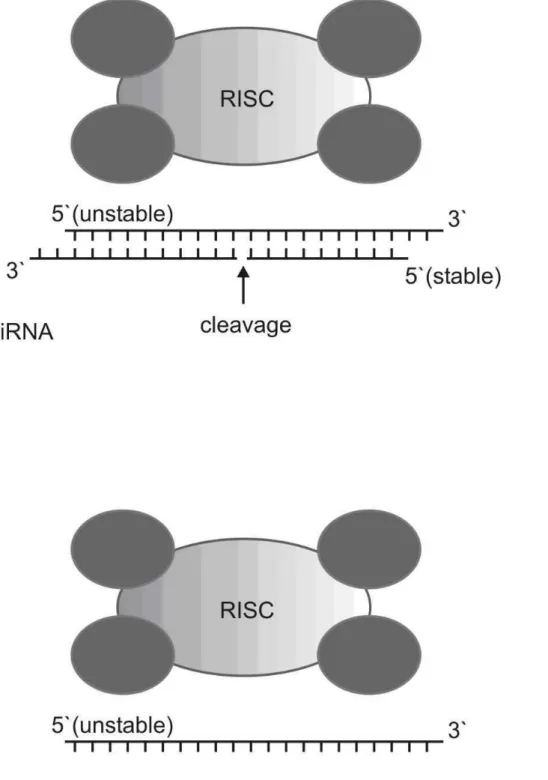
slicer endonuclease activity. Slicer cleaves one strand of siRNA while keeping the other strand (the guide strand) to direct target RNA cleavage (supplementary data, Figure S1: Rand et al., 2005). If the antisense strand remains in the RISC, efficient silencing occurs but if the sense strand re-mains in the RISC silencing is reduced or even compromised (Khvorovaet al., 2003; Schwarzet al., 2003). Two inde-pendent research groups (Khvorovaet al., 2003; Schwarzet al., 2003) have shown that the thermodynamic features of the siRNA termini, defined in terms of Gibbs free energy (∆G, kcal mol-1), determines the guide strand choice. Thus, Tuschl’s rules, the well known protocol for siRNAs design (Elbashiret al., 2001) now includingDG via computational
and systematic calculations, would reduce the time and costs involved in RNAi experiments.
In this paper we present Strand Analysis (SA), a free online program (see internet resources section) for the identification of the best RNAi targets based on thermody-namic features (Khvorovaet al., 2003, Table 1). The SA program computes∆G in kcal mol-1, the higher the
∆G
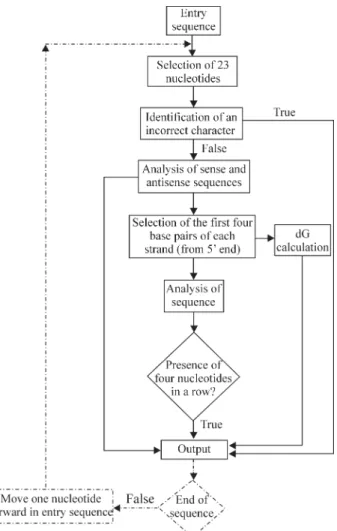
value then the more preferentially will the antisense strand be kept within the RISC slicer domain thus resulting in better efficiency. As shown in Figure 1, the SA program has two different entry modes “Oligo Analysis” (OA mode) and “Sequence analysis” (SA mode). The OA mode can be used to compute single pre-selected 23-mer targets derived from messenger RNA (DNA or RNA Genetics and Molecular Biology, 30, 4, 1206-1208 (2007)
Copyright by the Brazilian Society of Genetics. Printed in Brazil www.sbg.org.br
Send correspondence to Iscia Lopes Cendes. Departamento de Genética Médica, Faculdade de Ciências Médicas, Universidade Estadual de Campinas, Caixa Postal 6111, 13084-970 Campinas, SP, Brazil. E-mail: [email protected].
format) and presents the results as∆G values, with posi-tive∆G values for the “active guide strand” and null or
negative∆G values for the “non-active guide strand”. The SA mode scans all the query sequence and calculates the
∆G values for all the 23-mer targets along the sequence to
produce a list of∆G values which may be set as a function
of target position along the transcript or as the best values in decreasing order. Alternative outputs are the identifica-tion of only active or non-active strands. The SA∆G
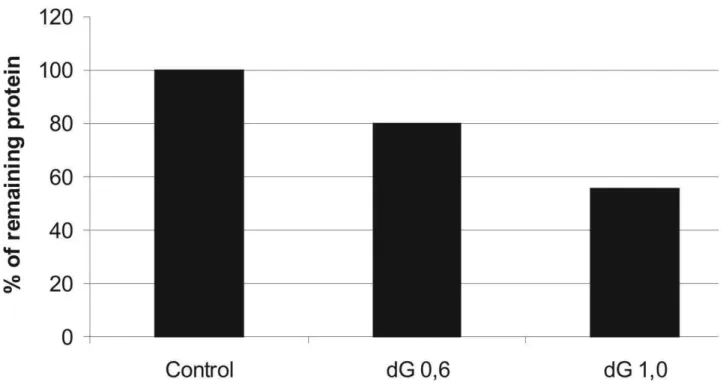
gra-dient varies from +9.3 kcal mol-1to -9.3 kcal mol-1and may be used for special purposes in molecular analysis, as for example when a haploinsufficiency (50% silencing) would be more interesting than a knockdown (99.9% si-lencing). More exact molecular analysis may now be pos-sible using this gradient principle, uncovering new phenotypes resulting from partial silencing. The correla-tion between∆G values and silencing efficiency has been well-characterized (Khvorovaet al., 2003; Schwarzet al., 2003) and was reproduced in our laboratory during the ex-perimental validation of the SA program (supplementary data, Figure S2).
When working with H1/U6-based vectors for the pro-duction of short-hairpins it is important to avoid four thymines (Ts) or adenines (As) in a row and, likewise, four guanines (Gs) or cytosines (Cs) in a row should also be avoided when chemical synthesis is the choice. The SA program takes these factors into consideration and presents a warning message when such motifs are found during analyses.
The input file for the SA program is a.txt file, with the first line format as “> name of the gene” and its coding se-quence (CDS, with or without numbers or spaces, DNA or RNA sequence) in the lines below. The .txt format output file is automatically generated in the same folder as the in-put file and presents i) position of the first siRNA nucleo-tide along the input sequence, ii) the ∆G value, iii) the siRNA structure (anti-parallel misaligned duplex for didac-tic visualization) and iv) the resulting siRNA oligos both on 5’-3’ orientation (for ordering).
The SA program calculates the∆G values of specific
23-mer targets or performs a complete scanning of the query sequence, listing the best targets by position or by the best∆G values. Given that optimal siRNAs are selected, we believe that the SA program will improve knockdown effi-ciencies in RNAi experiments. When using RNAi to com-bat viral replication for example, targeted genomes may extend to tens of kilobases. The SA program can scan such large sequences presenting the few excellent targets (∆G value greater than 6.0), which would not be identified by random choice. For example, a SA scan of the HIV genome (Genbank AF033819) indicated that the best target is lo-cated in position 1940, within the “pol” gene (∆G = 8.5).
Furthermore, the ∆G gradient may also be used to shed
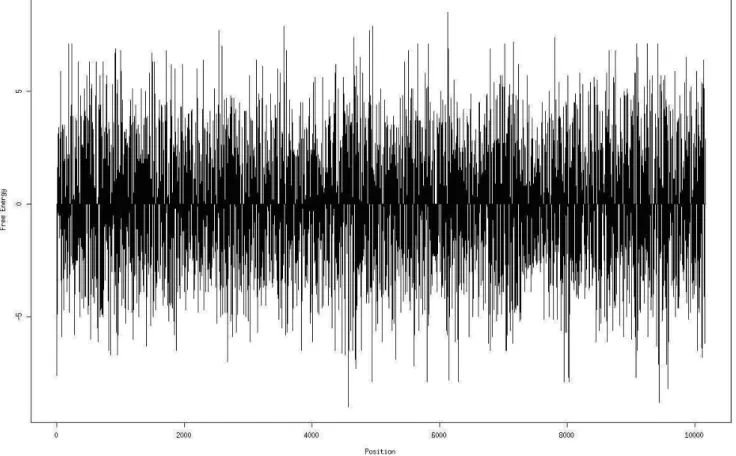
some light on RISC activity and the mechanism of RNAi. The SA program also displays a∆G-based landscape along the gene sequence in a graphic format, which facili-tates visualization of gene (or genomic) “∆G hotspots” where many siRNAs may be used (supplementary data, Figure S3). Furthermore, since RNAi acts as an antiviral
Pereiraet al. 1207
Table 1- Standard Gibbs energy of activation∆G values (kcal mol-1) used for calculating the internal stability of RNA duplexes. The equation used was∆G = SGas- SGs, where SGas= Sum of the∆G values for the first four
nucleotides in the anti-sense 5’ region, SGs= Sum of the∆G values for the first four nucleotides in the sense 5’ region. Note that∆G≤for the
non-functional strand and∆G > 0 for the functional strand. Table modified
from Khvorovaet al., 2003).
First nucleotide
base pair Second nucleotide∆G values (kcal mol
-1)
A C G U
A-U 1.1 2.4 1.9 1.1
C-G 2.2 3.3 2.2 1.9
G-C 2.7 3.8 3.3 2.4
G-U 1.5 2.7 2.2 1.4
U-A 1.4 2.6 2.2 1.1
system, such landscapes may provide insight into changes in viral genomes and adaptations which occur over time un-der such pressure, aspects which are currently unun-der inves-tigation in our laboratory.
The SA program was implemented on the Linux plat-form, is web based and written in the Perl programming language, which is widely used in bioinformatics. With a small source code of only 7.9 kb the SA program shows good performance, taking only 2.3 s to run a sequence of 20,000 bases, and can be used along with other bioin-formatics tools developed in our laboratory. The SA pro-gram is freely available, but is not open source.
It is important to note that the SA program must be used in combination with other computational tools for the design of siRNAs (Tuschl’s rules) and not alone. For exam-ple, it is important to exclude 23-mer targets with strong secondary structures, a task that may be performed using Gene Runner (see internet resources section). Strand Anal-ysis has already been registered at the Brazillian Patent Of-fice (Instituto Nacional de Propriedade Industrial, INPI) under number 00068371.
Although there are other web-based programs used for siRNA design (Peiet al., 2006), some of them are very slow, not user friendly or do not even consider thermody-namic features in their calculations. Those which do in-clude thermodynamic parameters compute them along with many other factors, generating a raking that is not a func-tion of ∆G alone, thus making selection based on free
energy difficult. Our Strand Analysis (SA) program distin-guishes itself from its counterparts by providing the follow-ing advantages: i) the results are displayed in RNA format for both strands in the 5’ to 3’ orientation; ii) the ability to view positive or negative values alone or altogether; iii) the fact that the list of standard Gibbs energy values (∆G) result may be set as a function of target position along the tran-script or as∆G values; and iv) the∆G landscape may be an-alyzed along the gene sequence, thus providing a distinct and innovative tool.
Acknowledgments
This work was supported by the Brazilian agency Fundação de Amparo à Pesquisa do Estado de São Paulo
(FAPESP), process number 02/01828-8-TCP and
03/10900-7). I.G.M. and I.L.C. are recipients of research fellowships from the Brazilian agency Conselho Nacional de Desenvolvimento Científico e Tecnológico (CNPq), Brazil.
The authors declare no competing interests.
References
Brummelkamp TR, Bernards R and Agami R (2002) Stable sup-pression of tumorigenicity by virus-mediated RNA interfer-ence. Cancer Cell 2:243-247.
Elbashir SM, Harborth J, Lendeckel W, Yalcin A, Weber K and Tuschl T (2001) Duplexes of 21-nucleotide RNAs mediate RNA interference in cultured mammalian cells. Nature 411:494-498.
Fedoriw AM, Stein P, Svoboda P, Schultz RM and Bartolomei MS (2004) Transgenic RNAi reveals essential function for CTCF in H19 gene imprinting. Science 303:238-240. Fire A, Xu S, Montgomery MK, Kostas SA, Driver SE and Mello
CC (1998) Potent and specific genetic interference by dou-ble-stranded RNA in Caenorhabditis elegans. Nature
391:806-811.
Fraser AG, Kamath RS, Zipperlen P, Martinez-Campos M, Sohr-mann M and Ahringer J (2000) Functional genomic analysis ofC. elegans chromosome I by systematic RNA
interfer-ence. Nature 408:325-330.
Gitlin L, Karelsky S and Andino R (2002) Short interfering RNA confers intracellular antiviral immunity in human cells. Na-ture 418:430-434.
Holen T, Amarzguioui M, Wiiger MT, Babaie E and Prydz H (2002) Positional effects of short interfering RNAs targeting the human coagulation trigger Tissue Factor. Nucleic Acids Res 30:1757-1766.
Khvorova A, Reynolds A and Jayasena SD (2003) Functional siRNAs and miRNAs exhibit strand bias. Cell 115:209-216. Mohmmed A, Dasaradhi PV, Bhatnagar RK, Chauhan VS and
Malhotra P (2003)In vivogene silencing in Plasmodium berghei- A mouse malaria model. Biochem Biophys Res Commun. 309:506-511.
Ogita S, Uefuji H, Yamaguchi Y, Koizumi N and Sano H (2003) Producing decaffeinated coffee plants. Nature 423:823. Pei Y and Tuschl T. (2006) On the art of identifying effective and
specific siRNAs. Nat Methods 3:670-6.
Rand TA, Petersen S, Du F and Wang X (2005) Argonaute2 cleaves the anti-guide strand of siRNA during RISC activa-tion. Cell 123:621-619.
Schwarz DS, Hutvagner G, Du T, Xu Z, Aronin N and Zamore PD (2003) Asymmetry in the assembly of the RNAi enzyme complex. Cell 115:199-208.
Xia H, Mao Q, Eliason SL, Harper SQ, Martins IH, Orr HT, Paulson HL, Yang L, Kotin RM and Davidson BL (2004) RNAi suppresses polyglutamine-induced neurodegene-ration in a model of spinocerebellar ataxia. Nat Med 10:816-820.
Internet Resources
Generunner program at www.generunner.com.
The Strand Analysis (SA) program is available for academic use at http://lgm.fcm.unicamp.br: 9001/cgi-bin/SA/SA.cgi.
Supplementary Material
The following online material is available for this ar-ticle:
Figure S1 Figure S2 Figure S3
This material is available as part of the online article from http://www.scielo.br/gmb.
Associate Editor: Luciano da Fontoura Costa