Received February 16th, 2011, Revised August 12th, 2011, Accepted for publication August 18th, 2011. Copyright © 2011 Published by LPPM ITB, ISSN: 1978-3043, DOI: 10.5614/itbj.sci.2011.43.3.6
Surfaces with Prescribed Nodes and Minimum Energy
Integral of Fractional Order
H. Gunawan1, E. Rusyaman2 & L. Ambarwati1,3
1Analysis and Geometry Group, Faculty of Mathematics and Natural Sciences, Bandung
Institute of Technology, Bandung, Indonesia.
2
Department of Mathematics, Padjajaran University, Bandung, Indonesia.
3Department of Mathematics, State University of Jakarta, Jakarta, Indonesia
Email: [email protected]
Abstract. This paper presents a method of finding a continuous, real-valued,
function of two variables zu x y( , ) defined on the square 2 : [0,1]
S , which mi- nimizes an energy integral of fractional order, subject to the condition u(0, )y
(1, ) ( , 0) ( ,1) 0
u y u x u x and u x y( ,i j)cij, where 0x1 ... xM 1,
1
0y ... yN 1, and 𝑐 ∈ ℝ are given. The function is expressed as a
double Fourier sine series, and an iterative procedure to obtain the function will be presented.
Keywords: 2-D interpolation; energy-minimizing surfaces.
1
Introduction
In [1], A.R. Alghofari studied the problem of finding a sufficiently smooth function on a square domain that minimizes an energy integral and assumes specified values on a rectangular grid inside the square. In particular, he discussed the existence and uniqueness of a solution to the problem, using tools in functional analysis and calculus of variations. The problem is related to the analysis of satellite data, which is important and useful from the application point of view.
In this paper, we shall discuss a method of finding a continuous, real-valued, function of two variables z= ( , )u x y defined on the square 2
:= [0,1]
S , which minimizes the energy integral
1 1 2
2 0 0
( ) := | ( ) | ,
E u u dxdy
subject to the condition u(0,y)=u(1,y)=u(x,0)=u(x,1)=0 and u x y( ,i j) =cij,
Laplacian on ℝ2, and ( )2
(with
0) is its fractional power --- which will be defined soon. For =2, E(u) represents the (total) curvature or the strain energy onS
(see [2]).Using real and functional analysis arguments, we show that such a function exists and is unique if and only if >1. The function may be expressed as a double Fourier sine series. As in [3], we also provide an iterative procedure to obtain the function, and explain how it works through an example.
Related works may be found in [4,5]. Applications of energy-minimizing surfaces may be found in [6-8] and the references therein.
2
The Existence and Uniqueness Theorem
We shall here show that given
M
N
points ( ,x yi j) with1
<
<
<
<
0
x
1
x
M ,0
<
y
1<
<
y
N<
1
, andM
N
values 𝑐 ∈ ℝ, there exists a function z=u(x,y) such that (i) u(0, ) = (1, ) =y u y( , 0) = ( ,1) = 0
u x u x , (ii) u(xi,yj)=cij for i=1,,M , j=1,,N, and (iii) the energy integral E(u) is minimum. The continuity of the function will depend on the value of , which we shall see later.
As we are working with functions uon S=[0,1]2 that vanish on the boundary, we may represent u as a double Fourier sine series
, =1
( , ) =
mnsin
.sin
.
m n
u x y
a
m x
n y
Since the boundary condition (i) is already satisfied, we only need to take
care of the other two conditions.
The fractional power of
is defined as follows. Computing
2 2 2 2
= u u
u
x y
, we obtain
2 2 2
, =1
( , ) = ( ) mnsin .sin .
m n
u x y m n a m x n y
As in [9], for 0, we define the fractional power ( )2
y n x m a n m y x u mn n m
( ) sin .sin
:= ) , ( )
( 2 2 2
1 = , 2
Thus, if u is identified by the array of its coefficients
[
a
mn]
, then ( ) u2 is
identified by the array [ ( 2 2)2 ]
mn
m n a
. One may observe that the formula matches the computation of the nonnegative integral power of , that is,when
= 2 ,k k= 0,1, 2,. [Note also that ( ) (2 ) = (2 ) 2
for
every
, 0.]
With the above definition of ( )2
, the energy integral E(u) may now be given by the sum
2
2 2 2
, =1
( ) =
(
) .
4
m n mnE u
a
m
n
Thus our problem can be reformulated as follows: find a continuous, real-valued, function of two variables zu x y( , ) defined on the square
S
: [0,1]
2 , which minimizes the energy integral2
2 2 2
, =1
( ) =
(
) .
4
m n mnE u
a
m
n
subject to the condition u(0, )y u(1, )y u x( , 0)u x( ,1)0 and
( ,i j) ij
u x y c , where
0
x
1...
x
M
1
,0
y
1
...
y
N
1
and 𝑐 ∈ ℝ are given. Here u is identified by[
a
mn]
, and the problem is to determine the value ofa
mn's such that the prescribed values cij are assumed at (xi,yj) and the latest sum is minimized.Let us now turn to how to solve the problem. Denote by W =W the space of
all functions
, =1
( , ) = mnsin sin
m n
u x y a m x n y
for which 2 2 2 , =1( ) <
mn m n
a m n
--- our admissible functions. On
W
, we define the inner product , by 2 2, =1
,
:=
mn mn(
) ,
m n
u v
a b
m
n
where
a
mn's andb
mn's are the coefficients of u and v respectively. Its induced norm is1 2
2 2 2
, =1
:=
mn(
)
.
m n
u
a
m
n
Then we have the following fact, whose proof is routine, and so we leave it to the reader.
Fact 2.1 (W,,)is a Hilbert space.
For >1, we have the following result.
Theorem 2.2 Let >1. If
(
u
k)
converges to u in norm, then ( )2k
u
converges to ( )2u
uniformly, whenever 0
< 1. In particular, if)
(
u
k converges to u in norm, then(
u
k)
converges to u uniformly.Proof. Let amn( )k 's and
a
mn's be the coefficients ofu
k and u respectively, and0
< 1. Then, for every ( , )x y S, we have
2 2
2 2 2 ( ) , 1 1 1 2 2 2 2 2 2 2 ( )
2 2
, 1 , 1
( , ) ( , ) sin sin sin sin . k k mn mn m n k mn mn
m n m n
u x y u x y
m n a a m x n y
m x n y
m n a a
Let us now have a closer look at the last expression on the right hand side. The first sum is nothing but uk u 2. The second sum is dominated by
2 2 , =1
1 ( )
m n m n
. Since >1, this sum is convergent (by the integral test). Hence, we find that2 2
| ( ) u x yk( , ) ( ) u x y( , ) | C uk u ,
where
C
is independent of ( , )x y . This shows that ( )2k
u
converges to
2 ( ) u
uniformly, as desired.
□
Corollary 2.3 Let >1. Then, every function
u
W
is continuous onS
.Proof. If
u
W
, then u is a limit (in norm), and hence a uniform limit, of the partial sumsu
a
mnm
x
n
y
k
n k
m
k
:=
sin
sin
1 = 1 =
. Since the partial sums are
continuous on
S
, then u too must be continuous onS
. □ To prove the existence and uniqueness of the solution to our problem, we define:= { : ( ,i j) = ij, = 1, , , = 1, , }
U uW u x y c i M j N
and
:= { : ( ,i j) = 0, = 1, , , = 1, , }.
V uW u x y i M j N
Then, as in [1], we have the following fact.
Fact 2.4
U
is a non-empty, closed, and convex subset, whileV
is a closed subspace ofW
.Proof. We shall only prove that
U
is non-empty, and leave the others to the reader. Consider the system of linear equations=1 =1
sin sin = , = 1, , , = 1, , .
M N
mn ij
m n
a m x
n y
c i M j NThe system will have a solution if the matrix
1 1 1
1 1 2
sin [sin ] sin 2 [sin ] sin [sin ]
sin [sin ] sin 2 [sin ] sin [sin ]
:= ,
sin [sin ] sin 2 [sin ] sin [sin ]
i i i
i i i
N i N i N i
y m x y m x N y m x
y m x y m x N y m x
A
y m x y m x N y m x
is non-singular. The matrix A is the Kronecker product of the nn matrix
n j j
j n y
y
n ]:=[sin ] ,
sin
[ and the mm matrix [sinm x i]:= [sinm x i i m], . Hence, we obtain
det
A
= (det[sin
n y
j])
m
(det[sin
m x
i])
n(
see [10]). Since [sinn y j] and [sinm x i] are both non-singular (see, forexample, [11]), we conclude that the matrix A is non-singular too. Therefore
the above system of equations has a solution, which means that
U
is non-empty.□
The existence and uniqueness of the solution to our problem follows from the best approximation theory in Hilbert spaces.
Theorem 2.5 The problem has a unique solution in
W
, and the solution is given by0 0
:=
proj ( )
Vu
u
u
for any choice
u
0
U
. Furthermore, for >1, the function u is continuous onS
.Proof.
Take an elementu
0 inU
. Then, for anyv V
,u
0
v
is also inU
. SinceU
is a convex subset ofW
, there must exist a unique elementv
0
V
such that
u
0
v
0 is minimum [12]. Thusu
:=
u
0
v
0 is the unique solution inW
for our minimization problem. By the best approximation theory in Hilbertspaces, the element
v
0
V
that minimizesu
0
v
0 must be the orthogonal projection ofu
0 onV
, that is,v
0= proj ( )
Vu
0 . The solution is independent of the choice ofu
0
U
. Indeed, ifu u
0,
1
U
, thenu
0
u
1V
, and so
0 1
0 1In the next section, we shall discuss how we actually find the solution to our problem.
3
The Procedure to Find the Solution
To find an element
u
0 inU
is easy, we only need to solve the system of linear equations=1 =1
sin sin = , = 1, , , = 1, , .
M N
mn ij
m n
a m x
n y
c i M j N
Here
u
0 can be thought of as an initial approximation to the solution we are looking for. Once we haveu
0, we just have to compute its orthogonal projection on the subspaceV
.To do so, we first determine an orthogonal basis of
V
. We note that every element ofV
must satisfy=1 =1 ,
sin
sin
=
sin
sin
,
M N
mn i j mn i j
m n m n
a
m x
n y
a
m x
n y
for i=1,,M, j=1,,N, where the sum on the right hand side is taken over m and n with “
m
M
1
orn
N
1
”. From this, we may basically expressa
mn for m=1,,M,n=1,,N in terms ofa
mn with “m
M
1
or
n
N
1
”. Thus, every element ofV
may be written as ,= mn mn,
m n
v
a vfor some elements
v
mn inV
. [For >1, one may check that the subspaceV
has co-dimension
M
N
.]* * 1 0
, * * 0 0 0 0
where the entries marked by an asterisk comes from
a
mn,
= 1, , , = 1, ,m M n N, and all others are 0 except for the entry in Row 1, Column
N
1
--- which is equal to 1. To be concrete, see the example below. For similar ideas in the one dimensional case, we refer the reader to [3].From the
v
mn's, we can get an orthogonal basis forV
, call it{
v
*mn}
. We can then compute the orthogonal projection of our initial approximationu
0 onV
iteratively, by projecting it on the
v
*mn's. Each time the projection is computed, the energy is reduced, and we stop the iteration up till the reduction is no longer significant.We shall now give an example to explain how the procedure really works. Suppose we wish to find the function u such that u(0.5,0.5)=1 and the energy
)
(
1.5u
E
is minimized. [In this example, M = N=1, x1=y1=0.5, andc
11=
1
; while =1.5.]Our initial approximation is
u
0(
x
,
y
)
=
sin
x
sin
y
, which is identified by the array1
0
0
0
0
0
.
0
0
0
Next, to find the basis of
V
, we note that ifv
:=
[
a
mn]
is an element ofV
, then we have, =1
sin 0.5
sin 0.5
= 0.
mn m n
a
m
n
11 13 15
31 33 35
51 53 55
0
0
0
0
0
0
0
0
0
0
0
0
0
0
0
0
a
a
a
a
a
a
a
a
a
is equal to zero. Hence
a
11 may be expressed as the sum of the entries of the array13 15
31 33 35
51 53 55
0
0
0
0
0
0
0
0
0
0
0
0
0
0
0
0
0
a
a
a
a
a
a
a
a
Therefore, v may be written as
11 12 13
21 22 23
12 22
31 32 33
21 13
23
0
1
0
0
0
0
0
0
0
0
1
0
=
0
0
0
0
0
0
0
0
0
1
0
1
1
0
0
0
0
0
0
0
0
0
0
0
0
0
0
0
0
1
0
0
0
a
a
a
a
a
a
a
a
a
a
a
a
a
a
3312 12 22 22 21 21 13 13 23 23 33 33
1 0
0
0
0
0
0
0
1
=
.
a
a v
a v
a v
a v
a v
a v
In this case, the set
{
v
12,
v
22,
v
21,
v
13,
v
23,
v
33,
}
forms a basis forV
. Note that each element of this basis has zero entries except for finitely many entries. This feature is one among others that makes the computation handy.Starting from the initial approximation
u
0, we compute the next approximations 1 0 * 012 = proj ( )
v
u u u , 2 1 * 0
22 = proj ( )
v
u u u , 3 2 * 0
21 = proj ( )
v
u u u ,
and so on, where {v*mn} is an orthogonal basis obtained from
{
v
mn}
. Associated to each approximation, we compute the energyE
1.5( )
u
k , which is a multiple of2
k
u . As
k
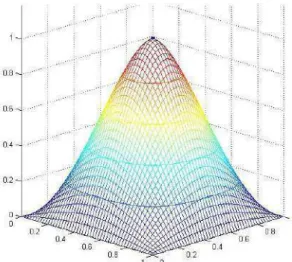
grows, the energy decreases (as explained earlier), and we stop the iteration when the decrease is less than a treshold. Figure 1 shows the resulting surface, within a treshold of 104. Note that u is like „one and a half‟ timesdifferentiable almost everywhere on
S
, so that the surface zu x y( , ) is not that smooth at (0.5, 0.5,1) .Figure 1 The surface passing through (0.5,0.5,1) with minimum E1.5( )u .
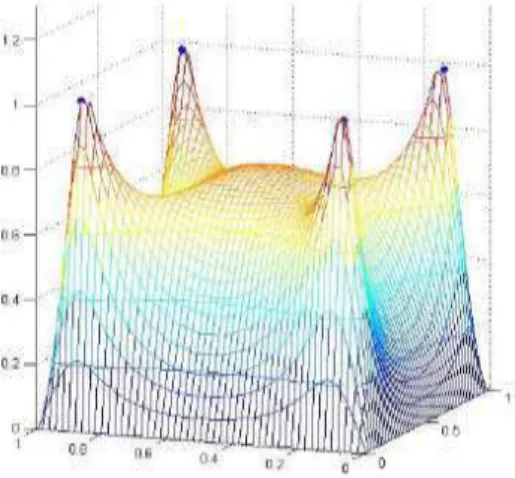
Figures 2-5 are obtained for different order and/or different points
) , ,
are not that smooth at the prescribed points. The symmetry follows from the fact the prescribed points are of the same height and distributed evenly on
S
. It is interesting to observe that as the four points spread away, the surface shows four peaks. This relates to the fact that the solution is a linear combination of four functions whose graphs look like that in Figure 1 (but with different locations of the peak).Figure 2 The surface passing through (0.5,0.5,1) with minimum curvature.
Figure 4 A surface passing through four prescribed points with minimum 1.5( )
E u .
Figure 5 Another surface passing through four prescribed points with minimum )
(
1.5 u
E
.
4
The Case
01uniqueness of such a function is guaranteed by Theorem 2.5, but as we shall see now the continuity is lost.
Recall that if
v
:=
[
a
mn]
is an element ofV
, then , =1sin 0.5 sin 0.5 = 0.
mn m n
a m n
This implies that the only element that is orthogonal to
V
is 2 2sin 0.5 sin 0.5 :=
( )
m n
u
m n
or its multiples. But then we have
2 2 1 2 2 2
2 1 ...
5 9 13 17 25 1 1
2 1 3. 5. ... 9 25 .
u
Thus V={0} or V =W, the whole space. This tells us that, starting from any initial approximation
u
0, we will end up with u=u0proj ( ) = 0V u0 , that is,0 = ) , (x y
u almost everywhere on
S
. Since we wish to keep the value 1 at(0.5,0.5), the function u cannot be continuous on
S
. For instance, if we start fromu
0(
x
,
y
)
=
sin
x
sin
y
, then we will end up with
.
0,
(0.5,0.5),
=
)
,
(
1,
=
)
,
(
therwise
o
y
x
y
x
u
This result is actually predictable in the case =0, that is, when we minimize the volume under the surface z=u(x,y), subject to the condition
0 = ,1) ( = ,0) ( = ) (1, = )
(0,y u y u x u x
u and u(0.5,0.5)=1.
To sum up, to have a continuous solution to our minimization problem, the condition >1 is not only sufficient but also necessary.
Acknowledgement
having translated our ideas into the codes. The authors also thank the referees for their useful comments on the earlier version of the paper.
References
[1] Alghofari, A.R., Problems in Analysis Related to Satellites, Ph.D. Thesis, The University of New South Wales, Sydney, 2005.
[2] Langhaar, H.L., Energy Methods in Applied Mechanics, John Wiley & Sons, New York, 1962.
[3] Gunawan, H., Pranolo, F. & Rusyaman, E., An Interpolation Method that
Minimizes an Energy Integral of Fractional Order, in D. Kapur (ed.), ASCM 2007, LNAI 5081, Springer-Verlag, 2008.
[4] Wallner, J., Existence of Set-Interpolating and Energy-Minimizing
Curves, Comput. Aided Geom. Design, 21, 883-892, 2004.
[5] Wan, W.L., Chan, T.F. & Smith, B., An Energy-Minimizing Interpolation
for Robust Multigrid Methods, SIAM J. Sci. Comput. 21, 1632-1649,
1999/2000.
[6] Ardon, R., Cohen, L.D. & Yezzi, A., Fast Surface Segmentation Guided
by User Input Using Implicit Extension of Minimal Paths, J. Math.
Imaging Vision, 25, 289-305, 2006.
[7] Benmansour, F. & Cohen, L.D., Fast Object Segmentation by Growing
Minimal Paths from A Single Point on 2D or 3D images, J. Math.
Imaging Vision, 33, 209-221, 2009.
[8] Capovilla, R. & Guven, J., Stresses in Lipid Membranes, arXiv: cond-mat/0203148v3, 2002.
[9] Stein, E.M., Singular Integrals and Differentiability Properties of
Functions, Princeton University Press, Princeton, 1971.
[10] Rao, C.R. & Rao, M.B., Matrix Algebra and Its Applications to Statistics
and Econometric, World Scientific, Singapore, 1998.
[11] Lorentz, G.G., Approximation of Functions, AMS Chelsea Publishing, Providence, 1966.
[12] Atkinson, K. & Han, W., Theoretical Numerical Analysis: A Functional