ACPD
15, 3745–3776, 2015Modeling study of PM2.5pollutant
transport across cities
C. Jiang et al.
Title Page
Abstract Introduction
Conclusions References
Tables Figures
◭ ◮
◭ ◮
Back Close
Full Screen / Esc
Printer-friendly Version
Interactive Discussion
Discussion
P
a
per
|
Discussion
P
a
per
|
Discussion
P
a
per
|
Discussion
P
a
per
|
Atmos. Chem. Phys. Discuss., 15, 3745–3776, 2015 www.atmos-chem-phys-discuss.net/15/3745/2015/ doi:10.5194/acpd-15-3745-2015
© Author(s) 2015. CC Attribution 3.0 License.
This discussion paper is/has been under review for the journal Atmospheric Chemistry and Physics (ACP). Please refer to the corresponding final paper in ACP if available.
Modeling study of PM
2.5
pollutant
transport across cities in China’s
Jing–Jin–Ji region during a severe haze
episode in December 2013
C. Jiang1, H. Wang2,3, T. Zhao1, T. Li1, and H. Che2,3
1
Nanjing University of Information Science & Technology, Nanjing 210044, China
2
Institute of Atmospheric Composition, Chinese Academy of Meteorological Sciences (CAMS), CMA, Beijing, 100081, China
3
ACPD
15, 3745–3776, 2015Modeling study of PM2.5pollutant
transport across cities
C. Jiang et al.
Title Page
Abstract Introduction
Conclusions References
Tables Figures
◭ ◮
◭ ◮
Back Close
Full Screen / Esc
Printer-friendly Version
Interactive Discussion
Discussion
P
a
per
|
Discussion
P
a
per
|
Discussion
P
a
per
|
Discussion
P
a
per
|
Abstract
To study the influence of particulate matter (PM) transported from surrounding regions on the high PM2.5pollution levels in Beijing, the GRAPES-CUACE model was used to
simulate a serious haze episode that occurred on 6–7 December 2013. The results demonstrate the model’s suitability for describing haze episodes throughout China,
es-5
pecially in the Beijing–Tianjin–Hebei (Jing–Jin–Ji) region. A very close positive correla-tion was found between the southerly wind speed over the plain to the south of Beijing and changes in PM2.5in Beijing, both reaching maximum values at ca. 900 hPa,
sug-gesting the lower atmosphere was the principal layer for pollutant PM transport from its southern neighboring region to Beijing. During haze episodes, and dependent upon the
10
period, Beijing was either a pollution source or sink for its surrounding area. PM input from Beijing’s environs was much higher than the output from the city, resulting in the most serious pollution episode, with the highest PM2.5values occurring from 00:00 to 10:00 UTC 7 December 2013. PM pollutants from the environs of the city accounted for over 50 % of the maximum PM2.5values reached in Beijing. At other times, the Beijing
15
area was a net contributor to pollution in its environs.
1 Introduction
Air pollution has become a serious problem in megacities around the world (Kanaki-dou et al., 2011), and the topic has been receiving increased attention because of the close relationship between air pollution and the atmospheric environment, human
20
health and ecosystems (Kan et al., 2012; Liu et al., 2012). China’s air pollution has become increasingly serious since the economic reforms of 1978, which allowed rapid economic development. Gross Domestic Product has grown by ca. 10 % per annum (China Statistical Yearbook, 2012, 2013). China is now considered as one of the en-gines of global economic growth, but this rapid growth has resulted in an increase in
25
ACPD
15, 3745–3776, 2015Modeling study of PM2.5pollutant
transport across cities
C. Jiang et al.
Title Page
Abstract Introduction
Conclusions References
Tables Figures
◭ ◮
◭ ◮
Back Close
Full Screen / Esc
Printer-friendly Version
Interactive Discussion
Discussion
P
a
per
|
Discussion
P
a
per
|
Discussion
P
a
per
|
Discussion
P
a
per
|
In recent years, haze has become a major pollution problem in Chinese cities (Wu et al., 2010; Du et al., 2011; Tan et al., 2011). Under the observation standards released by the China Meteorological Administration (CMA), haze is defined as a pollution phe-nomenon characterized by deteriorated horizontal visibility of<10 km, caused by fine particulate matter (PM) suspended in the atmosphere (CMA, 2003). Haze occurs when
5
sunlight is absorbed and scattered by high concentrations of atmospheric aerosols (E. Kang et al., 2013; Salinas et al., 2013). It has a negative impact on human health and the environment (Wu et al., 2005; Gurjar et al., 2010), and it changes the climate on a regional or global scale by altering solar and infrared radiation in the atmosphere (Wang et al., 2011; Yu et al., 2011; Chen et al., 2012).
10
With an increasing number of local and regional haze events reported by the me-dia, much attention has been paid to reducing air pollutant emissions and to improving air quality across the cities (Huang et al., 2013; H. Kang et al., 2013; Xu et al., 2013; Tan et al., 2014), municipalities, and provinces of China (Cheng et al., 2014; Ji et al., 2014). The Jing–Jin–Ji region, located in central-eastern China, is not one of China’s
15
most economically developed and industrialized regions, but is the area that most fre-quently experiences haze episodes (Ji et al., 2014; H. Wang, 2014a; L. T. Wang et al., 2014). Beijing, at the center of the Jing–Jin–Ji region, is one of China’s most econom-ically developed cities, and has suffered from increasingly severe haze events (Duan et al., 2012; Wang et al., 2012; Liu et al., 2014; Quan et al., 2014). It is vital that air
pol-20
lution in Beijing is studied in detail so as to inform policy aimed at averting irreversible environmental damage (Cheng et al., 2013; Zhang et al., 2014). The other areas of the Jing–Jin–Ji region should also be studied, as they are an important component of the wider region and affect Beijing directly via the transport of PM pollutants (Fu et al., 2014; Ying et al., 2014). In the present reported study, an online mesoscale haze
25
ACPD
15, 3745–3776, 2015Modeling study of PM2.5pollutant
transport across cities
C. Jiang et al.
Title Page
Abstract Introduction
Conclusions References
Tables Figures
◭ ◮
◭ ◮
Back Close
Full Screen / Esc
Printer-friendly Version
Interactive Discussion
Discussion
P
a
per
|
Discussion
P
a
per
|
Discussion
P
a
per
|
Discussion
P
a
per
|
2 Modeling
2.1 Model description
The new-generation Global/Regional Assimilation and PrEdiction System
(GRAPES_Meso) and the Chinese Unified Atmospheric Chemistry Environment (CUACE) model developed by the Chinese Academy of Meteorological Science
5
(CAMS), the CMA, were integrated to build an online chemical weather forecast-ing model, GRAPES-CUACE, focusforecast-ing especially on haze pollution forecastforecast-ing in China and East Asia (Zhang et al., 2008; Wang et al., 2009). GRAPES_Meso was adopted as the numerical weather prediction model for aerosol determination. It is a new-generation general hydrostatic/non-hydrostatic, multi-scale numerical model
10
developed by the Research Center for Numerical Meteorological Prediction, CAMS, CMA (Zhang and Shen, 2008). The model uses standardized and module-based software and has been developed in accordance with strict software engineering requirements, including program-operated parallel calculations (Xue et al., 2008). Test-ing has shown that the design and application of the model meet these prerequisites,
15
and that it can therefore serve as a good foundation for the sustainable development of a numerical prediction system for China (Chen et al., 2008). The large-scale horizontal and vertical transportation and diffusion processes for all gases and aerosols can also be processed using GRAPES_Meso’s dynamic framework (Xu et al., 2008). Again, testing has demonstrated that both the design of the model’s framework and
20
its implementation meet the requirements of real-time operational weather forecasting, especially in China and East Asia. GRAPES_Meso has therefore been used as an operational, real-time, short-term weather prediction system in China since 2009 (Yang et al., 2008; Zhu et al., 2008).
The CUACE model was developed by the CAMS Centre for Atmosphere Watch
25
ACPD
15, 3745–3776, 2015Modeling study of PM2.5pollutant
transport across cities
C. Jiang et al.
Title Page
Abstract Introduction
Conclusions References
Tables Figures
◭ ◮
◭ ◮
Back Close
Full Screen / Esc
Printer-friendly Version
Interactive Discussion
Discussion
P
a
per
|
Discussion
P
a
per
|
Discussion
P
a
per
|
Discussion
P
a
per
|
by this model of processes such as aerosol sources, transport, dry and wet depo-sition, and dust removal both in and below clouds, clearly describes the interaction between aerosols and clouds (Zhou et al., 2008). CUACE has been designed as a uni-fied chemistry model that can be easily coupled with any atmospheric model (e.g. re-gional air quality and climate models) at various temporal and spatial scales. It has
5
thus been integrated online with GRAPES_Meso to produce the GRAPES-CUACE model (Wang et al., 2009, 2010, 2014c). Dust particles are divided into 12 size bins with diameter ranges of 0.01–0.02, 0.02–0.04, 0.04–0.08, 0.08–0.16, 0.16–0.32, 0.32– 0.64, 0.64–1.28, 1.28–2.56, 2.56–5.12, 5.12–10.24, 10.24–20.48 and 20.48–40.96 µm (Gong, 2003), following guidelines provided by the measurement of soil dust size in
10
Chinese desert regions during 1994–2001 (Zhang, 2003).
2.2 Model domain and parameters
In this study, GRAPES-CUACE was used to simulate a haze episode in Decem-ber 2013. The model’s vertical cap was set at ca. 30 km, with 31 vertical layers. As shown in Fig. 1, its domain covered the East Asia region (20–55◦N, 90–140◦E) with
15
a horizontal resolution of 0.25◦
×0.25◦. National Centers for Environmental Prediction (NCEP) 1◦
×1◦ reanalysis data were used for the model’s initial and six-hour meteoro-logical lateral direction input fields. The simulation period was 1–31 December 2013. The time step was set to 300 s, the forecasting time was 48 h, and the simulation began at 00:00 UTC every day.
20
3 Data description
This study employed CMA ground visibility and operational weather observation data. The data covered mainland China, including a total of 600 ground observation stations. The daily mean PM2.5 concentrations were from surface observations made by the
China National Environmental Monitoring Center (CNEMC, http://www.cnpm25.com).
ACPD
15, 3745–3776, 2015Modeling study of PM2.5pollutant
transport across cities
C. Jiang et al.
Title Page
Abstract Introduction
Conclusions References
Tables Figures
◭ ◮
◭ ◮
Back Close
Full Screen / Esc
Printer-friendly Version
Interactive Discussion
Discussion
P
a
per
|
Discussion
P
a
per
|
Discussion
P
a
per
|
Discussion
P
a
per
|
They included values for 74 cities in mainland China. The data represented the mean values of data from different observation stations distributed in various downtown, sub-urb, and suburban areas of each city. For example, pollutant concentrations in Beijing were obtained by extracting the mean value from the data from 12 observation sites. This value was then used to represent the mean pollution conditions for each city as
5
a whole.
Detailed high-resolution emission inventories of reactive gases from emissions over China in 2007, i.e. for SO2, NOx, CO, NH3, and volatile organic compounds (VOCs),
were updated to form current emission data, based on official national emission source criteria (Cao et al., 2006, 2010). The Sparse Matrix Operator Kernel Emissions
10
(SMOKE) system was used to transform these emission data into the hourly-gridded data required by the GRAPES_CUACE model, including the five aerosol species of black carbon (BC), organic carbon (OC), sulfate, nitrate, and fugitive dust particles, in addition to 27 gases, such as VOCs, NH3, CO, CO2, SOx and NOX(An et al., 2013).
4 Results 15
4.1 Model evaluation
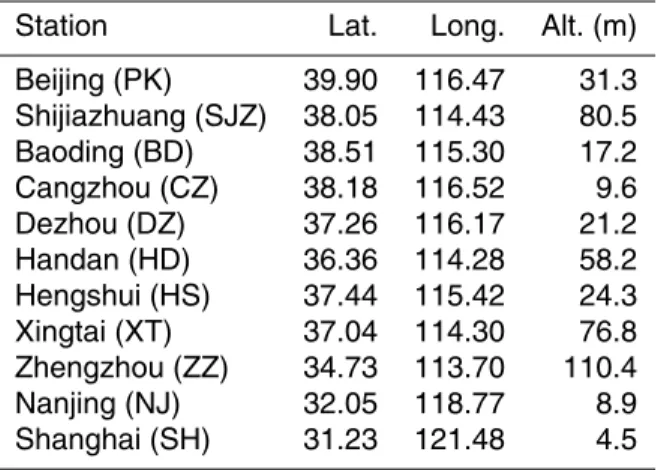
First, the simulation results were compared with the observation data from the major cities in the Jing–Jin–Ji region during the haze episode of 6–7 December to evaluate the model’s capabilities. The Jing–Jin–Ji region and the Yangtze River Delta (YRD) re-gion were the most severely polluted during 6–7 December, with mean observed PM2.5
20
values for the two-day period of ca. 200 µg m−3(Fig. 1). Simulated PM
2.5values were
similar to the observed PM2.5values for most of the cities, especially in the Jing–Jin–
Ji region (e.g. Zhangjiakou (ZJK), Chengde (CD), Qinhuangdao (QHD), Beijing (PK), Tianjin (TJ), Baoding (BD), Cangzhou (CZ), Shijiazhuang (SJZ), Hengshui (HS), Xing-tai (XT), Handan (HD), Dezhou (DZ) and Jinan (JN)). Both datasets showed that cities
25
ACPD
15, 3745–3776, 2015Modeling study of PM2.5pollutant
transport across cities
C. Jiang et al.
Title Page
Abstract Introduction
Conclusions References
Tables Figures
◭ ◮
◭ ◮
Back Close
Full Screen / Esc
Printer-friendly Version
Interactive Discussion
Discussion
P
a
per
|
Discussion
P
a
per
|
Discussion
P
a
per
|
Discussion
P
a
per
|
affected by PM2.5 during this haze episode (e.g. ZJK, CD, and QHD, with observed PM2.5concentrations of 59.1, 51.9 and 94.1 µg m−
3
, respectively, and simulated PM2.5
concentrations of 30.9, 44.3 and 60.1 µg m−3, respectively), while the cities in the cen-tral and southern sectors of the Jing–Jin–Ji region experienced severe pollution and high PM2.5 levels (e.g. PK, TJ, BD, CZ, SJZ, HS, XT, HD, DZ and JN, with observed
5
PM2.5concentrations of 194.3, 165.6, 302.1, 237.3, 268.7, 160.1, 295.1, 223.3, 224.3
and 149.9 µg m−3, respectively, and simulated PM
2.5 concentrations of 115.7, 207.1,
250.1, 267., 237.7, 326.5, 323.3, 263.6, 312.1 and 256.1 µg m−3, respectively). The modeled results thus accurately described the haze episode over the whole region.
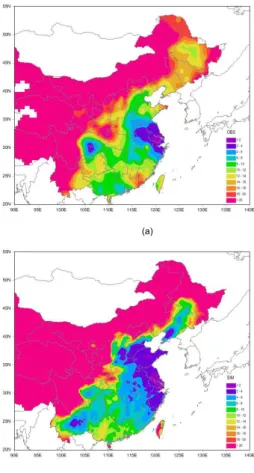
The horizontal distribution of simulated PM2.5concentrations was compared with
ob-10
served weather phenomena in eastern China. The centralized hazy weather observed in the region at 14:00 UTC 7 December 2013 corresponded with the area of high sim-ulated PM2.5(Fig. 2). Simulated PM2.5values were>150 µg m−
3
for the whole of east-ern China, with most areas of the highest concentration reaching 300 µg m−3 or even 500 µg m−3. Hazy weather was concentrated in the Jing–Jin–Ji region, i.e. Shandong,
15
Jiangsu, and Zhejiang provinces, and Shanghai. There were clearly delineated areas of high simulated PM2.5 values that corresponded with these regions. However, high
simulated PM2.5values did not match the observed PM2.5and weather phenomena for southeastern Shanxi Province, which may be because emissions were overestimated in the 2007 inventory. Simulated results will improve further once the 2010 inventory
20
can be used.
There was an obvious demarcation line with respect to observed visibility from the southwest to the northeast, dividing China into high visibility and low visibility regions, with the low visibility region centered on the YRD (Fig. 3a). The simulated visibility showed similar results (Fig. 3b), albeit it was lower than the observed visibility in
Shan-25
dong, southern Hebei and Shanxi provinces.
ACPD
15, 3745–3776, 2015Modeling study of PM2.5pollutant
transport across cities
C. Jiang et al.
Title Page
Abstract Introduction
Conclusions References
Tables Figures
◭ ◮
◭ ◮
Back Close
Full Screen / Esc
Printer-friendly Version
Interactive Discussion
Discussion
P
a
per
|
Discussion
P
a
per
|
Discussion
P
a
per
|
Discussion
P
a
per
|
values during 1–31 December 2013, to test the validity of long-term simulations. As shown in Fig. 4, the simulated daily results were fairly close to the observed values for the 6–7 December haze episode. Beginning on 6 December, this episode was most severe on 7 December; and then PM2.5 levels decreased rapidly from 8 December onwards. The simulated results for Beijing were highly consistent with the trends in
5
observed daily values for the whole of December. Simulated results for the other cities in the Jing–Jin–Ji region also showed close correlation with observed data for 6–7 De-cember, even considering that the maximum value appeared one day earlier in HS and one day later in SH. While the simulated values for NJ were lower than the observed data, they essentially exhibited the same daily trends.
10
The results obtained by GRAPES-CUACE for the Jing–Jin–Ji region through its sim-ulation of PM2.5 concentrations demonstrate the model’s suitability for studying the
impact of particulate transport on PM2.5 concentrations. The Jing–Jin–Ji region was
therefore chosen as an appropriate study area.
4.2 Wind field 15
PK is currently experiencing the severest haze pollution in its history. On the plains of Hebei to the south, the most seriously polluted area in China, haze and fog episodes are much more serious even than in Beijing. Seven of the 10 cities with the highest levels of PM2.5pollution in China are located in this region (Wang et al., 2014a, b). The
contribution made by cross-city pollutants transported from southern Hebei Province
20
to levels of PM2.5 pollution in PK is receiving much attention. The construction of the wind field over this region, particularly the wind field pattern in the planetary boundary layer (PBL), is a key factor in determining the impact of the cross-city transport of PM2.5
pollutants.
The wind field was analyzed to study the impact that PM transport from its environs
25
ACPD
15, 3745–3776, 2015Modeling study of PM2.5pollutant
transport across cities
C. Jiang et al.
Title Page
Abstract Introduction
Conclusions References
Tables Figures
◭ ◮
◭ ◮
Back Close
Full Screen / Esc
Printer-friendly Version
Interactive Discussion
Discussion
P
a
per
|
Discussion
P
a
per
|
Discussion
P
a
per
|
Discussion
P
a
per
|
direction was northwesterly and the wind speed lower in the region to the north of PK. From both the observed and simulated data (Figs. 1–3), it is apparent that the region to the south of PK was the most polluted area, with the highest PM2.5, lowest visibility and
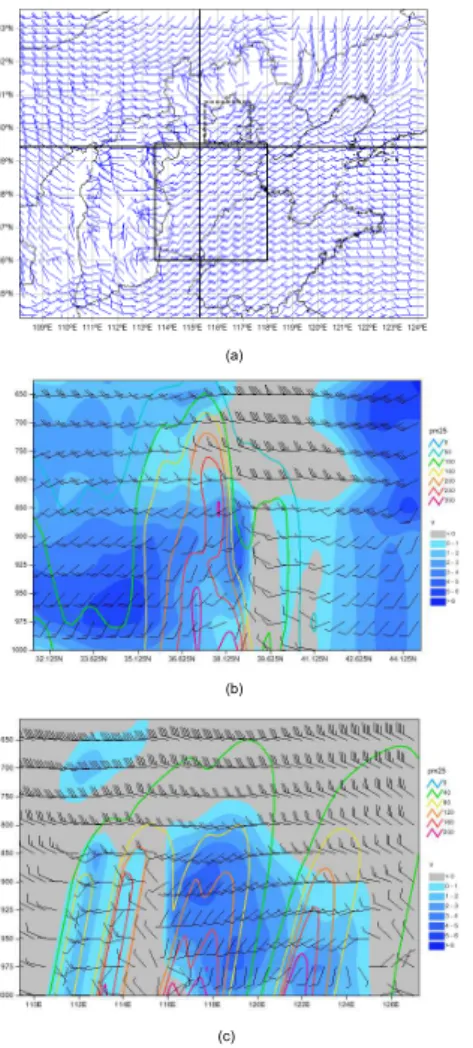
densest haze, and this region was therefore the likely main contributor to pollution levels in PK during this haze episode. The vertical section along 115.25◦E (Fig. 5b) enabled
5
us to explore the relationship between the wind field and PM2.5 concentrations and
transport at different vertical heights. Figure 5b shows a southwesterly wind at 39◦N blowing from the surface to the 800 hPa level in the region’s southern sector. In the southern sector closest to PK, the southerly wind speed reached its maximum value at ca. 900 hPa; and PM2.5also exhibited high values at the same height. Pollutants could
10
thus be transported to PK by the stable southwesterly wind from the southern environs via the 900 hPa layer. The northerly, or very weak southerly, wind in the region north of 41◦N, together with the southerly wind south of 39◦N, led to the formation of a wind convergence field over PK stretching from the surface level to 900 hPa. This would have been beneficial to the accumulation of PM2.5 and the consequent aggravation of
15
haze. The vertical section along 39.375◦N describes a southerly wind in the region to the south of PK from 116 to 125◦E (Fig. 5c). This southerly wind, extending from the surface to 800 hPa, reached its maximum velocity at 900 hPa in the area to the south of PK (116 to 118◦E). PM
2.5 concentrations were also significantly higher in this region;
pollutants from the 116–125◦E area would have been easily transported northward by
20
the southerly wind. PK was most likely affected by this process, raising pollution levels and aggravating the haze. To verify these results, we analyzed the relationship between PM2.5concentrations in PK and the wind field of the area to the south of PK (i.e. 113.5– 118◦E, 34.5–39.5◦N) (Fig. 5a). In the analysis, positive average hourly wind speed (v) values were representative of a southerly wind, and negative v values a northerly
25
wind. The results showed that, when there was southerly wind in the area to the south of PK, average PM2.5 concentrations in PK always increased (Fig. 6). This was most
ACPD
15, 3745–3776, 2015Modeling study of PM2.5pollutant
transport across cities
C. Jiang et al.
Title Page Abstract Introduction Conclusions References Tables Figures ◭ ◮ ◭ ◮ Back Close
Full Screen / Esc
Printer-friendly Version Interactive Discussion Discussion P a per | Discussion P a per | Discussion P a per | Discussion P a per |
longer periods of stable southerly winds. When there was a northerly wind in the area to the south of PK, average PM2.5concentrations in PK fell, and then stabilized.
4.3 PK’s PM2.5input and output
To investigate the contribution of PM2.5 transported from its surroundings to PK pol-lution levels, the transport rates (kg s−1) for PM
2.5 from four directions, east (E), west
5
(W), south (S) and north (N), were calculated using the following formulas:
TranN(t)= 7
X
z=1
x2 X
x=x1
PMy1(x,z,t)·∆xy1·∆zy1(x,z)·vy1(x,z,t)
TranS(t)=−
7
X
z=1
x2 X
x=x1
PMy2(x,z,t)·∆xy2·∆zy2(x,z)·vy2(x,z,t)
TranE(t)=
7
X
z=1
y2 X
y=y1
PMx
1(y,z,t)·∆y(y)·∆zx1(y,z)·ux1(y,z,t)
TranW(t)=−
7
X
z=1
y2 X
y=y1
PMx
2(y,z,t)·∆y(y)·∆zx2(y,z)·ux2(y,z,t)
10
Trannet(t)=TranN(t)+TranS(t)+TranW(t)+TranE(t)
where TranN, TranS, TranE and TranW represent the PM2.5 transport rate for N, S, E and W, respectively (Fig. 7). Positive Tran values indicated net pollutant input into PK; negative Tran values described net pollutant output from PK. PM stands for PM2.5
concentration; x1, x2 (Fig. 7) are the westernmost and easternmost PK longitudes,
15
ACPD
15, 3745–3776, 2015Modeling study of PM2.5pollutant
transport across cities
C. Jiang et al.
Title Page
Abstract Introduction
Conclusions References
Tables Figures
◭ ◮
◭ ◮
Back Close
Full Screen / Esc
Printer-friendly Version
Interactive Discussion
Discussion
P
a
per
|
Discussion
P
a
per
|
Discussion
P
a
per
|
Discussion
P
a
per
|
The constantly negative PM2.5 transport rate toward PK, reaching a maximum rate of −112.8 kg s−1 at 11:00 UTC in the southerly direction, indicated a constant output of PM2.5southward from PK to its southern environs on 6 December (Fig. 8a). Eastward
PM2.5 transport rates were largely negative before 12:00 UTC, indicating net PM2.5 output from PK downwind. After 12:00 UTC, the PM2.5 transport rate became slightly
5
positive and then remained steady, indicating a small net input in the afternoon. There was little westerly or northerly transport throughout the day.
The total input/output rate was calculated by summing the input/output transport rate for the four directions; and the net transport rate was obtained by summing the total input and output rate. Positive net transport values indicated that the PK area was
10
receiving PM2.5from its surroundings; negative net values showed PK to be exporting
PM2.5to its surroundings. The total output rate clearly exceeded the input rate, and the
net transport rate was negative, indicating a net output of pollutants from PK during the period 00:00–13:00 UTC 6 December (Fig. 8b). After 14:00 UTC, the output rate clearly fell, while the input rate remained substantially unchanged, resulting in the net transport
15
rate falling close to zero. This shows that the PK area was a source of pollutants for the areas to its east and south throughout the whole of 6 December.
For 7 December (the most polluted day in this episode), transport rate values for each direction changed substantially (Fig. 8c). There were large positive values for westerly and southerly winds, indicating major PM2.5transport from these directions to PK; and
20
this correlates with the inferences drawn from Figs. 5 and 6. The transport rate east-ward was always positive, reaching a maximum of 149.5 kg s−1 at 08:00 UTC; it was always negative in the westward direction, reaching a minimum of −174.2 kg s−1 at 12:00 UTC. This suggests that a westerly wind dominated on 7 December and trans-ported PM2.5 from the area to the west of PK to the city and to its eastern
down-25
di-ACPD
15, 3745–3776, 2015Modeling study of PM2.5pollutant
transport across cities
C. Jiang et al.
Title Page
Abstract Introduction
Conclusions References
Tables Figures
◭ ◮
◭ ◮
Back Close
Full Screen / Esc
Printer-friendly Version
Interactive Discussion
Discussion
P
a
per
|
Discussion
P
a
per
|
Discussion
P
a
per
|
Discussion
P
a
per
|
rection of input/output pollutant transport. Net pollutant output turned southward; the output rate was clearly greater than the input rate from the north during the period 12:00–24:00 UTC.
The net transport rate for PK on 7 December was positive before 10:00 UTC, rising from ca. zero to a maximum of 118.1 kg s−1 at 06:00 UTC, and then began to decline
5
to consistently negative values after 11:00 UTC (Fig. 8d). This suggests that the input of pollutants into PK exceeded the output during the period 00:00–10:00 UTC. After 11:00 UTC, input transport rates into PK were markedly reduced, resulting in a net negative transport of pollutants, indicating that PK was a source of pollutants for its environs. Combined with the results from Fig. 8c, there was net pollutant output to PK’s
10
east and south. By analyzing Fig. 8c and d, it can be seen that changes in the net transport rate for PK correlated with the transport rate southward. This was principally because westerly input and easterly output were basically equal and so offset one another. The northward transport rate was consistently low, and the variable southward transport rate therefore had an enormous influence on the PK area. These results
15
indicate that pollutant transport between PK and its southern environs had the most significant impact on pollution levels in PK in comparison to other areas.
4.4 Contribution of pollutant transport to PM2.5concentrations over PK
In order to evaluate the contribution made by pollutants transported from its environs to PK PM2.5pollution, the total PM2.5 suspended in the atmosphere between the surface
20
and a height of 3000 m over the PK area during this haze episode was calculated, according to the formula
TotalPM2.5(t)= 7
X
z=1
x1 X
x=x1 y2 X
y=y1
PM(x,y,z,t)·∆x(y,t)·∆y(y,t)·∆z(x,y,z,t),
along with the net hourly transport amount (Fig. 9). Total PM2.5 changed little
dur-ing 6 December, but did rise slightly after a small decline at 12:00 UTC when the net
ACPD
15, 3745–3776, 2015Modeling study of PM2.5pollutant
transport across cities
C. Jiang et al.
Title Page
Abstract Introduction
Conclusions References
Tables Figures
◭ ◮
◭ ◮
Back Close
Full Screen / Esc
Printer-friendly Version
Interactive Discussion
Discussion
P
a
per
|
Discussion
P
a
per
|
Discussion
P
a
per
|
Discussion
P
a
per
|
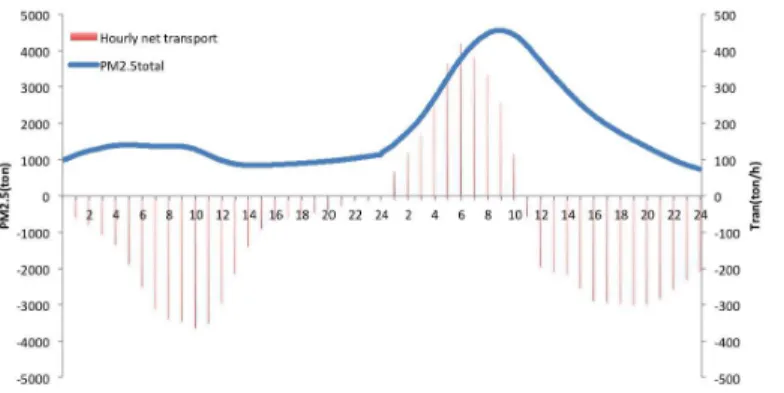
hourly output transport value decreased. The total PM2.5 amount continued rising on
7 December and began to accelerate sharply until 09:00 UTC (4555.4 t) with a large net hourly input. After 12:00 UTC, net hourly transport became highly negative, and total PM2.5 decreased rapidly. By the end of 7 December, the total PM2.5 suspended
in the atmosphere over PK was consistent with the values for 6 December. As Fig. 9
5
shows, this sharp rise in total PM2.5began at 12:00 UTC on 6 December, and ended at
12:00 UTC on 7 December, when total PM2.5reached its maximum value before
begin-ning to decrease. As the calculation results in Table 1 show, the total PM2.5suspended over the PK area increased by ca. 2727 t from 12:00 UTC 6 December to 12:00 UTC 7 December. Net input was 1497 t, accounting for 55 % of the total PM2.5 increase.
10
The remaining 1230 t could be attributed to local emissions, and accounted for 45 % of the total PM2.5 increase (Fig. 10). This suggests that the transport of particle
pollu-tants from its environs made a significant contribution to the peak PM2.5 values over
PK during this haze episode.
5 Conclusions 15
The GRAPES-CUACE online mesoscale chemical weather forecasting model was used to study the influence of PM transported from its near environs on high PM2.5 pollution levels in PK during a severe haze episode on 6–7 December 2013. Simulated results were compared with ground-level horizontal visibility, weather phenomena as observed by CMA, and surface PM2.5 concentrations observed by CNEMC, to
evalu-20
ate the model’s ability to accurately describe haze pollution in China. The 3-D wind field over the Jing–Jin–Ji region and its relationship with PM2.5 variations in PK, the
input/output pollutant transport rates for PK and its N, S, E and W environs, the total in-put, output and net pollutant transport amounts for PK, and the total PM2.5suspended
in the atmosphere over PK, were all calculated in relation to the possible contribution
25
ACPD
15, 3745–3776, 2015Modeling study of PM2.5pollutant
transport across cities
C. Jiang et al.
Title Page
Abstract Introduction
Conclusions References
Tables Figures
◭ ◮
◭ ◮
Back Close
Full Screen / Esc
Printer-friendly Version
Interactive Discussion
Discussion
P
a
per
|
Discussion
P
a
per
|
Discussion
P
a
per
|
Discussion
P
a
per
|
1. The spatial and temporal comparison of the simulated results with observational data showed that the model is capable of accurately describing haze episodes in China, and especially in the Jing–Jin–Ji region. This then formed a sound foundation for the calculation of PM transported across cities in this region.
2. There was a very close positive correlation between the southerly wind speed
5
over the area to the south of PK and PM2.5 variations in PK, suggesting the likely
important contribution made by PM transport from PK’s southern environs to the city. At 08:00 UTC on 7 December, southwesterlies from the surface to 80 hPa were largely stable in PK and its southern environs; the region north of PK was affected by a gentle wind. Both the southerly wind speed in the area to the south of PK, and PM2.5, reached
10
their maxima at ca. 900 hPa, suggesting this height served as the major transport layer for pollutants from the south to PK.
3. The PK area was a net output source for its environs for most of the haze episode during 6–7 December, except for the period from 00:00 to 10:00 UTC 7 December, when the haze was at its most serious and was accompanied by the highest PM2.5
15
values. Input from the west was more or less offset by transport eastward. The input rate from the south was much higher than the output rate to the north from 00:00 to 10:00 UTC 7 December, and there was thus a net input during this period, resulting in the most serious pollution levels and peak PM2.5values for this haze episode. This
shows that pollutant transport from the south was the major contributor to the peak
20
PM2.5pollution levels in the PK area.
4. Total PM2.5 suspended in the atmosphere from the surface to 3000 m over the
PK area changed very little during 6 December. Total PM2.5 began to rise slightly at 12:00 UTC 6 December, when the net hourly output transport rate decreased; then rose clearly at 00:00 UTC 7 December; and was followed by a rising trend that
main-25
tained until 09:00 UTC 7 December, accompanied by high net hourly input values. After 12:00 UTC, the net hourly transport rate became significantly negative as total PM2.5decreased rapidly. Total PM2.5suspended over PK increased by ca. 2727 t from
ac-ACPD
15, 3745–3776, 2015Modeling study of PM2.5pollutant
transport across cities
C. Jiang et al.
Title Page
Abstract Introduction
Conclusions References
Tables Figures
◭ ◮
◭ ◮
Back Close
Full Screen / Esc
Printer-friendly Version
Interactive Discussion
Discussion
P
a
per
|
Discussion
P
a
per
|
Discussion
P
a
per
|
Discussion
P
a
per
|
counting for 55 % of the total PM2.5 increase during this period. The remaining 1230 t could be attributed to local emissions, and accounted for 45 % of the total PM2.5
in-crease. This suggests that PM transport from its environs significantly influenced the peak PM2.5values over PK during this episode.
Acknowledgements. This work was supported by the National Basic Research Program (973)
5
(Grant No. 2014CB441201), the National Natural Scientific Foundation of China (Grant Nos. 41275007 and 41130104), the Jiangsu Collaborative Innovation Center for Climate Change-CAMS key projects (Grant No. 2013Z007), the Science and Technology Support Program of Jiangsu Province (Grant No. BE2012771), and the Priority Academic Program Development of Jiangsu Higher Education Institutions (PAPD).
10
References
An, X. Q., Sun, Z. B., Lin, W. l., Jin, M., and Li, N.: Emission inventory evaluation using obser-vations of regional atmospheric background stations of China, J. Environ. Sci., 25, 537–546, 2013.
Cao, G., Zhang, X., and Zheng, F.: Inventory of black carbon and organic carbon 446 emissions
15
from China, Atmos. Environ., 40, 6516–27, 2006.
Cao, G. L., AN, X. Q., Zhou, C. H., Ren, Y. Q., and Tu, J.: Emission inventory of air pollutants in China, Chin. Environ. Sci., 30, 900–906, 2010.
Chan, C. K. and Yao, X.: Air pollution in mega cities in China, Atmos. Environ., 42, 1–42, doi:10.1016/j.atmosenv.2007.09.003, 2008.
20
Chen, D., Xue, J., Yang, X., Zhang, H., Shen, X., Hu, J., Wang, Y., Ji, L., and Chen, J.: New generation of multi-scale NWP system (GRAPES): general scientific design, Chinese Sci. Bull., 53, 3433–3445, doi:10.1007/s11434-008-0494-z, 2008.
Chen, Y., Liu, Q., Geng, F., Zhang, H., Cai, C., Xu, T., Ma, X., and Li, H.: Vertical distribu-tion of optical and micro-physical properties of ambient aerosols during dry haze periods in
25
Shanghai, Atmos. Environ., 50, 50–59, doi:10.1016/j.atmosenv.2012.01.002, 2012.
ACPD
15, 3745–3776, 2015Modeling study of PM2.5pollutant
transport across cities
C. Jiang et al.
Title Page
Abstract Introduction
Conclusions References
Tables Figures
◭ ◮
◭ ◮
Back Close
Full Screen / Esc
Printer-friendly Version
Interactive Discussion
Discussion
P
a
per
|
Discussion
P
a
per
|
Discussion
P
a
per
|
Discussion
P
a
per
|
Cheng, Z., Wang, S., Fu, X., Watson, J. G., Jiang, J., Fu, Q., Chen, C., Xu, B., Yu, J., Chow, J. C., and Hao, J.: Impact of biomass burning on haze pollution in the Yangtze River delta, China: a case study in summer 2011, Atmos. Chem. Phys., 14, 4573–4585, doi:10.5194/acp-14-4573-2014, 2014.
China Statistical Yearbook 2012, 2013, National Bureau of Statistics of China, China Statistics
5
Press, Beijing, 2012, 2013.
CMA: Specifications for the Surface Meteorological Observations, Meteoro-logical Press, Bei-jing, China (in Chinese), 2003.
Du, H., Kong, L., Cheng, T., Chen, J., Du, J., Li, L., Xia, X., Leng, C., and Huang, G.: Insights into summertime haze pollution events over Shanghai based on online water-soluble ionic
com-10
position of aerosols, Atmos. Environ., 45, 5131–5137, doi:10.1016/j.atmosenv.2011.06.027, 2011.
Duan, J., Guo, S., Tan, J., Wang, S., and Chai, F.: Characteristics of atmospheric carbonyls during haze days in Beijing, China, Atmos. Res., 114–115, 17–27, doi: 10.1016/j.atmosres.2012.05.010, 2012.
15
Fu, X., Wang, S. X., Cheng, Z., Xing, J., Zhao, B., Wang, J. D., and Hao, J. M.: Source, transport and impacts of a heavy dust event in the Yangtze River Delta, China, in 2011, Atmos. Chem. Phys., 14, 1239–1254, doi:10.5194/acp-14-1239-2014, 2014.
Gong, S. L.: Characterization of soil dust aerosol in China and its transport and distribu-tion during 2001 ACE-Asia: 2. Model simuladistribu-tion and validadistribu-tion, J. Geophys. Res., 108,
20
doi:10.1029/2002jd002633, 2003.
Gong, S. L. and Zhang, X. Y.: CUACE/Dust – an integrated system of observation and mod-eling systems for operational dust forecasting in Asia, Atmos. Chem. Phys., 8, 2333–2340, doi:10.5194/acp-8-2333-2008, 2008.
Gurjar, B. R., Jain, A., Sharma, A., Agarwal, A., Gupta, P., Nagpure, A. S., and Lelieveld, J.:
25
Human health risks in megacities due to air pollution, Atmos. Environ., 44, 4606–4613, doi:10.1016/j.atmosenv.2010.08.011, 2010.
Huang, K., Zhuang, G., Lin, Y., Wang, Q., Fu, J. S., Fu, Q., Liu, T., and Deng, C.: How to improve the air quality over megacities in China: pollution characterization and source analysis in Shanghai before, during, and after the 2010 World Expo, Atmos. Chem. Phys., 13, 5927–
30
5942, doi:10.5194/acp-13-5927-2013, 2013.
ACPD
15, 3745–3776, 2015Modeling study of PM2.5pollutant
transport across cities
C. Jiang et al.
Title Page
Abstract Introduction
Conclusions References
Tables Figures
◭ ◮
◭ ◮
Back Close
Full Screen / Esc
Printer-friendly Version
Interactive Discussion
Discussion
P
a
per
|
Discussion
P
a
per
|
Discussion
P
a
per
|
Discussion
P
a
per
|
in northern China in January, 2013: insights gained from observation, Atmos. Environ., 92, 546–556, doi:10.1016/j.atmosenv.2014.04.048, 2014.
Kan, H., Chen, R., and Tong, S.: Ambient air pollution, climate change, and population health in China, Environ Int., 42, 10–19, doi:10.1016/j.envint.2011.03.003, 2012.
Kanakidou, M., Mihalopoulos, N., Kindap, T., Im, U., Vrekoussis, M., Gerasopoulos, E.,
Der-5
mitzaki, E., Unal, A., Koçak, M., Markakis, K., Melas, D., Kouvarakis, G., Youssef, A. F., Richter, A., Hatzianastassiou, N., Hilboll, A., Ebojie, F., Wittrock, F., von Savigny, C., Burrows, J. P., Ladstaetter-Weissenmayer, A., and Moubasher, H.: Megacities as hot spots of air pollution in the East Mediterranean, Atmos. Environ., 45, 1223–1235, doi: 10.1016/j.atmosenv.2010.11.048, 2011.
10
Kang, E., Han, J., Lee, M., Lee, G., and Kim, J. C.: Chemical characteristics of size-resolved aerosols from Asian dust and haze episode in Seoul Metropolitan City, Atmos. Res., 127, 34–46, doi:10.1016/j.atmosres.2013.02.002, 2013.
Kang, H., Zhu, B., Su, J., Wang, H., Zhang, Q., and Wang, F.: Analysis of a long-lasting haze episode in Nanjing, China, Atmos. Res., 120–121, 78–87, doi:
15
10.1016/j.atmosres.2012.08.004, 2013.
Liu, Q., Liu, Y., Yin, J., Zhang, M., and Zhang, T.: Chemical characteristics and source ap-portionment of PM10 during Asian dust storm and non-dust storm days in Beijing, Atmos. Environ., 91, 85–94, doi:10.1016/j.atmosenv.2014.03.057, 2014.
Liu, W.-T., Hsieh, H.-C., Chen, S.-P., Chang, J. S., Lin, N.-H., Chang, C.-C.,
20
and Wang, J.-L.: Diagnosis of air quality through observation and modeling of volatile organic compounds (VOCs) as pollution tracers, Atmos. Environ., 55, 56–63, doi:10.1016/j.atmosenv.2012.03.017, 2012.
Quan, J., Tie, X., Zhang, Q., Liu, Q., Li, X., Gao, Y., and Zhao, D.: Characteristics of heavy aerosol pollution during the 2012–2013 winter in Beijing, China, Atmos. Environ., 88, 83–89,
25
doi:10.1016/j.atmosenv.2014.01.058, 2014.
Salinas, S. V., Chew, B. N., Miettinen, J., Campbell, J. R., Welton, E. J., Reid, J. S., Yu, L. E., and Liew, S. C.: Physical and optical characteristics of the October 2010 haze event over Singapore: a photometric and lidar analysis, Atmos. Res., 122, 555–570, doi:10.1016/j.atmosres.2012.05.021, 2013.
30
ACPD
15, 3745–3776, 2015Modeling study of PM2.5pollutant
transport across cities
C. Jiang et al.
Title Page
Abstract Introduction
Conclusions References
Tables Figures
◭ ◮
◭ ◮
Back Close
Full Screen / Esc
Printer-friendly Version
Interactive Discussion
Discussion
P
a
per
|
Discussion
P
a
per
|
Discussion
P
a
per
|
Discussion
P
a
per
|
Tan, J., Yang, L., Grimmond, C. S. B., Shi, J., Gu, W., Chang, Y., Hu, P., Sun, J., Ao, X., and Han, Z.: Urban integrated meteorological observations: practice and experience in Shanghai, China, B. Am. Meteorol. Soc., 140602092802009, doi:10.1175/bams-d-13-00216.1, 2014. Wang, G., Chen, C., Li, J., Zhou, B., Xie, M., Hu, S., Kawamura, K., and Chen, Y.: Molecular
composition and size distribution of sugars, sugar-alcohols and carboxylic acids in airborne
5
particles during a severe urban haze event caused by wheat straw burning, Atmos. Environ., 45, 2473–2479, doi:10.1016/j.atmosenv.2011.02.045, 2011.
Wang, H., Gong, S., Zhang, H., Chen, Y., Shen, X., Chen, D., Xue, J., Shen, Y., Wu, X., and Jin, Z.: A new-generation sand and dust storm forecasting system GRAPES_CUACE/Dust: model development, verification and numerical simulation, Chinese Sci. Bull., 55, 635–649,
10
doi:10.1007/s11434-009-0481-z, 2009.
Wang, H., Zhang, X., Gong, S., Chen, Y., Shi, G., and Li, W.: Radiative feedback of dust aerosols on the East Asian dust storms, J. Geophys. Res., 115, doi:10.1029/2009jd013430, 2010.
Wang, H., Shi, G., Zhu, J., Chen, B., Che, H., and Zhao, T.: Case study of longwave
15
contribution to dust radiative effects over East Asia, Chinese Sci. Bull., 58, 3673–3681, doi:10.1007/s11434-013-5752-z, 2013.
Wang, H., Tan, S.-C., Wang, Y., Jiang, C., Shi, G.-y., Zhang, M.-X., and Che, H.-Z.: A mul-tisource observation study of the severe prolonged regional haze episode over eastern China in January 2013, Atmos. Environ., 89, 807–815, doi:10.1016/j.atmosenv.2014.03.004,
20
2014a.
Wang, H., Xu, J., Zhang, M., Yang, Y., Shen, X., Wang, Y., Chen, D., and Guo, J.: A study of the meteorological causes of a prolonged and severe haze episode in January 2013 over central-eastern China, Atmos. Environ., 98, 146–157, doi:10.1016/j.atmosenv.2014.08.053, 2014b.
25
Wang, H., Shi, G. Y., Zhang, X. Y., Gong, S. L., Tan, S. C., Chen, B., Che, H. Z., and Li, T.: Mesoscale modeling study of the interactions between aerosols and PBL meteorology during a haze episode in China Jing-Jin-Ji and its near surrounding region – Part 2: Aerosols’ radia-tive feedback effects, Atmos. Chem. Phys. Discuss., 14, 28269–28298, doi:10.5194/acpd-14-28269-2014, 2014.c.
30
ACPD
15, 3745–3776, 2015Modeling study of PM2.5pollutant
transport across cities
C. Jiang et al.
Title Page
Abstract Introduction
Conclusions References
Tables Figures
◭ ◮
◭ ◮
Back Close
Full Screen / Esc
Printer-friendly Version
Interactive Discussion
Discussion
P
a
per
|
Discussion
P
a
per
|
Discussion
P
a
per
|
Discussion
P
a
per
|
Wang, L. T., Wei, Z., Yang, J., Zhang, Y., Zhang, F. F., Su, J., Meng, C. C., and Zhang, Q.: The 2013 severe haze over southern Hebei, China: model evaluation, source apportionment, and policy implications, Atmos. Chem. Phys., 14, 3151–3173, doi:10.5194/acp-14-3151-2014, 2014.
Wu, D., Tie, X., Li, C., Ying, Z., Kai-Hon Lau, A., Huang, J., Deng, X., and Bi, X.: An extremely
5
low visibility event over the Guangzhou region: a case study, Atmos. Environ., 39, 6568– 6577, doi:10.1016/j.atmosenv.2005.07.061, 2005.
Wu, D., Wu, X. J., Li, F., Tan, J., Chen, Z. Q., Cao, X., Sun, H. H., Chen, and Li, H. Y.: Temporal and spatial variation of haze during 1951–2005 in Chinese mainland, Meteorologica Sinica, 68, 680–688, 2010.
10
Xu, G., Chen, D., Xue, J., Sun, J., Shen, X., Shen, Y., Huang, L., Wu, X., Zhang, H., and Wang, S.: The program structure designing and optimizing tests of GRAPES physics, Chi-nese Sci. Bull., 53, 3470–3476, doi:10.1007/s11434-008-0418-y, 2008.
Xu, H. M., Tao, J., Ho, S. S. H., Ho, K. F., Cao, J. J., Li, N., Chow, J. C., Wang, G. H., Han, Y. M., Zhang, R. J., Watson, J. G., and Zhang, J. Q.: Characteristics of fine particulate non-polar
or-15
ganic compounds in Guangzhou during the 16th Asian Games: effectiveness of air pollution controls, Atmos. Environ., 76, 94–101, doi: 10.1016/j.atmosenv.2012.12.037, 2013. Xue, J., Zhuang, S., Zhu, G., Zhang, H., Liu, Z., Liu, Y., and Zhuang, Z.: Scientific design and
preliminary results of three-dimensional variational data assimilation system of GRAPES, Chinese Sci. Bull., 53, 3446–3457, doi:10.1007/s11434-008-0416-0, 2008.
20
Yang, X., Hu, J., Chen, D., Zhang, H., Shen, X., Chen, J., and Ji, L.: Verification of GRAPES unified global and regional numerical weather prediction model dynamic core, Chinese Sci. Bull., 53, 3458–3464, doi: 10.1007/s11434-008-0417-z, 2008.
Ying, Q., Wu, L., and Zhang, H.: Local and inter-regional contributions to PM2.5 nitrate and sulfate in China, Atmos. Environ., doi:10.1016/j.atmosenv.2014.05.078, 2014.
25
Yu, X., Zhu, B., Yin, Y., Yang, J., Li, Y., and Bu, X.: A comparative analysis of aerosol prop-erties in dust and haze-fog days in a Chinese urban region, Atmos. Res., 99, 241–247, doi:10.1016/j.atmosres.2010.10.015, 2011.
Zhang, R. and Shen, X.: On the development of the GRAPES – a new generation of the national operational NWP system in China, Chinese Sci. Bull., 53, 3429–3432, doi:
10.1007/s11434-30
008-0462-7, 2008.
ACPD
15, 3745–3776, 2015Modeling study of PM2.5pollutant
transport across cities
C. Jiang et al.
Title Page
Abstract Introduction
Conclusions References
Tables Figures
◭ ◮
◭ ◮
Back Close
Full Screen / Esc
Printer-friendly Version
Interactive Discussion
Discussion
P
a
per
|
Discussion
P
a
per
|
Discussion
P
a
per
|
Discussion
P
a
per
|
for the most stringent vehicle emission control program in China, Atmos. Environ., 89, 216– 229, doi:10.1016/j.atmosenv.2013.12.002, 2014.
Zhang, X. Y.: Sources of Asian dust and role of climate change versus desertification in Asian dust emission, Geophys. Res. Lett., 30, doi:10.1029/2003gl018206, 2003.
Zhou, C. H., Gong, S. L., Zhang, X. Y., Wang, Y. Q., Niu, T., Liu, H. L., Zhao, T. L., Yang, Y. Q.,
5
and Hou, Q.: Development and evaluation of an operational SDS forecasting system for East Asia: CUACE/Dust, Atmos. Chem. Phys., 8, 787–798, doi:10.5194/acp-8-787-2008, 2008. Zhu, G., Xue, J., Zhang, H., Liu, Z., Zhuang, S., Huang, L., and Dong, P.: Direct assimilation
of satellite radiance data in GRAPES variational assimilation system, Chinese Sci. Bull., 53, 3465–3469, doi:10.1007/s11434-008-0419-x, 2008.
ACPD
15, 3745–3776, 2015Modeling study of PM2.5pollutant
transport across cities
C. Jiang et al.
Title Page
Abstract Introduction
Conclusions References
Tables Figures
◭ ◮
◭ ◮
Back Close
Full Screen / Esc
Printer-friendly Version
Interactive Discussion
Discussion
P
a
per
|
Discussion
P
a
per
|
Discussion
P
a
per
|
Discussion
P
a
per
|
Table 1.Total input, total output and total net transport (all in tons) for the PK area for each time period (UTC) during 6–7 December 2013.
Time Input Output Net 00:00–12:00 6 Dec 2032 −4854 −2822
12:00–24:00 6 Dec 1850 −2617 −767
00:00–12:00 7 Dec 6551 −4288 2264
12:00–24:00 7 Dec 3523 −6653 −3130
00:00–24:00 6 Dec 3882 −7471 −3588
00:00–24:00 7 Dec 10 074 −10 940 −866
00:00 6 Dec–24:00 7 Dec 13 956 −18 411 −4455
ACPD
15, 3745–3776, 2015Modeling study of PM2.5pollutant
transport across cities
C. Jiang et al.
Title Page
Abstract Introduction
Conclusions References
Tables Figures
◭ ◮
◭ ◮
Back Close
Full Screen / Esc
Printer-friendly Version
Interactive Discussion
Discussion
P
a
per
|
Discussion
P
a
per
|
Discussion
P
a
per
|
Discussion
P
a
per
|
Table 2.Station locations.
ACPD
15, 3745–3776, 2015Modeling study of PM2.5pollutant
transport across cities
C. Jiang et al.
Title Page
Abstract Introduction
Conclusions References
Tables Figures
◭ ◮
◭ ◮
Back Close
Full Screen / Esc
Printer-friendly Version
Interactive Discussion
Discussion
P
a
per
|
Discussion
P
a
per
|
Discussion
P
a
per
|
Discussion
P
a
per
|
Figure 1.Mean observed and simulated PM2.5(µg m−3
ACPD
15, 3745–3776, 2015Modeling study of PM2.5pollutant
transport across cities
C. Jiang et al.
Title Page
Abstract Introduction
Conclusions References
Tables Figures
◭ ◮
◭ ◮
Back Close
Full Screen / Esc
Printer-friendly Version
Interactive Discussion
Discussion
P
a
per
|
Discussion
P
a
per
|
Discussion
P
a
per
|
Discussion
P
a
per
|
ACPD
15, 3745–3776, 2015Modeling study of PM2.5pollutant
transport across cities
C. Jiang et al.
Title Page
Abstract Introduction
Conclusions References
Tables Figures
◭ ◮
◭ ◮
Back Close
Full Screen / Esc
Printer-friendly Version
Interactive Discussion
Discussion
P
a
per
|
Discussion
P
a
per
|
Discussion
P
a
per
|
Discussion
P
a
per
|
(a)
(b)
ACPD
15, 3745–3776, 2015Modeling study of PM2.5pollutant
transport across cities
C. Jiang et al.
Title Page
Abstract Introduction
Conclusions References
Tables Figures
◭ ◮
◭ ◮
Back Close
Full Screen / Esc
Printer-friendly Version
Interactive Discussion
Discussion
P
a
per
|
Discussion
P
a
per
|
Discussion
P
a
per
|
Discussion
P
a
per
|
Figure 4.Daily variations in observed and simulated PM2.5(µg m−3) for 1–31 December 2013
ACPD
15, 3745–3776, 2015Modeling study of PM2.5pollutant
transport across cities
C. Jiang et al.
Title Page
Abstract Introduction
Conclusions References
Tables Figures
◭ ◮
◭ ◮
Back Close
Full Screen / Esc
Printer-friendly Version
Interactive Discussion
Discussion
P
a
per
|
Discussion
P
a
per
|
Discussion
P
a
per
|
Discussion
P
a
per
|
(a)
(b)
(c)
Figure 5. (a) Horizontal wind field at 900 hPa, its vertical section at (b) 115.25◦E and (c)
ACPD
15, 3745–3776, 2015Modeling study of PM2.5pollutant
transport across cities
C. Jiang et al.
Title Page
Abstract Introduction
Conclusions References
Tables Figures
◭ ◮
◭ ◮
Back Close
Full Screen / Esc
Printer-friendly Version
Interactive Discussion
Discussion
P
a
per
|
Discussion
P
a
per
|
Discussion
P
a
per
|
Discussion
P
a
per
|
Figure 6.Hourly variations in PM2.5(µg m−3) in PK and mean southerly wind speed (negative
ACPD
15, 3745–3776, 2015Modeling study of PM2.5pollutant
transport across cities
C. Jiang et al.
Title Page
Abstract Introduction
Conclusions References
Tables Figures
◭ ◮
◭ ◮
Back Close
Full Screen / Esc
Printer-friendly Version
Interactive Discussion
Discussion
P
a
per
|
Discussion
P
a
per
|
Discussion
P
a
per
|
Discussion
P
a
per
|
ACPD
15, 3745–3776, 2015Modeling study of PM2.5pollutant
transport across cities
C. Jiang et al.
Title Page
Abstract Introduction
Conclusions References
Tables Figures
◭ ◮
◭ ◮
Back Close
Full Screen / Esc
Printer-friendly Version
Interactive Discussion
Discussion
P
a
per
|
Discussion
P
a
per
|
Discussion
P
a
per
|
Discussion
P
a
per
|
(a)
(c)
(b)
(d)
Figure 8.PM2.5transport rates (kg s−1) from S, N, W and E of PK on(a)6 and(c)7 December.
Total input, output and net PM2.5 transport rate (kg s−1) from PK’s environs on (b) 6 and(d)
ACPD
15, 3745–3776, 2015Modeling study of PM2.5pollutant
transport across cities
C. Jiang et al.
Title Page
Abstract Introduction
Conclusions References
Tables Figures
◭ ◮
◭ ◮
Back Close
Full Screen / Esc
Printer-friendly Version
Interactive Discussion
Discussion
P
a
per
|
Discussion
P
a
per
|
Discussion
P
a
per
|
Discussion
P
a
per
|
ACPD
15, 3745–3776, 2015Modeling study of PM2.5pollutant
transport across cities
C. Jiang et al.
Title Page
Abstract Introduction
Conclusions References
Tables Figures
◭ ◮
◭ ◮
Back Close
Full Screen / Esc
Printer-friendly Version
Interactive Discussion
Discussion
P
a
per
|
Discussion
P
a
per
|
Discussion
P
a
per
|
Discussion
P
a
per
|