www.epjournal.net – 2012. 10(2): 296-319
¯ ¯ ¯ ¯ ¯ ¯ ¯ ¯ ¯ ¯ ¯ ¯ ¯ ¯ ¯ ¯ ¯ ¯ ¯ ¯ ¯ ¯ ¯ ¯ ¯ ¯ ¯ ¯
Original Article
Dominance-Popularity Status, Behavior, and the Emergence of Sexual
Activity in Young Adolescents
Eddy H. de Bruyn, Institute of Educational and Behavioral Studies, Amsterdam, The Netherlands. Email:
Antonius H. N. Cillessen, Radboud Universiteit Nijmegen and University of Connecticut, The Netherlands and USA.
Glenn E. Weisfeld, Wayne State University, USA.
Abstract: In this paper, we investigated the sexual activity levels of several subtypes of middle adolescents (age 14-15 years). The subtype profiles were based on dominance-popularity status and a range of behaviors associated with dominance and dominance-popularity. In addition, gender differences in behavioral profiles were examined among dominant-popular, sexually active young adolescents. Results showed that socially dominant and popular young adolescent boys who exhibited a highly aggressive profile were more sexually active than their low-status and non-aggressive male peers; dominant-popular girls who were very attractive and gossips were more sexually active than their female peers. The results are discussed from an evolutionary psychological framework.
Keywords: dominance, popularity, peer status, sexual activity, young adolescence, aggression, attractiveness
¯ ¯ ¯ ¯ ¯ ¯ ¯ ¯ ¯ ¯ ¯ ¯ ¯ ¯ ¯ ¯ ¯ ¯ ¯ ¯ ¯ ¯ ¯ ¯ ¯ ¯ ¯ ¯ ¯ ¯ ¯ ¯ ¯ ¯ ¯ ¯ ¯ ¯ ¯ ¯ ¯ ¯ ¯ ¯ ¯ ¯ ¯ ¯ ¯ ¯ ¯ ¯ ¯ ¯ ¯ ¯ ¯ ¯ ¯ ¯ ¯ ¯ ¯ ¯ ¯ ¯ ¯ ¯ ¯ ¯ ¯ ¯ ¯ Introduction
Evolutionary Psychology – ISSN 1474-7049 – Volume 10(2). 2012. -297-
Rose, 2005; Cillessen and Borch, 2006; Dong, Weisfeld, Boardway, and Shen, 1996; Weisfeld, 1987). Second, emerging sexuality is fundamental to adolescence (Schlegel, 1995; Weisfeld, 1999; Weisfeld and Woodward, 2004). However, in middle adolescence (14-15 years), access to mating opportunities is still a scarce resource, with mating opportunities for some but not for others. We therefore hypothesized that high-status middle adolescent individuals would be more sexually active than low-status middle adolescent individuals.
Evolutionary Psychology: Status and Reproductive Success
Behavioral theories concerning sexual behavior, such as Sexual Selection Theory (e.g., Andersson, 1994; Daly and Wilson, 1983; Darwin, 1871; Trivers, 1972) and Sexual Strategies Theory (e.g., Buss, 2003) are firmly embedded in an evolutionary framework and have successfully predicted one important reward that is bestowed on high-status individuals: more mating opportunities and thus increased reproductive success (Barkow, 1989), particularly for males of most species. According to Betzig (1986), “hierarchical power should predict a biased outcome in conflict resolution, which should in turn predict size of the winner’s harem, for men, a measure of success in reproduction” (p. 9). This is true for human adults in many cultures, both ‘modern’ as well as ‘primitive’ (Betzig, 1986). In fact, this theory seems to be confirmed for non-human primates (Cheney, 1983; Cowlishaw and Dunbar, 1991; Dewsbury, 1982; Gray, 1985; Maslow, 1936) and other animals from widely differing ecologies (Ellis, 1995) such as squirrels (Farentinos, 1972), cockerels (Kratzer and Craig, 1980), and cockroaches (Breed, Smith, and Gall, 1980).
For females, it is generally argued that dominance is not necessarily a path to more copulations, as it is for males. It appears that important benefits bestowed upon dominant women are access to resources and less harassment from rivals (Campbell, 2002). Thus, dominant females tend to have higher offspring survival rates, at least among simians (Pusey, Williams, and Goodall, 1997); thus, dominance among females also appears to be linked to reproductive success.
In humans, status hierarchies are continuously present across ontogeny, starting at the age at which children first interact in small groups. Consequently, hierarchies based on dominance, prestige, or consensual popularity are found among preschoolers (e.g., Hawley, Johnson, Mize, and McNamara, 2007; Hawley and Little, 1999; Pellegrini, Roseth, Milner, Bohn, Van Ryzin, Vance, Cheatham, and Tarullo, 2007; Strayer and Strayer, 1976), in childhood (Omark, Omark, and Edelman, 1975; Zeller, Vannatta, Shafer, and Noll, 2003), in adolescence (De Bruyn and Cillessen, 2006a, 2006b; Hawley, 2003; Savin-Wiliams, 1976; 1977; 1979; 1980a; 1980b), and in adulthood (Austin and Bates, 1974; Cummins, 2005; Hawley, 1999). From a Darwinian view, high status should carry some kind of reward or privilege (Henrich and Gil-White, 2001). These rewards range from toys in toddlerhood to an increase in quality and quantity of mates in adulthood.
Status Hierarchies in Middle Adolescence
Evolutionary Psychology – ISSN 1474-7049 – Volume 10(2). 2012. -298-
middle adolescence. The main status hierarchy in middle adolescence is based on
dominance, prestige, and reputation, often referred to as perceived popularity (Cillessen
and Rose, 2005; Parkhurst and Hopmeyer, 1998), judgmental popularity (Babad, 2001),
reputational popularity (Prinstein and Cillessen, 2003), or consensual popularity (De Bruyn and Van den Boom, 2005; De Bruyn and Cillessen, 2006a). The last term reflects the fact that this type of popularity does not measure personal liking but the shared view of the
peer group of who is socially dominant or socially central. The terms social dominance and
consensual popularity are both in common usage in the child and adolescent psychological
literature. However, the term popularity never applies to non-humans, and considering that
the present article intends to provide an evolutionarily framed explanation of adolescent behavior by drawing on information from both animal and human research, we decided to
use the term dominant-popular to indicate adolescent individuals who are at the top of the
social dominance cum reputation-based popularity hierarchy.
Dominant-popular middle adolescents tend to be attractive, fashionable, athletic (especially in the US, but less so in, for instance, China, e.g., Dong, et al., 1996), and aggressive and high in bullying (Cillessen and Mayeux, 2004; Cillessen and Rose, 2005; De Bruyn and Cillessen, 2006a, 2006b, 2010; Parkhurst and Hopmeyer, 1998). Thus, in most modern Western societies, the dominance-popularity hierarchy in middle adolescence is a well-described hierarchical organization of which individuals at the high end exhibit an idiosyncratic behavioral profile based on a combination of attractiveness, sartorial finesse, and aggression or fighting ability.
Sex as a Scarce Resource in Middle Adolescence
In Western societies, most middle adolescence children enter pubescence. Pubescence is sexual maturation and, not surprisingly, an important main motivational change takes place in middle adolescence around sexual behavior (Jones and Bayley, 1950; Weisfeld, 1999). In middle adolescence, sexual relationships are becoming an important, yet scarce, resource for both boys and girls (Pellegrini and Bartini, 2001). Thus, it appears that some adolescents have many partners, some have one, but the majority has none (Sorensen, 1973; Laumann, Gagnon, Michael, and Michaels, 1994) making middle adolescence a time of great competitiveness for the same sexually active peers. Cultural variability between Western and tribal societies does exist, where in the majority of tribal societies, premarital sex during puberty is typical for boys and girls (Broude and Greene, 1976). However, the present article is concerned with a typical modern society in Western Europe.
Although the idea of sexual relationships has firmly inundated the adolescent mind, taking the first step of approach or flirtation towards someone else is risky. By doing so, an adolescent crosses the boundary of sex-segregation that has been in place since middle childhood (Maccoby 1998; Pellegrini and Long, 2003). Any initiative towards a member of the opposite sex may end in rejection and public humiliation. Thus, it is hypothesized that it takes an adolescent with a certain behavioral repertoire and status to cross that boundary. It is unlikely that this type of middle adolescent is at the bottom of the peer group hierarchy, but is more likely to be a high-status, dominant-popular peer.
Evolutionary Psychology – ISSN 1474-7049 – Volume 10(2). 2012. -299-
Several studies point towards the notion that adolescents who display behaviors typical of dominant-popular peers are more sexually active than low-ranking ones. For instance, Mazur, Halpern, and Udry (1994) revealed that dominant looking males had more coital opportunities than submissive looking ones. Adolescent boys high in toughness and fighting ability appeared popular with girls (Feldman and Weisfeld, 1973) and bullies have been found to date relatively early (Connolly, Pepler, Craig, and Taradash, 2000). More recent studies in the US have reported a positive association between dominance-popularity status and sexual activity (Mayeux, Sandstrom, and Cillessen, 2008) and the practice of oral sex (Prinstein, Meade and Cohen, 2003), both studies conducted among older adolescents. However, we were unable to find studies of the relationship between dominance-popularity status and actual sexual activity in middle adolescence. Pellegrini and Bartini (2001) and Pellegrini and Long (2003) probably have come closest to confirming this relationship by using dating popularity as a proxy for sexual activity. The present study was designed to fill this lacuna by asking middle adolescents about their actual sexual activity. Therefore:
Hypothesis 1: High dominant-popular adolescents report higher sexual activity levels than their low dominant-popular peers.
Dominance-Popularity and Gender Differences in Behavior
An important question is whether we should expect gender differences in the behavioral repertoire associated with dominance and sexual activity. Barkow (1989) predicted that intersexual (mate choice) selection by females depends on three criteria.
First, desirable males should possess an agonistic quality based on physique; second,
desirable males should show willingness to provide parental investment; and third, they
should display the ability for parental investment. However, parental investment should
matter less in middle adolescence than in adulthood, considering the fluidity of dating in middle adolescence and the preponderance of short-term relationships (Laumann, et al., 1994; Sorensen, 1973). Relevant to this line of reasoning is that adult women, when seeking short-term relationships, placed great emphasis on adult male physical prowess (Buss and Schmitt, 1993). Also, Campbell (1995; 1999) argued that the rise in male aggression found in early adolescence (e.g., Björkvist, Lagerspetz, and Kaukianen, 1992) was likely due to both intrasexual competition with the aim of subduing rivals, and intersexual competition with the aim of displaying attributes that attract females (Campbell, 1999). In the case of middle adolescent males, both strategies are greatly abetted by physical strength and agonistic behavior. Pellegrini and colleagues (Pellegrini and Bartini, 2001; Pellegrini and Long, 2003) also showed that aggression to gain dominance was positively related to hypothetical dating preference. The present research will look at sexual activity level instead of hypothetical dating preferences. Therefore, we expected a strong association among middle adolescent males between aggression and sexual activity. Hence:
Hypothesis 2: Sexually active middle adolescent boys are high in fighting and bullying behaviors.
Evolutionary Psychology – ISSN 1474-7049 – Volume 10(2). 2012. -300-
(1995; 1999; 2002, 2004) argued that females use both passive and active strategies towards intersexual mate attraction and intrasexual competition. The passive strategy is a demonstration of attributes that are valued highly by males, such as youth and beauty. Several studies among adults have demonstrated this strategy (Buss and Barnes, 1986; Rhodes, 2006; Rhodes, Simmons, and Peters, 2005). In fact, physical attractiveness among girls probably serves as a two-sided sword: attracting interesting males and also intimidating other girls (Campbell, 2002). The active strategy is aimed at subduing rivals, and girls thereby gain access to valuable resources and the best mates. Although it is correct to say that women do not really have to fight each other in order to mate (because they can always find a willing male), it makes sense for them to vie for the highest quality mates available. In fact, research has shown that antagonism is as rife among girls as it is among boys, with a similar peak in middle adolescence (e.g., Björkvist et al., 1992). However, due to the greater risk to their reproductive fitness and the fact that females gain less from multiple matings secured by fighting than do males, females tend to avoid direct physical confrontations (Campbell, 1995, 1999; Daly and Wilson, 1994), instead relying on ridicule, defamation, shunning, and malicious gossip (Björkvist et al., 1992; Hess and Hagen, 2006; Savin-Williams, 1987). Indeed, Pellegrini and Long (2003) showed that middle adolescent girls’ success at dating was associated with indirect aggression such as gossip. Also, a link has been found between aggression among girls and their subsequent number of children (Underwood, Kupersmidt, and Coie, 1996), indicating a reproductive fitness payoff, even for females. Thus:
Hypothesis 3: Sexually active middle adolescent girls are physically attractive and high in relational aggression such as gossip.
Research Goals of the Present Study
This study examined different types of middle adolescents through an individual differences approach by examining status and behavioral profiles consisting of dominance-popularity status, behavioral repertoire, and sexual activity in middle adolescence. It was hypothesized that highly dominant-popular middle adolescents who display high levels of aggression (physical for boys, relational for girls) and attractiveness (in particular for girls), are relatively sexually precocious at the age of 14 years.
Materials and Methods
Participants and Procedure
The target sample consisted of 381 middle adolescents aged 14-to-15 years (190
boys, 191 girls, M age = 14.42, SD = .52), who formed the complete third-year cohort of
two secondary schools in The Netherlands. Because a few students were absent during testing due to illness or other reasons, the actual sample consisted of 354 students (177 boys, 177 girls).
Evolutionary Psychology – ISSN 1474-7049 – Volume 10(2). 2012. -301-
The letter indicated that student participation was voluntary. Parents could return the letter if they did not wish their child to participate. According to Dutch law, IRB approval was not needed for this study due to its non-experimental nature. None of the parents refused participation.
Research assistants administered the computer-based questionnaire to students individually during quiet study periods at school. Students had been informed that participation was voluntary and that their answers would be kept confidential. In addition, student assent was obtained on the day of data collection. Immediately prior to testing, students were reminded of the goals of the study and the voluntary nature of their participation. All students present at the time of data collection agreed to participate and completed the questionnaire. It was not possible to hold makeup sessions at a later date for students who were absent on the day of testing (13 boys and 14 girls)
Measures
Peer nominations. In order to collect data regarding participants’ social status and social behaviors, sociometric methods were used. Students were presented with a list of names of all classmates in which the first names were in alphabetical order. A computer
program ensured that a student’s own name did not appear in this list. Although students in
the participating schools share breaks in common areas, the majority of school time (7 to 8 hours daily) was spent with students from their own classroom. Therefore, nominations were restricted to the student’s own classroom. Cross-gender voting was permitted.
Dominance-popularity, social behavior, and appearance. Positive and negative nominations were solicited for ten constructs. These constructs fell into four groups: social dominance-popularity, antisocial behavior, prosocial behavior, and physical appearance. For each construct, participants were again asked to name three classmates who displayed it the most and three who displayed it the least. By using both positive and negative nominations, a broad picture of adolescents’ traits and behaviors was obtained. Dominance-popularity was assessed by two separate constructs, social dominance and consensual popularity. Social dominance was assessed by asking participants to nominate three classmates who “played the boss” most and three classmates who “played the boss” least. In Dutch “Playing the boss” corresponds most closely to the concept of being dominant. Asking directly who is most and least dominant was not comprehended well by respondents in pilot studies. In addition to social dominance, a traditional measure of
adolescent peer group status was assessed: consensual popularity. Participants were asked
Evolutionary Psychology – ISSN 1474-7049 – Volume 10(2). 2012. -302-
measured by most and least nominations of “attractive” and “dressing hip”.
In addition, five constructs were included for cluster analysis validating purposes (e.g., De Bruyn and Cillessen, 2006a): leadership, friendships, academic behaviors, being victimized, and being considered boring. The first was assessed by asking participants to nominate three classmates they consider most like a leader and three they consider least like a leader. The second was assessed by asking participants to nominate three classmates whom they consider their best friends and three classmates with whom they would never want to be friends. Academic behavior was assessed by asking participants to nominate three classmates who “showed disrespect to teachers” most and three who showed disrespect to teachers least, and three classmates who “are attentive in class” most and three who were least attentive in class. For victimization, participants were asked to nominate classmates who were victimized most. For being considered boring, participants were asked to nominate three classmates who were most, and three classmates who were least boring. Each validating construct was chosen because past research had shown high associations with the clustering variables used in the cluster analysis. For instance, being considered a leader is closely related to dominance-popularity; the number of nominated friendships is highly associated with being considered friendly; academic behavior is associated with dominance-popularity, in particular for a subgroup of dominant-popular students (see, e.g., De Bruyn and Cillessen, 2006a; Farmer, Estell, Bishop, O’Neal, and Cairns, 2003; Jonkmann, Trautwein, and Lüdtke, 2009); and being considered boring has been shown to be highly correlated with low dominance-popularity (e.g., De Bruyn and Cillessen, 2006a; De Bruyn and Van den Boom, 2005).
For all of the above nomination constructs, the difference between the number of positive and negative nominations received was computed for each student and standardized within classrooms.
Sexual activity. Middle adolescent sexual activity was assessed by two methods, self-report and a report by a designated “social expert”. The first method consisted of asking each participant whether or not they had engaged in (1) kissing, (2) heavy petting (defined as genital touching and/or oral sex), and (3) sexual intercourse. The phrasing of these questions followed procedures from a nationwide Dutch questionnaire on sexuality in adolescence conducted by the Dutch Ministry of Health (De Graaf, Meijer, Poelman, and Vanwesenbeeck, 2005). Subsequently, participants were categorized into three groups:
those who had done “nothing,” those who had “only kissed,” and those who had engaged in
“heavy petting and/or intercourse.”
The second method consisted of interviewing social experts about the sexual activity of classmates. Social experts were appointed by the headmaster of each class in response to the question ‘which two boys and two girls in your class are the most knowledgeable about their classmates’ social lives?’ The social experts were interviewed privately and were asked to indicate each classmate’s sexual activity level in the same wording as the self-report. If they had no knowledge about a classmate’s sexual activity, they left their answer blank. The rank-order correlation between self-reports and social
experts was .78 (P < .01), validating the self-report of sexual activity. Subsequently, the
self-reported data were used in the analyses.
Evolutionary Psychology – ISSN 1474-7049 – Volume 10(2). 2012. -303-
Results are presented in four sections. First, descriptive statistics of all variables are presented. Second, cluster analyses were conducted as an individual differences person-centered method in order to identify groups of adolescents with idiosyncratic patterns of status and behavior (e.g., De Bruyn and Cillessen, 2006a). Third, the clusters were compared in terms of their sexual activity level. And fourth, a variable-centered approach was applied, in which an ANOVA was used to identify differences in behavior and sexual activity level at the univariate level. In order to investigate multivariate associations between status, behavior, and sexual activity, a discriminant function analysis was conducted. This multiple-method approach is very pertinent to identifying subgroups of adolescents as well as the specific behaviors associated with differing levels of sexual activity. A good example of this kind of multi-method approach is Jonkmann, et al.’s (2009) study on the heterogeneity of social dominance behaviors. Gender was included in all analyses.
Descriptive Statistics of Status and Behaviors by Gender
A 2 (Gender) MANOVA on clustering and validating variables used in this study
yielded a multivariate effect of gender, F9, 344 = 14.46, P < .001, partial η2 = .27. Univariate
tests (see Table 1) revealed a small gender difference in favor of girls for being
dominant-popular (.01; the effect size, partial η2
Table 1
Gender Differences in Status and Behaviors in Early Adolescence
Boys Girls Effect Size
Clustering variables M SD M SD F1, 352 Partial η2
Dominant-Popular -.10 1.02 .10 .94 3.82* .01
Likeable -.12 .97 .12 .99 5.27* .02
Plays the Boss -.02 1.02 .02 .95 .09 .00 Fights .34 1.16 -.34 .60 40.22*** .12 Gossips -.33 .63 .33 1.15 45.31*** .11
Mean -.02 .86 .02 1.10 .15 .00
Bully .17 1.05 -.17 .88 11.36** .03
Keeps Promises -.12 1.01 .12 .95 5.23* .02 Attractive -.12 .86 .12 1.10 4.92* .01 Hip Dress -.19 .95 .19 .98 13.78*** .04
Validating variables
Leader .02 .97 -.02 .99 1.21 .00
Friendship -.09 .96 .09 1.00 2.81 .01
Victim .12 1.09 -.12 .85 5.53* .02
Disrespectful to Teacher -.01 .92 .01 1.04 .01 .00 Attentive in Class -.12 .94 .12 1.01 5.37* .02
Boring .03 1.01 -.03 .95 .45 .00
Note. * P < .05; ** P < .01; *** P < .001.
Evolutionary Psychology – ISSN 1474-7049 – Volume 10(2). 2012. -304-
Identification and Description of Clusters
We chose cluster analysis as the first method of analysis because of the person-centered approach. This approach has been very fruitful in the past in discovering subtypes of individuals who may be high on one dimension (e.g., dominance-popularity) but who may differ widely on other dimensions, such as aggression and likeability (e.g., De Bruyn and Cillessen, 2006a; Farmer, et al., 2003; Jonkmann et al., 2009).
Hierarchical cluster analysis was used to classify boys and girls on the basis of dominance-popularity status, friendliness, and the behavioral dimensions. In order to minimize within-cluster variance, Ward’s method of clustering was used (Aldenderfer and Blashfield, 1984). This resulted in a three-cluster solution for both genders. Because cluster solution is affected by sample size, membership stability was tested by applying the same cluster technique to a two-thirds random selection of the original sample. This new cluster analysis revealed a stable pattern with 87% of the participants maintaining their original cluster membership.
Boys. A 3 (Cluster) MANOVA was conducted on the scores for
dominance-popularity, friendliness, and the behavioral dimensions. A significant multivariate effect of
cluster was found, F20, 330 = 32.22, P < .001, partial η2 = .66. The univariate effect was also
significant for each clustering variable: dominant-popular, F2, 174 = 72.85, partial η2 = .46;
friendliness, F2, 174 = 15.44, partial η2 = .15; being bossy, F2, 174 = 131.89, partial η2 = .60;
fighting, F2, 174 = 76.48, partial η2 = .47; gossip, F2, 174 = 47.86, partial η2 = .36; being
mean, F2, 174 = 56.94, partial η2 = .40; bullying, F2, 174 = 163.94, partial η2 = .65; keeping
promises, F2, 174 = 13.54, partial η2 = .14; attractive, F2, 174 = 89.92, partial η2 = .51;
dressing hip, F2, 174 = 83.87, partial η2
Table 2
Means and Standard Deviations for Clustering and Validation Variables for Early Adolescent Boys’ Clusters
High Dominant-Popular N = 32
Average N = 117
Low Dominant-Popular N = 28
M SD M SD M SD
Clustering variables
Dominant-Popular .77a 1.26 .00b .50 -1.54c .90
Friendliness -.68a 1.02 .15b .70 -.60a 1.36
Plays the Boss 1.48a 1.06 -.16b .45 -1.14c .71
Fights 1.83a 1.06 .21b .76 -.82c .96
Gossips .28a .62 -.34b .43 -1.01c .67
Mean .95a .87 -.08b .52 -.87c .91
Bully 1.97a 1.04 -.22b .51 -.25b .33
Keeps Promises -.90a 1.49 .06b .70 .03b 1.03
Attractive .60a .69 .00b .54 -1.43c .75
Hip Dress .71a .76 -.11b .57 -1.55c .96
Validating variables
Leader 1.31a 1.16 -.09b .49 -1.02c .67
Friendship -.40a .97 .20b .58 -.92a 1.49
Victim -.19a .60 -.14a .78 1.58b 1.45
Disrespectful to Teacher 1.23a 1.06 -.11b .42 -.97c .83
Attentive in Class -1.02a 1.02 -.02b .60 .49b 1.29
Boring -.81a .89 -.11b .54 1.60c 1.01
Note. Cluster means with different subscripts are significantly different from one another at P < .01.
Evolutionary Psychology – ISSN 1474-7049 – Volume 10(2). 2012. -305-
Post-hoc comparisons with Bonferonni corrections demonstrated how the three clusters of boys differed on the clustering variables (see Table 2). Based on these
comparisons, the clusters were described as follows: High Dominant-Popular (N = 32,
18%), boys were characterized as very dominant-popular, playing the boss, fighting a lot, being mean, bullies, attractive, and dressing hip. They were judged low on friendliness and
low on keeping promises. The second cluster was named Average Boys (N = 117, 62%),
considering that as a group, these boys were judged average in dominance-popularity and
they did not display extreme behaviors. The third cluster was named Low
Dominant-Popular (N = 28, 15%). The latter group’s behavioral profile was characterized by very low scores on dominance-popularity, friendliness, playing the boss, fighting, gossip, mean, attractive, and hip dress.
Girls. A 3 (Cluster) MANOVA was also conducted on the clustering variables for
girls, again yielding a significant multivariate effect for cluster, F20, 330 = 26.02, P < .001,
partial η2 = .61. The univariate effect was significant for each variable: dominant-popular,
F2, 174 = 45.38, partial η2 = .34; friendliness, F2, 174 = 29.80, partial η2 = .26; playing the
boss, F2, 174 = 121.92, partial η2 = .58; fighting, F2, 174 = 50.13, partial η2 = .37; gossip, F2,
174 = 146.44, partial η2 = .63; being mean, F2, 174 = 100.31, partial η2 = .54; bullying, F2, 174
= 94.56, partial η2 = .52; keeping promises, F2, 174 = 16.50, partial η2 = .16; attractive, F2,
174 = 53.88, partial η2 = .38; dressing hip, F2, 174 = 81.34, partial η2
Table 3
Means and Standard Deviations for Clustering and Validation Variables for Early Adolescent Girls’ Clusters
High Dominant-Popular N = 28
Average N = 88
Low Dominant-Popular N = 61
M SD M SD M SD
Clustering variables
Dominant-Popular 1.14a 1.23 .19b .60 -.50c .70
Friendliness -.86a 1.04 .54b .65 -.03c 1.01
Plays the Boss 1.53a .78 .01b .48 -.67c .71
Fights .12a .59 -.15a .31 -.82b .62
Gossips 2.29a .91 .25b .69 -.45c .62
Mean 1.81a 1.05 -.14b .58 -.58c .82
Bully 1.29a 1.31 -.42b .41 -.50b .28
Keeps Promises -.74a 1.09 .32b .64 .22b 1.04
Attractive 1.22a 1.12 .33b .76 -.70b .85
Hip Dress 1.46a .82 .31b .62 -.57b .77
Validating variables
Leader 1.43a 1.00 .03b .46 -.75c .80
Friendship -.55a 1.08 .49b .54 -.20a 1.22
Victim -.27a .56 -.36a .34 .29b 1.24
Disrespectful to Teacher 1.14a 1.22 .07b .56 -.75c .74
Attentive in Class -.79a 1.20 .04b .82 .66c .84
Boring -.59a .57 -.41a .54 .76b 1.05
Note. Cluster means with different subscripts are significantly different from one another at P < .01.
Evolutionary Psychology – ISSN 1474-7049 – Volume 10(2). 2012. -306-
Post-hoc comparisons with Bonferonni corrections demonstrated how the three clusters of girls differed on the clustering variables (see Table 3). This led to the following
cluster descriptions. High Dominant-Popular (N = 28, 17%). Girls in this cluster were
judged as highly dominant-popular, playing the boss, gossips, mean, bully, attractive, and hip dressed. They were judged low on friendliness and keeping promises. The second
cluster was named Average Girls (N = 88, 46%). The third cluster was called Low
Dominant-Popular (N = 61, 32%) based on their behavioral profile. The profile of girls in this cluster was characterized by low scores on dominance-popularity, playing the boss, fighting, gossiping, being mean, bullying, attractiveness, and dressing hip.
Validation of Clusters
The clusters were further validated by comparing them on six variables not used to generate the clusters: leadership nominations, number of friendship nominations, being victimized, being disrespectful to teachers, being attentive in class, and being considered boring (for an example of this type of validation, see De Bruyn and Cillessen, 2006a). These variables have all been found to be highly associated with social dominance and popularity in previous studies. For both boys and girls, a 3 (Cluster) MANOVA was conducted on these variables. The multivariate effect of cluster was significant for both
boys and girls. For boys, the multivariate effect was F12, 338= 31.74, P < .001, partial η2 =
.53. Univariate effects were significant for each variable. For leadership nominations, F2,
174 = 89.69, η2 = .51; for number of friendship nominations F2, 174 = 21.88, partial η2 = .20;
for being victimized, F2, 174 = 44.49, partial η2 = .34; for disrespect to teachers, F2, 174 =
88.86, partial η2 = .51; for being attentive in class, F2, 174 = 27.63, partial η2 = .24 and for
being considered boring, F2, 174 = 94.77, partial η2
For girls, the multivariate effect was F
= .52 (All P < .001). Bonferroni
corrected paired comparisons (see Table 2) indicated that High Dominant-Popular boys were chosen more often as leader than Average Boys and Low Dominant-Popular boys. High Dominant-Popular boys were nominated less often as a friend than Average Boys, but did not differ from Low Popular boys on this dimension. High Dominant-Popular boys were highest in disrespect to teachers and lowest in attentiveness in class. Also, High Dominant-Popular boys were considered least boring. Low Dominant-Popular boys were victimized most and were most respectful to teachers. Low Dominant-Popular boys were also considered very boring.
12, 338= 22.13, P < .001, partial η2 = .44.
Univariate effects were significant for all variables. For leadership nominations, F2, 174 =
95.34, partial η2 = .52; for number of friendship nominations F2, 174 = 18.23, partial η2 =
.17; for being victimized, F2, 174 = 12.28, partial η2 = .12; for disrespect to teachers, F2, 174
= 77.08, partial η2 = .47; for being attentive in class, F2, 174 = 26.00, partial η2 = .23 and for
being considered boring, F2, 174 = 50.95, partial η2 = .37 (All P < .001). Bonferroni
Evolutionary Psychology – ISSN 1474-7049 – Volume 10(2). 2012. -307-
Sexual Activity by Gender
The self-report measures of sexual activity indicated that for boys, 24% (n = 42) had done ‘nothing’, 46% (n = 82) had ‘only kissed’, and 30% (n = 53) had engaged in ‘heavy petting and/or intercourse’. For girls, 24% (n = 42) had done ‘nothing’, 51% (n = 90) had ‘only kissed’, and 25% (n = 45) had engaged in ‘heavy petting and/or intercourse’. These numbers are comparable to national average estimates reported by De Graaf et al. (2005), who indicated that an estimated 16% of 14-year old boys and 29% of 15-year old boys had had sexual intercourse. For girls, these national average estimates were 11% at age 14 and 29% at age 15.
Sexual Activity by Cluster
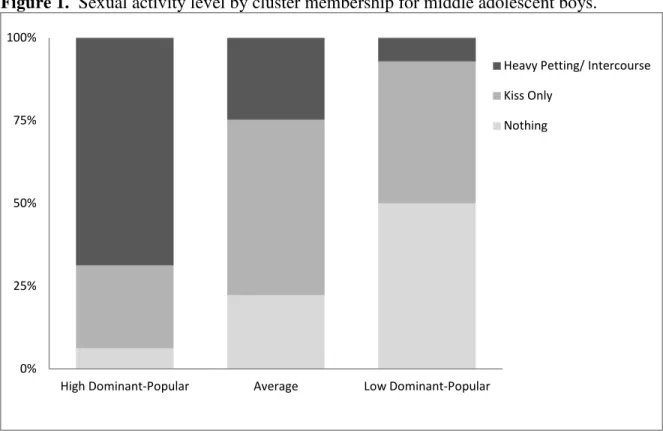
To address the main research question of this study, the three clusters were compared on sexual activity. Boys in the High Dominant-Popular cluster reported the highest level of sexual activity: 69% reported having engaged in heavy petting and/or intercourse. The percentages for the other clusters were: Average Boys, 25%; and Low Dominant-Popular boys, 7.1% (see Figure 1).
Figure 1. Sexual activity level by cluster membership for middle adolescent boys.
Planned comparisons indicated a significant difference in the level of sexual activity between the High Dominant-Popular cluster and the other two clusters. The difference in
sexual activity between High Dominant-Popular and Average boys was 44% (z = 4.44; P <
.01; CI99% = .21 - .67) and the difference between High Dominant-Popular and Low
Dominant-Popular boys was 62% (z = 4.62; P < .01; CI99%
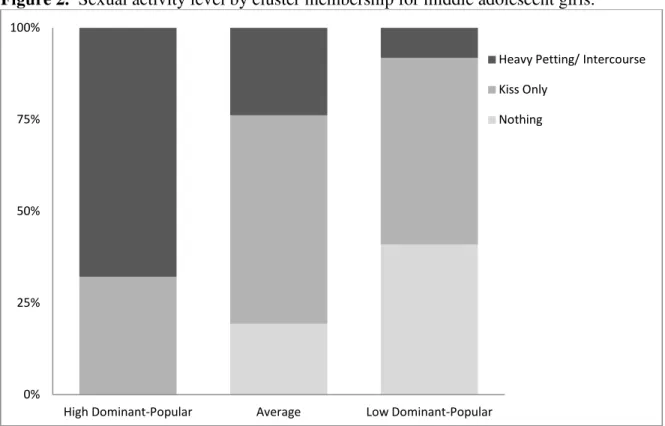
For girls, the highest level of sexual activity was reported for the High Dominant-Popular cluster: 68% of them reported having engaged in heavy petting and/or intercourse.
= .37 - .86). 0%
25% 50% 75% 100%
High Dominant-Popular Average Low Dominant-Popular
Heavy Petting/ Intercourse
Kiss Only
Evolutionary Psychology – ISSN 1474-7049 – Volume 10(2). 2012. -308-
The percentages for the other clusters were: Average Girls, 24%; Low Dominant-Popular, 8% (see Figure 2).
Figure 2. Sexual activity level by cluster membership for middle adolescent girls.
Planned comparisons indicated a significant difference between the sexual activity level of the High Dominant-Popular cluster and the other two clusters. The difference in
sexual activity level between High-Dominant-Popular and Average girls was 44% (z =
4.27; P < .01; CI99% = .18 - .70) and the difference between High Dominant-Popular and
Low Dominant-Popular girls was 60% (z = 5.89; P < .01; CI99%
In summary, middle adolescent boys and girls high in dominance-popularity appeared to have had earlier sexual encounters than their peers, thereby confirming the main hypothesis of this study. Also confirmed was the fact that these boys were very aggressive, bossy and bullies. They were also considered very attractive. As expected, the highly dominant-popular girls were considered very attractive and high in relational aggression.
= .35 - .84).
Univariate Analyses of Behavior and Sexual Activity Level
In addition to the person-centered method of cluster analysis, we chose to also perform a variable-centered approach, namely ANOVA. The ANOVA’s showed that middle adolescents who had performed heavy petting and/or intercourse differed remarkably from peers who had done ‘nothing’ or merely kissed. In fact, they differed significantly on all behavioral aspects except being friendly and being nominated as best friend (see Table 4).
0% 25% 50% 75% 100%
High Dominant-Popular Average Low Dominant-Popular
Heavy Petting/ Intercourse
Kiss Only
Evolutionary Psychology – ISSN 1474-7049 – Volume 10(2). 2012. -309-
Table 4
Means of all Variables by Sexual Activity Level
Boys Girls
Nothing Kissed Intercourse η2 Nothing Kissed Intercourse η2
Dominant-Popular -.54 -.19 .38a .17 -.34 -.02 .75a .24
Friendly -.01 -.05 -.32 .01 .16 .27 -.22 .05 Plays the Boss -.44 -.18 .56a .23 -.47 -.16 .83a .38
Fights -.11 .16 .97a .26 -.52a -.36ab -.13b .02
Gossips -.57 -.42 .00a .07 -.33 .20 1.22a .49
Mean -.38a -.07ab .35b .10 -.44 -.15 .79a .33
Bully -.23 .04 .70a .19 -.51 -.31 .43a .20
Keeps Promises .15 -.13 -.31 .03 .36 .28 -.44a .16
Attractive -.43 -.20 .26a .09 -.53a .16b .62b .24
Hip Dress -.52 -.32 .27a .13 -.29 .13 .77a .21
Leader -.36 -.10 .50a .15 -.37 -.21 .70a .27
Friendship -.13 .00 -.18 .01 .03 .24 -.18 .03 Victim .37 .17 -.14 .04 .20a -.21 -.24 .04
Disrespectful to Teacher -.40 -.11 .49a .17 -.54 -.15 .81a .39
Attentive in Class .36 -.07 -.58a .17 .57 .27 -.59a .28
Boring .39 .19 -.49a .18 .38a .00ab -.49b .14
Note. Means that do not share subscript within gender are significantly different from one another at P < .01.
Thus, middle adolescents who were at the high level of sexual activity were judged more dominant-popular, more bossy, fought more, gossiped more, were meaner, bullied more, were more attractive, hip dressed, more of a leader, more disrespectful to teachers, less attentive in class, and considered less boring than peers at lower levels of sexual activity. Some gender differences were also apparent. A comparison of sexually active adolescent boys and girls revealed that sexually active boys fought far more than sexually
active girls (F1,96 = 36.99; P < .01; η2 = .59). Sexually active girls, however, were
considered slightly more attractive, more fashionable, and far more gossipy than sexually
active boys (F1,96 = 3.80; P = .05; η2 = .05; F1,96 = 6.14; P < .05; η2 = .11; F1,96 = 37.85; P <
.01; η2 = .73, respectively).
Multivariate Analysis of Behavior and Sexual Activity Level
Evolutionary Psychology – ISSN 1474-7049 – Volume 10(2). 2012. -310-
entered into the DFA in order to predict the respective group membership.
Table 5
Structure Matrix for the Discriminant Function Analysis of Status and Behavioral Variables
Boys Girls
Bossy .70 Bossy .78
Starts fights .67 Disrespects teacher .69
Disrespects teacher .64 Gossips .68
Gossips .63 Leader .62
Boring -.63 Attentive in class -.60
Bully .61 Mean .60
Leader .61 Dominant-Popular .60
Attentive in class -.59 Bully .58
Dressed hip .58 Dressed hip .50
Dominant-Popular .57 Keeps promises -.50
Attractive .51
Mean .51
Note: Loadings less than .50 are not shown
The DFA for boys yielded one discriminant function, with Wilks’ Lambda = 0.75
(Χ2
(18) = 47.25; P < .001; Eigenvalue = .33). The structure matrix for each gender is
shown in Table 5. In general, boys who had had sex distinguished themselves from boys who had not had sex in overall negative behavior such as being bossy, fighting, disrespecting teachers, gossiping, bullying, non-attentive in class, and mean. They were also considered less boring, more of a leader, more dominant-popular, and more attractive. For boys, 77.4% of the original cases were correctly classified, with most misclassifications a result of boys who had had sex to be classified as not having had sex. For girls, one
discriminant function was revealed, with Wilks’ Lambda = 0.64 (Χ2
In sum, the multivariate method of analysis through DFA revealed that middle adolescent girls and boys who had had sex displayed highly dominant behavior and many
(18) = 73.06 ; P <
Evolutionary Psychology – ISSN 1474-7049 – Volume 10(2). 2012. -311-
negative peer-directed and teacher-directed behaviors, and were considered far more dominant-popular than adolescents who had not yet had sex.
Discussion
The present study confirmed the three hypotheses stated in the introduction. That is, middle adolescents who are highly dominant-popular and who also display high levels of bullying and (relational) aggression are sexually precocious. Individuals at the other end of the status and behavior spectrum, i.e., low dominant-popular, withdrawn, and victimized middle adolescents, are the least sexually precocious. The hypothesized gender differences in behavioral profile of sexually precocious adolescents were also confirmed. That is, sexually active middle adolescent boys were highly dominant-popular and physically aggressive (and also attractive), and sexually active middle adolescent girls were highly dominant-popular, attractive and relationally aggressive.
Adolescence marks the beginning of sexual maturation, and is thus a time when within-sex competition should rise. Sexual strategies theory (Buss, 2003; Campbell, 2002) predicts that both sexes set out to win this competition: boys through overt aggression and bullying, girls through being attractive and using relational aggression. By using aggression, middle adolescent boys can show off their strength and dominance to their male rivals and to potential female mates (Pellegrini, 2002). Bullying may be a successful way for them to lower their rivals’ chances of romantic success. It is also a signal to the opposite sex that they are interesting and should be given attention. In fact, intra-sexual competition probably evolved through the process of sexual selection (Buss, 1996; Darwin, 1871). That is, what predicts a top ranking among sex-mates (intra-sexual competition) is also what members of the opposite sex look for in potential mates (inter-sexual competition). Thus, there is just one hierarchy for each sex (e.g., Weisfeld, Bloch, and Ivers, 1983; 1984).
For girls and boys, physical attractiveness was positively associated with a high peer group status and sexual activity. The positive association between attractiveness and status in middle adolescence has been shown before, but the current study also shows connections with sexual behavior. Also, Udry and Billy (1987) found that US adolescent girls (ages 14-17) with high testosterone and high attractiveness had the strongest sex drives. It is no surprise that intra-sex competition among girls is aimed at lowering rivals’ status (derived from their attractiveness) through derogation. Buss and Dedden (1990) showed that in the US, reputation-hurting through gossip is common among girls. In a UK study, Duncan (2004) also showed that this derogation is often aimed at humiliating a girl for her sexual success, for example, through name calling. Also, Campbell (2002), studying female gangs in the UK and the US, has cogently argued that reputation-bashing among girls is most likely aimed at sexual promiscuity, that is, calling a girl a ‘whore’ or ‘slut’ is the most effective way of destroying a girl’s reputation among peers. Other studies conducted in Mexico (Fry, 1992), Bolivia (Holmberg, 1969), Argentina (Hines and Fry, 1994) and the US (Campbell, 1994) showed that intra-female competition is rife, fierce, and invariably involves a sexual partner.
Evolutionary Psychology – ISSN 1474-7049 – Volume 10(2). 2012. -312-
power through direct aggression), and SAHP as an ‘attractive’ display (the individual gains power through attractive personal qualities). Both types of power, however, make the individual feel esteemed. In fact, a positive association has been found between self-esteem and status (De Bruyn and Van den Boom, 2005). Also, self-esteem takes a prominent place in Barkow’s (1989) theorizing about status and reproductive success. He postulated that
self-esteem consists mainly of “an ongoing comparison of the self-representation with the
representation of others” (p. 180). This comparison process takes place whenever people
are in groups. Barkow invoked Chance’s concept of attention structure (Chance, 1967) to
indicate that most comparison encounters need not be physically agonistic, which would
indicate a RHP strategy, but may simply consist of who attends to whom, which indicates a
SAHP strategy. However, the notion of attention structure being the primary dimension of primate dominance-popularity hierarchies has been criticized by Hinde (1974; see also Schubert, 1983). Hinde agreed that dominant males in primate groups are attention-catchers through displays of dominant behavior. But, he argues, these displays invariably show off physical prowess and frighten others. Also, subordinates tend to monitor or pay attention to dangerous dominant troop members. Thus, attention seems to be a byproduct of dominance displays—at least among simians—and male dominant primates attract attention through dominance displays that are in turn evidence to rivals and potential mates of a high RHP. To rivals, the displays convey the message to back down, while to potential mates, they are a sign of good genes.
How do our findings contribute to the understanding of dominance-popularity behaviors among (adolescent) humans? Human ontogeny is marked by dominant bullying behavior and resource control: toddlers vie for the most interesting toys; adolescents (and adults) vie for the most interesting partners. Also, being successful in gaining control over resources early in life may actually have lasting consequences later in ontogeny (e.g., Weisfeld, 1987). Gaining resources through dominant behaviors such as bullying is thus reinforced through rewards (resource acquisition) and perhaps this learning mechanism may help explain the tenacity and ubiquity of bullying. It may not be a coincidence that bullying increases at this age (Björkvist et al., 1992; Cairns and Cairns, 1986). Adolescence is, after all, a developmental period marked by the crossing of gender boundaries in search for sexual opportunities. Intra-sex competition for these opportunities is high and recent retrospective research confirms that bullying and victimization may be linked to reproductive behavior (Gallup, O’Brien, White, and Sloan Wilson, 2009; White, Gallup, and Gallup, 2010). Thus, the struggle for sexual opportunities may be a factor in the prevalence of bullying and victimization in secondary schools.
In addition to bullying, anti-authority displays (e.g., receiving low grades and being disrespectful to teachers) are very typical for dominant-popular boys as well as girls (e.g., Adler and Adler, 1995; Adler, Kless, and Adler, 1992; De Bruyn and Cillessen, 2006a; 2006b; Rodkin, Farmer, Pearl, and Van Acker, 2000). Perhaps these anti-authority displays are part and parcel of the dominant-popular behavioral profile. They may benefit the
displayer in several ways: by impressing classmates (“oh, look how cool I am to defy this
Evolutionary Psychology – ISSN 1474-7049 – Volume 10(2). 2012. -313-
Mating Intelligence (Geher and Miller, 2008)? Future research should concentrate on delineating the behavioral factors underlying successful (and unsuccessful) adolescent sexual mating mechanisms.
There were some limitations to this study. The first is the ‘implicit’ fact-finding nature of cluster analysis. This method relies solely on statistical criteria to find subgroups. Other methods to identify subgroups should also be used in future studies, such as ethnography, interviews, or observations. Second, an important question regarding the positive association between dominance-popularity and sexual activity centers on directionality. Sexual selection theory suggests that status precedes and predicts sexual activity. The present study, however, is correlational and statements about causality should
be avoided. Thus, the statement being dominant-popular in a group and behaving
aggressively leads to sex is just as probable as sex leads to being considered dominant-popular and behaving aggressively. However, this line of reasoning becomes harder to maintain when we consider the strong association between dominance, behavior, and sexual activity. Remember, it was the dominant-aggressive boys and girls who were sexually most active, and the proposition that sexual activity should lead to dominant-aggressive behavior is harder to maintain than the reverse, i.e., dominant-dominant-aggressive behavior leads to increased sexual activity. Why would an individual who gained access to
a sexual mate become more aggressive? That makes much less sense than an aggressive
individual securing sole access to a willing mate. Longitudinal studies will help to address these questions of directionality and causality. Also, an alternative explanation is plausible, such that both sexual activity and dominance behavior are somehow ‘driven’ by a third variable, perhaps a personality type akin to a Machiavellian profile: cunning, smart, savvy, and high in opportunistic aggression (Byrne and Whiten, 1988; Whiten and Byrne, 1997). If so, then the behavioral profiles of attractive-dominant girls and aggressive-dominant boys uncovered in the current study seem to fit the bill to a certain degree. Further studies should investigate this hypothesis. Also, the findings of the current research apply to adolescents in a modern Western society, in this case The Netherlands. One must always be very cautious in extending findings from one culture to the human species as a whole. Future studies should look into cultures that are vastly different in, for instance, school organization and sexual permissiveness.
In spite of these limitations, this study provides an important step towards understanding the association between middle adolescent peer status, interpersonal behavior, and sexual activity. This study showed that middle adolescents’ sexual behavior is related to dominant-popularity status, in combination with certain idiosyncratic behaviors of boys and girls that enhance their competitiveness within their own gender, in particular, aggression and appearance. This study also shows that sexual strategies theory and the evolutionary perspective provide a framework to understand these associations.
Acknowledgements: We are grateful for the participation of the students and staff from the Pieter Nieuwland College and Maas Waal College who made this research possible. Thanks are also due to Logic8 for their implementation of the web-based questionnaires, and to the research assistants who collected the data in the schools. Also, many thanks go to the various anonymous reviewers from EP and Robert Kurzban.
Evolutionary Psychology – ISSN 1474-7049 – Volume 10(2). 2012. -314- 2011
References
Adler, P. A., and Adler, P. (1995). Dynamics of inclusion and exclusion in preadolescent
cliques. Social Psychology Quarterly, 58, 145-162.
Adler, P. A., Kless, S. J., and Adler, P. (1992). Socialization to gender roles: Popularity
among elementary school boys and girls. Sociology of Education, 65, 169-187.
Aldenderfer, M. S., and Blashfield, R. K. (1984). Cluster analysis. London: Sage.
Andersson, M. (1994). Sexual selection. Princeton University Press, Princeton.
Austin, W. T., and Bates, F. L. (1974) Ethological indicators of dominance and territory in
a human captive population. Social Forces, 52, 447-455.
Axelrod, R. (1984). The evolution of cooperation. Basic Books.
Babad, E. (2001). On the conception and measurement of popularity: More facts and some
straight conclusions. Social Psychology of Education, 5, 3-30.
Barkow, J. H. (1989). Darwin, sex, and status: Biological approaches to mind and culture.
Toronto: University of Toronto Press.
Betzig, L. L. (1986). Despotism and differential reproduction: A Darwinian view of
history. New York: Aldine de Gruyter.
Björkvist, K., Lagerspetz, K., and Kaukianen, A. (1992). Do girls manipulate and boys
fight? Developmental trends regarding direct and indirect aggression. Aggressive
Behavior, 18, 117-127.
Breed, M. D., Smith, S. K., and Gall, B. G. (1980). Systems of mate selection in a
cockroach species with male dominance hierarchies. Animal Behaviour, 18,
130-134.
Broude, G.J. and Greene, S.J. (1976). Cross-cultural codes on twenty sexual attitudes and
practices. Ethnology, 15, 409-429.
Buss, D. M. (1996). Sexual conflict: Evolutionary insights into feminism and the “battle of
the sexes.” In: Sex, power, conflict: Evolutionary and feminist perspectives, ed. D.
M. Buss and N. Malamuth. Oxford University Press.
Buss, D. M. (2003). The evolution of desire: Strategies of human mating (revised edition).
New York: Free Press.
Buss, D. M., and Barnes, M. (1986). Preferences in human mate selection. Journal of
Personality and Social Psychology, 50, 559-570.
Buss, D.M. and Dedden, L.A. (1990). Derogation of competitors. Journal of Social &
Personal Relationships, 7, 395-422.
Buss, D. M., and Schmitt, D. P. (1993). Sexual strategies theory: An evolutionary
perspective on human mating. Psychological Review, 100, 204-232.
Byrne, R. and Whiten, A. (1988). Machiavellian Intelligence: Social Expertise and the
Evolution of Intellect in Monkeys, Apes, and Humans. Oxford University Press. Cairns, R. and Cairns, B. (1986). The developmental-interactional view of social behavior:
Four issues of adolescent aggression. In: D. Olweus, J. Block and M.
Radke-Yarrow, (Eds.), Development of antisocial and prosocial behavior. Academic, New
York . pp. 315–342.
Campbell, A. (1995). A few good men: Evolutionary psychology and female adolescent
Evolutionary Psychology – ISSN 1474-7049 – Volume 10(2). 2012. -315-
Campbell, A. (1999). Staying alive: Evolution, culture and women’s intrasexual
aggression. Behavioral and Brain Sciences, 22, 203-252.
Campbell, A. (2002). A mind of her own. The evolutionary psychology of women. Oxford
University Press Inc., New York.
Campbell, A. (2004). Female competition: Causes, constraints, content, and contexts. The
Journal of Sex Research, 41, 16-26.
Chance, M. R. A. (1967). Attention structure as the basis of primate rank orders. Man, 4,
503-518.
Cheney, D. L. (1983). Extra-familial alliances among vervet monkeys. In R.A. Hinde (Ed.),
Primate social relationships: An integrated approach (pp. 278-86). Sunderland, MA: Sinauer.
Cillessen, A. H. N. and Borch, C. (2006). Developmental trajectories of adolescent
popularity: A growth curve modelling analysis. Journal of Adolescence, 29, 935–
959.
Cillessen, A. H. N., and Mayeux, L. (2004). From censure to reinforcement: Developmental changes in the association between aggression and social status.
Child Development, 75, 147-163.
Cillessen, A. H. N., and Rose, A. J. (2005). Understanding popularity in the peer system.
Current Directions in Psychological Science, 14, 102–105.
Connolly, J., Pepler, D., Craig, W., and Taradash, A. (2000). Dating experiences of bullies
in early adolescence. Child Maltreatment, 5, 299-310.
Cowlishaw, G., and Dunbar, R. I. M. (1991). Dominance rank and mating success in male
primates. Animal Behavior, 41, 1045-1056.
Cummins, D. (2005). Dominance, status, and social hierarchies. In D. M. Buss (Ed.), The
handbook of evolutionary psychology. Hoboken, NJ: Wiley.
Daly, M., and Wilson, M. (1983). Sex, evolution, and behavior (2nd
Daly, M., and Wilson, M. (1994). Evolutionary psychology of male violence. In J. Archer
(Ed.), Male violence. London: Routledge.
ed.). Boston: Willard Grant.
Darwin, C. (1871). The descent of man and selection in relation to sex. London: Murray.
De Bruyn, E. H., and Cillessen, A. H. N. (2006a). Heterogeneity of girls’ perceived
popularity: Academic and interpersonal behavioral profiles. Journal of Youth and
Adolescence, 35, 435-445.
De Bruyn, E. H., and Cillessen, A. H. N. (2006b). Popularity in early adolescence:
Prosocial and antisocial subtypes. Journal of Adolescent Research, 6, 1-21.
De Bruyn, E. H., and Cillessen, A. H. N. (2010). Associations of peer acceptance and
perceived popularity with bullying and victimization in early adolescence. Journal
of Early Adolescence, 30,543-566.
De Bruyn, E. H., and Van den Boom, D. C. (2005). Interpersonal behavior, peer popularity,
and self-esteem in early adolescence. Social Development, 14, 555-573.
De Graaf, H., Meijer, S., Poelman, J., and Vanwesenbeeck, I. (2005). Seks onder je 25e
[Sex under 25]. Utrecht, The Netherlands: Rutgers Nisso Groep.
Dewsbury, D. A. (1982). Dominance rank, copulatory behavior, and differential
reproduction. The Quarterly Review of Biology, 57, 135-159.
Dong, Q., Weisfeld, G., Boardway, R. H., and Shen, J.(1996). Correlates of social status
Evolutionary Psychology – ISSN 1474-7049 – Volume 10(2). 2012. -316-
Duncan, N. (2004). It’s important to be nice, but it’s nicer to be important: Girls,
popularity, and sexual competition. Sex Education, 4, 137-152.
Ellis, L. (1995). Dominance and reproductive success among non-human animals: A
cross-species comparison. Ethology and Sociobiology, 16, 257-333.
Farentinos, R. C. (1972). Social dominance and mating activity in the tassel-eared squirrel (Sciurus aberti ferreus). Animal Behaviour, 20, 316-326.
Farmer, T. W., Estell, D. B., Bishop, J. L., O’Neal, K. K., and Cairns, B. D. (2003). Rejected bullies or popular leaders? The social relations of aggressive subtypes of
rural African American early adolescents. Developmental Psychology, 39,
992-1004.
Feldman, R., and Weisfeld, G. (1973). An interdisciplinary study of crime. Crime &
Delinquency, 19, 150-162.
Fry, D. P. (1992). Female aggression among the Zapotec of Oaxaca, Mexico. In K.
Bjorqvist and P. Niemela (eds), Of mice and women: aspects of female aggression.
New York: Academic Press.
Gallup, A. C., O’Brien, D. T., White, D. D., and Sloan Wilson, D. (2009). Peer victimization in adolescence has different effects on the sexual behavior of male
and female college students. Personality and Individual Differences, 46, 611-615.
Geher, G. and Miller, G. (2008). Mating Intelligence. Sex, Relationships, and the Mind’s
Reproductive System. Lawrence Erlbaum Associates. New York, London.
Gilbert, P., Price, J., and Allan, S. (1995). Social comparison, social attractiveness and
evolution: How might they be related? New Ideas in Psychology, 13, 149-165.
Gray, J. P. (1985). Primate sociobiology. New Haven, CT: HRAF Press.
Hawley, P. H. (1999). The ontogenesis of social dominance: A strategy-based evolutionary
perspective. Developmental Review, 19, 97-132.
Hawley, P. H. (2003). Prosocial and coercive configurations of resource control in early
adolescence: A case for the well-adapted Machiavellian. Merrill-Palmer Quarterly,
49, 279-309.
Hawley, P. H., Johnson, S. E., Mize, J. A., and McNamara, K. A. (2007). Physical attractiveness in preschoolers: Relationships with power, status, aggression and
social skills. Journal of School Psychology, 45, 499-521.
Hawley, P. H., and Little, T. D. (1999). On winning some and losing some: A social
relations approach to social dominance in toddlers. Merrill-Palmer Quarterly, 45,
185-214.
Henrich, J., and Gil-White, F. J. (2001). The evolution of prestige: Freely conferred deference as a mechanism for enhancing the benefits of cultural transmission.
Evolution and Human Behavior, 22, 165-196.
Hess, N. H. and Hagen, E. H. (2006). Sex differences in indirect aggression; Psychological
evidence from young adults. Evolution and Human Behavior, 27 231-245.
Hinde, R. A. (1974). Biological bases of human social behavior. McGraw-Hill, Inc.
Hines, N. J. and Fry, D. P. (1994). Indirect modes of aggression among women of Buenos
Aires, Argentina. Sex Roles, 30, 213-236.
Holmberg, A. (1969). Nomads of the long bow: the Siriono of Eastern Bolivia. Garden
City, NY: Natural History Press.
Hopcroft, R. L. (2006). Sex, status, and reproductive success in the contemporary United
Evolutionary Psychology – ISSN 1474-7049 – Volume 10(2). 2012. -317-
Jones, M. C., and Bayley, N. (1950). Physical maturing among boys as related to behavior.
The Journal of Educational Psychology, 41, 129-148.
Jonkmann, K., Trautwein, U., and Lüdtke, O. (2009). Social dominance in adolescence:
The moderating role of the classroom context and behavioral heterogeneity. Child
Development, 80, 338-355.
Kanazawa, S. (2003). Can evolutionary psychology explain reproductive behavior in the
contemporary United States? Sociological Quarterly, 44, 291-302.
Kratzer, D. D. and Craig, J. V. (1980). Mating behavior of cockerels: Effects of social
status, group size and group density. Applied Animal Ethology, 6, 49-62.
Laumann, E., Gagnon, J., Michael, R., and Michaels, S. (1994). The social organization of
sexuality. Sexual practices in the United States. Chicago: University of Chicago Press.
Maccoby, E. E. (1998). The Two Sexes: Growing Up Apart, Coming Together. Cambridge,
MA: Harvard University Press, Belknap Press.
Maslow, A. H. (1936). The role of dominance in the social and sexual behavior of
infra-human primates: I. Observations at Vilas Park Zoo. Journal of Genetic Psychology,
48, 261–277.
Mayeux, L., Sandstrom, M. J., and Cillessen, A. H. N. (2008). Is being popular a risky
proposition? Journal of Research on Adolescence, 18, 49-74.
Mazur, A., Halpern, C, and Udry, J. R. (1994). Dominant looking male teenagers copulate
earlier. Ethology and Sociobiology, 15, 87-94.
Omark, D. R., Omark, M., and Edelman, M. S. (1975). Formation of dominance hierarchies
in young children: Action and perception. In T. Williams (Ed.), Psychological
anthropology. The Hague, The Netherlands: Mouton.
Parkhurst, J. T., and Hopmeyer, A. (1998). Sociometric popularity and peer-perceived
popularity: Two distinct dimensions of peer status. Journal of Early Adolescence,
18, 125-144.
Pellegrini, A. D. (2002). Affiliative and aggressive dimensions of dominance and possible
functions during early adolescence. Aggression and Violent Behavior, 7, 21-31.
Pellegrini, A. D., and Bartini, M. (2001). Dominance in early adolescent boys: Affiliative
and aggressive dimensions and possible functions. Merrill-Palmer Quarterly, 47,
142–163.
Pellegrini, A. D., and Long, J. D. (2003). A sexual selection theory: longitudinal analysis of
sexual segregation and integration in early adolescence. Journal of Experimental
Child Psychology, 85, 257-278.
Pellegrini, A. D., Roseth, C. J., Milner, S., Bohn, C. M., Van Ryzin, M., Vance, N., Cheatham, C. L., and Tarullo, A. (2007). Social dominance in preschool
classrooms, Journal of Comparative Psychology, 121, 54-64.
Perusse, D. (1993). Cultural and reproductive success in industrial societies: Testing the
relationship at proximate and ultimate levels. Behavioral and Brain Sciences, 16¸
267-322.
Prinstein, M. J., and Cillessen, A. H. N. (2003). Forms and functions of adolescent peer
aggression associated with high levels of peer status. Merrill-Palmer Quarterly, 49,
310-342.
Prinstein, M., Meade, C., and Cohen, G. (2003). Adolescent oral sex, peer popularity, and
Evolutionary Psychology – ISSN 1474-7049 – Volume 10(2). 2012. -318-
243–249.
Pusey, A., Williams, J. and Goodall, J. (1997). The influence of dominance rank on the
reproductive success of female chimpanzees. Science, 277, 1171-3.
Rhodes, G. (2006). The evolutionary psychology of physical beauty. Annual Review of
Psychology, 57, 199–226.
Rhodes, G., Simmons, L. W., and Peters, M. (2005). Attractiveness and sexual behavior:
Does attractiveness enhance mating success? Evolution and Human Behavior, 26,
186-201.
Rodkin, P. C., Farmer, T. W., Pearl, R., and Van Acker, R. (2000). Heterogeneity of
popular boys: Antisocial and prosocial configurations. Developmental Psychology,
36, 14-24.
Savin-Williams, R. C. (1976). An ethological study of dominance formation and
maintenance in a group of human adolescents. Child Development, 47, 972-979.
Savin-Williams, R. C. (1977). Dominance in a human adolescent group. Animal Behaviour,
25, 400-406.
Savin-Williams, R. C. (1979). Dominance hierarchies in groups of early adolescents. Child
Development, 50, 923-935.
Savin-Williams, R. C. (1980a). Dominance hierarchies in groups of middle to late
adolescent males. Journal of Youth and Adolescence, 9, 75-87.
Savin-Williams, R. C. (1980b). Dominance and submission among adolescent boys. In D.
R. Omark, F. F. Strayer, and D. G. Freedman (Eds.), Dominance relations: An
ethological view of human conflict and social interaction (pp. 217-229). New York: Garland.
Savin-Williams, R. C. (1987). Adolescence: An ethological perspective. Springer-Verlag,
New York.
Schlegel, A. (1995). A cross-cultural approach to adolescence. Ethos, 23, 15-32.
Schubert, G. (1983). The structure of attention: A critical review. Journal of Social and
Biological Systems, 6, 65-80.
Sorensen, R. (1973). Adolescent sexuality in contemporary America. New York: World.
Strayer, F.F., and Strayer, J. (1976). An ethological analysis of social agonism and
dominance relations among preschool children. Child Development, 47, 980– 989.
Tabachnick, B. G. and Fidell, L. S. (2007). Using Multivariate Statistics (5th
Trivers, R.L. (1972). Parental investment and sexual selection. In B. Campbell (ed.), Sexual
Selection and the Descent of Man, 1871-1971. Chicago: Aldine.
Edition). Boston, MA: Pearson: Allyn and Bacon.
Udry, J. R., and Billy, J. O. (1987). Initiation of coitus in early adolescence. American
SociologicalReview, 52, 841–855.
Underwood, M. K., Kupersmidt, J. B., and Coie, J. D. (1996). Childhood peer social status
as a predictor of adolescent pregnancy. Journal of Research on Adolescents, 6,
201-223.
Weisfeld, G. E. (1987). Stability of boys’ social success among peers over an eleven-year
period. In J. A. Meacham (Ed.), Interpersonal Relations: Family, Peers, Friends.
Basel, Switzerland: Karger.
Weisfeld, G. E. (1999). Evolutionary principles of human adolescence. New York: Basic.
Weisfeld, G. E., Bloch, S. A., and Ivers, J. W. (1983). A factor analytic study of
Evolutionary Psychology – ISSN 1474-7049 – Volume 10(2). 2012. -319-
Weisfeld, G. E., Bloch, S. A., and Ivers, J. W. (1984). Possible determinants of social
dominance among adolescent girls. Journal of Genetic Psychology, 144, 115-129.
Weisfeld, G. E., and Woodward, L. M. A. (2004). Current evolutionary perspectives on
adolescent romantic relations and sexuality. Journal of the American Academy of
Child and Adolescent Psychiatry, 43, 11-19.
White, D. D., Gallup, A. C., and Gallup, G. G., Jr. (2010). Indirect peer aggression in
adolescence and reproductive behavior. Evolutionary Psychology, 8, 49-65.
Whiten, A. and Byrne, R. (1997). Machiavellian Intelligence II: Extensions and
Evaluations. Cambridge University Press.
Zeller, M., Vannatta, K., Schafer, J., and Noll, R. B. (2003). Behavioral reputation: A