Advances in Geosciences, 4, 57–62, 2005 SRef-ID: 1680-7359/adgeo/2005-4-57 European Geosciences Union
© 2005 Author(s). This work is licensed under a Creative Commons License.
Advances in
Geosciences
Lake and climate models linkage: a 3-D hydrodynamic contribution
L. F. Leon1,2, D. Lam3, W. Schertzer3, and D. Swayne2
1University of Waterloo, Waterloo, Ontario, N2G3L1, Canada
2University of Guelph, Computing Research Laboratory for the Environment, Guelph, Ontario, N1G2W1, Canada 3Environment Canada, National Water Research Institute, Burlington, Ontario, L7R4A6, Canada
Received: 1 August 2004 – Revised: 1 November 2004 – Accepted: 15 November 2004 – Published: 9 August 2005
Abstract.Under a Canadian Foundation for Climate and At-mospheric Sciences (CFCAS) project, targeted to study the feasibility to link regional climate models with lake models, one of the tasks was to consider such a coupling in large lakes. The objective is to provide detailed information on temperature and circulation distributions of the lake to take into account the spatial variability for temperature and the heat exchange through the water’s surface. The major con-tribution of this work is focused on realistic representation of the heat fluxes and temperature distributions to and from lakes especially during the thermally stratified ice-free peri-ods. This paper presents the detailed 3-D ELCOM model applied in Lake Erie in order to produce, at the surface layer of the lake, the spatial distribution of temperature and heat exchanges that eventually can be coupled with a regional cli-mate model (CRCM). Preliminary results will be presented on how this lake model may improve the regional climate models, which currently do not consider such large lake cir-culation effects.
1 Introduction
Large lakes are recognized as an important agent which in-fluences the circulation of the atmosphere; the atmospheric forcing also affects the lake thermal structure. This interac-tion is complex and continues to be a critical issue consider-ing the millions of lakes in Canada, many of which are large, and are unaccounted for in current climatic models. Current models, without accounting for the water component, over-estimate the heat transfers when forecasting in areas covered with lakes. The inclusion of a fully interactive coupling of a lake model with an atmospheric model for regional climate modeling is one option and an important objective of current Canadian Regional Climate Model (CRCM) development.
Correspondence to:L. F. Leon ([email protected])
Only recently, has the CRCM implemented a lake model (Goyette et al., 2000) as an initial attempt to simulate the evolution of the water temperature and ice cover on the Lau-rentian Great Lakes. Another example is the implementation of a physicallybased column model which includes the ef-fect of ice (Hostetler et al., 1993). These efforts so far per-tain to simple one column (1-dimensional) and two layer (2-dimensional) models. In thes e attempts for the CRCM, the lake is assumed to have uniform surface lake temperature. For small lakes, such assumption may be valid.
For large lakes such as the Laurentian Great Lakes, the lake surface temperature is not uniform and therefore re-quires a hydrodynamic model with finer spatial resolution ar-chitecture (Lam and Schertzer, 1999). Swayne et al. (2003) proposed to use a hierarchy of 1-D, 2-D and 3-D lake thermo-dynamic models depending on the size of the lake and avail-able information to advance regional climate modelling. It aimed at conducting an independent evaluation of predictive capabilities of lake models for heat flux and thermal charac-teristics.
Such evaluations are a critical and essential element in the progression to development of fully coupled lake/CRCM model across lakes of different spatial scales. The purpose of our study is to evaluate the predictive capability of the 3-D models with the focus on large lakes in the context of linking them with the CRCM. The intention is to conduct an evalu-ation using high quality databases for selected large lakes in Canada, e.g. Lake Erie, Lake Ontario and Great Slave Lake, that have different morphometry over contrasting climatic re-gions. We will report on the preliminary results for Lake Erie as an example of how the 3-D model can be used to integrated with the CRCM.
2 Technical challenges
58 L. F. Leon et al.: Lake and climate models linkage
Fig. 1.Schematic representation of the proposed model coupling.
resolution); in synchronizing temporal scales (e.g. time steps of 15 min in CRCM vs. diurnal cycles produced by lake tem-perature models); and generalizing processes for application over lakes of different spatial scales. A major contribution of this work is focused on methodological procedures to eval-uate heat fluxes and temperature distributions to and from lakes. Databases are required which are valid for model ver-ification and uncertainty analyses. This study provides inde-pendent feed-back from lake modelers to CRCM modelers.
Such interaction is required to effect improvements in CRCM for application in the priority issues of climatic im-pacts research on aquatic ecosystems (e.g. on water quality, nutrient and dissolved oxygen concentrations). It also re-quires the lake modelers to adapt the model results required by the regional climate model, specifically the heat, mass and momentum exchanges at the air-water interface, surface air and water temperature, etc.
The main challenge is how to make these quantities consis-tent between the lake and the climate model. Two avenues of coupling will need to be explored. First the independent un-coupled simulations and the interactive coupling of the runs. In the first case, both models will run independently using the output of the other model as input for themselves. The sec-ond approach will require a linkage of input/output for each time step. Figure 1 represents the schematic of the proposed coupling and it shows different surface layers as simulated time progresses. The 3-D results in a finer grid (2×2 km)
must be averaged at every time step for the larger grid res-olution (25×25 km) of the climate model (top schematic in
Fig. 1).
A technical issue to resolve will be the coup ling of both models by exporting output data from the 3D hydrodynamic model to be used as input for the next time step in the climate model. Currently the bulk of the work is focused on attempt-ing to couple these two models by emphasizattempt-ing the consis-tency at the air-water interface, both in spatial and temporal resolution. Specifically, for heat transfer, the incoming and outgoing heat fluxes at the air-water interface should be the same at both models while the different time steps are set for a common value.
3 Spatial distribution in lakes
Canada contains several of the largest lakes in the world within the Laurentian Great Lakes (Lakes Superior, Michigan-Huron, Erie, Ontario), the Mackenzie Great Lakes. (Great Bear Lake, Great Slave Lake and Lake Athabasca) as well as others such as Lake Winnipeg. These lakes have large spatial extents, can have complicated bathymetric char-acteristics and can also have significant crosslake variability in meteorological and limnological components (Schertzer and Croley 1999). For example, Lake Erie is nearly 5-deg of latitude and 2-deg of longitude in size and has three dis-tinct basins with maximum depths of 10 m (west basin), 25 m (central basin) and 64 m (east basin).
L. F. Leon et al.: Lake and climate models linkage 59
Fig. 2.Meteorological/Limnological data for west, central and east basin of Lake Erie(a)air temperature,(b)surface water temperature,(c) evaporation,(d)evaporation,(e)total heat flux, and(f)heat content.
Fig. 3.Wind roses for the different basins in Lake Erie for l994.
lakes, they can have a pronounced seasonal and regional in-fluence as a result of seasonal lags in the heat transfers com-pared to the surround in land.
Figure 2a shows a pronounced difference between the mean monthly air temperatures recorded from land stations in the west basin of the lake compared to the other basins es-pecially in the spring and again in the fall. The differences in air temperature and other meteorological variables during the spring warming phase combined with the shallow basin
characteristics results in significant differences in the surface temperatures between basins (Fig. 2b).
60 L. F. Leon et al.: Lake and climate models linkage
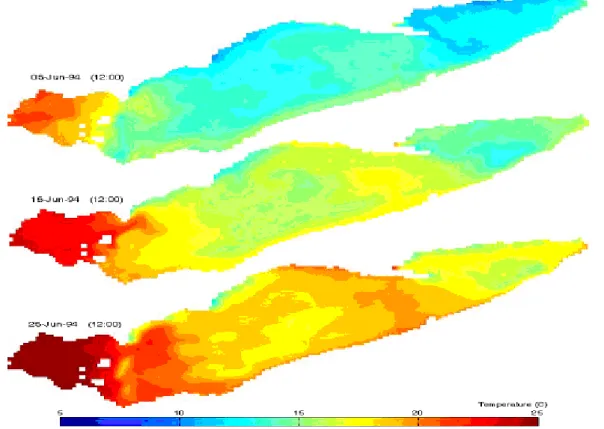
Fig. 4.Surface temperature in Lake Erie (3 time slices of the 1994 simulation).
Over the ice-free period, the large central basin in Lake Erie has the highest cumulative evaporation compared to ei-ther the west or east basins (Fig. 2d). The cross-lake differ-ences in meteorological and lake response characteristics can be significant especially in the transition seasons. Because of the large spatial extents of such lakes, a 3-dimensional hy-drodynamic model linked with a 3-dimensional atmospheric model is critical for realistic simulation of the influence of these lakes within the regional climate model.
Figure 3 shows characteristics of the wind field across the lake. As can be seen from the wind roses, the domi-nant wind direction is from the SW in all three basins, and the average wind speed is in the order of 5 m/s. The com-bined differences in air temperature, surface water temper-ature and wind influences the total radiative and turbulent heat exchange (Fig. 2e), the vertical temperature structure and lake heat content (Fig. 2f) (Schertzer et al., 1987). On a lake-wide basis, the latent heat flux is often a dominant component compared to other turbulent exchanges, generally small in the spring but high in the fall the lake heat content is released to the atmosphere.
4 The 3-D model
During the last decade a series of three-dimensional hydro-dynamic models have been developed at different research institutes. An overview can be found in Lynch and Davies (1995) which includes the well known Princeton Ocean
Model (Blumberg and Mellor, 1987; Schwab and Bedford, 1994; Simons, 1975). The model used in this application is ELCOM (Estuary and Lake COmputer Model). ELCOM is a three-dimensional hydrodynamics model for lakes and reservoirs, and is used to predict the variation of water tem-perature and salinity in space and time (Hodges et al., 2000). The heat exchange through the water’s surface is gov-erned by standard bulk transfer models found in the liter-ature (Schertzer et al., 1987). Energy transfer across the free surface is separated into nonpenetrative components of long-wave radiation, sensible heat transfer, and evaporative heat loss, complemented by penetrative short-wave radiation. Non-penetrative effects are introduced as sources of temper-ature in the surface-mixed layer, whereas penetrative effects are introduced as source terms in one or more grid layers on the basis of an exponential decay and an extinction coeffi-cient.
L. F. Leon et al.: Lake and climate models linkage 61
Fig. 5. Temperature results of the 3-D model. Top: surface temperature gradient on the lake Bottom: profiles for a selected week in 1994 (extracted from Leon et al., 2004).
of the 3-D model, several field data for 1994 were used to validate the hydrodynamics on the lake (Leon et al., 2004). To demonstrate the importance of the spatial distribution on Lake Erie, Fig. 4 presents the model output for surface tem-perature during the warming period of the 1994 simulation.
Figure 5 is an extract of such results showing the surface temperature gradient from west to east and selected profile comparisons of measured and calculated values at three lake sites. As can be seen from Fig. 5, the spatial distribution of temperature in such a great lake as Lake Erie, is quite im-portant (temperature differences between west and east up to 8◦C). The CRCM has a grid resolution of 25 km, then for day
215, the average temperature to pass to the climate model are in the order 25◦C, 20◦C and 18◦C for the west, central and
east basins. For the coupling, distributions of temperature, evaporation and heat fluxes can be computed directly from the 3-D model results at any time step. The results so far indicated that we achieved internal consistency in the lake model in that the west-east gradient of surface temperature gradient is consistent with the heat content (Fig. 3) and with the internal thermal structure as depicted in Fig. 5.
62 L. F. Leon et al.: Lake and climate models linkage
5 Conclusions
We have successfully applied a 3-D hydrodynamic model to Lake Erie. The next step will be to directly connect the 3-D results with the CRCM model with its selected grid resolu-tion and time step. This will have the advantage of seam-lessly rendering the air and water models in tandem in both spatial and temporal steps and thereby achieving compara-ble numerical stability and accuracy, as well as generating detailed information on temperature and circulation distribu-tions of the lake. However, it is also recognized that the 3-D approach currently has a disadvantage of high computational cost and requires detailed input data, not to mention the diffi-culty of having sufficient data for model calibration and ver-ification. Thus, we propose that the current generation of the 3-D hydrodynamic model will be limited to only a few of the larger lakes lakes such as Laurentian Great Lakes and others such as Great Slave Lake in Canada for this study.
Acknowledgements. The authors wish to thank the support from Canadian Foundation for Climate and Atmospheric Sciences, the Natural Sciences and Engineering Research Council of Canada, and Environment Canada. We thank the support and discussion with M. McKay at the Meteorological Service of Canada, W. Rouse from McMaster University and Rene Laprise from the Universit´e du Qu´ebec ´a Montr´eal. Also acknowledged is the support from R. Smith at the University of Waterloo and the support of J. Imberger at the University of Western Australia for the use of the ELCOM model.
Edited by: P. Krause, S. Kralisch, and W. Fl¨ugel Reviewed by: anonymous referees
References
Blumberg A. and Mellor, G.: A description of a three-dimensional coastal ocean circulation model, In Three-Dimensional Coastal Ocean Models, 1–16, AGU, Washington D.C., 1987.
Goyette, S., McFarlane, N., and Flato, G.: Application of the CRCM to the Laurentian Great Lakes Region: Implementation of a Lake Model, Atmos.-Ocean, 38, 481–503, 2000.
Hodges, B. R., Imberger, J., Saggio, A., and Winters, K. B.: Mod-eling basin-scale internal waves in a stratified lake, Limnol. Oceanogr., 45 (7), 1603–1620, 2000.
Hostetler, S. W., Bates, G. T., and Giorgi, F.: Interactive coupling of a lake thermal model with a regional climate model, J. Geophys. Res., 98, 5045–5057, 1993.
Lam, D. C. L. and Schertzer, W. M.: Potential Climate Change Ef-fects on Great Lakes Hydrodynamics and Water Quality, Amer-ican Society of Civil Engineers (ASCE) Press, Reston, Virginia, 232 p., 1999.
Le´on, L. F., Imberger, J., Smith, R. E. H., Hecky, R. E., Lam, D. C. L., and Schertzer, W. M.: Modeling as a Tool for Nutrient Man-agement in Lake Erie: A Hydrodynamics Study, J. Great Lakes Res., Lake Erie Trophic Status Special Issue, in press, 2004. Lynch, D. R. and Davies, A. M.: Assessment for Coastal Ocean
Models, Coastal and Estuarine Studies, Vol. 47, American Geo-physical Union, 1995.
Schertzer, W. M. and Croley II, T. E.: Climate and Lake Responses, Chapter 2, p. 1–74, in: Potential Climate Change Effects on Great Lakes Hydrodynamics and Water Quality, edited by: Lam, D. C. L., ASCE Press, Reston, Virginia, USA, 232 p. 1999. Schertzer, W. M., Saylor, J. H., Boyce, F. M., Robertson, D. G., and
Rosa, F.: Seasonal thermal cycle of Lake Erie, J. Great Lakes Res. 13 (4), 468–486, 1987.
Schertzer, W. M., Rouse, W. R., Blanken, P. D., and Walker, A. E.: Over-lake meteorology and estimated bulk heat exchange of Great Slave Lake in 1998–99, J. Hydrometeor., 4, 649–659, 2003.
Schwab, D. J. and Bedford, K. W.: Initial implementation of the Great Lakes Forecasting System: a real-time system for predict-ing lake circulation and thermal structure, Water Poll. Res. J. Canada, 29, 203–220, 1994.
Simons, T. J.: Verification of numerical models of Lake Ontario: Part II: stratified circulation and temperature changes, J. Phys. Oceanogr., 5, 98–110, 1975.