Genome-Wide Comparative Analysis Reveals
Similar Types of NBS Genes in Hybrid
Citrus
sinensis
Genome and Original
Citrus
clementine
Genome and Provides New
Insights into Non-TIR NBS Genes
Yunsheng Wang1,2, Lijuan Zhou3, Dazhi Li4, Liangying Dai1*, Amy Lawton-Rauh5, Pradip K. Srimani2, Yongping Duan3, Feng Luo2*
1College of Plant Protection, Hunan Agricultural University, Changsha, China,2School of Computing, Clemson University, Clemson, South Carolina, United States of America,3Agricultural Research Service, U. S. Horticultural Research Laboratory, Fort Pierce, Florida, United States of America,4National Center for Citrus Improvement, Hunan Agricultural University, Changsha, China,5Department of Genetics and Biochemistry, Clemson University, Clemson, South Carolina, United States of America
*[email protected](LD);[email protected](FL)
Abstract
In this study, we identified and compared nucleotide-binding site (NBS) domain-contain-ing genes from threeCitrusgenomes (C.clementina,C.sinensisfrom USA andC. sinen-sisfrom China). Phylogenetic analysis of allCitrusNBS genes across these three genomes revealed that there are three approximately evenly numbered groups: one group contains the Toll-Interleukin receptor (TIR) domain and two different Non-TIR groups in which most of proteins contain the Coiled Coil (CC) domain. Motif analysis con-firmed that the two groups of CC-containing NBS genes are from different evolutionary ori-gins. We partitioned NBS genes into clades using NBS domain sequence distances and found most clades include NBS genes from all threeCitrusgenomes. This suggests that threeCitrusgenomes have similar numbers and types of NBS genes. We also mapped the re-sequenced reads of three pomelo and three mandarin genomes onto theC. sinen-sisgenome. We found that most NBS genes of the hybridC.sinensisgenome have corre-sponding homologous genes in both pomelo and mandarin genomes. The homologous NBS genes in pomelo and mandarin suggest that the parental species ofC.sinensismay contain similar types of NBS genes. This explains why the hybridC.sinensisand original C.clementinahave similar types of NBS genes in this study. Furthermore, we found that sequence variation amongstCitrusNBS genes were shaped by multiple independent and shared accelerated mutation accumulation events among different groups of NBS genes and in differentCitrusgenomes. Our comparative analyses yield valuable insight into the structure, organization and evolution of NBS genes inCitrusgenomes. Furthermore, our comprehensive analysis showed that the non-TIR NBS genes can be divided into two
OPEN ACCESS
Citation:Wang Y, Zhou L, Li D, Dai L, Lawton-Rauh A, Srimani PK, et al. (2015) Genome-Wide Comparative Analysis Reveals Similar Types of NBS Genes in HybridCitrus sinensisGenome and Original Citrus clementineGenome and Provides New Insights into Non-TIR NBS Genes. PLoS ONE 10(3): e0121893. doi:10.1371/journal.pone.0121893
Academic Editor:Ji-Hong Liu, Key Laboratory of Horticultural Plant Biology (MOE), CHINA
Received:October 28, 2014
Accepted:February 4, 2015
Published:March 26, 2015
Copyright:This is an open access article, free of all copyright, and may be freely reproduced, distributed, transmitted, modified, built upon, or otherwise used by anyone for any lawful purpose. The work is made available under theCreative Commons CC0public domain dedication.
Data Availability Statement:All relevant data are within the paper and its Supporting Information files.
Funding:This work was supported in part by the Citrus Research and Development Foundation, Inc. The funders had no role in study design, data collection and analysis, decision to publish, or preparation of the manuscript.
groups that come from different evolutionary origins. This provides new insights into non-TIR genes, which have not received much attention.
Introduction
Disease resistance genes (Rgenes) are essential components of plant immune systems.
Amongst five diverse classes of disease resistance genes [1], the largest class ofRgenes includes genes that encode proteins with a nucleotide-binding site (NBS) domain and a Leucine-Rich Repeat (LRR) domain. The NBS domain is highly sequence constrained and is typically used to identify and characterize plantRgenes. The LRR domains inRgenes that mediate direct or in-direct interactions [2,3] with pathogen molecules are usually rapidly evolving to adapt to the change of pathogen ligands [4]. NBS domain-containingRgenes were classified into two major types based on their domain structures in N terminus: proteins with a Toll-Interleukin receptor (TIR) domain and proteins without TIR domains, which usually contain a Coiled Coil (CC) domain. While the TIR domain is usually well defined, the CC domain has higher sequence variation and is less well characterized.
Genome-wide analyses of NBS genes in many genomes have shown that NBSRgenes are di-verse in number, structure and organization [5–10]. For example, grass genomes studied to date do not have TIR NBS genes; on the other hand, dicot genomes usually contain more TIR NBS genes than non-TIR NBS genes [11]. Comparison of NBSRgenes in multiple genomes in-dicated thatRgenes are shaped by dynamic birth-and-death processes [12]. Comparative anal-yses of NBS genes in twoArabidopsisgenomes (A.thalianaandA.lyrata) indicate that mating system shift from outcrossing to inbreeding has had a limited impact on the numbers of NBS genes, at least in the time sinceA.lyrataandA.thalianadiverged from their common ancestor approximately 5 million years ago [13]. Comparative analyses of NBS genes of diploid Phaseo-lusand tetraploidGlycinespecies concluded that whole genome duplication did not result in NBSRgene number increasing. Recently, comparison ofRgenes in diverse grass genomes by
Yanget al. showed that rapid evolution inRgenes inZea,Sorghum, andBrachypodiumis
asso-ciated with rice blast disease resistance [14].
Citrusspecies are amongst the most important fruit trees and have been cultivated for more
than 4000 years [15,16]. Phylogenetic analyses using molecular markers showed that cultivated
Citrusspecies (sweet orange, grapefruit, and lemon) are derived from three original cultivated
Citrusspecies:C.medica(citron),C.reticulata(mandarin) andC.maxima(pomelo) [17,18].
For example, theC.sinensis(sweet orange) is suggested to be the backcross hybrid ofC. maxi-ma(pomelo) andC.reticulata(mandarin) [17–19]. Phylogenetic analyses of partial NBS genes
ofPoncirus trifoliata(trifoliate orange),C.reticulata(tangerine) and their F1 progeny showed
that NBS genes ofPoncirus trifoliata(trifoliate orange),C.reticulataformed genus-specific clades. Additionally, NBS genes of their F1 progeny had sister relationships to only one of the parents [20]. This suggests that NBS genes in crossing hybridCitrusspecies are also different from those in originalCitrusspecies.
Recently available draft whole genome sequences of threeCitrusspecies:C.clementina[21],
C.sinensisfrom USA andC.sinensisfrom China [19], have made it possible to scan and
identi-fy all NBS genes in those genomes. In this study, we performed a genome-wide comparative analysis of NBS genes in threeCitrusgenomes (C.clementina,C.sinensisfrom China andC.
sinensisfrom USA) to address the following questions: (1) What are the features of NBS genes
evolutionary dynamics of NBS genes?; (2) Do NBS genes differ between hybrid and non-hybrid
Citrusspecies?; and (3) DoCitrusNBS genes differ from NBS genes in other plant genomes?
Materials and Methods
Sequences Used
We downloaded the draft genome sequences and the original gene annotations ofC. clemen-tina(clementine) [21] andC.sinensisUSA (sweet orange from USA) from theCitrusGenome Database (http://www.citrusgenomedb.org/) and those ofC.sinensisChina (Chinese sweet or-ange [19]) from theC.sinensisannotation project (http://citrus.hzau.edu.cn/orange/). The sizes of assembled genomes ofC.clementina,C.sinensisChina andC.sinensisUSA are 301, 328 and 319 million base pairs, respectively. TheC.clementinagenomes assembled into nine major scaffolds and 95.8% of the sequences were assigned to those nine scaffolds. About 72.9% of theC.sinensisChina genome assigned to nine chromosomes. The genome ofC.sinensis USA only assembled to 12,574 scaffolds and the N50 of scaffolds is 250 kb. The original gene annotations ofC.clementina,C.sinensisChina andC.sinensisUSA have 24,533, 29,385 and 25,397 genes respectively. We also downloaded the re-sequence data of three mandarin and three pomelo genomes from theC.sinensisannotation project (http://citrus.hzau.edu.cn/ orange/download/data.php). The re-sequence data is single end Illumina reads with length of 101 bp.
Identification of NBS Genes in
Citrus
Genomes
We first screened the original predictedCitrusopen reading frames (ORFs) using hmmsearch [22] with the hidden Markov models (HMM) of Pfam [23] for NBS domain presence
(NB-ARC, PF00931) using an e-value cut-off of 0.1 for thehmmsearch. Then, the proteins se-lected by the HMM were searched against the Swiss protein database [24] using BLASTP [25]. Only the proteins that have a significant match (e-value<1E-5 inBLASTPsearch) with the
NBS proteins or resistant proteins in the Swiss protein database were identified as potential NBS-containing proteins. To recover possible NBS genes that may be missed in the original gene annotations, we mapped the identified NBS genes to the draft genome usingTBLASTN. The matched sequences with e-value<1E-5 were then predicted usingGenewise[26]. The
new potential NBS genes predicted by Genewise were also confirmed byBLASTPsearching through the Swiss protein database. Finally, we scanned all potential NBS genes for NBS do-main usinghmmsearch[22] and only keep the NBS genes with e value lower than more strin-gent cutoff of 1E-5.
Identification of Orthologous NBS genes in
C
.
clementina
and
C
.
sinensis
Orthologous NBS genes ofC.clementinaandC.sinensiswere identified using the reciprocal best blast method [27]. We used NBS genes ofC.clementinaas query sequences to search against the NBS genes ofC.sinensisandvice versa. Protein pairs with reciprocal best hits of e-value<1E-20 were defined as orthologs.
Phylogenetic Analysis
We constructed the best fit phylogenetic tree of NBS genes of the threeCitrusgenomes using only the conserved NBS domain. Only 1,099 NBS domain sequences that have both the P-loop and the MHDV motifs and were longer than 70% (200 amino acids) of the full-length NBS do-main were included. Next, NBS dodo-main sequences were aligned inmafft[30] using an auto alignment model and a best fit maximum likelihood phylogenetic tree of NBS genes was con-structed usingFastTree[31] with default parameters (JTT+CAT). The resultant best fit phylo-genetic tree was divided into 3 main groups based upon clade support. For each group, we constructed a new ML tree withStreptomyces coelicolorprotein P25941 as the outgroup using FastTree[31]. The average identity of each group was calculated using alistat implemented in SQUID(http://selab.janelia.org/software.html).
To evaluate the confidence level of the phylogenetic tree, we resampled the alignments 1000 times usingSEQBOOT[32]. Then, we constructed the phylogenetic tree from each resampled alignments usingFastTree[31]. The bootstrap values were calculated by comparing resampled phylogenetic trees to the original tree usingCompareToBootstrapprogram in theFastTree [31].
We further partitioned the NBS gene tree into clades using the depth-first phylogeny parti-tion method inPhyloPart[33] with distance threshold 0.025. This clustered the NBS genes into 114 clades, which contain more than 2 genes, and 8 orphan genes.
Domain and Motif Annotation
The Toll-Interleukin receptor (TIR) domains inCitrusNBS-containing proteins were identi-fied usinghmmsearch[22] with the HMM model of Pfam domain PF01582 and a 0.1 e-value cut-off. The Leucine-Rich Repeat (LRR) domains inCitrusNBS containing proteins were iden-tified using the HMM models of Pfam LRR domains with e-value cut-off of 0.1. As long as there is a significant hit to one of LRR domain models (e-value<0.1), it was define as an
LRR-containing protein. We usedMARCOIL[34] with a threshold probability of 90 andCOILS [35] with a threshold of 0.9 to search for Coiled Coil (CC) domains in the N-terminal region of
CitrusNBS-containing protein. We considered a protein as a CC-containing protein if either
MARCOIL orCOILSreported a CC domain in it.
We identified 20 motifs amongst the NBS genes in each of the three main phylogenetic groups separately usingMEME SUITE[36]. The motif width was set to between 6 and 50 for MEME. Then, we searched the motif structure of all genes in each group usingMASTwith de-fault parameters (-ev 10—mt 0.0001).
Pseudogene Identification
We identified possible pseudogenes usingPseudoPipe[37] with default parameters (-e 0.1). ThePseudoPipealgorithm identifies pseudo genes by integrating sequence similarity, intron-exon structure, plus presence of stop codons and frame-shifts. We used allCitrusNBS genes to searchCitrusgenomes for potential NGS pseudo genes.
Transposon Identification
NBS Gene Synteny Identification
Gene synteny was identified and defined usingMCScanX[39] with default parameters (-A-u 5000). First, NBS genes between two genomes were aligned usingBLASTPand matches with E-value<1e-5 were sorted according to their chromosome positions. Synteny scores were
then calculated for each block based upon gene position. Two genes were considered in the same block if there were fewer than 25 genes separating them.MCScanXreported blocks with at least 5 collinear gene pairs.
Gene Cluster Analysis
We grouped the NBS genes in eachCitrusgenome into the same cluster if the genome location between two genes was within 200 kb. We also identified the conserved gene clusters between
theC.clementinaandC.sinensis. If all genes in a cluster ofC.clementinahave orthologs in the
corresponding cluster ofC.sinensisand vice versa, then these two clusters were called completely conserved clusters. If only part of genes in the clusters have orthologs, we called these two clusters partially conserved.
Gene Conversion Detection
We first aligned the sequences of NBS genes in the same cluster usingmafft[30]. Then, we usedGENECONV[40] version 1.81a with default settings (N = 10,000) to detect gene conver-sions.GENECONVidentifies gene conversions by finding identical fragments between pairs of sequences in a nucleotide alignment. A globalPvalue0.05 was used to assess the statistical significance of the observed conversions.GENECONVrequires at least three sequences for analyses in order to account for shared ancestral states. Thus, we only detected conversions in clusters containing three or more genes.
Tests for Sites under Positive Selection
The amino acid sequences of NBS genes from the same clade were aligned withmafft[30]. Then we converted the protein alignments to codon-based alignment usingPAL2NAL[28]. The positively selected sites were statistically identified using the Bayesian approach imple-mented incodemlwithinPAML[29]. We also further examined sites in theω>1 class with >90% posterior probability.
Mapping of Re-sequencing Data of Mandarin and Pomelo
We mapped the raw reads of each re-sequenced sample to the draft genome ofC.sinensis China usingBWA[41] with default parameters (-k 19-d 100-A 1-B 4-O 6). Then, the mapped reads of NBS genes regions were extracted usingBEDtools[42]. Two types of coverage of each NBS gene inC.sinensiswere calculated. One coverage type divides the length of mapped quences by the whole gene sequence length and the other type divides the length of mapped se-quences by the length of exon sequence only.
Citrus
DNA Extraction and PCR Amplication
Citrusleaf samples were collected from the sixCitrusplants in USHRL's (USDA Horticultural
Research Laboratory, Fort Pierce, Florida):C.sinensis(sweet, navel orange),C.aurantium (karum jamir, sour orange),C.reticulata(mandarin orange),C.clementina(clementina),C.
aurantiifolia(sweet lime),C.japonica(Yuzu, kumquat), andC.maxima(pomelo). Total DNA
chose the NBS gene, Cs1g09350, which was conserved inC.clementinaandC.sinensisfor vali-dating the conservation of NBS gene among differentCitrusgenomes. Primers used in this study were designed using Oligo 7.23 (Molecular Biology Insights, Inc., Cascade, CO, USA). DNA Polymerase (Invitrogen, Carlsbad, CA, USA) was used to amplify the NBS-LRR genes
fromCitrusDNA. For PCR, 20μL reactions using standard conditions provided by the
manu-facturer for DNA Polymerase. PCR was performed using an initial denaturation at 95°C for 3 minutes, 35 cycles of 94°C for 20 seconds, 50–52°C for 20 seconds (specified by different primer sets) and 68°C for 3 minutes, follow by final extension at 68°C for 10 minutes. The clon-ing and sequencclon-ing analysis of amplified PCR products were conducted as previously described [43]
Results
Identification and classification of
Citrus
NBS Genes
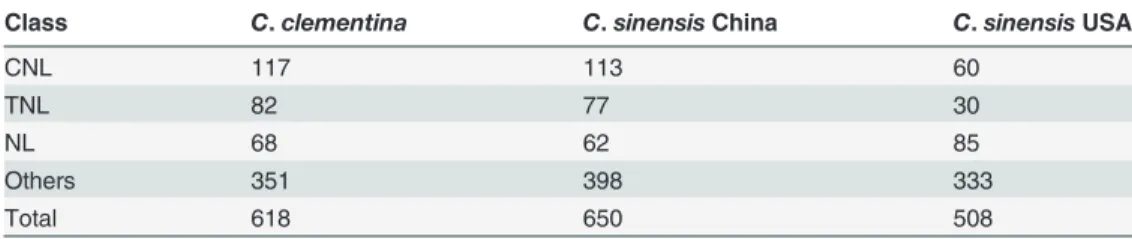
We searched theC.clementina,C.sinensisChina andC.sinensisUSA genomes for genes con-taining the NBS domain usinghmmsearch. Then, the NBS-containing genes were confirmed through homology searches against the Swiss protein database (see“Materials and Methods”). We identified similar numbers of NBS domain-containing genes amongst these three genomes. We found 618, 650 and 508 NBS genes fromC.clementina,C.sinensisChina andC.sinensis USA genomes respectively (Table 1). Among them, 413, 499 and 484 NBS genes were predicted in the original gene annotations and 205, 151 and 24 NBS genes inC.clementina,C.sinensis China andC.sinensisUSA respectively were newly predicted in this project (S1 Table).
NBS genes could be classified into different classes based on their domain structures [6]. We searched the Toll-Interleukin receptor (TIR) and Coiled Coil (CC) domains in the N-terminal region and the Leucine-Rich Repeat (LRR) domains in the C-terminal of NBS genes. We iden-tified 117 NBS genes with CC-NBS-LRR (CNL) domains, 82 NBS genes with TIR-NBS-LRR (TNL) domains, 68 NBS genes with NBS-LRR (NL) and 351 others NBS genes without LRR domains (N, CN and TN) fromC.clementina(Table 1). We also identified 113 CNL, 77 TNL, 62 NL and 398 others NBS genes fromC.sinensisChina and 60 CNL, 30 TNL, 85 NL and 333 others NBS genes fromC.sinensisUSA (Table 1). In comparison to other genomes, there are many moreCitrusNBS genes without the LRR domain. There are only 43.2%, 38.8% and 34.4% NBS genes with existing LRR domains inC.clementina,C.sinensisChina andC.sinensis USA, respectively, while 72% NBS genes inArabidopsis thaliana[6] and 78% NBS genes in
Po-pulus trichocarpa[44] have LRR domain.
Table 1. Classification ofCitrusNBS genes.
Class C.clementina C.sinensisChina C.sinensisUSA
CNL 117 113 60
TNL 82 77 30
NL 68 62 85
Others 351 398 333
Total 618 650 508
The CNL class of NBS genes contains three domains: Coiled Coil (CC), nucleotide-binding sites (NBS) and Leucine-Rich Repeat (LRR). The TNL class of NBS genes contains three domains: Toll-Interleukin receptor (TIR), nucleotide-binding sites (NBS) and Leucine-Rich Repeat (LRR). The NL class of NBS genes contains two domains: nucleotide-binding sites (NBS) and Leucine-Rich Repeat (LRR). The other NBS genes contain no LRR domain.
The structures of TNL and CNL NBS genes are significantly different. The TNL NBS genes tend to have more introns than that of CNL NBS genes as previously found inArabidopsis[6]
andPopulus[44]. The average numbers of introns in TNL NBS genes are 4.39, 4.70 and 4.47,
while the numbers of introns in CNL NBS genes are 0.89, 1.15 and 1.38 inC.clementina,C.
sinensisChina andC.sinensisUSA respectively (S1 Fig.). The median numbers of introns of
different types of NBS genes in the threeCitrusgenomes are similar: four in TNL NBS genes and one in CNL NBS genes.
The NBS genes were unevenly distributed in theCitrusscaffolds/chromosomes. There were 158, 217 and 110 NBS genes, totaling 78.3% of 618 NGS genes, distributed in scaffolds_3, _5 and _7 ofC.clementina, respectively. There were 125, 121 and 75 NBS genes distributed in chromosomes 1, 3 and 5 ofC.sinensisChina. The majority (95 out of 107) of NBS genes with TIR domain inC.clementinawas distributed in scaffold 3. There were 33 and 51 (out of 102) NBS genes with TIR domain inC.sinensisChina distributed on chromosome 5 and chromo-some unknown, respectively.
Phylogenetic and Clade Analysis of the
Citrus
NBS Genes
To avoid mutation saturation effects in nucleotide sequences over time which can lead to an underestimation of the number of mutation events due to higher substitution rates versus pro-teins, we used the protein sequences of NBS domains, which are the most conserved part of NBS genes, to construct a phylogenetic tree of NBS genes. We only selected NBS domain se-quences longer than 200 amino acid residues and contain both P-loop and MHDV motifs. Fi-nally, 442C.clementina, 393C.sinensisChina, and 264C.sinensisUSA NBS domain
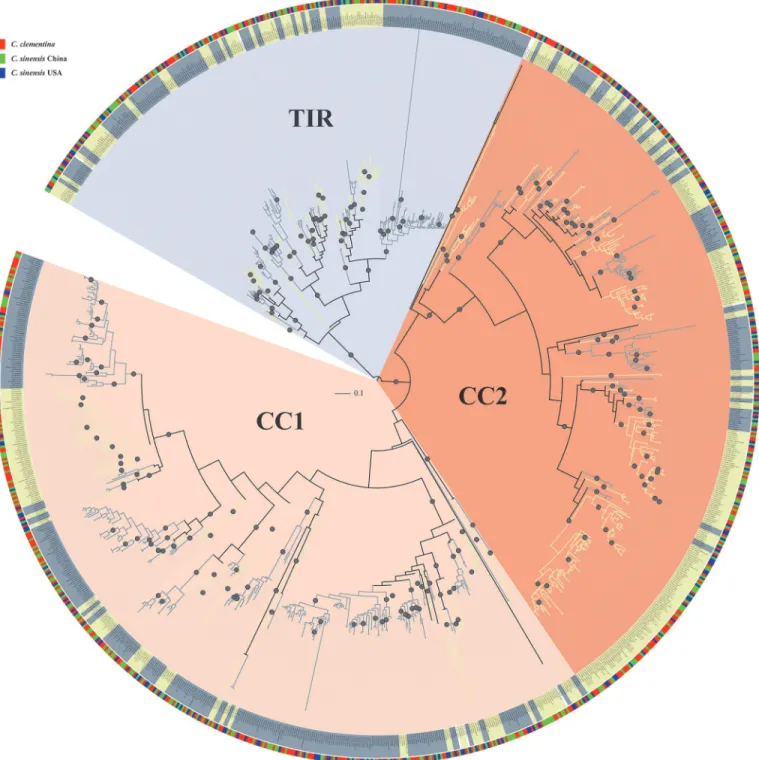
sequences were used for phylogenetic analysis (S2 Table). A Maximum Likelihood (ML) phylo-genetic tree of these 1,099 NBS genes was then constructed usingFastTree[31]. As shown in Fig. 1, the un-rooted phylogenetic tree can be divided into three main groups. Most NBS genes containing the TIR domain are in one branch and the non-TIR NBS genes comprise the other two branches (Fig. 1), in which most of them contain a CC domain. Therefore, we denoted the three branches as TIR, CC1 and CC2.
There were 452, 382 and 265CitrusNBS genes in CC1, CC2 and TIR groups, respectively. S2 Tablelists the group classification of 1,099CitrusNBS genes. For each sub-group, we con-structed a new ML phylogenetic tree rooted byStreptomyces coelicolorprotein P25941 (S2 Fig.). The NBS domains in CC groups, especially in the CC1 group, were relatively more diverged in sequence versus those in TIR group. The average Poisson corrected distances between sequence pairs within each group were 0.947, 0.827 and 0.663 for CC1, CC2 and TIR groups, respective-ly. We aligned the NBS domains sequences in each group using mafft with default parameters (—auto). The average percentages of identities for NBS domain sequences were 40%, 44% and 52% for CC1, CC2 and TIR groups, respectively.
The number of LRR domains varied amongst the three classes ofCitrusNBS genes. The number of LRR domains in the TIR group is significantly higher than the numbers of LRR do-mains in the CC1 and CC2 groups (S3 Fig.). The majority of CC1 NBS genes have only one LRR domain. On other hand, the TIR NBS genes have 2.4 LRR domains on average. The most frequent type of LRR domain in the CC1 group is LRR_8 (PF13855), but LRR_1 (PF00560) is the most frequent domain in both the CC2 group and the TIR group (S3 Table).
respectively. We calculated average sequence similarities between NBS domains in each clade usingalistatinSQUID(http://selab.janelia.org/software.html). The minimum average se-quence similarity of NBS domains in each clade was 70%. The largest clade included 90 NBS Fig 1. Maximum likelihood phylogenetic tree ofCitrusNBS-LRR genes constructed from multiple sequences alignment of NBS domain.There are three gene groups in the phylogenetic tree: CC1 (pink fan-shape), CC2 (orange fan-shape) and TIR (light grey fan-shape). Clades were classified using PhyloPart as shown in alternating color and represented by alternative light yellow and grey colors in the middle circle. The outer circle shows species withC. clementinain red,C.sinensisChina in green andC.sinensisUSA in blue. Nodes with bootstrap support of 100 are indicated with grey circles on the tree.
genes. On average, there were 9.56 genes per clade. There were seven clades with more than 40 genes. Among these clades, four clades were in CC1; two clades were in CC2 and one clade was in the TIR group. Most of the clades contain NBS genes from the threeCitrusgenomes (Fig. 1, Table 2). There are 89 clades with at least three NBS genes and 87 of these clades contain mem-bers from each of the threeCitrusgenomes. Together, these results imply that threeCitrus ge-nomes may have similar types of NBS genes.
To understand the evolutionary dynamics maintaining functional constraint while main-taining so many gene family members, we tested for evidence of accelerated sequence evolution (positive selection) by searching for positively-selected sites within each clade. We detected positively selected sites in 53.5% (61) of clades. There were 18, 24 and 19 clades with sites under positive selection in CC1, CC2 and TIR groups, respectively. In total, we detected 541 positively selected sites. Consistent with previous reports [6], there are more positively selected sites in the C-terminal region of NBS genes (LRR domains) than those in the N-terminal and NBS domains (S4 Table). Approximately 56.4% (305 out of 541) of the positively selected sites were located in the C-terminal region (LRR domain). While most clades have positively select-ed sites in the LRR domain, there were clades with a greater number of positively selectselect-ed sites within the NBS domain. For example, there were 46 positively selected sites in Clade_1260 that are located in NBS domain while there are only two positively selected sites in LRR domain (S4 Fig.).
Mapping Re-sequencing Reads Showed the Conservation of NBS
Genes in
Citrus
Genomes
To verify thatC.sinensis(sweet orange) is a backcross hybrid ofC.maxima(pomelo) andC.
reticulata(mandarin) [19], Xuet al. previously re-sequenced three pomelo cultivars and three
mandarin cultivars and showed that SSR and SNP markers in theC.sinensisgenome derive from the pomelo and mandarin genomes at an approximately ratio of 1:3 [19]. Since our com-parison ofC.sinensisandC.clementinagenomes showed that most of their NBS genes are very similar in sequence, we investigated the relationships amongst the NBS genes ofC.sinensis (sweet orange),C.maxima(pomelo), andC.reticulata(mandarin) to compare and contrast how mutations accumulated and determine if there are differences in sequence, and hence po-tentially functional, constraints amongst NBS gene types inCitrusgenomes.
We mapped the re-sequenced reads of threeC.maxima(pomelo) genomes and threeC.
reti-culata(mandarin) genomes to hybridized genome ofC.sinensis(sweet orange) China using
BWA with mem method [41] and calculated the coverage of each NBS gene inC.sinensis China. We detected 524 of 650C.sinensisChina NBS genes with more than 50% coverage in all of the six re-sequenced genomes. Additionally, 249 of 650C.sinensisChina NBS genes with more than 85% coverage in all six resequenced genomes and 592 (91%) ofC.sinensisChina Table 2. Types ofCitrusNBS gene clades.
NBS genes from Citrus genomes Number of Clade
C.clementina,C.sinensisChina,C.sinensisUSA 87
C.clementina,C.sinensisChina 13
C.clementina,C.sinensisUSA 7
C.sinensisChina,C.sinensisUSA 5
C.clementina, 1
C.sinensisChina, 0
C.sinensisUSA 1
NBS genes with coverage over 85% in at least one of the re-sequencedCitrusgenomes. Using a cutoff of 15% coverage as missing calls over the entire length of the gene, only 25 (<4%) ofC.
sinensisChina NBS genes seem to be deleted in at least one of the six re-sequenced genomes.
No NBS genes were lost amongst all of the six re-sequenced genomes.
Re-sequenced reads tended to map to exons rather than to introns (S5 Table). For example, the entire coding region of NBS gene Cs9g13310 was 3,693 bp in length and covered by all reads from the re-sequenced samples. However, the 16 kb introns were not consistently present in all of the re-sequenced reads. When we used exon presence instead of whole gene coverage, 403 out of 650 (62%)C.sinensisChina NBS genes have more than 85% coverage in all six re-sequenced
Citrusgenomes and 645 (99%)C.sinensisChina NBS genes have more than 85% coverage in at
least one of the resequencedCitrusgenomes. MostC.sinensisChina NBS genes have high exon coverage on both theC.maxima(pomelo) andC.reticulata(mandarin) genomes (S5 Fig.). There were only threeC.sinensisChina NBS genes, Cs1g02140.1, Cs6g02120.1 and Cs7g02220.1, with low (<40%) exon coverage in all threeC.maximagenomes, but high coverage was achieved
in at least two of the threeC.reticulatagenomes (S5 Fig.). Our mapping results showed that most NBS genes ofC.sinensis(sweet orange) have a corresponding copy in the re-sequencedC. maxi-ma(pomelo) andC.reticulata(mandarin) genomes.
Motif Patterns in
Citrus
NBS Genes
To further examine the gene structures of threeCitrusNBS gene groups, we searched the mo-tifs in the sequences of each group usingMEME.Fig. 2lists consensus sequences of the top 20 motifs identified by MEME from the CC1, CC2 and TIRCitrusNBS gene groups.
The motifs in the N-terminal of CC1 and CC2 groups showed little similarity to each other. The MEME found two motifs from CC1 group. One of them, EEQQQMRRLNQVQGWLSRVEA, was present in 356 of 452 CC1 NBS genes. The other motif, GSQEIDKLCLGGYCSKNCKSSYKF GKKVA, was present in 189 of 452 CC1 NBS genes. Both motifs have high level of sequence simi-larities with the CC NBS genes ofArabidopsis(S6 Fig. A). The MEME found three motifs from CC2 group. Two of the motifs, KKLTNMLEMIKAVLDDAEEKQ and AVKLWLGKLKDAAYD-VEDVLDEFQTEALR were identified in 325 and 340 of 382 CC2 NBS genes, respectively. The motif AVKLWLGKLKDAAYDVEDVLDEFQTEALR has high levels of similarity with the motif identified from the CC NBS genes ofOryza sativa japonica(Japonica rice) [45] (S6 Fig. B). The dif-ferent motifs in CC1 and CC2 NBS genes implied that they may be from difdif-ferent evolutionary origins.
For the TIR group, the MEME identified five motifs in the N-terminal. They can be found in 76% to 90% of 265 TIRCitrusNBS genes. The first four motifs YDVFLSFRGEDTRDNFTSHLY, AIEASAISVIIFSEGYASSRWCLDELVKI, GQIVIPVFYRVDPSDVRKQTG, and ENPEKVQK WRDALKEA were very similar to the TIR1-4 motifs identified from TIR NBS genes in
Arabi-dopsis[6] andPopulus trichocarpa[44] (S6 Fig. C).
The MEME algorithm identified nine motifs from NBS domains of CC2 and TIR groups, which are similar to the motif structures of NBS domains inArabidopsis thaliana[6] and
Popu-lus trichocarpaNBS genes [44]. MEME results also showed that the motif structure of NBS
Populuspreviously. Meanwhile, the motifs RNBS-A, RNBS-C, and RNBS-D were quite dissim-ilar to each other amongst three groups.
The LRR domains in the C-terminal of NBS genes usually have high sequence diversity as they play a role in recognizing pathogen virulence proteins. The MEME algorithm identified five, six, and four motifs from LRR domains of CC1, CC2 and TIR NBS genes, respectively. Most of the motifs contained LxxL repeats. The LRR motifs from different groups were highly variable in sequence, which implied that the three groups of NBS genes play different roles in theCitrus immune system. Some LRR motifs had repeated several times in the same gene. Examples in-clude: motif APNLKSLEVSSCxxMEEIISV found in 367 of 452 CC1 group with an average 4.8 motifs per gene; motif IKTLPESVCELYNLQTLDLEGCRRLKKLP found in 332 of 382 CC2 group with an average 2.8 times per gene and motifs CKRLKSLPSSLCKLKSLGxLNLSGCSNLE and GNISELFLDGTAIEELPSSIE found in 208 and 209 of 265 TIR group with 2.5 and 2.1 times per gene, respectively.
Fig 2. Architecture of NBS gene motifs inCitrus.The consensus sequences of the top 20 motifs identified by MEME for each group ofCitrusNBS genes are listed (A: CC1 group, B: CC2 group, C: TIR group). The motifs in blue are identified from N-terminal (CC or TIR domain). The motifs in red are identified from NBS domain. The motifs in green are identified from C-terminal (LRR domain). The motifs in black are identified from other region of NBS genes. The bold letters highlight the conserved motifs inArabidopsis. The motifs underlined in green were repeated in C-terminal (LRR domain).
Analysis of NBS Gene Clusters in
Citrus
Genomes
The majority ofCitrusNBS genes were physically clustered in genome (Table 3). 525 of 618 NBS genes inC.clementinawere found in 108 clusters and 500 of 650 NBS genes inC.sinensis China were found in 126 clusters (S2 Table). Although the assembly ofC.sinensisUSA is more fragmented, there still are 207 of 508 NBS genes present in 72 clusters. The largest number of gene clusters in C.clementina,C.sinensisChina andC.sinensisUSA contain 55, 37 and 13 NBS genes, respectively.
Most clusters contain NBS genes from the same group. InC.clementina, there were 38 clusters with NBS genes of CC1 group, 40 clusters with NBS genes of CC2 group and 23 clusters with NBS genes of TIR group. Only seven out of 108 clusters contain the NBS genes from two or three groups. InC.sinensisChina, there were 41 clusters with NBS genes of CC1 group, 44 clusters with NBS genes of CC2 group and 26 clusters with NBS genes of TIR group. There were 15 clusters con-taining NBS genes from two or three groups inC.sinensisChina. InC.sinensisUSA, there were 27 clusters with NBS genes of CC1 group, 25 clusters with NBS genes of CC2 group and 15 clusters with NBS genes of TIR group. Only five clusters contain NBS genes from different groups inC.
sinensisUSA. The lower number of clusters inC.sinensisUSA may due to its fragmented assembly.
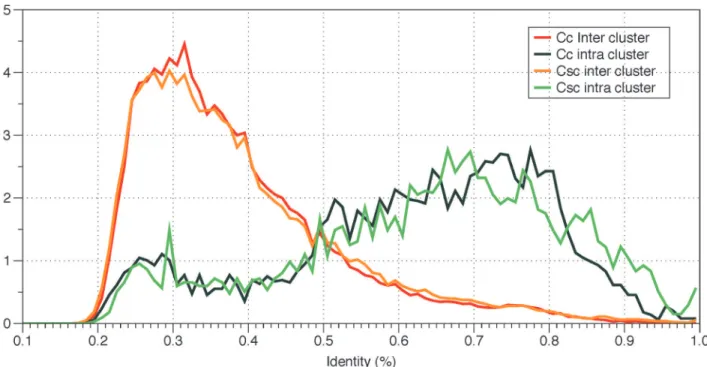
The sequences of NBS genes within clusters are much more similar to each other than those between clusters (T-test p value<2.2e-16). The mean identities between genes within and
be-tween clusters were 0.628 and 0.393 respectively (Fig. 3). Furthermore, NBS genes in the same Table 3. CitrusNBS genes in clusters.
Citrus species Total NBS genes Number of NBS genes in cluster Number of clusters Percent of NBS genes in cluster (%)
C.clementina 618 525 108 84.9
C.sinensisChina 650 500 126 76.9
C.sinensisUSA 508 207 72 40.7
doi:10.1371/journal.pone.0121893.t003
Fig 3. Percentage identity distribution of NBS-encoding genes inC.clementina(Cc) andC.sinensisChina (Csc).Green lines indicate pairwise identity distribution of inter-cluster NBS-encoding genes. Orange lines indicate intro-cluster NBS-encoding genes.
cluster tend to be in the same strand, which indicates that the NBS genes in the clusters are due to tandem duplication. We detected 204 pairs of tandem duplications inC.clementinaand 217 pairs of tandem duplications inC.sinensisChina using MCScanX [39]. The numbers of tan-dem duplications within CC1 and CC2 groups are much greater than that within the TIR group. Among 204 pairs inC.clementina, 90 and 85 pairs were present in the CC1 and CC2 groups and only 29 pairs from TIR group. Among 217 tandem gene pairs inC.sinensisChina, 88 and 87 pairs were present in the CC1 and CC2 groups and only 42 pairs in the TIR group. The fewer tandem duplications of NBS genes in the TIR group may be the reason that there are fewer clusters of TIR groups inCitrusgenomes.
We identified 254 and 246 gene conversion events from 116 NBS gene clusters inC. clemen-tinaand 144 NBS gene clusters inC.sinensisChina, respectively (Table 4). The gene conver-sion events inC.sinensisUSA is much less due to fragmented assembly. It is interesting that most of the conversion events (483 out of 520) were identified from the relatively small clusters with less than 10 NBS genes. Among these conversions, 119 events located in N-terminal, 178 in NBS domains and 223 in C-terminal, which indicating that there was no significantly bias in the location of conversion. Most gene conversions were between genes from the same group. We identified 101, 184 and 229 conversion events from NBS genes in TIR, CC1 and CC2 groups respectively and only four conversion events were identified between NBS genes of TIR and CC2 groups. While we could identify similar total numbers of conversion events inC.
clementinaandC.sinensisChina, we found almost double such events inC.sinensisChina TIR
clusters versus inC.clementinaTIR clusters. Meanwhile, we also found many more conversion events inC.clementinaCC2 clusters than that inC.sinensisChina CC2 clusters (Table 4).
Analysis of NBS Orthologs
We identified 719CitrusNBS gene pairs of orthologs amongstC.clementina,C.sinensisChina
andC.sinensisUSA. 270 orthologs were shared betweenC.clementinaandC.sinensisChina
(S7 Fig.); 227 orthologous gene pairs were shared betweenC.clementinaandC.sinensisUSA and 222 orthologous gene pairs were shared betweenC.sinensisChina andC.sinensisUSA. The percentages of identities between orthologous genes range from 53.8% to 100% (mean of 93.6%, median of 96.8%). The percentages of identities between orthologous genes from TIR group (TNL and TN, 88.42 ± 10.04) were significantly (T-test: P<2.6e-6) lower than those
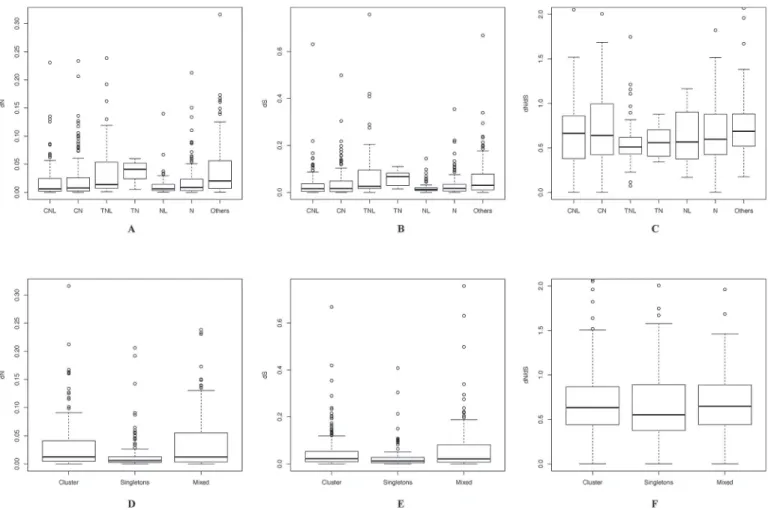
from CC groups (CNL and CN, 92.92 ± 7.03). The nonsynonymous divergence (dN) values of the 719 orthologs ranged from 1.46e-6 to 0.31 (mean of 0.03, median of 0.08) and the synony-mous divergence (dS) values ranged from 1.14e-5 to 0.75 (mean of 0.05, median of 0.019) (Fig. 4A, B). The dN/dS rate ratios ranged from 0.001 to 50 with a median of 0.62. Similar to
Arabidopsis, the dN and dS of orthologs from TIR group (TNL and TN) were higher than
those from CC groups (CNL and CN). The dN values of orthologs from TIR group ranged Table 4. Gene conversion events found inC.clementinaandC.sinensisChina.
Citrus species Cluster type
Number of clusters (with conversion events)
Number of conversion events
Affected genes
Mean size of conversion tracts
C.clementina TIR 27 35 32 111
CC1 43 86 67 137
CC2 46 133 83 146
C.sinensis China
TIR 36 69 42 137
CC1 51 89 48 162
CC2 57 92 75 116
from 0.001 to 0.24 (mean of 0.038, median of 0.017) while those of orthologs from CC group ranged from 1.4e-6 to 0.23 (mean of 0.025, median of 0.007). The dS rate of orthologs from TIR group ranged from 3.27e-5 to 0.76 (mean of 0.078, median of 0.029) while those of ortho-logs from CC group ranged from 1e-5 to 0.67 (mean of 0.04, median of 0.016). However, the dN/dS rate ratios of orthologs from TIR group were relatively lower than that of orthologs from CC group (Fig. 4C).
The dN and dS rates as well as dN/dS rate ratios of ortholog residues in clusters are generally greater than those of orthologous singletons (Fig. 4D-F). The median dN/dS rate ratio of 148 orthologous singletons was 0.55 while that of 361 orthologs in clusters was 0.63. There were 124 orthologs with dN/dS rate ratios above 1. Variation in these orthologs may be shaped by positive selection pressure. Most of the positive selected orthologs (87.9%, 109 out of 124) be-longed to CC groups (49 orthologs from CC1 group and 50 from CC2 group).
We also detected 38 NBS gene syntenic blocks betweenC.clementinaandC.sinensisChina using MCScanX [39]. Totally, there are 416 syntenic orthologs of NBS genes betweenC.
clem-entinaandC.sinensisChina (S8 Fig.). On average, there are 11 genes per block. The biggest
block contains 45 NBS genes and was located in scaffold_5 ofC.clementinaand chromosome
Fig 4. Divergence of orthologous NBS-encoding genes amongstCitrusspecies. A-C.Divergence of different classes.D-F.Divergence of singletons and cluster members. dN indicates the nonsynonymous mutation rate (rate of nonsynonymous mutations per nonsynonymous site). dS indicates the synonymous mutation rate. CNL, CN, TNL, TN, NL and N indicate orthologs between two proteins belonging to same cluster with CC-NBS-LRR domains (CNL), CC-NBS domains (CN), TIR-NBS-LRR domains (TNL), TIR-NBS domains (TN), NBS-LRR domains (NL), NBS domain (N), respectively. The others indicate orthologs between different clusters.
3 ofC.sinensisChina. There were 80, 77 and 71 syntenic NBS genes in scaffold_5 ofC. clemen-tina/chromosome 5 ofC.sinensisChina, scaffold_3 ofC.clementina/chromosome 5 ofC.
sinensisChina and scaffold_7 ofC.clementina/chromosome 1 ofC.sinensisChina.
Further-more, there were 68, 66 and 8 syntenic NBS genes in the unknown chromosome ofC.sinensis China corresponding to NBS genes in scaffold_3, _5 and _7 ofC.clementina, respectively.
Analysis of Conserved NBS Gene Clusters
We identified 118 pairs of conserved NBS gene clusters betweenC.clementinaandC.sinensis China (S9 Fig.). There were 19 NBS gene clusters completely conserved inC.clementinaandC.
sinensisChina. For example, all 14 NBS genes in cluster CL225 ofC.sinensisChina have
ortho-logs in the cluster CL168C.clementinawhich contains nine NBS genes and vice versa. Some clusters (in bothC.clementinaandC.sinensisChina) have several corresponding conserved clusters. This may due to either the genome arrangement or the incomplete assembly of ge-nomes. Furthermore, there were 19 clusters ofC.clementinawith no conserved clusters inC.
sinensisChina and 18 clusters ofC.sinensisChina with no conserved clusters inC.clementina.
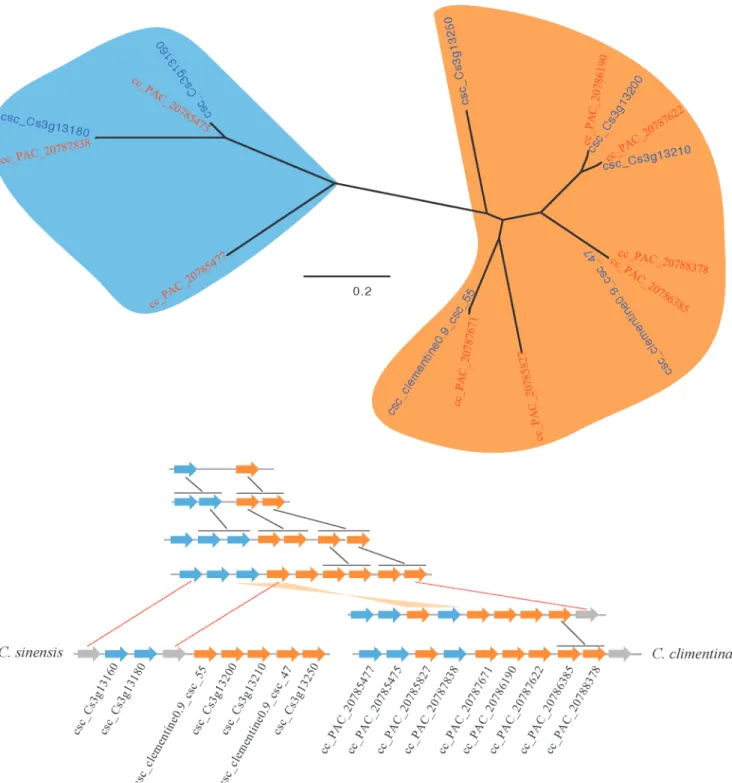
The conserved clusters provided additional insights into NBS gene evolution within and be-tweenCitrusgenomes. For example, cluster CL142 (9 NBS genes) inC.clementinaand cluster CL282 (7 NBS genes) inC.sinensisChina were highly conserved. The phylogenetic tree of these 16 genes suggested division into two subgroups (depicted in blue and orange color in Fig. 5A). This division suggests two ancestral genes for this conserved cluster. Using the phylo-genetic tree as a framework, we reconstructed the evolutionary history of these two clusters. There were several tandem duplication events in the evolutionary history of the conserved clus-ters, and extra tandem duplication was observed inC.clementinaafter it separated fromC.
sinensis(Fig. 5B). Two NBS genes were lost inC.sinensisand one NBS gene was lost inC.
clem-entina. Furthermore, there was a recombination event withinC.clementina.
Mutations and Transposons in
Citrus
NBS Genes
Plant NBS genes are continuously evolving. Sequence variation and structural constraints are shaped by gene birth-and-death processes [46]. Besides possible interallelic recombination and gene conversion, gene mutations and transposable elements appear to play important roles in NBS gene evolution.
We compared the DNA sequences of NBS genes from differentCitrusgenomes to identify mutations. Approximately half ofCitrusNBS genes have mutations maintained amongst corre-sponding orthologs. When a mutation took place in an exon and resulted in stop-codon gain-ing or frame-shift, the target gene often became a pseudogene. For example,
Cs1g18610.1_cc_32, Cs1g18610.1 and orange1.1g003367m are orthologs ofC.clementina,C.
sinensisChina andC.sinensisUSA. There were 2 stop-codon gaining mutations in
Cs1g18610.1 (S10 Fig. A), which means that Cs1g18610.1 might become a pseudo (nonfunc-tional) gene after gaining these mutations.
LTR retrotransposons are widespread in eukaryotic genomes, especially plant genomes. We predicted 19014, 6296 and 1479 LTR retrotransponsons with typical LTR characters in the draft genomes ofC.clementina,C.sinensisChina andC.sinensisUSA, respectively. Then, we filtered out LTR retrotransponsons with low similarity with known TE proteins using BLASTX with e-value greater than 1e-5. Finally, 4920, 3726 and 1240 LTR retrotransponsons remained
inC.clementina,C.sinensisChina andC.sinensisUSA, respectively. We identified 33, 32 and
4 NBS genes that were inserted with LTR retrotransposons inC.clementina,C.sinensisChina
andC.sinensisUSA respectively (S6 Table). Most of these genes will likely become
orange1.1g043039m_cc_116 and orange1.1g043039m_csc_123 were orthologs ofC.sinensis
USA,C.clementinaandC.sinensisChina respectively (S10 Fig. B). The results of gene structure
analysis showed that structure in orange1.1g043039m inC.sinensisUSA seems relatively well Fig 5. Duplication histories of one of the conserved NBS-encoding genes cluster inC.clementinaandC.sinensis. A.Phylogenetic tree of the NBS-encoding genes;B.Orthologs in the conserved cluster ofC.clementinaandC.sinensis. Black connectors indicate tandem duplications and red dotted connectors indicate gene loss. A gene recombination event occurred in the ancestor ofC.clementina, as indicated with an orange connector.
maintained. But there is an about 10 kb fragment of LTR-retrotransposons in the correspond-ing homologous gene inC.clementinaandC.sinensisChina (S10 Fig. B). We identified both orange1.1g043039m_cc_116 and orange1.1g043039m_csc_123 as pseudogenes using Pseudo-Pipe [37].
Experimental Validation of One NBS Gene in
Citrus
Genomes
We validated the orthologs of a conserved NB gene, Cs1g09350.1, in a wide range ofCitrus spe-cies. Cs1g09350.1 conserved in the 3 sequencedCitrusgenomes. It is a CNL NBS gene and has 5 exons with about 4 kb in length. We designed the primers targeting about 3.5 kb fragment and could amplify a 3.5 kb fragment using PCR in differentCitrusspecies, includingC.sinensis (sweet orange),C.clementina(clementine),C.japonica(kumquat),C.sinensisNavelina (navel orange),C.maxima(pomelo),C.aurantiifolia(lime), andC.aurantium(sour orange). The orthologs fromC.sinensisandC.clementinawere identical as expected. There are a few muta-tions in the orthologs ofC.japonica,C.sinensisNavelina, andC.maxima, but the orthologs of
C.aurantiifoliaandC.aurantiumshould be undergoing a pseudogenization process. There
was a deletion plus several mutations in the NBS domain inC.aurantiifolia. There was an eight-base deletion in the LRR domain inC.aurantiifoliaandC.aurantium. MostC.
aurantii-foliamutations were shared withC.aurantium(S11 Fig.), and these mutations were not shared
with other species. The results suggest that inC.aurantiifoliaandC.aurantium, this gene is likely derived from the same common ancestor and was inherited as a pseudogene.
Discussion
Similar NBS Genes in Hybrid
Citrus sinensis
and Original
Citrus
clementina
Genome
After carefully reannotating theCitrusgenome sequences, we found similar numbers of NBS genes inC.clementinaandC.sinensisChina. There are slightly fewer NBS genes inC.sinensis USA, possibly due to the more fragmented assembly of this genome. In phylogenetic tree using NBS domains, the NBS genes from three differentCitrusgenomes are spread across clades. After partitioning NBS genes on the tree into clades, we found that 97.7% of the clades contain-ing at least three genes had members from each of threeCitrusgenomes. This pattern suggests that these threeCitrusgenomes have similar types of NBS genes derived from common ances-tors. BecauseC.sinensisis the hybrid ofC.reticulata(mandarin) andC.maxima(pomelo), it should be heterozygous and some of NBS genes inC.sinensisare expected have different genet-ic distances from NBS genes inC.clementina. This would support previous observations of NBS genes in F1 progeny ofPoncirus trifoliata(trifoliate orange) andCitrus reticulata (tanger-ine). However, this is clearly not the case.
Furthermore, we mapped the re-sequenced reads of threeC.maxima(pomelo) genomes and threeC.reticulata(Mandarin orange) genomes onto the genome ofC.sinensisChina. In this case, 62% ofC.sinensisChina NBS genes have a copy present in all six resequenced genomes and 99% ofC.sinensisChina NBS genes have a copy in at least one of the re-sequenced ge-nomes. The mapping results confirmed that a significant percentage of NBS genes of hybridC.
sinensisgenomes have corresponding homologous genes in both theC.maximaand theC.
reti-culatagenomes. Because the reference genome sequence ofC.maximais not yet available, the
inC.maximaandC.reticulatamay be the reason that NBS genes in their hybridC.sinensisare similar to those inC.clementinain this study.
Three Groups of
Citrus
NBS Genes
We identified 442, 393 and 264 genes with full length NBS domains fromC.clementina,C.
sinensisChina andC.sinensisUSA reference genomes, respectively. There are also many genes
with short NBS domains in threeCitrusgenomes. TheCitrusNBS genes can be divided into three groups according to the phylogenetic tree of NBS domains: two of them without TIR do-main (CC1 and CC2 groups) and the other group with TIR dodo-main (TIR group). The number of non-TIR NBS genes is three times of the number of TIR NBS genes. In most of the TIR NBS genes, we can find the LRR domains defined in Pfam database [47]. We only can identify LRR domains in small part of non-TIR NBS genes using Pfam LRR domain definition. However, we can find the LxxLs repeats in most of the non-TIR NBS genes as shown in motifs from MEME. This implied that there may be other types of LRR domain inCitrusnon-TIR NBS genes.
Our motif analyses also showed that motifs of TIR domains inCitrusTIR NBS genes are similar to those of TIR domains inArabidopsis[6] andPopulus trichocarpa[44] TIR NBS genes. Furthermore, the motifs ofCitrusCC domains in CC1 NBS genes are similar to those motifs of CC domains inArabidopsisCC NBS genes and the motifs ofCitrusCC domains in
CitrusCC2 NBS genes are similar to those motifs of CC domains in japonica rice CC NBS
genes [45]. The different structure of motifs in NBS domain and CC domain betweenCitrus CC1 NBS genes andCitrusCC2 NBS genes suggested that they are likely from separate evolutionary origins.
To further confirm the three groups of NBS genes, we identified the NBS genes from
Arabi-dopsis,Populus,Oryza sativaand grape. We used the same criteria to select the NBS domains
from NBS genes of these genomes. Finally, we selected 152, 216, 209, 126 NBS domains from
Arabidopsis,Populus,Oryza sativaand grape, respectively. Then, together with 442 NBS
do-mains selected fromC.clementina, we constructed a phylogenetic tree of those 1145 NBS do-main sequences from five genomes. As shown inFig. 6, the un-rooted phylogenetic tree was divided into three main branches. ThePopulus, grape andCitrusgenomes have significant amount of NBS genes in all three branches. However, the NBS genes ofOryza sativadominated in CC2 branch and most ofArabidopsisNBS genes located in CC1 and TIR branches. Our study showed that the NBS genes can be divided into three major groups as the non-TIR NBS genes are separated into two groups. The three groups of NBS genes underwent divergent evo-lution in different genomes. Further comparison of NBS genes of more genomes may help to understand the evolution of NBS genes and will help elucidate how plants maintain and adapt their defense system against pathogens.
Highly Clustering of
Citrus
NBS Genes
TheCitrusNBS genes are highly clustered in the genome. 84.9% of NBS genes inC.clementina
and 76.9% of NBS genes inC.sinensisChina were found in clusters. Previous studies showed 76% of rice [48], 64% ofA.lyrataand 71%A.thaliana[13], 83.2% of grapevine and 67.5% of poplar [9] NBS genes are found in clusters. The percentage ofCitrusNBS genes in clusters is in the high level comparing to other genomes. The average number of genes per clusters is 4.86 in
C.clementinaand 3.97 inC.sinensisChina. These numbers are similar to those in other
Molecular Evolution of
Citrus
NBS Genes
Similar to NBS genes in other genomes,CitrusNBS genes are highly dynamic and are shaped by several evolutionary processes leading to several differences amongst NBS genes, including Fig 6. The maximum likelihood phylogenetic tree of NBS genes ofC.clementina,Arabidopsis thaliana,Populus trichocarpa,Oryza sativaandV.
vinifera(grape).Species are indicated by the color of the outer circle and branches. Nodes with bootstrap support of 100 are indicated with grey circles on the tree.
domain presence and mutation constraints and genome organization. Our results revealed multiple molecular evolution events amongstCitrusNBS genes including gene duplications, gene conversions, mutation constraint changes, recombination and transposable element in-sertions. Likely these events support a birth-and-death process leading to the origins of new NBS genes as well as nonfunctionalization and total loss of other NBS genes [12]. We found more than 200 tandem duplications in bothC.clementinaandC.sinensisChina genomes alone. We also found that NBS genes become pseudogenes following original frame-shift muta-tions leading to mutation accumulamuta-tions plus disruption of gene constraint leading to loss of function through transposable element insertions.
Most molecular evolutionary events occurred within NBS gene groups, suggesting that gene birth-death processes have been occurring since divergence from a common ancestral gene copy. Interestingly, the molecular evolution processes occurred differently amongst NBS gene groups and differently within eachCitrusgenome. For example, the number of gene conversion events inC.sinensisChina TIR clusters is almost double than that inC.clementinaTIR clus-ters, while there are many more conversion events inC.clementinaCC2 clusters than inC.
sinensisChina CC2 clusters (Table 4). Numbers of tandem duplications in CC1 and CC2
groups are much greater than that from the TIR group.
Conclusions
Our comparative analyses yield valuable insight into the understanding of the structure, evolu-tion and organizaevolu-tion of NBS genes inCitrusgenomes.CitrusNBS genes are structurally highly clustered. The hybridC.sinensisgenomes have similar types of NBS genes as those progenitor
C.clementinagenomes have. Furthermore, our comprehensive analysis also showed that there
are three groups of plant NBS genes while non-TIR NBS genes can be divided into two groups. The distributions of three groups of NBS genes among genomes are different implied that the three groups of NBS genes underwent divergent evolution in different genomes.
Supporting Information
S1 Fig. Average intron number of CNL and TNL.Cc:C.clementina, CsCN:C.sinensisChina and CsUSA:C.sinensisUSA.
(PDF)
S2 Fig. Phylogenetic trees of three groups ofCitrusNBS gene with P25941 as outgroup. A. CC1 group;B.CC2 group; andC.TIR group. Nodes with bootstrap support of 100 are indicat-ed with grey circles on the tree.
(PDF)
S3 Fig. Structure ofCitrusNBS gene domains.The red rectangles indicate NBS domains, the green ellipses indicate CC domains, the left pointing pentagons indicate TIR domains and the left pointing triangles indicate LRR domains.
(PDF)
S4 Fig. Positively selection sites of Clade_1260.The grey box indicate the NBS domain. (PDF)
S5 Fig. The exon coverage of NBS-encoding genes in the resequences ofCitrusgenome (3 mandarin and 3 pomelo).
S6 Fig. Multiple alignments of motifs from CC1 domain (A), CC2 domain (B) and TIR do-main (C).
(PDF)
S7 Fig. Orthologs ofCitrusNBS-encoding genes ofC.clementinaandC.sinensisand their genome locations.The outer blue circles indicate the nine largest scaffolds of Cc and orange circles indicate nine chromosomes plus a non-localized pseudo-chromosome. The NBS-encod-ing genes were arranged by their chromosomal positions. The NBS genes in the TIR group are indicated with orange links, CC1 in blue links and CC2 in light blue links. The NBS-encoding orthologs ofC.clementinaandC.sinensisare indicated by link lines.
(PDF)
S8 Fig. Dot plots of syntenic orthologs of the NBS genes betweenC.clementina(Cc) andC. sinensisChina (CsCN) produced by MCScanX.The numbers in the grids indicate the number
of syntenic ortholog pairs in the corresponding scaffolds. The scaffolds ofC.clementina(Cc) are arranged along the x-axis and that ofC.sinensisChina (CsCN) are arranged on the y-axis. (PDF)
S9 Fig. Diagram of conserved cluster betweenC.clementinaandC.sinensis.The nodes in orange color indicate clusters ofC.clementina, the blue nodes indicate clusters ofC.sinensis, and the sizes of the nodes are shown relative to cluster size. The numbers on the edges indicate the number of orthologs identified in other species.
(PDF)
S10 Fig. Pseudogenization of NBS-encoding genes ofCitrusdue to mutation (A) and retro-transposon insertion (B).A: Sequences alignment of Cs1g18610.1, Cs1g18610.1_cc_32 and orange1.1g003367m. The bases indicated the variation bases in eachCitrusspecies. The star in red color represented stop-codon gaining mutation and may result in pseudogene of
Cs1g18610.1. B: LTR retrotransposon insertion in NBS-encoding genes
oran-ge1.1g043039m_cc_116 and orange1.1g043039m_csc_123 fromC.clementinaandC.sinensis respectively, and the multiple sequences alignment of the orthologs. LTR, Long terminal re-peats; TSR, Target site repeats.
(PDF)
S11 Fig. Validation and phylogenetic analysis of NBS-LRR gene, Cs1g09350.1, in different Citrusspecies.A) multiple sequence alignment, with blue bars along exons and thin lines
along introns. The vertical lines in each alignment blocks indicate mutations that differ from the reference sequences ofC.sinensis.B)neighbor-joining phylogenetic tree of the orthologs of Cs1g09350.1 in differentCitrusspecies and bootstrap support displayed on the branches. (PDF)
S1 Table. The NBS genes in threeCitrusgenomes. (DOCX)
S2 Table. Classification, cluster and clade ofCitrusNBS genes. (XLSX)
S3 Table. LRR domain distribution ofCitrusNBS gene. (XLSX)
S5 Table. The exome coverage of NBS genes from the 3 mandarin and 3 pomelo rese-quenced genomes.
(XLSX)
S6 Table.CitrusNBS gene interrupted with LTR transposons. (XLSX)
Author Contributions
Conceived and designed the experiments: FL YD PS LD. Performed the experiments: LZ. Ana-lyzed the data: YW DL ALR FL. Wrote the paper: ALR PS LD YD FL.
References
1. Dangl JL, Jones JD. Plant pathogens and integrated defence responses to infection. Nature. 2001; 411 (6839):826–33. PMID:11459065
2. Jia Y, McAdams SA, Bryan GT, Hershey HP, Valent B. Direct interaction of resistance gene and aviru-lence gene products confers rice blast resistance. The EMBO Journal. 2000; 19(15):4004–14. PMID:
10921881
3. Ellis JG, Lawrence GJ, Luck JE, Dodds PN. Identification of regions in alleles of the flax rust resistance gene L that determine differences in gene-for-gene specificity. The Plant Cell Online. 1999; 11(3):495– 506. PMID:10072407
4. Ellis J, Dodds P, Pryor T. The generation of plant disease resistance gene specificities. Trends in plant science. 2000; 5(9):373–9. PMID:10973092
5. Mun J-H, Yu H-J, Park S, Park B-S. Genome-wide identification of NBS-encoding resistance genes in Brassica rapa. Molecular Genetics and Genomics. 2009; 282(6):617–31. doi: 10.1007/s00438-009-0492-0PMID:19838736
6. Meyers BC, Kozik A, Griego A, Kuang H, Michelmore RW. Genome-wide analysis of NBS-LRR-encod-ing genes in Arabidopsis. The Plant cell. 2003; 15(4):809–34. PMID:12671079
7. Wan H, Yuan W, Bo K, Shen J, Pang X, Chen J. Genome-wide analysis of NBS-encoding disease re-sistance genes in Cucumis sativus and phylogenetic study of NBS-encoding genes in Cucurbitaceae crops. BMC genomics. 2013; 14(1):109.
8. Sun X, Wang G-L. Genome-wide identification, characterization and phylogenetic analysis of the rice LRR-kinases. PloS one. 2011; 6(3):e16079. doi:10.1371/journal.pone.0016079PMID:21408199 9. Yang S, Zhang X, Yue J-X, Tian D, Chen J-Q. Recent duplications dominate NBS-encoding gene
ex-pansion in two woody species. Molecular Genetics and Genomics. 2008; 280(3):187–98. doi:10.1007/
s00438-008-0355-0PMID:18563445
10. Ameline-Torregrosa C, Wang B-B, O'Bleness MS, Deshpande S, Zhu H, Roe B, et al. Identification and characterization of nucleotide-binding site-leucine-rich repeat genes in the model plant Medicago trun-catula. Plant physiology. 2008; 146(1):5–21. PMID:17981990
11. Pan Q, Wendel J, Fluhr R. Divergent evolution of plant NBS-LRR resistance gene homologues in dicot and cereal genomes. Journal of Molecular Evolution. 2000; 50(3):203–13. PMID:10754062
12. Michelmore RW, Meyers BC. Clusters of resistance genes in plants evolve by divergent selection and a birth-and-death process. Genome Research. 1998; 8(11):1113–30. PMID:9847076
13. Guo Y-L, Fitz J, Schneeberger K, Ossowski S, Cao J, Weigel D. Genome-wide comparison of nucleo-tide-binding site-leucine-rich repeat-encoding genes in Arabidopsis. Plant physiology. 2011; 157 (2):757–69. doi:10.1104/pp.111.181990PMID:21810963
14. Yang S, Li J, Zhang X, Zhang Q, Huang J, Chen J-Q, et al. Rapidly evolving R genes in diverse grass species confer resistance to rice blast disease. Proceedings of the National Academy of Sciences. 2013. doi:10.1073/pnas.1318211110.
15. Barrett H, Rhodes A. A numerical taxonomic study of affinity relationships in cultivated Citrus and its close relatives. Systematic Botany. 1976:105–36.
16. Scora RW. On the history and origin of Citrus. Bulletin of the Torrey Botanical Club. 1975:369–75.
18. Li X, Xie R, Lu Z, Zhou Z. The origin of cultivated citrus as inferred from internal transcribed spacer and chloroplast DNA sequence and amplified fragment length polymorphism fingerprints. Journal of the American Society for Horticultural Science. 2010; 135(4):341–50.
19. Xu Q, Chen LL, Ruan X, Chen D, Zhu A, Chen C, et al. The draft genome of sweet orange (Citrus sinen-sis). Nature genetics. 2013; 45(1):59–66. doi:10.1038/ng.2472PMID:23179022
20. Xu Q, Biswas MK, Lan H, Zeng W, Liu C, Xu J, et al. Phylogenetic and evolutionary analysis of NBS-en-coding genes in Rutaceae fruit crops. Molecular Genetics and Genomics. 2011; 285(2):151–61. doi:
10.1007/s00438-010-0593-9PMID:21153735
21. Wu GA, Prochnik S, Jenkins J, Salse J, Hellsten U, Murat F, et al. Sequencing of diverse mandarin, pummelo and orange genomes reveals complex history of admixture during citrus domestication. Nat Biotech. 2014; 32(7):656–62. doi:10.1038/nbt.2906PMID:24908277
22. Finn RD, Clements J, Eddy SR. HMMER web server: interactive sequence similarity searching. Nucleic acids research. 2011; 39(Web Server issue):W29–37. doi:10.1093/nar/gkr367PMID:21593126 23. Punta M, Coggill PC, Eberhardt RY, Mistry J, Tate J, Boursnell C, et al. The Pfam protein families
data-base. Nucleic acids research. 2012; 40(Database issue):D290–301. doi:10.1093/nar/gkr1065PMID:
22127870
24. Boeckmann B, Bairoch A, Apweiler R, Blatter MC, Estreicher A, Gasteiger E, et al. The SWISS-PROT protein knowledgebase and its supplement TrEMBL in 2003. Nucleic acids research. 2003; 31(1):365– 70. PMID:12520024
25. Altschul SF, Madden TL, Schaffer AA, Zhang J, Zhang Z, Miller W, et al. Gapped BLAST and PSI-BLAST: a new generation of protein database search programs. Nucleic acids research. 1997; 25 (17):3389–402. PMID:9254694
26. Birney E, Clamp M, Durbin R. GeneWise and Genomewise. Genome research. 2004; 14(5):988–95. PMID:15123596
27. Moreno-Hagelsieb G, Latimer K. Choosing BLAST options for better detection of orthologs as recipro-cal best hits. Bioinformatics. 2008; 24(3):319–24. PMID:18042555
28. Suyama M, Torrents D, Bork P. PAL2NAL: robust conversion of protein sequence alignments into the corresponding codon alignments. Nucleic acids research. 2006; 34(Web Server issue):W609–12. PMID:16845082
29. Yang Z. PAML 4: phylogenetic analysis by maximum likelihood. Molecular biology and evolution. 2007; 24(8):1586–91. PMID:17483113
30. Katoh K, Standley DM. MAFFT Multiple Sequence Alignment Software Version 7: Improvements in Performance and Usability. Molecular biology and evolution. 2013; 30(4):772–80. doi:10.1093/molbev/ mst010PMID:23329690
31. Price MN, Dehal PS, Arkin AP. FastTree: computing large minimum evolution trees with profiles instead of a distance matrix. Molecular biology and evolution. 2009; 26(7):1641–50. doi:10.1093/molbev/ msp077PMID:19377059
32. Retief JD. Phylogenetic analysis using PHYLIP. Bioinformatics methods and protocols: Springer; 1999. p. 243–58.
33. Prosperi MC, Ciccozzi M, Fanti I, Saladini F, Pecorari M, Borghi V, et al. A novel methodology for large-scale phylogeny partition. Nature communications. 2011; 2:321. doi:10.1038/ncomms1325PMID:
21610724
34. Delorenzi M, Speed T. An HMM model for coiled-coil domains and a comparison with PSSM-based pre-dictions. Bioinformatics. 2002; 18(4):617–25. PMID:12016059
35. Lupas A. Prediction and analysis of coiled-coil structures. Methods in enzymology. 1996; 266:513–25. PMID:8743703
36. Bailey TL, Boden M, Buske FA, Frith M, Grant CE, Clementi L, et al. MEME SUITE: tools for motif dis-covery and searching. Nucleic acids research. 2009; 37(Web Server issue):W202–8. doi:10.1093/nar/ gkp335PMID:19458158
37. Zhang Z, Carriero N, Zheng D, Karro J, Harrison PM, Gerstein M. PseudoPipe: an automated pseudo-gene identification pipeline. Bioinformatics. 2006; 22(12):1437–9. PMID:16574694
38. Xu Z, Wang H. LTR_FINDER: an efficient tool for the prediction of full-length LTR retrotransposons. Nu-cleic acids research. 2007; 35(Web Server issue):W265–8. PMID:17485477
39. Wang Y, Tang H, Debarry JD, Tan X, Li J, Wang X, et al. MCScanX: a toolkit for detection and evolu-tionary analysis of gene synteny and collinearity. Nucleic acids research. 2012; 40(7):e49. doi:10. 1093/nar/gkr1293PMID:22217600
41. Li H. Aligning sequence reads, clone sequences and assembly contigs with BWA-MEM. arXiv:13033997v2. 2013.
42. Quinlan AR, Hall IM. BEDTools: a flexible suite of utilities for comparing genomic features. Bioinformat-ics. 2010; 26(6):841–2. doi:10.1093/bioinformatics/btq033PMID:20110278
43. Zhou L, Powell CA, Hoffman MT, Li W, Fan G, Liu B, et al. Diversity and plasticity of the intracellular plant pathogen and insect symbiont "Candidatus Liberibacter asiaticus" as revealed by hypervariable prophage genes with intragenic tandem repeats. Applied and environmental microbiology. 2011; 77 (18):6663–73. doi:10.1128/AEM.05111-11PMID:21784907
44. Kohler A, Rinaldi C, Duplessis S, Baucher M, Geelen D, Duchaussoy F, et al. Genome-wide identifica-tion of NBS resistance genes in Populus trichocarpa. Plant molecular biology. 2008; 66(6):619–36. doi:
10.1007/s11103-008-9293-9PMID:18247136
45. Zhou T, Wang Y, Chen JQ, Araki H, Jing Z, Jiang K, et al. Genome-wide identification of NBS genes in japonica rice reveals significant expansion of divergent non-TIR NBS-LRR genes. Molecular genetics and genomics: MGG. 2004; 271(4):402–15. PMID:15014983
46. Tan S, Wu S. Genome Wide Analysis of Nucleotide-Binding Site Disease Resistance Genes in Brachy-podium distachyon. Comparative and functional genomics. 2012; 2012:418208. doi:10.1155/2012/ 418208PMID:22693425
47. Punta M, Coggill PC, Eberhardt RY, Mistry J, Tate J, Boursnell C, et al. The Pfam protein families data-base. Nucleic Acids Research. 2012; 40(D1):D290–D301.