A genomic analysis of disease-resistance genes encoding nucleotide binding
sites in
Sorghum bicolor
Xiao Cheng, Haiyang Jiang, Yang Zhao, Yexiong Qian, Suwen Zhu and Beijiu Cheng
School of Life Science, Anhui Agricultural University, Hefei, Anhui, China.
Abstract
A large set of candidate nucleotide-binding site (NBS)-encoding genes related to disease resistancewas identified in the sorghum (Sorghum bicolor) genome. These resistance (R) genes were characterized based on their structural di-versity, physical chromosomal location and phylogenetic relationships. Based on their N-terminal motifs and leucine-rich repeats (LRR), 50 non-regular NBS genes and 224 regular NBS genes were identified in 274 candidate NBS genes. The regular NBS genes were classified into ten types: CNL, CN, CNLX, CNX, CNXL, CXN, NX, N, NL and NLX. The vast majority (97%) of NBS genes occurred in gene clusters, indicating extensive gene duplication in the evolution ofS. bicolor NBS genes. Analysis of the S. bicolor NBS phylogenetic tree revealed two major clades. Most NBS genes were located at the distal tip of the long arms of the ten sorghum chromosomes, a pattern signifi-cantly different from rice andArabidopsis, the NBS genes of which have a random chromosomal distribution.
Key words:bioinformatics, disease resistance gene, nucleotide binding site,Sorghum bicolor.
Received: July 22, 2009; Accepted: December 1, 2009.
Introduction
Most higher plants are susceptible to infection by a variety of pathogens. A common mechanism of defense against pathogens involves a “hypersensitive response” that results in apoptosis or natural cell death of infected cells, a process in which resistance or R genes play an im-portant role (Dhalowal and Uchimiya, 1999). Resistance genes encode proteins involved in plant resistance to a vari-ety of pathogens, including bacteria, viruses, fungi, oomy-cetes, nematodes and insects. The best characterized R genes encode products that contain a nucleotide-binding site (NBS) and a series of leucine-rich repeats (LRR) (Lu-paset al., 1991). The NBS sequences have been extensively used to identify and classify plant R genes based on their content of conserved motifs. The NBS-LRR genes are the most common type of R genes that have been sequenced and disease resistance is the only function that has been as-cribed to them. Meyerset al.(1999) divided the NBS-LRR genes into two sub-types based on the N-terminal structure of the encoded proteins,i.e., those with an N-terminal re-gion homologous to the Toll/interleukin-1 receptor (TIR) and those with no such homologous region (so-called non-TIR NBS-LRR or non-TNL genes). Non-TNL genes are of two types: those with a coiled-coil (CC) domain in the N-terminal region (that is shorter than in CNL genes), re-ferred to as CC-NBS-LRR, and those with an unknown
structure (X) in the N-terminus (XNL), referred to as X-NBS-LRR.
According to the specific gene-for-gene hypothesis proposed by Flor (1971), interaction between the host plant and its pathogens involves avirulence genes that encode a product recognized by a specific R gene of the host plant; virulence thus represents a loss-of-function in the pathogen and a failure to trigger the defense response that in turn fa-cilitates the occurrence of disease. If an R gene recognizes the avr gene product of the pathogen then a signal trans-duction cascade that leads to differential gene expression and disease resistance is activated. A proper understanding of the host plant-pathogen relationship and determination of the structure, function and mechanism of R genes are im-portant areas of research in phytopathology and plant dis-ease resistance (Bakeret al., 1997).
The genome sequence ofSorghum bicolorhas been reported (Patersonet al., 2009). In this work, we used this database to investigate the diversity ofS. bicolorR genes and assess their importance in the mechanisms of disease resistance. In the future, the cloning of R genes (The ArabidopsisGenome Initiative 2000; Venteret al., 2001; Goffet al., 2002; Yuet al., 2005) should help to accelerate the breeding of disease-resistantS. bicolor.
Methods
TheSorghum bicolorgenome
The complete genome sequence of S. bicolor was downloaded from the phytozome database.
www.sbg.org.br
Send correspondence to Beijiu Cheng. School of Life Science, Anhui Agricultural University, 230036 Hefei, Anhui, China. E-mail: [email protected].
Identification of NBS-encoding genes
By using keywords such as “NBS” and “resistance” to search 117 gene groups in GenBank we identified 143 genes with a cereal NBS motif. This NBS domain nucleo-tide sequence was then used as a query in BLASTN searches for possible homologs encoded in theS. bicolor genome. The threshold expectation value was set to 10-3, a value determined empirically to filter out most of the spuri-ous hits. This step was crucial in identifying the maximum number of candidate genes. The nucleotide sequences of candidate NBS genes were used as queries to find homologs in theS. bicolorgenome by BLAST searches (p value = 0.001). All of the sequences that met the require-ments were analyzed by using the Pfam (Proteinfamily) da-tabase in order to remove genes that did not contain NBS gene sequences. Each of the candidate sequences was checked manually by using available annotations in GenBank to confirm that they encoded the corresponding NBS candidate proteins. The sequences were then aligned with ClustalW using MEGA 3.1 software (Kumaret al., 2004) and identical sequences located in longer sequences or genes were eliminated.
Classification of NBS genes
The NBS amino acid sequences derived from the standard NBS gene region of the Pfam database by using the hidden Markov model (HMM), starting from a pre-P-Loop structure to the end of the MHDV motif, generally contained 260-300 amino acids. (The four amino acid se-quence MHDV is a key feature of most NBS-LRR proteins; Meyerset al., 2003). The N-terminus precedes the pre-P-Loop structure and the LRR region follows the MHDV mo-tif. All of the corresponding NBS candidate proteins were surveyed to determine whether they encoded TIR, CC, NBS or LRR motifs. This survey was based on the Pfam da-tabase (http://pfam.janelia.org) and used SMART (Simple ModularArchitectureResearchTool) protein motif analysis (Schultz et al., 1998) and COILS, a program to detect coiled coil (CC) domains (Lupaset al., 1991) and used with a threshold = 0.9).
Physical location of NBS genes on sorghum chromosomes
The software DNATOOLS was used to construct lo-cal databases with the complete S. bicolor nucleotide sequence and the starting positions of all NBS genes on each chromosome were obtained using tBLASTn (p value = .001). This method was used to confirm the physi-cal locations of all NBS genes. Finally, a chromosomal map showing the physical location of all regular NBS resistance genes was generated with Genome Pixelizer software.
Sequence alignment and phylogenetic analysis
Multiple alignments of amino acid sequences were done with the NBS region based on the Pfam results.
Phylo-genetic trees were constructed using MEGA 3.1 based on the bootstrap neighbor-joining (NJ) method (bootstrap = 1000) with a Kimura 2-parameter model; these trees were subsequently used to analyze the evolutionary relationships among sorghum NBS disease-resistant genes.
Results
Identification and classification of NBS genes
Two hundred and eighty-three prospective R genes were identified in the S. bicolorgenome, nine of which were subsequently found not to be NBS-encoding genes. Analysis of the remaining 274 genes with an NBS structure (based on the Pfam database) identified 224 genes with highly conserved NBS regions and a complete open read-ing frame (ORF). Based on sequence differences in the N-terminal and LRR regions, these 224 NBS disease-resis-tance genes were classified into six types: NBS, NBS-LRR, NBS-X, X-NBS, NBS-LRR-X and NBS-X-LRR (the N-terminal region of most regular NBS genes contained unknown motifs represented as X). Fifty genes had highly differentiated NBS regions with structures that varied con-siderably from the other 224 genes. The N-terminal regions of these genes were also short (less than 2/3 the length of the normal NBS proteins). These genes were therefore clas-sified as non-regular NBS genes. All non-redundant candi-date NBS genes were also surveyed using Pfam, SMART and COILS to determine whether they encoded TIR, CC, NBS or LRR motifs (see Materials and Methods). This in-formation on protein motifs and domains was used to clas-sify the NBS-encoding genes into subgroups. Finally, 143 genes containing a CC motif were identified and divided into subtypes (NBS, NBS-LRR, COILS-NBS-LRR-X, COILS-NBS-X); these genes accounted for 63.8% of all standard NBS genes (Table 1).
At least 30,434, 45,555, 27,000, 37,544 and 36,338 protein-coding genes have been identified in the fully se-quenced grape (Hulbertet al., 2001; Jaillonet al., 2001), poplar (Tuskan et al., 2006), Arabidopsis (Richly et al., 2002), rice (Zhouet al., 2004) andSorghumgenomes, re-spectively. NBS-LRR genes accounted for approximately 1.51%, 0.72%, 0.53%, 1.23% and 0.18% of all predicted ORFs in these five species, respectively. Although the ab-solute number of NBS-LRR genes inSorghumwas similar to rice, the relative proportion of these genes was signifi-cantly lower than in the vine grape, poplar,Arabidopsisand rice genomes (Table 1).
Chromosomal locations ofSorghumNBS genes
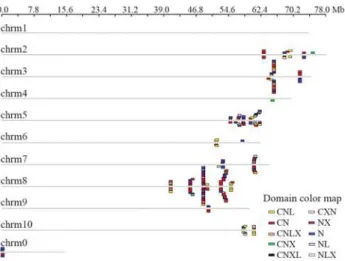
Based on the location of individual NBS genes, 268 of the 274SorghumNBS-encoding genes were mapped on the ten chromosomes. The remaining genes were located on a sequence not yet linked to a chromosome (referred to as chromosome 0 in Figure 1). Of the 268 anchored NBS genes, 223 (83.2%) were located on chromosomes 3, 5, 7 and 8 (41, 45, 24 and 113 NBS-encoding genes on each re-spective chromosome); chromosome 1 had no NBS-encoding gene. No CC type genes were identified, while the chromosomal distribution of non-CC type genes showed an obvious pattern. As defined by Holub (2001), a gene cluster is a region in which two neighboring homolo-gous genes are < 200 kb apart. Of the genes analyzed here, 217 were located in 20 gene clusters, each with an average of 12 genes (twice the average number of genes/cluster in rice). The largest cluster contained 36 NBS genes on chro-mosome 8. MostSorghumNBS genes fell into multi-gene clusters, a distribution similar with that of rice and Arabidopsis.However, in contrast to the latter two species, most of the sorghum NBS gene clusters were located at the distal end of each chromosome (Figure 1).
Phylogenetic analysis of regular NBS genes in
Sorghum
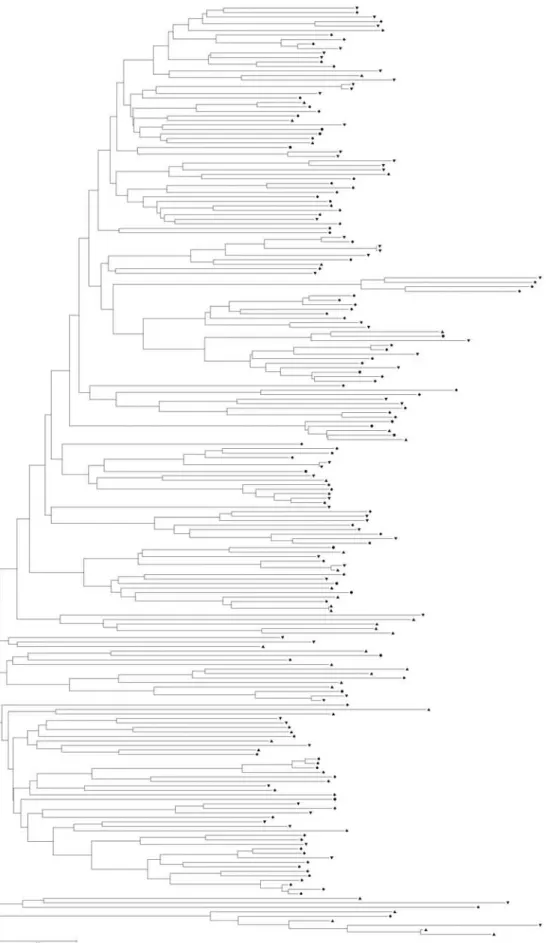
The amino acid sequences of the NBS region con-tained highly conserved motifs with high homology that allowed sequence alignment and the construction of phylo-genetic trees to assess the relationships among the standard NBS disease-resistance genes in the sorghum genome (Fig-ure 2). Two hundred and twenty-four standard NBS alleles were selected for sequence alignment and phylogenetic tree
construction. The other 50 non-regular NBS genes were ex-cluded because of their short N-termini.
The phylogenetic tree of the NBS domain in Arabidopsis (a dicotyledon) has two distinct clades, whereas there is no clear division of NBS regions in rice (a monocotyledon), which has a divergent, star-shaped distri-bution. Figure 2 shows that the phylogenetic tree of the Sor-ghumNBS domain also contained two major clades, which suggests that the evolutionary pattern of theSorghumNBS domain was similar to that ofArabidopsis. Phylogenetic analysis revealed no independent clade for the NBS-LRR gene with the CC-motif, which suggested a complex pat-tern of evolution (Figure 2).
Discussion
By using the NBS genes of other plants as queries we were able to identify 224Sorghumgenes with highly con-served NBS regions. No TIR-encoding genes were found among these 224 genes, a finding similar to that reported for rice (only one TIR-X gene identified) (Zhou et al., 2004) and maize. In contrast, the number of TIR encoding genes varies from 98 inArabidopsisto 78 in poplar. TIR and non-TIR sequences are remarkably different among di-cots and monodi-cots, which suggest an ancient origin and subsequent divergence between the two NBS gene types; TIR-encoding genes appear to have been lost in grass geno-mes. The deduced NBS-LRR proteins were divided into two subfamilies, TIR-NBS-LRR (TNL) and non-TNL, based on their N-terminal features. Whereas dicotyledons such asArabidopsisand poplar (Yanget al., 2008) have many NBS resistance genes that encode proteins with N-termini containing a TIR structure, no such structures were found among theSorghumNBS-LRR genes; this situation is similar to that of other monocotyledons such as rice and maize. It is unclear why grass genomes have a greatly
re-Table 1- The number of genes that encode domains similar to NBS genes in theSorghum bicolorgenome.
Predicted protein domains Letter code Number of genes
Regular NBS genes
CC-NBS-LRR CNL 36
CC-NBS CN 99
CC-NBS-LRR-X CNLX 2
CC-NBS-X CNX 4
CC-NBS-X-LRR CNXL 1
CC-X-NBS CXN 1
NBS-X NX 3
NBS N 61
NBS- LRR NL 16
NBS-LRR-X NLX 1
Total regular NBS genes 224
Non-regular NBS genes
NBS - 40
NBS-LRR - 10
Total non-regular genes 50
Total NBS genes 274
Figure 2- Phylogenetic analysis of the NBS genes in theSorghum bicolorgenome based on the amino acid sequences in the NBS domain.āCN,qN,p
duced set of TIR-encoding genes, although gene loss or the lack of TIR gene amplification are possible explanations. Phylogenetic analysis of the NBS genes revealed differ-ences betweenSorghumand other plants. Thus, unlike rice which shows no major clades in its NBS domain (Zhouet al., 2004), two major clades were identified in theSorghum sequences. This difference may reflect different forms of duplication in the past, although the actual mechansim re-mains unclear.
There was considerable variation in the chromosomal distribution of NBS genes inSorghum. For example, there were no NBS genes on chromosome 1, whereas chromo-some 8 contained 90 NBS genes; this situation was similar to that of rice in which 25% of the R-like genes were pres-ent on chromosome 11. This finding indicates that there are chromosomal hot spots in which the NBS genes share greater homology; these genes may have originated by tan-dem duplication and subsequently diverged under selective pressure. Vine grape and poplar contain 77 and 75 clusters, respectively, including 445 and 281 NBS genes with an av-erage of 5.78 and 3.75 NBS members per cluster. In Sor-ghum, 97% of the NBS genes were located in gene clusters, a much higher proportion than in vine grape and poplar; there was also potentially more duplication and more mul-ti-gene families in theSorghumgenome compared to the latter two species. TheSorghumNBS resistance genes were distributed in clusters in the distal part of the chromosomes. This peculiar location may reflect the long period of contact between Sorghum and its pathogen, with the disease-resistance genes expanding by duplication and rearrange-ment to eventually form distributional hot spots on the chromosomes. Phylogenetic analysis of theSorghumNBS genes revealed clusters containing NBS genes from the same or different families. Mixed clusters could arise by chromosomal rearrangement and transposition or by ge-nomic duplication and mutations. Unequal crossing over based on regions of homology could also expand the cluster sizes.
Acknowledgments
This work was supported by grants from the National Natural Science Foundation of China (grant no. 10675002). We thank members of the Laboratory of Biomass Improve-ment and Conversion of Anhui province and Qing Ma for assistance in this work.
References
Baker B, Zambryski P, Staskawicz B and Dinesh-Kumar SP (1997) Signaling in plant-microbe interactions. Science 276:726-733.
Dhalowal HS and Uchimiya H (1999) Genetic engineering for disease and pest resistance in plants. Plant Biotechnol 16:255-261.
Flor H (1971) Current status of the gene-for-gene concept. Annu Rev Phytopathol 9:275-296.
Goff SA, Ricke D, Lan TH, Presting G, Wang R, Dunn M, Glazebrook J, Sessions A, Oeller P, Varma H,et al.(2002) A draft sequence of the rice genome (Oryza sativaL.ssp. ja-ponica). Science 296:92-100.
Holub EB (2001) The arms race is ancient history inArabidopsis, the wildflower. Nat Rev Genet 2:516-527.
Hulbert SH, Webb CA, Smith SM and Sun Q (2001) Resistance gene complexes: Evolution and utilization. Annu Rev Phytopathol 39:285-312.
Jaillon O, Aury JM, Noel B, Policriti A, Clepet C, Casagrande A, Choisne N, Aubourg S, Vitulo N, Jubin C,et al.(2001) The grapevine genome sequence suggests ancestral hexaploi-dization in major angiosperm phyla. Nature 449:463-467. Kumar S, Tamura K and Nei M (2004) MEGA3: Integrated
soft-ware for molecular evolutionary genetics analysis and se-quence alignment. Brief Bioinform 5:150-63.
Lupas A, Van Dyke M and Stock J (1991) Predicting coiled coils from protein sequences. Science 252:1162-1164.
Meyers BC, Dickerman AW, Michelmore RW, Sivaramakrishnan S, Sobral BW and Young ND (1999) Plant disease resistance genes encode members of an ancient and diverse protein family within the nucleotide-binding superfamily. Plant J 20:317-332.
Meyers BC, Kozik A, Griego A, Kuang H and Michelmore RW (2003) Genome-wide analysis of NBS-LRR-encoding genes inArabidopsis. Plant Cell 15:809-834.
Paterson AH, Bowers JE, Bruggmann R, Dubchak I, Grimwood J, Gundlach H, Haberer G, Hellsten U, Mitros T, Poliakov A,
et al.(2009) TheSorghum bicolorgenome and the diversifi-cation of grasses. Nature 457:551-556.
Richly E, Kurth J and Leister D (2002) Mode of amplification and reorganization of resistance genes during recentArabidopsis thalianaevolution. Mol Biol Evol 19:76-84.
Schultz J, Milpetz F, Bork P and Ponting CP (1998) SMART, a simple modular architecture research tool: Identification of signaling domains. Proc Natl Acad Sci USA 95:5857-5864. TheArabidopsisGenome Initiative (2000) Analysis of the
ge-nome sequence of the flowering plantArabidopsis thaliana. Nature 408:796-815.
Tuskan GA, DiFazio S, Jansson S, Bohlmann J, Grigoriev I, Hellsten U, Putnam N, Ralph S, Rombauts S, Salamov A,et
al. (2006) The genome of black cottonwood, Populus
trichocarpa(Torr. & Gray). Science 313:1596-1604. Venter JC, Adams MD, Myers EW, Li PW, Mural RJ, Sutton GG,
Smith HO, Yandell M, Evans CA, Holt RA,et al.(2001) The sequence of the human genome. Science 291:1304-1351.
Yang S, Zhang X, Yue J, Tian D and Chen J (2008) Recent dupli-cations dominate NBS-encoding gene expansion in two woody species. Mol Genet Genomics 280:187-198. Yu J, Wang J, Lin W, Li S, Li H, Zhou J, Ni P, Dong W, Hu S,
Zeng C,et al.(2005) The genome ofOryza sativa: A history of duplications. PloS Biol 3:e38.
Zhou T, Wang Y, Chen J, Araki H, Jing Z, Jiang K, Shen J and Tian D (2004) Genome-wide identification of NBS genes in
Internet Resources
Phytozome database of Sorghum bicolor,
http://www.phytozome.net/sorghum (version 1.0) (Jan 25, 2007).
Pfam database, http://pfam.janelia.org (Pfam 22.0) (Mar 24, 2009).
Simple Modular Architecture Research Tool (SMART),
http://smart.embl-heidelberg.de (Oct 31, 2008).
Prediction of Coiled Coil Regions in Proteins (COILS), http://www.ch.embnet.org/software/COILS_form.html (May 22, 2009).
Genome Pixelizer software,
http://www.niblrrs.ucdavis.edu/GenomePixelizer/Genome Pixelizer_Welcome.html (Jul 3, 2002).
Associate Editor: Márcio de Castro Silva Filho