Departamento de Química e Bioquímica
Université Pierre et Marie Curie – Paris VI
École Doctorale de Chimie Moléculaire de Paris Centre – ED 406
Synthesis of gem-difluorocarbasugars
João Carlos Falcão Sardinha
Doutoramento em Química
(Química Orgânica)
Departamento de Química e Bioquímica
Université Pierre et Marie Curie – Paris VI
École Doctorale de Chimie Moléculaire de Paris Centre – ED 406
Synthesis of gem-difluorocarbasugars
João Carlos Falcão Sardinha
Supervised by
Amélia Pilar Rauter
(Professora Associada com Agregação do Departamento de Química e Bioquímica da Faculdade de Ciências da Universidade de Lisboa)
Pierre Sinaÿ
(Professeur Emérite de l’Université Pierre et Marie Curie-Paris VI, Membre de l’Académie des Sciences)
Doutoramento em Química (Química Orgânica)
Acknowledgements
First of all I would like to express my sincere gratitude to my supervisors, Prof. Amélia Pilar Rauter for her enthusiasm, guidance and constant encouragement along this work and Prof. Pierre Sinaÿ for the opportunity to work within his very pleasant group and for the valuable discussions about my work. I also wish to express my deepest thanks to Prof. Matthieu Sollogoub for his active supervision, friendship and good teaching.
A special thanks to Dr Yves Blériot and Dr Yongmin Zhang for all the support and valuable discussions about my work during my stay in Paris.
I am grateful to Fundação para a Ciência e Tecnologia for the PhD grant SFRH/BD/17839/2004.
I also would like to acknowledge Prof. Jesús Jiménez-Barbero for his precious work on structural studies, Prof. Pierre Vogel for the glycosidase inhibition assays and Dr Jérôme Marrot for the X-ray crystallography experiments.
The organic chemistry is not an isolated discipline, it is always necessary the contribution/collaboration of several other departments. For that reason I would like to express my gratitude to all people who made this work possible, namely, Verónique, Nicole, Alban and Anne from École Normale Supérieure de Paris; Elsa and Sylvie from Université Pierre et Marie Curie Paris VI; Paulo Madeira from Faculdade de Ciências da Universidade de Lisboa and Dra Cristina Moiteiro from Instituto Nacional de Engenharia, Tecnologia e Inovação.
My time in Paris was made enjoyable in large part due to the many friends and Lab colleagues that became part of my life. To all of them my deepest recognition and thanks… I will never forget you.
I wish to address my special thanks to Dominique for her support, friendship availability and for the French lessons during our wonderful dinners. In the same way I also express my gratitude to Samuel Guieu, who has been a very good friend, for his friendship and support, for the fantastic moments spent in Paris and the unforgettable “soirées” in his house.
Quanto a ti Luis, não sei como te agradecer por tudo o que fizeste por mim, por todo o apoio, por tornares a adaptação a Paris muito fácil, por todos os conselhos e pelo grande amigo em que te tornaste. Muito obrigado por tudo.
Não posso deixar de agradecer a todos os colegas que partilharam comigo o laboratório durante a minha estadia em Portugal, por terem tornado o trabalho mais alegre e divertido. Uma palavra de profundo reconhecimento a alguns bons amigos que fiz ao longo desta etapa da minha vida, e para os quais eu desejo a maior sorte do mundo. Muito obrigado a todos.
Queria agradecer também a todos os amigos da “velha guarda” por todo o apoio e compreensão ao longo de todos estes anos. À Ana Isabel o meu muito obrigado por toda a ajuda, amizade e pela sua preciosa contribuição na leitura e correcção desta tese.
Aos meus bons amigos Paulo e Catarina um agradecimento muito especial por todos os excelentes momentos que passámos juntos, pelas inesquecíveis férias, pelas vossas visitas a Paris, pelo apoio e também por todas as discussões sobre os mais variados temas.
Agradeço do fundo do coração a toda a minha família pelo carinho, compreensão e encorajamento ao longo desta caminhada. Uma homenagem sentida ao meu avô Gumercindo que infelizmente já não está entre nós e não pode acompanhar a conclusão desta etapa da minha vida pela qual eu sei que iria ficar extremamente feliz. O meu profundo obrigado por todos os valores que me transmitiu, pela amizade, simpatia e pelo grande Homem que foi.
À minha mãe um obrigado do tamanho do mundo, pelo apoio incondicional, carinho, ajuda, incentivo, amizade, compreensão e amor dedicado ao longo de toda a minha vida.
Quanto a ti Filipa, o que possa dizer não chega para te agradecer tudo o que passamos juntos nestes últimos 4 anos, estiveste sempre presente e foste um suporte muito importante para que tivesse chegado até aqui. Muito obrigado por me aturares e por seres assim.
Abstract
The term “carbasugar” is used to describe a class of compounds, structurally analogous to natural and synthetic carbohydrates in which the ring oxygen has been replaced by a methylene group. Being similar in shape to sugars, these derivatives are of value in the investigation of biological metabolism, and of potential use for diabetics and anticancer therapy. However the effectiveness of the carbasugars as sugar mimetics is compromised by electronic effects associated to this replacement. To overcome this disadvantage we envisaged the synthesis of gem-difluorinated analogues which would hopefully induce conformational bias through stereoelectronic effects as well as provide key polar groups for the interaction with potential receptors.
In this work the synthesis of both α and β isomers of gem-difluorocarbamannose and –galactose is presented. The strategy is based on a Lewis acid induced rearrangement of a gem-difluoroalkene derivative containing an original cobalt cluster as electron donating group.
The synthesis starts from the corresponding natural sugars and involves 4 major steps: construction of the triple bond in C-6, introduction of the gem-difluoroalkene in anomeric position, rearrangement sequence, and final deprotection.
It is also described the synthesis of the mono-fluorinated analogues of the (+)-MK7607, a patented compound possessing herbicidal activity, serendipitously obtained from the aldehyde reduction step in the gem-difluorocarbagalactose derivative.
All the gem-difluorinated deprotected sugars and the fluorinated analogues of the (+)-MK7607 were assessed as glycosidase inhibitors, however, no interesting activity was detected.
Finally, several approaches aiming at the preparation of gem-difluorocarbalactose and –lactosamide, valuable scaffolds for elucidation of the role of the endocyclic oxygen in carbohydrate-enzyme interactions, are investigated. However, all the methodologies tried for the coupling of gem-difluorocarbocyclic products with a suitable protected molecule employing anomeric O-alkylation, cyclic sulfates, orthoesters and bromine activation, failed. For that reason, we envisaged an alternative strategy by construction of the gem-difluoroalkene moiety at C-5, followed by the TIBAL induced rearrangement. This approach was applied on a monosaccharide scaffold and succeeded to transform the gem-difluoroalkene scaffold into the expected gem-difluorocarbocyclic product with retention of the anomeric information. These results allowed to accurate the reliability of this strategy, which applied now to the lactose natural sugar should provide the target disaccharides.
Keywords: gem-difluorocarbasugars, pseudo-carbasugars, (+)-MK7607, sugar
Resumo
Os carbaaçúcares, análogos de açúcares nos quais o oxigénio endocíclico está substituído por um grupo CH2, têm despertado grande interesse em químicos e
bioquímicos devido às suas potenciais propriedades biológicas. A capacidade dos carbaaçúcares para mimetizar o tamanho, a estrutura e a polaridade dos açúcares parentais, bem como a sua estabilidade à hidrólise, torna-os potenciais candidatos a inibidores de glicosidases. No entanto, esta substituição tem a desvantagem de suprimir qualquer possibilidade de ligações por pontes de hidrogénio que envolvam o átomo electronegativo do anel. Esta desvantagem está bem patente no caso da carbalactose, um mimético da lactose, a qual já não é reconhecida pelo enzima β-galactosidase. Um modelo posterior mostrou que o átomo de oxigénio endocíclico da unidade D-galactose está envolvido na interacção com grupos dadores de protões nos centros activos do enzima. Uma forma de ultrapassar este problema consiste em substituir o átomo de oxigénio endocíclico por outro grupo, também ele capaz de proporcionar ligações de hidrogénio. Seria ainda importante conseguir diferenciar os dois pares de electrões não-ligantes e verificar se algum destes pares, e qual deles, está envolvido em ligações de hidrogénio com o centro activo do enzima. Os átomos de flúor não são aceitadores de ligações de hidrogénio tão fortes como o átomo de oxigénio, mas são suficientemente electronegativos para exibirem esta propriedade. Os derivados fluorados possuem um interesse acrescido em virtude de terem o isótopo 19F activo em espectroscopia de RMN-19F,
pelo que alguns deles têm vindo a ser utilizados como sondas moleculares em centros activos de enzimas. É assim razoável pensar que a substituição do grupo CH2 endocíclico pelo grupo CF2 num carbaaçúcar irá conduzir a um avanço
significativo no âmbito do desenvolvimento desta família de miméticos de açúcar. As vantagens destes novos compostos resultam de vários factores, nomeadamente da sua eventual capacidade para serem aceites por enzimas, visto que o grupo CF2
pode mimetizar o átomo de oxigénio endocíclico e ainda da possibilidade do estudo da sua complexação por espectroscopia de RMN.
No presente trabalho é apresentada a primeira síntese de ambos os isómeros α e β
rearranjo induzido por um ácido de Lewis de um gem-difluoroalceno contendo um complexo hexacarbonílico de cobalto como grupo dador de electrões.
Os correspondentes açúcares naturais serviram de material de partida e o esquema sintético foi dividido em 4 etapas fundamentais: construção da ligação tripla em C-6, introdução do gem-difluoroalceno na posição anomérica, sequência de rearranjo e desprotecção final.
Desta forma, os primeiros passos da síntese foram direccionados para a protecção ortogonal da posição anomérica com o grupo p-methoxifenilo (OpMP), seguindo-se uma sequência de protecções e desprotecções que permitiram proteger os grupos hidroxilo secundários com grupos benzilo, deixando a função álcool primária livre para posterior funcionalização. A introdução da ligação tripla, crucial para o rearranjo após complexação com o octacarbonilo de dicobalto, foi conseguida
através de uma oxidação de Swern do álcool primário seguida de uma reacção de Corey-Fuchs e metilação.
Introduzida a ligação tripla, o próximo passo consistiu na introdução do gem-difluoroalceno na posição anomérica. A desprotecção selectiva do grupo OpMP com nitrato de amónio e cério (CAN) conduziu à formação dos correspondentes lactóis. No entanto, no caso do derivado galactose, esta etapa revelou-se bastante complicada e os seus rendimentos dependentes da quantidade de material de partida utilizado. Visto este ser um precursor para a preparação dos produtos carbocíclicos com a estereoquímica da gem-difluorogalactose, que serão intermediários importantes para a investigação da síntese dos dissacáridos, decidiu-se substituir o grupo OpMP pelo grupo SPh. Esta substituição revelou-se bastante vantajosa, melhorando substancialmente a preparação do lactol derivado da galactose. De seguida os lactóis foram oxidados a lactonas, que por sua vez foram convertidas nos gem-difluoroalcenos precursores utilizando o método de Motherwell.
Sintetizados os precursores-chave, procedeu-se então à crucial e delicada reacção de rearranjo que consiste numa sequência de 2 passos reaccionais. A primeira etapa envolveu a complexação do alcino pelo octacarbonilo de dicobalto, seguindo-se o rearranjo redutivo induzido por TIBAL (ácido de Lewis). A descomplexação do “cluster” de cobalto com CAN levou à formação da mistura de isómeros α e β dos produtos carbocíclicos desejados. Posteriormente foram estudados outros ácidos de Lewis com vista ao melhoramento da estereoselectividade da reacção. Contudo, não foi possível optimizar estes resultados.
A última etapa do esquema de síntese delineado consistiu na desprotecção final da molécula. Assim, a função CH2OH foi restaurada após hidrogenação controlada da
ligação tripla utilizando o catalisador de Lindlar, seguida de uma ozonólise redutiva. Finalmente os grupos benzilo foram removidos através de uma hidrogenação clássica usando paládio sobre carvão como catalisador.
Inesperadamente, no caso do derivado com a configuração da D-galactose, a redução do aldeído, obtido após a etapa de ozonólise, conduziu não só à formação dos produtos gem-difluorados, como também dos produtos resultantes da
eliminação de HF. A mistura de produtos difluorados/monofluorados só se revelaram cromatograficamente separáveis após acetilação dos grupos hidroxilo livres. A semelhança estrutural destes compostos com o produto natural patenteado (+)-MK7607, que possui uma elevada actividade herbicida, levou-nos a investigar a sua síntese para posteriores ensaios biológicos. Desta forma, foram investigadas várias tentativas visando a síntese destes produtos via eliminação α,β do aldeído intermediário. De todos os reagentes testados, LiAlH4 foi o único que
permitiu melhorar ligeiramente o rendimento da molécula-alvo, apesar do produto maioritário continuar a ser o composto gem-difluorado. Os produtos monofluorados totalmente desprotegidos foram finalmente obtidos após remoção dos grupos benzilo com BCl3 e desacetilação.
Todos os gem-difluorocarbaaçúcares e pseudo-carbaaçúcares monofluorados foram testados como inibidores de glicosidases. No entanto, nenhum deles apresentou uma actividade relevante.
Sintetizados os isómeros α e β gem-difluorocarbamanose e –galactose, iniciou-se a preparação do gem-difluorocarbalactose e gem-difluorocarbalactosamida, os quais serão interessantes candidatos com vista à elucidação do papel do oxigénio endocíclico no mecanismo de reconhecimento biológico açúcar-proteina. Foram delineadas várias estratégias tendo como base o acoplamento directo entre os produtos carbocíclicos obtidos após a etapa de rearranjo e outra molécula, convenientemente protegida e com a estereoquímica pretendida. A primeira estratégia centrou-se na O-alquilação do produto carbocíclico através de um ataque nucleófilo a um triflato. No entanto, todas as reacções falharam tanto em triflatos derivados da galactose nas conformações 4C1 e 1C4, esta última conhecida
por ser mais reactiva em virtude da orientação equatorial do substituinte em C-4. O passo seguinte consistiu em colocar o triflato na posição anomérica do produto carbocíclico e testar o ataque nucleófilo de uma molécula de glucose convenientemente protegida. Mais uma vez esta estratégia mostrou-se infrutífera. Falhada a possibilidade de acoplamento via triflatos, foi realizada a reacção de acoplamento através do ataque nucleófilo do precursor carbocíclico a um sulfato cíclico, uma metodologia desenvolvida por Sharpless e descrita como sendo mais eficiente do que um ataque nucleófilo a um epóxido. No entanto, não foi possível
obter o produto pretendido. Como alternativa, decidiu-se investigar uma metodologia desenvolvida por Ikegami e colaboradores que consiste numa modificação engenhosa da clivagem regioselectiva de acetais de tipo 4,6-O-benzilideno. Assim, investigou-se a formação do acetal entre a cetona gem-difluorocarbocíclica e uma molécula de glucose contendo os grupos hidroxilo nas posições 4 e 6 livres. Apesar de todos os esforços, não foi obtido nenhum resultado prático na formação do produto pretendido. De forma a verificar a reprodutibilidade deste método efectuou-se a reacção descrita na literatura entre a glucono-1,5-lactona perbenzilada e 2.3-di-O-benzilglucopiranósido de metilo, tendo-se obtido o respectivo ortoéster com bom rendimento. A estratégia seguinte consistiu na alquilação de um derivado carbocíclico bromado na posição anomérica através da activação com HFIP, uma metodologia utilizada por Bonnet-Delpon na alquilação de um derivado da artemisinina possuindo um grupo CF3
vicinal. Mais uma vez, a estratégia mostrou-se ineficaz não se verificando qualquer alteração nos materiais de partida.
Em virtude da reactividade anomérica estar severamente comprometida pela presença do grupo CF2, decidiu-se investigar uma estratégia de rearranjo
alternativa tendo em vista a síntese do dissacárido. Nesta metodologia a construção do gem-difluoroalceno faz-se ao nível do carbono 5 de forma a reter a informação anomérica. Inicialmente esta abordagem foi aplicada a um monossacárido, facilmente acessível, de forma a verificar a validade do método. Assim, o composto 2,3-di-O-benzil-α-D-glucopiranósido de metilo foi transformado no derivado 2,3,4-tri-O-benzil-6-desoxi-6,6-difluoro-α-D-xylo-hex-5-enopiranósido de metilo em 5 passos. O rearranjo reductivo induzido por TIBAL deste precursor deu origem ao álcool gem-difluorocarbocíclico desejado com retenção do grupo e configuração anoméricos. A aplicação desta metodologia à lactose e à lactosamida permitirá alcançar a síntese dos gem-difluorocarbaaçúcares-alvo.
Palavras-chave: gem-difluorocarbaaçúcares, pseudo-carbaaçúcares, (+)-MK7607,
List of Abbreviations
Å Angstrom Ac Acetyl AIBN 2,2′-Azobis(2-methylpropionitrile) app apparent aq. aqueous arom. aromatic Bn Benzyl br s broad singlet Bz Benzoyl c concentration in Mca. circa, approximately
calcd calculated
CAN Ammonium Cerium(IV) Nitrate COSY Correlation Spectrocospy
CSA Camphorsulfonic Acid
d doublet
DBU 1,8-Diazabicyclo[5.4.0]undec-7-ene
dd double doublet
ddd double double doublet ddq double double quartet DEAD Diethyl Azodicarboxylate DIBAL-H Diisobutylaluminum Hydride DMAP 4-(N,N-dimethylamino)pyridine
DMF Dimethylformamide
DMS Dimethyl sulfide
DMSO Dimethyl Sulfoxide
dq double quartet
dt double triplet
eq. equivalent(s)
ESI Electrospray Ionization EtOAc Ethyl acetate
FAB Fast Atom Bombardment
h hour(s)
HFIP 1,1,1,3,3,3-hexafluoro-2-propanol
HMPA Hexamethylphosphoramide
HMPT Tris(dimethylamino)phosphine
HMQC Heteronuclear Multiple-Quantum Correlation HRMS High Resolution Mass Spectra
J Coupling Constant
LA Lewis Acid
LDA Lithium Diisopropylamide
m multiplet m. p. melting point m/z masse-to-charge ratio Me Methyl min minute(s) mmol milimole
MS Molecular sieves or Mass Spectra
Ms Mesyl
NBS N-Bromosuccinimide
NMR Nuclear Magnetic Resonance PCC Pyridinium Chlorochromate Pd/C Palladium on Charcoal
PDC Pyridinium dichromate
pMP Para-methoxyphenyl
ppm parts-per-million
PTSA para-toluenesulfonic acid
py Pyridine
quant. quantitative
RCM Ring Closing Metathesis
Rf Retention factor
rt room temperature
s singlet
Soln Solution
t triplet
TBAF Tetrabutylammonium Fluoride TBDMSCl tert-Butyldimethylsilyl Chloride
TBDMSOTf tert-Butyldimethylsilyl triflate
TBDPSCl tert-Butyldiphenylchlorosilane
TESOTf Triethylsilyl triflate TFA Trifluoroacetic acid
THF Tetrahydrofuran
TIBAL Triisobutylaluminium TLC Thin Layer Chromatography
Tr Trityl
Ts Tosyl
w/v weight/volume percentage solution
w/w weight/weight percentage solution or mixture
δ chemical shift(s)
Contents
ACKNOWLEDGEMENTS ... I ABSTRACT ... III RESUMO ... V LIST OF ABBREVIATIONS ... XI 1. INTRODUCTION ... 1 1.1 – Carbasugars ... 5 1.1.1 – General Considerations ... 51.1.2 – Natural Occurring Carbasugars and Biological Significance ... 6
1.1.3 – Synthetic Carbasugars and Biological Significance ... 9
1.1.4 – Synthesis of Carbasugars ... 15 1.1.4.1 – Diels-Alder approach ... 15 1.1.4.2 – Carbanionic Cyclizations ... 20 1.1.4.2.1 – Malonates ... 21 1.1.4.2.2 – Nitro groups ... 23 1.1.4.2.3 – Phosphorous Ylides ... 25 1.1.4.2.4 – Aldol Cyclizations ... 29 1.1.4.3 - Radical Cyclizations ... 34
1.1.4.3.1 – 6-exo-trig Radical Cylization ... 34
1.1.4.3.2 – 6-exo-dig Radical Cylization ... 37
1.1.4.4 – Ring Closing Metathesis ... 40
1.1.4.5 – Rearrangement of Cyclic Sugars ... 43
1.1.4.5.1 – The Ferrier-II Rearrangement ... 44
1.1.4.5.2 – Endocyclic Cleavage Induced Rearrangement ... 47
2. RESULTS AND DISCUSSION ... 51
2.1 – Motivation ... 53
2.2.1 – Construction of the triple bond in C-6 ... 59
2.2.2 – Introduction of the gem-difluoroalkene unit ... 61
2.2.3 – Rearrangement Sequence ... 64
2.2.4 – Final Deprotection ... 73
2.3–Synthesis of 5a-gem-difluorocarbagalactose ... 75
2.3.1 – Construction of the triple bond in C-6 ... 75
2.3.2 – Introduction of the gem-difluoroalkene unit ... 78
2.3.2.1 - Alternative approach to the lactol 307a,b precursor ... 79
2.3.3 – Rearrangement Sequence ... 83
2.3.4 – Final Deprotection ... 85
2.4 – Structural Studies ... 89
2.5 – Synthesis of mono-fluorinated pseudo-carbasugars ... 92
2.6 – Biological Studies ... 95
2.7 – Carbadisaccharides synthesis ... 96
2.7.1 – Anomeric O-alkylation approach ... 96
2.7.1.1 – Synthesis of the 1,6-anhydro-2,3-di-O-benzyl-4-O-trifluoromethanesulfonyl-β-D-galactopyranoside (341) ... 97
2.7.2 – Cyclic Sulfates approach ... 104
2.7.2.1 – Synthesis of 1,6-anhydro-2-azido-2-deoxy-3,4-sulfone-β-D -galactopyranoside (373) ... 104
2.7.3 – Orthoesters approach ... 107
2.7.4 – Bromine activation approach ... 110
2.7.5 – Rearrangement approach ... 112
3. CONCLUSION ... 117
4. EXPERIMENTAL PART ... 123
4.1 General Methods. ... 125
Contents of Figures
Figure 1. Different strategies involved in the construction of new carbohydrate mimics. ... 4
Figure 2. Structure of a sugar and of a carbasugar. ... 5
Figure 3. First three carbasugars synthesized by McCasland’s group. ... 5
Figure 4. Carbasugar structures. ... 6
Figure 5. Examples of naturally occurring pseudo-carbasugars. ... 7
Figure 6. Validamycins antibiotics. ... 8
Figure 7. Acarbose 22 and Acarviosine 23 structures. ... 9
Figure 8. Carbasugars as stable chemical probes. ... 10
Figure 9. Voglibose structure. ... 10
Figure 10. Carbocyclic analogues of glycosylamides and glycosylceramides. ... 11
Figure 11. N-alkyl valienamine and carbafucopyranosylamines analogues. ... 12
Figure 12. Carbasugar analogues of N-acetyl-5a’-carba-β-lactosaminides and –isolactiminides. ... 13
Figure 13. Enzymatic synthesis of the 5a’-carbatrisaccharides. ... 14
Figure 14. The anomeric effect: interaction of the endocyclic oxygen electron lone pair with the non-bonding orbital. ... 54
Figure 15. Exo-anomeric effect. ... 55
Figure 16. Theoretical energy values for the transition between minimum A (the global minimum) and minimum B (characterized by a non-exo-anomeric orientation): The conformational change is favored for α-C-man-(1→→→→1)-β-gal. ... 55
Figure 17. Galactopyranose and its carbocyclic analogues. ... 56
Figure 18. Ahn-Eisenstein effect to obtain the axial reduction. ... 85
Figure 19. X-ray structure of 5a-difluoro-5a-carba-α-D-galactopyranose 331. ... 88
Figure 20. Proposed conformation for both isomers of methyl 2,3-di-O-benzyl-4,6-O-(2,3,4,6-tetra-O-benzyl-D-mannopyrano-sylidene)-α-D-glucopyranoside calculated by Ikegami’s group. ... 108
Contents of Schemes
Scheme 1. Synthesis of 5a-carba-α-DL-talopyranose, the first synthetic carbasugar (only D
-enantiomers are shown). ... 15
Scheme 2. Epimerization of the 5a-carba-α-DL-talopyranose pentaacetate (51) into
5a-carba-α-DL-talopyranose (2) (only D-enantiomers are shown). ... 16
Scheme 3. Synthesis of 5a-carba-α-DL-talopyranose (3) (only D-enantiomers are shown).
... 16
Scheme 4. S. Ogawa and T. Suami precursors for carbahexopyranoses (only D
-enantiomers are shown). ... 17
Scheme 5. Synthesis of 5a-carba-β-DL-glucopyranose (25) and 5a-carba-α-DL
-galactopyranose (2) from the hydroxylactone 61 (only D-enantiomers are shown). ... 17
Scheme 6. Synthesis of carba-DL-hexopyranosides from bromo lactone 62 (only D
-enantiomers are shown). ... 18
Scheme 7. Enantiomeric resolution of (±)-60. ... 19
Scheme 8. Synthesis of (±)-validamine 8 (only D-enantiomers are shown). ... 19
Scheme 9. Synthesis of carbasugars using malonates. ... 21 Scheme 10. Improved synthesis of a carbasugar using malonates. ... 22 Scheme 11. Synthesis of carbasugars using malonates. ... 23 Scheme 12. Synthesis of carbasugars using nitro sugar precursors. ... 24 Scheme 13. Synthesis of aminocarbasugars using a nitro group. ... 25 Scheme 14. Synthesis of carbasugars using phosphorous ylide. ... 26 Scheme 15. Synthesis of valienamine 7 via phosphorous ylide. ... 27
Scheme 16. Synthesis of 5a-carba-α-L-fucopyranose (L-133) via phosphorous ylide. ... 28
Scheme 17. Synthesis of key intermediate 137 by intramolecular aldol cyclisation. ... 30
Scheme 18. Synthesis of 5a-carba-α-L-altropyranose pentaacetate (L-96) from key
intermediate 137. ... 31
Scheme 19. Synthesis of 5a-carba-β-L-allopyranose pentaacetate (L-145) from key
intermediate 137. ... 32
Scheme 20. Synthesis of a carbasugar using an aldol reaction on D-glyceraldehyde. ... 33
Scheme 22. Synthesis of carbasugars using a 6-exo-trig radical cyclization. ... 34 Scheme 23. Synthesis of precursors for radical cyclization. ... 35 Scheme 24. Substituent effects in radical cyclizations. ... 36 Scheme 25. Synthesis of carbasugars using 6-exo-dig radical cyclization. ... 37
Scheme 26. Synthesis of 5a-carba-β-D-rhamno- and 5a-carba-α-L-gulopyranose
pentaacetates (186) and (L-188). ... 38
Scheme 27. Gómez et al. retrosynthesis of 5a-carba-β-D-mannopyranose pentaacetate
(91). ... 38
Scheme 28. Synthesis of 5a-carba-β-D-mannopyranose pentaacetate (91) using 6-exo-dig
radical cyclization. ... 39
Scheme 29. Synthesis of 5a-carba-α-D-allo-, 5a-carba-α-L-gulo- and 5a-carba-β-L
-talopyranose pentaacetate derivatives. ... 40
Scheme 30. Synthesis of (+)-valienamine 7 by RCM. ... 41 Scheme 31. Synthesis of penta-N,O-acetyl-valienamine 211 via RCM. ... 42 Scheme 32. Synthesis of (+)-cyclophellitol 6 by RCM. ... 43 Scheme 33. Ferrier type II reaction. ... 44
Scheme 34. Synthesis of 5a-carba-α-D-glucopyranose (24) from the product of Ferrier
rearrangement. ... 45
Scheme 35. Stereodivergent synthesis of carbasugars from a product of Ferrier II
rearrangement. ... 46
Scheme 36. Mechanism proposed for TIBAL-promoted rearrangement: endo-glycosidic
cleavage. ... 48
Scheme 37. Rearrangement induced by titanium-based Lewis acid. ... 48
Scheme 38. Synthesis of methyl carba-β-D-idopyranoside 252 by rearrangement induced
by TIBAL. ... 49
Scheme 39. Synthesis of a carbadisaccharide using the TIBAL induced rearrangement. ... 50 Scheme 40. General scheme for the Lewis acid induced rearrangement. ... 57 Scheme 41. TIBAL-promoted rearrangement. Increasing electron-donating ability of the
substituent at C1 favors carbocyclization over reductive cleavage of the endocyclic C5-O
bond. ... 57
Scheme 42. Retrosynthesis of gem-difluorocarbasugars. ... 58 Scheme 43. Strategy to accomplish the synthesis of gem-difluorocarbamannose. ... 58
Scheme 44. Formation of p-methoxyphenyl 2,3,4,6-tetra-O-acetyl-α-D-mannopyranoside (259). ... 59
Scheme 45. Synthesis of primary alcohol derivative 263. ... 60 Scheme 46. Synthesis of alkyne precursor 266. ... 60 Scheme 47. Synthesis of hemiacetal 267a,b by cleavage of anomeric protecting group. ... 62 Scheme 48. Synthesis of lactone 268. ... 63 Scheme 49. Ylide formation catalyzed by zinc. ... 63 Scheme 50. Synthesis of the gem-difluoroalkene 269 precursor. ... 64 Scheme 51. Alkyne activation and rearrangement step. ... 65 Scheme 52. Hexacarbonyl cobalt cluster formation. ... 65 Scheme 53. Synthesis of the de-O-benzylated derivative 275 and its carbamate analogue 276 for structural elucidation purposes. ... 67 Scheme 54. Proposed mechanism for the TIBAL-mediated de-O-benzylation. ... 68 Scheme 55. Synthesis of the desired carbocyclic products 280 and 281. ... 69
Scheme 56. Stereoselectivity of the reduction of the transient D-glucose ketone derivative
by TIBAL. ... 70
Scheme 57. Debenzylation mechanism promoted by TiCl4. ... 72
Scheme 58. Proposed intermediate to explain the de-O-benzylation induced by TiCl4. ... 72
Scheme 59. Reconstruction of the CH2OH function from the carbocyclic alkynes 280 and
281. ... 73 Scheme 60. Cleavage of the benzyl protecting groups to yield the target molecules 290
and 291. ... 74
Scheme 61. Introduction of p-methoxyphenol as anomeric protecting group. ... 75 Scheme 62. Synthesis of the primary alcohols 298 and 299. ... 76 Scheme 63. Synthesis of the alkyne precursors 302 and 305. ... 77 Scheme 64. Side product obtained in alkyne formation. ... 78 Scheme 65. Synthesis of hemiacetal 307a,b by cleavage of anomeric protecting group. ... 78 Scheme 66. Protection of the anomeric position with a thiophenyl group. ... 80 Scheme 67. Alternative approach for the synthesis of galactose alkyne precursor. ... 81 Scheme 68. Synthesis of the lactol 307a,b precursor. ... 82
Scheme 69. Synthesis of the gem-difluoroalkene 317 precursor. ... 82 Scheme 70. Rearrangement sequence of the galactose gem-difluoroalkene derivative. ... 83
Scheme 71. Rearrangement of the galactose derivative 318 promoted by TiCl3(OiPr). ... 84
Scheme 72. Synthesis of the alkene 325 and 326 precursors. ... 86 Scheme 73. Synthesis of the targets gem-difluorocarbagalactose 331 and 333. ... 87 Scheme 74. Synthesis of the 6-deoxy-5-fluoro-(+)-MK7607 335. ... 93 Scheme 75. Synthesis of the 5-fluoro-(+)-MK7607 338 and 1-epi-5-fluoro-(+)-MK7607 340. ... 94 Scheme 76. gem-Difluorocarbalactose and gem-difluorocarbalactosamide synthetic
strategy. ... 96
Scheme 77. Synthesis of the 1,6-anhydro-β-D-galactopyranoside (347). ... 97
Scheme 78. Synthesis of the suitable triflate 341 for the coupling reaction. ... 98 Scheme 79. Synthesis of the gem-difluorocarbagalactose triflate derivative 351. ... 99
Scheme 80. Preparation of the methyl 2,3,6-tri-O-benzyl-α-D-glucopyranoside precursor
(354). ... 100
Scheme 81. Attempt to triflate displacement by sodium azide. ... 100 Scheme 82. Synthesis of the galactose triflate precursor 357. ... 101 Scheme 83. Synthesis of the galactose mesylated precursor 358. ... 101 Scheme 84. Preparation of the primary sugar triflate 360. ... 102
Scheme 85. (1→→→→6)-gem-difluorocarbadisaccharides synthesis attempt. ... 103
Scheme 86. Preparation of the primary mesylated compound 363. ... 103 Scheme 87. Sharpless methodology for the preparation of cyclic sulphates. ... 104
Scheme 88. Preparation of D-galactal 366 from galactose pentaacetate 293. ... 105
Scheme 89. Preparation of the key cyclic sulphate precursor 373. ... 106 Scheme 90. Disaccharide synthesis attempt via nucleophilic attack to a cyclic sulfate. ... 107 Scheme 91. Ikegami’s methodology for the preparation of sugar orthoesters from sugar
lactones and sugar diols. ... 108
Scheme 92. Reduction of sugar orthoester with LiAlH4-AlCl3. ... 109
Scheme 93. Disaccharide approach by employing the methodology developed by Ikegami.
Scheme 94. Bonnet-Delpon’s methodology for the alkylation of an alcohol adjacent to a
CF3 group. ... 111
Scheme 95. Preparation of the bromine derivative 384 for further alkylation. ... 111 Scheme 96. Attempt to alkylation of the bromine derivative 384. ... 112 Scheme 97. Activation pathway of substitution reaction of bromide 383. ... 112
Scheme 98. gem-Difluorocarbalactose retrosynthetic strategy based on the
rearrangement induced by a Lewis acid. ... 113
Scheme 99. Nucleophilic attack to cyclic keto acetals type 391. ... 114 Scheme 100. Preparation of the key gem-difluoroalkene precursor 396. ... 115 Scheme 101. Synthesis of the gem-difluorocarbocyclic product 397 by TIBAL induced
Contents of Tables
Table 1. Attempts for alkyne methylation. ... 61 Table 2. Experimental conditions for anomeric deprotection. ... 62 Table 3. Rearrangement essays induced by TIBAL. ... 66 Table 4. Rearrangement trials with titanium based Lewis acids. ... 71 Table 5. Cleavage of the p-methoxyphenyl protecting group with CAN. ... 79 Table 6. Structural data for the gem-difluoro derivatives synthesized in the present work,
obtained from X-ray crystallography and theoretical calculationsaErro! Marcador não
definido.
Table 7. Experimental conditions tried for mono- and difluorinated selectivity
The carbohydrates are the most abundant of the four major classes of biomolecules, which also include nucleic acids, lipids and proteins. As their name implies, carbohydrates (derived from the French “hydrate de carbone”) were originally believed to consist solely of carbon and water and thus were commonly designated by the generalized formula Cn(H2O)n. Nowadays, the definition of what
is a carbohydrate has been much expanded to comprise compounds derived from monosaccharides by reduction of the anomeric carbonyl group (alditols), oxidation of one or more terminal groups to carboxylic acids or replacement of the hydroxyl group(s) by a hydrogen (deoxy derivatives), amino, thiol group(s) or a similar heteroatomic functionality. Due to the presence of multiple functional groups, carbohydrates contain several chiral centres and thus form many stereoisomers. They include the monosaccharides, which are the simplest compounds, as they cannot be further hydrolyzed to smaller constituent units, and saccharides which are formed by two or more monosaccharides via an acetal (glycosidic) linkage and can be split into the former by acidic hydrolysis.
In the past, carbohydrates were considered to be solely of use for energy storage (starch, glycogen) and as structural components (cellulose in plants and chitin in animals). However, this naïve view was challenged in 1969[1] when a protein was
isolated from Canavalia ensiformis that demonstrated ability to bind to carbohydrates in leukocytes. The study of carbohydrates within biological systems has shown that they are present in a wide range of fundamental biological functions such as cell-cell recognition and cell-external agent interactions.[2-4]
These interactions can initiate beneficial biological events such as fertilization, cell growth and immune responses, as well as undesired disease processes, such as inflammation, viral and bacterial infections and cancer metastasis. Therefore, the total comprehension of carbohydrates biochemistry, particularly of recognition processes would not only contribute towards better understanding of carbohydrate processing enzymes but also may result in future therapeutic agents.[5]
Despite being potential candidates for future drug development, carbohydrates progressed slowly in this direction. Especially oligosaccharides have always
remained unattractive targets for synthesis, due to the large number of reactions that are usually involved and the difficulty of the stereochemical control. Moreover, their biological function when conjugated with a particular protein is not always well established.
Within this stimulant background, the current efforts are focused towards the design and syntheses of small molecules which can mimic the function of complex carbohydrates involved in important signaling and recognition events, but have improved properties in terms of stability, specificity and practical availability. Carbohydrate mimics can be defined as those molecular entities, which resemble the carbohydrates in structure, size, shape and thereby mimic their function. Over the past few years, several groups have been engaged in design and synthesis of such carbohydrate mimics. Inside the various strategies involved, some of them have focused their attention on the replacement of the endocyclic oxygen by some other heteroatom, which increases the stability of these new compounds towards hydrolysis; other groups have used modifications of the anomeric hydroxyl group as their central investigations (Figure 1).
Figure 1. Different strategies involved in the construction of new carbohydrate mimics.
Carbasugars, a family of carbohydrate mimics, have attracted great interest in recent years among chemists and biochemists due to their potential biological properties. The ability of carbasugars to mimic the size, structure and polarity of parent sugars and its stability towards hydrolysis make them potential candidates for the competitive inhibition of glycosidases and glycosyltransferases.
1.1 – Carbasugars
1.1.1 – General Considerations
Carbasugars are carbohydrate analogues in which the endocyclic oxygen has been replaced by a methylene group. This means that the acetal linkage of a sugar is formally transformed into a non-hydrolysable ether in a carbasugar (Figure 2). Natural and synthetic carbasugars, either as single molecules or as subunits of more complex molecules, have shown to display interesting biological activities,[6, 7] mainly as enzymatic inhibitors.
Figure 2. Structure of a sugar and of a carbasugar.
The carbasugars were introduced about forty years ago when McCasland and co-workers[8] first synthesized the talopyranose analogue 1, followed by two new
isomeric compounds 2 and 3[9, 10] (Figure 3). The term pseudosugar has been
coined by him to designate any such analogues.
Figure 3. First three carbasugars synthesized by McCasland’s group.
In the very first paper describing a carbasugar, McCasland[8] stated: “it is hoped
that pseudosugars may be found acceptable in place of corresponding true sugars to some but not all enzymes or biological systems, and thus might serve to inhibit growth of malignant or pathogenic cells.” This subtle change constituted an
appealing possibility, since, while guaranteeing a high similarity with the true sugar, it would lead to compounds more stable toward degradative enzymes.
As time passed, the term “pseudosugar” was besmirched and employed for a large variety of sugar analogues, thus requiring a specification of the definition for different subclasses of mimetics. S. Ogawa[11] proposed the use of the prefix
“carba”, preceded, where considered necessary, by the appropriate locant (“4a” for an aldopyranose, “5a” for an aldopyranose), followed by the name of the sugar (Figure 4).
Figure 4. Carbasugar structures.
However, even this definition is misconstrued by many authors, who include carbocyclic polyols containing a non-substituted carbon, which should be called pseudo-carbasugars because they do not have a homomorphic sugar associated.[12, 13] This implies that there are only thirty-two 5a-carba-aldohexopyranoses and
sixteen 4a-carba-aldopentofuranoses. So far, from the thirty-two isomers of 5a-carba-aldopyranoses theoretically possible, all sixteen of the racemic forms have already been synthesized[14], as well as twenty-five of the possible thirty-two pure
enantiomers.
1.1.2 – Natural Occurring Carbasugars and Biological Significance
The carbasugars are not very abundant in Nature, at least the “real” ones. The 5a-carba-α-D-galactopyranose (2) is the only “genuine” carbasugar isolated as a weak antibiotic against Klebsiella pneumonia MB-1264, from the fermentation broth of
Streptomyces sp. MA-4145.[15] Curiously, it was isolated seven years after its first
and cyclohexene derivatives, closely related to carbasugars (some authors[16-19]
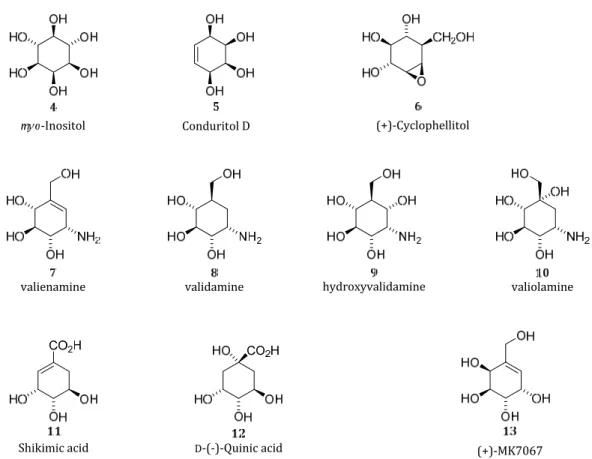
insist on calling such compounds as carbasugars, we, for the reason presented above, call them pseudo-carbasugars) which have been isolated from Nature, presenting interesting biological properties. In this category are included the inositols,[20, 21] components of the cell-membrane and second messengers; the
glycosidase inhibitors conduritols[22, 23] and cyclophellitols[24, 25];
aminocarbasugars derivatives, such as valienamine[26-32] 7, validamine[33] 8,
hydroxyvalidamine[33] 9 and valiolamine[33] 10, which are components of natural
aminoglycoside antibiotics[34, 35]; and the shikimic[36] 11 and quinic[37] 12 acids,
important biochemical intermediates in plants and microorganisms (Figure 5).
Figure 5. Examples of naturally occurring pseudo-carbasugars.
Among them the (+)–cyclophellitol 6 and the (+)–MK7067 13 have relevant biological activities. (+)–Cyclophellitol 6, isolated from the culture filtrate of a mushroom strain, Phellinus sp.[25, 38-40] is a potent inhibitor of β-glucosidases with
potential inhibition of the human immunodeficiency virus (HIV) and with possible antimetastic therapeutic activity.[41] The (+)-MK7607 13, isolated from the
fermentation broth of Curvularia eragrostidis D2452,[42] is a patented naturally
occurring unsaturated pseudo-carbasugar possessing herbicidal activity.
But the most important and appealing carbasugar derivatives from a biological point of view are the aminocarbasugars. Some of them have become clinically successful to combat diseases in humans and plants. In 1970, during the screening for new antibiotics from the fermentation culture of Streptomyces hygroscopicus subsp. Limoneus, researchers at Takeda Chemical Company discovered the agricultural antibiotic Validamycin A[43] 14 (Figure 6). Extensive studies on
isolation of minor components of the fermentation broth have led to the discovery of seven homologous antibiotics Validamycins B – H[44, 45] 15 – 21 (Figure 6). The
core of these antibiotics is composed by a valienamine 7 unit and another aminoalcohol unit, which are linked through a single nitrogen atom.
Figure 6. Validamycins antibiotics.
The Validamycin A 14 is the most active compound of the complex and has been widely used in China and many other eastern Asia countries as a prime control reagent against sheath blight disease of rice plants caused by the fungus
Rhizoctonia solani.
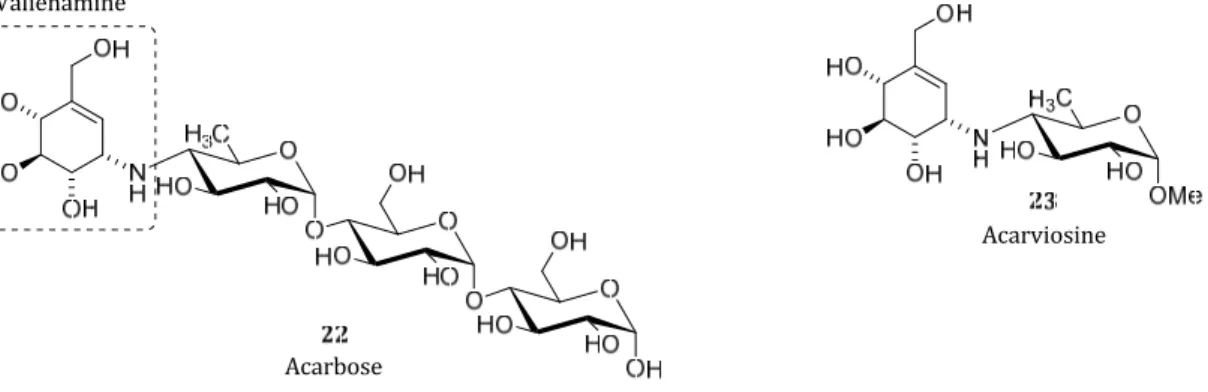
Soon afterwards, the α-amylase inhibitor acarbose 22 (Figure 7) was isolated in a screening of strains of various Actinomycete genera.[46] Structurally acarbose, one
pseudo-carbatrisaccharide comprising the units valienamine 7, a deoxyhexose and maltose. In addition to its α-glucosidase activity, acarbose also displays potent inhibitory activity against sucrase, maltase, dextrinase and glucoamilase.[47] This
pronounced inhibitory effect has resulted in its use as a clinical drug for the treatment of type II non insulin dependent diabetes in order to enable patients to better control blood sugar contents while living with starch-containing diets.
Figure 7. Acarbose 22 and Acarviosine 23 structures.
The glycosidase inhibitory activities of acarbose 22 and related carba-oligosaccharides have been ascribed to their acarviosine 23 moiety, in which the valienamine portion mimics the glucopyranosyl cation intermediate at the active site of the enzymes.[48]
1.1.3 – Synthetic Carbasugars and Biological Significance
An interesting property of the carbasugars that demonstrates their similarity with sugars is the fact that they taste sweet. Humans cannot differentiate synthetic 5a-carba-α-D-glucopyranose (24) and D-glucose by their taste,[49] and synthetic
6a-carba-β-D-fructopyranose showed to be almost as sweet as D-fructose.[50]
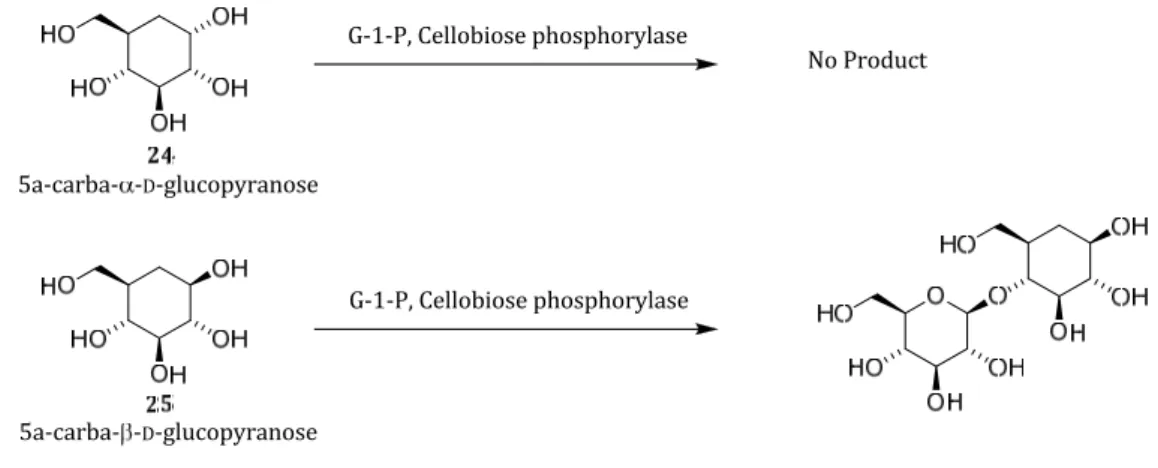
It was also found that carbasugar 24 inhibited both glucose–stimulated insulin release and glucokinase activity whereas the β-anomer 25 showed no activity.[51]
Moreover, these two carbasugar isomers were used in the elucidation of the stereochemical selectivity of the reverse reaction of the cellobiose phosphorylase
of Cellvibrio gilvuse,[52] where in this case, only the 5a-carba-β-D-glucopyranose
(25) was a substrate of the reaction – not the α anomer (Figure 8). This study was of course unrealizable with D-glucose itself because of mutarotation.
Figure 8. Carbasugars as stable chemical probes.
The pronounced biological activity of the aminocarbasugars as glycosidase inhibitors prompted the scientists to synthesize and evaluate several derivatives. And in the search for new bioactive compounds, the valiolamine 10 played an important role since it was found that it has a more potent α-glucosidase inhibitory activity against porcine intestinal sucrase, maltase and isomaltase than valienamine 7, validamine 8 and hydroxyvalidamine 9.[45] This information
stimulated the synthesis and screening of a series of N-substituted valiolamines, resulting in the preparation of the glycosidase inhibitor voglibose[53] 26 (Figure 9),
which is used as a therapeutic agent since 1994 to control diabetes mellitus type II. The voglibose 26 competes with saccharides as enzyme substrate, suppressing the elevation of the glucose concentration in blood after oral sucrose, maltose or starch administration.
Since then, several pseudo-aminocarbasugar derivatives have been synthesized, and in this field much credit has to be given to S. Ogawa who prepared and evaluated an important number of compounds. Among them are: carbocyclic analogues of glycosylamides[54] 27 and 28, structurally related to
glycosphingolipids and glycoglycerolipids (Figure 10), which showed similar potencies as immunomodulators, comparable to those of the corresponding true sugar analogues; and N-linked carbocyclic analogues of glycosylceramides[55-57]
(Figure 10), where it was demonstrated that the unsaturated derivatives 31 and
32 inhibited β-gluco- or β-galactocerebrosidase more strongly and selectively than
the saturated counterpart 29 and 30. This result suggests that the unsaturated analogues should more efficiently mimic the transition state of the natural substrate during the enzymatic reaction.
Later then, attempting to develop a similar type of glycosidase inhibitors structurally more simple, they prepared several N-alkyl valienamine derivatives [58, 59] (Figure 11), where the N-octyl derivative 33 presented the highest inhibitory
activity (IC50 = 3 x 10⁻⁸ M) against rat liver β-glucocerebrosidase.
In the search for new types of inhibitors of α-L-fucosidase, Ogawa and co-workers prepared and evaluated several carbafucopyranoside derivatives.[60-62] Among
them, 5a-carba-α-DL-fucopyranosylamine (DL-34) and 5a-carba-β-L -fucopyranosylamine (35) (Figure 11) showed to be very potent and specific inhibitors of α-L-fucosidase (bovine kidney), being the effect of the former DL-34 essentially comparable to that of mammalian α-L-fucosidase deoxyfuconojirimicin[63, 64] 36, the most powerful inhibitor identified so far.
Finally, they also evaluated a series of N-alkyl and phenylalkyl derivatives, verifying a considerable improvement of the inhibitory activity against α-L -fucosidase, reaching a maximum again with an octyl chain, which seems to act as a structurally efficient hydrophobic spacer.
Carbasugar derivatives have also been envisaged as potential entities for the elucidation and/or control of biological events involving sugar moieties. The construction of enzyme substrate analogues, in which part of their structure has been replaced by a carbasugar unit, is expected to be useful in the elucidation of the mode of action of sugar transferases.
An area of recent interest is the design of potential substrates and inhibitors of fucosyl and sialyl transferases involved in the last steps of the biosynthesis of Lewis oligosaccharide antigens. These antigens include Sialyl LewisX (SLeX) 38,
which is a tumor-associated structure and a ligand of E-selectin mediated inflammatory processes.[65, 66] In this context, Ogawa and co-workers carried out
studies envisaging the discovery of efficient substrates for α-(1→ 3/4)-fucosyltransferase, since the presence of the fucose moiety was established to be crucial for the recognition of the SLeX 38 determinant by E-selectin.[67-70] They
prepared ether- and imino-linked N-acetyl-5a’-carba-β-lactosaminides and –isolactiminides[71] (Figure 12) and tested them against fucosyltransferases.
Compounds 39 and 40 were found to be acceptor substrates for human-milk α-(1→3/4)-fucosyltransferase with kinetic parameters comparable to those for standard true disaccharides.[72] Small-scale reaction of 39 and 40 with GDP-fucose
and milk fucosyltransferase resulted in conversion to trisaccharides 43 and 44, respectively (Figure 13). Surprisingly, compounds 41 and 42 were neither acceptors nor inhibitors for milk fucosyltransferase suggesting that α-(1→4) transfer is not possible. The milk preparation contains a mixture of two different α-(1→3/4)- and α-(1→3)-fucosyltransferase enzymes. These two enzymes were separated and it was shown that both forms utilized compounds 39 and 40 as acceptor substrates, whereas 41 and 42 were neither substrates nor inhibitors for the enzyme. This was the first demonstration of a specific substrate for an α-(1→3)-fucosyltransferase.
Figure 13. Enzymatic synthesis of the 5a’-carbatrisaccharides.
The biological significance of carbasugars has stimulated the scientific community to synthesize them and their analogues either in racemic or in chiral form and several approaches have been developed.[73] The most prominent strategies make
use of Diels-Alder reaction of cyclic dienes, carbanionic and radical cyclizations, ring closing metathesis (RCM), cycloaddition reactions, rearrangement of cyclic sugars and manipulations on quinic[74] and shikimic acids.
In the next section it will be presented an overview of carbasugars preparation, starting with the pioneer work of Prof. McCasland, which led to the first synthesis of a carbasugar.
1.1.4 – Synthesis of Carbasugars
1.1.4.1 – Diels-Alder approach
The Diels-Alder reaction between some oxygen containing dienes and dienophiles, nowadays highly diastereoselective, provides hydroxylated cyclohexenes in a single step, which after further transformation allow the preparation of appropriately functionalised carbocycles.
The first synthesis of a carbasugar, performed by prof. McCasland[8] group, was
carried out based on the Diels-Alder reaction of 2-acetoxyfuran (45) and maleic anhydride 46 (Scheme 1). syn-Hydroxylation with OsO4 and hydrolysis of the
oxanorbornene intermediate 47 gave the diol diacid 48, which on prolonged reaction with water undergoes a series of transformations (acetyl migration, opening of the 1,4-oxacyclic ring, carbonyl liberation, and decarboxylation) leading to 49. Sodium borohydride reduction of 49 and subsequent esterification with methanol and trifluoroacetic acid, followed by acetylation gave the tetraacetate 50, which was converted into the target carbasugar 1 by reduction with lithium aluminum hydride followed by hydrolysis.
Scheme 1. Synthesis of 5a-carba-α-DL-talopyranose, the first synthetic carbasugar (only D -enantiomers are shown).
The 5a-carba-α-DL-galactopyranose (2) (Scheme 2) was prepared by deacetylation of pentaacetate 53, which in turn was readily obtained from 5a-carba-α-DL -talopyranose pentaacetate (51) by acid-induced epimerization at C-2through an intermediary cyclic acetoxonium ion 52, which was formed by anchimeric assistance of the neighboring acetoxyl group.[10]
Scheme 2. Epimerization of the 5a-carba-α-DL-talopyranose pentaacetate (51) into 5a-carba-α-DL -talopyranose (2) (only D-enantiomers are shown).
The 5a-carba-α-DL-gulopyranose (3) (Scheme 3) was synthesized by syn-hydroxylation of the intermediate 56, obtained by Diels-Alder cycloaddition of 1,4-diacetoxy-1,3-butadiene (54) and allyl acetate (55). Successive acetylation and hydrolysis afforded the free carbasugar in 33% overall yield.[9]
Scheme 3. Synthesis of 5a-carba-α-DL-talopyranose (3) (only D-enantiomers are shown).
After the pioneering work of McCasland and co-workers, 7-oxanorbornene derivatives were extensively used as starting materials for the synthesis of carbapyranoses and derivatives.[75] An impressive contribution in this field was
given by Profs. S. Ogawa and T. Suami who extensively used this methodology to prepare a large number of carbasugars.
The key intermediate in their approach, 7-oxabicyclo-[2.2.1]hepten-5-ene-2-carboxylic acid (60), readily prepared by Diels-Alder cycloaddition of furan (58) and acrylic acid 59 (Scheme 4), was shown to be an ideal starting material for the forthcoming synthesis of carbasugars, and eleven of the original sixteen racemic syntheses have made use of it.
Scheme 4. S. Ogawa and T. Suami precursors for carbahexopyranoses (only D-enantiomers are shown).
When acid 60 was treated with hydrogen peroxide and formic acid, the hydroxylactone 61 was formed. This compound was the key intermediate for the syntheses of β-DL-gluco-,[76, 77] α-DL-galacto-,[76, 77] β-DL-allo-,[78] and α-DL -gulocarbapyranoses.[79] The majority of the remaining carbapyranoses, α-DL
-manno-,[76, 77] β-DL-manno-,[76, 77] β-DL-altro-,[76, 77] α-DL ido-,[76, 77] α-DL-gluco-[78]
and α-DL-allopyranose,[78] were derived from the bromo lactone 62, prepared by
treatment of the acid 60 with hydrobromous acid (Scheme 4). An example of carbasugar synthesis using this methodology is shown in Scheme 5.
O O O HO 61 O OAc OAc AcO OAc OAc AcO AcO OAc OAc OAc AcO AcO OAc 63 64 25 53 2
Scheme 5. Synthesis of 5a-carba-β-DL-glucopyranose (25) and 5a-carba-α-DL-galactopyranose (2) from the hydroxylactone 61 (only D-enantiomers are shown).
Reduction of the lactone 61 with LiAlH4 followed by peracetylation afforded the
triacetate 63, which under acidic conditions underwent a non-regioselective cleavage of the 1,4-oxa-bridge to yield 5a-carba-β-DL-glucopyranose pentaacetate (64) and 5a-carba-α-DL-galactopyranose pentaacetate (53).[76, 77]
Alternatively, reduction, acetylation, and acetolysis of the lactone 62 gave a mixture of bromo derivatives 65 and 66 (Scheme 6), which were independently subjected to a substitution reaction with acetate ion to furnish 5a-carba-α-DL -galactose (2), carba-5a-α-DL-idopyranose (68), 5a-carba-α-DL-mannopyranose (71) and 5a-carba-β-DL-altropyranose (72).
Scheme 6. Synthesis of carba-DL-hexopyranosides from bromo lactone 62 (only D-enantiomers are shown).
The Diels-Alder adduct 60 has also been used in the synthesis of optically active series of carbahexopyranoses. Acid 60 is readily resolved by the fractional
recrystallization of the mixture of salts formed with optically active R-(+)-methylbenzylamine to give the (–)-adduct 60. The analogous procedure with
(S)-(–)-methylbenzylamine and 60 afforded the optically pure (+)-adduct 60 (Scheme 7).[80]
Scheme 7. Enantiomeric resolution of (±)-60.
In this way, all enantiomeric carbasugars will be accessible either in D or L forms, starting from the optical pure acids (–)-60 or (+)-60 by the same strategies employed in the synthesis of racemic carbasugars.
These strategies have also been applied to the preparation of aminocarbasugars in both racemic and enantiomerically pure forms. The synthesis of DL-validamine 8 (Scheme 8) was reported[76] in the mid-1970s using as starting material 63, easily
prepared from the hydroxylactone 61 (scheme 5).[81]
Scheme 8. Synthesis of (±)-validamine 8 (only D-enantiomers are shown).
Treatment of triacetate 63 with 20% hydrogen bromide at 80 °C afforded the dibromide 73. The primary bromide was then selectively replaced by an acetoxy group and the secondary bromo function was displaced with azide ion to give 75,
which was hydrogenated and acetylated to afford, after deprotection, racemic validamine 8. Since then, DL-valienamine,[82-85] DL-hydroxyvalidamine,[86] DL
-valiolamine,[87] 2-amino-5a-carbadeoxy-DL-pyranoses, [88, 89] 3-amino-5a-deoxy-DL
-pyranoses,[90] DL-hydroxyvalidamine,[91] DL-1-epi-validamine,[92] DL-2-epi-
validamine,[77]DL-2-amino-2-deoxyvalidamine having α- and gluco and α- and
β-manno configurations,[93] 5a-carba-α-DL-fucopyranosylamine,[60] 5a-carba-α-DL
-galactopyranosylamine,[60] and fucose-type α- and β-valienamine derivatives,[62] all
in racemic form, have also been synthesized using Diels-Alder adduct 60 as starting material.
Enantiopure (+)-validamine 8[94] and (+)-valienamine 7[95] were later prepared
from chiral (–)-60 following the same procedure previously employed for the synthesis of their racemates.
As we have seen, the Diels-Alder approach constitutes a valuable tool in organic synthesis for the preparation of cyclohexene derivatives, and more specifically a useful methodology for the synthesis of carbasugars and derivatives. However carbohydrates are much more attractive and widely used starting materials for the preparation of carbasugars, since they are generally inexpensive, with all the requisite stereochemistry in place and no need of extensive functionalizations.
1.1.4.2 – Carbanionic Cyclizations
The generation of anionic species and their use as nucleophiles in the formation of C-C bonds is well established in the field of organic chemistry. As applied to the formation of carbasugars, various stabilizing groups have gained particular attention, namely malonates, nitro groups, phosphorous ylides and aldol precursors.
1.1.4.2.1 – Malonates
The use of malonate anions to recyclize open-chain sugars was first introduced by Suami et al.[96, 97] in the course of their extensive studies towards the synthesis of
new carbasugars. After conversion of the starting material L-arabinose into the diethyl dithioacetal open form, the sugar was protected by selective tritylation of the primary alcohol and subsequent benzylation of the secondary hydroxyl groups. Replacement of the trityl by a tosyl group afforded compound 78 (Scheme 9).
The aldehyde function was restored and the tosylate was substituted by iodide, giving the key iodo-aldehyde 79. Reaction of 79 with dimethyl malonate anion and spontaneous cyclisation, followed by further acetylation provided the cyclohexane derivative 82 and a secondary pyranose derivative 83 in the ratio of 5:3. The formation of compound 83 could be explained by the initial addition of the malonate anion to the carbonyl followed by the displacement of the iodo group by the resulting alkoxide. Krapcho decarboxylation of 82 in aqueous dimethyl sulfoxide with NaCl proceeded with simultaneous β-elimination of the acetoxyl group to give the cyclohexene derivative 84. Reduction of the unsaturated ester with LiAlH4, followed by hydroboration-oxidation and final deprotection gave a
mixture of 5a-carba-α-D-glucopyranose (24) and 5a-carba-β-L-altropyranose (L
-72). The main drawback of this strategy is the low yield of the carbocyclization
step, because of the competition between addition to the carbonyl and substitution of the iodide. To circumvent this problem, an alternate pathway incorporating the malonate moiety prior to the transformation of the primary hydroxyl group into a leaving group was explored. This alternative method was used, for instance, in the preparation of 5a-carba-β-L-mannopyranose pentaacetate[98] (L-91) (Scheme 10).
Scheme 10. Improved synthesis of a carbasugar using malonates.
As illustrated, the silylated derivative 87 was synthesized following a similar strategy reported for 79 (Scheme 9). Then compound 87 underwent a
Knoevenagel condensation in the presence of an excess of dimethyl malonate in a mixture of acetic anhydride and pyridine to afford an α,β-unsaturated diester. This product was hydrogenated and desilylated to give the alcohol 88. The crucial cyclization into a cyclohexane derivative was accomplished by oxidation of compound 88 with PCC followed by acetylation to afford 89 as a single diastereoisomer. Applying the same concluding sequence described in Scheme 9, only the 5a-carba-β-L-mannopyranose pentaacetate (L-91) was isolated, which means that in this case the hydroboration step was selective. This strategy was extended to different carbasugars (Scheme 11). D-Arabinose diethyl acetal[99] 92
was converted into cyclohexene 93 (C-1 epimer of 90) from which 5a-carba-α-L -mannopyranose pentaacetate (L-69) was stereoselectively obtained.
Scheme 11. Synthesis of carbasugars using malonates.
On the other hand, D-xylose diethyl dithioacetal[99] 94 was transformed into
cyclohexene 95, which was used in the preparation of 5a-carba-β-L-glucopyranose pentaacetate (L-64) and 5a-carba-α-D-altropyranose pentaacetate (96).
1.1.4.2.2 – Nitro groups
Nitro groups are commonly used to stabilize carbanions on adjacent carbon atoms. Kitagawa and co-workers[100] showed that reactions involving cyclization of
carbasugars. As shown is Scheme 12, benzylated diacetone-D-glucose, easily obtained from D-glucose, was selectively deprotected and the resulting diol reprotected at the primary position. Swern oxidation, followed by addition of nitromethane, afforded two alcohols 98 and 99.
Scheme 12. Synthesis of carbasugars using nitro sugar precursors.
The application of identical reaction sequences to each diastereoisomer led to 5a-carba-α-D-glucopyranose (24) and 5a-carba-β-L-idopyranose (L-104). According to this sequence, the reductive deacetoxylation, on 98 and 99, with NaBH4
proceeded stereoselectively to provide SN2-type reaction products 100 and 102,
respectively. Cyclization under basic conditions and re-introduction of the isopropylidene group yielded the nitro pyranose derivatives 101 and 103,