Article
J. Braz. Chem. Soc., Vol. 26, No. 1, 117-123, 2015. Printed in Brazil - ©2015 Sociedade Brasileira de Química 0103 - 5053 $6.00+0.00
A
*e-mail: [email protected]
A
3-Coupling Reaction as a Strategy Towards the Synthesis of Alkaloids
Rafaela C. Carmona,a Edison P. Wendler,a George H. Sakae,a João V. Comassetoa,b and
Alcindo A. Dos Santos*,a
aInstituto de Química, Universidade de São Paulo, Av. Prof. Lineu Prestes, 748, 05508-000 São Paulo-SP, Brazil
bInstituto de Ciências Ambientais, Químicas e Farmacêuticas, Universidade Federal de São Paulo, Av. Prof. Artur Riedel, 275, 09972-270 Diadema-SP, Brazil
Uma série de aldeídos, alquinóis e benzilaminas foram submetidos a reação, por catálise mediada por CuCl, na formação de hidróxi-benzilaminas funcionalizadas. O procedimento permite a utilização de aldeídos alquílicos e arílicos. Substratos representativos foram convertidos em alcalóides cíclicos de cinco e seis membros através da reação concomitante de N-debenzilação e redução total da ligação tripla promovida por Pd, seguido de ciclização tipo Mitsunobu.
A number of aldehydes, alkynols and benzylamines were submitted to A3-coupling reaction,
under CuCl catalysis, giving strategically functionalized hydroxy-propargylamines. The procedure allows the use of alkyl as well as aryl aldehydes. Representative substrates were converted into five- and six-membered cyclic alkaloids by sequential one-pot N-debenzylation/triple bond reduction promoted by Pd, followed by a Mitsunobu-type cyclization.
Keywords: hydroxy-propargylamines, A3-coupling, C–H activation, cyclic alkaloids
Introduction
In the last decades, multicomponent reactions have become an important alternative to prepare highly functionalized building blocks in high yields and in a straightforward way.1 This kind of transformation is very attractive since the whole process is intrinsically atom-, energy- and step-economical.2,3 Many relatively old, as well as new multicomponent strategies, have been investigated and important contributions have been made in this field. Structurally complex compounds can be assembled by means of multicomponent reactions, and recently, by coupling this strategy with organocatalysis, enantioenriched products were efficiently prepared in a short and elegant way.4-11 Propargylamines are important building blocks for the preparation of complex amino derivatives and bioactive substances.12-16 An important strategy for the synthesis of this class of compounds consists in the addition reaction of non-functionalized terminal alkynes to C–N double bond containing-compounds, usually imines, nitrones, iminium salts, etc.17-21 There are several
reports on the preparation of propargylamines by a A3-coupling multicomponent reaction, but most of them are restricted to non-functionalized alkynes,22-24 which is quite unattractive from the synthetic point of view. In addition, many procedures are dependent on the aldehyde nature, presenting good performance for either alkyl or aryl ones25 but rarely for both.
Due to the importance of nitrogen-containing compounds, development of practical strategies to construct highly functionalized nitrogen-containing skeletons is desirable.
Results and Discussion
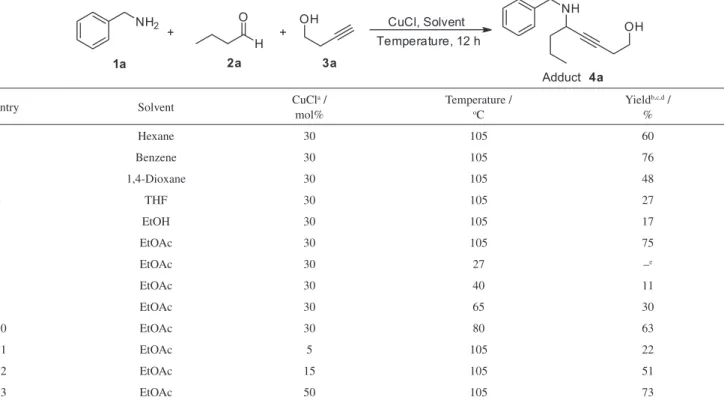
To test the feasibility of the strategy we selected benzylamine (1a), butyraldehyde (2a) and 3-butyn-1-ol (3a) as the starting materials for the A³-coupling reaction and CuCl (30 mol%) as the catalyst. In the first attempt to obtain the corresponding hydroxy-propargylamine, the reaction was performed in tetrahydrofuran (THF) in a sealed tube at 105 oC, and after 12 h the desired adduct 4 was obtained in only 27% yield. Aiming to improve the yield, a systematic study involving solvent, catalyst amount and temperature was undertaken and the results are presented in Table 1.
The experiments were conducted for 12 h in a sealed tube to achieve temperatures higher than the boiling points of the solvents. In hexane and benzene (entries 1 and 2), using 30 mol% of CuCl, the A3-coupling product was isolated in 60 and 76% yield, respectively. In 1,4-dioxane, THF and ethanol the product was formed in lower yields (entries 3-5). In ethyl acetate the product was isolated in the same average yield as in benzene (entries 2 and 6). As ethyl acetate is an environmentally benign solvent, it was chosen for the next experiments. No product was detected when the reaction was performed at room temperature (entry 7), the starting materials remaining unchanged. Increase in
the product yields were observed when the reactions were performed at higher temperatures (entries 8-10), and a maximum of 75% yield was achieved at 105 oC (entry 6). This temperature was considered as limit for security reasons, as the sealed tubes were designed to operate at this temperature or below.28 After setting this temperature, the quantity of the catalyst was screened. By using 5 and 15 mol% of CuCl, the product was obtained in 22 and 51% isolated yield respectively (entries 11 and 12). Use of 30 as well as 50 mol% of the catalyst led to the product in the same average yield (entries 6 and 13). In this way, 30 mol% was chosen as the ideal amount of the catalyst.
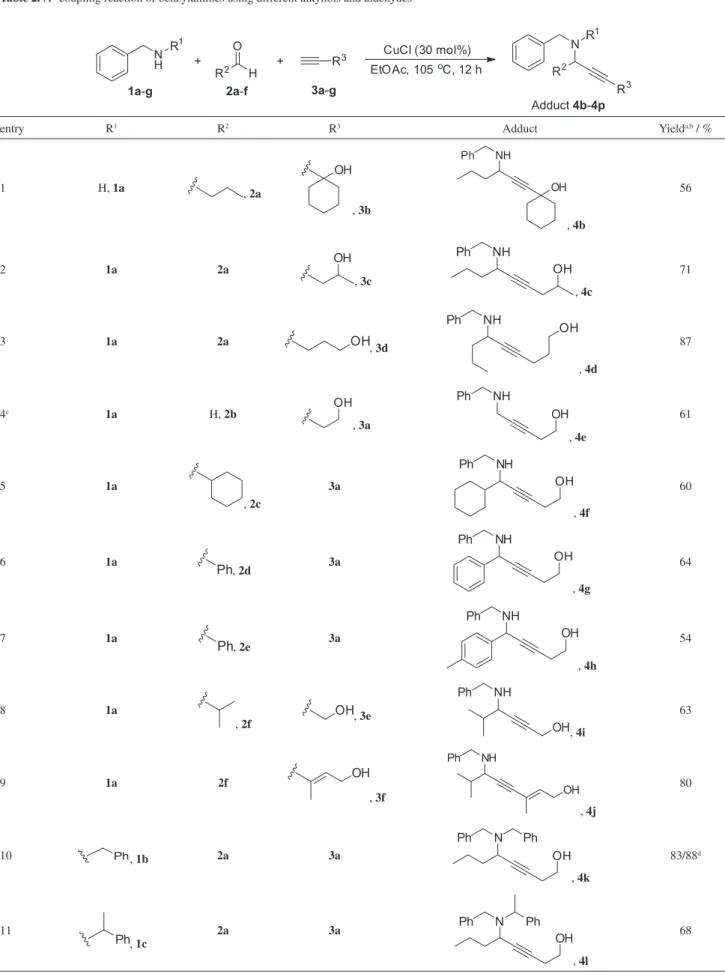
In order to define the scope and limitations of the protocol, other alkynes, aldehydes and benzylamines were submitted to the A³-coupling reaction under the conditions of choice, and the results are presented in Table 2.
As can be observed in Table 2, the methodology is quite general tolerating structurally diverse alkynols, alkyl and aryl aldehydes with equally good performance. Ethynylcyclohexanol and propargyl alcohol gave the desired adducts in reasonable yields (entries 1 and 8). Good yields were achieved using high-weight alkynols and alkyl aldehydes (entries 3 and 9). p-Formaldehyde presented good reactivity allowing the isolation of the corresponding A3-coupling product in 61% yield (entry 4). Benzaldehyde
Table 1. Solvent, catalyst amount and temperature screening for A3-coupling reaction
OH
Adduct 4a
CuCl, Solvent
H
O OH
+ NH2
NH
+
3a 2a
1a
Temperature, 12 h
entry Solvent CuCla /
mol%
Temperature / oC
Yieldb,c,d / %
1 Hexane 30 105 60
2 Benzene 30 105 76
3 1,4-Dioxane 30 105 48
4 THF 30 105 27
5 EtOH 30 105 17
6 EtOAc 30 105 75
7 EtOAc 30 27 –e
8 EtOAc 30 40 11
9 EtOAc 30 65 30
10 EtOAc 30 80 63
11 EtOAc 5 105 22
12 EtOAc 15 105 51
13 EtOAc 50 105 73
Table 2. A3-coupling reaction of benzylamines using different alkynols and aldehydes
R2
R3 EtOAc, 105oC, 12 h
R2 H
O + N H
N + R3 CuCl (30 mol%)
3a g
-2a f
-1a g
-Adduct4b 4p
-R1 R
1
entry R1 R2 R3 Adduct Yielda,b / %
1 H, 1a , 2a
OH
, 3b
OH NH
Ph
, 4b
56
2 1a 2a OH
, 3c
NH Ph
OH
, 4c
71
3 1a 2a OH,
3d
NH
OH Ph
, 4d
87
4c 1a H, 2b OH
, 3a
NH Ph
OH
, 4e
61
5 1a
, 2c
3a
NH Ph
OH
, 4f
60
6 1a
Ph, 2d 3a
NH Ph
OH
, 4g
64
7 1a
Ph, 2e 3a
NH Ph
OH
, 4h
54
8 1a
, 2f
OH, 3e
OH NH
Ph
, 4i
63
9 1a 2f OH
, 3f
NH
OH Ph
, 4j
80
10 Ph, 1b 2a 3a
Ph N Ph
OH
, 4k
83/88d
11
Ph, 1c 2a 3a
Ph N Ph
OH
, 4l
entry R1 R2 R3 Adduct Yielda,b / %
12
Ph, 1d
2a 3a Ph N Ph
OH
, 4m
60
13
Ph OH
, 1e
2a
Ph, 3g Ph N
O
Ph , 4n
63
14e
Ph OTBDMS
, 1f
2a 3a Ph N Ph
OH OTBDMS
, 4o
60 (30% d.e.)
15e
Ph OTIPS
, 1g
2a 3a Ph N Ph
OH OTIPS
, 4p
30 (24% d.e.)
aAll reactions were performed with a benzylamine (1 mmol), aldehyde (1.3 mmol) and alkynol (2 mmol) in a pressure tube with CuCl (30 mol%), EtOAc at 105 oC; bisolated yields; creaction was performed using paraformaldehyde; dreaction performed using 1 mol% of the catalyst for 2 h; ereaction was performed at 80 oC for 24 h. d.e.: diastereoisomeric excess.
Table 2. A3-coupling reaction of benzylamines using different alkynols and aldehydes
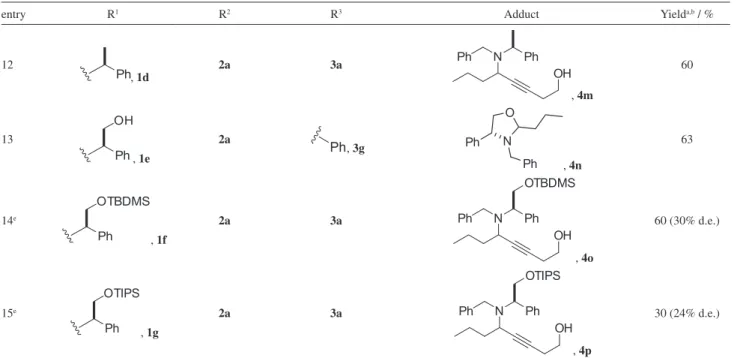
and p-tolualdehyde also reacted as expected leading to the corresponding propargylamines in reasonable yields (entries 6 and 7). By monitoring the reactions by gas or thin layer chromatography a much faster conversion of the starting materials was observed when dibenzylamine (1b) was used as the amine source on reaction with butyraldehyde and 3-butyn-1-ol (entry 10). Aiming to optimize the reaction conditions for dibenzylamine (1b), it was found that the use of only 1 mol% of the catalyst resulted in the corresponding product in 88% yield after 2 h reaction time (entry 10). On the other hand, higher reaction times and catalyst amounts were necessary when the racemic as well as the optically active methyl-substituted benzylamines (1c and 1d) were reacted with the same alkyne and aldehyde (entries 11 and 12). No diastereoisomeric excess (d.e.) was observed for the optically active amine (entry 12).
Phenylglycinol was used in the coupling reaction in order to verify if diastereoselection could be achieved; however, instead of the A3-coupling product, the corresponding
N,O-ketal was isolated in 63% yield, resulting from the intramolecular attack of the hydroxyl group to the intermediate iminium carbon (entry 13). To circumvent this side reaction, the corresponding silyl ethers were used. The tert-butyl dimethylsilyl (TBDMS) derivative led to the A3-coupling product in 60% yield and 30% d.e., and the tri-isopropylsilyl (TIPS) analogue led to the product in only 30 and 24% d.e. (entries 14 and 15).
Hydroxy-propargylamine adducts 4a, 4c and 4i were converted into the corresponding cyclic alkaloids by concomitant hydrogenation/hydrogenolysis, followed by a Mitsunobu-type29,30 cyclization reaction, as presented in Scheme 1.
Scheme 1. Synthesis of cyclic alkaloids from the A3-coupling adducts.
N H R1 PPh3, DEAD
R2 R1
NH
OH
R2
R1 NH2
R2 OH Pd/C (10%)
KOH, H2(1 atm)
MeOH, 4 days THF, r.t., 12 h
Ph
4i, R1=i-Prop, R2= H,n= 0
4a, R1=n-Prop, R2= H,n= 1
4c, R1=n-Prop, R2= Me,n= 1
6a, R1=i-Prop, R2= H,n= 0; (55% two steps)
6b, R1=n-Prop, R2= H,n= 1; (62% two steps)
6c, R1=n-Prop, R2= Me,n= 1; (60% two steps)
5a, R1=i-Prop, R2= H,n= 0
5b, R1=n-Prop, R2= H,n= 1
5c, R1=n-Prop, R2= Me,n= 1
( )n
( )
n
( )
The pyrrolidine alkaloid 6a is used in the food industry as flavoring31 and its structure is found as a substituent group in several bioactive compounds.32 Coniine (6b) is a highly toxic alkaloid extracted from mushrooms and is able to induce muscular paralysis.33-36 Dihydropinidine (6c) was isolated from young seedlings of Pinus ponderosa
presenting activity against Alzheimer’s diseases37 and displays a high antifeedant activity for the pine weevil
Hylobius abietis.38
The presented synthetic strategy allowed the synthesis of the alkaloids 2-isopropylpyrrolidine (6a), coniine (6b) and dihydropinidine (6c) in three synthetic steps in an overall yield of 35, 46 and 42%, respectively. The A³-coupling reaction can be considered as the key step of the synthetic sequence, and consequently as an alternative route to the synthesis of bioactive alkaloids.
Conclusions
In summary, we demonstrated the easy preparation protocol to access hydroxy-propargylamines, by a catalyzed A3-coupling reaction. Alkynols and benzylamines were directly reacted with aromatic and aliphatic aldehydes presenting good reactivity. Alkyl and aryl aldehydes, as well as functionalized alkynes, were tolerated. The use of benzylamines is synthetically strategic since concomitant hydrogenonlysis of the benzyl nitrogen and triple bond reduction can be performed in good yields, resulting in the corresponding saturated amino-alcohols. Cyclic alkaloids can be easily obtained by sequential A3-coupling, hydrogenation/hydrogenolysis sequence followed by a Mitsunobu-type cyclization reaction. As a proof of concept this procedure was applied to the synthesis of three cyclic bioactive alkaloids.
Experimental
General information
All reagents were purchased from Aldrich. The reactions was performed using an Ace® pressure tube bushing type, back seal, volume ca. 35 mL, 17.8 cm × 25.4 mm (L × o.d.)
from Sigma-Aldrich (product code Z181072). Analytical thin layer chromatography (TLC) was carried out by using silica gel 60 F254 pre-coated plates. Visualization was accomplished with vanillin [0.01 g mL-1 vanillin in AcOH/H2SO4 (99:1) solution] or ninhydrin as color reagent [0.005 g mL-1 ninhydrin in EtOH (96%) solution]. The gas chromatography (GC) analyses were performed on a Shimadzu® GC2014 equipment, with flame ionization detection (FID), N2 as carrier gas and equipped with a
DB-5 column (30 m × 0.25 mm × 0.25 mm) or DB-5-HT
(30 m × 0.32 mm × 0.10 mm). All new products were
characterized by their nuclear magnetic resonance (NMR), infrared (IR), mass spectrometry (MS) and high-resolution MS (HRMS) spectra. The 1H NMR (200 MHz) and 13C NMR (50 MHz) were recorded on a Bruker® AC 200
spectrometer and the 1H NMR (400 MHz) and 13C NMR (100 MHz) were recorded on a Bruker® DRX 400 spectrometer, in both cases using tetramethylsilane (TMS) as the internal standard. Chemical shifts were reported in parts per million (ppm, d) downfield from the TMS. The infrared analyses were recorded on a Shimadzu® equipment, model IRPrestige-21, and Bomen Hartmann & Braun® MB-Series equipment, model Arid-Zone®. Low-resolution mass spectra were recorded on a Shimadzu® GC-17A coupled with QP5050A MS, using HP-5MS column (30 m × 0.25 mm × 0.25 mm). High-resolution mass
analyses were recorded on a LC/MS Bruker® Daltonics MicroTOFIc equipment by direct injection of pure samples. High performance liquid chromatography (HPLC) analyses were performed on Shimadzu® LC-10AD and LC-30AD devices equipped with a UV-Vis SPD-M20A detector, using a Daicel Chiralpak® OD-H and Daicel Chiralpak® OD columns and hexane:isopropanol (99:1) as mobile phase with 0.8 mL min-1 flow.
General procedure for the synthesis of benzylamines 1b
and 1c
To a 10 mL round-bottomed flask containing benzaldehyde (0.233 g, 0.202 mL, 2.2 mmol) was added dropwise the amine (2.0 mmol). The mixture was stirred at room temperature and the progress of amine consuption was monitored by GC-FID or TLC chromatography. To the reaction mixture, at 0 oC, EtOH (2.0 mL) and sodium borohydride (0.076 g, 2.0 mmol) were added sequentially. The reaction was warmed to room temperature, stirred for 2 h and quenched with water (5 mL) and HCl (10 mL, 10% v/v). After separantion, the aqueous phase was treated using NaHCO3 solution (until pH 8) and then extracted with EtOAc (4 × 10 mL). After combination, the organic
phase was dried over Na2SO4, filtered and concentrated under reduced pressure giving the corresponding amine in high purity grade.
General procedure for the synthesis of benzylamines 1f
and 1g
1.5 mmol) and N,N-dimethylformamide (1 mL) at 0 oC, was added, in two portions, the trialkylsilane (2.0 mmol). The reaction was warmed to room temperature and, after 18 h, quenched with water (5 mL). The aqueous phase was extracted with EtOAc (3 × 10 mL). The organic extracts
were combined and washed with brine (2 × 10 mL), dried
over Na2SO4, filtered and concentrated under reduced pressure giving the corresponding amine in high purity grade.
General procedure for the synthesis of hydroxypropargyl benzylamines
To a 35 mL pressure tube were sequentially added copper(I) chloride (0.060 g, 0.6 mmol), benzylamine (0.107 g, 0.14 mL, 1.0 mmol), aldehyde (1.3 mmol), alkynol (2.0 mmol) and EtOAc (2 mL). The mixture was stirred at 105 oC and the progress of the reaction was monitored by GC-FID or TLC. The reaction mixture was filtered in a short pad Celite® column. The Celite® residue was washed with EtOAc (2 × 10 mL). The organic phase was dried over
MgSO4, filtered and concentrated under reduced pressure. The residue was directly purified by silica gel column chromatography using the appropriate eluent.
General procedure for the synthesis of amino alcohols 5a,
5b and 5c
To a 10 mL round-bottomed flask containing Pd/C 10% (0.070 g), previously activated with hydrogen gas, were sequentially added MeOH (15 mL), hydroxypropargylamine (2.0 mmol) and KOH (two drops, 1.0 mol L-1 solution). The mixture was stirred at room temperature, in H2 atmosphere (1 atm) and the progress of the reaction (4 days) was monitored by GC-FID. The reaction mixture was filtered in a short pad Celite® column. The Celite® residue was washed with CH2Cl2 (4 × 10 mL). The organic phase was dried over MgSO4, filtered and concentrated under reduced pressure. The residue was directly purified by silica gel column chromatography using the appropriate eluent.
General procedure for the synthesis of cyclic alkaloids 6a,
6b and 6c
To a 25 mL round-bottomed flask were added triphenylphosphine (0.619 g, 2.36 mmol) and THF (8 mL). The mixture was refrigerated in an ice/acetone/NaCl bath (–10 oC) followed by dropwise addition of diethyl azodicarbolylate (0.411 g, 0.37 mL, 2.36 mmol). After 30 min a white solid was formed and a solution of amino alcohol (2.0 mmol) in THF (7 mL) was added. The mixture
was stirred for 12 h and the progress of the reaction was monitored by GC-FID or TLC. At the end of this time, the reaction mixture was concentrated under reduced pressure and the crude product was purified by Kugelrohr distillation apparatus.
Typical procedure for A3-coupling
To a 35 mL pressure tube were sequentially added copper(I) chloride (0.060 g, 0.6 mmol), benzylamine (1.0 mmol), aldehyde (1.3 mmol), alkynol (2.0 mmol) and EtOAc (2 mL). The mixture was stirred at 105 oC and the progress of the reaction was monitored by GC-FID or TLC. The reaction mixture was filtered in a short pad Celite® column. The Celite® residue was washed with EtOAc (2 × 10 mL). The organic phase was dried over
MgSO4, filtered and concentrated under reduced pressure. The residue was directly purified by silica gel column chromatography using the appropriate eluent.
Supplementary Information
Supplementary data are available free of charge at http://jbcs.sbq.org.br as PDF file.
Acknowledgments
The authors thank FAPESP (grants No. 2008/55401-1, 2011/11613-8, 2011/17228-6 and 2011/03244-2), CAPES (grants No. 23038.000497/2010-14 and 33002010191P0), and CNPq (grant No. 57.5417/2008-0) for financial support. The authors are also grateful for the financial and structural support offered by the University of São Paulo through NAP-CatSinQ (Research Core in Catalysis and Chemical Synthesis). E. P. Wendler is grateful to CAPES for fellowships and to Federal University of São Carlos for access to their facilities.
References
1. Trost, B. M.; Science 1991, 254, 1471.
2. Gore, R. P.; Rajput, A. P.; Drug Invent. Today2013, 5, 148. 3. Heravi, M. M.; Hashemi, E.; Beheshtiha, Y. S.; Kamjou, K.;
Toolabi, M.; Hosseintash, N.; J. Mol. Catal. A: Chem. 2014, 392, 173.
4. Alemán, J.; Cabrera, S.; Chem. Soc. Rev. 2013, 42, 774. 5. Guo, Q.; Zhao, J. C.-G.; Org. Lett. 2013, 15, 508. 6. Bisai, A.; Singh, V. K.; Org. Lett. 2006, 8, 2405.
7. Clavier, H.; Pellissier, H.; Adv. Synth. Catal. 2012, 354, 3347. 8. Su, Y.; Bouma, M. J.; Alcaraz, L.; Stocks, M.; Furber, M.;
9. Xu, D.-Z.; Li, H.; Wang, Y.; Tetrahedron 2012, 68, 7867. 10. Tu Pham, H.; Chataigner, I.; Jean-Luc, R.; Curr. Org. Chem.
2012, 16, 1754.
11. Dagousset, G.; Retailleau, P.; Masson, G.; Zhu, J.; Chem. Eur. J. 2012, 18, 5869.
12. Wei, C.; Mague, J. T.; Li, C.-J.; Proc. Natl. Acad. Sci. U. S. A. 2004, 101, 5749.
13. Bariwal, J. B.; Ermolat’ev, D. S.; Glasnov, T. N.; Van Hecke, K.; Mehta, V. P.; Van Meervelt, L.; Kappe, C. O.; Van der Eycken, E. V.; Org. Lett. 2010, 12, 2774.
14. Li, P.; Pereshivko, O. P.; Peshkov, V. A.; Van der Eycken, E. V.; Org. Lett. 2010, 12, 2638.
15. Nandakumar, A.; Muralidharan, D.; Perumal, P. T.; Tetrahedron Lett. 2011, 52, 1644.
16. Luz, I.; Llabrés i Xamena, F. X.; Corma, A.; J. Catal. 2012, 285, 285.
17. Wei, C.; Li, Z.; Li, C.-J.; Synlett 2004, 9, 1472. 18. Zani, L.; Bolm, C.; Chem. Commun. 2006, 4263.
19. Abels, F.; Lindemann, C.; Koch, E.; Schneider, C.; Org. Lett. 2012, 23, 5972.
20. Aschawanden, P.; Stephenson, C. R. J.; Carreira, E. M.; Org. Lett. 2006, 8, 2437.
21. Knöpfel, T. F.; Angew. Chem., Int. Ed. 2004, 43, 5971. 22. Wei, C.; Li, C.-J.; J. Am. Chem. Soc. 2002, 124, 5638. 23. Gommermann, N.; Knochel, P.; Chem. Eur. J. 2006, 12, 4380. 24. Zhang, K.; Huang, Y.; Chen, R.; Tetrahedron Lett. 2010, 51,
5463.
25. Iqbal, J.; Huma, H. Z. S.; Halder, R.; Kalra, S. S.; Das, J.; Tetrahedron Lett. 2002, 43, 6485.
26. Melgar, G. Z.; Wendler, E. P.; Dos Santos, A. A.; Porto, A. L. M.; Tetrahedron: Asymmetry 2010, 21, 2271.
27. Wendler, E. P.; Dos Santos, A. A.; Quim. Nova 2013, 36, 1155. 28. G e n e r a l d e s c r i p t i o n o f p r o d u c t Z 1 8 1 0 7 2 , h t t p : / / w w w. s i g m a a l d r i c h . c o m / c a t a l o g / p r o d u c t / a l d r i c h / z181072?lang=en®ion=US accessed in August 2014. 29. Mitsunobu, O.; Yamada, M.; Bull. Chem. Soc. Jpn. 1967, 40,
2380.
30. Mitsunobu, O.; Yamada, M.; Mukaiyama, T.; Bull. Chem. Soc. Jpn. 1967, 40, 935.
31. Okumura, S.; Kawanobe, T.; Amaike, M.; Jpn. Kokai Tokkyo Koho 05015329 A 1993.
32. Lemin, A. J.; US pat. 34022451968.
33. Nettekoven, M. H.; Roche, O.; US pat. 20070281921 A12007. 34. Gerritz, S.; Shi, S.; Zhu, S.; US pat. 20060287287 A12006. 35. Haviv, F.; Bradley, M. F.; Henkin, J.; Dinges, J.; Sauer,
D. R.; Kolaczkowski, L.; Vasudevan, A.; Park, D. C.; US pat. 20060030557 A12006.
36. Gommermann, N.; Knochel, P.; Chem. Eur. J. 2006, 12, 4380. 37. Dobbs, A. P.; Guesné, S. J. J.; Synlett 2005, 2101.
38. Eriksson, C.; Sjödin, K.; Schylter, F.; Höberg, H.-E.; Tetrahedron: Asymmetry 2006, 17, 1074.
Submitted: July 29, 2014
Published online: September 26, 2014