Short Report
J. Braz. Chem. Soc., Vol. 21, No. 6, 1129-1135, 2010. Printed in Brazil - ©2010 Sociedade Brasileira de Química 0103 - 5053 $6.00+0.00*e-mail: [email protected] or [email protected]
An Eficient Protocol for Accessing
β
-Amino Dicarbonyl Compounds
through aza-Michael Reaction
Ihssan Meskini,a Loïc Toupet,b Maria Daoudi,a Abdelali Kerbal,a Brahim Bennani,a
Pierre H. Dixneuf,c Zahid H. Chohan,d Ana Cristina Lima Leite*,e
and Taibi Ben Hadda*,f
aLaboratoire de Chimie Organique, Faculté des Sciences Dhar Mehraz, Fès, Morocco
bInstitut de Physique - IPR - UMR 6251, CNRS, Université de Rennes, 1, Rennes, France
cLaboratoire Catalyse et Organométalliques, Institut Sciences Chimiques de Rennes, UMR 6226, CNRS, University of Rennes, Av. Géneral Leclec, 35042 Rennes, France
dDepartment of Chemistry, Bahauddin Zakariya University, Multan 60800, Pakistan
eDepartment of Pharmaceutical Science, Centre for Health Science, Federal University of Pernambuco, 50740-520 Recife-PE, Brazil
fLaboratoire Chimie des Matériaux, Faculté des Sciences, 60000 Oujda, Morocco
Compostos β-amino-dicarbonilados constituem uma classe de ligantes promissores para a química de coordenação. Diante desta perspectiva, um método eiciente e fácil visando à síntese de compostos β-amino-dicarbonilados foi desenvolvido, explorando a reação de adição do tipo azo-Michael em meio aquoso. Com isso, uma série de dez dietil 2-(feniletil)malonatos dissubstituídos foram obtidos de uma maneira regiosseletiva e facilmente puriicados, levando à rendimentos satisfatórios. As análises cristalográicas de dois destes compostos forneceram as informações apropriadas sobre a conformação e coniguração dos mesmos. Por último, uma proposta complementar do mecanismo reacional para as reações de adição de Michael em meio aquoso foi também descrito.
β-Amino dicarbonyl compounds comprise a class of useful ligands on the coordination chemistry. In view of their importance, an eficient and facile method for the synthesis of β-amino
dicarbonyl compounds has been developed, exploring the aza-Michael addition reactions in an aqueous medium. It was possible to achieve good to excellent yields, along with regioselectivity, the substituted diethyl 2-(phenylmethyl)malonates that were easily isolated without any chromatographic puriication. The correct coniguration of two of these β-amino dicarbonyl compounds were conirmed by X-ray crystallography. A complementary mechanism of this aza-Michael protocol is proposed to explain the results obtained.
Keywords: polydentate ligands, β-amino dicarbonyl compounds, Michael addition, aqueous medium
Introduction
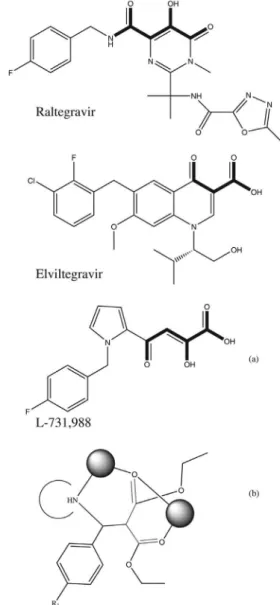
The rational design of new HIV-1 Integrase (HI) inhibitors, a valid target for chemotherapeutic intervention,1 is primarily based on intermolecular coordination between HI / chemical inhibitor / metals (Mg2+ and Mn2+,
An Eficient Protocol for Accessing β-Amino Dicarbonyl Compounds J. Braz. Chem. Soc. 1130
compounds are considered in structural terms to block the intramolecular electron transfer on the HI structure.6 This explanation clearly demonstrates that polydentate ligands are of special interest in the ield of bioorganometallic chemistry.7 In view of our interest in designing novel bimetallic coordinating ligands8 endowed with potential action to inhibit the HI enzyme, the object of this study is the synthesis of polydentate ligands with the same topology, as drawn in Figure 1.9
For preparation of such polydentate ligands, the aza-Michael reactions appear to be the key-step leading the expected β-amino esters adducts.10 In fact, this kind of reaction has been widely employed to generate structurally diverse β-amino dicarbonyl compounds, where the undoubted importance of the aza-Michael step can be seen from the large number of unconventional
methodologies, as well as the broad range of applications.11 Most of these unconventional methodologies have used Lewis acids, which although leading to satisfactory yields, require to remove the Lewis acids through tediously chromatography.12 Moreover, the use of an aqueous medium also has been successful achieved.13 As a drawback, the use of substituted alkenes, such as benzylidene-malonic acid diethyl ester, is rarely reported in the literature. These substrates are expected to be less reactive or conversely more resistant to undergo the Michael condensation, resulting in low conversion of the desired adducts.14 For a synthetic point of view, this is a considerable limitation on the aza-Michael reaction process and poses a signiicant challenge.
To this end, we decided to investigate the feasibility of applying the aza-Michael reactions to the more challenging substituted alkene derivatives. Our plan also included the application of this key-step to the synthesis of a novel set of polydentate ligands, in order to highlight the versatility of the procedure as well as to generate some insights regarding the reaction mechanism.
Results and Discussion
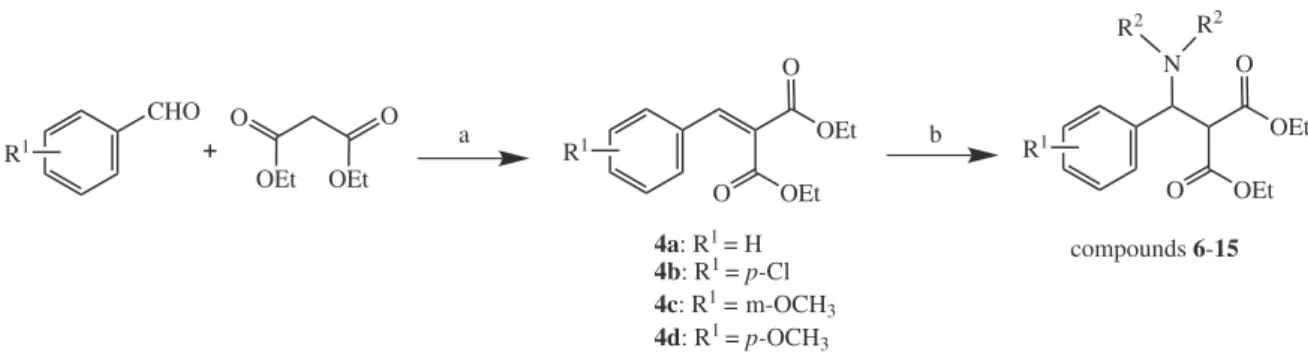
Firstly, diethyl 2-benzylidenemalonates (4a-d) were
prepared from the classical condensation of benzaldehydes with diethyl malonate under ethanol relux, using piperidine and glacial acetic acid as a catalyst system. This procedure furnished the intermediates, 2-arylidene-malonic acid diethyl esters (4a-d), very quickly and in excellent yields
(Scheme 1).
To understand the scope and limitations of the aza-Michael reactions, compound 6 was chosen as the model
reaction because of its thermostability and also because piperidinyl is considerably less reactive when employing the traditional Michael protocols. Some of these conditions are presented in Table 1. During the investigation of experimental conditions, it was possible to observe that the acid catalyst (HOAc, 0.1 mL) accelerates such reactions. Interestingly,only a short reaction time (3 h) was required to furnish product 6 on very good yields with no detected
by-products (Table 1, entries 4 and 5). In contrast, neither the presence of co-solvent (EtOH) nor the heating were crucial, the yields remaining similar to or lower than those expected when using pure water (entries 2 and 3). Boric acid also well works, but it was necessary additional puriication by chromatography. Apart from the aqueous medium, the use of dichloromethane as solvent at catalyst-free condition led to low conversion (yield < 20%) of the desired product 6, in agreement with the previous results
by Shou and colleagues.15
Figure 1. (a) Structures of representative HI inhibitors that act through the sequestration of enzyme’s co-factors; 5 (b) Expected coordination mode
Meskini et al. 1131 Vol. 21, No. 6, 2010
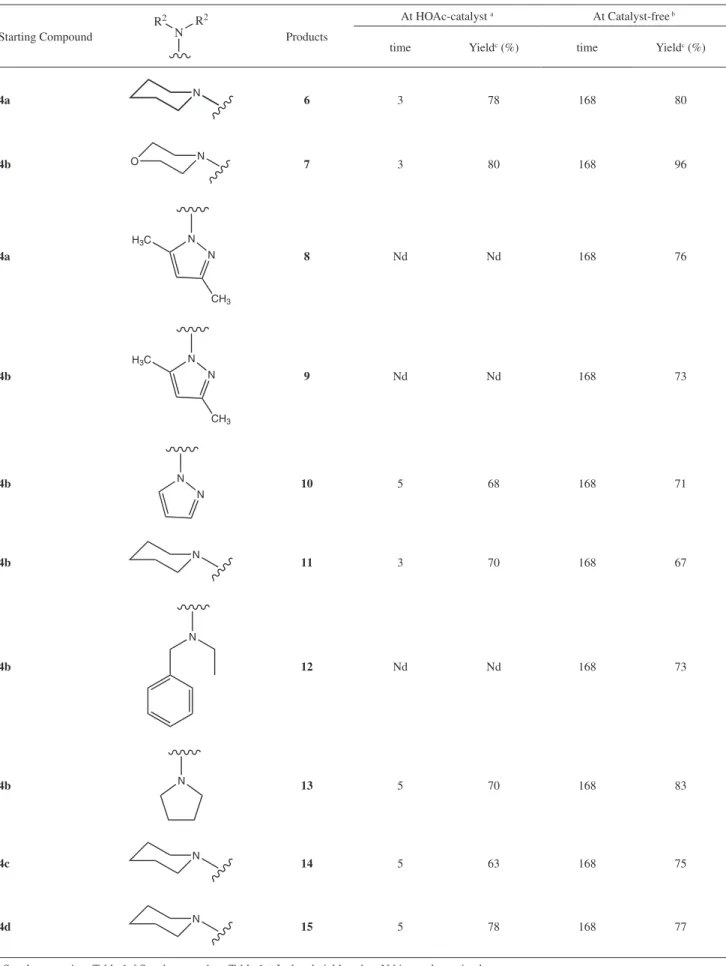
Having determined the best conditions, it was identiied that precursors 4a-d reacted satisfactorily, albeit slowly,
with various secondary amines under catalyst-free conditions to provide the desired adducts 6-15 in good to
excellent yields, along with regioselectivity and without needs of column chromatography (Table 2). Moreover, the reactions proceeded normally even when the methoxy group was attached on aromatic ring (14 and 15), in contrast with
the protocol described by Shou and colleagues.15 It is worth noting that the yields were found to be essentially the same as those obtained when the reactions were performed under either the presence or absence of the acid catalyst (HOAc). These results suggest that the acid catalyst accelerates the aza-Michael reactions under these substrates.
These products were characterized using spectroscopic and micro-analytical data. Compounds 8 and 9 were
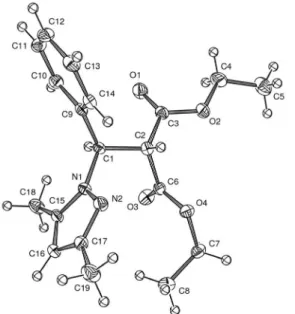
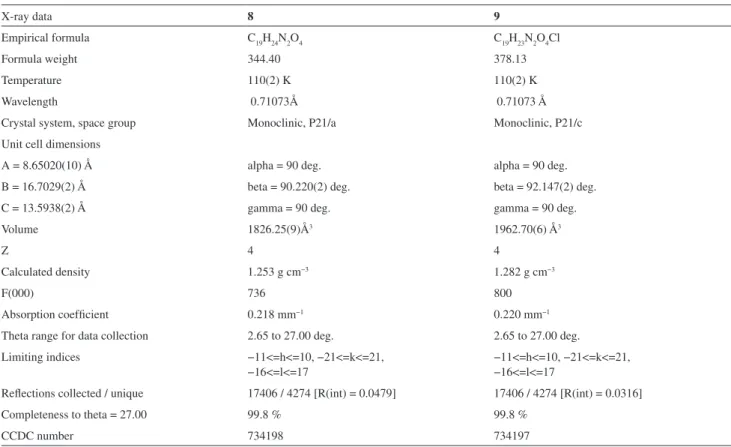
crystallized from ethanol solutions and gave single crystals suitable for X-ray analysis. These single crystals displayed centrosymmetric space groups for both compounds, indicative that each crystalline structure was composed of both enantiomers. An ORTEP view of the polydentate ligands 8 and 9 are shown in Figures 2 and 3,
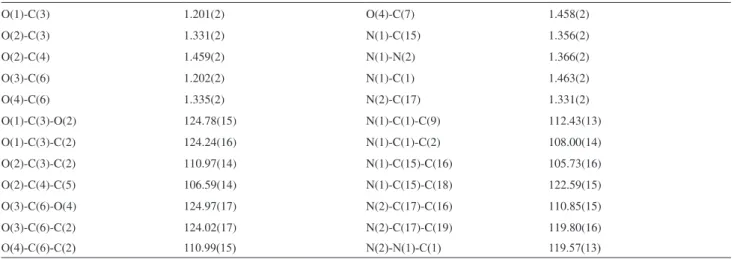
while the crystal data for these are reported in Table 3 and the bond lengths and angles of compound 9 are
summarized in supplementary material. In the molecular structure of 9, the nitrogen (N2) and the two oxygen (O1
and O3) of the carbonyl groups are in cisoidal / transoidal
conformations, with respective dihedral angles of the 0.04(1), 145.7(2) and 88.3(1) for the planes O1–C3–C6–O2, O1–C3–C1–N1 and O3–C6–C1–N1. We have note that after the trans addition around the C1=C2 double bond; the observed angles were quite different from 180° [H1–C1–C2–H2 = 176.9(2), C3–C2–C1–C9 = 56.9(1) and N1–C1–C2–C6 = 60.6(9)]. In fact, these untypical values were conirmed by the angle of atoms in trans positions, which was again different of 180°, as the example the [N1–C1–C2–H2 = −60.3(5)]. More unexpected, it was possible to observe that, in contrast with the polydentate ligand 8, the crystal structure of the ligand 9 was stabilized
by one unusual intramolecular type-H bonding within the C–Cl+δ…−δN=C, resulting in an interesting 3D network, as
depicted in Figure 4.
In light of this interesting finding, we decided to apply several primary amines (arylamines, benzylamines, 1,4-phenylenediamine and unprotected amino acids) using this same synthetic protocol, but the presence of the desired products was no longer observed in all the cases using either prolonged reaction times or a large excess of amines. In contrast to secondary amines, which enabled functionalized polydentate compounds 6-15 to be obtained
in good to excellent yields, the reaction of 4a-d with the
primary amines (arylamines, benzylamine and para-phenylenediamine) in water did not furnish the expected polydentate ligands bearing the central RN-H group, either
R1 CHO R1 O OEt R2 R2 N OEt O a b
4a: R1 = H 4b: R1 = p-Cl
4c: R1 = m-OCH
3 4d: R1 = p-OCH3
compounds 6-15
R1 O OEt OEt O + OEt OEt O O
Scheme 1. General synthesis of the polydentate ligands (6-15). Reagents and conditions: a) piperidine, HOAc, EtOH, relux, 12 h; b) secondary amine,
water, r.t., catalyst.
Table 1. Investigation of the aza-Michael condensation promoted by aqueous medium for the synthesis of compound 6
Entry Catalyst Co-solvent Temp (°C) time (h) Yield a (%)
1 None None 30 120 80
2 None None 100 3 30b
3 None EtOHc 30 120 61
4 HOAcd None 30 3 78
5 HOAcd None 60 3 75
6 Boric acid (10% mol)e None 30 4 63
a Determined as isolated products after recrystallization; b The starting materials were recovered and at the same time, by-products were observed; c Using
An Eficient Protocol for Accessing β-Amino Dicarbonyl Compounds J. Braz. Chem. Soc. 1132
Table 2. Aqueous medium-promoted aza-Michael condensation
Starting Compound
R2 R2
N Products
At HOAc-catalyst a At Catalyst-free b
time Yieldc (%) time Yieldc (%)
4a N 6 3 78 168 80
4b O N 7 3 80 168 96
4a N
N H3C
CH3
8 Nd Nd 168 76
4b N
N H3C
CH3
9 Nd Nd 168 73
4b
N
N 10 5 68 168 71
4b N 11 3 70 168 67
4b
N
12 Nd Nd 168 73
4b N 13 5 70 168 83
4c N 14 5 63 168 75
4d N 15 5 78 168 77
Meskini et al. 1133 Vol. 21, No. 6, 2010
the nucleophilic character of the nitrogen atom of the amine. This proposed mechanism would seem to present a plausible and satisfactory explanation of the formation of enol intermediates. To complement this, we would like to address the issue of why this protocol did not work well with primary amines. Since the chemical behaviour of primary and secondary amines undergoing these aza-Michael reactions is quite different, it is plausible to suggest that secondary amines in an aqueous medium probably give rise to the formation of ammonium species, which easily attacks the electrophilic alkene, thereby furnishing the unstable intermediate of addition with subsequent proton abstraction from protonated water by way of the enolate. On the other hand, using primary amines under aqueous medium probably results in the formation of ammonium salts. This implies that these ammonium salts are catalytically deactivated species or, conversely, less nucleophilic and thus less susceptible to attack from the respective alkenes (Scheme 2). Furthermore, the
Figure 2. ORTEP drawing of compound 8 in its correct coniguration
with thermal ellipsoid plot (50% probability). Critical distances [O1—O3 = 3.5(2) Å, O3—N2 = 3.9(3) Å and O1—N2 = 5.0(6) Å].
Figure 3. ORTEP view of the compound 9 with the atom numbering scheme. Displacement ellipsoids for non-H atoms are drawn at the 50% probability level. Critical distances [O1—O3 = 3.3(3) Å, O3—N2 = 3.8(2) Å and O1—N2 = 5.0(3) Å].
Figure 4.View of the H-bonding interactions of the ligand 9 in the unit
cell.
in the presence of the acid catalyst (HOAc) or with the addition of more than one equivalent of aniline.
Moreover, the mechanism for formation of the aza-Michael adducts should be mentioned. This is different from the Lewis acid-promoted aza-Michael reactions, in that such Lewis acids function by activating the unsaturated double bond, generating a nucleophilic attack by way of chelation of the 1,3-dicarbonyl core. More recently, Ranu and Banerjee13 have argued that the aqueous medium
An Eficient Protocol for Accessing β-Amino Dicarbonyl Compounds J. Braz. Chem. Soc. 1134
equilibrium steps occurring in the course of the aza-Michael reactions are probably the slowest, and are, consequently, speeded up when an acid catalyst is used. Additionally, a referee commented that the water effect in reactions with amines is more complex than dual activation. This statement is genuine and we agree with him. For instance, the nature of species generated from mixture of primary / secondary amines and water depends on the nucleophilicity of the employed amine.16 Likewise, solubilization of reactants and products in water is usually of relevancy to get desirable yields in such aza-Michael reactions.14
Conclusions
One important result of this study was a straightforward synthesis of ten novel 2-(aryl-disubstituted amino-1-yl-methyl)-malonic acid diethyl esters (6-15), which constitute
a functionalized class of polydentate ligands. Despite prolonged reaction times, this aza-Michael protocol led to higher yields in an aqueous medium at room temperature, and consequently, would appear to be a simple and useful synthetic protocol. Considering their high eficiency on the gram-scale synthesis, in addition to the especially high purity of the inal products, this protocol appears to be of use for synthesis and pharmacological screening of drug candidates.
Experimental
General methods
Synthesis of intermediates 4a-d
To a solution of ethyl malonate (15 g, 93 mmol) in 40 mL of ethanol, were added the respective aldehyde (100 mmol), 1.5 mL of piperidine and 1 mL of glacial acetic acid. Then, the mixture was stirred at reluxing temperature of ethanol for 12 h, until thin-layer chromatography indicated the complete consume of the starting material. After removing solvent, the crude product was washed with a saturated solution of sodium bisulite (20 mL). The product was extracted by diethyl ether (2 × 20 mL), dried with sodium sulphate and evaporated to give the respective pure oil.
General procedure for the synthesis of compounds 6-15 To a solution of the intermediate 4a-d (8.1 mmol) in
water (25 mL) was added the respective secondary amine (6 mmol) at the presence or absence of acetic acid (0.1 mL) and the mixture was stirred at room temperature until the complete consume of the starting material. After removing solvent, the crude products were dissolved in diethyl ether (2 × 40 mL) and washed with water until the pH became neutral. The organic solvent was dried with sodium sulphate and then evaporated to give the respective pure compound.
Table 3. Crystal data and structure reinement for the compounds 8 and 9
X-ray data 8 9
Empirical formula C19H24N2O4 C19H23N2O4Cl
Formula weight 344.40 378.13
Temperature 110(2) K 110(2) K
Wavelength 0.71073Å 0.71073 Å
Crystal system, space group Monoclinic, P21/a Monoclinic, P21/c
Unit cell dimensions
A = 8.65020(10) Å alpha = 90 deg. alpha = 90 deg.
B = 16.7029(2) Å beta = 90.220(2) deg. beta = 92.147(2) deg.
C = 13.5938(2) Å gamma = 90 deg. gamma = 90 deg.
Volume 1826.25(9)Å3 1962.70(6) Å3
Z 4 4
Calculated density 1.253 g cm−3 1.282 g cm−3
F(000) 736 800
Absorption coeficient 0.218 mm−1 0.220 mm−1
Theta range for data collection 2.65 to 27.00 deg. 2.65 to 27.00 deg. Limiting indices −11<=h<=10, −21<=k<=21,
−16<=l<=17
−11<=h<=10, −21<=k<=21, −16<=l<=17
Relections collected / unique 17406 / 4274 [R(int) = 0.0479] 17406 / 4274 [R(int) = 0.0316]
Completeness to theta = 27.00 99.8 % 99.8 %
Meskini et al. 1135 Vol. 21, No. 6, 2010
Supplementary Information
Detailed experimental procedures, full set of 1H and 13C NMR spectra and X-ray data are available free of charge
at http://jbcs.sbq.org.br, as a PDF ile.
Acknowledgements
This work was funded by Project Global de Recherche de l’Université Mohamed Premier (PGR-UMP-BHT-2005, Morocco), Centre National de la Recherche Scientiique (CNRS, France), Brazilian Research National Council (CNPq, grant 479982/2008-2), National Institute of Research and Technology in Dengue (INCT-Dengue, grant 573876/2008-8, Brazil) and FACEPE PRONEX (grant APQ-0981-1.06/08). Authors acknowledge the referees and the editor of JBCS for their helpful comments and corrections.
References
1. Goldgur, Y.; Craigie, R.; Cohen, G. H.; Fujiwara, T.; Yoshinaga, T.; Fujishita, T.; Sugimoto, H.; Endo, T.; Murai, H.; Davies, D. R.; Proc. Natl. Acad. Sci. U. S. A.1999, 96, 13040; Walker, M. A.; Johnson, T.; Naidu, B. N.; Banville, J.; Remillard, R.; Plamondon, S.; Martel, A.; Li, C.; Torri, A.; Samanta, H.; Lin, Z.; Dicker, I.; Krystal, M.; Meanwell, N. A.; Bioorg. Med. Chem. Lett.2007, 17, 4886; Gopi, H.; Cocklin, S.; Pirrone, V.; McFadden, K.; Tuzer, F.; Zentner, I.; Ajith, S.; Baxter, S.; Jawanda, N.; Krebs, F. C.; Chaiken, I. M.; J. Mol. Recognit.
2008, 22, 169.
2. Lebon, F.; Boggetto, N.; Ledecq, M.; Durant, F.; Benatallah, Z.; Sicsic, S.; Lapouyade, R.; Kahn, O.; Mouithys-Mickalad, A.; Deby-Dupont, G.; Reboud-Ravaux, M.; Biochem. Pharmacol.
2002, 63, 1863; Dayam, R.; Neamati, N. Bioorg. Med. Chem.
2004, 12, 6371; Dayam, R.; Al-Mawsawi, L. Q.; Neamati, N.; Bioorg. Med. Chem. Lett. 2007, 17, 6155.
3. Zeng, L.-F.; Jiang, X.-H.; Sanchez, T.; Zhang, H.-S.; Dayam, R.; Neamati, N.; Long, Y.-Q.; Bioorg. Med. Chem.2008, 16, 7777; Sechia, M.; Carta, F.; Sannia, L.; Dallocchio, R.; Dessi, A.; Al-Sai, R. A.; Neamati, N.; Antiviral Res. 2009, 81, 267. 4. Sorrell, T. N.; Vankai, V. A.; Garrity, M. L.; Inorg. Chem.
(Washington, DC, U. S.) 1991, 30, 207.
5. Sechi, M.; Bacchi, A.; Carcelli, M.; Compari, C.; Duce, E.; Fisicaro, E.; Rogolino, D.; Gates, P.; Derudas, M.; Al-Mawsawi, L. Q.; Neamati, N.; J. Med. Chem.2006, 49, 4248; Bacchi, A.; Biemmi, M.; Carcelli, M.; Carta, F.; Compari, C.; Fisicaro, E.; Rogolino, D.; Sechi, M.; Sippel, M.; Sotriffer, C. A.; Sanchez, T. W.; Neamati, N.; J. Med. Chem.2008, 51, 7253.
6. Orvig, C.; Abrams, M. J.; Chem. Rev. 1999, 99, 2201. 7. Castillo-Blum, S. E.; Barba-Behrens, N.; Coord. Chem. Rev.
2000, 196, 3; Amslinger, S.; ChemMedChem2010, 5, 35156. 8. Touzani, R.; Ben-Hadda, T.; Elkadiri, S.; Ramdani, A.; Maury,
O.; Bozec, H. L.; Toupet, L.; Dixneuf, P. H.; New J. Chem.
2001, 25, 391; Daoudi, M.; Larbi, N. B.; Bonvoisin, J.; Kerbal, A.; Ben-Hadda, T.; Bennani, B.; Launay, J. B.; Dixneuf, P. H.; Tetrahedron2006, 62, 3123; Daoudi, M.; Ben Larbi, N.; Benjelloun, D.; Kerbal, A.; Launay, J. P.; Bonvoisin, J.; Jaud, J.; Mimouni, M.; Ben-Hadda, T.; Molecules2003, 8, 269. 9. Akkurt, M.; Yildirim, S. O.; Benjelloun, O. T.; Larbi, N. B.;
Ben-Hadda, T.; Buyukgungorc, O.; Acta Crystallogr., Sect. E: Struct. Rep. Online2007, E63, o1656.
10. Hayashi, Y.; Rode, J. J.; Corey, E. J.; J. Am. Chem. Soc.1996,
118, 5502.
11. Phua, P. H.; Mathew, S. P.; White, A. J. P.; de Vries, J. G.; Blackmond, D. G.; Hii, K. K. M.; Chem. Eur. J. 2007, 13, 4602; Zhu, Q.; Jiang, H.; Li, J.; Zhang, M.; Wang, M.; Qic, C.; Tetrahedron2009, 65, 4604; Phua, P. H.; de Vries, J. G.; Hii, K. K.; Adv. Synth. Catal.2005, 347, 1775; Azad, S.; Kobayashi, T.; Nakano, K.; Ichikawa, Y.; Kotsuki, H. Tetrahedron Lett.
2009, 50, 48; Kumar, D.; Patel, G.; Mishra, B. G.; Varma, R. S.; Tetrahedron Lett.2008, 49, 6974.
12. Loh, T. P.; Wei, L. L.; Synlett1998, 975; Basu, B.; Das, P.;
Hossain, I.; Synlett2004, 2630; Wabnitz, T. C.; Spencer, J. B.; Tetrahedron Lett.2002, 43, 3891; Chaudhuri, M. K.; Hussain, S.; Kantam, M. L.; Neelima, B.; Tetrahedron Lett.2007, 48, 141; Ranu, B. C.; Dey, S. S.; Hajra, A.; ARKIVOC(Gainesville, FL, U. S.)2002, 7, 76.
13. Firouzabadi, H.; Iranpoor, N.; Jafari, A. A.; Adv. Synth. Catal.
2005, 347, 655; Ranu, B. C.; Dey, S. S.; Samanta, S.; ARKIVOC (Gainesville, FL, U. S.)2005, 3, 440; Firouzabadi, H.; Iranpoor, N.; Jafarpour, M.; Ghaderi, A.; J. Mol. Cat. A: Chem.2006, 252, 150; Ranu, B. C.; Mandal, T.; Synth. Commun. 2007, 37, 1517; Ranu, B. C.; Banerjee, S.; Tetrahedron Lett.2007, 48, 141; Chen, X.; She, J.; Shang, Z.; Wu, J.; Zhang, P.; Synthesis
2008, 24, 3931; Azad, S.; Kobayashi, T.; Nakano, K.; Ichikawa, Y.; Kotsuki, H.; Tetrahedron Lett.2009, 50, 48.
14. Vicario, J. L; Badia, D.; Carrillo, L.; Etxebarria, J.; Reyes, E.; Ruiz, N.; Org. Prep. Proced. Int.2005, 37, 513.
15. Shou, W. G.; Yang, Y. -Y.; Wang, Y. G.; Tetrahedron Lett.2006, 47, 1845.
16. Brotzel, F.; Chu, Y. C.; Mayr, H.; J. Org. Chem.2007, 72, 3679.
Received: August 27, 2009
Supplementary Information
J. Braz. Chem. Soc., Vol. 21, No. 6, S1-S18, 2010. Printed in Brazil - ©2010 Sociedade Brasileira de Química 0103 - 5053 $6.00+0.00*e-mail: [email protected] or [email protected]
An Eficient Protocol for Accessing
β
-Amino Dicarbonyl Compounds
through aza-Michael Reaction
Ihssan Meskini,a Loïc Toupet,b Maria Daoudi,a Abdelali Kerbal,a Brahim Bennani,a
Pierre H. Dixneuf,c Zahid H. Chohan,d Ana Cristina Lima Leite*,e
and Taibi Ben Hadda*,f
aLaboratoire de Chimie Organique, Faculté des Sciences Dhar Mehraz, Fès, Morocco
bInstitut de Physique - IPR - UMR 6251, CNRS, Université de Rennes, 1, Rennes, France
cLaboratoire Catalyse et Organométalliques, Institut Sciences Chimiques de Rennes, UMR 6226, CNRS, University of Rennes, Av. Géneral Leclec, 35042 Rennes, France
dDepartment of Chemistry, Bahauddin Zakariya University, Multan 60800, Pakistan
eDepartment of Pharmaceutical Science, Centre for Health Science, Federal University of Pernambuco, 50740-520 Recife-PE, Brazil
fLaboratoire Chimie des Matériaux, Faculté des Sciences, 60000 Oujda, Morocco
General remarks
All common laboratory chemicals were purchased from commercial sources and used without further puriication. Melting points were determined using a Thomas Hoover apparatus and are uncorrected. Infrared spectra were recorded on a Beckman 310 spectrometer as KBr pellets. The 1H and 13C NMR spectra were recorded on Bruker
AC 300 spectrometer and TMS as an internal standard. Coupling constants (J) are given in hertz. The FAB mass spectra were obtained on a Hewlett-Packard 5989A Mass Spectrometer (70 eV). Elemental analyses (C, N and H) were performed by the Service Central Analyses (CURI, Université Sidi Mohamed Ben Abdellah, Fès, Morocco) and the results lay within the acceptable range (±0.4%). CCD Saphire 3 Xcalibur diffractometer (Oxford Diffraction) with graphite monochromatized MoKα radiation was used to record the X-ray analysis.
General procedure
To a solution of ethyl malonate (15 g, 93 mmol) in 40 mL of ethanol, were added the respective aldehyde (100 mmol), 1.5 mL of piperidine and 1 mL of glacial acetic acid. Then the mixture was stirred at reluxing temperature of ethanol for 12 h, until thin-layer chromatography indicated the complete consume of the starting material. After removing solvent, the crude product was washed with a saturated solution of
sodium bisulite (20 mL). The product was extracted by diethyl ether (2 x 20 mL), dried with sodium sulphate and evaporated to give the respective pure oil.
Diethyl 2-benzylidenemalonate (4a): Yellow oil, 71%
of yield, Rf 0.7 (ether/n-hexane, 1/1). IR (KBr): νmax/cm−1
2875-2982 (CH), 1722 (C=O), 1629 and1497 (C=C), 1294-1254 (C-O). 1H NMR (300 MHz, CDCl
3) d: 1.25 (t, 3H,
H2C-CH3, 3J 7.1 Hz), 1.31 (t, 3 H, CH
2-CH3, 3J 7.1 Hz),
4.28 (q, H, CH2-CH3, 3J 7.2 Hz), 4.32 (q, 2H, CH
2-CH3, 3J
7.2 Hz), 7.45–7.32 (m, 5H, Ph), 7.72 (s, 1H, C=CH-Ph).
13C NMR (75.5 MHz, CDCl
3) d: 61.6/61.6 (2C, 2CH2-CH3),
14.1/13.8 (2C, 2CH2-CH3), 126.1 (Cquat, =C-), 128.7 (2Ctert, ortho), 129.4 (Ctert, para), 130.5 (2Ctert, meta), 132.8 (Cquat, Ph), 142.0 (Ph-CH), 166.6 and 166.2 (2C=O). MS (IE): Calc. for [M]+ C
14H16O4: 248, [M+H]+ (m/z) = 249 (100%).
Diethyl 2-(4-chlorobenzylidene)malonate (4b): Yellow
oil, 77% yield, Rf 0.73 (ether/hexane, 1/1). IR (KBr): νmax/cm−1 2906-2982 (CH), 1724 (CO) 1591/1631 (C=C),
1254/1308 (C-O). 1H NMR (300 MHz, CDCl
3) d:
1.31-1.25 (2 t, 6H, 2H2C-CH3, 3J 7.11 Hz), 4.31-4.4 (2 q, 4H,
2CH2-CH3, 3J 7.12 Hz), 7.45-7.30 (m, 4H, Ph), 7.7 (s, 1H,
C=CH-ph). 13C NMR (75.5 MHz, CDCl
3) d: 13.7 and 13.8
(2CH3-CH2), 61.4 and 61.7 (2CH2-CH3), 125.4 (C=C-(CO2Et)2), 129.0 (2Cortho), 130.3 (2Cmeta), 130.4 (Cquat, para/ Cl), 132.9 (Cquat, C-Cl-Ph), 140.0 (ClPh-CH=), 166.3 and 163.8 (2C=O). MS (IE): Calc. for [M]+ C
14H15ClO4: 282.07;
An Eficient Protocol for Accessing β-Amino Dicarbonyl Compounds J. Braz. Chem. Soc.
S2
Diethyl 2-(3-methoxybenzylidene)malonate (4c):
Yellow oil, 70% yield, Rf 0.53 (ether/hexane, 2/1). IR (KBr): νmax/cm−1 2906-2982 (CH), 1754 (C=O), 1254/1308
(C-O). 1H NMR (300 MHz, CDCl
3) d: 1.31-1.25 (2 t, 6H,
2H2C-CH3, 3J 7.11 Hz), 4.31-4.4 (m, 4H, 2CH
2-CH3), 4.01
(s, 3H, CH3O), 7.30 -7.45 (m, 4H, Ph), 7.4 (s, 1H, C=CH-Ph). 13C NMR (75.5 MHz, CDCl
3) d: 13.7 and 14.0 (2CH3
-CH2), 61.4 and 60.1 (2CH2-CH3), 125.4 (C=C-(CO2Et)2), 125.4 (C=C-(CO2Et)2), 129.0 (2Cortho), 130.3 (2Cmeta), 130.4 (Cquat, para/CH3O), 132.9 (Cquat, Ph-OMe), 140.0 (Ph-CH=), 166.3 and 163.8 (2C=O). Elemental analysis for C15H18O5 Calc. (Found): C 64.74 (65.03) H 6.52 (6.32)%.
General procedure for the synthesis of 6-15
To a solution of the intermediate 4a-d (8.1 mmol) in
water (25 mL) was added the respective secondary amine (6 mmol) at the presence or absence of acetic acid (0.1 mL) and the mixture was stirred at room temperature until the complete consume of the starting materials. After removing solvent, the crude products were dissolved in diethyl ether (2 × 40 mL) and washed with water until the pH became neutral. The organic solvent was dried with sodium sulphate and then evaporated to give the respective pure compound.
Diethyl 2-(phenyl(piperidin-1-yl)methyl)malonate (6): White powder, mp 67-68 °C. Rf = 0.72 (ether/hexane, 1/1). IR (KBr): νmax/cm−1 2848-2974 (C-H, Ph), 2754/2800
(C-H, aliph), 1750/1740 (C=O), 1514/1450 (C=C), 1313/1257 (C-O). 1H NMR (300 MHz, CDCl
3) d: 1.00
(t, 3H, H2C-CH3,3J 7.1 Hz); 1.26 (m, 2H, -C3’H
2-,piper),
1.35 (t, 3H, H2C-CH3,3J 7.1 Hz), 1.50 (m, 4H, 2C2’H 2,
piper), 2.20 (s large, 2H, C1’H
2, piper), 2.59 (s large, 2H,
C1’H
2 , piper), 4.02 (dq, 2HAB, O-CH2 –CH3, 2JA-B 10.7 Hz, 3J 6.9 Hz), 4.23 (d, 1H, C2H-(CO
2Et)2, 3J 12.1 Hz), 4.33
(dq, 2H, O-CH2 –CH3,JA-B 0.2 Hz, 3J 7.1 Hz), 4.43 (d, 1H, ph-C3H, 3J 12 Hz), 7.15-7.34 (m, 5H, Ph). 13C NMR (75.5
MHz, CDCl3) d: 14.30/13.75 (2C, 2OCH2CH3), 24.40 (C, C3’H
2, piper), 26.50 (2C, 2C2’H2, piper), 50.55 (2C,
2C1’H
2, piper), 54.96 (Ctert, C2H(CO2Et)2), 61.30/ 61.15 (2C,
2OCH2CH3), 69.15 (Ctert, PhC2H), 127.53 (2C
tert, meta, Ph),
127.80 (Ctert, para,Ph), 128.69 (2Ctert, ortho, Ph), 133.93 (Cquat, Ph), 167.22/168.04 (2C=O). MS (IE): Calc. for [M]+
C19H27NO4: 333.19, [M+H]+ (m/z) = 334 (35%), 174 (100%).
Elemental analysis for C19H27NO4 Calc. (Found): C 68.46 (67.89), H 8.40 (7.89), N 4.20 (4.22)%.
Diethyl 2-((4-chlorophenyl)(morpholino)methyl) malonate (7): White crystals, mp 68-69 °C. Rf = 0.55 (ether/ hexane: 1/1). IR (KBr): νmax/cm−1 2935-2985 (C-H,
4-Cl-Ph), 2826-2887 (C-H), 1747 (C=O), 1712 (C=O), 1590-1489 (C=C), 1306-1258 (C-O). 1H NMR (300 MHz,
CDCl3) d: 1.06 (t, 3H, OCH2CH3, 3J 7.1 Hz), 2.30 (s, 2H,
C1’H
2), 2.53 (s, 2H, C1’H2), 3.93 (s, 4H, C2’H2OC2’H2),
3.90-4.07 (m, 2H, OCH2CH3), 4.20 (d, 1H, C2H (CO 2Et)2, 3J 10.3 Hz), 4.25-4.39 (m, 3H, OCH
2CH3 + PhC3H), 7.12
(d, 2H, meta, 3J 8.30 Hz), 7.35 (d, 2H, ortho, 3J 8.30 Hz). 13C NMR (75.5 MHz, CDCl
3) d: 13.8 (C, OCH2CH3, ester),
14.3 (C, OCH2CH3, ester), 49.5 (2C, 2 C1’H
2N, morph),
54.6 (Ctert, C2H(CO
2Et)2), 61.5 (C, CH2OCH3, ester),
61.6 (C, CH2OCH3, ester), 67.1 (2C, 2C2’H
2O, morph),
68.0 (Ctert, C3H-Ph), 128.4 (C
tert, 2C-meta, Ph), 130 (Ctert,
2C-ortho, Ph), 131.8 (Cquat, Ph, para/Cl), 134.8 (Cquat, CCl, Ph), 167.6 (2 C=O). 2D NMR experiments have conirmed the signals observed and the different correlations of homo and heteronuclear. MS (IE): Calc. for [M]+ C
18H24ClNO5:
369.13, [M+H]+ (m/z) = 370 (15%), [M-CH(CO
2Et)2]+ (m/z)
= 210 (100%). Elemental analysis for C18H24NO5Cl Calc. (Found): C 58.53 (58.60), H 6.50 (6.71), N 3.79 (4.03)%.
Diethyl 2-((3,5-dimethyl-pyrazol-1-yl)(phenyl)methyl) malonate (8): White powder, mp 86-88 °C. Rf = 0.69 (ether/hexane: 1/1). IR (KBr): νmax/cm−1 2868-2974 (C-H),
1747/1719 (C=O), 1586/1554 (C=C), 1460/1419 (C=N), 1269/1264 (C-O). 1H NMR (300 MHz, CDCl
3) d: 0.98 (t,
3H, CH2CH3, 3J 7.1 Hz), 1.17 (t, 3H, CH
2CH3, 3J 7.1 Hz),
2.21 (s, 1H, C3’H, pyrazol), 2.25 (s, 1H, C1’H, pyrazol),
3.97(q, 2H, OCH2CH3, 3J 7.1 Hz), 4.16-3.99 (2q, 2H,
OCH2CH3, 3J 7.3 Hz), 4.9 (d, 1H, PhC3HC2H, 3J 11.4 Hz),
5.74 (s, 1H, H2’, pyrazol), 7.45-7.25 (m, 5H, Ph), 7.78 (d,
1H, ph-C3H, 3J 11.2 Hz). 13C NMR (75.5 MHz, CDCl 3)
d: 13.67 (C, C3’H
3, pyrazol), 13.64/10.06 (2C, 2CH2CH3),
13.87 (C, C1’H3, pyrazol), 57.52 (C
tert, Ph-C3HC2H),
60.35 (Ctert, PhC3HC2H), 61.57 (2C, 2CH
2CH3), 105 (Ctert,
C2’H, pyrazol), 128.50/128.3/127.93 (5C, Ph), 137.30
(Cquat, C3’, pyrazol), 139.30 (C
quat, Ph), 147.3 (Cquat, C1’,
pyrazol), 166.90/166.85 (2C=O). MS (IE): Calc. for [M]+
C19H24N2O4: 344.17, [M+H]+ (m/z) = 345 (11%), 83 (100%).
Elemental analysis for C19H24N2O4 Calc. (Found): C 66.27 (65.71), H 6.97 (5.80), N 8.13 (8.78)%.
Diethyl 2-((4-chlorophenyl)(3,5-dimethyl-pyrazol-1-yl)methyl)malonate (9): White powder, mp 77-79 °C. Rf = 0.68 (ether/hexane: 1/1). IR (KBr): νmax/cm−1 2969
(C-H , Ph), 2674/2806 (C-H), 1747/1720 (C=O), 1592/1464 (C=C), 1329/ 1256 (C-O). 1H NMR (300 MHz, CDCl
3)
d: 7.32-7.29 (m, 2H, aromatic), 7.14-7.18 (m, 2H, Ph), 4.5 (d, 1H, PhC3H, 3J 11.40 Hz), 4.25 (q, 2H, CH
2OCH3, 3J 7.1 Hz), 4.09 (d, 1H, C2H(CO
2Et)2, 3J 11.40 Hz), 3.95 (m,
2H, CH2OCH3), 2.49 (m, 2H, N-C1’H
2, pyrazole), 2.35 (m,
2H, NC1’H
2, pyrazole), 1.59 (m, 4H, 2C1’H2C2’H2, pyrazole),
1.30 (t, 3H, OCH2CH3, 3J 7.1 Hz), 1.03 (t, 3H, OCH 2CH3, 3J 7.1 Hz). 13C NMR (75.5 MHz, CDCl
Meskini et al. S3 Vol. 21, No. 6, 2010
(2C=O), 133.35 (Cquat, CCl, Ph), 133.22 (Cquat, Ph, para/ Cl), 130.35 (Ctert, 2C ortho, Ph), 128.05 (Ctert, 2C meta, Ph), 64.05 (Ctert, C3HPh), 61.40 (C, OCH
2CH3, ester), 61.30 (C,
OCH2CH3, ester), 56.50 (Ctert, C2H(CO
2Et)2), 48.41/46.88
(2C, 2C1’H
2N, pyrazole), 22.84 (2C, 2C1’H2C2’H2),
pyrazole), 13.91/14.12 (2C, 2OCH2CH3). MS (IE): Calc. for [M]+ C
18H24ClNO4: 353.14, [M+H]+ (m/z)=354 (18%),
[M-CH(CO2Et)2]+ (m/z)=194 (100%), [M-pyrol]+ (m/z) =
283. Elemental analysis for C18H24NO4Cl Calc. (Found): C 62.12 (62.10), H 7.08 (7.28), N 3.18 (4.04)%.
Diethyl 2-((4-chlorophenyl)(pyrazol-1-yl)methyl) malonate (10): White crystals, mp 87-89 °C. Rf = 0.65 (ether/hexane; 1/1). IR (KBr): νmax/cm−1 2896/2985 (CH),
1748 (C=O), 1514/1595 (C=C), 1292/1308 (C-O). 1H NMR
(300 MHz, CDCl3) d: 7.5 (d, 2H, C3’H, C5H, pyrazol, 3J 14.27 Hz), 7.28-7.44 (m, 4H, Ph, 3J 8.68 Hz), 6.20 (t,
1H, pyrazol, 3J 2.08 Hz), 5.85 (d, 1H, PhC3H, 3J 11.33 Hz),
4.80 (d, 1 H, C2H(CO
2Et)2, 3J 11.33 Hz), 4.10 (dq, 2HAB,
OCH2CH3, JAB 14.32 Hz, 3J 7.11 Hz), 4.01 (dq, 2H AB,
OCH2CH3,JAB 14.32 Hz, 3J 7.11 Hz), 2.25 (s, 3H, CH3, pyrazol), 2.20 (s, 3H, CH3, pyrazol), 1,13 (t, 3H, OCH2CH3,
3J 7.11 Hz), 1.04 (t, 3H, OCH
2CH3, 3J 7.11 Hz). 13C NMR
(75.5 MHz, CDCl3) d: 166.36 (C=O), 166.26 (C=O), 147.65 (Cquat, pyrazol), 139.3 (Cquat, pyrazol), 135.7 (Cquat, CCl, Ph), 134.62 (Cquat, Ph, para/Cl), 129.83 (Ctert, 2C meta, Ph), 128.7 (Ctert, 2C ortho, Ph), 129.27 (Ctert, C3’C4’, pyrazol), 105.45 (Ctert, C4H, pyrazol), 61.75/ 61.70 (C
sec, 2CH2, ester),
59.55 (Ctert, C3HPh), 57.45 (C
tert, C2H(CO2Et)2), 13.87 (C,
OCH2CH3, ester), 13.75 (C, OCH2CH3, ester), 13.66 (C, CH3, pyrazol), 10.95 (CH3, pyrazol). MS (IE): Calc. for [M]+ C
17H19N2O4Cl: 350.5, [M+H]+ (m/z) = 351 (15%),
[M-CH(CO2Et)2]+ (m/z) = 191 (100%), [M-pyrol] + (m/z) = 283
(21%). Elemental analysis for C18H24ClNO4 Calc. (Found): C 64.55 (64.46), H 6.32 (6.62), N 8.86 (9.06)%.
Diethyl 2-((4-chlorophenyl)(piperidin-1-yl)methyl) malonate (11): White powder, mp 63-65 °C. Rf = 0.65 (ether/hexane: 1/1). IR (KBr): νmax/cm−1 2973/2930
(aromatic C-H, Ph), 2797/2848 (aliphatic C-H), 1755 (C=O), 1737 (C=O), 1493/1452 (C=C), 1312/1257 (C-O).
1H NMR (300 MHz, CDCl
3) d: 1.05 (t, 3H, OCH2CH3, 3J 7.10 Hz), 1.26 (m, 2H, 2N(CH
2)2C 3’H2, 3J 5.9 Hz), 1.35
(t, 3H, OCH2CH3, 3J 7.10 Hz), 1.48 (m, 4 H, NC 1’H 2C2’H2),
2.16 (m, 2H, NC1’H
2), 2.46 (m, 2H, NC 1’H2), 4.16* (d, H,
C2H(CO
2Et)2, 3J 12.10 Hz), 4.35* (d, H, PhC3H, 3J 12.20 Hz);
4.02 (dq, 2HAB, OCH2CH3, JAB 11.3 Hz); 4.30 (dq, 2HAB, OCH2CH3, JAB 10.7 Hz); 7.1 (d, 2H, aromatic-ortho, 3J 10.7 Hz), 7.32 (d, 2H, aromatic-meta, 3J 10.9 Hz).
13C NMR (75.5 MHz, CDCl
3) d: 14.3 and 13.8 (2C, 2CH3,
esters), 24.40 (C, N(CH2)2C3’H
2), 26.4 (2C, 2C2’H2CH2N),
50.51 (2C, 2C1’H
2N), 54.95 (Ctert, C2H(CO2Et), 61.4 and
61.3 (2C, 2CH2CH3, ester), 69.5 (Ctert, C3HPh), 129.9
(Ctert, 2C meta/Ar), 128.04 (Ctert, 2C ortho/Ar), 132.6 (Cquat, para/Cl), 133.4 (Cquat, ClC), 167.03 (C=O), 167.71 (C=O). MS (IE): Calc. for [M]+ C
19H26ClNO4: 367.16,
[M+H]+ (m/z) = 368 (16%), [M-CH(CO
2Et)2]+ (m/z) = 208
(100%), [M-PhCl]+ (m/z) = 256. Elemental analysis for
C19H26NO4Cl Calc. (Found): C 62.12 (62.10), H 7.08 (7.28), N 3.18 (3.14)%.
Diethyl 2-((benzyl(ethyl)amino)(4-chlorophenyl) methyl)malonate (12):White crystals, mp 70-72 °C. Rf = 0.56 (ether/hexane: 1/1). IR (KBr): νmax/cm−1 2808/2985 (CH);
1732 (C=O), 1594/1595 (C=C), 1248/1291 (C-O). 1H NMR
(300 MHz, CDCl3) d: 1.30 (t, 3H, OCH2CH3 , 3J 7.07 Hz);
2.1 (m, 1H, CHCH3, 3J 12.90 Hz), 1.01 (t, 3H, OCH 2CH3 , 3J 7.07 Hz), 2.55 (m, 1H, CHCH
3, 3J 12.90 Hz), 2.9 (d, 1H,
CH-Ph, 3J 13.80 Hz ), 3.9 (d, 1H, CH-Ph, 3J 13.80 Hz), 4.01
(dq, 2HA-B, OCH2CH3, JAB 14.10 Hz, 3J 7.07 Hz), 4.24 (d, 1H, C2H(CO
2Et)2, 3J 12.30 Hz), 4.30 (dq, 2HAB, OCH2CH3, JAB
14.10 Hz, 3J 7.07 Hz), 4.62 (d, 1H, ClPhC3H, 3J 12.30 Hz),
7.23-7.1 (m, 5H, aromatic, 3J 4.42 Hz), 7.24-7.37 (m, 4H,
PhCl, 3J 8.43 Hz). 13C NMR (75.5 MHz, CDCl
3) d: 13.41
(C, NCH2CH3), 13.79 (C, OCH2CH3, ester), 14.07 (C, 2OCH2CH3, ester), 54.21 (Csec, NCH2CH3), 55.47 (Ctert, C2H(CO
2Et)2), 61.75 (Ctert, C3HPhCl), 61.75/61.70 (Csec,
2CH2, ester), 126.91 (Ctert, 2C para, Ph), 167.84 (C-O), 128.15 (Ctert, 2C ortho, Ph), 128.15 (Ctert, 2C ortho, Ph-Cl), 128.28 (Ctert, 2C meta, Ph), 130.81 (Ctert, 2C meta, Ph-Cl), 133.54 (Cquat, Ph, para/Cl), 139.41 (Cquat, CCl, Ph), 166.93 (C=O). MS (IE): Calc. for [M]+ C
23H28ClNO4: 417.5,
[M+H]+ (m/z)= 418 (12%), [M-CH(CO
2Et)2]+ (m/z) = 258
(100%), [M- N(CH2Ph,C2H5)]+ (m/z) = 283. Elemental
analysis for C23H28ClNO4 Calc. (Found): C 66.18 (65.53), H 6.71 (6.66), N 3.35 (3.55)%.
Diethyl 2-((4-chlorophenyl)(pyrrolidin-1-yl)methyl) malonate (13):White crystals, mp 81-83 °C. Rf = 0.67 (ether/hexane: 1/1). IR (KBr): νmax/cm−1 2981/2935
(CH); 1764 (C=O), 1594/1554 (C=C), 1490/1463 (C=N), 1300/1257 (C-O). 1H NMR (300 MHz, CDCl
3) d: 1.04
(t, 3H, OCH2CH3, 3J 7.1 Hz), 1.16 (t, 3H, OCH 2CH3, 3J 7.1 Hz), 2.20 (s, 3H, CH
3, pyrazol), 2.25 (s, 3H, CH3,
pyrazol), 4.0 (dq, 2HAB, OCH2CH3, JAB 14.3 Hz, 3J 7.2 Hz);
4.12 (dq, 2HAB, OCH2CH3, JAB 14.3 Hz, 3J 7.2 Hz), 4.84 (d, 1H, C2H(CO
2Et)2, 3J 11,3 Hz), 5.70 (d, 1H, PhC3H, 3J 11.3 Hz), 5.74 (s, 1H, pyrazol), 7.25-7.44 (m, 4H, Ph,
3J 8.25 Hz). 13C NMR (75.5 MHz, CDCl
3) d: 10.95 (CH3,
pyrazol), 13.66 (CH3-pyrazol), 13.75 (OCH2CH3, ester), 13.87 (OCH2CH3, ester), 57.45 (Ctert, C2H(CO
2Et)2), 59.55
(Ctert, C3HPh), 61.75/61.70 (C
An Eficient Protocol for Accessing β-Amino Dicarbonyl Compounds J. Braz. Chem. Soc.
S4
(Ctert, CH, pyrazol), 128.7 (Ctert,2C ortho, Ph), 129.4 (Ctert, 2C meta, Ph), 134.25 (Cquat, Ph, para/Cl), 138.9 (Cquat, CCl, Ph), 139.3 (Cquat, pyrazol), 147.65 (Cquat, pyrazol), 166.60 (C=O), 166.75 (C=O). MS (IE): Calc. for [M]+
C19H23ClN2O4: 378.13, [M+H]+ (m/z) = 379 (17%),
[M-CH(CO2Et)2]+ (m/z) = 219 (100%), [M-pyrazol)]+
(m/z) = 283. Elemental analysis for C19H23N2O4Cl Calc. (Found): C 60.31 (60.43), H 6.08 (6.05), N 7.40 (7.69)%.
Diethyl 2-((3-methoxyphenyl)(piperidin-1-yl)methyl) malonate (14): White crystals, mp 98 °C. Rf = 0.70 (ether/hexane: 2/1). IR (KBr): νmax/cm−1 1760 (C=O),
1320/1277 (C-O). 1H NMR (300 MHz, CDCl
3) d: 1.30
(t, 3H, OCH2CH3, 3J 9.0 Hz), 1.58 (t, 3H, OCH 2CH3, 3J 9.0 Hz), 2.45-2.30 (m, 2H, NC1’H
2), 2.58-2.66 (m, 2H,
NC1’H
2), 4.19 (dq, 2HAB, OCH2CH3, JAB 10 Hz), 4.07 (s,
3H, CH3OPh), 4.38 (dq, 2HAB, OCH2CH3, JAB 10 Hz); 4.73 (d, H, PhC3H, 3J 10 Hz); 7.03 (d, 2H, Ph), 7.25 (d, 2H, Ph). 13C NMR (75.5 MHz, CDCl
3) d: 14.3 and 14.5 (2C, 2CH3,
ester), 22.10 (C, N(CH2)2C3’H
2), 24.8 (2C, 2C2’H2CH2N),
50.1 (2C, 2C1’H
2N), 54.1 (Ctert, C2H(CO2Et), 58.3 (Ctert,
C3HPh), 60.5 (CH
3OPh), 61.9 and 62.3 (2C, 2CH2CH3,
ester), 119.6 (Ctert), 130.5 (Ctert), 159.3 (Cquat, CH3OC), 137.2 (Cquat), 175.1 (C=O), 176.7 (C=O). MS (IE): Calc.
for [M]+ C
20H29NO5: 363.56, [M+H]+ (m/z) = 364 (10%),
[M-CH(CO2Et)2]+ (m/z) = 204 (100%). Elemental analysis
for C20H29NO5 Calc. (Found): C 66.09 (66.12), H 8.04 (8.14), N 3.85 (3.89)%.
Diethyl 2-((4-methoxyphenyl)(piperidin-1-yl)methyl) malonate (15): White crystals, mp 101 °C. Rf = 0.71 (ether/hexane: 2/1). IR (KBr): νmax/cm−1 2981/2935 (CH);
1764 (C=O), 1280/1277 (C-O). 1H NMR (300 MHz,
CDCl3) d: 1.35 (t, 3H, OCH2CH3, 3J 7.0 Hz), 1.51 (t, 3H,
OCH2CH3, 3J 7.0 Hz), 2.45 (m, 2H, NC1’H
2), 2.76 (m, 2H,
NC1’H
2), 4.05 (s, 1H, CH3O), 4.35 (dq, 2HAB, OCH2CH3, JAB 10 Hz), 4.48 (dq, 2HAB, OCH2CH3, JAB 11.3 Hz), 4.81 (d, H, PhC3H, 3J 10 Hz); 7.58-7.69 (m, 4H, Ph). 13C NMR
(75.5 MHz, CDCl3) d: 15.0 and 14.8 (2C, 2CH3, ester), 22.10 (C, N(CH2)2C3’H
2), 25.2 (2C, 2C2’H2CH2N), 48.61
(2C, 2C1’H
2N), 56.15 (Ctert, C2H(CO2Et), 58.3 (Ctert, C3HPh),
61.4 and 61.3 (2C, 2CH2CH3, ester), 113.10 (Ctert), 129.9 (Ctert), 132.6 (Cquat), 153.1 (Cquat, CH3OC), 172.71 (C=O), 171.00 (C=O), MS (IE): Calc. for [M]+ C
20H29NO5: 363.57,
[M+H]+ (m/z) = 364 (19%), [M-CH(CO
2Et)2]+ (m/z) = 204
(100%). Elemental analysis for C20H29NO5 Calc. (Found): C 66.09 (65.92), H 8.04 (8.02), N 3.85 (3.68)%.
Table S1. Bond lengths (Å) and angles (deg) for 9
O(1)-C(3) 1.201(2) O(4)-C(7) 1.458(2)
O(2)-C(3) 1.331(2) N(1)-C(15) 1.356(2)
O(2)-C(4) 1.459(2) N(1)-N(2) 1.366(2)
O(3)-C(6) 1.202(2) N(1)-C(1) 1.463(2)
O(4)-C(6) 1.335(2) N(2)-C(17) 1.331(2)
O(1)-C(3)-O(2) 124.78(15) N(1)-C(1)-C(9) 112.43(13)
O(1)-C(3)-C(2) 124.24(16) N(1)-C(1)-C(2) 108.00(14)
O(2)-C(3)-C(2) 110.97(14) N(1)-C(15)-C(16) 105.73(16)
O(2)-C(4)-C(5) 106.59(14) N(1)-C(15)-C(18) 122.59(15)
O(3)-C(6)-O(4) 124.97(17) N(2)-C(17)-C(16) 110.85(15)
O(3)-C(6)-C(2) 124.02(17) N(2)-C(17)-C(19) 119.80(16)
Meskini et al. S5 Vol. 21, No. 6, 2010
Table S2. Torsion angles [deg] for (9)
N(1)-C(1)-C(2)-C(3) 178.59(12) C(1)-C(2)-C(6)-O(3) 39.9(2) N(1)-C(1)-C(2)-C(6) 60.69(16) C(1)-N(1)-C(15)-C(16) −175.55(16)
N(1)-N(2)-C(17)-C(16) −0.37(18) C(1)-N(1)-N(2)-C(17) 175.98(14) N(1)-N(2)-C(17)-C(19) −179.40(15) C(1)-N(1)-C(15)-C(18) 5.4(3)
N(1)-C(1)-C(9)-C(14) −128.96(16) C(1)-C(2)-C(6)-O(4) −141.76(14) N(1)-C(1)-C(9)-C(10) 51.2(2) C(3)-O(2)-C(4)-C(5) 174.73(15) N(1)-C(15)-C(16)-C(17) 0.49(19) C(3)-C(2)-C(6)-O(3) −79.0(2) N(2)-N(1)-C(1)-C(2) 41.34(19) C(3)-C(2)-C(6)-O(4) 99.30(16) N(2)-N(1)-C(1)-C(9) −83.05(18) C(6)-O(4)-C(7)-C(8) −81.9(2) N(2)-N(1)-C(15)-C(16) −0.77(19) C(7)-O(4)-C(6)-O(3) −1.1(3) N(2)-N(1)-C(15)-C(18) −179.86(16) C(7)-O(4)-C(6)-C(2) −179.43(14)
Table S3. Electrostatic-bond parameters for 9 (Å, °)
D-X...A d(D-X) d(X...A) d(D...A) <(D-X…A)
C12 Cl1 N2 1.74(2) 3.11(4) 4.84(7) 118.5(4)
An Eficient Protocol for Accessing β-Amino Dicarbonyl Compounds J. Braz. Chem. Soc.
S6
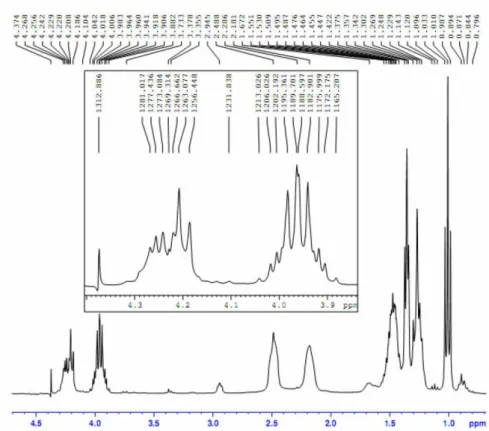
Figure S2. 1H NMR (300 MHz) spectrum of compound 6 in CDCl
3 expanded at 4.5-1.0ppm.
Meskini et al. S7 Vol. 21, No. 6, 2010
Figure S5. COSY of compound 6 in CDCl3.
An Eficient Protocol for Accessing β-Amino Dicarbonyl Compounds J. Braz. Chem. Soc.
S8
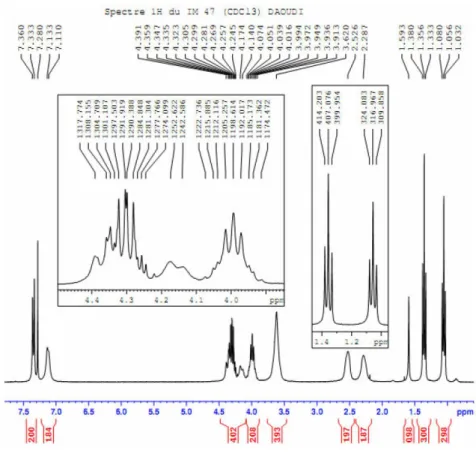
Figure S6. 1H NMR (300 MHz) spectrum of compound 7 in CDCl 3.
Meskini et al. S9 Vol. 21, No. 6, 2010
Figure S8. COSY of compound 7 in CDCl3.
An Eficient Protocol for Accessing β-Amino Dicarbonyl Compounds J. Braz. Chem. Soc.
S10
Figure S10. COSY of compound 7 in CDCl3.
Meskini et al. S11 Vol. 21, No. 6, 2010
Figure S13. COSY of compound 9 in CDCl3.
An Eficient Protocol for Accessing β-Amino Dicarbonyl Compounds J. Braz. Chem. Soc.
S12
Figure S14. 1H NMR (300 MHz) spectrum of compound 9 in CDCl
3 expanded at 4.5-1.0ppm.
Meskini et al. S13 Vol. 21, No. 6, 2010
Figure S17. COSY of compound 10 in CDCl3.
An Eficient Protocol for Accessing β-Amino Dicarbonyl Compounds J. Braz. Chem. Soc.
S14
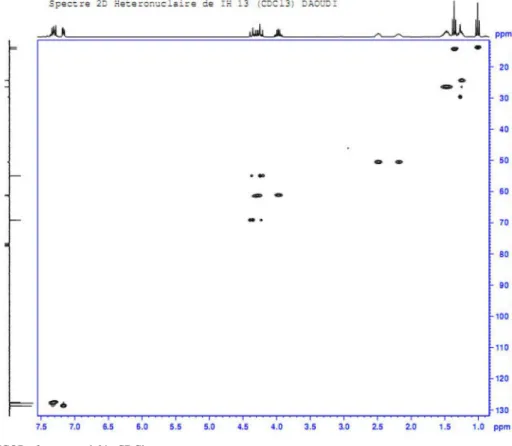
Figure S18. HETCOSY of compound 10 in CDCl3.
Meskini et al. S15 Vol. 21, No. 6, 2010
Figure S21. COSY of compound 11 in CDCl3.
An Eficient Protocol for Accessing β-Amino Dicarbonyl Compounds J. Braz. Chem. Soc.
S16
Figure S22. HETCOSY of compound 11 in CDCl3.
Meskini et al. S17 Vol. 21, No. 6, 2010
Figure S25. COSY of compound 12 in CDCl3.
An Eficient Protocol for Accessing β-Amino Dicarbonyl Compounds J. Braz. Chem. Soc.
S18
![Table S2. Torsion angles [deg] for (9)](https://thumb-eu.123doks.com/thumbv2/123dok_br/18994558.461785/12.892.94.827.138.371/table-s-torsion-angles-deg-for.webp)