2
Reflection as a Means to Develop
Young Learners’ Metacognition
Paula Joana Katchi Cravo
Março, 2017
Relatório de Estágio de Mestrado em Ensino de Inglês
no 1º Ciclo do Ensino Básico
Relatório de Estágio apresentado para cumprimento dos requisitos necessários à obtenção do grau de Mestre em Mestrado em ensino de inglês no 1º ciclo do
ensino básico realizado sob a orientação científica de Professora Doutora Carolyn Leslie e de Professor Doutor Carlos Ceia.
ii Dedicatória pessoal Ao meu marido e aos meus dois filhos com quem tanto partilhei o desenvolvimento deste estudo.
iii
ACKNOWLEDGMENTS
I thank Professora Doutora Sandie Mourão for opening the path towards the topic, in which I came to work upon, for my final report, I thank Dra. Gabriela Caetano for all her support and positive attitude during my practicum, as well as for her valuable help in data collection, and I thank deeply Professora Doutora Carolyn Leslie, who helped me sharpen the focus, enhance clarity and ultimately increase the usefulness of this paper. Last, but not least, I thank the children who participated in my study.
iv
REFLECTION AS A MEANS TO DEVELOP YOUNG LEARNERS’ METACOGNITION
PAULA JOANA KATCHI CRAVO
ABSTRACT
KEYWORDS: metacognitive awareness, cognitive awareness, self-awareness, reflection, teacher’s role, self-assessment, young learners
The present study conducted as part of the practicum during my master’s degree studies in teaching English at primary level aimed to explore two strands of the umbrella term, metacognitive awareness. These were self-awareness (Who am I as a language learner?) and cognitive awareness (Why and how do I learn a language?). Secondly, the study aimed to help understand the teacher’s role in fostering reflection and how reflection can support students’ learning. Finally, it attempted to recognize what adjustments in practical terms were needed for metacognitive awareness through reflection to occur in the lesson. The study was conducted during a 2 month period in the first term of the school year, and involved a group of 26 students aged 9-10 years old in year 4 at primary level. As research methodology, small scale classroom-based action research was used, which entailed a qualitative and quantitative approach to data collection. The data collection tools consisted of a teaching journal, questionnaires, teacher observation and a student’s self-assessment worksheet. As day-to day practice, strategic questioning was used. In addition, reflection upon the activities carried out in the lesson through the use of reflection cards was promoted at the end of the lesson and a reflective summary was written after acknowledging the contents covered in the lesson that had been presented in the beginning of each lesson. Results showed that over time, through reflection fostered by the teacher, more students were able to recognize their mistakes, share their learning strategies with their peers, and students were able to provide more reasons for the activities carried out in the classroom. In addition, they gave greater thought to what they learnt in English. The responses to the self-assessment worksheet at the end of the action research seemed to indicate students’ rigor in their self-assessment. Moreover, the study demonstrated that the teacher’s role is fundamental in promoting students’ reflective attitudes to understand who they are as language learners and why and how they learn a language. Raising students’ self-awareness remains however, an area for further research. Results of the study may encourage English teachers to implement regular use of reflection cards, reflective summaries and self-assessment worksheets as a means to promote young learners’ cognitive awareness.
v
A REFLEXÃO COMO UM MEIO PARA DESENVOLVER A METACOGNIÇÃO DE JOVENS APRENDENTES
PAULA JOANA KATCHI CRAVO
RESUMO
PALAVRAS-CHAVE: consciencialização metacognitiva, consciencialização cognitiva, auto-consciêncialização, reflexão, o papel do professor, auto-avaliação, jovem aprendente.
O presente estudo conduzido no âmbito de um estágio de ensino de inglês numa escola portuguesa no primeiro ciclo teve como objectivo a exploração de dois ramos do termo genérico metacognição: auto-consciencialização (Quem sou eu como aprendente de uma língua?), e consciencialização cognitiva (Porquê e como aprendo uma língua?). Em segundo lugar, o estudo teve como objectivo a compreensão do papel do professor no fomento da reflexão, e em que medida esta pode sustentar a aprendizagem dos alunos. Finalmente, teve como objectivo reconhecer os ajustes necessários em termos prácticos para que a consciencialização metacognitiva através da reflexão pudesse ocorrer durante as aulas. O estudo foi conduzido durante o período de cerca de dois meses no primeiro período escolar, e envolveu um grupo de 26 alunos com idades compreendidadas entre os 9 e os 10 anos no 4º ano no primeiro ciclo. Como metodologia de investigação, foi usada uma investigação de acção em pequena escala que implicou uma abordagem qualitativa e quantitativa na recolha de dados que consistiu num diário do professor, questionários, observação do professor e uma ficha de auto-avaliação para os alunos. Na práctica de ensino, foi usada a interrogação estratégica, a reflexão sobre as actividades levadas a cabo durante as aulas através do uso de cartões de reflexão foi promovida, e um sumário reflexivo foi escrito depois do reconhecimento dos conteúdos abordados na aula apresentados no princípio da lição. Os resultados mostraram que com o tempo, através da reflexão, um maior número de alunos foi capaz de reconhecer os seus erros, partilhar as suas estratégias de aprendizagem com os colegas e os alunos foram capazes de apresentar mais razões para a realização das actividades desenvolvidas em aula. Além disso, aprofundaram a sua reflexão relativamente ao que aprendiam em inglês. As respostas aos questionários de auto-avaliação no final na investigação de acção pareceu indicar rigor dos alunos na sua auto-avaliação. Adicionalmente, o estudo demonstrou que o papel do professor é fundamental na promoção de atitudes de reflexão nos alunos, de modo a que compreendam quem são como aprendentes de uma língua e porquê e como aprendem uma língua. A promoção de auto-consciencialização dos alunos permaneceu, no entanto, uma área de estudo a desevolver no futuro. Os resultados do estudo podem encorajar os professores de inglês a implementar o uso regular de cartões de reflexão, sumários reflexivos e fichas de auto-avaliação, como meio de promover a consciencialização cognitiva.
vi TABLE OF CONTENTS
Introduction ... 1
1.Background to the study ... 1
2.How did the idea originate? ... 1
3. Aims of the study ... 2
4. Purpose of the research ... 2
Chapter I: Literature review ... 3
I. 1. Introduction ... 3
I. 2. What is learning to learn?... 3
I. 3. What is learner autonomy? ... 4
I. 4. What is metacognitive awareness? ... 5
I. 5. Reflection as a learning strategy. What is the role of the teacher in fostering students’ reflection? ... 6
I. 6. Relevant empirical research related to the topic ... 7
I. 7. Summary ... 7
Chapter II: The action research ... 8
II.1.Context ... 8
II.2.Methodology ... 9
II. 2. 1. Ethical considerations ... 9
II. 2. 2. Distribution of the first questionnaire ... 9
II. 2. 3. My teaching journal ... 10
II. 2. 4. Strategic questioning ... 10
II. 2. 5. Use of reflection cards ... 11
II. 2. 6. Reflective summary ... 11
II. 2. 7. Use of teacher’s observation grid ... 11
II. 2. 8. Distribution of the second questionnaire ... 12
II. 2. 9. Use of self-assessment ... 12
II.3. Results ... 13
II. 3. 1. The first questionnaire: getting to know my students ... 13
II. 3. 2. Practices implemented in the classroom: strategic questioning, reflection cards, and reflective summary ... 15
II. 3. 2. 1. Strategic questioning ... 15
II. 3. 2. 2. Reflection cards ... 15
II. 3. 2. 3. Reflective summary ... 16
II. 3. 3. The use of teacher’s observation grid ... 17
II. 3. 4. The second questionnaire: developing students’ metacognitive awareness ... 17
vii
II. 3. 6. Summary of results and limitations of the study ... 23
chapter III: Discussion and conclusion ... 24
III. 1. Brief summary of research and reflecting on findings ... 24
III. 2. The importance of the action research for my own professional development 26 III. 3. How relevant might the results be for other young learner classrooms? What future research would relate to the present study? ... 26
III. 4. Final conclusion ... 27
References ... 28
Appendices ... 31
AppendixA: Letter of consent to parents ... 32
Appendix B: Mind-map to explain my study to children ... 32
Appendix C: Letter of consent to parents ... 32
Appendix D: The first questionnaire: getting to know my students ... 32
Appendix E: Reflection cards (reduced version) ... 32
Appendix F: Trainer's observation grid ... 32
Appendix G: The second questionnaire: develping students' metacognitive awareness ... 32
Appendix H: Self-assessment worksheet after oral task ... 32
1
Introduction
1. Background to the study
From an early age children are equipped with metacognitive knowledge. Wenden as cited in Cardenas (2009) defines metacognitive knowledge as “the knowledge about learning that learners of different ages and learning proficiency hold, and which influences how they face the language learning process and the expectations they have about the results of their efforts” (p.25).
Cardenas further suggests that success in language learning depends on students’ knowledge about their learning processes. However, the fact that metacognitive skills can be developed among young learners is often not taken into account (Ellis & Ibrahim, 2015). Cardenas (2009) suggests that learners need support in their conscious effort to develop their metacognitive knowledge. My study resulted from my ambition to exploit this area of knowledge to develop young learners’ metacognition through one of the metacognitive strategies to regulate learning identified by Ellis and Ibrahim (2015), which is reflection.
2. How did the idea originate?
In my teaching the intention to undertake a learner-centered approach to teaching aimed at fostering my students’ communicative skills, as well as their autonomy, led me to promote various activities such as those suggested by Read (2007) and Slattery and Willis (2001), which entailed encouraging my students to develop projects in group, fostering pair-share, playing games and doing oral presentations. Pair work and group work provide opportunities for students to use the language and to participate in lessons. In addition, games give added opportunities for learners to encounter the target vocabulary leading to better language learning (Read, 2007). However, I felt that this work did not fully benefit my students’ learning process, as they tended to overlook classroom rules, use L1 too often, and did not seem focused on the accomplishment of the tasks. Why? Was I abandoning my students in these tasks, by letting them work without enough guidance? Why did they not seem to take the activities seriously?
My concern led me to ponder how to best enhance the work carried out in class. The concept of metacognitive awareness shed light on my questions. I gained the belief that the work referred to above would be enhanced if students understood the reasons
2 underlying the activities, as to take the activities seriously, and not as a sort of a break, or a prize. In addition, I also came to understand that metacognitive awareness is inherent in the whole learning process. Thus, fostering my students’ metacognitive awareness explicitly would contribute towards helping my students understand who they are as learners, and why and how they learn a language, and ultimately fully benefit from all the work developed in the classroom.
3. Aims of the study
My aim was firstly to explore the two following strands of the umbrella term metacognitive awareness referred to by Ellis and Ibrahim (2015), which are, in my view, inter-related: self-awareness (Who am I as a language learner?) and cognitive awareness (Why and how do I learn a language? Secondly, it seemed vital to understand how teachers can foster reflection and how reflection can support students’ learning. Finally, it was important to recognise what adjustments in practical terms were needed for metacognitive awareness through reflection to take place in the classroom.
4. Purpose of the research
How can I raise two aspects of metacognitive awareness in my students, these being self-awareness and cognitive awareness through reflection? This became the research question of this study. In practical terms, through what means could I raise my students’ metacognitive awareness? Ellis and Ibrahim (2015) and Pinter (2006) suggest various ways to incorporate reflection in language lessons. Based on their practical suggestions, I developed my study as an English teacher trainee during my supervised practicum of twelve weeks with a group of 26 students in year 4 primary education who have English two hours a week as a curricular subject. The following chapter of this paper includes the literature review, which provides background information to support my study. Chapter II describes the action research and contains the context, methodology and results of the study and lastly chapter III summarises the findings of research questions, discusses results and presents the final conclusion of the study. It also discusses the importance of the action research for my own professional development and suggests future research that could relate to the present study.
3
Chapter I: Literature review
I. 1. Introduction
It is widely accepted that the new century brought changes in various areas such as social, economic and technological, and that children need to be equipped from an early age with the critical learning skills required to meet those changes. Over the last 30 years there has been a considerable growing body of literature related to the development of children as independent learners (Whitebread & Colman, 2007). According to Meyer (2010) independent learning is vital to the continuing development of high quality, lifelong learning, social equity, and cohesion in schools.
This review will focus on the understanding of four terms that are used, among others within the area of children’s development as independent learners, and their significance in relation to young learners’ language learning: learning to learn, learner autonomy, metacognitive awareness, and reflection, since these seem to share commonalities but differ in subtle aspects that will be shown later in this report. In addition, it will also address the roles of reflection as a means to develop young learners’ metacognitive awareness and of the teacher in promoting young learners’ metacognitive awareness through reflection. Lastly, it will address relevant empirical research related to the topic.
I. 2. What is learning to learn?
According to Ellis and Ibrahim (2015) learning to learn defined as “an umbrella term for a wide variety of activities designed to develop metacognitive awareness and learning strategies” (p.9) referred to as an aim of curricula throughout the world, and identified by the EU as one of eight key competences (Bostrom, 2012), has always remained under investigated. Thus, due to the lack of practical guidelines it has not been implemented by teachers. Pinter (2006) claims that the aim of fostering learning to
learn is to “raise children’s awareness of the various factors that influence their
language learning and to give them time and space to start to think for themselves” (p.99).
Ellis and Ibrahim (2015) address learning to learn at a practical level by providing activities and their underpinning pedagogical principles. Pinter, in line with Ellis and Ibrahim, also considers learning to learn in practical terms. She suggests that various aspects of learning to learn can be incorporated into the day-to-day practice in
4 the language classroom without changing usual practices. Furthermore, she claims that most of the suggested techniques and ideas provided with the aim of fostering learning
to learn principles can be adapted to all types of contexts, including large classes or
mixed ability classes. Also Moon (2008b) suggests a set of questions which learners should learn to ask themselves with the teacher’s help: How do I learn? What are my goals? How shall I manage my learning and how am I getting on? Read (2007, p. 286) suggests that the main aim of learning to learn at primary level is to “start children off on their own personal journey towards self-knowledge, self-reliance and independence in their learning”. The teacher’s role seems inherent to the concept.
I. 3. What is learner autonomy?
Learner autonomy, referred to as a buzz-word of the 1990s by Dam (2004, p.1) is used “to denote learners’ active involvement in and responsibility for their own learning process”, entailing therefore an ability and willingness to acquire knowledge independently, as well as in co-operation with peers, thus indicating social skills. Bergen as cited in Dam (2004) characterizes an autonomous learner as one who evolves “an awareness of the aims and processes of learning and is capable of the critical reflection which syllabuses and curricula frequently require but traditional pedagogical measures rarely achieve” (p.2).
The author suggests that methodology is the aspect to be considered. Dam (2004, pp. 4-6) recommends changes that would lead to students’ ability to take charge of their own learning and to a teacher/learner-directed learning environment. The changes suggested are a shift in focus from teaching to learning resulting in equal concern for both teachers and learners about “what to learn” and “how to learn, and a change in learner’s role, in which the learner gains ability to define his or her own objectives to choose relevant materials and activities, and to evaluate the outcome of learning. Other suggestions are a change in the teacher’s role leading to a shift from focus on teaching to focus on learning, and a change in the evaluation entailing answering questions such as “What am I /are you/are we doing?”, “Why am I /are you/are we doing?”, “What was good/bad? Why?”, and “What can it be used for?”. Lastly, Dam suggests that if the language classroom is considered a rich learning environment, it becomes a place where teachers and learner teach and learn from each other.
5 Dam suggests that the above changes are part of a slow and difficult process that requires effort on the part of teachers and learners in co-operation. Bajrami (2015) defines the process of becoming an autonomous learner as a dynamic one that entails the learner’s acquisition of learning strategies, that will enable him/her to gain understanding of how he/she learns, and ultimately control his/her way of learning. The literature review seems to indicate that learning to learn will lead to learner autonomy, with metacognitive awareness being the core part of the process.
I. 4. What is metacognitive awareness?
Metacognitive awareness is defined by Ellis and Ibrahim (2015) as the umbrella term that incorporates the following strands: self-awareness, language awareness, cognitive awareness, social awareness and intercultural awareness. What do they involve? Self-awareness refers to knowing about oneself as a language learner, language awareness entails knowing about language, cognitive awareness entails knowing about the processes of language learning, social awareness involves knowing about collaborative learning techniques, and lastly cultural awareness relates to knowing about cultural similarities and differences. In this review I will refer to two of the strands in further detail, which are self-awareness and cognitive awareness.
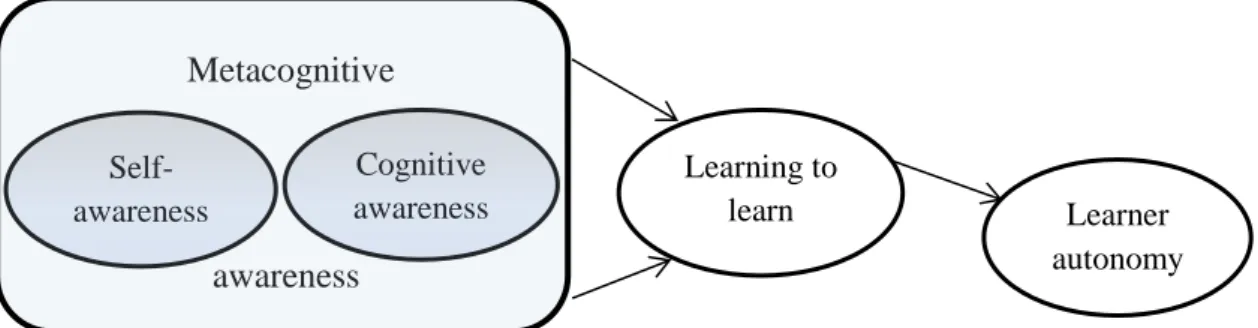
Self-awareness, according to Ellis and Ibrahim (2015), entails children’s better understanding of themselves as language learners; thus their awareness of their preferences, their understanding of what affects their motivation and their ability to set and meet individual goals. Cognitive awareness is defined by Ellis and Ibrahim (2015) as what helps children understand why and how they are learning a language. This involves explaining to the children how they are going to learn the target language in class, the type of materials they are going to use and the activities they are going to do. In addition, it entails getting learners to think about how they learn, that is, which strategies they use to help them remember, to concentrate and pay attention. Lastly, cognitive awareness develops students’ ability to recognize how and when to review, how to monitor their learning and what they need to do next. Cardenas (2009) suggests that success in language learning depends on the extent to which learners are aware of and knowledgeable about their learning processes. However, learners’ need for guidance is necessary, as metacognitive awareness is not innate but it must be taught, as pointed by Masouleh and Jooneghani (2012). To sum up, metacognitive awareness encourages learning to learn, which leads to learner autonomy (Figure1).
6
Metacognitive
awareness
Figure 1. Relationship between metacognitive awareness and learner autonomy.
In other words, metacognitive awareness is the core element for students to learn to learn and by learning to learn students become increasingly more autonomous.
I. 5. Reflection as a learning strategy. What is the role of the teacher in fostering students’ reflection?
Learning strategies are defined by Cardenas (2009) as “all the tactics employed by the learner to facilitate the acquisition of a second language” (p.43). It is commonly accepted that learning strategies include metacognitive strategies, which are used to regulate learning. Reflection is one of the metacognitive strategies. Reflective thinking is, according to Dewey as cited in Hazari (2014) a thought that entails a “conscious, thoughtful and a voluntary effort” (p.11).
Pinter (2006) advocates the introduction of activities in the classroom that include “encouraging children to think about what they did well and why, and what they enjoyed and why” (p.100). Moreover, Pinter suggests that ongoing reflection boosts students’ ability to think about the reasons for doing various activities and tasks and about lessons that can be learnt from each learning experience. The same author suggests that reflection is a “natural part of effective learning” (p.100) and it can follow individual activities, tasks, lessons, or can be used at the end of term or end of year. Learners can be encouraged, for example, to reflect on why and how well they interacted, whether they contributed fully, or whether they listened to their peer.
The teacher’s role is therefore considered essential in the implementation of reflection in the classroom. Hazari (2004) suggests that “children cannot reflect on their own. Thus, the role of the teacher in promoting the reflective attitudes of children is unavoidable” (p. 20). Ellis and Ibrahim (2015) offer some guidelines in order to encourage active reflection among learners. Among others, the authors suggest firstly ask questions in a clear, directed manner, using child-friendly vocabulary that encourage students to think, and trigger questions. Secondly, they suggest teachers give the learner time to think, share ideas with a peer and then discuss in a wider group or in
Learning to learn Learner autonomy Self-awareness Cognitive awareness
7 the whole class. Thirdly, the authors suggest teachers give students two minutes to write three things they remember about something learnt in class, and fourthly, get the learners to explain how to do an activity to their peers. Ellis and Ibrahim suggest that questions such as these offer a link between teaching and learning.
I. 6. Relevant empirical research related to the topic
A small-scale study on implementing metacognitive strategies for students of English aged 10 to 12 years old as a foreign language was carried out by Hazari (2014). Four Iranian learners participated in four sessions over a total of eight hours that consisted of three stages: planning, monitoring and evaluating learning tasks. The results showed that learners developed an explicit awareness of the reflective process, and demonstrated knowledge of self-evaluation, some signs of self-regulated behaviour and interest in the project. However, there were limitations of the study, which included the small sample of participants and the reduced time. Another relevant study aimed to compare students’ learning styles profiles and their estimation of how they thought they learnt. It was carried out in Sweden, it involved 56 ten-year old students of English and the methodology entailed the use of the Learning Styles Inventory, oral estimates of students’ learning styles preferences and interviews. Results showed a clear discrepancy between the students’ learning styles profiles and their estimation of how they thought they learnt, which may indicate that students’ knowledge about themselves as language learners may bring forth contradictions.
I. 7. Summary
Fostering students’ metacognitive awareness is relevant, since it contributes towards helping them to get involved in their own learning processes. The definitions of the terms provided in this section seem to indicate that they are intertwined. In fact, metacognitive awareness, learning to learn, learner autonomy and reflection are not independent within the area of language learning. The need to guide students, and the consequent primordial role attributed to the teacher seem to be the most striking commonalities among the terms defined. Keywords in this study are metacognitive awareness which entails, as Cardenas (2009) suggests, learners being more aware of metacognitive knowledge through a conscious effort, and reflection, which serves as a means to enhance metacognitive awareness. Research mentioned above demonstrated that learners guided by the teacher grew awareness of the reflective cycle and increased efficiency in the tasks developed.
8
Chapter II: The Action research
II. 1. Context
The participants in this study were a group of 26 fourth year-students from a private school in the outskirts of Lisbon, aged between nine and ten years old. The number of boys and girls was balanced and there were no students with special educational needs. All students were native speakers of Portuguese and were learning English as their only second language. One of them had lived in an English speaking country for two years. They had two hours of English a week divided into two lessons: one of 45 minutes; and the other of 75 minutes. Most participants had been learning English since pre-school. 1st cycle students started school at 8:30 and finished at 16:15.
The course book together with the workbook adopted in 4th grade was Backpack
Gold 3 (Herrera & Pinklev, 2014b) as a continuation of the use of Backpack Gold 2
(Herrera, Pinklev: 2013a). During the lessons the digital versions of the books were displayed on the interactive board. Some of the topics that are part of the Metas
Curriculares de Inglês 1º ciclo1 (Bravo, Cravo & Duarte, 2015) are not covered in the course book adopted. It was thus necessary to supplement the book with material produced or adapted from various sources. On the other hand, the course book includes grammar topics that are not part of the Metas Curriculares de Inglês 1º ciclo.
Priority was given to the development of listening and speaking skills in the official document mentioned. Accordingly, classroom activities were guided by the communicative approach, which entailed fostering of real and meaningful communication, for example, learners finding out personal information about their peers through asking questions.
The school, located in a prosperous neighborhood, is run by Dominican sisters, and ensures parallel teaching with state schooling. Religious values alongside value of work and discipline are part of the school’s ethos and are revealed not only in the tight discipline kept in the classrooms, but also in the long and spotless corridors of the school, where passersby come across well-organized quiet queues of students in their school uniform leaving or entering their classrooms.
1 The Metas Curriculares de Inglês 1º ciclo is the official document that establishes the goals for each
language skill: listening, spoken interaction, spoken production, reading, writing, and for the vocabulary and grammar, and lastly, for the intercultural domain. It came into force in 2015-16 for the 3rd year, and in 2016-17 for 4th year, when English became part of the Portuguese National curriculum.
9
II. 2. Methodology
As research methodology, small scale classroom-based action research was used, which entailed a qualitative and quantitative approach to data collection. It consisted of the following (Table 1):
Table 1
Stages, Procedures and Tools in Action Research
1. Planning
September Identification of the problem (see introduction) 2. Action
October &
Use of the first questionnaire after consent was granted, use of teaching journal, strategic questioning, reflection cards, reflective summaries, teacher’s observation grid, the second questionnaire, and a self-assessment.
3. Observation October-December
4. Reflection January
Analysis of data expressed as percentages and reflection on the results (see section 3 of the present chapter)
Note. (Adapted from Burns, 2010, p. 8.)
Through the implementation of the action research referred to above, incorporated into the day-to-day practice in the language classroom, I hoped to foster my students’ metacognitive awareness through reflection.
II. 2. 1. Ethical considerations
Prior to my action the consent letters from the school’s director, and then from the students’ parents (Appendix A) were collected. Secondly, I explained the aims of my study and the tools I would use to collect data to the students. Turek (2013) suggests that in order to engage young learners as active participants, “the researcher should provide meaningful, comprehensive information about the study” (p.9). Thus, I used a mind map that included the image of Homer Simpson, which is familiar and appealing to children, and child friendly words (Appendix B) as visual aids to explain my study. I then asked their consent using the consent letter (Appendix C). The content of the letter followed the guideline given by Leslie and Mourão (personal communication September 23, 2016). Among other indications, it was made simple for the child to understand, brief, and it referred to parents’ previous permission to participate in the study.
II. 2. 2. Distribution of the first questionnaire
In early October The first questionnaire: getting to know my students (Appendix D) was distributed. It included open questions, which as suggested by Bryman (2008)
10 has the advantage of revealing respondents’ levels of knowledge and understanding of issues, as the questions do not suggest any kind of answers. The analysis required the identification of patterns in students’ responses followed by categorization. In addition, closed questions, were included. Results of both open and closed questions were expressed as a percentage. My aim was to understand learners’ motivation to learn English, students’ awareness of their own ability to improve their English and their expectations as English learners. Within the scope of my research, the aforementioned aims relate to knowing “Who am I as a learner?” and “Why and how do I learn?” which are self-awareness and cognitive awareness respectively, two strands of the umbrella term of metacognitive awareness.
II. 2. 3. My teaching journal
I used qualitative data from my teaching journal developed with regular entries. Moon (2006a) suggests that reflective writing in the academic context is
likely to involve a conscious and stated purpose for the reflection, with an outcome specified in terms of learning, action or clarification. It may be preceded by a description of the purpose and /or the subject matter of the reflection (pp.37-38).
Likewise, pertinent questions, responses or comments from students that occurred during the lessons were registered during the lessons. My reflections in the journal are presented as quotes related to my observations.In addition, the journal also included records of strategic questioning that I implemented in my lessons. Nunan (2001) advocates for the use of teaching journals in language learning research claiming that journal entries “provide insights into processes of learning which would be difficult, if not impossible, to obtain in any other way” (p.123).
II. 2. 4. Strategic questioning
In order to guide my students in their reflection, I used regular strategic questioning, such as: “Why are we going to play this game?”, or “Why did we watch this video?”. Thestudents were encouraged to explain why activities were done before starting, or after finishing them, through strategic questioning. That is, clear and straightforward questions were posed. Strategic questioning during the lessons was a means to foster reflection among learnersand to help them to become more aware of the different ways they learnt English. Also, in the use of reflection cards, and in the writing
11 of reflective summaries strategic questioning by the teacher played an important role, as will be discussed later.
II. 2. 5. Use of reflection cards
In order to foster my students’ acknowledgment of the activities that had been carried out in the lesson, I used reflection cards (Appendix E) on a regular basis. Reflection cards, as suggested by Dias and Mourão (2005), were used (Appendix E) at the end of each lesson. The displaying of the cards went along with questions aimed at knowing if students had spoken English during the lesson, listened to music, read in English, written in English, played games, done anything creative, worked in pairs or in group, learnt and remembered new words, and what students liked best in the lesson. I believe this use of reflection cards was central in the action part of action research as it was a means “to intervene in a deliberate way in the problematic situation in order to bring about changes and even better, improvements in practice” (Burns, 2010, p.2). In each lesson some cards from the set were selected and students were asked questions (Appendix E) aimed at helping them recognize the activities that had been carried out, while my trainer registered their responses as a means to collect data which was then expressed as a percentage.
II. 2. 6. Reflective Summary
At the beginning of each lesson I wrote the contents to be taught on the interactive board to help students focus on the activities to be developed in the lesson. At the end of each lesson, as a substitution for the normal summary, in which students copy the summary written by the teacher, I showed the contents presented at the beginning of the lesson and I asked the students whether we had covered each topic. The contents covered were ticked, and the topics not covered were erased and the students copied the items ticked into their notebooks, which then became their summary. In this procedure students were given the opportunity to reflect on the work developed in the classroom. Moreover, in this way, and as a complement to the reflection cards, I had the opportunity to help my students rethink, through strategic questioning, any misunderstandings that had occurred during the use of reflection cards.
II. 2. 7. Use of teacher’s observation grid
Over 7 lessons (31st October to 7th December), my contribution in fostering students’ metacognitive awareness was observed by my trainer, who used a checklist
12 during the observation, which was the Teacher’s observation grid (Appendix F). Richards and Farrell, as cited in Day (2013) suggest that peer observation in pre-service teacher training helps “teachers become more aware of the issues they confront and how they can be resolved” (p.2). Moreover, peer observation is, according to Day, aligned with reflection. Thus, the analysis of the checklist, based on the occurrences expressed as percentages, helped me to evaluate my role in encouraging students to express their learning preferences, to think about what they learnt, to think why they were learning a certain area of vocabulary, and to share their learning strategies with their peers. In addition, it also helped me to understand my role in helping students to recognize their mistakes, to understand the reasons why activities were done, and to understand the importance of reflection. Lastly, it helped me in my role in fostering students’ self-assessment.
II. 2. 8. Distribution of the second questionnaire
In the middle of November The second questionnaire: developing students’
metacognitive awareness, which included open and closed questions (Appendix G) was
distributed to students. This tool gave me insights into learners’ preferences regarding language skills, their belief about their ability to recognize mistakes, and their perception about the aims underlying the various activities done in class, for example, playing games. In addition, this tool clarified if they thought about English outside the English lesson, their strategies to remember the English words and whether they shared the strategies with their peers. The open questions were analysed for patterns, and then expressed as percentages and the closed questions were quantified and expressed as percentages. The same questionnaire was distributed in the middle of December to compare results.
II. 2. 9. Use of self-assessment
In December the Self-assessment worksheet after oral task (Appendix H) which included closed questions as a follow-up to a task consisting of interaction in pairs was given to students. This tool involved learners directly in the assessment process, as they were encouraged to reflect upon their own progress (Hedge, 2004). It also served as a research tool to understand students’ own participation in their self-assessment. They were encouraged to reflect, among other, if they had listened to their peer attentively, if they had always asked the questions in English, if they had always answered in English,
13 if they had helped their peer to say the sentence in English, and if they had spoken correctly. Data was analysed and the results were expressed as a percentage.
II. 3. Results
This part of the work aims to present the results of my action research, aimed to raise my students’ metacognitive awareness. Various research tools were used and are presented in different sections. These were first of all the first questionnaire, aimed at getting to know my students at the beginning of my action research cycle, followed by strategic questioning, reflection cards and the reflective summary that were included in the classroom practices. In addition, I used the teacher’s observation grid, the teaching journal and the second questionnaire aimed at developing students’ metacognitive awareness and verifying students’ progress: Lastly, I used a self-assessment worksheet that followed an oral task.
II. 3. 1. The first questionnaire: getting to know my students
As an initial stage of enquiry and before any intervention on my part, it was important to understand students’ motivation in learning English, their awareness of the learning process, and their expectations as learners. For that I distributed the first questionnaire (Appendix D).
As shown in Table 2 (question 1) 54 % of the students felt motivated to learn English, in contrast to the low percentage of students, represented by one single student who did not like learning English. However, the percentage of students who were indifferent about learning English was still 31%, and this result was surprising if we take into account that English teaching at primary level aims to be fun.
When asked why they needed to learn English (question 6) 92 % of students’ answers related to its importance in their future, revealing an extrinsic motivation, whereas 80 % demonstrated an intrinsic motivation in learning English. Still the results indicated that half of the students were strongly influenced by their parents as they learned English because their parents wanted them to. This number could eventually relate to the percentage of students who felt indifferent about English learning, referred to above because 4th
grade learners learning English is nowadays the result of the implementation of English in the Portuguese curricula by the Portuguese government, and not their choice.
14 Table 2
Getting to Know My Students
⃰Note. The percentage refers to the students who answered both questions affirmatively.
N. A. = Not Applicable
An important element of students knowing about themselves as learners is, I believe, their perception of their own expectations with regard to learning (question7). 89 % of students indicated they believed they were going to improve their English because they were going to work hard, followed by 46% who believed their improvement would result from their own aptitude to learn English. Interestingly, 67% associated these two conditions that seem ideal in language learners, which are willingness to work and aptitude. Table 2 (question 5) also shows that 89% of the students were going to study with an adult, which could indicate some lack of autonomy by the participants. Questions Answers by students % Yes No So, so Not valid Can choose only one answer
1. I like learning English 54 4 31 12
2. I can understand what I should study to improve my English 65 35 N.A. 0
3. I know how I'm going to improve my results in English 69 31 N.A. 0
4. I'm going to learn English
quickly with little work 8 58 N.A 35
slowly with little work 8 58 N.A 35
quickly with much work 15 50 N.A 35
slowly with much work 35 31 N.A 35
Can choose more than one answer
5. I'm going to study English
on my own 42 50 N.A. 8
with a friend 50 85 N.A. 8
with an adult 89 12 N.A. 0
6. I need to learn English because
my parents want me to 50 0 N.A. 0
I want to 81 0 N.A. 0
It's going to be important when I grow up
92 0 N.A. 0
7. I know I'm going to improve my English because
I'm going to work hard 89 8 N.A. 4
67⃰
15 Students’ expectations with regard to learning seem, in my opinion, to relate the two strands of metacognitive awareness exploited in this study, which are self-awareness and cognitive self-awareness. This connection results from a combination of students’ knowledge about themselves (Who am I as a learner?), namely their ability to study, and their own aptitude to learn English and their acknowledgment of their need to study (How do I learn a language?).Students’ responses to question 4 were confusing as most of them chose more than one answer. As results are ambiguous they will not be further discussed.
II. 3. 2. Practices implemented in the classroom: strategic questioning, reflection cards, and reflective summary
How do we learn a language? In the present section the outcomes from activities that promoted reflection on the various ways my students learnt English are discussed. The practices implemented in the classroom were strategic questioning, use of reflection cards and the writing of a reflective summary at the end of the lesson.
II. 3. 2. 1. Strategic questioning
Strategic questioning during the lessons was a means to foster reflection among learners. For example, I asked them in English: “Why do you think we did peer correction?” to which different answers were given by different students in L1:
“Porque é divertido!” [Because it’s fun] (Student A).
“Porque percebemos os erros dos outros!” [Because we understand other’s
mistakes!] (Student B).
“Porque nos ajuda na escrita inglesa!” [Because it helps us to write in
English] (Student C).
(Teaching journal, 29 September, 2016). Strategic questioning was also used with the reflection cards and in the writing of reflective summaries.
II. 3. 2. 2. Reflection cards
The use of reflection cards (Appendix E) became part of our lesson routine and with time it was welcomed by all the participants. The results show (Table 3) however, that at times 100 % of students wrongly acknowledged the aims of the activities done in class. The students’ misunderstandings involved mainly speaking, writing and reading activities.
16 Table 3
Use of Reflection Cards: Samples of Wrong Answers Given by Students
In fact, students’ misunderstandings due to their misconceptions of what “speaking”, or “writing”, or “reading” really means, made me acknowledge my role in guiding my students in their reflection. Helping students to understand what skill was developed in the different activities entailed, first of all understanding their perceptions. For example, simply copying the date for a young learner can mean “written work”.
Then strategic use of questioning in order to lead them to acknowledge the work done was needed. Strategic questioning was: “What have we written?”, “Did you have to think in order to write?” Also speaking was misinterpreted by students: “Some students mentioned they said the date and the lesson number, and they considered them speaking activities” (Teaching journal, 19 October, 2016). My role as a guide in students’ reflection was thus most relevant:
(…) we did our reflection time. Students raised their hands when they were asked if we had spoken in class and I helped them to acknowledge what spoken activities meant, and that in fact there hadn’t been any spoken activities in the lesson. (Teaching journal, 27 November, 2016)
My own involvement through direct and clear questions successfully helped my students to think about the activities that had been carried out and ultimately helped them to recognize how they learnt English.
II. 3. 2. 3. Reflective summary
Through the implementation of the reflective summaries, I had the opportunity to help my students to better understand the activities carried out in the lesson, and the language skills developed.
I felt that the writing of the summary, which was done by acknowledging what work was done in class was a good opportunity to help students to acknowledge that in fact no written or reading activities had been done in class. (Teaching journal, 15 October, 2016).
Wrong answers Students (%) Dates of occurrences
in speaking 100 21/11
in writing 65 28/09
17 Students needed my help to gain understanding about what skills were worked on in each activity developed in the lesson.
II. 3. 3. The use of teacher’s observation grid
During lessons it was my concern to regularly encourage students to reflect. In order to understand my own performance in this task, I asked my trainer to observe my practice and fill in an observation grid (Appendix F).
Paula’s Role in Fostering Students’ Reflection
What Paula does in class: occurrences over seven lessons (% of strategic questions)
1. encourages sts to express their learning preferences. 14
2. helps sts to recognize their mistakes. 57
3. explains sts the reason why activities are done beforehand. 71
4. asks sts the reason why activities are done. 71
5. explains why materials are going to be used the activity beforehand. 71
6. asks students what materials have been used for the activity. 0
7. encourages sts to think about what they learn. 86
8. encourages sts to think why they are learning a certain area of vocabulary. 43
9. encourages sts to recognize which strategies they use to help them
remember, concentrate and pay attention.
43
10. encourages sts to share their learning strategies with their peers. 14
11. reminds sts of the importance of reflection. 57
12. fosters self-assessment in class. 86 The results from the observations carried out in seven lessons from the end of October to the beginning of December are presented on Table 4. It shows that I was able to consistently foster self-assessment (question 12), encourage students to think about what they learned (question 7) and encourage students to say why activities were done (question 4). However, it also shows that my encouragement of students to share their learning strategies with their peers (question 10) and to express their learning preferences (question 1) were scarce, which revealed areas for future research.
Lastly, it is shown (question 6) that I did not ask students what materials were used for the activities, as I soon realized that such a question would not challenge 9-year-old students.
II. 3. 4. The second questionnaire: developing students’ metacognitive awareness
The second questionnaire (Appendix G) was distributed on 17th November to 26 participants, and repeated on 12th December to 25 participants. Table 5 shows results that refer to self-awareness: Who am I as a learner? And tables 6 to 8 show results that refer to metacognitive awareness: How and why do I learn a language?
18 Table 5
How do Learners Prefer Learning English?
Table 5 shows the preferences of skills pointed out by the group of participants. If we compare the results from the two different stages, the preference for listening was the one which varied less, in contrast to the written skill where results varied greatly. Less than a month later the preference for writing had decreased by 20 %. I attribute the referred decreased to the increased spread in preferences of all skills that is shown. The most surprising result was that the number of students who stated that they did not know what skill they preferred more than doubled. The result could indicate students’ intensified exposure to all skills and consequent indecision about their preferences.
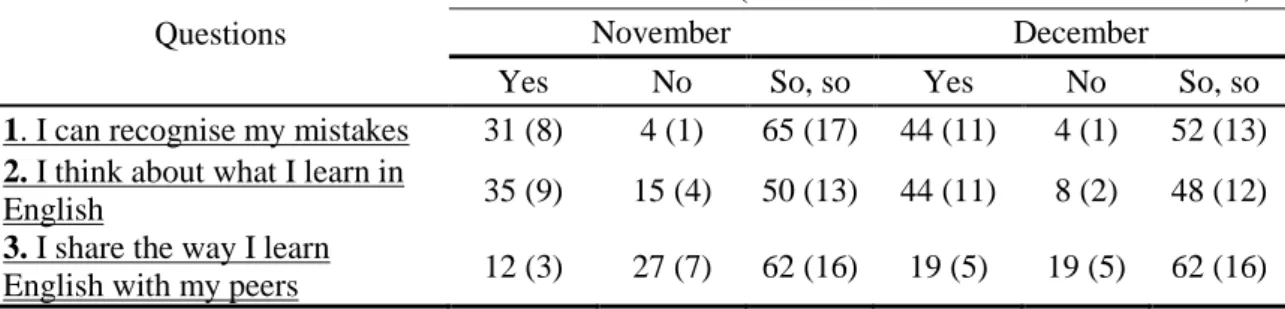
Particularly challenging for young learners is their ability to recognize their mistakes. In an initial stage of the action research, results from a closed questionnaire (Table 6, question 1) demonstrated that 8 students (equivalent to 31 % affirmed that they were able to recognize their mistakes, in contrast to the majority of students who felt uncertain. Later there was an increase in the number of students affirming that they were able to recognize their mistakes. Although the number of students who affirmed not to be able to recognize their mistakes did not alter, the number of students who felt uncertain increased significantly.
Table 6
Thinking about Language Leaning
2 stages of action research
Preferred skills by students (%)
listening speaking reading writing all skills I don't know
November 17 8 8 28 31 8
December 20 17 17 7 24 15
Questions
Students’ answers (% and number of students in brackets)
November December
Yes No So, so Yes No So, so
1. I can recognise my mistakes 31 (8) 4 (1) 65 (17) 44 (11) 4 (1) 52 (13) 2. I think about what I learn in
English 35 (9) 15 (4) 50 (13) 44 (11) 8 (2) 48 (12) 3. I share the way I learn
19 In all, it seems that students were becoming more aware of their own mistakes (question 1). It is also shown in Table 6 that the percentage of learners who affirmed that they thought about what they learnt in English increased and the number of students who affirmed that they did not think about what they learnt decreased by nearly half (question 2). It is also shown that 7 students (equivalent to 27% of students) affirmed that they did not share their learning strategies in November. This number decreased a month later (question 3). However, the number of students who affirmed sharing their ways of learning remained still low. To sum up, the results seem to indicate that students were giving greater thought to their learning process by the end of the action research.
Learning awareness relates to knowing the reasons for doing activities carried out in the lesson. Table 7 shows the results provided from the open questions. It is shown that 20% of the reasons given by the students for the activities done in class at the second stage were new, which could indicate increased awareness. Interestingly, a significant percentage of students in December pointed out learning from peers (questions 1 and 2) as a new reason of working in pairs or in groups, acknowledging therefore that they do not only learn from the teacher, but also from their peers. Also, table 7 (question 2) shows that 12 % of students believed they learnt better when they work collaboratively, revealing thus increased self-awareness.
The majority of students pointed out that they were taught what the words meant and how they were pronounced before writing them (question 3) because they would know the meanings of the words. Also, there were a considerable number of students who understood that they would say the words correctly before trying to read them. I attribute this result to the strategic questioning regularly carried out in class.
20 Table 7
Students’ Reasons for Doing Things in the Classroom
The results mentioned are in line with the goals established by the Metas de
Aprendizagem do Inglês, 1º ciclo, which focus primarily on listening and speaking
skills. In general, the number of students who did not know how to answer the questions decreased (question 3), if we compare the two stages of the action research. These results are attributed, I believe, to the regular reflection fostered in class.
Table 8 shows that almost a quarter of the students asked their relatives’ help in the process of remembering the words in English in November and that this number significantly decreased in December (question 2), although a considerable percentage of
Questions and answers Students’ answers (%) November December
1. We play games in the English lesson...
To learn 46 28
To learn and to have fun 35 32
To have fun 4 4
To interact 8 8
To help memorize 4 -
I don't know 4 8
To learn from peers - 8
To do something different - 12
2. We work in pairs because...
I don't know 23 8
It's a different way of learning 4 -
It's fun 8 -
We learn together 65 -
We learn from peers - 28
We interact - 8
We learn better - 12
It's a good way to learn - 4
It's a different way of learning - 8
Unclear answers - 8
3. We learn the words before we write them because...
I don't know 12 8
To know the words - 8
To be able to say them correctly 8 25
To be able to read them 14 -
To know their meanings 42 46
Unclear 23 -
21 students were unable to answer the question in both stages of the action research (question1). A significant number of students claimed that they “thought” about the words in November (question 4).
Table 8
What Students do to Remember Words in English
It seems pertinent to question if the students who “think” in order to remember, also read and/ or write, as thinking seems to require a support. If so, the number of students who read or read and write rises significantly from 50 % to 66% in November, whereas in December the same strategies represent 46 % (questions 4, 5 and 6). We could then hypothesize that the most traditional methods, such as reading and writing were the ones adopted by a vast number of students in November and that in a later stage other learning strategies started being adopted, such as oral practice and thinking about the games that took place in the classroom (questions 7 and 8). The number of students who compared L1 to L2 as a learning strategy was low in both stages (question 3). This could indicate that the use of translation from Portuguese to English was reduced.
As part of the routine during my teaching I used reflection cards at the end of each lesson. From the set of cards (Appendix E) I randomly picked some of them to use and it was my concern to include some cards and ask some questions even when I expected the answer to be “No”. As shown in Table 9, there is a striking change in students’ perception for the reasons underlying the use of reflection cards. In the first stage students believed that the aim of this activity was teacher assessment (questions 1-4).
In order to remember the words in English I…
Students’ answers (%)
November December
1. don't know/ unclear answers 23 21
2. ask relatives' help 23 4
3. compare L1 to L2 8 4
4. think 15 0
5. read 15 21
6. write and read 15 25
7. practise the words orally 0 21
22 Table 9
Use of the Reflection Cards at the End of the Lesson
In contrast, on the second stage results show that students believed that the aim of this activity was self-assessment (questions 5-7). This result is encouraging for teachers who intend to promote self-assessment through the use of reflective cards, as their use was accepted by the vast majority of students as a means for self-assessment. However, their use with the purpose of raising cognitive awareness entails guidance from the teacher.
II. 3. 5. Students’ self-assessment worksheet after oral task
Students’ self-assessment is a means of helping students reflect on their learning process. Oral interactions held in a class of twenty or more students are difficult for the teacher to monitor. Thus, self-assessment (Appendix H) as a regular follow-up to oral interaction, may contribute to students’ motivation to do well.
Table 10
Self-assessment after an Oral Task
How did I do in my interaction? Students’ answers (%)
Yes So, so No Unclear
1. I listened attentively to my peer 85 15 0 0
2. I always asked the questions in English 62 35 0 4
3. I always answered in English 58 42 0 0
4. I helped my peer saying the sentence in English 54 42 0 4
5. I helped my peer to understand the sentence in English 58 31 8 4
6. I enjoyed speaking English 85 15 0 0
7. I spoke well 46 54 0 0
At the end of the lesson Paula asks us what we did during the lesson. Why?
Students’ answers (%) November December
Teacher’s assessment
1. She wants to know if we were attentive in class 18 8
2. She wants us to understand what we did in the lesson 23 -
3. She wants us to train our memory 18 8
4. She wants to check whether we remember things 32 -
Self-assessment
5. For us to remember what we did in class - 52
6. For us and Paula to remember what we did - 4
7. For us to reflect - 8
23 Table 10 shows that over 80 % of the students stated that they enjoyed speaking English (question 1) and that they listened attentively to their peers (question 6). It also showed that over 50% of the students stated that they had always asked the questions in English (question 2). None of the students stated having spoken incorrectly (question 7), and almost half of the students seemed confident that they had spoken well. The balanced results seem to indicate students’ rigor in their self-assessment and ability to develop self-regulation.
II. 3. 6. Summary of results and limitations of the study
Results show that through the introduction of regular strategic questioning, reflective cards and reflexive summaries in the classroom, as well as through the use of the questionnaires, and self-assessment, the group of 26 participants was intensively encouraged to reflect upon the way they learnt English, but less focus was given on getting students to know about themselves as learners. It is shown that in general students responded well to the activities proposed. The answers to the questionnaires showed that students became more thoughtful about their learning, and more aware about the reasons underlying certain activities carried out in the lesson. Furthermore, results triggered by the students’ misunderstanding of what certain activities really mean, confirmed that teacher’s crucial role in guiding young learners in their reflections.
One limitation of this study was time. The two- month period, in which the action research was developed, was too short to implement more cycles of action research. A longer period of intervention would have allowed me to develop my study to related areas, namely the development of students’ self-awareness through reflection, which was part of my plan. As the present study was action research, the results presented cannot be extrapolated to other classes.
24
CHAPTER III: DISCUSSION AND CONCLUSION
III. 1. Brief summary of research and reflecting on findings
Who am I as a learner? Why and how do I learn a language? My action-research,
which involved a group of 26 students aged 9-10 years old in year 4 at primary level started in October and finished in December and aimed to raise my students’ metacognitive skills through reflection. As research tools for my study I used a teaching journal, questionnaires with open and closed questions, self-assessment, and a grid where my trainer registered my students’ responses to reflection cards as a means to collect data followed by the necessary analysis and reflection.
As day-to day practice, I fostered my students’ reflection upon the activities carried out in the lesson through the use of strategic questioning during the lessons, and reflection cards at the end of the lesson. In addition, a reflective summary was written by the students after acknowledging the contents that had been presented at the beginning of the lesson. Over time, I sensed that students were increasingly more aware about why activities were carried out in the lesson. That is, I recognized an increase of my students’ cognitive awareness:
Interactions in pairs or in groups regularly came as a novelty among these students (…). Nowadays, they are totally familiar with these interactions; they quickly organize themselves, they respect the rules, they enjoy doing these activities and in general they understand the reason why we do them, as they stated in their learning assessment sheet (Teaching journal, 3 December 2016). However, contrary to my belief that raising my students’ ability to know about their learning preferences, for example, would be combined with raising their cognitive awareness, practice made me believe that in fact, raising my students’ cognitive awareness precedes self-awareness. That is, I suggest that only when they understand
how they learn, can they fully understand how they enjoy learning. Furthermore, results
displayed in the previous section showed that the number of learners who responded that they did not know what skills they preferred in the second stage of the action research increased contrary to my expectations, which can mean that by the end of the action research students may have given deeper thought to the questions posed which may have made them confused.
25 With regard to cognitive awareness, a greater variety of results were seen in the second stage of the research and in general they are encouraging. That is, in the second stage of the action research numbers indicated that more students were able to recognize their mistakes, thought about what they learnt in English and shared the way they learnt English with their peers. The number of answers to open questions that justified the activities carried out in the lessons, which refer to how students learnt a language, increased. The results described confirmed that my role as a teacher was fundamental in fostering and guiding students through strategic questioning and the use of reflection cards. In fact, students needed guidance while they were getting familiar with the activity. Bruner’s theory of scaffolding explains that:
when children start to learn new concepts, they need help from teachers and other adults in the form of active support, but as they become more independent in their thinking and acquire new skills, and knowledge, the support can be gradually faded (Bruner as cited in Wheeler 2014).
In fact, over time students gained some autonomy in their reflections:
As part of the routine we did our reflection using some of my reflection cards. I feel that the students are now very familiar with this activity and are increasingly more seriously involved in this activity being increasingly more able to identify the activities developed in class. They can even reveal disappointment: when I asked if we had worked in pairs or in groups, the students answered with a strong “No!” (Teaching journal, 6 November, 2016).
Students’ “strong no” could indicate their understanding about their own preference to working in group in language learning. If so, understanding how a language was learnt through group work may have led to increased self-awareness.
No discussion about why students learnt English took place in the lesson, as despite the surprising number of students who felt indifferent in relation to English learning revealed in the analysis of the first questionnaire, they showed motivation to learn English in the lessons, through their cheerful contribution to all tasks proposed. Moreover, 4th grade learners learning English is nowadays the result of the implementation of English in the Portuguese curricula by the Portuguese government.
Cognitive awareness was exploited in this study in more depth. The positive results shown cannot be generalized due to the limitations mentioned earlier in this