What type of incentives earned by CEO´s of US Banks
have higher impact on banking performance?
José Maria Bebiano Correia
Dissertation written under the supervision of
Professor Diptes Chandrakante Prabhudas Bhimjee
Dissertation submitted in partial fulfilment of requirements for the MSc in
Finance, at the Universidade Católica Portuguesa, March, 2018
March, 2018
Abstract
During the last years there has been a growing interest around this
topic, mainly due to its impact in generating the Global Financial
Crisis. The aim of the presente Dissertation is to determine which
senior executive incentives have higher impact in the Banking Sector
of the U.S.A., acknowledging the resources allocated by the banques
to each type of remuneration, contextualizing them with regards to the
total anual compensation plan for each CEO present in the sample.
Seeking a practical approach, this thesis estimates the models that
better fit the sample, provided its main characteristics. The results
obtained point to interesting conclusions, which are representative of
the north-american Banking Industry; using a sample of the 62 biggest
U.S. Banks & Investment Banks, it combines about 89% of the total
market capo f the Industry. The presente academic study looks into
executive compensation schemes to observe which variableshave
greater impact on Net Income Before Taxes. The results of the tests
direct the argumentation used quite clearly, elaborating on the
incentives given to CEO´s that more significantly impact the profits of
north-american banks.
Keywords:
Executive compensation, Corporate Governance Procedures and Frameworks, Global Financial Crisis, CEO Annual Compensation, Banking Performance, U.S. Banking IndustryAcknowledgements
The past few months have been very important for my career, and this Dissertation provides the boost needed to reach the next level. Having worked in the financial industry for the last 4 years, this challenge was approached with great enthusiasm – as it represents the end of a cycle and a stepping stone for new horizons.
Professor Diptes Chandrakante Prabhudas Bhimjee was an essential piece of my final work as a student, pointing out the strategies most suited to develop this project while providing insightful comments, fundamentally supporting the structure of the present Dissertation. Additionally, I would like to state my special thank you to my good friend, the informatic engineer António Melo Franco - who leads a team of software engineers at Oliver Wyman in Dublin, Ireland. He took the Degree in Informatic Engineering at Instituto Superior Técnico, and has advanced programming capabilities that were most welcome to estimate the logit regression model.
Last but not the least, I express my gratitude to all the stakeholders in my life, especially to those that, in some way or another, helped me get to where I am today.
CONTENTS
I.
Introduction
...1II. Literature review
...5III. Data and Methodology
...91. Data
2. Methodology
IV. Empirical Findings
... 13V. Conclusions
... 24VI. References
... 271
I. Introduction
Two of the main goals of effective management are to maximize performance of the institution and create conditions of sustainability for all the stakeholders involved, focusing on the financial aspects that matter for business while implementing corporate governance procedures. In the last ten years since the Global Financial Crisis (hereafter, the GFC) took place, corporate governance framework of banks has been in the spotlight: back then, financial markets suffered one of the biggest sell-off´s in the last decades, caused by the effect of financial contagion of the ´toxic´ assets held in balance sheet statements of the biggest US Banks & Investment Banks. The devastating impact of the GFC on the global economy negatively influenced the life of millions of people, and could have possibly been avoided if appropriate incentives were provided to the most influential group of bankers in the United States.
Understanding the causes that lead to this outcome was therefore a necessity, and governments together with financial regulators of developed economies worldwide began monitoring more closely how to minimize excessive risk taking by the decision-makers in the banking industry. By perceiving it as a topic of the utmost importance that caused a major downturn in the business cycle - defaulting some of the biggest US Banks, and inducing governments to bailout hundreds of banks with taxpayers´ money - market participants are nowadays significantly more aware of the fact that quality of governance and ethics practiced in financial firms has a determinant impact on every other sector of the Economy. The modus operandi of these institutions created conditions for excessive risk taking in the past, resulting in short term measures to achieve ´more appealing´ results to shareholders – Bebchuk and Spaman (2010) studied this effect on manager´s behavior, arguing that stock-based compensation schemes may cause executives to give excessive importance to short-term goals, with the intention of boosting the stock price momentarily just so they can reach the goals proposed, rather than focusing on sustainable value creation. Artificially rising the stock price has been a tactical behavior from some of the best minds in the finance world, but one that doesn´t provide sustainable growth.
Although the CEO´s are ultimately the decision-makers, the responsibility isn´t only on their side: Gropp and Kohler (2010) studied a sample comprised of 1,100 banks from 25 OECD countries during the period 2000-2008, and concluded that aligning the interests of top management and shareholders increases risk-taking behavior in banks. For this matters,
2
governance of firms shouldn´t only be in the hands of direct market participants, but also carefully monitored by regulators and governments alike.
Devriese et al. (2004) state that directors earning performance-related income take more initiative to achieve results, when compared to those whom salary is the main/only way of reward. Arguably, it can be sometimes prejudicial for other stakeholders and the institution itself - the Subprime Crisis shows evidence of excessive risk taking - as stated by Bebchuk and Fried (2003, 2004, 2005, 2009) who discuss the compensation packages earned by senior executives during the years that preceded the GFC. Although other researches, such as Gregg et al. (2012) and DeYoung et al. (2013) find evidence that remuneration packages of banking executives’ weren´t significantly higher than the non-financial executives during the period 1994-2006, studying the origins of the Subprime Crisis is an important step to learn how to decrease the risk of a similar event happening in the future. The consequences of not appropriately implementing corporate governance procedures can affect performance and induce less effective results, thus making this topic very important to address. The international financial contagion that followed the Subprime Crisis originated in the United States strongly devalued assets of banks at global level, even those that were not accountable for the context of excessive risk taking lived in the north-american economy. Although not being directly responsible for this event, most financial institutions were exposed to the global systemic shock that ensued (i.e., the GFC) affecting not only the banking industry of multiple countries but also non-financial firms and households.
Hence, corporate governance is a topic with impact on the global economy and should be studied more profoundly. The present academic study addresses the governance of U.S. banking industry (including U.S investment banks), specifically researching the different types of compensation schemes earned by the CEO´s of the most valuable institutions of this sector in the United States of America - with the goal of trying to quantify the impact of each remuneration variable on performance metrics such as Net Income Before Taxes, Return On
Activity (ROA), Earnings Per Share (EPS), Dividends Per Share (DPS) and Total Assets. The
present Dissertation´s findings aim to define what compensation variables have a greater impact on the banking performance of each institution.
The academic literature on this subject is quite extensive, as there are distinctive approaches to the evaluation of corporate governance mechanisms: Agency theory, stakeholder theory and stewardship theory dominate the schools of thought describing the dynamics of corporate
3
governance (Deloitte, 2016). This Dissertation addresses the research question with a results-oriented perspective. The quantitative approach pursued by Friedman (1970) and Drucker (2006) to focus on performance metrics such as profit and goodwill, based on the market value of each institution is a reasonable form of evaluating firm performance.
Maher and Andersson (OECD 1999) also reflect the importance of studying these remuneration variables, stating that full disclosure is optimal for transparency that leads to market confidence in the institution. Reliability of financial reports alongside with ethical standards constitute a solid base for economic stability; more recently, financial institutions have registered a sharp increase in terms of scrutiny of their operations, with regulators aiming to provide adequate incentives for good governance; Especially in the first few months of 2018, there has been significant controversy surrounding corporate governance structures of banks, mainly in advanced (i.e., Western) economies.
The timing of this research question is adequate to the analysis of current reality and the evolution of the global business cycle, as it convenes actual information about governance practices in the U.S. banking industry, therefore generating insights on how to find the best remuneration package – one that is more likely to boost the performance of US Banks & Investment Banks. Interestingly, there is a growing hype around this topic, with some banks taking steps to adjust their executive payments according to shareholder voting. One example is the Royal Bank of Scotland, the first-ever bank in the United Kingdom “to vote on whether to give investors more power over executive pay and other controversial issues” (Financial Times, 2018). This case may become very important to further develop the regulation of governance procedures, because it can act as a precursor of the corporate governance framework to come in the future. Moreover, the governance system is similar in the US and UK – in both cases, the basic conflict of interest for these economies happens between strong managers and widely dispersed shareholders, making a comparison and possible implementation in the future more feasible.
Mehran, Mollineaux (Federal Reserve, 2012) study the tension created by dual demands of financial institutions to be value-maximizing entities that also serve public interest, and highlight the importance of reporting crucial information to market participants, stating that the lack of transparency in the banking industry may be a symptom rather than the primary cause of bad governance. They conclude their scientific paper with examples of compensation and resolution, adjacent to reforms that promote the quality and reliability of security prices through
4
information production. By doing so, the authors reiterate the improvements possible in governance of financial institutions, but acknowledge that future research is needed to examine the interactions between disclosure, information, and governance.
In chapter II, the present academic research will proceed with the analysis of existing literature about corporate governance, analyzing several ways of measuring it and highlighting previous studies´ conclusions on the most common ways to approach this topic - taking into consideration the timeliness of each one, and describing some of the metrics used in the estimation of the models applied.
Subsequently in chapter III, the present academic study will focus on the sample obtained through the detailed analysis of financial information about each bank, and corresponding chief executive officer´s several forms of compensation - searching the income statement, proxy statement, balance sheet, and fact sheet of every element present in the sample used for this research. The information included in the sample was obtained from multiple financial databases, including Eikon, Reuters, and the proxy statements available from the corresponding institutions´ official websites. We also elaborate on the methods applied to examine the sample, defining its characterization and explaining the fundamental reasons to use the referred methodology. Assembling in one data set the remuneration variables earned by the leaders of top U.S. banks, chosen with regards to their market value – our study establishes the ranking of the 62 most valuable institutions of the north- american banking industry. Using the multivariate regression model and the logit regression model, we address different aspects of executive compensation. In chapter IV we proceed to study the data set in two perspectives: what type of incentives are more significantly related to performance measures such as Net Income Before
Taxes (partly excludes exogenous factors), Dividends Per Share, Earnings Per Share and Return On Assets; and also an analysis of the different compensation schemes´ impact on
banking performance - observing the remuneration package earned by the CEO in 2014 - with a special focus on growth, measured as the difference between years 2016 and 2014 in the explained variable Net Income Before Taxes. The present Dissertation applies the empirical methodology to the sample data and elaborates on the results obtained, discussing what variables are more effective in boosting the performance of U.S. Banks & Investment Banks within the sample, and corresponding reasons. The first approach (multivariate regression model) obtains results showing a significant relationship for the variables Stock Awards and All Other Compensation, while the logit regression model identifies Salary, Bonus, Stock Awards and All Other Compensation as the set of remuneration variables earned by CEO´s that
5
has higher linkage to performance outcomes, measured as the difference in Net Income Before
Taxes for the years 2016 and 2014.
The final notes in chapter V determine the conclusions of this dissertation, comparing with the existing literature´s results to anchor the insights reached. This chapter also considers the challenges and limitations of the analysis undertaken, explaining its rationale and elaborating on possibilities for future research.
II - Literature Review
The academic literature is extensive on this subject, as there are distinctive schools of thought to approach and evaluate corporate governance: Agency theory, stakeholder theory and stewardship theory (Deloitte, 2016) are the most broadly recognized theories regarding good governance classification, and the underlying importance of adequate reporting of financial information is a common basis for all. In our view, the quality of the top management in firms is essential to generate competitive advantages, creating economic and financial value with the goal of maximizing performance. The quality of executives is even more critical in the banking sector, where information asymmetries are more likely to occur due to the complexity of operations involved in business.
Seeking a practical approach, the present academic research opted to follow a quantitative-oriented analysis of the chief executives´ remuneration, focusing on the results achieved to gain insights. As Milton Friedman wrote: “there is one and only one social responsibility of business — to use its resources and engage in activities designed to increase its profits so long as it stays within the rules of the game, which is to say, engages in open and free competition without deception or fraud” (Friedman, 1970, p.178). Both Friedman (1970) and Drucker (1993) analyze three types of metrics to gauge firm performance: profit, return on equity and perceived goodwill. Our study focuses on profit and goodwill of US Banks & Investment Banks to eliminate differences in corporate governance systems, because as Maher and Andersson (OECD 1999) declare, in ‘outsider’ systems (notably the US and UK) of corporate governance, the basic conflict of interest is between strong managers and widely dispersed shareholders, a concept characterized by local context and regulatory environment that differs from continental Europe.
Achtenhagen et al. (2010) produce a literature review on 56 studies published from 1997 to 2008, observing a strong tendency to study firm performance based on turnover. Given that
6
approximately 50% of the literature use it as a measurement unit, the profit metric is commonly accepted as one of the most appropriate indicators to study the impact of effective corporate governance. On the other hand, addressing executive characteristics such as leadership structure, board ownership and board independence to study firm performance has also become popular, representing approximately 30% of the literature sample critically analyzed by the authors. Although the qualitative method is considered valid to evaluate corporate governance, Dalton et al. (1998) performed a meta-analysis of empirical studies to conclude that the proportion of inside / outside elements in the supervisory board does not impact firm performance, nor does leadership structure. In line with these arguments, the present academic study used a results driven approach while realizing there are other methods that can also generate consistent conclusions.
Wiklund and Sheperd (2003) state that according to prevailing theory, management has discretion in manipulating resources to build competitive advantages. One of the notorious differences between financial and non-financial firms is that there are potentially higher informational asymmetries in the financial sector than the ones existing in other sectors of the economy, due to the nature of operations and complexity involved. Intrinsically, the type of remuneration earned by senior bank executives can lead them to get involved in riskier deals, so that they can exceed certain metrics that aren´t necessarily the best for sustained growth.
DeYoung et al. (2013) study the period that preceded the GFC, and conclude that compensation of CEO´s in US Banks & Investment Banks was adjusted to direct them into growth opportunities that were generated by deregulation and debt securitization. With some of the most recognized agency ratings classifying as “investment grade” these so-called growth opportunities, it represented a period of leveraged income for banking institutions. Consequently, these structured products were spread throughout the north-american banks´ balance sheets. The authors measure CEO´s remuneration controlling for pay-performance sensitivity (delta), detailing how much more the CEO earns when the bank benefits from a stock price increase1, and pay-risk sensitivity to observe how much CEO´s gain or lose when the
institutions they lead increase in stock price volatility (vega) - which refers to stock options granted by each bank. The findings of this study suggest a significant relation between the
1 During 2017, the most successful CEO´s of U.S. banks received the greater part of their anual remuneration
7
income of banks that is generated by non-traditional banking activities (typically involves riskier endeavors) and the proportion of vega-type compensation. Likewise, Chesney et al. (2010) study the impact of pay-risk sensitivity on risk taking behavior by senior executives, proxied by standard deviations of stock returns and write downs. Their findings show a significant impact in terms of rise in risk taking investments when stock options represent a relatively high proportion of the remuneration scheme.
In addition, according to Maher and Andersson (OECD 1999), corporate governance affects the development and functioning of capital markets by having a strong influence on resource allocation, and has become an important framework affecting industrial competitiveness. Consequently, studying the different sources of remuneration paid to the decision makers in the banking industry is conducive to higher levels of transparency and may improve the efficiency of the incentives given to CEO´s, with the aim of simultaneously improving profits and aligning interests with other stakeholders.
Regarding the impact of regulation on banking governance structures, Gompers et al. (2003) state that the Sarbanes-Oaxley Act (2002) was an important stepping stone to regulate corporate governance in the U.S.A., finding strong evidence of improved return on equity, better stock returns and sales growth whenever corporate governance is considered to be effective. Conversely, McKinsey (2000) underlines that investors are willing to pay a premium for reputable corporate governance: after conducting three separate surveys, considering more than 200 institutional investors worldwide between 1999 and 2002, it was made clear that good governance creates growth opportunities, as the great majority of participants stated that they would choose (as an investment vehicle) the firm with the better governance, within a group of comparable companies exhibiting a similar pattern of financial performance. As referred by McKinsey (2000) firms can expect a 10-12% boost to their market valuation when ´good´ governance comes into play. The institutional investors included in the mentioned three separate surveys considered periodic and detailed disclosure of information as the most important characteristic of a firm, making quite clear the firm advantages of higher levels of corporate transparency. On the other hand, one of the strategies used by regulators to mitigate excessive risk taking behavior of financial institutions is by providing adequate incentives to the top management, legislating with the intention to properly align the interests of all stakeholders.
8
Jensen (1993, p.865) addresses a sample of U.S. firms and acknowledges the quality of decision making is somewhat reduced when boards become larger, generating the ´board-size effect´. On the other hand, Carline et al. (2009) also show that ´board ownership´ is linked to higher performance. Bauer et al. (2004), Brown and Caylor (2006), Bhagat and Bolton (2007), Daines et al. (2008), Renders, Gaeremynck and Sercu (2010) along with Gupta, Chandrasekhar and Tourani-Rad (2013) proceed to separately rank the corporate governance of different firms in the multiple countries in order to compare the quality of governance amongst them. By doing so, the researchers opt not to measure the impact of single corporate governance variables, and rely solely on comparative analysis to achieve their corresponding findings.
Considering these insights, as well as the existence of country-specific legislation, the withdrawal of conclusions based on single country analysis of governance models and frameworks is conducive to less biased results.
As Filatotchev et al. (2012) stated, empirical cross-country studies are biased due to the existence of legal and regulatory differences, diverging in a way that makes comparison less feasible. Meier and Meier (2013) also arrive at similar conclusions while studying the governance policies of the United States, United Kingdom, Netherlands, Switzerland and Germany. Mehran, Mollineaux (Federal Reserve, 2012) study the tension created by dual demands of financial institutions to be value-maximizing entities that also serve public interest, and highlight the importance of reporting crucial information to market participants, stating that the lack of transparency in the banking industry may be a symptom rather than the primary cause of bad governance. They conclude their scientific paper with examples of compensation and resolution, adjacent to reforms that promote the quality of security prices through information production. By doing so, the authors reiterate the improvements possible in governance of financial institutions, but acknowledge that future research is needed to examine the interactions between disclosure, information, and governance.
Finally, most of the studies conducted in this field for the past 20 years reflect an overall positive impact from effective corporate governance frameworks and mechanisms on firm performance. Nevertheless, it should be pointed out that the time frame is generally short (two to four years) and the sample chosen is usually comprised of firms that operate under different economic and regulatory conditions. OECD (2017) refers that effective corporate governance is not a result in itself. Instead, it is a means to create an environment of market confidence and business
9
integrity, and totally supports capital market development and corporate access to equity capital for long-term productive investments.
Incorporating these concepts about Corporate Governance while having in mind that “cash is king”, but not at all costs - the present study aims to expand the insights associated with a single-country governance analysis (as opposed to a panel data), while using a quantitative measure that relies on incentive and performance metrics to determine what remuneration variables are associated to Net Income Before Taxes, Dividends Per Share, Earnings Per Share, Return On
Assets and tries to identify the combination of remuneration variables more likely to generate
growth (or negative growth) on the banking institutions in the United States, considering each of the mentioned explained variables.
III – Data & Methodology
The present chapter describes both the data and the methodology used in the present Dissertation. Sub-section III.1 addresses the present Dissertation’s underlying data and corresponding sources; while sub-section III.2 addresses the methodology employed by the present Dissertation.
The object of this study is the impact of CEO´s compensation on their corresponding bank performance, analyzing the sample with regards to the banks´ position in terms of market capitalization ranking. The present Dissertation investigates the CEO´s remuneration of the most relevant Banks & Investment Banks in the United States of America, monitoring their annual compensation plan and trying to identify which senior executive compensation variables have higher linkage to better banking performances, over the years 2014 and 2016.
The present academic research uses financial information from these two years (ignoring 2015) as it was considered more adequate to measure corporate governance, recognizing the time gap needed to produce results that are sustainable (by opposition to short-term perspective) based on appropriate governance procedures, and also requires actual information to be able to contextualize incentives and banking performance with current economic conditions.
10
III.1 Data
The data presents information collected from the proxy statement, balance sheet, income statement and fact sheet of every sample constituent used for this academic research. The sample was obtained from the income statements, balance and fact sheets available through Eikon, Reuters, as well as the proxy statements available in the corresponding institutions´ official websites.
The main driver to choose which elements would be considered in the sample was based on common standard components of executive compensation among the banks, a fact which implies some degree of homogeneity when reporting this kind of financial information. Given the impact of U.S. banking institutions in generating the Global Financial Crisis, the U.S.A. was selected as the preferred source for the banks included. This industry is generally regarded as one of the most competitive banking industries in the world, and the financial reports submitted by each institution to the Securities and Exchange Commission provide reliable access to essential information about CEO´s remuneration.
By studying a sample solely composed of U.S. banks, the present Dissertation tries to overcome the challenges that could take place if remuneration elements that are based on different countries and operate under varied regulatory conditions were considered in the same group. Fortunately, albeit small the chosen sample is representative of the Financial Industry in this country since it is composed of 62 banks which combine about 89% of all the Banks & Investment Banks by market capitalization in the United States of America.
The impact of the different types of CEO remuneration on Net Income Before Taxes, Dividends
Per Share, Earnings Per Share and Return On Assets is measured by monitoring whether a type
of remuneration or a combined set thereof is linked to banks’ higher performance, analyzing the data of each bank through a research conducted for the years 2014 and 2016. This time frame was chosen due to the relevance of the bullish economic cycle associated to this period, characterized by the possibility of increase in interest rates by the Federal Reserve, generating a context of expansion that was also prompted by Donald Trump´s politics, especially in the third and fourth trimesters of 2016. In this perspective, it also provides actual data about remuneration practices in the executive compensation of the Banking Industry in the U.S.A. The different typ.es of incentives analyzed for each CEO are the following: i) Salary; ii) Bonus; iii) Stock Awards; iv) Option Awards; v) Non-Equity Compensation; vi) Change In Pension
11
Value; and vii) All Other Compensation. These are the CEO´s compensation variables reported
to the Securities and Exchange Comission (SEC) observable in the proxy statement of each institution, reported under the same format and detailing the entire annual remuneration package of each CEO.
II.2 Methodology
This dissertation analyses the different types of remuneration earned by the CEO´s of top US banks (the present academic study’s independent variables) grouped with regards to their market value ranking, and encompassing the years 2014 and 2016. Our research design focuses on the methodology that could more adequately fit the sample, using two methods for the estimations: the multivariate linear regression model and the logit regression model.
There are several examples in the literature using a multivariate regression model to measure banking performance, and the present study firstly observes the impact of the remuneration variables using a multivariate regression model:
The first approach uses Ordinary Least Squares (OLS) through the multivariate linear regression, to observe if there is a relationship involving some of the most vital performance measures in business - Net Income Before Taxes2, Dividends Per Share, Earnings Per Share
and Return On Assets - and the types of remuneration earned by each CEO;
ii) A logit regression implemented by the linear classifier model, using Tensorflow - an innovative prediction model library, available with Python programming language. With the aim of identifying which remuneration package in the sample has a positive impact in banking performance, we classify the difference between Net Income Before Taxes of each bank for years 2016 and 2014 as Good or Bad depending if it is positive or negative. One of the advantages of implementing the Logit Regression is to confront each element of the sample
2 Before Taxes was preferred since it partly excludes exogenous factors (e.g. tax rate).
12
with their own results in the past, taking into consideration the remuneration policy of each bank and performing a growth analysis. By utilizing the logit regression we address each element according to their specific reality, normalizing the remuneration incentives into quartiles (first quartile: 0-25, second quartile: 25-50, third quartile: 50-75, fourth quartile: 75-1) and considering their ranking position3, which most likely determines higher remuneration
packages for the top – tier elements of the ranking. We process the data to estimate and test the model created, using 70% of the sample (approximately 43 banks) for the estimations and the remaining 30% to test the predictions obtained against the real differences in Net Income Before
Taxes of the 19 banks left.
In this study, the logit regression considers as Good a remuneration package that results in higher Net Income Before Taxes for year 2016, computed as the difference between 2016 and 2014; and as Bad a remuneration package that results in lower Net Income Before Taxes for year 2016 (if there is negative growth).
Where p is the probability of presence of the outcome variable (difference between 2016 and 2014 for Net Income Before Taxes). The logit transformation is defined as the logged odds:
And
Unlike the OLS regression in which we choose the incentives that minimize the sum of squared errors, the logit regression chooses the incentives that maximize the likelihood of observing the data values. The second methodology applied in the present Dissertation was adopted considering the challenges associated with the wide distribution of heterogeneous variables within the sample, acknowledging the disparity of observations in terms of the value of each executive compensation component across the different institutions. Since differences in remuneration between the elements with higher market cap and lower market cap in our ranking
3 From the ranking of the 62 biggest US Banks & Investment Banks by market cap.
(2)
(3)
13
are considerable, it becomes important to adjust the analysis of the sample accordingly - thus we use a linear logit regression to address this data issue. The main assumptions of this model are met with this sample, as it provides a versatile framework to work with: The error terms (residuals) don´t need to be normally distributed, homoscedasticity is not required, and the dependent variable Net Income Before Taxes isn´t measured on an interval or ratio scale. The binary logit regression assumes, however, that Net Income Before Taxes is binary (measured in terms of growth) and observations are independent, meaning the independent variables shouldn´t be too highly correlated with each other.
All the banks included in the sample retrieved are related to the United States of America and operate under the same regulatory context, making them a suitable choice of study given the impact that U.S. banks can have at a worldwide level. The types of remuneration of the leaders from these institutions are of great importance and should be monitored carefully, so it is possible to identify the ones who provide the ´right´ incentives for better management and the achievement of higher financial returns, while also considering the sustainability of the remuneration policy implemented and its impact in long term.
Exploring the adequacy of the incentives given to the top executives in relation to performance-related variables such as Net Income Before Taxes can be interesting to better understand what kind of remuneration elements result in higher bank performance. Hence, and supporting the second part of the present academic study on this methodology, we look to find which incentives lead to the advantages associated to an appropriate remuneration package for CEO´s: one that can raise profits for banks, increase the retention of high skilled individuals while also directing them in a responsible manner - aligning the interests of all stakeholders, and providing incentives that are focused on sustainable growth - which could ultimately lead towards greater financial stability.
IV - Empirical findings
The present study uses both the OLS multivariate regression model and the Logit Regression Model, with the aim of retrieving statistically significant conclusions about the research question proposed. The OLS method provides insight about how the different type of incentives given to the CEO impact banking performance, measured as Net Income Before Taxes, Return
14
Considering the wide disparity of values in the different remuneration variables observed (between the upper and lower end of the sampled CEO´s ranking), our research design addresses each remuneration packages´ effectiveness in providing adequate incentives, measured as the growth of results. Subsequently, it also performs a Logit Regression based on the remuneration package of each CEO, training the binary model to focus on growth - defined by the positive/negative difference in Net Income Before Taxes of each element present in the sample, between years 2016 and 2014.
After conducting tests with the sample, we discovered that the explained variables Return On
Activity, Earnings Per Share, Dividend Per Share and Total Assets are inconclusive when
considered in the OLS Multivariate Regression to answer the research question. However, when the explanatory variables are regressed with Net Income Before Taxes of the year 20164, the
p-values obtained showed a significant relationship with two types of incentives: Stock Awards, a form of payment well known for aligning interests between executive management of these institutions, and All Other Compensation, one of the most subjective components of the CEO´s remuneration.
The academic study present a summary for the descriptive statistics corresponding to the 2016 data set:
4 The results of year 2014 are detailed later on – Stock Awards show significant association to Net Income
15
Table 1 – Summary statistics of 2016
The first approach used was the Ordinary Least Squares (multivariate regression model), assuming the outcome variable to be a linear combination of the inputs, defined as the remuneration variables by the CEO´s leading the sampled institutions. Conveying results that show a strong relationship for the variables Stock Awards and All Other Compensation, the multivariate regression model deems this one as the set that seems to have a higher impact on
16
Table 2 – OLS multivariate regression (2016)
The two variables Stock Awards and All Other Compensation are statistically significant to impact the explained variable Net Income Before Taxes, the former at a 99% confidence interval and the latter at a 90% confidence interval. Both incentives show evidence of connectedness to
Net Income Before Taxes for the year 2016, presenting sufficiently low p-values to reject the
null hypothesis of no linear relationship between the remuneration variables and the explained variable. Using a multivariate regression, we implement the Newey-West Robusts to the sample in order to make the standard deviations efficient.
The coefficient Stock Awards determines that for each extra dollar paid to the CEO, there is a positive impact on the Net Income Before Taxes of the bank adding 1342.72 dollars. On the other hand, the coefficient All Other Compensation shows that for each dollar increase in this form of compensation, there is an erosion of 1129.947 dollars in the Net Income Before Taxes of the institution. The goodness of fit of the model is relatively significant of the universe studied, presenting a coefficient of determination (R-squared) of 76,65%.
Stock Awards is one of the best corporate governance incentives present in the remuneration
package of CEO´s for the sample observed, an answer that comes in line with the literature about corporate governance. Brown et al. (2009) investigate whether the firm’s corporate governance impacts the value of equity grants for its CEO, and the authors find that “more poorly” governed firms grant higher values of stock options and restricted stock to their CEO´s after controlling for the economic determinants of these grants, showing that the negative
17
relation between governance strength and equity grants is not likely to be attributable to omitted economic factors. They acknowledge that association between governance strength and abnormal equity grants is less negative in the post-Enron period than it was in the pre-Enron period, consistent with firms making more efficient equity-granting decisions after the corporate governance changes mandated by the Sarbanes-Oxley Act of 2002.
Regarding All Other Compensation, it´s interesting to notice that within the data set obtained, this explanatory variable has a negative impact in the banking performance monitored. As a type of incentive that involves subjective remuneration, the results obtained for 2016 suggest that this negative relationship is most likely due to the disparity of earnings paid to the CEO´s across the sampled institutions, mainly caused by the difference in proportion of executive remuneration of each bank: since there is consolidation in the Industry, the more successful CEO´s (the elite group) have a much bigger annual reward, in proportion to the total remuneration package of most CEO´s present in the sample. Nonetheless, it clearly points out a type of incentive that could potentially raise a red flag in the future.
Lately, it´s been noticeable the increasingly higher levels of scrutiny applied to financial institutions by authorities and regulators worldwide, and more specifically around the executive compensation of banking institutions. Based on the findings of this Dissertation, the author recommends that special focus on the values earned under this form of incentive should be studied - and is encouraged for further researches.
Additionally, the Securities and Exchange Commission (SEC) established several procedures of reporting, one of them being the Compensation Discussion and Analysis (“CD&A”) - a section providing narrative disclosure and explaining all material elements of the banks´ executive compensation programs. The federal securities laws require banks to put the disclosed pay of its executives to a vote by shareholders (say-on-pay votes), but given that the votes are only required to be advisory in nature, there is still opportunity for decision makers to undermine the focus of these regulations.
Finally, All Other Compensation substantiates the type of incentives that characterize the CEO´s high-flying profile, such as sponsoring the chief executive´s family expenses or providing a personal driver – hence, understanding the right incentives to motivate skilled individuals, increase performance and talent retention is a very important factor in the executive compensation scheme. Furthermore, this rubric should not be overlooked while at the same time should not be very representative in proportion to the rest of remuneration variables.
18
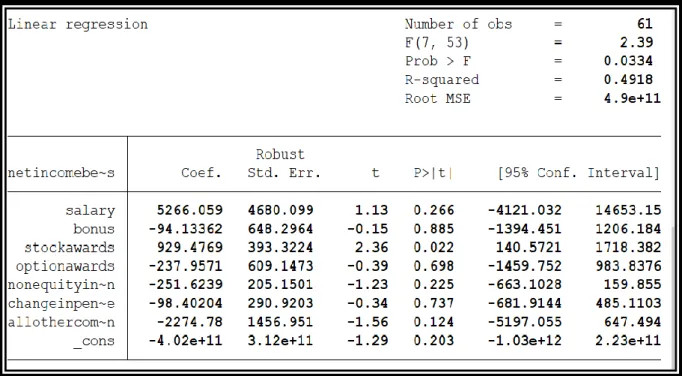
For the year 2014, the OLS regression (Robust) results are presented below: Table 3- OLS Multivariate regression for 2014
From the table above, only one variable shows a sufficiently low p-value to reject the null hypothesis: the variable Stock Awards, with a 95% confidence interval. One possible explanation is that the economy was not as expansive in 2014 as it developed later on during 2016, and the CEO´s didn´t have as much success in 2014 as they did in 2016.
The Ramsey Test (omitted-variables test) was not conducted for any of the years because all possible types of remuneration are subject to reporting to the Securities and Exchange Commission, as required by law; Since the focus of this research are the types of incentives, we decided to overlook this analysis of the multivariate model.
Regarding the sample, it´s important to notice the different types of remuneration and the disparity of payments for the CEO´s compensation plan, with big differences between the top tier and lower tier elements of the sample retrieved.
19
Fig.1 – U.S. Banks & Investment Banks: Total senior executive compensation Vs. Bank Market Capitalization. (Detail on BlackRock Inc)
20
Fig.2 – Graphic perspective of the distribution of compensation package considering market cap. Detail on JP Morgan Chase, evidencing consolidation in the Industry.
Source: Eikon, Reuters. (2017)
This discrepancy in terms of payments from the industry leaders when compared to the lowest market cap banks in the sample could limit the unbiasedness the results, as these institutions differ in their approach to executive retention policy and there is also a tendency towards
21
consolidation, with the highest ranked banks making for a large portion of the total market cap of the industry.
Consequently, the present study found relevant to address a Logit Regression: considering the remuneration package of the CEO for 2014 and comparing it with the growth of the corresponding institution, established as the positive/negative difference in Net Income between years 2016 and 2014 to observe if the cases that are positive have common characteristics in terms of the incentives given.
Using Python programming language, we input the variables Net Income Before Taxes, Salary, Bonus, Stock Awards and All Other Compensation for each bank regarding 2016 and 2014. The resulting data set equals the difference between the two years for the variable Net Income Before Taxes, and allows for a direct analysis of the remuneration policy of the bank during the period observed.
The model is trained with 70% of the dataset and generates predictions based on that subgroup, which is then tested against the remaining 30% - as to observe if the predictions of the model are similar to the real differences registered in the variable Net Income Before Taxes.
The model normalizes the explanatory variables from 2014 into quartiles, and compares them in the same dimension for all the elements in the sample. The categorization is made to each explanatory variable inputted, regarding their position relatively to counterparts – classifying as Low until quartile 25, Medium from quartile 25 to 75, and High for quartile greater than 75. The results obtained using the trained model showed some responsiveness to reality, since using these variables in the Logit Regression as the predictors of the model matched the real differences substantially, reaching a level of precision higher than 75%, when compared with the real differences in the variable Net Income Before Taxes regarding 2016 and 2014.
22
Table 4 –Summary information about the Tested sample5, using the logit regression model.
Source: Tensorflow results of the logit regression model (Python programming language) - Data set correspondent to the tested sample (30%) by the Logit Regression Model.
We proceed to classify the compensation variables into quartiles, detailed in Table 4: from quartile 0-25, it´s considered a low reward (when compared to what other banks are paying to CEO´s in the same category of remuneration), or medium level reward if the values observed fall into any of the quartiles 25-50 or 50-75. If the bank highly rewards the CEO comparing to competitors, it pertains to the 75-1 quartile.
The research design devised for this method focuses on the logit regression model, considering and comparing the different types and categories of the remuneration incentives paid in 2014.
5Corresponding to the 19 banks that were out of the aleatory sub-group used to generate the model. - Data set reflects the
tested sample (30%) by the Logit Regression Model. It classifies as 1 (corresponds to good governance) the elements that show positive difference in Net Income between 2016 and 2014, and as 0 the ones that reveal a lower Net Income for 2016.
Stock Awards Quartile Salary Quartile Bonus Quartile All Other Compe Quartile Δ Net Income
low low low low 1
low low low low 0
low low low low 1
low low low low 0
low low low low 1
medium low low low 1
low medium medium high 1
medium medium high medium 0
medium medium medium medium 1
medium medium low medium 0
high medium medium medium 1
medium medium medium medium 1
high high medium high 0
low low low low 1
high high medium medium 1
high high high high 1
high high high high 1
medium high medium high 1
23
The present Dissertation then comments on the results of Table 4, detailing each explanatory variable:
Stock Awards
There are 7 banks that pay low level of Stock Awards to their CEO´s, when compared to competitors in the tested sample. Five out of seven banks that paid this level actually performed well in our analysis, while the other 2 banks didn´t register an increase in the Net Income Before
Taxes of 2016, focusing on the value of the remuneration incentives given to CEO´s in year
2014. Regarding the medium-level remuneration, there are 7 banks that fall under this category, from which five can effectively boost the Net Income Before Taxes of 2016 with the exception of only two. Out of the five best paid CEO´s in the sample considering Stock Awards, only one manager wasn´t able to increase performance.
Salary
There are 8 banks in the sample that pay low level of Salary to their CEO´s, when compared to competitors in the tested sample. Even though these CEO´s are underpaid considering fellow colleagues, six out of eight banks that paid low Salary in 2014 to the CEO´s could effectively thrive in Net Income Before Taxes of 2016. Regarding the CEO´s that fall under the medium-level reward, there are 6 of them that get fairly rewarded while the majority (four out of six) did successfully manage the bank during those years, being able to increase the binary variable. There are five well-paid directors of banks, and only 1 of them didn´t manage to exceed performance.
Bonus
There are 8 banks that pay low level bonuses to their CEO´s, although five of them still have motivation to perform, registering growth in the explained variable Net Income Before Taxes. Considering the medium level bonus paid to the seven CEO´s in the tested sample, six of them were able to generate higher Net Income Before Taxes in year 2016. The four CEO´s that got paid higher level bonuses (Table 4) are almost all successful in this analysis, albeit there was one that couldn´t generate higher performance in 2016.
24
All Other Compensation
There are 7 banks in the tested sample paying low levels of All Other Compensation to the corresponding leaders, with five of them reaching higher performances. In regards to the CEO´s that fall under the medium level of All Other Compensation, the majority of them (four) are able to generate better results in 2016. There are five chief executives in the sample that get paid high levels of this form of compensation, with four of them being able to raise the performance of the corresponding banking institution.
Looking at each remuneration variable, it is clear that all of them suggest an impact on performance, but ´the good balancing´ of Stock Awards, Salary, Bonus and All Other Compensation altogether becomes harder to find and implement.
By observing the sample of the differences between 2016 and 2014 in Net Income Before Taxes, it seems that the explanatory variables Stock how the remuneration package as a who performance, considering the different levels of payment (quartiles) relative to the same variable from other banks. In sum, elements that have variables corresponding to a low/medium/high quartile in each dimension either have growth/no growth, in a seemingly undistinctive pattern.
Finally, elements that have a mix of medium/high/low quartiles for the explanatory variables (more than just one type of quartile in each remuneration variable) show a tendency towards growth, and indicate that possibly the best remuneration package compensates CEO´s in a diverse way, paying more than competitors in some variables and less in others, but doesn´t show a clear measure of each one to reach a higher Net Income Before Taxes.
V. Conclusion
The research question proposed for this Dissertation investigates if the banking performance of U.S. Banks is impacted by the different types of remuneration given to CEO´s of these institutions.
With the purpose of studying which remuneration variables have a positive impact on performance - measured as Net Income Before Taxes - we test the sample of the major Banks
25
& Investment Banks quoted in North American stock exchanges. Given the impact of the Global Financial Crisis, several measures were implemented by regulators towards greater transparency, and the benefits of understanding the underlying research question can help explain what type of incentives are most likely correlated to Net Income Before Taxes, with special focus on the incentives that produce growth, aligning the interests of shareholders with the top management of banking institutions. The type of payments to finance related employees started being monitored more closely since the financial crisis took place in 2008, with the aim of reducing excessive risk-taking behavior from top management. It is an important step to understand how banking firms can increase results and talent retention by focusing on a reward package that motivates the CEO to generate higher results with a sustainable vision. This way, and together with careful monitoring from regulators to liquidity levels, we may decrease the risk of default and financial contagion.
The findings of the study point to interesting directions about how to compensate the senior executives that are in most cases both CEO and Chairman, a structure (CEO duality) that has been implemented by most banks to mitigate agency problems.
The variables studied include all the types of remuneration paid to CEO´s in the U.S. Banking Industry for the 62 elements present in the sample. The banking performance measures such as Net Income Before Taxes, Earnings Per Share, Dividend Per Share and Total Assets were inputted as explained variables, to observe if there was a relationship between these and the remuneration variables. From all the explained variables, Net Income Before Taxes was the variable that showed higher responsiveness to the CEO´s compensation, namely the set Stock
Awards and All Other Compensation for the OLS multivariate linear regression model. By
reasoning to the answers provided by this method, these results also support the theories developed to induce that the estimations using ordinal regression models can be less effective in generating conclusions, because it groups big banks with medium to small ones - increasing the risk of outliers in the sample.
The literature reviewed together with the logit regression implemented detailed that variables
Salary, Stock Awards, Bonus, and All Other Compensation are indicative of better predictions
for the model estimated and tested. In the analysis of the logit results, it isn´t noticeable the existence of the “perfectly-balanced” remuneration package earned by CEO´s. Alternatively, the results obtained provide insights on how effective are the incentives in generating excess return for the bank, as well as about which set presents a higher degree of relation with Net
26
Income Before Taxes, and a concrete pattern is discerned ( the set Salary, Stock Awards, Bonus,
and All Other Compensation obtained a goodness of fit higher than 75% regarding the 19 banks tested, revealing statistic adherence of the model estimated.
27
VI. References
Achtenhagen L., Naldi L., Melin (2010), “Business Growth”—Do Practitioners and Scholars Really Talk About the Same Thing? Volume34, Issue2,Entrepreneurial and Business Growth, Pages 289-316
Bauer R., Guenster N., Otten R. (August 2004) - Empirical evidence on corporate governance in Europe: The effect on stock returns, firm value and performance. Journal of Asset Management, Volume 5, Issue 2, pp 91–104.
Bhagat s., Bolton B. (October 2007) The Promise and Peril of Corporate Governance Indices, ECGI - Law Working Paper No. 89/2007, Yale Law & Economics Research Paper No. 367.
Bebchuk L, Fried J., Executive Compensation as an Agency Problem, Journal of Economic Perspectives—Volume 17, Number 3—Summer 2003—Pages 71–92
Bebchuk L., Spamann H. (2010), Regulating Bankers’ Pay, 98 Geo. L.J. 247.
Categories: Banking & Finance; Sub-Categories: Financial Markets & Institutions, Banking, Financial Reform.
Brown L., Caylor M. (July 2005) Corporate Governance and Firm Valuation, Journal of Accounting and Public Policy, Vol. 25, No. 4, 2006.
Carline, N. F., Linn, S. C., & Yadav, P. K. (2009). Operating performance changes associated with corporate mergers and the role of corporate governance. Journal of Banking and Finance,
33(10), 1829–1841.
Chesney M, Stromberg J., Wagner A. (January 2010), Risk-Taking Incentives, Governance, and Losses in the Financial Crisis Article in SSRN Electronic Journal · DOI:10.2139/ssrn.1595343
28
Dalton, Certo,Roengpitya. (1998) Meta-Analyses of Financial Performance and Equity: Fusion Or Confusion? Article in The Academy of Management Journal F ebruary2003 DOI: 10.2307/30040673 https://www.researchgate.net/publication/275862297
Deloitte (2016) https://www2.deloitte.com/content/dam/Deloitte/nl/Documents/risk/deloitte-nl-risk-good-governance-driving-corporate-performance.pdf
Devriese et al. (January 2004) Corporate Governance, Regulation and Supervision of Banks.
DeYoung R., Peng E., Meng Y., (08 January 2013) Executive Compensation and Business Policy Choices at U.S. Commercial Banks, Volume 48, Issue 1 February 2013 , pp. 165-196, https://doi.org/10.1017/S0022109012000646
Drucker P. (2006) - The Effective Executive, The Definitive Guide to Getting the Right Things Done.
Friedman M. (September 13, 1970), The Social Responsibility of Business is to Increase its Profits, The New York Times Magazine.
Gregg et al. (February 2014) The Squeeze On Real Wages - And What It Might Take To End It, Prepared for National Institute Economic Review Special Issue on ‘Financial Crisis and Economic Performance.
Gropp R., Kohler M. (February 2010) Bank Owners or Bank Managers: Who is Keen on Risk? Evidence from the Financial Crisis, European Business School Research Paper No. 10-02
Gompers, P., Ishii, J., Metrick, A. Corporate governance and equity prices. Quarterly Journal of Economics 118, 107-155].
Jensen M. (June 1983) - Separation of Ownership and Control, foundations of organizational strategy, Harvard University Press, 1998, and Journal of Law and Economics, Vol. 26.
29
Mehran H., Mollineaux L., (February 2012) Corporate Governance of Financial Institutions, Federal Reserve Bank of New York Staff reports, staff report no.539
McKinsey & Company, Inc. et al. (July 2002) , Global Investor Opinion Survey: Key Findings, Confidential.
Wiklund J., Sheperd D. (2003), knowledge-based resources, entrepreneurial orientation, and the performance of small and medium-sized businesses, Strategic Management Journal Strat. Mgmt. J., 24: 1307–1314 (2003) Published online in Wiley InterScience (www.interscience.wiley.com). DOI: 10.1002/smj.360
30
31
APPENDIX
Royal Bank of Scotland