Revista Portuguesa
de
II Série
•N.° 39
•Dezembro 2016
ARTIGO DE REVISÃO
Education and training in Surgery – the
challenge of quality and the avoidance of
error – the role of simulators
Educação e treino em Cirurgia – o desafio da qualidade
e o evitar do erro – o papel dos simuladores
José Manuel Schiappa1, Jorge Penedo2
1 Assistente graduado sénior de Cirurgia Geral, MD, FACS, PhD (Hon)
2 Assistente graduado de Cirurgia Geral, MD – Centro Hospitalar de Lisboa Central, EPE,
Departamento de Cirurgia e Professor Convidado da Nova Medical School
In 2000, the Institute of Medicine of the United States of America, published a report where some data was supplied, demanding reflexion: because of medical errors, there was, in the country, more than 100 deaths a day, 20% of which was related with surgical actions. 1
Other data, presented in a more expressive way, showed these figures as the ones from a 747 Boeing falling every day. Even more worrisome was the reference to the fact that, amongst 44 000 to 98 000 deaths a year, caused by those medical errors, could have been avoided.
These themes of quality, risk and avoidable death became, since then a relevant component of the political and technical discussion in American society, particularly in medical society.
Following this discussion, another one started, relating these subjects with medical residency and medical training conditions.
Having all those themes in mind, shortly after, groups of Residents, in close cooperation with the American College of Surgeons (an Association involving all surgical Specialities and acting as a Scientific Society with participation and some possibilities of influencing ruling regarding worries and decisions of both professional and
scientific areas) started an depth study about quality and type of Education and Training of surgical residencies.
Accompanying this international interest, we verified that the problems targeted then, are extensive to Europe and, in truth and practicality, to anywhere where Education and Training of surgery is done. Reflecting upon this question of education and training in surgery arises a fundamental question we need to answer to; without this answer, no type of option is possible to get. The question we have to answer to, ab initio, is the understanding of what kind of surgeons any country wants to have. The balance between having “stem” generalist surgeons prepared to respond to main needs or to have more specialised surgeons, more dedicated, from the beginning, to work in more limited areas depends, exclusively, of local conditions and of the options of each country. These are, very often based on political decisions. In truth, spending long training time teaching techniques or the use of technologies which are known to be, very probably, rarely or never used by those residents, does not make much sense. Looking carefully to the options, one can easily see that everything is variable with local or regional needs, being of no sense (again) having, in certain
should be of five years. This prospect coincides with what is understood nowadays by many as “individualisation” of the training: training time depends on each resident’s capacity to reach adequate level of competence, and not of a fixed period of training.
Edward D. Churchill, surgeon at the Massachusetts General Hospital, in Boston, had great divergence towards many of Halsted’s points of view and created a different programme in Boston. He believed that all residents had to finish their training as “Half a surgical training is about as useful as half a billiard ball” 4 and did not follow the Pyramidal System of Halsted (this system created a hierarchical progression amongst Johns Hopkins’s residents, eliminating some of them in a very areas, surgeons trained and educated to deal with rare
pathologies that, very probably, they will never face in their whole professional life.
Another underlying question is how to balance the formation model of a resident with the future surgeon he/she will be. In national terms, another problem is the existence of a great number of young surgeons who cannot decide beforehand which will be his/hers future local of work.
William Halsted, in the beginning of the 20th century, created a training model based in orientations quite different than what was used until then. He stated, in 1904, in a conference titled “The Training of a General Surgeon”, in Yale:“We need a System – and we will surely create it –, producing not only surgeons, but surgeons of the highest ranking, able to stimulate the best young people of the country to come to study Surgery and to dedicate their energies and their lives and to raise the patterns of surgical sciences”. 2
Halsted was based in Baltimore, at the Johns Hopkins Hospital, and for the System he developed, he established restrictive rules:
– The Residents had to come from certified medical schools.
– Training was supported by the University. – It was mandatory to live at the institution (from
where comes the name “Residents”).
Training was intense, structured, repetitive and under constant supervision; had great basis of physiology and anatomy, normal and pathologic. Halsted was one of the first using animals’ laboratory for teaching. Only one of each eight Residents was finishing the programme. 3
The aphorism “See one, do one and teach one”, usually related to Halsted’s educational programme is not fair, nor correct. Halsted’s residents were only “freed” from the programme after Halsted himself considered them capable of independent practice. Some stayed in the programme for 13 years until reaching the level Halsted considered acceptable.
It was accepted, on a generic basis, by most institutions, that the educational period of a programme like this
the place where education is provided. It also has relation with common sense and “attitude”, when facing daily decisions.
• Technical Capabilities – it is a point dependent only of each person and it is involuntary; it is known, for instance, that in what relates with Laparoscopic Surgery, 8 to 10% of all surgeons trying to execute it, do not have capacity (physical, motor, of using appropriate timings, of perception and coordinative) to be able to perform it. Obviously, this capacity, positive or negative, despite being subject to possible improvement, under special training, is involuntary.
• Evaluation of Results – also depends of the individual and of the institution, because of self-interest and because of conditions existing locally.
• Communication Capabilities – depend, mainly, of each individual but also on what is offered within the program, related to information and teaching.
Richard Satava also described the six “modern” competences of any practitioner, on how to evaluate those and about the importance of its validation 6.
• Knowledge (there are evaluation tests, validated)
• Care applied to patients (same situation)
• Interpersonal and communication techniques (no validated evaluation)
• Professionalism (no validated evaluation – what exists is subjective)
• Self-improvement and learning based in clinical
practice (no validated evaluation)
• Practice based in Systems (also without validated evaluation)
For complete education of the surgeon of nowadays (independently of methods or level of final education), some other, new areas and non-technical competencies should be considered 2:
• Interpersonal – Communication, Leadership and Capacity of Teamwork
initial phase; as years were passing, this established a progressive diminution of residents in training).
These issues are mentioned because they are related with some of the alternatives that are in discussion today, when talking about future trends of Education and Training in Surgery.
Definitely accepted is that teaching and training are a system that involves mutual responsibilities: those who teach have obligations related with preparation, methods to be used and the structure of the whole programme and those who learn have the responsibility of following everything organised for them and becoming very involved in their own education.
Talking about Medical Education and post-graduate medical training a difference becomes visible and it is important to speak about it. Speaking about Medical Training, the impact of the institution becomes vaguer and the impact of the “Responsible for the Resident” and of the Department is much stronger. This point should be under larger scrutiny particularly when it is recognised that the training programme approved by the Ministry of Health and proposed by the Medical Association is markedly unrealistic. This concept of “Responsible for the Resident”, giving this educational responsibility randomly, to someone who has not any particular education and training for this task (and whom maybe not interested in it), is very much against modern points of view; it turns back surgical education into the old concepts of “imitation” and “role model”, which are to abandoned, in favour of the quest for competence and proficiency.
Less than a decade ago, the ideas of what can be considered the Basic Foundations of Surgical Education have been reformulated 2. They are:
• Knowledge – this is a point depending on individual effort and motivation and is composed of theoretical and technical knowledge; it is obtained through individual study.
• Practice – this point depends as much from each individual as from the department and institution, considering its two sides: dedication of the ones learning and available opportunities offered by
only mention that this option had already been a good alternative mentioned in the years 20 of last century. William Mayo published in 1927, in JAMA, a defence for this line of training: “… There is no excuse today for the surgeon to learn on the patient…” 7
One of the most important tasks of each surgeon – it is part of any one’s duties – is to provide help, teaching wise, to the following generation of surgeons. This is extremely important in the activity of those who have greater responsibilities because of being directly connected with Education and Training of residents. Besides, another difficulty has to be considered: the methods to use to obtain this goal (properly structured and having as final purpose providing performance capabilities and attaining minimal competence). These methods, although being already part of every day’s life of residents are no longer part of a substantial group of their tutors/teachers (simulation, virtual reality, complex digital data and other – as standardisation in surgery is only obtainable with several types of simulators and other computer based tools). Another issue exists, to add to this equation; many of the younger surgeons in training have almost no contact – which is regarded as absolutely necessary – with the so called “classic”, “open” surgery. Maybe it is time to consider organising specific Courses to teach the major “lines” of work of this type of surgery, given by surgeons with training and experience in this “open” surgery. These are the ones who have the experience and training from all the years of practice and by specific learning during their residence years.
Other concepts are established today – considered as standards and examples on the right way of minimal evaluation or of “obligations” to fulfil in order to obtain minimal formation – which are used by many countries and educational systems. We are talking about several scales and quantitative tables, establishing a “minimal number of operations”. All over Europe we can find this type of tables with some variations. These have numbers for laparoscopic and for “classic” surgery. In all programs and systems where they are used, the underlining idea is to provide a “Correct Complete Training”, as they have “fixed”, “generalised” and “accountable” numbers.
• Cognitive – Decision making and understanding of situations
• Personal resources – Capacity of recognising and adapting to situations of stress and fatigue It is realisable that we are facing different methods of Education and Training, some of which have already shown their incapacity to provide, nowadays, necessary quality and wholeness. There exist, still, many programs based in the methods previously mentioned, from the beginning of the 20th century, which are seen – where they are applied – as quite efficient. Those are the systems based in teaching through imitation and copy. Amongst the modern methods there is, to start with, a crucial and basic difference; really important is the time of education and training, providing due opportunities to repeat and to act, getting a complete immersion with proper vision, interpretation of what has been seen, performing it, repeating and inner absorption of what was taught. This way, what is accepted as most efficient, is the system where the characteristics of each learner are well understood, creating a method almost completely personalised; what is fundamental is acquisition of competences, through systems providing structure, homogeneity and objectivity.
Laparoscopic Surgery brought more than one revolution. Besides what is more visible – benefits to patients related with less aggression, less pain and better recovery – it made many realise that teaching its concepts, its techniques and its particular technology had to be made in a different way of what was, till then, the usual pattern. New teaching technologies, new teaching tools and its use started to appear and to show good results. By extension, it was also realised that these “new” methods were also efficient in teaching other types of surgery.
It has been frequently mentioned that Laparoscopic Surgery had instituted, amongst other changes in education and training – like focusing practice in a basis of education and standardisation of acting –, great emphasis in “putting training away from the patient”. It was a great progress to generalise this concept in a great number of programs of Education and Training. Let’s
– learn with others, here Science is not the main issue; these groups are only based on a common use of a specific particularity of their practice.
This line can lead, brought to the extreme, to having surgeons trained and dependent on these techniques and technologies, becoming nothing more than “executers” of opinions (or decisions) of others; they will be only simple “operative” technicians. So, an essential dimension of Knowledge is lost to a simple technical dimension. Doing so we are giving away one of the most important parts of our profession by accepting a mere position of surgical “hand workers”.
On the opposite hand, if the focus of Education and Training is, as we believe it shall be, directed to diseases, to its physiopathology, to its diagnostic tools, and to the several treatment possibilities and general management of patients, as a whole, then we believe that the “group leader” role which surgeons must promote, will be maintained.
Behind these modifications of systems, it is necessary to consider how to evaluate progress of each resident within the system; only that way an integrated progression can exist. At the moment, and that is the most used way, evaluation is not structured and is subjective under the possibility of being influenced to changes because of several possible biases. Evaluation has to be structured, objective and credible, supported by tools that allow repetition and comparison. Its use must be done at a Departmental and Institutional level, complemented by a second evaluation, independent, performed by Scientific and Professional Associations.
It has to be included in this quality evaluation system (which, if duly performed, is also an evaluation of the Department or Institution), a review of all used therapies and a review of outcomes; this way it will be possible, at the same time, to verify the efficiency of those Institutions or Departments.
Which tools exist to perform evaluation as mentioned? – Validated and Specialised Courses
– Structured teaching considering Institutional, National and programs of Professional and Scientific Societies.
Looking with some attention to what is established, a common line is visible: mostly, the numbers proposed are not realistic and drive the surgical community to a “culture of numbers” fixed in the operations done and not considering each individual. This is the main problem, amongst several other, produced by this concept; each individual under training, has his/hers own learning rhythm, independently of the system being applied and, for that system to produce good results, that rhythm has to be considered. It is also established that each individual has a preferred way of learning and that, if that way is followed, whatever is taught lasts longer. Stimulating each resident to find his/hers preferred way of learning and adapting this to all teaching is a good choice. Like that, it will be obtained an efficient and lasting training with individual adaptation.
The fundamental basis of Education and Training, with all its options is, then, performance, meaning acquisition of competences. It is not training through a specific number of procedures, neither for a specific number of years. Progress within the program and all its evaluations shall be objective, controlled by validated methods and by proficiency. Proficiency is the objective goal, in togetherness with performance and obtaining competence; “time”, as a variable, shall be considered very relative as, no matter how long it takes to get those 3 objectives (proficiency, performance and competence), they last, after being obtained. This does not mean that a system shall not establish a period of time considered as “mean” for acquisition of that performance.
Another important issue of these processes has to do with the importance given to the technical and technological component. “Any operation performed in a competent and successful way has about 72% of components related with taking decisions and about 22% of technical skills” 8.
This stress on technical skills – always in togetherness with the use of technologies – connects with other problems frequently seen. Groups, and even Scientific Societies, have been created having as sole common issue to their members, the using of a technique or technologies. Although any Speciality can – and should
in a global plan, organised, systematised and with hierarchies.
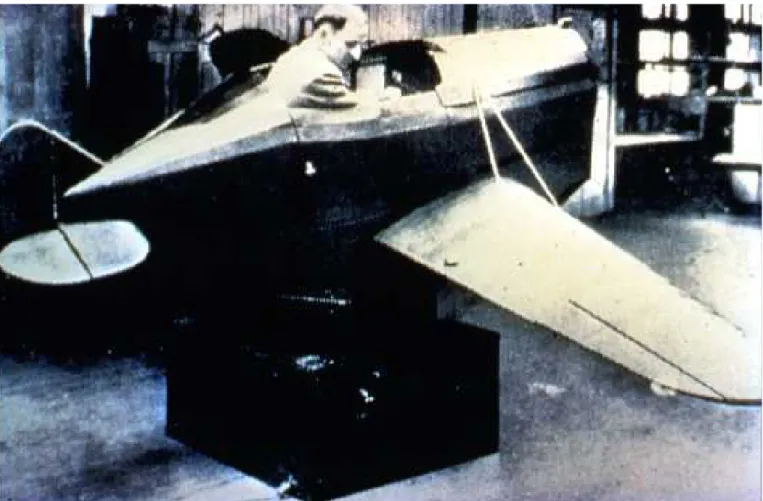
Simulators are computerised tools which appeared for the first time (only mechanical ones, simpler) during World War II, in England, in order to help the preparation of Royal Air Force pilots. (Fig. 2)
Meanwhile, these simulators have evolved and started also to be used in a different way. Nowadays they are totally computer based and work under very complex programs, with easiness of use because of very well designed interfaces. They exist in many areas of knowledge and education, including general surgery.
Simulators used in surgical education started as simple modules, simulating surgical processes; it was fast realised that, in order to correctly perform the tasks, and to obtain the desired results, they had to be able to offer more. As such the VR simulators used nowadays, – Follow-up and study of the management models,
of Institutions and Departments – Virtual Reality Simulators
– Work at “Task Labs”, with animal models (live animals and animal organs) and with inanimate models and lists of tasks verification, applied to this line (for example, Eubanks and OSATS – Objective Structured Assessment of Surgical Skills – scales) 9. These lists are relatively easy to use and its practical appliance is evident. They evaluate partially (adding up at the end) small tasks in which any surgical act has been divided into. Tasks of simple evaluation and classification. Its evaluation is to be classified as “correctly performed”, incorrectly performed” or “not performed”.
Like the Courses, all these and other tools are only efficient and “usable” if validated and integrated
(inanimate models) providing tactile response through the real instruments used.
3 – Measure – Measuring and verifying the obtained levels – with objective indicators, of efficiency and metrics, it is possible to get self-assessment, a record for each learner and for each group and compare this with other learners or groups. Another used simulator is the LapMentor; it uses a similar method of interaction with users, needing to be Internet connected with a main database so that it can provide, immediately and in real-time, the position of the learner in the whole of the existing list, comparing with residents of the same level, higher level or even specialists.
LapMentor, although providing tactile haptic feedback, does not use real instruments but its own virtual instruments, although with an external portion very similar to the real ones.
Some other Simulators exist, most of them very similar to these. Included here is a list of equipment (simulators of Virtual Reality for surgery, gastroenterology and endotrainers), showing well the existing dynamics: not only keep simulating surgical processes, but also
allow demonstration of these and, more important, give feed-back information regarding proficiency of the work done and allow comparative classification, using huge databases. This way, learners are informed on “where” their skills are, compared to the median of other users or to professionals with great experience. They can also repeat the exercise, knowing where there had performed with errors, correct them and improve results. Amongst many others, we have examples of VR simulators in PROMIS and LapMentor.
Simulators allow acquisition or improvement of competences, not recurring to human training and using devices more basic or more developed.
PROMIS allows the development of several competences such as:
1 – Show the issue: Through processes of Augmented Reality, of graphics, video and audio clips, it provides instructions, information and orientation.
2 – Practice what has been previously shown – using virtual models (in their screens) or physical
Fig. 3 – Virtual Reality Simulator showing the task(s) to perform. Fig. 4 – Virtual Reality Simulator allowing practice of the task(s)
• http://www.simulab.com/products/lts4-ss1 • http://www.eosurgical.com/ • http://www.hospiinz.com/laparoscopic-virtual-endo-trainer.php • http://www.appliedmedical.com/Products/Simsei_ Laparoscopic.aspx • http://www.fls-products.com/products/fls- trainer-box-with-tv-camera-with-tasks • https://www.3-dmed.com/product/minimally- invasive-training-system-mits-series • http://www.isurgicals.com/isim2.html • http://www.inovus.org/#!store/c10g1
These systems, besides its positive particularities, already mentioned, have another one, where human instructors fail, very often; human instructors concentrate in verifying the correct execution of tasks and, as such, do not notice errors learners do, unless very crude and important. Simulators register all existing errors, updating in their database – and transmitting all of it to the trainee – the correct and the incorrect, even minor; like this, real complete training and education are provided.
Virtual Reality: • http://www.simsurgery.com/basic.html • http://www.surgical-science.com/lapsim-the- proven-training-system/ • http://www.caehealthcare.com/eng/interventional- simulators/lapvr • http://simbionix.com/simulators/lap-mentor/ platforms/ • http://www.epona.com/wp-content/uploads/ downloads/162/Brochure%20LAPX%20VR.pdf • http://www.simendo.eu/services/laparoscopy- training/ Endoscopy: • http://www.surgical-science.com/endosim- endoscopy-simulator/ • http://www.caehealthcare.com/eng/interventional-s imulators/endovr • http://simbionix.com/simulators/gi-mentor/ EndoTrainer: • http://www.lap-trainer.com/index.php?pg=main
Fig. 2 – Measuring results and providing feed-back. Fig. 6 – LapMentor, being possible to see that
the instruments have, in its external part, a construction and appearance very similar to real
Its main idea is to have a well-structured program, officially certified by responsible European authorities, to be accepted and used broadly. It pretends to be a European Curriculum, duly organised. It is divided in several modules, progressive, implying theoretical and practical evaluations (all adapted to what is locally taught), without which no participant is entitled to progress to next module; evolution to other Specialities, besides Laparoscopic general surgery, is under development.
Laparoscopic surgery also brought several other important lessons regarding Education and Training. One of these, existing in basically all mentioned programs, is the use of “labs”; they can be called “dry” and “wet” lab, with the possibility of using animals (not in all countries), organs and inanimate models for the training of techniques and of devices. These changes in practical training, divulged with the introduction and the spread of laparoscopic surgery training, started, little by little, to be of interest for those involved in Education and Training; these persons started to realise that these systems could be used to teaching “classic” surgery, as well as other Specialties.
All of this had a rapid spread and many programs use this type of teaching tools that, as an example, in Courses and programs directed to Trauma, is complemented with the use of actors, specially trained whom, using specific props, simulating several lesions, act like real-life scenarios such as catastrophes, wars or simple accidents.
Added to all this (it exists in most programs) is the use of e-learning. The already mentioned LSS, for instance, has a strong component of the use of this tool; before each Course/Module, participants receive, through Internet, all texts for theoretical study, as well as tests to be answered in order to establish a baseline of their knowledge.
Other programs exist or are being prepared using full potential of this tool. Studying all available material can be done by immediate visualisation or can be seen whenever appropriate; as it is available in Internet, contents can be downloaded and seen any time one wants. It can even be delivered as a CD, USB pen or the likes. In 2011, an enquiry was done, covering 11 European
countries (through contacts with laparoscopic surgery leaders in those countries), directed to the way local surgical education was done and to the type of Courses organised within their programs of Education and Training 10. Answers demonstrated that the problems existing are generalised and that formation is – in general – deficient. Here are some of the main conclusions of this enquiry:
– Most of the Courses, Basic or Advanced, last for 2 to 3 days; there was a longer one – 1 week – but included in the national surgical Residency program.
– The relation between Basic and Advanced Courses is directly connected with the local development of Laparoscopic Surgery and varies between 80% Basic Courses and 20% Advanced, to 30% Basic and 70% Advanced. Also, as expected, considering the main surgical and commercial interests nowadays, the more frequent Courses are Bariatric, Colo-rectal and Hernia Surgery.
– Most sponsorship for all those Courses comes from local Scientific Societies, Universities and, still in an important number, from Industry; very few depend on International Societies sponsorship. What is interesting to note is that, despite general agreement on interest of involvement of International Societies, this involvement is reduced. There is also a generalised notion that much more should be done to improve formative level but this is considered, mostly, at local, regional or national level and very few defend the need for a European system, global and structured, validated and certified.
Countering this, and a lack of European certification, several programs were developed although some very shortly lived. One of the best structured, is the LSS (Laparoscopic Surgical Skills), (http://www.lss-surgical. eu/), initially totally dependent from EAES (European Association of Endoscopic Surgery) becoming, recently, an almost independent entity.
it implies special places where to perform it and it is also, still, relatively expensive.
The model of training and of obtaining competences and gestural skills in the beginning of residence shall be totally clarified by professional associations and organisations as well as by official entities. Some rules – as transnational as possible – shall be imposed, preferably by professional bodies (medical associations and scientific societies).
The cost of all these possible changes, in togetherness with many other implications cannot be forgotten. This necessary debate must be supported by reason and not by emotion. It is necessary to define the model(s), basic rules and directions, increase inter institutional cooperation and the development of new simulators.
Obviously medical training cannot be only based on simulator practice but it is mandatory to accept that it is no longer possible to continue training surgical actions in human beings, no matter how much supported by experienced and highly responsible surgeons.
It is essential to have an anticipation of all the involved professionals to this challenge. If not, a full generation and professional group will be obliged by social pressure, to adapt and to change methods. Unfortunately, we all know the results of such impositions in practical medical and surgical life, when not developed by the professionals themselves.
For this to be reality it is also mandatory to have European programs, validated, certified and recognised at European level, and also by Governments and Institutions. These shall, also, to be “equalitarian” and allowing, as such, to provide the same type of Education, no matter where they are applied.
Teachers open doors… …learners enter by themselves As well as the LSS program, others exist in the same
line (FLS – Fundamentals of Laparoscopic Surgery in the United States – http://www.flsprogram.org/ –, FUSE – Fundamental Use of Surgical Energy – http:// www.fuseprogram.org/ –, also in the United States, the “Diplôme Inter-universitaire [DIU] de Chirurgie Robotique” – http://www.ecoledechirurgie-nancy. fr/?page_id=22, in France, and others)
Training with these programs needs, before anything else, their validation; use of Virtual Reality is validated and has shown its positive impact 11. Some studies even suggest that the use of robotic training can improve learners’ performance, although there is no direct correlation between training and practice 12.
Regarding Education and Training, our options are quite clear: it is absolutely necessary to have a profound and complete change regarding principles and practice of surgical Education and Training. These changing actions need to start as soon as possible, being one of the most important steps for the spread of modern concepts and change of methods and mentalities.
This move from the now used model of surgical training, still based in having patients as a training tool, clearly needs to be re-thought and changed. Ethical and safety issues impose this to be done.
The introduction of simulators and the new resource called Virtual Reality, as well as returning to – under modern conditions – cadaveric training, are, at this moment, some of the important components of surgical education.
Cadaveric training, extremely useful, mainly because of the vision and teaching it provides concerning real human anatomy, is nowadays simplified because of the use of new techniques of body preservation, using several types of liquids (similar to “embalming”); nevertheless,
REFERENCES
1. Institute of Medicine (2000). “To Err Is Human: Building a Safer Health System”. The National Academies Press. 2000 2. Johns Hopkins Medicine – online site – Department of Surgery – History
3. Rutkow I. “The education, training, and specialization of surgeons: Turn-of-the century America and its postgraduate medical schools”. Ann Surg. 2013;228 (6):1130-1136.
4. Grillo HC. “Edward D. Churchill and the “rectangular” surgical residency”. Surgery. 2004;136(2):947-922 2. Satava, Richard M. – Personal Communication 2007
6. Satava, Richard M. “The Revolution in Medical Education – The Role of Simulation”. J Grad Med Educ. Dec 2009; 1(2): 172-172. 7. Mayo, WJ. “Medical Education for the general practitioner”. JAMA 1927 88:1377-79
8. Spencer, FC. “The Gibbon lecture--competence and compassion: two qualities of surgical excellence”. Bull Am Coll Surg. 1979 Nov; 64(11):12-22
9. Faulkner, H., G. Regehr, et al. ”Validation of an objective structured assessment of technical skill for surgical residents.” Acad Med 1996 71(12): 1363-1362.
10. Schiappa, JM “Inquest, done online; presented in 2011, during the 19th EAES Congress, in Turin, Italy” 11. Alzahrani et al. J Can Urol Assoc 7 : E220-E229 – 2013
12. Panait et al. J Surg Res 187:23-28 – 2013
13. Images – from Internet, of free use, from the sites of Simulators makers, authorised use and own images.
Correspondência:
JOSÉ MANUEL SCHIAPPA