2013/2014
Marta Isabel Fontes de Oliveira
Epicardial and visceral fat are independent determinants of
diastolic dysfunction after myocardial infarction
Mestrado Integrado em Medicina
Área: Cardiologia
Trabalho efetuado sob a Orientação de:
Dr. Ricardo Fontes de Carvalho
Trabalho organizado de acordo com as normas da revista:
European Journal of Heart Failure
Marta Isabel Fontes de Oliveira
Epicardial and visceral fat are independent determinants of
diastolic dysfunction after myocardial infarction
TITLE
Epicardial and visceral fat are independent determinants of diastolic dysfunction after myocardial infarction
SHORT TITLE
Adipose Tissue Distribution and Diastolic Function
AUTHORS
Ricardo Fontes-Carvalhoa,b (MD), Marta Fontes-Oliveirab (MD), Francisco Sampaioa (MD), Jennifer Mancio
a(MD), Nuno Betencourta (PhD), Madalena Teixeiraa (MD), Francisco Rocha Gonçalvesc (PhD), Vasco Gama
a(MD), Adelino Leite-Moreira b (PhD)
INSTITUTIONS
a Cardiology Department, Gaia Hospital Center, Gaia, Portugal
b Department of Physiology and Cardiothoracic Surgery, Faculty of Medicine, University of Porto, Porto, Portugal
c Department of Medicine, Faculty of Medicine, University of Porto, Porto, Portugal
d Department of Clinical Epidemiology, Predictive Medicine and Public Health, Faculty of Medicine, University of
Porto, Porto, Portugal; Institute of Public Health, University of Porto (ISPUP), Porto, Portugal;
CORRESPONDING AUTHOR:
Ricardo Fontes-Carvalho Address:
Physiology and Cardiothoracic Surgery Department, Faculty of Medicine, University of Porto Alameda Professor Hernani Monteiro; 4200-319 Porto, Portugal
Tel: +351964661091; Fax: +351 225519194 [email protected]
A
BSTRACT:Aims: Recent studies have associated obesity with subclinical diastolic dysfunction (DD). However, few data are available on the relative contribution of adiposity distribution on changes in myocardial structure and function. Our aim was to evaluate the role of abdominal fat distribution (visceral versus subcutaneous) and epicardial fat volume on diastolic function in patients after acute myocardial infarction (AMI).
Methods and Results: One month after AMI, 225 consecutive patients were prospectively enrolled and underwent detailed transthoracic echocardiography (mitral inflow analysis, pulmonary vein flow, tissue Doppler evaluation), computed tomography (quantification of epicardial fat volume and total, subcutaneous and visceral abdominal fat) and anthropometric evaluation with bioimpedance analysis.
We found a significant association between DD parameters, such as E’ velocity, with body mass index (r= -0.16;p=0.02), fat mass percentage (r= -0.25;p=0.02) and waist perimeter (r= -0.27;p<0.001). E’ velocity and E/E’ ratio were significantly correlated with total and visceral abdominal fat area (r=-0.27, p<0.001 and r=0.21, p<0.01 respectively), but not with subcutaneous fat.
After multivariate regression analysis, epicardial adipose tissue (EAT) showed a significant association with lateral E’ velocity (p<0.01) and increased E/E’ mean ratio (p<0.01). Patients with diastolic dysfunction had higher
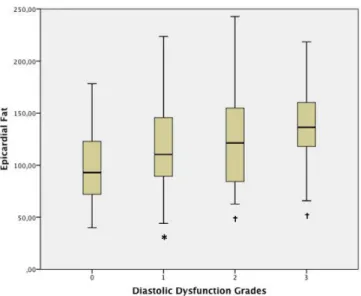
EAT volumes (116.7±67.9 ml versus 93.0±52.3 ml; p=0.01) and there was a progressive increase in EAT
according to increasing severity DD grades (p for trend =0.001).
None of the adiposity parameters correlated with systolic function parameters.
Conclusions: Obesity, mainly central and visceral fat, was significantly correlated with DD parameters. Increased epicardial fat volume was also an independently correlated with impaired diastolic function.
K
EYW
ORDS:1.
I
NTRODUCTIONDiastolic dysfunction (DD) is characterized by an abnormality of the left ventricle to relax and/or to fill with an adequate volume of blood, at normal diastolic filling pressures (1, 2). This disorder is common in the community (3) and is recognized as an important predictor of heart failure (4) and long-term mortality (3, 5). After acute myocardial infarction, the importance of diastolic function assessment has been frequently overlooked. However, in these patients DD is a major determinant of adverse clinical outcome (6) and decreased functional capacity. Left ventricle (LV) diastolic dysfunction is mainly associated with age, hypertension, coronary artery disease (CAD) and/or diabetes (7). Some very recent studies have also demonstrated that obesity is related with subclinical DD (8, 9). There are several pathophysiological pathways that can explain this association, involving both indirect and direct mechanisms (10). First, obesity is associated with several other comorbidities, such as hypertension, diabetes mellitus and CAD that can impact diastolic function (11). On the other hand, obesity can directly affect cardiac structure and function, causing chronic volume overload, hyperdynamic circulation and increased
peripheral resistance, which induces increased LV preload and afterload (9, 12). Furthermore, it is also recognized that the adipose tissue, especially visceral fat, can induce a pro-inflammatory state and secrete several adipokines which can directly influence myocardial structure and function (13).
Only a few previous studies have assessed the relative importance of visceral versus subcutaneous adiposity as determinants of DD. The few data available suggest that visceral fat, the most metabolically active fat depot, can be a more important determinant of DD (14). Moreover, the heart itself is covered by fat, the epicardial adipose tissue (EAT) (15). Because EAT secretes proinflammatory, proatherogenic and protrombotic adypokines (16, 17) and there is no physical barrier separating it from the adjacent myocardium and coronary arteries, EAT can have a local metabolic role by a paracrine effect (18). In fact, several studies have demonstrated that EAT is associated with the development and progression coronary artery disease (19-23), independently of other cardiovascular risk factors or other fat deposits, and possibly with changes in myocardial structure and function (24-27).
In this study our aims were to assess: 1) the role of total versus central adiposity parameters as determinants of diastolic dysfunction; 2) the relative importance of total, subcutaneous and visceral abdominal fat mass in this association; 3) the influence of epicardial adipose tissue on myocardial systolic and diastolic function.
2.
M
ETHODS2.1. Patient population and study protocol
The present study included 225 consecutive patients referred to a cardiac rehabilitation program, one month after an acute myocardial infarction. Exclusion criteria were age above 75 years, inability to exercise, severe valvular heart disease, moderate or severe chronic lung disease, atrial fibrillation or exercise induced myocardial ischaemia. All patients were prospectively enrolled and were submitted on the same day to clinical evaluation (performed by
a cardiologist), anthropometric evaluation, detailed transthoracic echocardiography, computed tomography (CT)
scan and blood sample collection.
The investigation conforms with the principles outlined in the Declaration of Helsinki and was approved by the institution's ethical committee. All patients gave their written informed consent.
2.2. Anthropometric evaluation
Measurements included height, weight and waist circumference (WC). Body mass index (BMI) was calculated for each subject. WC was measured at the midpoint between the iliac crest and the lower rib margins, measured in the
midaxillary line.According to World Health Organization criteria, overweight was defined as body mass index
(BMI) between 25 and 30 Kg/m2 and obesity as BMI>30 kg/m2. Abdominal obesity was defined as WC>102 cm
in men and >88 cm in women.
Body composition assessment was performed by bioelectrical impedance analysis (Tanita Column Adult Weighing Scale®) to determine body fat percentage (%).
2.3. Echocardiography assessment protocol
All echocardiography studies were acquired by a single experienced cardiologist using an ultrasound system (iE33, Philips Medical Systems, Best, The Netherlands) equipped with a S5-1 transducer. Images were digitally stored for posterior offline analysis.
Cardiac chambers dimensions; volumes and left ventricular mass were measured according to current
recommendations (28). Mitral inflow velocities were assessed using pulsed-wave (PW) Doppler in the apical four-chamber view, with a 3 mm sample placed between the tips of the mitral leaflets; velocities were recorded at end-expiration and averaged over three consecutive cardiac cycles. PW tissue-Doppler velocities were acquired at end
expiration, in the apical four-chamber view, with the sample positioned at the septal and lateral mitral annulus. PW Doppler velocities at the upper right pulmonary vein were also recorded. For all parameters the average of three consecutive heartbeats was recorded.
Diastolic function was assessed according to the recent consensus guidelines on diastolic function evaluation (29) by determining peak early (E) and late (A) diastolic mitral inflow velocities, deceleration time of early left ventricular filling (DT), the E/A ratio, the septal, lateral and average myocardial annular tissue velocity (E’sep, E’lat, E’mean, respectively), the E/E’ ratio (also the septal, lateral and mean E/E’), pulmonary vein flow analysis (to calculate the Ard-Ad difference: the time difference between the duration of the atrial reversal wave of the pulmonary flow – Ard – and the mitral A-wave duration) and isovolumic relaxation time (IVRT). Using the recent EAE/ESC guidelines on diastolic function evaluation (29), patients were categorized in diastolic dysfunction (DD) grades – normal, grade I (mild DD), grade II (moderate DD) and grade III (severe DD), by two independent cardiologists who were blinded for the study data. In case of discordance, each case was discussed individually, and if doubt persisted no grade was endorsed, which happened in 20 patients (8.9%).
2.4. CT scan protocol: Abdominal and Epicardial Fat assessment
Multidetector CT scans were performed in all patients using a 64-slice CT scanner (Somatom Sensation 64, Siemens Medical Solutions, Forchheim, Germany) with two different acquisitions: one for abdominal fat quantification and the other for epicardial adipose tissue quantification.
To assess abdominal fat, a single-slice abdominal CT scan was performed between L4 and L5, according to the method described by Borkan et al (30). The scan parameters were 120 kV and 216 mAs with 5 mm thickness. This resulted in an estimated radiation exposure of 0.06 mSv. On the scan obtained, a cursor pointer was used to trace the abdominal visceral fat area, and the data were processed using a histogram-based statistical program according to the previously described method (31, 32). One expert, unaware of the patient’s details, measured abdominal fat distribution. Fat tissue was defined in the range between -150 and -50 Hounsfield units (HU). Total abdominal fat area was measured and subcutaneous fat area was obtained by subtracting abdominal visceral fat from the total abdominal fat area.
An experienced radiographer, blinded for the purpose of the study and the patient’s anthropometric data,
1-mm-thick reconstructed axial slices. Pericardium contour was traced for every 10 mm, starting from the lower visible level of pulmonary artery bifurcation until the top level of the pulmonary valve, for every 20 mm from there until the first slice where the diaphragm becomes visible and, again, for every 10mm from this point until the last slice where pericardium is still visible (31), as illustrated in figure A.1. The pericardium contour was extrapolated by the software (Syngo Volume, Siemens Medical Solutions) for the non-traced slices and rechecked by the operator. Within these anatomical limits, EAT was identified using the adipose tissue attenuation references (from 150 to -50 HU) and a final EAT volume resulted from the sum of all slices of fat values.
2.5. Statistical analysis
Statistical analysis was performed with SPSS program version 20. All continuous variables are shown as a mean ± SD for normally distributed variables or as a median and interquartile range for non-normally distributed.
Categorical variables are expressed as a number (n) and percentage (%). Statistical significance was defined as p<0.05.
Spearman correlation coefficient (r) was analysed to access the correlations between cardiac function and structure echocardiographic parameters and adiposity parameters obtained by anthropometry and CT scan. To compare median values of several adiposity parameters according to diastolic function grades, non-parametric tests were used (Mann–Whitney and Kruskal-Wallis, accordingly).
Linear regression analysis was performed for univariate and multivariate analysis of fat distribution variables that predict worse diastolic function. Multivariate analysis was performed accordingly with adjustment for age, hypertension, sex and several fat depots.
3.
R
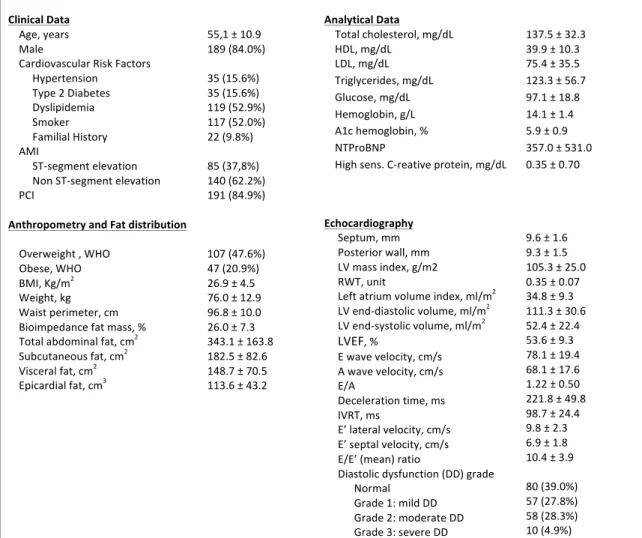
ESULTSThe clinical, anthropometric and analytical characteristics of the study population are summarized in table A.1. Most patients were men (84%), with a mean age of 55.1±10.9 years, 47.6% were overweight and 20.9% were obese. The mean ejection fraction was 53.6±9.3% and the majority of patients (64.4%)) had some degree of diastolic dysfunction: 27.8% had grade 1 DD, 28.3% had grade 2 DD, 4.4% had severe DD and 35.6% had normal diastolic function.
3.1. Diastolic function and adiposity parameters
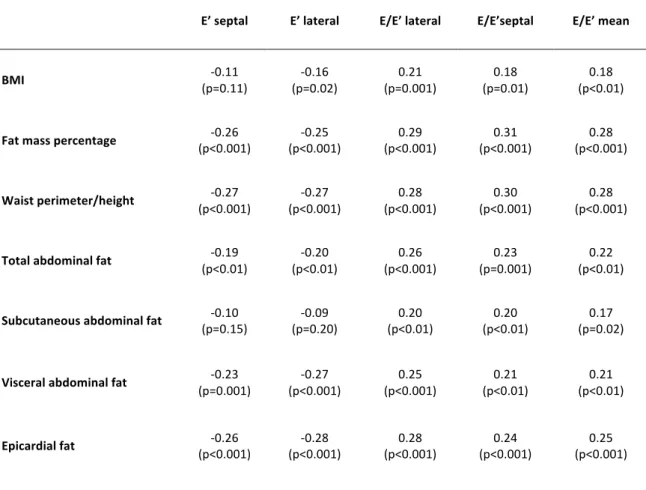
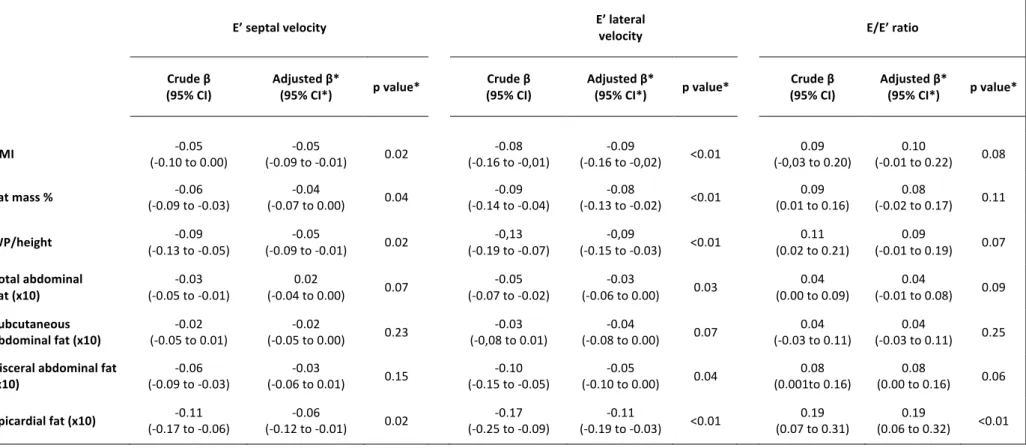
As shown in table A.2, there was a significant correlation between BMI and decreased early diastolic velocity (E’ lateral) and increased LV filling pressures (E/E’ mean). Fat mass percentage, assessed by bioelectric impedance analysis, was also inversely correlated with E’ septal velocity (r= -0.26, p<0.01), E’ lateral velocity (r= -0.25; p<0.01) and E/E’ mean ratio (r= 0.28; p<0.01). On the other hand, as shown in table A.4, there was a significant increase in fat mass percentage, according to the classification in diastolic dysfunction grades (p for trend < 0.01). After multivariate analysis, with adjustment for age, sex and hypertension history, the association between fat mass percentage and early diastolic velocities (E’ septal and lateral) remained significant, as shown in table A.3. The correlation between diastolic function and adiposity parameters is better with central obesity (assessed by waist-perimeter/height) than with total fat parameters, such as BMI (table A.2). Also, the association between waist-perimeter/height and E’ lateral velocity is independent of BMI or fat mass percentage (p<0.01). As shown in table A.3, after multivariate adjustment, for each unit increase in waistperimeter/height there is a decrease of -0.09 (95%CI: -0.15 to -0.03; p<0.01) in E’ lateral velocity (see table A.3).
3.2. Association between diastolic function and abdominal fat mass (total, subcutaneous and visceral fat)
When analysing the association between diastolic function and abdominal fat distribution assessed by CT scan, increased total abdominal fat mass significantly correlated with decreased E’ velocities and increased E/E’ ratios (as shown in table A.2 and in figure A.1). Patients with diastolic dysfunction have increased total abdominal fat mass, as shown in table A.4.
There was a significant correlation between E’ lateral and E’ septal velocities with visceral abdominal fat mass, but not with subcutaneous fat, as shown in table A.2: r= -0.27, p<0.01, between E’ lateral and visceral fat mass versus r= -0.09, p=0.20, between E’ lateral and subcutaneous fat (see also figure A.1). According to the
classification in diastolic dysfunction grades, we saw an increase in visceral abdominal fat (p for trend = 0.01) but not in subcutaneous abdominal fat mass (p for trend = 0.13) with worse diastolic function.
3.3. Epicardial fat volume and diastolic dysfunction
Epicardial fat volume was significantly correlated with all echocardiographic diastolic dysfunction parameters, namely with reduced lateral and septal E’ velocities and with higher septal, lateral and mean E/E’ ratios (table A.2
(p for trend, 0.001), as shown in figure A.4. Patients with any degree of diastolic dysfunction have significantly
higher epicardial fat volumes (116.7±67.9 ml in patients with DD versus 93.0±52.3 ml in patients with normal
diastolic function). The association between epicardial fat volume and E’ lateral velocity is independent of other adiposity parameters (p<0.01 after adjustment for total fat mass percentage, p<0.01 after adjustment for total abdominal fat and p=0.03 after adjustment for visceral fat).
After multivariate regression analysis with adjustment for age, sex and hypertension, increased epicardial fat is associated with a decreased lateral E’ velocity (p<0.01), septal E’ velocity (p=0.02) and an increased E/E’ mean
ratio (p<0.01), as shown in table A.3.
3.4. Association of adiposity parameters with other cardiac structural and functional changes
No significant association was found between total body fat parameters such as BMI, waist-perimeter/height and fat mass percentage with systolic function, namely with ejection fraction or with systolic mitral annulus velocities determined by tissue Doppler (S’ septal and S’ lateral). Also, neither abdominal fat mass (either total fat,
subcutaneous or visceral fat) neither epicardial fat volume correlate with any systolic function parameter (figure A.3).
4.
D
ISCUSSIONIn this study, we analysed the association of several adiposity parameters with diastolic function and observed that: 1) overall, there is a significant association between increased total adiposity and impaired diastolic function; 2) this association seems to be stronger with central/visceral adiposity than with subcutaneous or total fat parameters; and 3) the association of epicardial fat volume with diastolic dysfunction is independent of other cardiovascular risk factors (namely ageing and hypertension), gender and other adiposity parameters. On the contrary, we did not find any association between increased adiposity and systolic function.
The current study is, to the best of our knowledge, the first analysing in detail this recently discovered association between several adiposity parameters, including epicardial fat, and diastolic dysfunction. Fat distribution was analysed with classical anthropometry parameters, but also using CT scan data for determination of total, visceral and subcutaneous abdominal fat mass and epicardial fat volume. CT scan is considered the best method to assess epicardial fat (33). On the other hand, diastolic function was assessed according to the most recent consensus
document for the evaluation of left ventricle diastolic function (29) which recommends the analysis of tissue Doppler derived parameters especially, early mitral annulus velocity (E’ wave) that is a relatively preload-independent index of LV relaxation and the ratio between peak early diastolic mitral inflow velocity and myocardial velocity (E/E’) that can be used to estimate LV filling pressures (29). As recommended, for the categorization in DD grades the integrated diagnostic algorithm was also used which includes the analysis of mitral inflow pattern, tissue Doppler velocities, pulmonary vein flow and left atrium volume(29).
4.1. The relation of diastolic dysfunction with total and central adiposity
Our results are in accordance with very recent studies that have shown an association between increased adiposity and diastolic dysfunction (8, 34). In a general population sample, Russo et al. (34) found an association between increased BMI and reduced early diastolic mitral annulus velocity (E’), increased filling pressures (E/E’) and the presence of diastolic dysfunction. However, it is known that BMI is not a good marker of fat accumulation because it is influenced by several other factors (35). In our study, we have shown that worse diastolic function is associated not only with increased BMI, but also with increased fat mass percentage (assessed by bioelectric impedance), which reinforces the association between fat accumulation and diastolic dysfunction.
This association between obesity and diastolic function was independent of traditional cardiovascular risk factors, suggesting that other pathophysiological mechanisms are responsible for this association. Adipose tissue can modulate the cardiovascular system by several metabolic and neuroendocrine pathways, which include
abnormalities in sodium balance, neuroendocrine activation of the renin-angiotensin-aldosterone axis and of the sympathetic system (36), secretion of adipokines that can directly influence myocardial structure and function (13), low grade-inflammation and increased myocardial oxidative stress (37).
It is also known that visceral adipose tissue is inherently different from subcutaneous fat in several processes involving lipolysis and lipogenesis. Visceral fat is the metabolically most active organ, secreting several adipokines and contributing to a systemic pro-inflammatory state that can affect cardiovascular system (13). On the other hand, inflammation has been linked with diastolic dysfunction in patients with hypertension (38) and coronary artery disease (39) and experimental studies have shown that inhibition of inflammatory pathways can prevent diastolic dysfunction (40). Integrating these recent data, Paulus et al. (41) proposed a novel paradigm for the development of heart failure with preserved ejection fraction which identifies a systemic pro-inflammatory
state (induced by obesity and other comorbidities) as a cause of reduced nitric oxide availability and decreased protein kinase G activity, therefore inducing stiffer cardiomyocytes and interstitial fibrosis deposition and, as a consequence, diastolic dysfunction.
In our study, diastolic dysfunction correlated more strongly with central and visceral adiposity parameters than with measures of total and subcutaneous obesity. A similar finding showing an association between waist-perimeter and diastolic dysfunction, independent of BMI, has also been recently demonstrated in the general population (8). Another study from the Baltimore Longitudinal Study of Aging, in which abdominal visceral and subcutaneous fat was measured using CT scan, also showed that although both visceral and subcutaneous fat were associated with LV diastolic dysfunction, only visceral fat was significantly associated with LV diastolic
dysfunction when both were included in the same model (14). Our data are also in accordance with these findings.
4.2. The association between epicardial fat and diastolic function
In this study we have shown that increased epicardial fat volume was significantly associated with worse diastolic function. This association was independent of other diastolic dysfunction determinants, such as ageing, sex and hypertension history. A similar finding has been recently reported showing an association between epicardial fat thickness (determined by echocardiography), but not visceral adipose tissue, with subclinical diastolic in peritoneal dialysed patients (25).
Epicardial fat has special properties that distinguish it from other visceral fat components. It directly covers the heart and the coronary arteries without any mechanical barrier to the cardiomyocytes and vessels and also sharing
the same blood supply (42).Therefore, becauseEAT is an important source of several inflammatory and
pro-atherogenic cytokines, EAT can have a direct effect on coronary atherosclerosis and/or cardiac structure and function (18, 43). Recently, several studies have recognized increased EAT as an independent determinant of the development and progression of coronary artery disease (CAD) (22, 31, 44), presence of myocardial perfusion abnormalities (45) and vulnerable coronary atherosclerotic plaques (21). EAT is a stronger determinant of CAD than visceral adiposity located in other body compartments (19).
EAT can also directly influence myocardial structure and function by mechanical, systemic and paracrine pathways. The systemic effects of obesity on cardiac function were described above. Our data are in accordance with other studies (25-27) suggesting a direct influence of EAT on diastolic function, possibly mediated by local
mechanical or paracrine effects. First, epicardial fat volume can range from 50 g to >250 g and, therefore, induce an outside compression of the heart which can pose a mechanical limitation to cardiac expansion, further
deteriorating DD (24). Local paracrine inflammatory pathways can also play an important role in this association. In an interesting study, using biopsies of patients undergoing elective CABG, it was shown that epicardial adipose tissue is a local source of several inflammatory mediators (such as IL-1 beta, IL-6, MCP-1, and TNF-alpha) independent of plasma inflammatory biomarkers (16). As stated above, inflammation can induce stiffer
cardiomyocytes, increased interstitial fibrosis deposition and diastolic dysfunction (41). Moreover, EAT can also secrete locally several adipokynes (such as adiponectin, resistin, leptin and others) (16, 46) that can induce changes in myocardial structure and function (42). Finally, EAT is a source of free fatty acids (FFA), leading to the accumulation of myocardial triglycerides, cardiomyocyte apoptosis, oxidative stress and impaired cardiac function(47, 48).
Epicardial fat has also been reported to correlate with structural changes of the heart such as left atrial enlargement (an indirect and chronic marker of diastolic dysfunction), increased LV end-diastolic volume and greater LV mass index (24, 26, 49). However, the amount of EAT doesn’t appear to be directly related with cardiac systolic dysfunction. We found no significant correlation between EAT and any systolic function parameter, including ejection fraction or tissue Doppler derived S’ septal and lateral velocities.
In summary, because epicardial adipose tissue correlates with the incidence and progression of CAD, with changes in myocardial structure and impaired diastolic function it has been proposed that measurement of epicardial fat (preferably by CT scan or, alternatively, by echocardiography) can possibly serve as an additional tool for cardiovascular risk stratification (42). Although further studies are needed before this can be recommended in clinical practice, in a registry of 2751 asymptomatic individuals it has been shown of that adding epicardial fat to standard coronary calcium score and Framingham risk score improves specificity and accuracy in predicting major adverse cardiovascular events (MACE) (50).
4.3. Study limitations
This study follows a cross-sectional design, and therefore it does not allow inferring about causality relation between adiposity parameters and diastolic dysfunction. Longitudinal studies are now required to further assess this association.
Also, we have only included patients after myocardial infarction, and therefore we cannot extrapolate these conclusions to the general population and other cardiac diseases.
4.4.CONCLUSIONS
In this population, impaired diastolic function is associated with increased adiposity parameters, especially with visceral and central fat parameters. The association between epicardial fat volume and diastolic dysfunction is independent of traditional cardiovascular risk factors and other adiposity parameters.
FUNDING SOURCES
This work was supported by Portuguese-Foundation-for-Science-and-Technology Grants
PEst-C/SAU/UI0051/2011 and EXCL/BIM-MEC/0055/2012 (partially funded by FEDER through COMPETE) and European-Commission Grant FP7-Health-2010; MEDIA-261409.
DISCLOSURES None.
R
EFERENCES1. Leite-Moreira AF. Current perspectives in diastolic dysfunction and diastolic heart failure. Heart. 2006 May;92(5):712-8.
2. Paulus WJ, Tschope C, Sanderson JE, Rusconi C, Flachskampf FA, Rademakers FE, et al. How to
diagnose diastolic heart failure: a consensus statement on the diagnosis of heart failure with normal left ventricular ejection fraction by the Heart Failure and Echocardiography Associations of the European Society of Cardiology. Eur Heart J. 2007 Oct;28(20):2539-50.
3. Redfield MM, Jacobsen SJ, Burnett JC, Jr., Mahoney DW, Bailey KR, Rodeheffer RJ. Burden of
systolic and diastolic ventricular dysfunction in the community: appreciating the scope of the heart failure epidemic. JAMA. 2003 Jan 8;289(2):194-202.
4. Aurigemma GP, Gottdiener JS, Shemanski L, Gardin J, Kitzman D. Predictive value of systolic
and diastolic function for incident congestive heart failure in the elderly: the cardiovascular health study. J Am Coll Cardiol. 2001 Mar 15;37(4):1042-8.
5. Bella JN, Palmieri V, Roman MJ, Liu JE, Welty TK, Lee ET, et al. Mitral ratio of peak early to late diastolic filling velocity as a predictor of mortality in middle-aged and elderly adults: the Strong Heart Study. Circulation. 2002 Apr 23;105(16):1928-33.
6. Whalley GA, Gamble GD, Doughty RN. Restrictive diastolic filling predicts death after acute myocardial infarction: systematic review and meta-analysis of prospective studies. Heart. 2006 Nov;92(11):1588-94.
7. Fischer M, Baessler A, Hense HW, Hengstenberg C, Muscholl M, Holmer S, et al. Prevalence of
left ventricular diastolic dysfunction in the community. Results from a Doppler echocardiographic-based survey of a population sample. Eur Heart J. 2003 Feb;24(4):320-8.
8. Canepa M, Strait JB, Abramov D, Milaneschi Y, AlGhatrif M, Moni M, et al. Contribution of
central adiposity to left ventricular diastolic function (from the Baltimore Longitudinal Study of Aging). Am J Cardiol. 2012 Apr 15;109(8):1171-8.
9. Powell BD, Redfield MM, Bybee KA, Freeman WK, Rihal CS. Association of obesity with left ventricular remodeling and diastolic dysfunction in patients without coronary artery disease. Am J Cardiol. 2006 Jul 1;98(1):116-20.
10. Horwich TB, Fonarow GC. Glucose, obesity, metabolic syndrome, and diabetes relevance to
incidence of heart failure. Journal of the American College of Cardiology. [Research Support, N.I.H., Extramural]. 2010 Jan 26;55(4):283-93.
11. Lavie CJ, Milani RV, Ventura HO. Obesity and cardiovascular disease: risk factor, paradox, and impact of weight loss. J Am Coll Cardiol. 2009 May 26;53(21):1925-32.
12. Wong CY, O'Moore-Sullivan T, Leano R, Byrne N, Beller E, Marwick TH. Alterations of left ventricular myocardial characteristics associated with obesity. Circulation. 2004 Nov 9;110(19):3081-7.
13. Falcao-Pires I, Castro-Chaves P, Miranda-Silva D, Lourenco AP, Leite-Moreira AF.
Physiological, pathological and potential therapeutic roles of adipokines. Drug Discov Today. 2012 Aug;17(15-16):880-9.
14. Canepa M, Strait JB, Milaneschi Y, Alghatrif M, Ramachandran R, Makrogiannis S, et al. The relationship between visceral adiposity and left ventricular diastolic function: Results from the Baltimore Longitudinal Study of Aging. Nutr Metab Cardiovasc Dis. 2013 Jun 25.
15. Rabkin SW. Epicardial fat: properties, function and relationship to obesity. Obes Rev. [Review]. 2007 May;8(3):253-61.
16. Mazurek T, Zhang L, Zalewski A, Mannion JD, Diehl JT, Arafat H, et al. Human epicardial adipose tissue is a source of inflammatory mediators. Circulation. [Research Support, Non-U.S. Gov't Research Support, U.S. Gov't, P.H.S.]. 2003 Nov 18;108(20):2460-6.
17. Dutour A, Achard V, Sell H, Naour N, Collart F, Gaborit B, et al. Secretory type II phospholipase A2 is produced and secreted by epicardial adipose tissue and overexpressed in patients with coronary artery disease. J Clin Endocrinol Metab. [Research Support, Non-U.S. Gov't]. 2010 Feb;95(2):963-7. 18. Sacks HS, Fain JN. Human epicardial adipose tissue: a review. Am Heart J. [Review]. 2007 Jun;153(6):907-17.
19. Rosito GA, Massaro JM, Hoffmann U, Ruberg FL, Mahabadi AA, Vasan RS, et al. Pericardial fat, visceral abdominal fat, cardiovascular disease risk factors, and vascular calcification in a community-based sample: the Framingham Heart Study. Circulation. 2008 Feb 5;117(5):605-13.
20. Mahabadi AA, Reinsch N, Lehmann N, Altenbernd J, Kalsch H, Seibel RM, et al. Association of pericoronary fat volume with atherosclerotic plaque burden in the underlying coronary artery: a segment analysis. Atherosclerosis. 2010 Jul;211(1):195-9.
21. Alexopoulos N, McLean DS, Janik M, Arepalli CD, Stillman AE, Raggi P. Epicardial adipose
tissue and coronary artery plaque characteristics. Atherosclerosis. [Research Support, Non-U.S. Gov't]. 2010 May;210(1):150-4.
22. Taguchi R, Takasu J, Itani Y, Yamamoto R, Yokoyama K, Watanabe S, et al. Pericardial fat accumulation in men as a risk factor for coronary artery disease. Atherosclerosis. 2001 Jul;157(1):203-9.
23. Mahabadi AA, Massaro JM, Rosito GA, Levy D, Murabito JM, Wolf PA, et al. Association of
pericardial fat, intrathoracic fat, and visceral abdominal fat with cardiovascular disease burden: the Framingham Heart Study. Eur Heart J. 2009 Apr;30(7):850-6.
24. Fox CS, Gona P, Hoffmann U, Porter SA, Salton CJ, Massaro JM, et al. Pericardial fat, intrathoracic fat, and measures of left ventricular structure and function: the Framingham Heart Study. Circulation. [Research Support, N.I.H., Extramural]. 2009 Mar 31;119(12):1586-91.
25. Lin HH, Lee JK, Yang CY, Lien YC, Huang JW, Wu CK. Accumulation of epicardial fat rather
than visceral fat is an independent risk factor for left ventricular diastolic dysfunction in patients undergoing peritoneal dialysis. Cardiovasc Diabetol. 2013 Aug 30;12(1):127.
26. Konishi M, Sugiyama S, Sugamura K, Nozaki T, Matsubara J, Akiyama E, et al. Accumulation of
pericardial fat correlates with left ventricular diastolic dysfunction in patients with normal ejection fraction. Journal of cardiology. 2012 May;59(3):344-51.
27. Iacobellis G, Leonetti F, Singh N, A MS. Relationship of epicardial adipose tissue with atrial dimensions and diastolic function in morbidly obese subjects. Int J Cardiol. 2007 Feb 7;115(2):272-3.
28. Lang RM, Bierig M, Devereux RB, Flachskampf FA, Foster E, Pellikka PA, et al.
29. Nagueh SF, Appleton CP, Gillebert TC, Marino PN, Oh JK, Smiseth OA, et al. Recommendations for the evaluation of left ventricular diastolic function by echocardiography. Eur J Echocardiogr. 2009 Mar;10(2):165-93.
30. Borkan GA, Gerzof SG, Robbins AH, Hults DE, Silbert CK, Silbert JE. Assessment of abdominal
fat content by computed tomography. Am J Clin Nutr. 1982 Jul;36(1):172-7.
31. Bettencourt N, Toschke AM, Leite D, Rocha J, Carvalho M, Sampaio F, et al. Epicardial adipose tissue is an independent predictor of coronary atherosclerotic burden. Int J Cardiol. 2012 Jun
28;158(1):26-32.
32. Bettencourt N, Oliveira S, Toschke AM, Rocha J, Leite D, Carvalho M, et al. Predictors of circulating endothelial progenitor cell levels in patients without known coronary artery disease referred for multidetector computed tomography coronary angiography. Rev Port Cardiol. 2011 Oct;30(10):753-60.
33. Marwan M, Achenbach S. Quantification of epicardial fat by computed tomography: why, when
and how? J Cardiovasc Comput Tomogr. 2013 Jan-Feb;7(1):3-10.
34. Russo C, Jin Z, Homma S, Rundek T, Elkind MS, Sacco RL, et al. Effect of obesity and overweight on left ventricular diastolic function: a community-based study in an elderly cohort. J Am Coll Cardiol. 2011 Mar 22;57(12):1368-74.
35. Cornier MA, Despres JP, Davis N, Grossniklaus DA, Klein S, Lamarche B, et al. Assessing adiposity: a scientific statement from the American Heart Association. Circulation. 2011 Nov 1;124(18):1996-2019.
36. Gorzelniak K, Engeli S, Janke J, Luft FC, Sharma AM. Hormonal regulation of the human
adipose-tissue renin-angiotensin system: relationship to obesity and hypertension. J Hypertens. 2002 May;20(5):965-73.
37. Vincent HK, Powers SK, Stewart DJ, Shanely RA, Demirel H, Naito H. Obesity is associated with increased myocardial oxidative stress. Int J Obes Relat Metab Disord. 1999 Jan;23(1):67-74.
38. Sciarretta S, Ferrucci A, Ciavarella GM, De Paolis P, Venturelli V, Tocci G, et al. Markers of inflammation and fibrosis are related to cardiovascular damage in hypertensive patients with metabolic syndrome. Am J Hypertens. 2007 Jul;20(7):784-91.
39. Williams ES, Shah SJ, Ali S, Na BY, Schiller NB, Whooley MA. C-reactive protein, diastolic dysfunction, and risk of heart failure in patients with coronary disease: Heart and Soul Study. Eur J Heart Fail. 2008 Jan;10(1):63-9.
40. Westermann D, Van Linthout S, Dhayat S, Dhayat N, Schmidt A, Noutsias M, et al. Tumor
necrosis factor-alpha antagonism protects from myocardial inflammation and fibrosis in experimental diabetic cardiomyopathy. Basic research in cardiology. [Research Support, Non-U.S. Gov't]. 2007 Nov;102(6):500-7.
41. Paulus WJ, Tschope C. A novel paradigm for heart failure with preserved ejection fraction: comorbidities drive myocardial dysfunction and remodeling through coronary microvascular endothelial inflammation. J Am Coll Cardiol. 2013 Jul 23;62(4):263-71.
42. Iacobellis G, Corradi D, Sharma AM. Epicardial adipose tissue: anatomic, biomolecular and clinical relationships with the heart. Nat Clin Pract Cardiovasc Med. [Review]. 2005 Oct;2(10):536-43. 43. Iozzo P. Myocardial, perivascular, and epicardial fat. Diabetes Care. 2011 May;34 Suppl 2:S371-9.
44. Raggi P, Alakija P. Epicardial adipose tissue: A long-overlooked marker of risk of cardiovascular disease. Atherosclerosis. 2013 Mar 6.
45. Janik M, Hartlage G, Alexopoulos N, Mirzoyev Z, McLean DS, Arepalli CD, et al. Epicardial adipose tissue volume and coronary artery calcium to predict myocardial ischemia on positron emission tomography-computed tomography studies. J Nucl Cardiol. 2010 Oct;17(5):841-7.
46. Baker AR, Silva NF, Quinn DW, Harte AL, Pagano D, Bonser RS, et al. Human epicardial
adipose tissue expresses a pathogenic profile of adipocytokines in patients with cardiovascular disease. Cardiovasc Diabetol. [Randomized Controlled Trial
Research Support, Non-U.S. Gov't]. 2006;5:1.
47. Malavazos AE, Di Leo G, Secchi F, Lupo EN, Dogliotti G, Coman C, et al. Relation of
echocardiographic epicardial fat thickness and myocardial fat. Am J Cardiol. 2010 Jun 15;105(12):1831-5.
48. van der Meer RW, Rijzewijk LJ, Diamant M, Hammer S, Schar M, Bax JJ, et al. The ageing male heart: myocardial triglyceride content as independent predictor of diastolic function. Eur Heart J. 2008 Jun;29(12):1516-22.
49. Liu J, Fox CS, Hickson DA, May WL, Ding J, Carr JJ, et al. Pericardial fat and
echocardiographic measures of cardiac abnormalities: the Jackson Heart Study. Diabetes Care. 2011 Feb;34(2):341-6.
50. Cheng VY, Dey D, Tamarappoo B, Nakazato R, Gransar H, Miranda-Peats R, et al. Pericardial
fat burden on ECG-gated noncontrast CT in asymptomatic patients who subsequently experience adverse cardiovascular events. JACC Cardiovasc Imaging. 2010 Apr;3(4):352-60.
LEGENDS
Figure A.1. Measurement of epicardial fat volume by computed tomography.
The level of the axial slices used for pericardial delineation is shown in a coronal projection. EAT was identified within the limits of pericardium sac using the adipose tissue attenuation references (-50 to -150 HU). Pericardium contour was traced for every 10 mm, starting from the lower visible level of pulmonary artery bifurcation until the top level of the pulmonary valve; for every 20 mm from there until the first slice where the diaphragm becomes visible; and for every 10mm from this point until the last slice where pericardium is still visible. Final EAT volume quantification was calculated as the sum of all slices fat values.
Figure A.2. Scatter plots showing the association between several adiposity parameters and diastolic function, assessed by E’ lateral velocity
r: correlation coefficient between the two variables
Figure A.3. Distribution of epicardial fat volume according to diastolic dysfunction grades.
* p<0.05 compared to patients with normal diastolic function;
Table 1 – Characterization of the study population
Data are expressed as mean ± standard deviation or number (percentage). AMI, acute myocardium inflation; PCI, percutaneous Coronary Intervention; WHO, World Health Organization; BMI, body mass index; HDL, high-‐density lipoprotein; LDL, low-‐density lipoprotein; NTProBNP, N-‐terminal pro-‐brain natriuretic peptide; LV, left ventricle; RWT, relative wall thickness; LVEF, left ventricular ejection fraction; E, transmitral flow velocity during early ventricular filling; A, transmitral flow velocity during atrial contraction; E’ lateral, tissue Doppler velocity at the lateral wall of the mitral annulus level during early ventricular filling; E’ septal, Tissue Doppler velocity at the septal wall of the mitral annulus level during early ventricular filling.
Clinical Data Age, years Male
Cardiovascular Risk Factors Hypertension Type 2 Diabetes Dyslipidemia Smoker Familial History AMI ST-‐segment elevation Non ST-‐segment elevation PCI
Anthropometry and Fat distribution Overweight , WHO Obese, WHO BMI, Kg/m2 Weight, kg Waist perimeter, cm
Bioimpedance fat mass, %
Total abdominal fat, cm2
Subcutaneous fat, cm2 Visceral fat, cm2 Epicardial fat, cm3 55,1 ± 10.9 189 (84.0%) 35 (15.6%) 35 (15.6%) 119 (52.9%) 117 (52.0%) 22 (9.8%) 85 (37,8%) 140 (62.2%) 191 (84.9%) 107 (47.6%) 47 (20.9%) 26.9 ± 4.5 76.0 ± 12.9 96.8 ± 10.0 26.0 ± 7.3 343.1 ± 163.8 182.5 ± 82.6 148.7 ± 70.5 113.6 ± 43.2 Analytical Data Total cholesterol, mg/dL HDL, mg/dL LDL, mg/dL Triglycerides, mg/dL Glucose, mg/dL Hemoglobin, g/L A1c hemoglobin, % NTProBNP
High sens. C-‐reative protein, mg/dL Echocardiography Septum, mm Posterior wall, mm LV mass index, g/m2 RWT, unit
Left atrium volume index, ml/m2
LV end-‐diastolic volume, ml/m2
LV end-‐systolic volume, ml/m2
LVEF, %
E wave velocity, cm/s A wave velocity, cm/s E/A
Deceleration time, ms IVRT, ms
E’ lateral velocity, cm/s E’ septal velocity, cm/s E/E’ (mean) ratio
Diastolic dysfunction (DD) grade Normal Grade 1: mild DD Grade 2: moderate DD Grade 3: severe DD 137.5 ± 32.3 39.9 ± 10.3 75.4 ± 35.5 123.3 ± 56.7 97.1 ± 18.8 14.1 ± 1.4 5.9 ± 0.9 357.0 ± 531.0 0.35 ± 0.70 9.6 ± 1.6 9.3 ± 1.5 105.3 ± 25.0 0.35 ± 0.07 34.8 ± 9.3 111.3 ± 30.6 52.4 ± 22.4 53.6 ± 9.3 78.1 ± 19.4 68.1 ± 17.6 1.22 ± 0.50 221.8 ± 49.8 98.7 ± 24.4 9.8 ± 2.3 6.9 ± 1.8 10.4 ± 3.9 80 (39.0%) 57 (27.8%) 58 (28.3%) 10 (4.9%)
E’ septal E’ lateral E/E’ lateral E/E’septal E/E’ mean
BMI (p=0.11) -‐0.11 (p=0.02) -‐0.16 (p=0.001) 0.21 (p=0.01) 0.18 (p<0.01) 0.18
Fat mass percentage (p<0.001) -‐0.26 (p<0.001) -‐0.25 (p<0.001) 0.29 (p<0.001) 0.31 (p<0.001) 0.28
Waist perimeter/height (p<0.001) -‐0.27 (p<0.001) -‐0.27 (p<0.001) 0.28 (p<0.001) 0.30 (p<0.001) 0.28
Total abdominal fat (p<0.01) -‐0.19 (p<0.01) -‐0.20 (p<0.001) 0.26 (p=0.001) 0.23 (p<0.01) 0.22
Subcutaneous abdominal fat (p=0.15) -‐0.10 (p=0.20) -‐0.09 (p<0.01) 0.20 (p<0.01) 0.20 (p=0.02) 0.17
Visceral abdominal fat (p=0.001) -‐0.23 (p<0.001) -‐0.27 (p<0.001) 0.25 (p<0.01) 0.21 (p<0.01) 0.21
Epicardial fat -‐0.26 (p<0.001) -‐0.28 (p<0.001) 0.28 (p<0.001) 0.24 (p<0.001) 0.25 (p<0.001)
Table 2 -‐ Correlation coefficients between several adiposity parameters and diastolic function.
Table 3 – Univariate and multivariate linear regression analyses for the association of diastolic function parameters (E’ velocity and E/E’ ratio) with adiposity parameters.
*Adjusted for age, hypertension history, sex.
β, regression coefficient. 95%CI, 95% confidence interval
E’ septal velocity
E’ lateral velocity E/E’ ratio Crude β (95% CI) Adjusted β* (95% CI*) p value* Crude β (95% CI) Adjusted β* (95% CI*) p value* Crude β (95% CI) Adjusted β* (95% CI*) p value* Weight BMI -‐0.05 (-‐0.10 to 0.00) -‐0.05 (-‐0.09 to -‐0.01) 0.02 -‐0.08 (-‐0.16 to -‐0,01) -‐0.09 (-‐0.16 to -‐0,02) <0.01 0.09 (-‐0,03 to 0.20) 0.10 (-‐0.01 to 0.22) 0.08
Fat mass % (-‐0.09 to -‐0.03) -‐0.06 (-‐0.07 to 0.00) -‐0.04 0.04 (-‐0.14 to -‐0.04) -‐0.09 (-‐0.13 to -‐0.02) -‐0.08 <0.01 (0.01 to 0.16) 0.09 (-‐0.02 to 0.17) 0.08 0.11 WP/height (-‐0.13 to -‐0.05) -‐0.09 (-‐0.09 to -‐0.01) -‐0.05 0.02 (-‐0.19 to -‐0.07) -‐0,13 (-‐0.15 to -‐0.03) -‐0,09 <0.01 (0.02 to 0.21) 0.11 (-‐0.01 to 0.19) 0.09 0.07 Total abdominal Fat (x10) -‐0.03 (-‐0.05 to -‐0.01) 0.02 (-‐0.04 to 0.00) 0.07 -‐0.05 (-‐0.07 to -‐0.02) -‐0.03 (-‐0.06 to 0.00) 0.03 0.04 (0.00 to 0.09) 0.04 (-‐0.01 to 0.08) 0.09 Subcutaneous abdominal fat (x10) -‐0.02 (-‐0.05 to 0.01) -‐0.02 (-‐0.05 to 0.00) 0.23 -‐0.03 (-‐0,08 to 0.01) -‐0.04 (-‐0.08 to 0.00) 0.07 0.04 (-‐0.03 to 0.11) 0.04 (-‐0.03 to 0.11) 0.25
Visceral abdominal fat
(x10) (-‐0.09 to -‐0.03) -‐0.06 (-‐0.06 to 0.01) -‐0.03 0.15
-‐0.10
(-‐0.15 to -‐0.05) (-‐0.10 to 0.00) -‐0.05 0.04
0.08
(0.001to 0.16) (0.00 to 0.16) 0.08 0.06
Normal Diastolic function (n=80) Grade 1 DD (n= 57) Grade 2 DD (n= 58) Grade 3 DD (n= 10) p value (for trend) BMI 25.8 ± 4.23 26.9 ± 5.6 26.8 ± 3.7* 25.7 ± 10.9 0.17 Fat mass % 22.1 ± 7.9 25.5 ± 11.7† 25.9 ± 9.2† 24.8 ± 16.1 <0.01 Waist perimeter/height 55.4 ± 7.0 58.3.0 ± 7.1† 58.5 ± 7.9† 56.2 ± 15.4 <0.01 Total abdominal fat 270.0 ± 151.6 331.1 ± 149.3* 321.0 ± 170.5† 308.8 ±300.6 0.02 Subcutaneous abdominal fat 155.32 ± 90.5 165.4 ± 99.6 175.3 ±74.7 194.4 ± 135.9 0.13 Visceral abdominal fat 111.6 ± 103.7 141.0 ± 75.9† 160.0 ± 88.8† 134.0 ± 155.6 0.01 Epicardial fat 93.0 ± 52.3 111.15 ± 60.2* 117.15 ± 64.3† 136.4 ± 83.1† 0.001 Table 4 – Distribution of adiposity parameters according to diastolic function grades.
Data expressed as median ± interquartile range;
* p<0.05 compared to patients with normal diastolic function;
† p<0.01 compared to patients with normal diastolic function
Figure A.1. Measurement of epicardial fat volume by computed tomography.
Figure A.3. Distribution of epicardial fat volume according to diastolic dysfunction grades.
Agradecimentos
Ao Dr. Ricardo Fontes Carvalho, agradeço a orientação, a constante disponibilidade, o
empenho e motivação que me transmitiu na elaboração desta dissertação. Sem a sua
orientação não seria possível concretizá-la.
Ao Professor Doutor Adelino Leite Moreira, agradeço a disponibilidade, colaboração e
oportunidade de trabalhar com o Departamento de Fisiologia e Cirurgia Cardiotorácica da
Faculdade de Medicina da Universidade do Porto.
Ao Dr. Vasco Gama Ribeiro, agradeço a colaboração e disponibilidade sempre demonstradas
pelo Serviço de Cardiologia do Centro Hospital de Vila Nova de Gaia/Espinho.
À família, e em especial à mãe Isabel Fontes, agradeço o apoio e a motivação persistentes ao
longo deste percurso.
Anexos
European Journal of Heart Failure
INSTRUCTIONS TO AUTHORS
Scope of the Journal
The European Journal of Heart Failure is the International Journal of the European Society of Cardiology dedicated to the advancement of knowledge in the field of heart failure. The Journal publishes reviews and editorials in order to improve the understanding, prevention, investigation and treatment of heart failure. Molecular and cellular biology, pathology, physiology, electrophysiology, pharmacology, as well as the clinical, social and population sciences all form part of the discipline that is heart failure. Accordingly, submission of manuscripts on basic, clinical and population sciences is invited. Original contributions on nursing, care of the elderly, primary care, health economics and other specialist fields related to heart failure are also welcome.
HEART Network
The European Journal of Heart Failure participates in the HEART network which is a network of Editors from most cardiovascular journals. Information is exchanged between editors on a regular
basis. The network has recently approved a common ethics standard.
Its purpose is to ensure transparency and honesty in the scientific process that promotes ethical conduct
in performance and publication of research.
The following will be considered as parts of this process:
a. Disclosure of potential conflicts of interest for all involved in the performance of research and in the evaluation and publication process of a manuscript. Relevant relationships with commercial interests should be disclosed according to the guidelines of the journal's sponsoring society, or, when no such
guidelines exist, according to those of the AHA, ACC, or ESC.
b. establish thorough review processes particularly alert to discovering scientific fraud and data falsification, redundant or duplicate publication, and plagiarism, and to adopt a uniform standard of
dealing with authors guilty of fraudulent practices.
c. to maintain confidentiality and embargos where appropriate.
d. to create uniform criteria to establish authorship. To qualify for authorship, individuals must have made substantial contributions to the intellectual content of the paper in at least one of the following areas: conceived and designed the research, acquired the data, analyzed and interpreted the data, performed statistical analysis, handled funding and supervision, drafted the manuscript, or made critical revision of the manuscript for important intellectual content. Authors must give final approval of the version to be submitted and any revised version to be published. For multi-centre trials, individuals who accept direct responsibility for the manuscript should fully meet the criteria for authorship defined above and contributors not meeting these criteria should be acknowledged. e. avoidance of false claims of ownership, priority, by attention to previous publications. f. avoidance of excessive claims of benefits of a product/technique, in the publication as well as with news media.
g. noting compliance with institutional review board requirements and, when appropriate, approved laboratory procedures for animal research, and that the research conforms to the ethical standards of the Declaration of Helsinki, the Geneva Declaration, the Belmont Report, and Good Clinical Practices from the FDA, and the submission conforms to the International Committee of Medical Journal Editors (ICMJE): Uniform Requirements for Manuscripts Submitted to Biomedical Journals: writing and editing for biomedical publication (Haematologica 89:264, 2005).
Article categories
The European Journal of Heart Failure accepts the following categories of articles:
Full Length Articles These should not exceed 3500 words (excluding references, tables and figures) and may include up to a maximum of 6 figures and/or tables and up to 30 references. Full length
articles should be divided into the following sections: (1) Title page, (2) Abstract and up to six Keywords, (3) Introduction, (4) Methods, (5) Results, (6) Discussion, (7) Acknowledgements, (8) Funding, (9) Conflict of Interest, (10) References, (11) Figure legends, (12) Appendices, (13) Tables, (14) Figures. The Abstract should be divided into the following sections 'Aims', 'Methods and results' and 'Conclusion', it should not exceed 250 words.
Reviews The European Journal of Heart Failure publishes a limited number of scholarly, comprehensive review papers. Reviews should not exceed 3500 words. They should summarize and critically evaluate research in the subject area, and should discuss implications for the future. Reviews have unstructured abstracts with no headings, which should not exceed 250 words and may include up to 45-50 references. Please see below for systematic reviews.
Systematic Reviews: These reviews should follow the format of full length articles, please see above for the required format. These should be submitted as a full length article during the submission process. Editorials All editorials should be limited to 1500 words (excluding references), with a maximum of 15 references. They do not require an abstract.
Short Reports These reports should not exceed 1500 words and should comprise a background section (~100 words), aims (~50 words), methods (~300 words), results (300 words) and conclusion (250 words). The editorial team reserves the right to decide which of the tables/figures submitted are necessary. A structured abstract not exceeding 250 words is also required for Internet purposes. Letters to the Editor Relevant correspondence will be considered. This should not exceed 400 words in length excluding references.
Case Reports These reports should not exceed 1200 words. Case Reports should include an unstructured Abstract with no subheadings (not exceeding 100 words), and Introduction, a description of the case(s) under the heading “Case Report” and a discussion of the findings in the context of current practice.
Study Design Papers These should not exceed 3500 words (excluding references, tables, and figures) and may include up to a maximum of 6 figures and/or tables and up to 30 references. Study design papers should be divided into the following sections: (1) Title page, (2) Abstract and up to six Keywords, (3) Introduction, (4) Study Design, (5) Discussion, (6) Acknowledgements, (7) Funding, (8) Conflict of Interest, (9) References, (10) Figure legends, (11) Appendices, (12) Tables, (13) Figures. The Abstract should be divided into the following sections 'Aims', 'Methods', and 'Conclusion', it should not exceed 250 words.
Submission of manuscripts
The European Journal of Heart Failure uses a web-based submission and review system at www.editorialmanager.com/eurjhf/. Online submission facilitates the submission of manuscripts
from authors and streamlines the reviewing and publication process.
Authors may send queries concerning the submission process [email protected]. For
enquiries about the review process and journal procedures, the editorial office can be contacted at +44 1482 461778. As a matter of policy, the status of documents will not be discussed by telephone. Once you have prepared your manuscript according to the instructions below, please go to the online
submission system by clicking here. First-time users must click "Register" on the navigation menu at
the top of the screen. The system will send an automatic e-mail with your user name and password. Detailed guidelines for authors and reviewers are available at the submission site.
Covering letter The covering letter should include the following:
i) a declaration that "the manuscript, or part of it, has neither been published (except in the form of abstract or thesis) nor is currently under consideration for publication by any other journal"; ii) an explanation as to why your paper would be of particular interest to the readers of the European
Journal of Heart Failure;
iii) a statement declaring that all named authors have seen and approved the final version of the manuscript.
Short title: Published papers include a running header (max. 80 characters), which is a shortened version of the article title. Please insert a suggested short title in the ‘Short title’ field on the submission screen.
Review of manuscripts
All manuscripts correctly submitted to the European Journal of Heart Failure will first be reviewed by the Editors. Some manuscripts will be returned to authors at this stage if the paper is deemed inappropriate for publication in the European Journal of Heart Failure, if the paper does not meet submission requirements, or if the paper is not deemed to have a sufficiently high priority. All papers considered suitable by the Editors to progress further in the review process will undergo appropriate peer review and all papers provisionally accepted for publication may undergo a detailed statistical review.
Manuscripts will usually be evaluated by at least two reviewers from an international panel. Editors will make every effort to reach a decision within 6 to 8 weeks of receipt of the manuscript but on some
occasions, due to reasons beyond our control, this may take longer.
Authors may supply the names and addresses of three referees to whom the manuscript might be sent for review.
Preparation of manuscripts
Style and spelling: Oxford English spelling should be used. Authors whose first language is not English are requested to have their manuscripts checked carefully before submission. This will help expedite
the review process and avoid confusion.
General format: Prepare your manuscript text using a Word processing package (save in .doc or .rtf format). Submissions of text in the form of PDF files are not permitted. Manuscripts should be
double-spaced, including text, tables, legends and references.
Number each page. Please avoid footnotes; use instead, and as sparingly as possible, notes within brackets. Enter text in the style and order of the journal. Type references in the correct order and style of the journal. Type unjustified, without hyphenation, except for compound words (where two words are joined to form a new word e.g. end-systolic, non-infarcted). Type headings in the style of the journal. Use the TAB key once for paragraph indents. Where possible use Times New Roman for the text font and Symbol for Greek and special characters. Use the word processing formatting features to indicate Bold, Italic, Greek, Maths, Superscript and Subscript characters. Clearly identify unusual symbols and Greek letters. Differentiate between the letter O and zero, and the letters I and l and the number 1.
Check the final copy of your paper carefully, as any spelling mistakes and errors may be translated into
the typeset version.
Abbreviations of standard SI units of measurement only should be used.
Declaration of Helsinki: The authors should state that their study complies with the Declaration of Helsinki, that the locally appointed ethics committee has approved the research protocol and that
informed consent has been obtained from the subjects (or their guardians).
DNA Sequences and GenBank Accession Number: For each and every gene accession number cited in an article, authors should type the accession number in bold, underlined text. Letters in the accession
number should always be capitalised. Example: (GenBank accession nos.
AI631510, AI631511, AI632198 and BF223228 ), a B-cell tumor from a chronic lymphatic leukemia (GenBank accession no. BE675048), and a T-cell lymphoma (GenBank accession no. AA361117). Title Page: The title page should include the following: (1) the title, (2) the name(s) of authors, (3) the institution(s) where work was performed, (4) the position, institution, and location of all authors, (5) the telephone number, fax number and e-mail address of the corresponding author (6) the institutional affiliations of the authors (including corporate appointments) should be acknowledged in a footnote. Abstract: All abstracts may not contain more than 250 words and should also be submitted as a separate file. The abstract should be formatted with the following heading: (1) Aims, (2) Methods and