Impact-focused enterprises, the BOP and the Future:
The case of East Africa
Daniel Silveira [152117270]
Dissertation submitted in partial fulfillment of the requirements for the degree of MSc in Business Administration at Católica-Lisbon School of Business & Economics
Thesis written under the supervision of Prof. Marta Bicho
Resumo
Título: Companhias com foco em Impacto, o BOP e o Futuro: O caso de África de Leste Autor: Daniel Silveira
O future é incerto, é expectável que algumas vozes estejam a pronunciar-se sobre o sector privado a intervir em mais esferas da sociedade para além da coleção de capital. No entanto serão as companhias tradicionais capazes de responder?
A tese foca-se em alternativas de modelos de negócios, companhias com foco em impacto, que estão presentemente a ser exploradas para aliviar as preocupações derivadas do capitalismo do século 21 numa das camadas mais afetadas, discutir a sua viabilidade e como chegar ao futuro que essas alternativas propõem.
Para este propósito, a tese encarou a problemática de duas formas: a análise de documentos em relação ao crescimento destas companhias e várias entrevistas com profissionais e especialistas presentes nas indústrias desta alternativa. O estudo sugere que as multinacionais não estão preparadas um futuro lucrativo e benéfico com as camadas pobres da população, apesar do potencial destas últimas. No entanto, há tipos de organizações que estão a ter sucesso relativo; a tese tenta perceber o seu trabalho para perceber que lições podem ser retiradas, se eles são capazes de responder às preocupações ambientais e socias e se conseguem contribuir para um futuro nestas camadas populacionais.
O que foi encontrado sugere um aumento no crescimento e na atenção face a companhias com foco no impacto e como o seu ethos é similar às ideias defendidas pela teoria do BOP. Sugere adições às noções contemporâneas do mercado do BOP e como ser uma companhia bem-sucedida dentro deste.
Key words: Companhias multinacionais, Teoria do BOP, Camada do BOP, Companhias com foco no Impacto, Futuro
Abstract
Title: Impact-focused enterprises, the BOP and the Future: The case of East Africa Author: Daniel Falcão Silveira
The future is uncertain, it is expected that some voices are asking the private sector to intervene in more spheres of society than collecting capital. However, are traditional businesses capable of answering these calls?
This thesis focuses on the business-alternatives, impact focused enterprises, which are presently being explored to alleviate the concerns of 21st century capitalism in the most affected layer of all, to discuss its viability and how to reach the future this alternative proposes.
For this purpose, the thesis approached the problematic in two ways: analysis of reports regarding the growth of these enterprises and several interviews to experts in the industries of these businesses were conducted. The study suggests that multinational companies are unfit to perpetuate a lucrative and benefic future with poor layers of the population, despite its potential. However, there are types of organizations that are having mild success at it; the thesis tries to understand their work and perceptions in order to understand what can be the lessons retained, and contribute for a better future at these layers.
The findings suggest an increased growth and attention regarding impact-focused enterprises and how their ethos is similar to the ideas defended by the BOP theory. It adds to the contemporaneous notions of how to approach the BOP market and how to be a successful enterprise amongst it. This thesis also addresses the need to study individual characteristics of BOP layers and provides insights to managers and investors.
Acknowledgments
Words can never truly express how thankful I am to those who helped me throughout this phase in my life. Some words are better said than written, but important nonetheless.
To my adviser, Professora Marta Bicho, thank you for not giving up and for always having the most patient and positive mindset. Even small positive notes alongside heavy emails helped tremendously. Thank you for your constant readiness and respected feedback, both were vital for the development of this thesis.
To my family and friends, to which I will thank individually, thank you. For believing in me even if I did not. For not giving up when I had already done it. For the motivation, the patience, the incredible support and the conversations that brought me back and guided me. Thank you sincerely.
To all the professional and personal obstacles and problems I endured during this especially hard time in my life, that gave me no choice other than to rise and face improvement and hope, thank you. The person that they have made me into is a much prouder and more motivated one than I could never be if not for them.
Index
1. Introduction ... 6
1.2. Managerial Relevance & Theoretical Contributions ... 9
2. Literature Review ... 10
2.1. Bottom of the Pyramid (BOP) ... 10
2.2. Impact of Multinational Corporations ... 14
2.3. Hybrid Companies in Africa ... 16
2.4. Impact Investment ... 17
3. Methodology and Data collection ... 23
3.1. Research setting- Sub-Saharan Africa as a test tube ... 24
3.2. Secondary Data Analysis... 26
3.2.1. Sub- Saharan Africa ... 27
3.2.2. East Africa ... 30
3.3. Primary Data Analysis ... 36
4. Main Findings and Discussion... 38
4.1. Mindsets ... 38
4.2. Challenges... 42
4.3. Main takeaway ... 45
5. Conclusions ... 48
5.1. Limitations and Future Research ... 50
6. Appendix ... 51
1. Introduction
In recent times we have seen significant advances in sustainability. New products are created every day, such as Tesla’s durable and cheap sun tiles and Massachusetts University transparent solar panels which goal is to serve as windows. The investment on sustainability is rising, shown by the recent doubling down in investment regarding climate action by the World Bank to 200 billion dollars in its 5-year investments program (World Bank, 2018). The legislative institutions are passing bills that fill certain voids for companies that focus in garnering non-financial value (Strom, 2011). The value of impact-oriented projects seems to be becoming increasingly conspicuous because of the increase of attention it has enjoyed (Dallmann, 2018).
As such we should attempt to analyze closely the aspects in which this attention has derived from and what is the current stance of perspectives regarding the future of these investments. One way to address this is to observe the business of impact-focused companies (i.e: Cookswell, Cleanfund) - which for this thesis refers to hybrid companies and impact investors - in one of the most vulnerable economical layers and note its survivability and development alongside a theoretical framework (UNDP, 2018).
East Africa has a plethora of vulnerabilities, for example, regarding social it can be noted the high level of unemployment; environmentally, the destruction of ecosystems in order for communities to survive; economically, the lack of capital in order to satisfy primary needs (i.e.: food, medicine, etc). In addition, has potential to raise strong sustainability-oriented industries and has comparable stability (in contrast with other African regions). Hence it seems indicative that it is a good setting to analyze.
The BOP theory is the name given to the presently existing human sphere on the globe of four billion individuals that live on less than 2$/day, (Prahalad 2012; Hammond, Kramer, Katz, Tran, and Walker, 2007; Sharma and Jaiswal, 2017). According to the World Resources Institute (2007), it has an overall purchasing power parity of $5 trillion, making it an unexplored and hence untapped market for private companies. Most of this sector is informal, inefficient and unorganized.
In order to garner the economic value of the BOP, the key is to gather these fragmented markets unto common sustainable missions (Prahalad, 2007). An increasing number of authors (Delios, 2010; Guthrie and Durand, 2008) believes that it is essential for any corporation to have an active role and lengthy in social and environmental problematics. At least half of the world largest economies were multinational companies (Cavanagh and Anderson 2000). Hence it was a logically conclusion that these corporations should be the ones pursuing it, as they would have relatively bigger capabilities to explore this “uncharted land” and capture its value (Prahalad and Hart, 2005). The theory resonated poorly. There are cases of multinationals being able to reach the BOP but with only intentions of using cheap manpower, there was no foresight to see focus on more than providing jobs (Munir, Gregg and Ansari, 2010). The reasons seem to point out to the disruptive nature of the changes the corporations needed to partake in (The Guardian, 2014; Hart 2016), both technologically-wise and structurally (i.e. trickle-up returns; size). Hart (2014) justified these claims by acknowledging that the premature expectation of returns has killed many ventures that attempt to penetrate the BOP market. They lack adapted capabilities and true knowledge and connection with their markets (Hart 2016), by being mostly “imported” to a market so disfranchised of their own knowledge and precedent-based procedures.
From another view, there are organizations – hybrid organizations – and a ramification of investment that focus on the previous enterprises - impact investment - that combine financial objectives with value in the social and environmental sphere (Jay, 2013; Porter and Kramer, 2011), that equally attend to the needs of communities but also make use of aptitudes of developing nations in serving markets with their products and services (Holt and Littlewood, 2015) and that have been fairly successful.
As Hart (2016) suggested, new models and lexicon have grown to the academic eye that could supply important input with it. This was a far cry from old beliefs that only traditional corporations were the ones with capacities to be able to adjust to the bottom of the pyramid and that the focus should be in the primary stakeholders (Frooman, 1999; Hillman and Keim, 2001). As it was suggested by the title “Impact-focused enterprises, the BOP and the Future”, the connection between the mentioned enterprises and the BOP is a relevant one. The BOP is the layer that is most affected and exposed to negative consequences of traditional companies’ business (Oshionebo, 2018). Impact-focused enterprises wish for the betterment of communities and of the
surroundings that affect them, directly and indirectly (Yunus and Weber, 2007). As such the pertinent question is these sorts of companies can be the future for capturing and creating value derived from these investments in this layer.
The thesis strives to understand the current paradigm in East Africa and regards that impact-focused enterprises such as impact investment firms and hybrid companies are the future to penetrating the BOP layer. In order to do so, Africa was chosen as a test tube, both for the inefficacy of multinational companies and the possible success of hybrid companies. By being both a fertile area of the BOP and facing immense pressure from a global neo-liberal market and as a latecomer economy (Abdulai et al, 2012) this is particularly relevant. In particular, this thesis will explore the context of East Africa, analyze the BOP and the mindsets that take place and how impact- focused enterprises are dealing with it.
In order to study the thesis proposal, we propose the following research questions: 1. Is this a wanted future?
2. At what stage is currently the development of this future? 3. What shift is needed for this future to happen?
I will attempt at answering it through different ways, always having Africa, namely Sub-Saharan East Africa, as a setting. Despite its recent improvement, many nations of Africa have serious development problematics. Just short of half of citizens in sub-Saharan Africa have a Purchasing Power Parity (PPP) of less than US1.25 (UNDP, 2018). They seem to fit the ideal context due to their large layer of BOP.
An analysis of the impact of multinationals and hybrid companies will allow for a comparative analysis of the flaws and advantages of the business models in terms of impact and action in Africa’s BOP. In addition to secondary data (journals and reports), primary sources of data (interviews with experts) will be used to understand the perspective of the premise proposed. In terms of methodology, the thesis will at first focus on the context chosen and the needs that seem to be most dire, then proceed to examine the characteristics and the impact of traditional companies and of hybrid companies. After these chapters, the thesis will advance in understanding the financial capabilities of impact-focused enterprises through the reports of the impact
investment market. As a final chapter, I have collected primary data through interviews in order to understand the current mindsets and predictions of employees with relation to impact-focused enterprises.
1.2. Managerial Relevance & Theoretical Contributions
In terms of managerial relevance, I intend to suggest adding to the discussion that the BOP markets are not lost but was simply analyzed with an incompatible business model and that the will of market is currently pointing towards this layer.
The managerial contributions are to provide insight for investors and managers regarding not only Africa but also how different connotations and models are the way to approach BOP markets, for example in community-based approach and “wider not taller” (Oshionebo, 2018). If managers and investors intend to pursue investments in this type of industry the findings provide a clear image on what strategies to pursue and what mindsets to possess. Additionally, the thesis can be seen as a way to provide exposure to impact-focused enterprises which, consequently, might spread awareness over these new types of business to the public.
Most of the BOP contributions (i.e. Hammond, 2007; Karmani, 2007; London, 2010; Landrum 2007) contributions have been focused on the deconstruction or construction on the BOP theory with traditional corporations as the object of study. One must imagine a closed microsystemic debate that is only restricted by its own apparent limits. As hinted by Hart (2016), new models and lexicon have emerged in the past years and for this reason, I intend to analyze the work done in the BOP layer from these impact-focused enterprises.
In short, the theoretical contributions will be: a) the analysis, through the BOP theory, of a geographical setting (East Africa); b) the comparisons between certain aspects of the theory and the hybrid business model and; c) the deconstruction of traditional companies as a reliable method for penetrating the BOP market.
2. Literature Review
2.1. Bottom of the Pyramid (BOP)
The BOP theory is defined at the conception of new profitable market prospects through the 4 billion of people from low-income layers in the emergent economies (Hammond et al, 2007). At the same time has the objective of helping to resolve massive societal and environmental problems in these regions (Olsen and Boxenbaum, 2009). The belief of this theory is that there is yield to be collected in helping these problematics. Another key component in the BOP theory is that these market prospects (i.e. new products, cost and payment structures, etc) allows for output to be sold to these low-income layers without making a loss and hence guaranteeing the survivability of the producer. Contrary to philanthropy, it requires an income generating factor (Faria and Hemais, 2017).
“Collectively, we have only begun to scratch the surface of what is the biggest potential market opportunity in the history of commerce. (...). In a very real sense, the fortune at the bottom of the pyramid represents the loftiest of our global goals.” - Prahalad and Hart (2002, pag 15)
There is currently a panoply of problems, and consequent concerns, associated with the modern global capitalist system. It was the hope of many that modern times and “help” approaches would help alleviate them. Unfortunately, the perception of the majority is that it was inefficient and hence market-based solutions has been recently regarded as a viable alternative (Roxas and Ungson, 2011). The situation provides an optimistic view: where companies get profits while at the same time the poorer layers benefit from their services and goods that have a specific focus on their needs (Munir, Gregg and Ansari, 2010).
Prahalad (2005) stresses the need for multinational corporations to grab the opportunity of lower economical classes, as not doing so is overlooking a golden opportunity. He claims that not only it would open a new perspective for profit but also have humanistic consequences, such as easing global poverty (Landrum, 2007). While meeting economic objectives of low cost and high returns, it would allow for an agenda based on social advantages to the less-fortunate (Kolk et al., 2014).
However, in order to make the last paragraph into a reality, the BOP argues that it is essential to have a shift in preconceptions about growth, interactions with institutions, institutions, etc (Munir, Gregg and Ansari, 2010). Creating new ways of obtaining commercial, social and environmental value would be necessary for the change (Martinez and Carbonell, 2007; Prahalad, 2005). For example, one situation that happens in markets of developing countries is that local monopolies exist regularly in informal businesses and poor communities are forced to pay more for items and services (Mendoza, 2011). If there was an enterprise that took the knowledge of these informal monopolies, adapted to them and made honest business, it could find success. For London and Hart (2010) there should be a shift in focus from “finding a fortune at the bottom of the pyramid” to “creating a fortune with the bottom of the pyramid.”
Driven by expectations of growth of the middle class and overzealous belief in multinational corporations, Prahalad and Hammond (2002) researched on the disposition of corporations to invest in the BOP. For them only through the involvement of multinational corporations could developing nations reach a state of economic growth and mark a period of prosperity. This would not mean direct investment, but dealing in their own self-interest. Individuals economic power would not be advantageous, but the potentiality of the BOP would be large and worth the effort. Hart and London (2011) would later state that a market-based ecosystem would be preferable with SME’s, NGOs, entrepreneurs and cooperatives instead of simply multinational corporations. For London (2008), multinationals revealed not to be well-suited to deal with the BOP due their precedent approach. The failures of changing their modus operandi resulted in a deeply rooted disruption. However, the authors see such as potential business opportunities: those companies entering this segment can try to meet the needs of the BOP consumers; that the relationship between making profits and alleviating poverty could create mutual value creation that would serve as a catalyzer for a strategic strength for the company. Hammond et al. (2007) expanded on this notion by claiming that the reform should have only sustainable solutions as part of the repertoire to meet the needs of the BOP.
However, the question of how the selling of non-essential products would alleviate poverty remained (Karnani 2007). There was such a focus on the financial side to the matter that the social part was being left unexplored. The theory prophesied how to make profits from BOP, but no figures or evidence on the easing of scarcity of this layer nor of how multinationals impacted their
customers seemed to exist. It seemed that the sustainability part of the premise was mostly used as rhetoric (Sharma and Jaiswal, A. K. 2017). Jaiswal (2008) concurred with this notion and expanded that the solution was not only through co-value creation but also by helping the poor becoming selective consumers.
Simanis and Hart (2008) agreed this to be an adjacent problematic and expanded on the idea. Foreign aid and a top-down perspective - as sellers-consumers - would be economic inefficient. Instead they proposed a process in which corporations would invent and create business with BOP communities, a partnership to develop sustainable expenditure in these societies. By understanding the delicate equilibrium of BOP economic relationship and perpetuating its value, long term corporate growth could be achieved. (Dunford, Palmer and Benveniste, 2010).
Agnihotri (2012) empirically criticized the examples used by Prahald (2005). The cases that were described on his work did not actually serve BOP customers, and ethical issues emerged. Not only such but only 1 out of 7 companies – a microfinance case, the most common within developing countries- succeeded. In the 6 other cases there was no evidence of profits.
Due to the attempts made in the last decade, it was possible to understand that the potential for generating profit from these market segments had still been absent, many of the BOP projects attempted had failed (Reficco and Gutiérrez, 2016). There was little evidence of multinationals who had created based values, gained commercial trust or grown into a relevant scale (Simanis, 2012). Warnholz (2007) studied the question and found that, again there, is no evidence that supports that multinational companies are more efficient in addressing these issues than informal enterprises at the BOP. Karnani (2007) even claimed that multinational’s business in these markets destroys many small businesses, which the latter are able to meet the market needs better due to the local roots and proximity to the cultural behaviors of the community.
Such resonates with several authors (Barney, 2005; Mahoney and McGahan, 2007) that feel that there is a need to incorporate several disciplines in order to understand the complex relations of businesses, government and communities in order to be able to grow alongside the BOP layer. Research shows that the contradicting nature of sustainability and profitability could not simply be ignored or removed by choosing one value over another (Smith and Lewis, 2011) – with basis on traditional structures - puts economic objectives first and only then they target social goals
(Carroll and Shabana 2010; Hahn et al. 2015). Additionally, the vulnerability of the BOP due to the lack of education could lead to undesired effects such as easier manipulation and misallocation of resources (Jaiswal and Gupta 2015), thus subverting the social mission into a more financial focus.
Given that this tension would be inherit to structures of traditional companies, only organizations that find newer structures built to consolidate these values could maintain a serving nature (McMullen and Warnick, 2016).
Besides poverty Hart (1997) reflected an interest in also essential factor, the ecosystems of the developing economies. For him, the multinational industries degraded the bionetworks in which many rural populations depended upon. Alongside the pressures of “short-term survival” forced practices that caused long term damage to the “forest, soil, water and biodiversity”, thus making it more difficult to search for fuel and water and driving the populations deeper into poverty. The inclusive market idea, in contrast with the more corporate biased focus of the original BOP concept, included the notion that cooperation with governments and other institutions was essential (UNDP, 2008). This progression of the mentality of the BOP has shown us that the penetration and sustainability of this market is not solely exclusive for multinational corporations (Halme, Lindeman and Linna, 2012).
Hence, a correction of sorts was attempted with the BOP 2.0, which underlined the importance of co-creation of products, of a mutual value approach, innovating from the bottom-up, leap frogging technology for environmentally sustainable practices in the communities and creating a way to measure the measure the success of sustainability (Hart, 2015; London and Hart, 2011).
Given that the argument that the multinational corporations were the only entities with the possibilities to garner the potentialities of the BOP has been extinguished in the recent years, the implicit suggestion that hybrid companies are fitting to have the bigger impact seems hinted at but not yet clear. In the next chapter the thesis will explore how the literature faces the impact of multinational corporations in the region chosen.
2.2. Impact of Multinational Corporations
Before one can comprehensively understand how to create alternatives that garner the most value, it is essential to understand why those alternatives are needed.
Traditionally, Sub-Saharan investments have been predominantly composed of multinational corporations interested in the mining and exploration of natural resources, such as oil. It is natural then, that the economic influence of multinationals often dwarfs the will of host developing countries, deepens economical class inequalities and worsens the tendencies of a liberal market (Oshionebo, 2018). With corporations with that level of economic power, nations are dependent and vulnerable. Roach (2007; page 1) expands this idea by claiming that “corporations exert political influence to obtain subsidies, reduce their tax burdens, and shape public policy” when their private interests are pursued.
Following this logic, emerging nations that are fortunate to possess natural resources lack the investment for technology and the know-how to extract them. It creates a dependency on multinational corporations to provide it for them. Multinational extractive industries are more economically influential than host nations, and therefore the latter are incapable of regulating and preventing wrongful actions (UNCTAD, 2016). As of 2015, global foreign investment was of US$1.76 trillion; multinationals from developed nations financed US$1.1 trillion in foreign operations and businesses (UNCTAD, 2016).
Many initiatives to limit their influence and irresponsible actions are delegitimized by transnational corporations. For example, in Nigeria the extractive industries of gas and oil jammed several attempts by governmental institutions to regain internal control over their production of these resources and increase taxes to these industries (Perouse De Montclos, 2014).
Although the dependency and vulnerability of these relationships differs from nation to nation, it regularly produces a “revolving door” of interests between governments and multinational corporations (Laryea, 2011). For example, problematic political paradigms - like those created by despots and warlords in Nigeria, Sudan and Sierra Leone – are sometimes sustained by networks financed by multinationals (Oshionebo, 2018).
This over bureaucratic hierarchy and opaque structure is a channel that feeds fraud, money laundering, bribery in Sub-Saharan Africa, and more prominently, price transfer operations – “shipping goods and services whose unit value, decided by the (multinational) itself, is often biased by tax considerations” (Contractor, 2016, pág 29).
According to Aguilera-Caracuel et al. (2013) the notion that scholars have is that multinational corporations “develop their own metrics” for environmental and social impact, independent of those used by host countries. It increments a further deepening of the mentioned income inequality, which, as mentioned, cyclically hurts ecosystems.
The African needs and progressive growth must be understood. Another shift of perspective needed is on the size of enterprises from the west, the small and medium enterprises (SME) role in Africa’s recent growth has been severely underrated (McMillan et al., 2014). Unfortunately, due to usual western perception and it being present in a more informal sector, they are understood as retrograde, informal and fruitless efforts (Loayza and Rigolini, 2011, McMillan et al., 2014). For Manning et al. (2017), building a “wider” market landscape - constituted by small and medium-scale hybrid organizations with incentives from the government – could have several positive effects such as comprehensive business sourcing employment and be a buffer from pressure from the international markets. Such goes against the notion that this relatively smaller size is an employment barrier and has little competitive advantages.
As Temple (2005) points out, the problem legislators face in emerging nations is that they solely focus on how to economically grow. Instead one should focus on structures and in which strategies to grow employment and thus revitalizing the poorest economical classes of society. If investment is not redirected into cultivating the capabilities of local communities, through infrastructures, profit in the short-term will not develop into more.
I then follow the suggestion of with London et al. (2004, 2011), which argues the many institutions who believe in a sustainability agenda, gain value from it. In the next chapters, the impact- focused models are analyzed.
2.3. Hybrid Companies in Africa
Businesses are progressively distinguishing opportunities for revenue generation and “shared value” creation (Porter and Kramer, 2011) in exploring or developing new business models and products that include challenges of sustainability in its discourse. This awakening has created philosophies of “trade not aid” in emergent economies, leading to tactical approaches to the base-of-the-pyramid sector and shared-value initiatives (Porter and Kramer 2011; Hart and London, 2011).
Becoming competitive by upgrading and reforming traditional companies has been shown to be losing credibility and has created a cynical approach to and from African businesses. (Africa Report, 2012).
Therefore, it is expected that more philanthropic organizations are sprouting into hybrid organizations with the intent of self-funding themselves (Holt and Littlewood, 2015).
Hybrid organizations are progressively being developed in order to complement a few misses of traditional organizations and of, in emerging economies, institutions (Mair et al., 2012; Kolk et al., 2014). One that taps a market of bringing inexpensive goods to the poor and provides alternative, that stimulates the markets (Lindeman, 2014). One must be reminded that the landscape for both traditional companies and hybrid is filled with certain deficiencies, faced by low-income homes and challenges in line with emerging economies (McMullen and Warnick, 2016).
Logically, such causes a relatively smaller dimension of many African companies in comparison to those of the developed nations. While an apparent drawback and block for the creation of jobs, the construction of a “wider” market landscape of small and medium industry players, would be able to develop as many jobs and reduce the burden of competing with other major players (Iacovone et al, 2013) while at the same time reinforcing local economies.
Most hybrids focus on a panoply of sustainable development opportunities that provides value in the long-term. The Book Bus Foundation (founded in 2008), a charity, operates with a network of hybrid partnerships to bring books to illiterate children, a key tool in climbing the economic ladder. These niches should not be underestimated; previsions point that impact sourcing, for example,
will occupy 17% of the industry by 2020 and be a key business within global services (Avasant, 2012).
In view of this, socially responsible and locally embedded impact sourcing may be another example of viable strategy to differentiate for both smaller and large providers. As it would be grown from the ground-up with the values of the employees and of the context, it would have fewer tensions. (Manning et al, 2015).
The studies of Littlewood and Holt (2015) add that the economic impact is shared amongst the close communities of the workers. In the Khayelitsha Cookie Company case, for example, employees support their dependents and the dependents of several members of the family, both close and afar of South Africa. Such generates income and stimulates more consumption power, revitalizing layers of rural spheres of the BOP.
In addition to social impact, there is also an environmental one. An example is “Kenya Seeds of Change” which engages in forestry related research, consultancy, education, impact sourcing and environmental efforts. Additionally, they sell seeds in small quantities to appeal to customers. With an emphasis on small-scale and BOP customers (Littlewood and Holt, 2015), it aims to encourage tree planting to result in fuel self-sufficiency for each household once the trees reach maturity (after approximately 10 years). This need for alternative energy is becoming more apparent. According to estimations, the need for renewable energies is now at around $34 billion (UN, 2015), which provides great ground for “new age” companies.
This chapter illustrates examples of some of the qualitative impacts often by hybrid organizations. These impacts are more intangible and with private progression therefore difficult to measure. In order to be inclusive to most of hybrid organizations and the demand for them, we shall use impact investment as a mean to show it.
2.4. Impact Investment
Impact investing is when there is a thought-out choice to reach for a financial return alongside a social and environmental focus from the investment (Hebb, 2013). These investments are normally regulated by an in-depth analysis of the company in question on grounds of their impact and work, regarding social, economic and environmental spheres (Mahn, 2016). This type of investing has a
Figure 1: Spectrum of Investment Approaches
Source: UNDP- Impact Investment in Africa (2014)
plethora of other designations, such as triple bottom line, blended- value, social finance, mission-related investing, economically targeted investing, etc. (Hebb 2013; Godeke and Pmares 2009) Impact investment can be as straightforward as banking with and for the community they are based on, helping to expand the capabilities of low-income stakeholders or through micro-financing funds (John and Carole, 2016).
Impact investors understand that prioritization of transforming informal business into one’s that might be brought to the system is essential, since most of the bulk of businesses in the regions they invest in are informal, that there is a lack of financial aid for local entrepreneurs, and that businesses should be bred trough incubators in order to achieve early stage (Dalberg, 2011). Investors also want to reenergize diasporas to get savvier workers, and in order to a focus on education is necessary to allow for talent to nourish (Saltuk, Idrissi et al., 2015).
Social impact investments can have a panoply of consequences across classes and nations which produce an even wider range of returns (Bridges Ventures, 2014). Not only with a diverse reach, these investors provide forms of capital that tackle social and environmental concerns, allowing for bigger scalability (Rangan, Appleby and Moon, 2011).
For impact investors, investments need to be made with the intention to generate measurable social impact alongside a financial return (Hebb 2013).
Figure 2: Spectrum of Investees
Source: UNDP- Impact Investment in Africa (2014)
Their interest in investing in mission-driven organizations encapsulates a demanded for blended social and financial values as shown below:
Impact investment is helping to reach the BOP population, helping with the mission in strategies and impact but also allowing a greater dimension to the targeted organization (Wilson, 2016). While this would be problematic with traditional investors, their raison d’etre is both for the mission and for returns, thus the need for leveraging executive power for returns is less dire. Additionally, one might add that this sentiment is furtherly reinforced by the fact that foundations and family offices have played a pivotal role in “the development of impact investment” (Koh, Karamchandani and Katz, 2012). What this means is that agents with bigger independence are the ones to break away from traditional values and allowed to explore innovative ways of obtaining cash flows.
However, investment capital, in the very least, needs to be repaid out of the cash flows generated by the business activity. One of the current challenges for making social impact investment work effectively, therefore, is identifying (and working creatively to expand) the opportunities for aligning revenue/profit generation for long-term survival with the achievement of social and environmental goals. Figure 3 represents this identification while figure 4 represents the benefits of this consolidation of goals.
Source: OECD (2016) Figure 3: The Spectrum of Capital
Source: J.P. Morgan GIIN “ Eyes on the horizon: The Impact Investor survey” (2016) Figure 5: Year of first impact investment
One of the examples that came most naturally was the one of the frog-leaping and proliferation of the mobile phone. They have had significant impact in not only improving internal communications but also as financial inclusion and disease response, for example. And of course, they provided a significant amount of returns for their investors. While on the early stages of hybrid companies, or for-profit motives, impact investment can help to develop new business models that would garner this market’s potential.
Successful cases are encouraging others in the private sector to seek out and further develop these BOP untapped markets as shown by the figure below.
As it is possible to observe, the graph shows a constant cyclical numbers of firms that get into impact investment for the first time. While it does reflect the motivations of investors, it does not represent the current number of funds. In terms of global growth, the following figures allow a portrait of the exponential rise in funds and investment.
Figure 6: Sustainable Investments Growth Figure 7: Sustainable Funds Number
Source: EY’s Sustainable investing: the millennial investor (2017)
As it is observable from the figures, we can conclude that sustainable investments and funds not only keep attracting newcomers but have grown exponentially. While in a different category from impact investment, figures 3, 6 and 7 show there is becoming a tendency to go to the left in the spectrum of capital. Before a further analysis on the growth of impact investment in Africa it is important to note that JP Morgan (2015) conducted a survey regarding impact performance management out of 146 respondents (from impact investors). For 99% of the sample, the social and environmental performance of their investments is measured through a pre-defined metric and framework, albeit there not existing a universal measurement.
3. Methodology and Data collection
The aim of this thesis is to understand the current paradigm in East Africa and regards that impact-focused enterprises such as impact investment firms and hybrid companies are the future to penetrating the BOP layer.
To achieve this purpose, one should follow a specific and accordingly research methodology (Crabtree and Miller, 1999). Hence the methodology should always be connected to the indications from the research framework, meaning to the agents explored above (BOP, Impact-focused enterprises, multinational companies). Hence, we chose a qualitative research demonstrated through empirical evidence of an industry, which has coinciding/representative vision to those of the BOP theory and of the previously mentioned impact-focused enterprises. According to Stern (1980) qualitative research should be realized when a topic is underdeveloped or at an early stage. Such matches the idea that the BOP theory has met difficulty it has been for the discussion to empirically be applied (London, 2010).
Secondary data is here used in order to understand both the scenario and the demand for impact- focused enterprises (research question 1: Is this a wanted future?) with primary data (interviews) being used to answer what are the mindsets that need to be interiorized by investors in order for businesses of the BOP to be successful and where do they stand presently (second research question – At what stage is currently the development of this future? – and third research question: What shift is needed for this future to happen?) .
The interviews were used in an exploratory perspective, to obtain further contextualization on the topic and help reflect the already existing parallels of this research. The objective of the findings is to understand the why impact-focused industries in East Africa are in demand and in which way it is necessary to understand the mindsets needed for penetrating the BOP and their mechanisms. The interviews will be used as a further argument to the needs of the BOP and what needs to shift, which was established through the context of Africa. Secondary data includes utilizing sources from news articles, reports from a number of companies, interviews, and empirical reported events. The research scenarios, Sub-Saharan Africa and more specifically East Africa, will supply a landscape that has seem to be been hurt by the current liberal globalization and adoption of
neo-liberal practices from multinationals but also one that is being shaped by the increase of the number of hybrid companies and investment in sustainability. Additionally, Africa has been a reference case for the failure from multinational corporations adapting to other BOP (Landrum, 2007). East Africa, in contrast, has been a port of development for hybrid companies and serves as a portrayal of a parallel paradigm.
In the next chapter the thesis will first take a closer look at the context in the region and the capabilities of Sub-Saharan Africa to elucidate the potential through secondary data collected. After this contextual chapter, the thesis will then move on to answering the questions described in the beginning of the methodology.
3.1. Research setting- Sub-Saharan Africa as a test tube
Africa has all the conditions necessaries to be a future successful case of hybrid companies and of impact investors. The continent is beginning to agitate creativity in investors, executives and academics as a market filled with new openings and prospects (African Investing for Impact Barometer, 2017).
Despite its average growth of 5 % in the last 15 years (World Economic Forum, 2015), Africa’s economies are still mainly agrarian, subject to informal markets and collection of natural primary resources. Regardless of the differences between territories, the continent has enjoyed a constant development due to economic integration, infrastructural revamp, “leap-frogging”, new business opportunities (such as renewable energy) and creation of new services and consumer products (African Development Bank, 2014).
Literature shows us that Sub-Saharan Africa has opened several precedents: that it has been a fertile soil for community/social entrepreneurship (Harris et al., 2013; Rivera-Santos et al., 2015); for policies and vanguard approaches to the bottom-of-pyramid demographics (Kistruck and Beamish, 2010; Kistruck et al., 2013) and for corporate sustainability inventiveness.
As a continent filled with latecomer economies, which faces over pressuring struggle from developed countries and other developing nations (Abdulai et al., 2012), hybrid companies and
BOP oriented-practices are essential to create their own growth and understand their own context. Africa has specific conditions.
However, trends like these have been changing the business landscape in Africa. Technology has given the continent many new chances, creating a sort of new-age infrastructures, connecting businesses to their clients to products and services (George, Khayesi, Has et al., 2016). By 2025, most communities in Africa will have Internet, giving them further possibilities not only to break from unfair informal businesses but also to connect them to institutions and to providers of their basic needs (McKinsey Global Institute, 2010). This, alongside that currently more than half the continents workforce is be under the age of 25, will provide a future with specialized demographic than the previous generations, allowing for bigger involvement in new investments.
Numerous efforts for new businesses in Africa have been thwarted by infrastructure problematics, corruption, political volatility (London et al., 2010), the high expenses and pressure to shift the operations into a more profitable way, and the lack of (flexible) procedures from traditional corporations to use the advantages of Africa. (Manning, 2013), lack of institutional support and legislative enforcement, inefficient mediators and conditions that perpetuate isolation - such as poor transportation and communication grids. (Khanna and Palepu, 2013).
As a positive take, according to London (2010), African enterprises are progressively being drawn to the expansion of social agendas, for example in business services. It is natural then that these businesses are in the vanguard of embracing the hybrid model (Holt and Littlewood, 2015), meaning embracing a corporate culture and modus operandi that mixes both profitable and social ambitions (Lee and Battilana, 2014).
Additionally, more African countries, due to growing entrepreneurial activity, are gradually obtaining stable institutional governance and structures due to growing entrepreneurial activity. This is creating solid foundations for legislative and regulative frameworks, which in turn affects the development of the local markets (African Development Bank, 2014). However, close interaction between private and the governmental sector, especially in terms of policy, should be analyzed in a cautious way.
There are many multinational companies there are many scholars that argue their impact is toxic to the host countries (Oshionebo, 2018; London, 2016).
Successful BOP businesses are frequently intrinsically entrenched in local communities; they have advanced means for sustainability-oriented mission goals and create a bridging of partnerships with institutions (governmental and private). Hence, in this context, they are better to solve certain problems - with an unalienated and contextual vision – that not only englobe economic problems but also social and environmental ones. (Bitzer and Hamann, 2015).
3.2. Secondary Data Analysis
Given that there is extensive work on the positive effects of hybrid companies, the intention of the study, as previously remarked, is to find the financial reasons that try to explain and incentivize its growth and value. With that in mind, during the first section the study found how the industry of impact investment has grown and performed in previous years through the gathering of several reports (UNDP, GIIN, World Bank, etc).
Source Year Number of reports
UNDP 2008; 2014; 2018 3
GIIN 2015; 2016 2
African Development Bank 2014 1
Avasant Report 2012 1 Bridge Ventures 2014; 2015 2 EY Sustainable Investing 2017 1 World Bank 2019 1 McKinsey 2010 1 UN 2015 1 UNCTAD 2016 1
World Economic Forum 2015 1
Dalberg Global Development Advisors
2011 1
The Africa Report 2012 1
OECD 2019 1
The African Investing for Impact Barometer
2017 1
Total N/A 20
The second section tried to understand, in a more micro-level, about the work and perceptions of leaders in the industry of impact investment and hybrid companies. The section will be englobed by the collection of primary data, through informal interviews of around 25-40 minutes with six specialists. Further details will be given in the subsequent chapter.
3.2.1. Sub- Saharan Africa
As remarked, the African Continent has a measurable BOP layer which brings not only an opportunity for discovery in strategies for impact but also for investment. In order to contextualize the East African region in the continent it is situated in, the thesis will use a short chapter to frame the region. The continent (more specifically Sub-Saharan Africa) allows for opportunities in the development of access to basic services in education, water, healthcare and energy (UNDP, 2014). Data (JP Morgan GIIN, 2015) indicates that Sub-Saharan Africa harboured 19% of active assets in impact investment (US $ 49.5 billion). Globally this is the region with the second biggest allocation, next to North America. The point is that impact investment has, consequently, the latent capability to balance public spending and complement areas in need of assistance by garnering private capital. Such would allow to buffer the vulnerabilities of these economies and of the BOP layer, providing unorthodox market-based strategies to address their needs and resist external pressure.
The figures below encapsulate this feeling, showing a progression of intent of investment in these opportunities.
Data also shows that in 2016, the region was the target of 19 % of the overall impact investment assets, maintaining its position as the second highest regional allocation. Given that the figure 1 also show an intention to increase 29% of investments in the area, it is then possible to conclude that the majority of investors intend to grow or maintain their investments. Given that the number of companies investing for the first time is also progressively increasing, a projection for a growth in Africa is fair.
Figure 8: Survey of 145 impact investors regarding decrease/increase of allocation of capital in specific regions Source: J.P. Morgan GIIN “ Eyes on the horizon: The Impact Investor survey” (2016)
Figure 9: Survey of 180 of foundations and family offices on distribution by region of impact investment, philanthropy and other investments
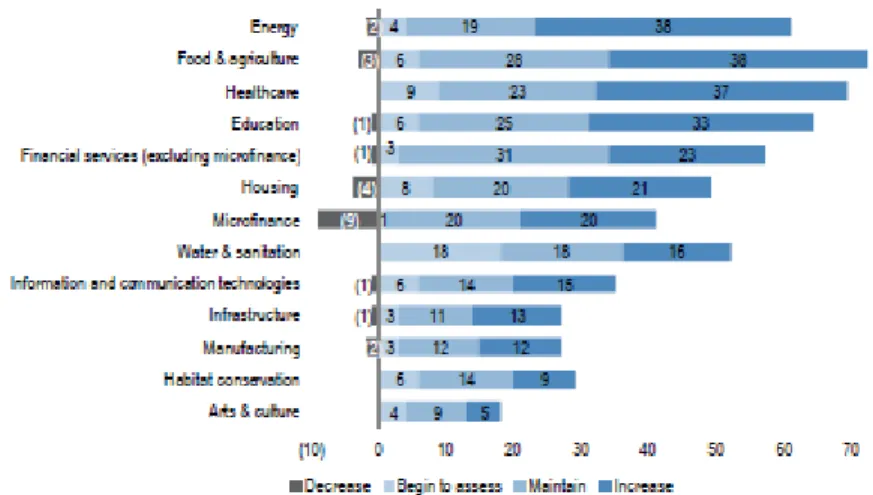
In regard to the allocation of investment in specific areas, it is a good sign that most of the sectors show intentions of having increased investment. The only one with the biggest decrease is the one of microfinance, while not problematic, one could reflect that the sector has always been attractive to many different impact investors. It is a more developed sector with a larger base through well-established local businesses, so fluctuations are to be expected.
As it is possible to note the primary needs of the BOP – energy, agriculture, healthcare and education- are the ones whose investment is growing in a more accentuated way. As it was discussed in the literature chapters, by investing in the primary needs of the BOP and its communities a company can create value in the medium-long term (see theory chapters). Although the data shows the predicted increase in demand for these types of investments (and its implicit recent success), one must ask how do these “bets” fair financially.
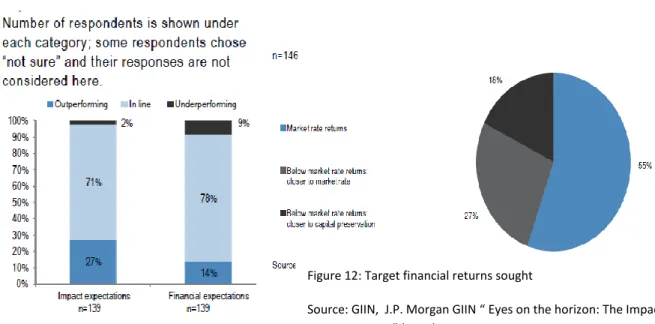
In a data sample of 146 participants, only 55% expected returns at a market rate level, 27% at a below market closer to market rate and 18% below closer to capital preservation. However, in another sample of 139 regarding financial performance versus expectations, 14% outperformed and 78% were in line. This was more positive regarding the performance of the expected impact, 27 % outperformed and 71% was in line with the expectations. From the data collected we are able
Figure 10: Change of allocation planned for 2015, by sector
to assume that no only growth is increasing, but also that the expectations for investments (both financially and impact-wise) are justified.
As it is possible to conclude, the study finds a healthy evolution in the markets regarding impact investment, not only in terms of international and sector growth and met expectations.
3.2.2. East Africa
Amongst the regions of Sub-Saharan Africa, East Africa is a center of global impact investing and has attracted significant attention from impact investors recently. Alongside a relative state of political stability, significant international investment and an increasingly numerous BOP layer, the region conjures perfectly the objects of which the thesis is focused on. While Sub-Saharan Africa has had an overall growth and magnitude in terms of investment in impact-focused enterprises, East and Southern Africa are the main contributories (The African Investing for Impact Barometer, 2017). Given that in Southern Africa, capital and initiatives are concentrated in South Africa, East Africa provides a much more diverse array of challenges, opportunities and a new
Figure 11: Performance relative to expectations
Source: GIIN, J.P. Morgan GIIN “ Eyes on the horizon: The Impact Investor survey” (2016) Figure 12: Target financial returns sought
Source: GIIN, J.P. Morgan GIIN “ Eyes on the horizon: The Impact Investor Survey” (2016)
landscape for investors. What constitutes East Africa are the countries of Kenya, Uganda, Tanzania and Rwanda.
In total, 186 impact capital vehicles are active across East Africa, managed by 107 fund managers and 28 other impact asset managers including foundations, family offices, banks, and angel networks. Most impact investors work in multiple nations in the region. Kenya is a clear leader in terms of investor interest, followed by Uganda.
In order to differentiate the nature and source of the investment, for it to be truly partake in by the private sector, the information considered will not englobe the development financial institutions. These institutions are defined by a backing of states with developed economies, hence it exists a tendency that does not reflect the markets. For example, development financial institutions have investment access to countries that put heavy constrictions on the market and focus more on financial and energy institutions (Open Capital GIIN, 2015).
It is noteworthy that a distinction between development finance institutions (DFIs) and Non-DFI. Such is because DFI investments have a large percentage of them done by governments and charities, and hence they are not representative of the markets will.
With the data available, both average deal sizes and capital disbursed are progressively increasing, with a pertinent note on that the amount of capital disbursed increased faster than the number of
Figure 13: Non-DFI Impact Investments by year.
Source: Open Capital GIIN (2015) Note: 2014 does not represent full data. 274 deals (valuing 586 USD), have been omitted due to unknown year
deals. As for the decline it may be justified to the incomplete data and that many try to close deals before the year’s end.
Given the fact that East Africa a rural country, with a great focus in agriculture, it is only expected that, as seen above, the number of deals and the capital disbursed. Disregarding financial services, which have a great volume of deals and capital. What we can observe is that energy, healthcare and housing have noticeable volume while education lacks behind. Interviewed non-DFI impact investors report that most financing is focused on various sectors of early-stage businesses (see above), frequently with the purpose of distributing capital through multiple targets (Open Capital GIIN, 2015). Again, this is a strategy that is suggested by the literature of the theory of the BOP and of what the needs of Africa are.
More specifically the study “The African Investing for Impact Barometer 2017” takes a look at the growing investing for impact (IFI) strategies and markets. The differentiation, of which focus in investment, strategies or sustainability focused ones, is important in order to represent the markets with fealty.
The strategy regarding impact and sustainability themed investments and impact investment, the ones who cause positive impact, had an investment of US$13.04 billion and 9.66 billion in 2017.
[Type a quote from the docum ent or the summ ary of an interes ting point. You can positio n the text box anywh ere in the docum ent. Use the Drawin g Tools tab to change the format ting of the pull quote text
Source: Open Capital GIIN (2015)
As a side note, the other 3 main IFI strategies also produce an important shift in mindset so the author feels they should be mentioned as it will allow for a good representation of the sustainability landscape. The most relevant for the study is screening, which was invested in 2017 with 13.29 billion, refers to the acceptance or rejection of investments based on ethical screening.
As the image shows, in East Africa the number of IFI funds are plentiful and more than half (55%) of the total funds.
The problem however, is that despite the interest in early stage companies, there is a need for investment for the seed-stage (under $100,000). It is particularly dire because these gaps cover sectors such as agriculture and manufacturing, which rely heavily on starting capital. Despite having a more risk-oriented take on investment, these investors still want an assurance on the success of the projects.
The reality is that all East African nations have a common necessity for investment in order to create environmental and social structures, with low human development indicators. The recent growth (2008-2018) has augmented the purchasing power parity of the population by 6-7% and is providing more opportunities for business (IMF World Economic Outlook, 2018).
Source: The African Investing for Impact Barometer 2017 Figure 15: East African Funds
Africa’s and East Africa’s growth has created several opportunities for impact investors and hybrid companies alike. First with the growing middle class, organizations now have bigger flexibility, in selling goods and services, to adjust to the mounting disposable income. Second, cities are surging in the horizon, result of investments and rapid urbanization, which in its turn demand services (such as sanitation and affordable housing). Third, such a disposable income, communication and urbanization accumulate growing pressure for not only the provision of basic services but also for a development of strategies and products that will adapt to their needs. This could result in a bigger driving force not only for hybrid companies and investors but also for the impact caused.
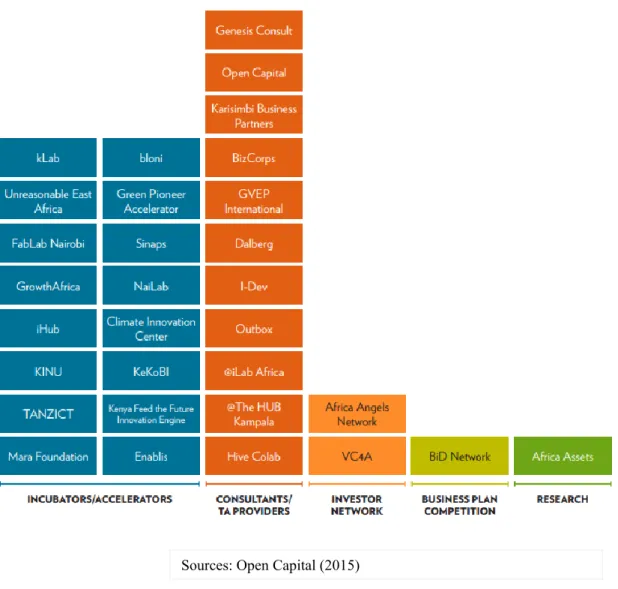
As these examples demonstrate, the network of support institutions is constituted (and has confirmed results) largely by incubators and accelerators. Given that their focuses are business in a seed or early-stage, this allows to address the previous mentioned gap with enterprises with this maturity. Such provides a more stable growth and structure balance in the SME layers of the economies. Unfortunately, the demand incubators satisfy mostly applies to information and energy, despite moderate interest in less intensive capital organizations in agriculture, manufactory and other sectors.
Another opportunity and gap to fill is the one of data research, having new bottom-of-the-pyramid strategies (see next chapter) might be a landscape with many creative and worthwhile ideas but it is always evolving. Details on consumption and habits are frequently lacking information that
Figure 16: Examples of Intermediaries and Service Providers Active in East Africa
might prove essential at some point in the operating life of a organization, even a smaller one. Additionally, lack of concrete and detailed information makes projections on business opportunities and investments opaquer in the eyes of the investor. With less transparency, more risk. With more risk, less demand.
Before moving on onto the interviews, figure 17 can be found in the annexes that resumes the main takeaways from these last pages.
In order to explore possible insights and the more personal perspective of people working in this area, the thesis will now go into the information collected through the interviews.
3.3. Primary Data Analysis
Given that the area of the subject is fairly new and that the secondary data found was not satisfactory to the research questions, the thesis chose to collect primary data to further explore the topic.
The data was collected through interviews as the intention was to allow exploration on motivations, predictions and personal opinions of the interviewee (Richardson, 1965). While the interviews were conducted in a semi-structured way, a script was initially used to start the interviews. As common in semi-structured interviews, there was an interest in exploring the questions further and in some cases the interviewer sought clarification (Skodol Wilson, 1992). The participants were not in the same country, so given the distance between the interviewer (the author of this thesis) and the interviewees, the interviews were made through calls that were recorded. The length of the interviews was between 25 and 50 minutes and the interviews were gathered between the 18th of November and 6th of March.
Regarding the sample the study used a purposive sampling technique since most of the interviewees were chosen due to their role in their organizations and their insight knowledge. Their names are not real in order to protect their identities. Only the roles are real in order to identify the different roles of each interviewee. Every participant works for or in a related way to impact investment or hybrid companies in East Africa.
In terms of collecting and exposing the data, this thesis employed a thematic analysis (Braun and Clarke, 2006; Marshall & Rossman, 1999). Data was analysed as follows: (1) the first step was organizing the data, to collect, record and transcribe the interviews; (2) the second step was reading the documents and underlying the most relevant content, which were then divided in three sub-themes; (3) the third step was understanding the narrative that fit the underlying thematic that would allow for a better understanding of the topics; and finally (4) utilizing examples and quotes in order to expose the narrative in a cohesive and understandable way.
In order to protect the identity of the participants, all the names used are alias.
Alias Role Country Sector of
Company
Date of the interview Linda Director of Research &
Impact
Kenya Research & Impact
5/3/2019
Todd Sustainability Director & Founder
Kenya Sustainability & R&D
27/2/2019
John Business Development
Manager
Uganda Business Development
6/3/2019
Cameron Associate Vice-President Kenya Business
Consulting & Research
6/3/2019
Marine Security Expert Portugal N/A 2/11/2018
Bernard Lecturer and Researcher in Strategic Management – Focus on Emerging Markets
United Kingdom
4. Main Findings and Discussion
The topic of collection of data throughout the interviews was the context in which impact investors and hybrid companies operate. The thesis intention is on how the actions of any agent in the industry should be a consequence of their surroundings and the characteristics of their surroundings.
Hence this chapter will be divided in three sub-chapters. The first will encapsulate what the strengths of doing impact work in East Africa and the mindset that is currently needed in order to penetrate the BOP in an efficient way. Secondly, the thesis will reiterate the challenges that were voiced as the most prominent. Thirdly, to share the previsions for the future given by the interviewers.
4.1. Mindsets
Given that the intention of the creation of the BOP theory is characterized by trying to reach and obtain the value of the poorer layers of certain countries (Hart, 2002), one of the most important underlying issues was about how to reach the communities that impact-focused organizations choose to interact and do business with.
Our findings reveal that such can be approached in several ways. First in regards for possible employable populations and for communities’ companies can energise economically through providing jobs, as it gives the community capital which will be used to purchase goods and services.
“Communities work in a different way, it is common for one worker to provide for large numbers of people” - Marine
The idea remarked in the above quote can be blamed to the constant problem that has plagued East Africa has been the high levels of unemployment of its native population. Despite such companies keep utilizing manpower from other countries.
“It’s important for populations and communities to be part of the companies. Meaning, instead of sending mostly workforce from abroad, to employ for the native populations in a balanced way. This is important in order to build trust and value.” – Marine
Another mindset is about the understanding of the conditions these communities are subjected to. Despite being a global trend for there to be a rural exodus from populations in order to have a better life in urban contexts one should be reminded that most times is due to the lack of choice. Certain industries are already taking advantage of the creation of capabilities in order to garner value.
As a solution, the Bernard synthesised this thought:
“This is a common problem in developing countries, where population runs to the cities for a better pay and conditions. Companies should be influenced from the solar energy industry and how they do things in the rural areas. The communities are then able to have power, irrigation skims and create small businesses due the availability of power.” - Bernard
The way a company interacts with the communities and their environment must also be adapted. This was mentioned by Bernard, as a lecturer in Strategic Management he observes many cases that many managers do not understand fully the cultures of the regions they are in and it hurts them in the medium-long term. Marine agreed with the thought, remarking:
“One thing that I can highlight is the uniqueness of the communities, you can never generalize these markets. You have many subcultures and tribes, each with their own unique attributes.” - Marine
Cameron also mentioned that given that for companies alienating themselves and be tone-deaf to their circles of business is counter-productive, they should be watchful on regards to the value they can create by just paying attention to the details of anthropological and cultural needs.
“When you come to do business, you need to identify the differences and the value attached to their uniqueness.” - Cameron
One successful example of this is Cookswell, which offers an alternative argument for the extreme shift to electrical products. Through a focus on reforestation and on making their products (coal ovens) growingly more energy efficient and less polluting, they believe that culturally a sudden aggressive shift would be unsuccessful. Hence they work around it.
“East Africans love barbecues outside so they would not be so inclined to buy electric ones, even due to the taste. So my role as a hybrid company is not to force them to buy my products but instead to use to the cards I am given to make a positive impact. It is about imagination and the creation of outside the box side projects. Not only are you causing an impact but you earn clients and positive reputation” – Todd
These feelings were also encapsulated by another interviewee and provided and additional advantage to this line of thought.
“We are always looking to have new projects and new actions all the time, but I also feel that one advantage of this business model is that there is not space for frugality. Every single investment we make is carefully deliberated, we look, for example in regards to machinery, to the lifetime, to how much it would cost to repair, to the extent we would use it, etc.” - Linda
During the interviews, every person mentioned at least once the notion of “creativity” and “imagination”. These can be asserted in a number of ways, from the diverse array of inventory products they sell (Cookswell with their unique brand of seeds and EFK with their complementary tools, for example) but also in all aspects of the business.
The first aspect is how any type of company interact with their environment. No company is alone in whatever industry they are in, they have competition, partnerships with other companies and institutions, and a whole set of relationships that allow for the healthy function of any business interaction. Regarding this interaction with institutions:
“It is essential for the close of interaction with all types of institutions and how much nationals relate to these institutions and their practices. Namely political institutions, financial institutions, social institutions, across a section of institutions. Multinationals need these institutions to relate with them (to have an effective market strategy)” – Marine