FINDING THE JIGSAW PIECE FOR OUR JIGSAW PUZZLE WITH CORPORATE SOCIAL RESPONSIBILITY: THE IMPACT OF CSR ON PROSPECTIVE APPLICANTS’
RESPONSES
Ana Patrícia Duarte
Business Research Unit (BRU-IUL), Instituto Universitário de Lisboa (ISCTE-IUL), Lisbon, Portugal
Daniel Roque Gomes
Business Research Unit (BRU-IUL) & Escola Superior de Educação de Coimbra, Instituto Politécnico de Coimbra, Coimbra, Portugal
José Gonçalves das Neves
Business Research Unit (BRU-IUL), Instituto Universitário de Lisboa (ISCTE-IUL), Lisbon, Portugal
Abstract
This study examines the influence of different corporate social responsibility (CSR) dimensions on prospective applicants’ responses, namely organizational attractiveness and intention to apply for a job vacancy. Using an experimental 2 x 3 crossed factorial design (n=195), the level of engagement of a hypothetical company in socially responsible practices (high vs. low) was manipulated concerning three dimensions of CSR (employees, community and environment, economic level). Participants were randomly assigned to one of the six conditions and, after reading the corresponding scenario, were asked to evaluate the extent to which the company was considered a good place to work and their intention to apply for a job vacancy in it. Finding reveal that the level of engagement in socially responsible practices had a positive effect both on the degree to which participants favorably perceived the organization as a place to work and on their intention to apply for a job vacancy. Furthermore, the level of engagement in practices towards employees and in the economic domain had a stronger effect on participants’ responses than the engagement in practices that benefit community and environment. Accordingly, this study supports the idea that CSR can be a source of competitive advantage in the recruitment of new employees. However, since not all CSR dimensions have the same effect upon applicants’ responses, companies should take into account the CSR dimensions in which they are engaged and communicate them to the public. As far as we know, this is the first study to examine the impact of different CSR dimensions both on organizational attractiveness and intention to apply for a job vacancy.
Keywords: Corporate social responsibility, organizational attractiveness, intention to apply for a job vacancy, recruitment, prospective applicants.
Introduction
In the last decades, corporate social responsibility (CSR) has received increasing attention amongst academics and practitioners, both groups being significantly interested in understanding if and how companies can “do well by doing good”. As a result, several studies examining the consequences of companies’ engagement in CSR practices were developed and are now available in the literature (Aguinis and Glavas, 2012). Taken as a whole, findings suggest that CSR can be a source of competitive advantages in view of its positive impact on financial performance, organizational image, corporate reputation, sales, employee motivation, attraction and retention, among others (Kotler and Lee, 2005; Porter and Kramer, 2006). However, although there is a certain consensus about the positive contribution of global CSR, research on the specific impact of different CSR dimensions is underdeveloped. Against this backdrop, the present study has adopted a multidimensional approach to CSR measurement to assess the impact of different CSR dimensions on prospective applicants’ responses towards a hypothetical company. Moreover, it has analyzed the impact of different CSR dimensions in simultaneously two kinds of responses: beliefs (i.e. organizational attractiveness) and behavioral intentions (i.e. intention to apply for a job vacancy).
It is widely recognized that human resources are the most distinctive and valuable asset of any organization (Cappeli and Crocker-Hefter, 1996) by providing companies with the necessary knowledge, skills, competences and behaviors to successfully pursue organizational goals. The ability to attract talented employees is surely a valuable path towards productivity, effectiveness and organizational goals. The pressure for effectiveness in the attraction of applicants has gained renewed importance since the beginning of this century with the “war for talent” issue, following labor shortages in several markets (Bhattacharya et al., 2008; Michaels et al., 2001) and the strong difficulties encountered when facing certain imbalances in employment markets. Such imbalances cause organizations to run into serious difficulties in attracting the desired kinds of applicants, usually struggling to attract the most talented workers in the employment market. By making use of Orlitzky’s (2007) “jigsaw piece” metaphor (regarding considerations on recruitment and selection), it is possible to highlight the relevance of applicant attraction to organizations by starting and enabling a cycle for “selecting the correct jigsaw piece from the incorrect pieces to fit into a particular hole in the jigsaw puzzle” (p.112). It is mainly due to this reason that it is a commonplace for recruiters to state that “applicant attraction is business” for organizations.
The centrality of organizational attraction to recruitment effectiveness has encouraged wide debate among academics. As a result, we now have a quite diverse area of research, built upon contributions from different scientific areas. Regardless of the main theoretical perspectives and of the empirical approaches followed, the attractiveness of the organization seems to be a decisive indicator affecting attraction effectiveness. By definition, organizational attractiveness relates to the degree to which a prospective applicant perceives an organization as a good place to work, and to the positive desirability of developing a work relationship with it (Aiman-Smith et al., 2001; Rynes, 1991). Due to the relevance given to organizational attractiveness, researchers have over the years tried to establish the most fundamental predictors of attractiveness.
Some studies suggest that CSR can be an important predictor of job choices. Prospective applicants seem to feel more attracted (e.g. Backhaus et al., 2002; Turban and Greening, 1997) and willing to apply for a job vacancy (e.g. Albinger and Freeman, 2000; Alniacik et al., 2011) in companies that they consider to be more socially responsible than in companies that they perceived as less responsible. It is thus pertinent to advance knowledge on the impact of CSR on the outputs of organizational attraction. The appraisal of CSR’s impact on prospective applicants’ attraction to organizations seems to be a quite important and stimulating research avenue. Some of the questions that remain unstudied relate to whether employers should consider their efforts to find the “jigsaw piece” for their “jigsaw puzzle” through CSR enrolment, and if so, in what specific areas. This study seeks to address these questions by investigating the effect of different CSR dimensions on two attraction indicators: organizational attractiveness and intention to apply for a job vacancy (IAJV). As argued by Smith et al. (2004), this strategy of capturing both beliefs (i.e. thinking positively about a company) and intentions (i.e. willingness to pursue a job in the company) minimizes the likelihood of making inaccurate associations due to the widely recognized gap between individuals’ beliefs and intentions.
The paper begins by exploring the literature on recruitment and attraction to organizations before reviewing the literature on CSR and its relation to prospective applicants’ responses.
Recruitment and prospective applicants’ attraction to organizations
Recruitment is one of the fundamental human resource management (HRM) practices supporting organizational success and growth (Hatch and Dyer, 2004; Henkens et al., 2005). It globally involves a sequence of stages whose primary purpose is to identify and attract prospective
employees (Barber, 1998; Newell and Shackleton, 2000). The attraction stage of recruitment occurs when organizations develop strong endeavors to attract prospective applicants to a job vacancy (Barber, 1998). It is at this specific stage that employers take a series of decisions and actions, thus enabling the attraction of prospective applicants well-adjusted to a required profile.
The centrality of organizational attraction to recruitment effectiveness has given cause for concern and raised considerable debate among academics, hence stimulating a research area that has been under discussion especially during the past three decades (e.g. Gomes and Neves, 2011; Lievens et al., 2005; Saks, 1994; Taylor and Bergman, 1987). One of the key characteristics of this research area is its abundance of research alignments, theoretical approaches, and empirical findings (Anderson et al., 2001; Erhart and Ziegert, 2005). This characteristic is mostly due to the fact that this research area is examined across a variety of literatures (e.g. Marketing; HRM; Organizational Psychology), which makes it possible to find answers to the important issue of understanding applicants’ attraction to organizations.
Probably the most fundamental research alignment in the studies on organizational attraction is the production of valuable research focused on understanding and explaining the development of prospective applicants’ attitudes and reactions towards a potential employer organization. It follows the individual viewpoint and is strongly organizational behavior-oriented (e.g. Chapman et al., 2005; Highhouse et al., 2003). As such, the research field of organizational attraction, in general and not exclusively, makes reference to three main theoretical perspectives: (1) cognitive-informationist; (2) attitudinal-behaviorist; and (3) interactionist. The first perspective generically refers to theoretical models explaining the individuals’ internal cognitive processes that result from their exposure to information (e.g. signaling theory, Spence, 1973; elaboration likelihood model, Petty and Caccioppo, 1986). This perspective is very close to what Erhart and Ziegert (2005) called the “environment processing underlying meta-theory” of organizational attraction, and it is mostly focused on explaining the cognitive processes that are activated when applicants are exposed to different kinds of persuasive information. The second perspective refers to models seeking to explain applicants’ behaviors resulting from the prediction of beliefs and attitudes (e.g. exposure-attitude hypothesis, Zajonc, 1968; theory of reasoned action, Fishbein and Ajzen, 1975). It provides the basis for recognizing applicants’ behaviors as the consequence of a cumulative set of steps in which attitudes and intention to behave bear strong relevance. As for the third perspective, it globally refers to theoretical models seeking to explain applicants’ attraction to
organizations as resulting from the combination of applicants’ characteristics and the environment in which they are embedded (e.g. similarity-attraction paradigm, Byrne, 1971; attraction-selection-attrition theory, Schneider, 1987). This perspective is close to what Erhart and Ziegert (2005) called the “interactionists processing underlying meta-theory” of organizational attraction.
Interestingly, regardless of the main theoretical perspectives and the empirical approaches followed, the attractiveness of the organization and leading applicants’ desire to apply for the job vacancy seem to be decisive indicators affecting attraction effectiveness (Carless, 2003; Porter et al., 2004). As mentioned above, organizational attractiveness relates both to the degree to which a prospective applicant perceives an organization as a good place to work and the positive desirability of developing a work relationship with it (Aiman-Smith et al., 2001; Rynes, 1991). Due to the relevance given to organizational attractiveness, researchers have tried to establish the most important predictors of attractiveness. They have done this with great effectiveness and through different theoretical perspectives and empirical options. Consequently, the variety of known attractiveness predictors is quite wide. Job characteristics and organizational attributes (e.g. Barber and Roehling, 1993; Carless, 2003; Chapman et al., 2005; Gomes & Neves, 2010), the information provided on companies’ web pages (Williamson et al., 2003), the employer brand (e.g. Berthon et al., 2005), the source, amount and type of information used in recruitment advertising (e.g. Fisher et al., 1979; Highhouse and Hoffman, 2001; Reeve et al., 2006; Roberson et al., 2005), and the organizational image, reputation or familiarity (e.g. Greening and Turban, 2000; Lievens and Highhouse, 2003; Lievens et al., 2005) are clear examples of this assortment of attractiveness predictors.
As regards applicants’ intention to apply for a job vacancy, attractiveness is also a very important indicator of organizational attraction effectiveness (Barber & Roehling, 1993), as it relates to the intended behavior of applying for a vacancy, thus severely affecting the quantity and quality of the applicant pool. When compared with the studies concerned with attractiveness prediction, the IAJV prediction is quite short on references. Nevertheless, findings in the existing literature show that there are relevant indicators to predict job choice intentions (e.g. Aiman-Smith et al., 2001; Carless, 2003). These studies globally point to the centrality of job and organizational attributes to predict applicants’ intentions when they are in a process of organizational attraction (Gomes & Neves, 2011), such as job tasks (e.g. Turban et al., 1998), compensation and job security (e.g. Chapman et al., 2005), organizational policies (e.g. Powell, 1984), and, lastly,
organizational attractiveness (one can find clear references of its association with IAJV) (Saks et al., 2005; Roberson et al., 2005; Gomes & Neves, 2011).
CSR has also been proposed as a good predictor of organizational attractiveness, as the results known seem to support a positive and meaningful association between them (Albinger and Freeman, 2000; Greening and Turban, 2000). As for the association between CSR and job choice intentions, IAJV in particular, this still remains an open question. It seems that researchers’ preferences when dealing with the link between CSR and organizational attraction have rather focused on understanding CSR’s predictive abilities concerning the development of beliefs and attitudes (e.g. Turban and Greening, 1997) and not quite on the prediction of behavioral intentions. In the next section, the literature on CSR is briefly reviewed and the role of CSR in job choices is discussed.
Corporate social responsibility and job choices
CSR has been under discussion for several decades, but a renewed interest in the theme has arisen in the last years. This is mainly due to the debate raised by the corporate scandals that took place in the beginning of the 21st century. Despite the plethora of different existing conceptualizations, CSR is frequently defined as a multidimensional construct that refers to companies’ integration of social and environmental considerations into their business operations and relationship with multiple stakeholders (European Commission, 2001; Duarte et al., 2010; Neves and Bento, 2005; Matten and Moon, 2005, 2008) and consequent development of principles, policies and practices that appear to further some social good (McWilliams and Siegel, 2001; Wood, 2001). Being a multidimensional construct, CSR includes a broad range of actions and practices, such as reducing business environmental impact, improving occupational health and safety, investing in people management and development, community support, or ensuring firm economic sustainability (Carroll and Shabana, 2010; Dahlsrud, 2008; Neves and Bento, 2005). Through their corporate social performance companies can maximize the creation of shared value for owners/shareholders, stakeholders and society at large, as well as identify, prevent and mitigate possible adverse impacts of their business operations (European Commission, 2011).
As it happens in the case of the literature on recruitment and organizational attraction, the body of research on the role of business in society is also vast and built upon the influence of several disciplines (e.g. Management; Philosophy; Sociology; Organizational Psychology) and
different approaches to CSR conceptualization and measurement can be found (Carroll and Shabana, 2010). Despite these divergences, the number of studies about the antecedents and consequents of CSR has constantly increased over the years (Aguinis and Glavas, 2012; Bakker et al., 2005). Three main research lines can be tracked upon a literature review (Duarte, 2014). The first and predominant one has to do with the investigation of the link between CSR and corporate social performance. A second research line is mostly interested in tracking and characterizing companies’ adherence to CSR in national or cross-national contexts by identifying the degree of engagement in socially responsible practices, perceived benefits and obstacles to CSR engagement. A third research line focuses on the relationship between CSR and the management of stakeholder groups (e.g. investors, consumers, employees) by examining how the different groups perceive companies’ engagement in CSR and the consequences of those perceptions on their attitudes and behaviors towards companies. Overall, the findings of these different research lines suggest that CSR has some benefits for companies, including increased sales and market share, decreased operating costs, strengthened brand positioning, increased appeals to investors and financial analysts, increased ability to attract, motivate and retain employees (Carroll and Shabana, 2010; Kotler and Lee, 2005; Margolis and Walsh, 2003; Orlitzky et al., 2003). Some studies have addressed potential negative effects of CSR (e.g. Luchs et al., 2010 – decreased consumer preferences; Cennamo et al., 2009 – adverse effects of stakeholder management), but CSR is usually seen as a potential source of diverse competitive advantages (Porter and Kramer, 2006).
Of particular interest to this study is the indication that companies’ social performance contributes to job choices, namely by increasing the companies’ ability to attract prospective applicants. Research about the impact of CSR on recruitment outcomes is not large, but existing studies suggest that individuals are more attracted (Backhaus et al., 2002; Bauer and Aiman-Smith, 1996; Evans and Davis, 2011; Greening and Turban, 2000; Lis, 2012; Turban and Greening, 1997) and willing to work for companies that they consider to be more socially responsible (Albinger and Freeman, 2000; Alniacik et al., 2011). This does not imply that CSR is the main predictor of job choices. In fact, other company and job features might be more relevant or critical to prospective applicants as recently argued by Auger et al. (2013). Albinger and Freeman (2000) have already shown that the impact of CSR on organizational attractiveness depends on the degree of job choice offered to the prospective candidates, it being stronger when
individuals have higher levels of job choice. Nevertheless, CSR seems to make a significant contribution to understanding and predicting a company’s ability to attract prospective applicants. Its impact has been explained through two main theories: signaling theory (Spence, 1973) and social identity theory (Ashforth and Mael, 1989; Dutton et al., 1994; Glavas and Godwin, 2013). Job choices are based on career expectations and prospective candidates are more prone to invest their time and resources into pursuing a job that displays future career success (Rynes and Lawler, 1983; Rynes, 1991). Signaling theory suggests that companies’ engagement and overall stance in the social responsibility arena may serve as signals of organizational values, norms and working conditions (Albinger and Freeman, 2000; Greening and Turban, 2000; Turban and Greening, 1997). When assessing a future place to work, and because individuals are often unable to know the company in depth, prospective applicants will probably consider that a company with high CSR provides good working conditions to its employees (Greening and Turban, 2000; Turban and Greening, 1997) and, based on that signal, will appraise the company as a good employer (Chatman, 1989; Lin et al., 2012).
In addition, CSR has been related to increased organizational image and corporate reputation (Fombrum, 1996; Fombrun and Van Riel, 1997; Riordan et al., 1997; Kim et al., 2010). Social identity theory proposes that people strive for a positive self-esteem, and this is affected by their organizational membership (Ashforth and Mael, 1989; Dutton et al., 1994). Therefore, individuals will be proud to identify themselves with a company that has a positive identity (Ashforth and Mael, 1989; Dutton et al., 1994), since the association with such a company will help to derive a positive self-concept and maintain a positive self-esteem. In the case of prospective applicants, companies with higher CSR might be considered a more attractive place to work because they manage to anticipate enhanced self-concepts through the association with an organization that does good things for its members or for community and society at large (Albinger and Freeman, 2000; Backhaus et al., 2002; Greening and Turban, 2000; Turban and Greening, 1997). Based on the above literature, we propose that:
Hypothesis 1 – The level of perceived corporate engagement in socially responsible practices impacts individuals’ beliefs and intentions towards the company. The levels of organizational attractiveness and IAJV will be higher when perceived corporate engagement is high.
Companies can demonstrate their commitment to CSR through the enrolment in different dimensions (e.g. economic, employees, community and environment). Since CSR is a contextual and socially–constructed construct (Dahlsrud, 2008; Duarte et al., 2010; Coles et al., 2013), the number and contents of these dimensions are mutable. For instance, Carroll (1979) has proposed four dimensions of CSR, namely economic, legal, and ethical and discretionary. Neves and Bento (2005) have identified six fields of responsibilities resulting from the interplay of the specific thematic area (social, economic or environmental) and focus of socially responsible practices (internal versus external). Duarte et al. (2010) found that people have three different conceptions of a socially responsible company. For some individuals, a socially responsible company is one that behaves in a community and ecological friendly way (e.g. supports social or environmental causes); for others is one that develops its business operations in an efficient and ethical manner (e.g. has an ethical behavior) and for another set of individuals is one that adopts HRM practices that promote the welfare of its employees and their families (e.g. promotes work-family balance). In this study, we have adopted a multidimensional approach to CSR based in these three conceptions.
Although all CSR dimensions may yield competitive advantages, certain dimensions may be more important than others. Previous studies revealed that CSR dimensions have dissimilar levels of association with individuals’ attitudes and behaviors in the workplace. As regards employee responses to CSR, attention to employee welfare shows a higher impact on job-related attitudes such as job satisfaction (Duarte and Neves, 2011) and organizational commitment (Duarte and Neves, 2012; Rego et al., 2010; Turker, 2009), namely because of the improvement of workplace and career conditions and the enhancement of corporate image and organizational identification (Duarte and Neves, 2010, 2012). Prospective applicants also seem to be more influenced by perceived corporate engagement in socially responsible practices targeting employees than by other CSR dimensions when assessing the level of attractiveness of a company as a future employer (Albinger and Freeman, 2000). This might be due to the fact that attention to employee welfare is a CSR dimension that signals working conditions (Turban and Greening, 1997) and as argued above prospective candidates have strong career expectations regarding their future employers (Rynes and Lawler, 1983; Rynes, 1991). Taking these suggestions into consideration, we propose that:
Hypothesis 2 – The effect of the level of corporate engagement in socially responsible practices is moderated by the CSR dimension in which the investment occurs. Perceived corporate engagement in socially responsible practices towards employees produces more extreme levels of organizational attractiveness and IAJV than corporate engagement in other CSR dimensions.
A description of the study designed to explore our hypotheses is now provided.
Method Sample
Participants were invited to voluntarily participate in the study during training courses organized by a trade association previously contact by researchers and also during undergraduate and master classes lectured by research team members. A sample of 195 participants, aged between 16 and 67 years (M=24.6; SD=10.1), most of them female (66.2 %), has participated in this study. The educational level of participants is as follows: 8.8 % have completed nine years of schooling or less, 68.0 % have between 10-12 years of schooling, and 23.2 % have a higher education qualification. Most participants have previous work experience (67.2 %) and 14.4 % were looking for a new job at the time of the study. A little more than half of the sample were full-time students (53.6%), 42.3% were employed workers and 4.1% were unemployed workers at the time of the study.
Design, procedure and measures
The present study used an experimental 2 x 3 crossed factorial design. Scenarios were used to manipulate two levels of engagement in CSR practices (high versus low) and three dimensions of CSR (CSR towards employees versus CSR towards community and environment versus CSR in the economic field).
A separate scenario for each condition depicted a hypothetical company named Qoppa as fulfilling a set of socially responsible practices in high corporate engagement conditions or as fulfilling none of the practices in low engagement conditions (e.g. investing in practices that promote equity between men and women; support social, cultural and sports activities; investing in environmental protection programs; obtaining profits). The practices described in each scenario were all related to one of the three CSR dimensions. Scenarios were based on Evans and Davis’s experimental paradigm (2011), which was adapted in order to obtain six conditions and pretested
in a previous study by Duarte (2011). To decrease socially desirable responses, the scenarios were written in the third person (Evans and Davis, 2011; Hughes and Huby, 2004).
Participants were randomly assigned to one of the six conditions. After reading the corresponding scenario, participants were asked to evaluate the extent to which the company was engaged in CSR practices and the extent to which it was considered a good place to work as well as to evaluate their intention to apply for a job vacancy in the organization.
Perceived company engagement in CSR (manipulation check variable) was measured using two items taken from Duarte (2011). These items were averaged to compute an aggregate measure of CSR engagement (“Qoppa is a socially responsible company”, “Qoppa is concerned with the welfare of society”; 1-Strongly disagree to 5-Strongly agree; r=.84). The manipulation worked as expected. Contrary to participants in high engagement conditions (M=3.98; SD=.66; F(1,194)=637.084, p<.000), participants in low engagement conditions considered the company to be less socially responsible (M=1.76; SD=.73). Furthermore, the CSR dimension had no effect on the level of perceived engagement in CSR activities (F(2,194)=.102, n.s.).
Organizational attractiveness (dependent variable) was assessed using three items adapted from Bauer and Aiman-Smith (1996), Highhouse et al. (2003), and Turban and Keon (1993). These items were averaged to compute an aggregate measure of organizational attractiveness (e.g. “This would be a good company to work for”, “This company is very attractive to me as a place to work for”, “This company is very attractive to me as a place for employment”; 1-Strongly disagree to 7-Strongly agree; α=.94).
Intention to apply for a job vacancy (dependent variable) was measured using three items based on Roberson et al. (2005) and Taylor and Bergman (1987). These items were averaged to compute an aggregate measure of IAJV (e.g. “If I were searching for a job, I would apply to this organization”, “If I were searching for a job, I would have a strong intention to apply to a job vacancy in this company”, “If I were searching for a job, there would be a strong probability of applying to this offer”; 1-Strongly disagree to 7-Strongly agree; α=.93).
Participants were also asked to indicate a set of socio-demographic characteristics (gender, age, educational level, previous work experience, searching for a job).
A confirmatory factor analysis (using Amos 20.0) was carried out on the eight items of the three measures to assess the goodness-of-fit of the measurement model. The results suggest that the three correlated factor model fits adequately to the empirical data (all lambdas >.76;
X2=49.170 (18); TLI=.969; CFI=.980; RMSEA=.094) in comparison to a single factor model (X2=270.164 (20); TLI=.779; CFI=.842; RMSEA=.254).
Results
Multivariate analysis of covariance (Mancova) was used to test the hypotheses. Previous analysis of correlations between all study variables has showed that organizational attractiveness and IAJV were significantly correlated (r=.84, p<.01) and that age and educational level were also significantly correlated to attractiveness (r=-.20, p<.01; r=.17, p<.05) and IAJV (r=-.21, p<.01; r=.18, p<.05, respectively) and should be, therefore, controlled for in subsequent data analysis. In situations in which two or more dependent variables are correlated and the control of concomitant variables is required the performance of Mancova is a more powerful analytical procedure than performing multiple comparisons using univariate analysis of variance (Maroco, 2003; Tabacknick and Fidel, 2006).
Hypothesis 1 proposes that the level of perceived corporate engagement in socially responsible practices influences individuals’ attitudes and intentions towards the company. Findings supported this hypothesis by revealing a main effect of the level of corporate engagement in both organizational attractiveness (F(1,191)=196.484, p<.000) and IAJV (F(1,191)=164.058, p<.000). Participants in low engagement conditions judged the company as a less interesting place to work (M=2.44; SD=1.32) and revealed a lower IAJV (M=2.53; SD=1.34) than those in high engagement conditions (M=4.83; SD=.99; M=4.91; SD=1.20, respectively).
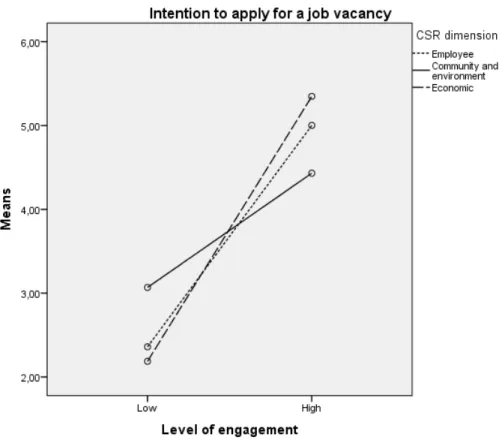
Findings also revealed that the level of corporate engagement in CSR practices interacts with the CSR dimension in which the investment is made. This interaction effect is significant for both organizational attractiveness (F(2,191)=9.641, p<.000) and IAJV (F(2,191)=8.854, p<.000). A post hoc analysis using Duncan comparisons was performed. It revealed that participants in conditions of employee- and economic-oriented CSR gave more extreme responses than participants in conditions of CSR towards community and environment. In high engagement contexts, organizational attractiveness (F(2,88)=3.100, p<.05) and IAJV (F(2,88)=4.494, p<.01) are higher in participants in conditions of employee- and economic-oriented CSR than in participants in conditions of CSR towards community and environment.
The reverse pattern is found in low investment contexts, where participants in employee- and economic-oriented CSR made more severe judgments of the company’s attractiveness as a
place to work (F(2,104)=7.478, p<.001) and expressed a even lower IAJV (F(2,104)=5.235, p<.01) than participants that had read about the company’s poor engagement in CSR towards community and environment. Thus, the perception of a poor implementation of responsible economic and HRM practices reveals a more damaging impact on organizational attractiveness and IAJV than the perception of poor social investment in community and environment. Hypothesis 2 was thus only partially supported since the impact of CSR on the economic domain was not anticipated.
Finally, age and educational level revealed no significant effects on organizational attractiveness and IAJV.
Figure 2 – Intention to apply for a job vacancy by level of engagement and CSR dimension
Discussion and conclusions
This study aimed to better understand the impact of CSR on companies’ ability to attract future employees, by adopting a multidimensional approach to CSR measurement. This allowed to assess the impact of different CSR dimensions on prospective applicants’ beliefs and behavioral intentions towards a hypothetical employer. Built on previous research, it examined the effect of perceived corporate social performance in three different dimensions (employee, community and environment, and the economic level) on individuals’ evaluation of the organization as a good place to work and their intention to apply for a job vacancy in the company. Consistent with previous studies, our findings indicate that prospective applicants are concerned about corporate social performance when considering a company as a future employer (Albinger and Freeman, 2000; Alniacik et al., 2011; Backhaus et al., 2002; Greening and Turban, 2000; Lis, 2012; Smith et
al., 2004; Turban and Greening, 1997). Their responses and job choices are significantly different depending on the perceived level of corporate engagement in socially responsible practices. Company perceived engagement in CSR practices influences both company’s attractiveness and its ability to elicit job applications. Results indicate that individuals feel more attracted to the organization as a future place to work and report a higher willingness to pursue a job in it when they consider the company to have a high corporate social performance. This effect is independent of the specific CSR dimension under consideration. A high engagement in CSR practices always results in a higher attractiveness and IAJV than a low engagement in the same practices.
In addition, results show that some CSR dimensions have higher relevance for individual decisions of engagement with new organizations than others. Organizational attractiveness and intention to apply for a job vacancy are higher when the company is seen as having a high engagement in practices towards their employees and in the economic domain. Corporate disinvestment in these two CSR dimensions has a severe negative impact on individuals’ responses, probably because it signals a bad and less reputable working environment (Backhaus et al., 2002). As discussed earlier, individuals have expectations regarding the success of their future career (Rynes and Lawler, 1983; Rynes, 1991) and, therefore, tend to search for an employment that provides good working conditions and helps them to achieve and/or maintain a positive self-concept and self-esteem (Ashforth and Mael, 1989; Backhaus et al., 2002; Dutton et al., 1994). Companies’ engagement in certain socially responsible practices may signal those conditions to outsiders (Albinger and Freeman, 2000; Greening and Turban, 2000; Lin et al., 2012; Turban and Greening, 1997).
It must be noted that the company’s engagement in community and environmental issues is also valued by prospective applicants. This is consistent with previous work by Bauer and Aiman-Smith (1996) according to which companies that take a pro-environmental stance are evaluated as more attractive employers than those who do not express such concerns. However, our study shows that the effect of such a stance on individuals’ beliefs and intentions toward the company, although significant, is not as expressive as in the case of the other two CSR dimensions here examined. Similar results have been reported in studies about employee reactions to CSR (Duarte and Neves, 2011, 2012; Rego et al., 2010; Turker, 2009).
The present study has some theoretical and practical implications. At a theoretical level, it extends earlier research on the individual-level impact of CSR, a much neglected level of analysis
in CSR research (e.g. Aguinis and Glavas, 2012), by showing that prospective candidates’ perceptions of different dimensions of CSR are important for their responses and job choices. The innovative use of a multidimensional approach to CSR allowed the evaluation of the relative impact of different CSR dimensions on the beliefs and behavioural intentions here analysed, thus overcoming limitations of prior research. Besides supporting the idea already advanced by previous studies that perceived level of engagement is determinant for prospective candidates’ responses, the present study showed that the specific dimensions in which the investment is done are also relevant. In this sense, the level of corporate engagement in economic CSR practices and in CSR practices that directly benefit employees have shown to be more relevant to organizational attractiveness and IAJV than the level of engagement in practices that benefit community or the environment. The study thus contributes to both CSR literature and that of recruiting because it identifies corporate investment in different dimensions of CSR as an antecedent of job choices.
At a practical level, the findings reinforce the importance of companies adopting wide-ranging CSR strategies, aligned with multiple stakeholders’ interests and needs (Bhattacharya et al., 2008). A high investment in CSR practices seems to be a “good business”, at least in what relates to prospective candidates, fostering positive responses towards the company. Depending on the target-population (e.g. prospective applicants, employees, consumers) and desired outcomes (e.g. attraction, organizational commitment, loyalty), companies can make their engagement in specific CSR dimensions more or less salient; they can increase knowledge about the corporate social performance that is most valued by each stakeholder group and thus maximize the impact of CSR on individuals’ response. With regard to prospective applicants, findings suggest that companies can make use of their investment in socially responsible practices that promote economic sustainability and employees’ welfare to raise their ability to attract prospective applicants. Communicating their engagement in these practices, for instance in job ads or career forums, along with providing other information about job and organizational attributes (Auger et al., 2013; Bhattacharya et al., 2008), can help maximize the applicant pool. Previous studies suggest that corporate social performance is particularly relevant in the case of job seeking populations with high levels of job choice (Albinger and Freeman, 2000). Therefore, in their social performance socially responsible companies have a relevant, additional tool for winning the “war for talent” (Bhattacharya et al., 2008).
Some limitations should also be noted regarding the current study. Participants’ responses were obtained in a laboratory setting based on a hypothetical situation. The concerns regarding this method, particularly regarding generalization to actual work settings, are well known. Regarding the issue of external validity, a review of organizational behavior and HRM research comparing the direction of the effects in laboratory versus field studies revealed that basically the same results were obtained in the field as in the laboratory (Locke, 1986). Efforts were made in this study in order to create a realistic experimental situation (Hughes & Huby, 2004). Nevertheless, generalizing results to actual work settings must be made with caution. Future studies might use a sample of individuals engaged in real job search (e.g. unemployed workers, students in the last year of graduation) to test the strength of the results obtained here and also consider certain individual characteristics (e.g. degree of urgency in getting a new job; level of job choice) that may moderate the impact of CSR on indicators of organizational attraction. Futures studies can also explore the role of person-organization fit perceptions (e.g. the congruence between the individual’s values and the perception of the recruiting organization’s values) in the relationship between CSR and prospective applicants’ responses. Cable and Judge (1996) found that person-organization fit perceptions are important in job choice decisions. Another interesting question for future research refers to the relative importance of CSR compared to other organizational and job attributes. The analysis of such a comparison should help to determine the incremental value of CSR for recruiting objectives over and beyond other more usual HRM practices (Auger et al., 2013; Bhattacharya et al., 2008).
To conclude, the findings of this study show that CSR can be a source of competitive advantage in the recruitment of new employees. Although this advantage does not constitute per se a primary motive for the integration of social and environmental considerations into business activities and for developing more responsible relationships with multiple stakeholders, it gives support to pro-CSR positions. By acknowledging the broader impact of these policies and options on their interactions with their stakeholders, namely potential candidates, companies can strategically use these options to gain not only the “war for talent”, but also the “war for sustainability” in an increasingly competitive and dynamic global market.
References
Aguinis, H. and Glavas, A. (2012), “What we know and don’t know about corporate social responsibility: a review and research agenda”, Journal of Management, 38, 4, pp. 932-968. Aiman-Smith, L., Bauer, T. and Cable, D. (2001), “Are you attracted? Do you intend to pursue?
A recruiting policy-capturing study”, Journal of Business and Psychology, 16, pp. 219-37. Albinger, H. and Freeman, S. (2000), “Corporate social performance and attractiveness as an
employer to different job seeking populations”, Journal of Business Ethics, 28, pp. 243-53.
Alniacik, U., Alniacik, E. and Genc, N. (2011), “How corporate social responsibility information influences stakeholders’ intentions”, Corporate Social Responsibility and Environmental
Management, 18, pp. 234-245.
Anderson, N., Born, M. and Cunningham-Snell, N. (2001), “Recruitment and Selection: applicant perspectives and outcomes”, In Anderson, N., Ones, D., Sinangil and Viswesvaran (Eds.),
Handbook of Industrial, Work and Organizational Psychology, Sage, London, pp. 200-218.
Asforth, B. and Mael, F. (1989), “Social identity theory and the organization”, Academy of
Management Review, 14, 1, pp. 20-39.
Auger, P., Devinney, T., Dowling, G., Eckert, C. and Lin, N. (2013), “How much does a company’s reputation matter in recruiting?”, MIT Sloan Management Review, 54, 3, pp. 78-88.
Backhaus, K., Stone, B. and Heiner, K. (2002), “Exploring the relationship between corporate social performance and employer attractiveness”, Business & Society, 41, pp. 292-318. Bakker, F., Groenewegen, P. and De Hond, F. (2005), “A bibliometric analysis of 30 years of
research and theory on corporate social responsibility and corporate social performance”,
Business & Society, 44, 3, pp. 283-317.
Barber, A. (1998), Recruiting employees: Individual and organizational perspectives, Sage, Oaks, CA.
Barber, A. and Roehling, M. (1993), “Job postings and the decision to interview: a verbal protocol analysis”, Journal of Applied Psychology, 78, pp. 845-856.
Bauer, T. and Aiman-Smith, L. (1996), “Green career choices: The influences of ecological stance on recruiting”, Journal of Business and Psychology, 10, pp. 445-458.
Berthon, P., Ewing, M. and Hah, L. (2005), “Captivating company: dimensions of attractiveness in employer branding”, International Journal of Advertising, 24, pp. 151-172.
Bhattacharya, C., Sen, S. and Korschun, D. (2008), “Using corporate social responsibility to win the war for talent”, MIT Sloan Management Review, 49, pp. 37-44.
Byrne, D. (1971), The attraction paradigm, Academic Press, New York.
Cable, D. and Judge, T. (1996), “Person-organization fit, job choice decisions, and organizational entry”, Organizational Behavior and Human Decision Processes, pp. 67, 294-311.
Cappeli, P. and Crocker-Hefter, A. (1996), “Distinctive human resources are firm’s core competencies”, Organizational Dynamics, 24, 3, pp. 7-22.
Carless, S. (2003), “A longitudinal study of applicant reactions to multiple selection procedures and job and organizational characteristics”, International Journal of Selection and
Assessment, 11, pp. 343-351.
Carroll, A. (1979), “A three-dimensional conceptual model of corporate performance”, Academy
of Management Review, 4, pp. 497-505.
Carroll, A. and Shabana, K. (2010), “The business case for Corporate Social Responsibility: A review of concepts, research and practice”, International Journal of Management Reviews, 12, 1, pp. 85-105.
Cennamo, C., Berrone, P. and Gomez-Mejia, L. (2009), “Does stakeholder management have a dark side?”, Journal of Business Ethics, 89, pp. 491-507
Chapman, D., Uggerslev, K., Carrol, S., Piasentin, K. and Jones, D. (2005), “Applicant attraction to organizations and job choices: A meta-analytic review of the correlates of recruiting outcomes”, Journal of Applied Psychology, 90, pp. 928-944.
Chatman, J. A. (1989), “Improving interactional organizational research: A model of person-organization fit”, Academy of Management Review, 14 (3), pp. 333–349.
Coles, T., Fenclova, E. and Dinan, C. (2013), “Tourism and corporate social responsibility: A critical review and research agenda”, Tourism Management Perspectives, 6, pp. 122-141. Dahlsrud, A. (2008), “How corporate social responsibility is defined: An analysis of 37
definitions”, Corporate Social Responsibility and Environmental Management, 15, pp. 1-15.
Duarte, A. P. (2014), “Responsabilidade social das organizações”, in S. P. Gonçalves (Ed.),
Psicossociologia do trabalho e das organizações – Princípios e práticas, Pactor, Lisboa
pp.537-566.
Duarte, A. P. and Neves, J. (2012), “Relationship between perceived corporate social responsibility and organizational commitment: The mediating role of construed external image”, in Simões, E. and Neves, J. (Eds.), Research on Ethics and Social Responsibility, ISCTE-IUL, Lisboa, pp.163-177.
Duarte, A. P., Mouro, C. and Neves, J. (2010), “Corporate social responsibility: Mapping its social meaning”. Management Research: The Journal of the Iberoamerican Academy of
Management, 8 (2), pp. 101-122.
Duarte, A.P. (2011), Corporate social responsibility from an employees’ perspective: Contributes
for understanding job attitudes, Non-published doctoral dissertation, ISCTE-IUL, Lisboa.
Duarte, A.P. and Neves, J. (2011), “Relação entre responsabilidade social percebida e satisfação no trabalho: O papel mediador da imagem organizacional”, in Roberto, M., Batista, M, Morais, R., Costa, R. and Lima, L. (Eds.), Percursos da investigação em psicologia social
e organizacional, Colibri, Lisboa, pp. 105-118.
Dutton, J., Dukerich, J. and Harquail, C. (1994), “Organizational images and member identification”, Administrative Science Quarterly, 39, 2, pp. 239-263.
Erhart, K. and Ziegert, J. (2005), “Why are individuals attracted to organizations?”, Journal of
Management, 31, pp. 901-919.
European Commission (2001). Green Paper: Promoting a European Framework for Corporate
Social Responsibility, EU Commission, Brussels.
European Commission (2011), A renewed EU strategy 2011-14 for Corporate Social
Responsibility, EU Commission, Brussels.
Evans, W. and Davis, D. (2011), “An examination of perceived corporate citizenship, job applicant attraction and CSR work role definition”, Business & Society, 50 (3), pp. 456-480. Fishbein, M. and Ajzen, I. (1975), Belief, attitude, intention and behaviour: An introduction to
theory and research, Addison-Wesley, Reading, MA.
Fisher, C., Ilgen, D. and Hoyer, W. (1979), “Source credibility, information favourability, and job offer acceptance”, Academy of Management Journal, 22, pp. 94-103.
Fombrun, C. (1996), Reputation: Realizing value from the corporate image, Harvard Business School Press, Boston.
Fombrun, C. and Van Riel, C. (1997), “The reputational landscape”, Corporate Reputation
Review, 1, 1/2, pp. 5-13.
Glavas, A. and Godwin, L. (2013), “Is the perception of ‘goodness’ good enough? Exploring the relationship between perceived corporate social responsibility and employee organizational identification”, Journal of Business Ethics, 114, pp. 15-27.
Gomes, D. and Neves, J. (2010), “Employer Branding constrains applicants’ job seeking behavior?” Journal of Work and Organizational Psychology, 26, pp. 223-234.
Gomes, D. and Neves, J. (2011), “Organizational attractiveness and applicant’s intentions to apply”, Personnel Review, 6, pp. 684-699.
Greening, D. and Turban, D. (2000), “Corporate social performance as a competitive advantage in attracting a quality workforce”, Business & Society, 3, pp. 254-280.
Hatch, N. and Dyer, J. (2004), “Human capital and learning as a source of sustainable competitive advantage”, Strategic Management Journal, 25, pp. 1155-1178.
Henkens, K., Remery, C. and Schippers, J. (2005), “Recruiting personnel in a tight labour market: An analysis of employers’ behavior”, International Journal of Manpower, 26, pp. 421-433.
Highhouse, S. and Hoffman, J. R. (2001), “Organizational attraction and job choice”, in Cooper, c. and Robertson, I. (Eds.), International Review of Industrial and Organizational
Psychology, Wiley, Chichester, pp. 37-64.
Highhouse, S., Lievens, F. and Sinar, E. (2003), “Measuring attraction to organizations”,
Educational and Psychological Measurement, 63, pp. 986-1001.
Hughes, R. and Huby, M. (2004), “The construction and interpretation of vignettes in social research”, Social Work & Social Sciences Review, 11, pp. 36-51.
Kim, H., Lee, M., Lee, H. and Kim, N. (2010), “Corporate social responsibility and employee-company identification”, Journal of Business Ethics, 95, pp. 557-569.
Kotler, P. and Lee, N. (2005), Corporate Social Responsibility: Doing the most good for your
company and your cause, John Wilson & Sons, Inc., New Jersey.
Lievens F. and Highhouse, S. (2003), “The relation of instrumental and symbolic attributes to a company’s attractiveness as an employer”, Personnel Psychology, 56, pp. 75-102.
Lievens, F., Van Hoye, G. and Schreurs, B. (2005), “Examining the relationship between employer knowledge dimensions and organizational attractiveness: An application in a military context”, Journal of Occupational and Organizational Psychology, 78, pp. 553-572.
Lin, C., Tsai, H., Joe, S. and Chiu, C. (2012), “Modeling the relationship among perceived corporate citizenship, firms’ attractiveness, and career success expectation”, Journal of Business Ethics, 105, pp. 83-93.
Lis, B. (2012), “The relevance of corporate social responsibility for a sustainable human resource management: An analysis of organizational attractiveness as a determinant in employees’ selection of a (potential) employer”, Management Revue, 23, 3, pp. 279-295.
Locke, E. (1986), “Generalizing from laboratory to field: Ecological validity or abstraction of essential elements”, In E. A. Locke (Ed.), Generalizing from laboratory to field settings: Research findings from industrial-organizational psychology, organizational behavior, and human resource management, Lexington, Lexington Books, (pp. 3-9).
Luchs, M., Naylor, R., Irwin, J. and Raghunathan, R. (2010), “The sustainability liability: Potencial negative effects of ethicality on product preference”, Journal of Marketing, 47 (5), pp. 18-31.
Margolis, J. and Walsh, J. (2003), “Misery loves companies: Rethinking social initiatives by business”, Administrative Science Quarterly, 48, pp. 268–305.
Maroco, J. (2003). Análise estatística com utilização do SPSS. Lisboa: Edições Sílabo.
Matten, D. and Moon, J. (2005), “A conceptual framework for understanding CSR”. In A. Habish, J. Jonker, M. Wegner, & R. Schimpeter (Eds.), Corporate social responsibility
across Europe, Springer Berlin, Hiedelberg, pp. 335-356.
Matten, D. and Moon, J. (2008), “Implicit” and “explicit” CSR: A conceptual framework for a comparative understanding of corporate social responsibility”, Academy of Management
Review, 33 (2), pp. 404-424.
McWilliams, A. and Siegels, D. (2001), “Corporate social responsibility: A theory of the firm perspective”, Academy of Management Review, 26, pp. 117-127.
Michaels, E., Handfield-Jones, H. and Axelrod, B. (2001), The war for talent, Harvard Business School Press Boston.
Neves, J. and Bento, L. (2005), “Traditional values and the pressures of transformation”. In A. Habish, J. Jonker, M. Wegner, and R. Schimpeter (Eds.), Corporate social responsibility
across Europe , Springer Berlin, Hiedelberg, pp.303-314.
Newell, S. and Shackleton, V. (2000), “Recruitment and selection”, in Bach, S. and Sisson, K.,
Personnel Management: A comprehensive guide to theory and practice (3rd ed.), Blackwell Publishers, Oxford, pp.111-136.
Orlitzky, M. (2007), “Recruitment strategy”, in Boxall, P., Purcell, J. and Wright, P. (Eds), The
Oxford handbook of human resource management, Oxford University Press, Oxford,
pp. 273-299.
Orlitzky, M., Schmidt, F., and Rynes, S. (2003), “Corporate social and financial performance: A meta-analysis”, Organization Studies, 24, pp. 403-441.
Petty, R. and Cacioppo, J. (1986), “The elaboration likelihood model of persuasion”, in Berkowitz, L. (Ed.), Advances in experimental social psychology, Academic Press, Orlando, Florida, pp.123-205.
Porter, C., Conlon, D. and Barber, A. (2004), “The dynamics of salary negotiations: effects on applicants’ justice perceptions and recruitment decisions”, The International Journal of
Conflict Management, 15, pp. 273-303.
Porter, M. and Kramer, M. (2006), “Strategy and society: The link between competitive advantage and corporate social responsibility”, Harvard Business Review, 84, 12, pp. 78-92.
Powell, G. (1984), “Effects of job attributes and recruiting practices on applicant decisions: a comparison”, Personnel Psychology, 37, pp. 721-732.
Reeve, C., Highhouse, S. and Brooks, M. (2006), “A closer look at reactions to realistic recruitment messages”, International Journal of Selection and Assessment, 14, pp. 1-15. Rego, A., Leal, S., Cunha, M., Faria, J. and Pinho, C. (2010, “How the perceptions of five
dimensions of corporate citizenship and their inter-inconsistencies predict affective commitment”, Journal of Business Ethics, 94, pp. 107-127.
Riordan, C., Gatewood, R. and Bill, J. (1997), “Corporate image: Employee reactions and implications for managing corporate social performance”, Journal of Business Ethics, 16, 4, pp. 401-412.
Roberson, Q., Collins, C. and Oreg S. (2005), “The effects of recruitment message specificity on applicant attraction to organizations”, Journal of Business and Psychology, 19, pp. 319- 339.
Rynes, S. (1991), “Recruitment, job choice, and post-hire consequences”, in Dunnette, M. and Hough, L. (Eds), Handbook of industrial and organizational psychology (2nd ed.), Consulting Psychologists Press, Palo Alto, CA, pp. 399-444.
Rynes, S. L., and Lawler, J. (1983), “A policy-capturing investigation of the role of expectancies in decisions to pursue job alternatives”, Journal of Applied Psychology, 68(4), pp. 620–631. Saks, M. (1994), “A psychological process investigation for the effects of recruitment source and organization information on job survival”, Journal of Organizational Behaviour, 15, pp. 225-244.
Schneider, B. (1987), “The people make the place”, Personnel Psychology, 40, pp. 437-453. Smith, W., Wokutch, R., Harrington, K. and Dennis, B. (2004), “Organizational attractiveness
and corporate social orientation: do our values influence our preference for affirmative action and managing diversity?”, Business & Society, 43, 1, pp. 69-96.
Spence, A. (1973), “Job market signalling”, Quarterly Journal of Economics, 87, pp. 355-374. Tabachnick, B. G., and Fidell, L. S. (2006), Using multivariate statistics (5th edition), New York,
Harper Collins.
Taylor, M. & Bergman, T. (1987), “Organizational recruitment activities an applicants’ reactions at different stages of the recruitment process”, Personnel Psychology, 40, 261-285.
Turban, D. and Greening, D. (1997), “Corporate social performance and organizational attractiveness to prospective employees”, Academy of Management Journal, 40, pp. 658-672.
Turban, D. and Keon, T. (1993), “Organizational attractiveness: Demography and turnover in top management groups. An interactionist perspective”, Journal of Applied Psychology, 78, pp. 184-193.
Turban, D., Forret, M. and Hendrickson, C. (1998), “Applicant attraction to firms: influences of organization reputation and organizational attributes, and recruiter behaviors”, Journal of
Vocational Behavior, 52, pp. 24-44.
Turker, D. (2009), “How corporate social responsibility influences organizational commitment”,
Williamson, I., Lepak, D. and King, J. (2003), “The effect of company recruitment web site orientation on individuals’ perceptions of organizational attractiveness”, Journal of
Vocational Behaviour, 63, pp. 242-263.
Wood, D. J. (1991), “Corporate social performance revisited”, Academy of Management Review, 16, pp. 691–718.
Zajonc, R. (1968), “Attitudinal effects of mere exposure”, Journal of Personality and Social