Campelo et al.: Mesozooplankton of Fernando de Noronha
Small-scale distribution of the mesozooplankton in a tropical insular
system
In the present work, spatial and seasonal fluctuations
of the abundance and diversity of mesozooplankton
are presented, with special attention being given to
copepod assemblages from coastal area of the Fernando
de Noronha Archipelago (FNA) (3°50'24''S and
32°24'48''W). Sampling was carried out during the dry
and rainy seasons of two consecutive years (July and
December 2013) and (June and November 2014). A
total of 37 mesozooplankton taxa were recorded, being
the copepods the most diversified group (15 taxa). The
Subclass Copepoda dominated in both periods sampled,
comprising 53% and 86% of the total abundance in
the dry and rainy season respectively. The species
considered abundant were:
Calanopia americana,
Undinula vulgaris, Oithona plumifera
and
Corycaeus
speciosus
. The rainy season favored a significant
increase in the abundance of mesozooplankton and
copepods. However, a low value of the
Shannon-Wiener diversity index was observed in this same
seasonal period. This was explained by the dominance
of the species
C. americana
and
U. vulgaris
in the
studied area. Spatial differences have not been verified.
The copepod assemblages was composed mostly by
species considered as predator-carnivours of greater
importance on the pelagic trophic web, indicators of
oligotrophic conditions and components of a major
portion of fish food items. Thus, we suggest that a
spatially homogeneous mesozooplankton community
characterizes the coastal area of Fernando de Noronha
Archipelago with variations related mainly to the
seasonal factor.
A
bstrAct
Renata Polyana de Santana Campelo
1,3*, Xiomara Franchesca Garcia Diaz
1, Gleice Santos
1, Pedro
Augusto Mendes de Castro Melo
1, Mauro Melo Junior
2, Lucas Guedes Pereira Figueiredo
1, Andrea
Pinto Silva
1, Luis Ernesto Arruda Bezerra
2, Manuel de Jesus Flores Montes
1, Sigrid
Neumann-Leitão
11 Universidade Federal de Pernambuco, Centro de Tecnologia e Geociências Museu de Oceanografia, Laboratório de Zooplâncton. (Av. Arquitetura s/n, Cidade Universitária, 50.740-550, Recife, Pernambuco, Brazil)
2 Universidade Federal Rural de Pernambuco Departamento de Biologia, Laboratório de Ecologia de Plâncton. (Rua Dom Manuel de Medeiros, s/n, Dois Irmãos, 52.171-900, Recife, Pernambuco, Brazil)
3 Universidade Federal do Ceará Instituto de Ciências do Mar (Av. da Abolição, 3207, Meireles, 60165-081, Fortaleza, Ceará, Brazil)
*Corresponding author: [email protected]
Descriptors:
Community structure, Copepoda,
Sazonality, Functional traits.
Neste presente trabalho, são apresentadas as flutuações
espacial e sazonal da abundância e diversidade do
me-sozooplâncton, com especial atenção para assembleia de
copépodes da área costeira do Arquipélago de Fernando
de Noronha (AFN) (3°50'24''S and 32°24'48''W). A
amos-tragem foi realizada durante as estações seca e chuvosa
de dois anos consecutivos (julho e dezembro de 2013)
e (junho e novembro de 2014). Um total de 37 taxa do
mesozooplâncton foram registrados, sendo os copépodes
o grupo mais diversificado (15 taxa). A Subclasse
Cope-poda dominou em ambos os períodos amostrados, com
valores de abundância relativa equivalentes a 53% e 86%,
respectivamente, nas estações seca e chuvosa. As espécies
consideradas abundantes foram:
Calanopia americana,
Undinula vulgaris, Oithona plumifera e Corycaeus
spe-ciosus
. A estação chuvosa favoreceu um aumento
signi-ficativo na abundância do mesozooplâncton e copépodes.
No entanto, um baixo valor do índice de diversidade de
Shannon-Wiener foi observado para este mesmo
perío-do sazonal. Isso foi explicaperío-do pelo perío-domínio das espécies
C. americana
e
U. vulgaris
na área estudada. Diferença
espacial não foi verificada. A assembleia de copépodes
apresentou um maior número de espécies consideradas
carnívoro-predador de grande importância na teia trófica
pelágica, indicadoras de condições oligotróficas e
compo-nente de grande porção dos itens alimentares dos peixes.
Assim, sugerimos que a área costeira do Arquipélago de
Fernando de Noronha é caracterizada por uma
comunida-de do mesozooplâncton espacialmente homogênea, oncomunida-de
as mudanças observadas estão principalmente
relaciona-das ao fator sazonal.
r
esumo
Descritores:
Estrutura da Comunidade, Copepoda,
Sazonalidade, Características funcionais.
BJOCE
Original Article /
Artigo Original
INTRODUCTION
The zooplankton community plays a key role in the pelagic environment including the export of ocean surface carbon, energy transfer and organic matter to higher tro-phic levels, influencing primary producers (top-down ef-fect) and predators (Falkowski et al., 1998; Barton et al., 2013).
Spatial and seasonal patterns of species distribu-tion have motivated ecological research (Gause, 1934; Hutchinson, 1957). Understanding the processes that create these patterns has become increasingly important in the face of continuing threats of habitat destruction, pollution, species invasion and climate change (Robinson et al., 2011). Thus, the driving processes of the spatial distribution of organisms (local topography, current pat-terns, winds and physico-chemical characteristics of water masses) can provide insights into the possible mechanisms responsible for the complexity and maintenance of natural diversity and provide critical information for conservation priorities (Cowie and Holland, 2006).
In tropical seas, the seasonal dynamics of zooplankton ecological attributes are difficult to identify and are much less marked than those observed in temperate aquatic ecosystems (Dias et al., 2010). The zooplankton com-munity structure of the Brazilian Northeastern region is directly influenced by rainy and dry periods and regional oceanographic phenomena (Neumann-Leitão et al., 1999). In addition to abiotic factors (seasonality and spatiality), the structure and composition of ecosystems are governed by biotic factors inherent to community such as the life cycles of organisms, migration, reproductive strategies, feeding approach, size and intra-interspecific relationships (Björnberg, 1981). Some zooplankton species, with well known tolerance levels to different environmental condi-tions can be used to describe the main characteristics of the water masses in which they occur (Wickstead, 1979; Rice and Stewart, 2016).
Despite their important in marine food web, few pa-pers have been published about zooplankton in tropical coastal marine waters of Northeastern Brazil (Neumann-Leitão et al., 1999; Neumann-(Neumann-Leitão et al., 1999; 2008) and to insular milieus (Mafalda Jr. et al., 2007; Diaz et al., 2009; Larrazabal et al., 2009; Melo et al., 2012). Insular environments in tropical oceans are hotspots for pelagic fauna, amidst the most nutrient-poor waters of the Atlantic Ocean, where occurs intensive fisheries. Analyses of species-diversity patterns of remote islands have been
crucial to the development of ecological processes enrich-ing production and to envisage the health quality of these environments.
In ocean, the holoplankton dominates numerically (Neumann-Leitão et al., 2008), and among all taxa, the copepods correspond to the most abundant (60 to 90% of the total abundance of zooplankton) and diverse group (Piontkovski et al., 2003). Furthermore, copepods play an important role in the functioning and maintenance of marine ecosystems. Thus the identification of functional groups based on species with similar responses to ecosys-tem functions and/or similar response to environmental conditions is a pressing need (Benedetti et al., 2015).
In spite of the above mentioned, our hypothesis was that abundance and diversity attributes of the mesozoo-plankton community fluctuate spatial and seasonally in a tropical insular system. Thus, the main objectives of our study are (i) To describe seasonal and spatial variations in the mesozooplankton community in a tropical oceanic Archipelago in Brazilian Northeastern; (ii) To provide data on seasonal and spatial changes of abundance and diversity of the main group (copepods); and (iii) To iden-tify the functional traits of dominant copepod species from this tropical area.
MATERIAL AND METHODS
Study area
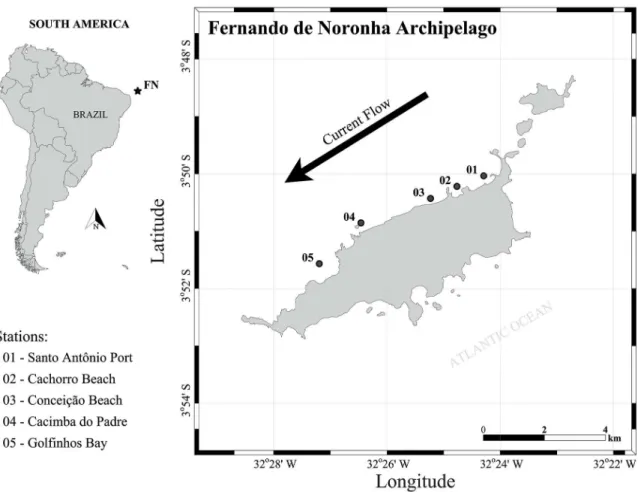
The Fernando de Noronha Archipelago (FNA) (Figure 1) lies in a National Marine Park (created by Decree No. 96.693 of September 14, 1988), as well as a State pro-tected area (created by Decree 92.755 of June 5, 1986) (Almeida, 1955), being located in the Equatorial Atlantic (Tropical). The park covers 21 islands, islets and rocks, encompassing part of the FNA and a chain of seamounts located at 3°50’24’’S and 32°24’48’’W. The FNA is locat-ed approximately 545 km from the capital of Pernambuco (Recife), 2.600 km from the African coast and 360 km from the South American continent (Lira et al., 2014).
Figure 1. Study area showing the collection stations off the Fernando de Noronha Archipelago (3°50’24’’S and 32°24’48’’W), State of Pernambuco, Northeastern Brazil. Santo Antonio Port (1), Cachorro Beach (2), Conceição Beach (3), Cacimba do Padre (4) and Golfinhos Bay (5).
undercurrents that flow mainly in an East-West direction along the equator, usually under the influence of the South Equatorial Current (SEC) in the surface layer of the water column. The prevailing winds are the southeasterly trades, varying to northeasterly, with a mean intensity of 4.8 m
s-1, from the surface to the level of 750 mb (Assunção et
al., 2016).
Sampling strategy
Sampling was carried out during four diurnal oceano-graphic expeditions along the western coast of FNA dur-ing the dry and rainy seasons of two consecutive years (July and December 2013 and June and November 2014). A total of 19 samples were collected. Five stations were determined being to the north: Santo Antonio Port (1), Cachorro Beach (2) and Conceição Beach (3) and to the south: Cacimba do Padre (4) and Golfinhos Bay (5) (Figure 1). The stations presented different local depths (ranging from 2 to 30 meters, with a mean of 16.6 m) due
to variations in the tide and the climatic periods through-out the study.
Sampling and laboratory analyses
Zooplankton samples were collected by horizontal subsurface hauls that were performed with a cylindrical-conical net (mouth area 0.6 m2, mesh size 300 μm) during
10 minutes. To obtain the water volume filtered, a flow-meter was coupled at the net mouth. After collection, the samples were transferred to plastic bottles and immedi-ately preserved in formaldehyde solution (4%), buffered with sodium tetraborate.
In the laboratory, the samples were fractionated in ali-quots of 1/32 or 1/64, using a Motoda splitter (Omori & Ikeda, 1984) provided that a minimum number of 200 individuals were analyzed (Frontier, 1981). The specimes were identified and inspected under a Zeiss Discovery V8 stereomicroscope.
and Araújo (2006). The overall abundance of each species was estimated for juvenile and adult copepodites. All the specimens found were deposited in the zooplankton col-lection of the Museum of Oceanography at UFPE.
In this study, only the species of copepods were clas-sified according to their functional characteristics, such as: body size (<1100 µm; 1000-1300 µm; 1500-3300 µm and >1700 µm), trophic group (herbivorous, sus-pensivores, omnivorous, detritivores and carnivorous), spawning strategy (broadcast spawner and sac-spawner) and vertical distribution (epipelagic, mesopelagic, epi-pelagic to mesoepi-pelagic and epiepi-pelagic to bathyepi-pelagic). The functional characteristics were obtained from the lit-erature (Boltovskoy, 1981; 1999; Benedetti et al., 2015; Pomerleau et al., 2015).
Statistical analysis
The Shannon-Wiener index (H′) was applied on copepod assemblages as the measure of diversity. Main ef-fects ANOVA was used to analyze the first-order (non-in-teractive) effects of multiple categorical independent vari-ables (spatial and seasonal) on biotic varivari-ables (abundance of mesozooplankton, abundance of copepods, dominant species of copepods (with more than 2% of total abun-dance) and Shannon-Wiener diversity index).
The heterogeneity of variances was verified through the Levene test and normality tested using the Shapiro Wilk’s test. The data were transformed by the Log (X + 1) when necessary. Multivariate procedures in-cluded: (i) Permutational Multivariate analysis of vari-ance (PERMANOVA) (Anderson, 2001; Mcardle and Anderson, 2001) was performed (with 999 permutations) based on the dissimilarity of Bray-Curtis (data trans-formed with Log X + 1). This analysis was used to de-termine whether there were significant differences in the structure of the mesozooplankton community between the dry and rainy seasons (seasonal factor) and among sam-pling stations (spatial factor). The interaction of these two factors was also tested. Only species that presented more than 2% of relative abundance were considered in this analysis. (ii) Multi-dimensional scaling (MDS) was used to represent the Bray-Curtis matrix graphically in a two-axis space (Sarmento and Santos, 2012). The significance of the PERMANOVA was assessed by the p value. (iii)
In case of significant differences, SIMPER (Similarity of percentages) test was used to identify the taxa that con-tributed most to the dissimilarity between the groups. (iv) Classification (cluster analysis) of the sample-copepod
species data matrix based on the Sorensen coefficient and weighted pair group method was used with the averaging clustering method built on four functional characteristics (body size, trophic group, spawning strategy and vertical distribution).
The indicator value analysis (Indval) was calculated to classify the fidelity of taxa in relation to the tested fac-tors (seasonal and spatial), and tests for the statistical significance of the associations by permutation (Dufrêne and Legendre, 1997; Legendre and Legendre, 1998). The values varied from 0% (no indication) to 100% (perfect indication). It was considered those taxa occurring with more than 20% of frequency of occurrence. Only the taxa that presented values of indicators (Indval) ≥50% were considered indicators of the factors tested. The indicator value (Indval) of a species has been used to show species status as ecological indicator.
The Shannon-Wiener index, SIMPER analyze, MDS and PERMANOVA were applied using the software Primer_v.6. The Main effects ANOVA test was calculated using the software STATISTICA 7.0. The Indval value was calculated using the software R-Studio (available at https://cran.r-project.org/) within the R-Studio (v.0.99) user interface (available at http://www.rstudio.com/). The level of significance was set at p<0.05 for all analyses.
Parametric statistical analysis followed Zar (1996).
RESULTS
Seasonal variation
Altogether, 37 taxa were identified (Table 1). Holoplankton dominated with 97% of all taxa. In general, copepods dominated in both periods sampled, comprising 53% of the zooplankton community in the dry season and 86% in the rainy season (Figure 2a and 2b). 15 species of Copepoda where recorded (Table 1); the most abundant species were Calanopia americana, Undinula vulgaris,
Oithona plumifera and Corycaeus speciosus (Figure 2c
and 2d). Among the copepods, C. americana was
consid-ered dominant, representing 35% (dry season) and 79.33% (rainy season) of the total copepods (Figure 2c and 2d).
RAINY SEASON DRY SEASON
Stations 1 2 3 4 5 1 2 3 4 5
Taxa
Foraminifera (Others) 0.00 0.00 9.82 19.71 0.45 1.13 0.01 2.30 4.60 1.91
Globigerinoides sp. 0.50 0.00 0.00 0.00 0.00 0.00 0.00 0.00 0.00 0.00
Siphonophorae 0.38 0.00 0.00 4.64 0.15 0.68 0.02 0.58 1.16 0.81
Bivalvia 0.00 0.00 0.00 0.00 0.00 0.01 0.00 0.32 0.64 0.00
Gastropoda
(Veliger and Juvenile) 0.38 2.58 3.93 6.57 0.07 0.92 0.02 0.51 1.03 0.43
Bryozoa 0.25 0.00 0.00 0.00 0.00 0.00 0.00 0.00 0.00 0.17
Polychaeta (Larvae) 0.00 0.83 0.00 0.00 0.00 0.02 0.01 0.06 0.13 0.00
Ostracoda 0.00 0.00 0.00 0.00 0.00 0.05 0.00 0.00 0.00 0.00
Calanoida 0.00 0.00 2.95 0.00 0.00 0.00 0.00 0.00 0.00 0.00
Calanoida (Copepodite) 3.05 5.81 0.00 105.12 3.71 0.45 0.05 0.00 0.00 0.55
Calanidae 0.00 0.00 0.00 0.00 7.95 0.00 0.00 0.00 0.00 0.00
Undinula vulgaris 5.41 6.08 2.95 13.53 1.74 1.41 0.07 0.81 1.62 0.85
Calocalanus pavo 0.00 1.22 0.98 6.57 0.07 0.45 0.01 0.00 0.00 0.22
Calocalanus (Copepodite) 0.00 1.55 0.00 0.00 3.62 0.00 0.00 0.00 0.00 0.00
Paracalanus aculeatus 0.25 0.00 0.00 0.00 0.00 0.00 0.00 0.00 0.00 0.00
Acrocalanus longicornis 5.20 20.73 14.73 6.57 0.00 0.45 0.00 0.00 0.00 0.00
Acrocalanus (Copepodite) 0.00 0.00 0.00 6.57 0.07 0.00 0.00 0.00 0.00 0.11
Clausocalanus furcatus 0.00 0.05 0.00 0.00 0.00 0.00 0.00 0.00 0.00 0.00
Euchaeta marina 0.00 0.00 0.00 0.00 0.00 0.00 0.00 0.00 0.10 0.00
Metridia spp.
(Copepodite) 0.00 0.00 0.00 0.00 0.30 0.00 0.00 0.00 0.00 0.00
Centropages velificatus 0.00 0.00 0.00 0.00 0.00 0.00 0.00 0.00 0.33 0.00
Candacia pachydactyla 0.00 0.00 0.00 2.84 0.00 0.00 0.00 0.00 0.07 0.00
Calanopia americana 25.14 84.52 50.08 519.03 0.52 1.63 0.12 0.14 0.28 1.56
Oithona plumifera 1.01 1.66 2.95 6.57 0.22 3.47 0.26 0.63 1.26 0.91
Oncaea mediterranea 0.00 0.00 0.00 0.00 0.00 0.00 0.00 0.00 0.01 0.00
Oncaea venusta 0.63 0.29 0.98 0.00 0.07 0.69 0.04 0.02 0.04 0.32
Corycaeus speciosus 0.50 3.25 0.00 2.32 0.60 2.27 0.17 0.08 0.16 1.07
Agetus flaccus 0.00 0.00 0.00 0.00 3.62 0.00 0.00 0.00 0.00 0.00
Farranula gracilis 2.29 9.90 5.89 28.60 0.22 2.31 0.07 0.08 0.15 0.86
Stomatopoda 0.00 0.00 0.00 1.16 0.00 0.00 0.00 0.00 0.00 0.00
Decapoda 0.84 0.00 0.00 0.00 0.00 0.00 0.00 0.00 0.00 0.00
Mysidacea 0.00 0.00 0.00 0.00 0.00 0.47 0.00 0.00 0.15 0.00
Amphipoda 0.00 0.00 0.00 0.00 0.00 0.00 0.00 0.00 0.05 0.00
Chaetognatha 3.26 0.00 0.00 19.32 0.97 1.13 0.15 0.01 0.02 1.71
Flaccisagitta enflata 0.00 0.00 0.00 0.00 0.07 0.00 0.00 0.00 0.00 0.43
Appendicularia 0.38 0.00 7.86 0.00 1.27 4.08 0.07 0.00 0.00 4.06
Teleostei (Eggs and Larvae) 40.96 1.66 6.87 13.14 0.00 1.13 0.06 0.00 0.00 0.88
Mean 2.44 3.79 2.97 20.60 0.69 0.61 0.03 0.14 0.31 0.45
STD (±) 7.76 14.18 8.63 86.10 1.59 1.00 0.05 0.41 0.82 0.80
Table 1. Total abundance of mesozooplankton (ind.m-3) identified in the stations: Santo Antonio Port (1), Cachorro Beach (2),
Figure 2. Relative abundance of the mesozooplankton community (abundance > 2%) during the dry (A) and rainy (B) seasons. Relative abundance of the dominant copepod species (abundance > 2%) in the dry season (C) and rainy season (D) from the months of July and December/2013 and June and November/2014 in the coastal area of the Fernando de Noronha Archipelago in northeastern Brazil.
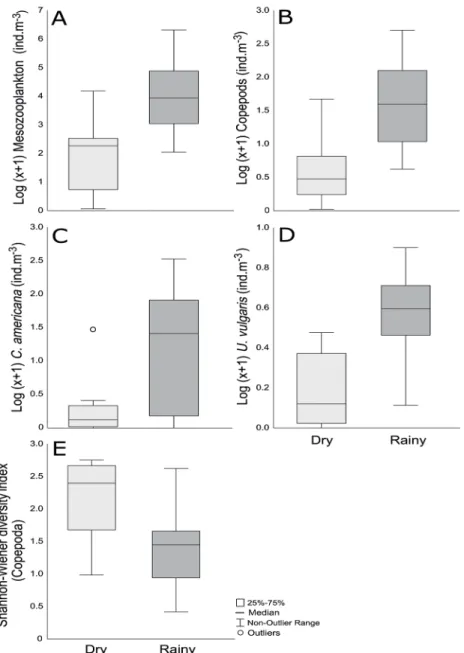
The effect of seasonality on the total abundance of me-sozooplankton, total abundance of copepods, Calanopia
americana, Undinula vulgaris (dominant species
co-pepods) and Shannon-Wiener diversity is illustrated in Figure 3a, 3b, 3c, 3d and 3 e, respectively.
The mean abundance of mesozooplankton and of co-pepods for dry season were: 13.04±19.39 ind.m-3; 7.53±14
ind.m-3 and for rainy season: 72.83±73.02 ind.m-3;
108.63±161.92 ind.m-3 respectively (Table 2b). The Anova
indicated the significant effect of the seasonal factor on the mean abundance of mesozooplankton (F (1, 13)=15.82,
p-level=0.001) and mean abundance of copepods (F (1,
13)=15.78, p-level=0.001) (Table 2a).
Among the copepod species considered to be domi-nants only C. americana (F (1, 10)=23.39, p-level=0.006)
and U. vulgaris (F (1, 12)=17.73, p-level=0.001)
re-sponded to the seasonal factor (Table 2a), whose mean abundance value was significantly higher in the rainy season 97±123.93 ind.m-3 and (3.30±2.26 ind.m-3)
respec-tively in comparison to dry season 3.84±9.79 ind.m-3 and
(0.72±0.74 ind.m-3) respectively(Table 2b).
The Shannon-Wiener diversity of copepods dif-fered significantly between the seasonal periods in-vestigated (F (1, 13)= 6.66, p-level=0.02) (Table 2a),
presenting a higher mean diversity during the dry season (2.19±0.57 bits.ind-1) compared to the mean
recorded in the rainy season (1.46±0.69 bits.ind-1)
(Table 2b).
Spatial variation
The mean abundance of mesozooplankton in sta-tions 1, 2, 3, 4 and 5 were respectively: 28.52 ± 21.58 ind.m-3, 35.69 ± 63.88 ind.m-3, 61.56 ± 50.13 ind.m-3,
194.60 ± 257.98 ind.m-3 and 11.41 ± 6.07 ind.m-3
equiv-alent to: 14.15±17.02 ind.m-3 at the station 1, 33.96±61
ind.m-3 at the station 2, 44.36±38 ind.m-3 at the station
3, 175.30±237.90 ind.m-3 at the station 4 and 7.29±8.28
ind.m-3 at the station 5(Figure 4a).
Figure 3. Box-Plot (median and quartiles) representing the Log (X + 1) of: (A) Mesozooplankton (ind.m-3); B) copepods (ind.m-3); (C) C. americana (ind.m-3) and (D) U. vulgaris (ind.m-3) between the seasonal periods (DRY vs RAINY) in the coastal area of the Fernando de Noronha Archipelago in northeastern Brazil.
mean values of Shannon-Wiener diversity recorded for the stations 1, 2, 3, 4 and 5 were: 2.02±0.63 bits.ind-1,
2.09±0.43 bits.ind-1, 2.03±0.62 bits.ind-1 , 1.19±0.86 bits.
ind-1 and 1.95±0.86 bits.ind-1 respectively(Figure 4b).
There were no significant differences among the sta-tions sampled in terms of total abundance of mesozoo-plankton, total abundance of copepods and Shannon-Wiener diversity.
All copepod species considered dominant: Calanopia
americana (129.82±164 ind.m-3), Undinula vulgaris
(3.78±3.49 ind.m-3), Oithona plumifera (1.95±3.11
ind.m-3) and Corycaeus speciosus (0.93±1.07 ind.m-3)
also recorded numerically highest mean values at sta-tion four (Cacimba do Padre), but statistical differences were not verified among the sampling stations. The
spe-cies Calanopia americana dominated spatially in both
a) ANOVA (i) Mesozooplankton abundance (ii) Copepods abundance
Source df MS F p Source df MS F p
Spatial (ST) 4 2.84 1.92 0.16 Spatial (ST) 4 0.54 1.67 0.21
Seasonal (S) 1 23.38 15.81 0.001 Seasonal (S) 1 5.17 15.78 0.001
Residual 13 1.47 Residual 13 0.32
(iii)
Undinula vulgaris
(iv)
Calanopia americana
Spatial (ST) 4 0.38 1.78 0.19 Spatial (ST) 4 3.39 1.73 0.21
Seasonal (S) 1 3.80 17.73 0.001 Seasonal (S) 1 23.39 11.96 0.006
Residual 12 0.21 Residual 10 1.95
(v) Shannon-Wiener diversity (H′)
Spatial (ST) 4 0.53 1.49 0.26
Seasonal (S) 1 2.38 6.66 0.02
Residual 13 0.35
b) BIOTIC VARIABLES Dry season Rainy season
Mean SD Mean SD
Total abundance of Zooplankton
(ind.m-3) 13.04 ±19.39 126.13 ±173.88
Total abundance of Copepods
(ind.m-3) 7.53 ±14.00 108.63 ±161.92
Undinulavulgaris (ind.m-3) 0.72 ±0.74 3.30 ±2.26
Calanopia americana (ind.m-3) 3.84 ±9.79 97 ±123.93
Shannon-Wiener diversity (H′) 2.19 ±0.57 1.46 ±0.69
Table 2. Main effects ANOVA results for abundance of: (i) Mesozooplankton; (ii) Copepods; (iii) Undinula vulgaris; (iv)
Calanopia americana and (v) Shannon-Wiener diversity in response to the seasonal factor (as between dry vs rainy) and
spatial factor (as between stations) on Fernando de Noronha Archipelago in northeastern Brazil.
Significant (p<0.05) - p values in bold.
much higher in the rainy period (more than 250 ind.m-3)
(Figure 5).
Mesozooplankton community structure
MDS analyses indicated differences in the structure of the mesozooplankton community of the Fernando de Noronha Archipelago between dry and rainy seasons (Figure 6), but dif-ferences among the five sampling stations were not verified. The pattern illustrated in the MDS ordination was confirmed by PERMANOVA. Significant differences in the structure of the mesozooplankton community of the Fernando de Noronha Archipelago were detected between seasons (dry vs. rainy)
(p=0.02) (Table 3). The interaction between factors (stations x
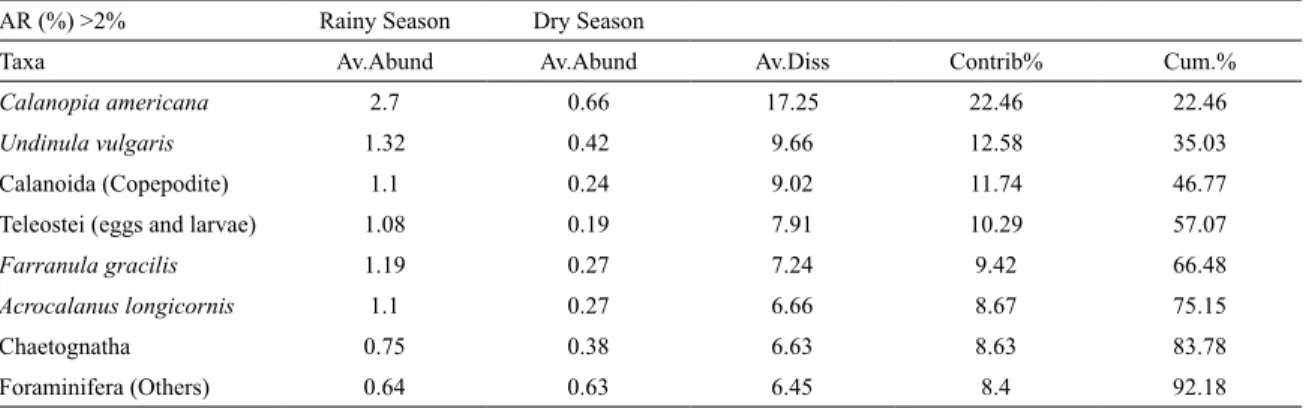
seasons) did not show statistical difference (Table 3). The ob-served differences between seasons were examined through of the average dissimilarity (SIMPER) among the two sets of data (mesozooplankton abundance), which was equivalent to 76.84%. The greatest dissimilarity between dry and rainy sea-sons is generated by Calanopia americana (as shown in Table 4).
Indicator value and functional traits
The rainy season was represented by two significant in-dicator (characteristic) species. Inin-dicator values (Indval) of more than 50% were found for species: Undinula vulgaris
(Indval=85%; p=0.01) and Calanopia americana (Indval=86%; p=0.03).
The Appendicularia Class was the only spatial indicator as-sociated with the combination between stations 3 (Conceição beach) and 5 (Golfinhos Bay) (Indval = 86%; p=0.005).
Cluster analysis for functional features of copepods assemblage showed two main groups (Figure 7): the first composed of broadcast spawners and the second, com-posed mostly of sac-spawners. Each group is subdivided in two subgroups. Subgroup 1 contained the greater num-ber of species and consisted of calanoid copepods with clearly herbivorous trend predominance. The species of this group contained calanoids with mean body sized of 1300 to 1700 μm (Acrocalanus longicornis, Calocalanus
pavo, Clausocalanus furcatus, Paracalanus aculeatus and
Calanopia americana). Subgroup 2 included fewer
spe-cies, consisting of larger-sized copepods (>1700 µm) as
Candacia pachydactyla, Centropages velificatus (both
car-nivorous) and Undinula vulgaris (herbivorous). Subgroup
3 consisted of copepods with body size of (1110 up to 1300 μm) such as the Calanoida: Euchaeta marina
(car-nivorous) and the Cyclopoida copepods Agetus flaccus and
Corycaeus speciosus. Subgroup 4 was characterized by
cyclopoids copepods (Farranula gracilis, Oncaea venusta,
Oithona plumifera and Oncaea mediterranea), classified
as small omnivores (<1100 μm) (exhibiting mixed feeding strategies depending on the availability of food items), and occurring from the epipelagic to the mesopelagic domain of the oceanic environment.
Figure 6. MDS ordination of the mesozooplankton community in response to the seasonal factor: Dry season (Black triangle) and rainy season (Gray triangle) in the coastal area of the Fernando de Noronha Archipelago in northeastern Brazil.
Source df MS Pseudo-F p(perm)
Spatial
(ST) 4 2802.8 1.012 0.483
Seasonal
(S) 1 7102.1 2.564 0.028
ST x S 4 2239.5 0.809 0.788
Residual 9 2769.8
Total 18
Table 3. Summary of PERMANOVA results for the
mesozooplankton community structure of the Fernando de Noronha Archipelago in response to the spatial (as between stations) and seasonal (as between dry vs. rainy) factors.
DISCUSSION
The study of the abundance, diversity and structure of the mesozooplankton community (with emphasis on co-pepods) in the years 2013 and 2014 corresponds to the first work carried out in the coastal area of Fernando de Noronha Archipelago, a south-western Atlantic Ocean tropical island. The results indicated a remarkable change in the seasonal distribution of the mesozooplankton com-munity, copepod assemblages and diversity of copepods, but a greater similarity between the quali-quantitative composition was verified between sampling stations, which is explained by the proximity between them.
Previous studies on zooplankton from tropical is-lands in Brazilian oceanic waters are relatively recent (Cavalcanti and Larrazabal, 2004; Lira et al., 2014), but some have also demonstrated the effect of seasonality on the ecological attributes of the mesozooplankton commu-nity (Diaz et al., 2009; Melo et al., 2012). The hypoth-esis of difference between dry and rainy seasons was verified in the present study, where the mean abundance of
mesozooplankton and copepods were significantly higher in the rainy season. Thus, our data suggest a seasonal ef-fect on the ecological attributes of mesozooplankton, but the long-term time series (preferably >10 years) is needed to further expand the present findings.
Variations in the meteorological regime, regional geomor-phological characteristics and anthropogenic impacts together establish the particular hydrographic regime of each region and, consequently, the taxonomic characteristics and tempo-ral-spatial dynamics of the copepods assemblage (Brandini et al., 1997). Coastal and oceanic epipelagic species of co-pepods, typical of the tropical and subtropical southwestern Atlantic were identified in the study area, but the numerically dominant species were Calanopia americana, Corycaeus
spe-ciosus, Undinula vulgaris and Oithona plumifera. In
particu-lar, the species U. vulgaris (suspensivore) and C. americana
(herbivore) responded significantly to the seasonal factor, pre-senting high abundance in the rainy season. Both species were considered by the results of the Indval analysis as indicators of the environmental conditions presented in the rainy season on Fernando de Noronha Archipelago.
The distribution of U. vulgaris in lagoon systems was
positively related to the abundance of organic (particulate) nitrogen sources and abundant food sources may be criti-cal for this species (Renon, 1993). According to Gerber and Gerber (1979) the daily metabolic losses of carbon by
U. vulgaris are very high, so considerable productivity is
required to keep these populations abundant. Therefore, the high, and for that reason, abundance of this specie ver-ified in the rainy season in the present study reinforces an increase of the productivity in “Inner Sea” of FNA during this seasonal period.
Calanopia americana occurs mainly in coastal regions
(Bowman, 1971). This species makes vertical migrations in both shallow coastal environments and in deeper locations, be-ing more frequently found in surface waters at night compared to day period (Clarke, 1934; Bowman, 1971; Turner et al., 1979; Cohen and Forward, 2002; Melo et al., 2010; Pessoa et al., 2014). The high abundance of C. americana in diurnal
samples of FNA could be explained by hydrodynamic effects since the stations are shallow. In addition, the occurrence of swell in some of the sampling periods of the years 2013 and 2014, resuspending bottom sediment and organisms associ-ated with it. Several studies showed the importance of this event in the called surf-zone fauna, where a group of inverte-brate species inhabit sandy beach surf zones (Mees and Jones, 1997). This is reforced in our results by the lesser abundance
Table 4. Summary of SIMPER showing the contribution of taxa (abundance >2%) for the differences between the dry
and rainy seasons, in the coastal area of Fernando de Noronha Archipelago. The Variable “Taxonomic composition” had a dissimilarity average between dry and rainy seasons of 76.84%.
AR (%) >2% Rainy Season Dry Season
Taxa Av.Abund Av.Abund Av.Diss Contrib% Cum.%
Calanopia americana 2.7 0.66 17.25 22.46 22.46
Undinula vulgaris 1.32 0.42 9.66 12.58 35.03
Calanoida (Copepodite) 1.1 0.24 9.02 11.74 46.77
Teleostei (eggs and larvae) 1.08 0.19 7.91 10.29 57.07
Farranula gracilis 1.19 0.27 7.24 9.42 66.48
Acrocalanus longicornis 1.1 0.27 6.66 8.67 75.15
Chaetognatha 0.75 0.38 6.63 8.63 83.78
Foraminifera (Others) 0.64 0.63 6.45 8.4 92.18
According to Assunção et al. (2016) the mean precipi-tation levels recorded for both the years of 2013 and 2014 was higher than usual for the rainy season. The intensifi-cation of the hydrological cycle caused salinity reduction, but a water surface heating was identified during the rainy season (June and July) in comparison to dry season. The author also reports that nutrient concentrations exhibited values characteristic of an oligotrophic area, but in gen-eral, these values were slightly higher in the rainy season, specifically in the bottom stratum.
Seasonal changes in nutrient concentration are fol-lowed by changes in planktonic productivity (Hawes, 1983). The increase in biological productivity in the sur-rounding islands has been reported in several studies as a consequence of the island mass effect (Doty and Oguri, 1956; Palacios, 2002). Patterns of plankton biomass accu-mulation or productivity increase near the FNA have been frequently described (Lira et al., 2014; Tchamabi et al., 2017) and related as a consequence of the island effect. Once, “Inner Sea” of FNA is dependent on the region of Figure 7. Functional groups of 15 species of copepod identified in the coastal area of the Fernando de Noronha Archipelago based on the Sorensen coefficient and weighted pair group method with averaging clustering method built on four functional characteristics (spawning strategy, trophic
its surroundings where the input of macro and micronutri-ents from island runoff (Perissinotto et al., 2000) and con-tributions from benthic processes (Signorini et al., 1999) stand out as the main mechanisms contributing to high productivity during the rainy season. Furthermore, the occurrence of rainfall allows the excrement of seabirds, present in the several elevations (hills) of FNA and espe-cially in the island Rata, (considered the largest deposit of guano and consequent phosphate in Brazil) arrived the waters of the Archipelago more quickly, also contributing to a significant response of planktonic productivity and consequently of the abundance of mesozooplankton and copepods observed in the rainy season in FNA.
In general, the abundance data of mesozooplankton community and copepod assemblages registered for the coastal area of Fernando de Noronha Archipelago are considered low. It is important to emphasize that in the present work, we performed subsurface hauls, with a net of 300 µm mesh size. Many researches with Copepoda has shown that the abundance of copepods collected with plankton net using smaller mesh size (<100 μm) has nearly two or more orders of degree higher than those obtained with larger mesh size plank-ton net. These differences are chiefly due to the loss of small-sized copepods in the samples obtained with big-ger mesh plankton net (Araujo et al., 2008; Wu et al., 2011). The mean value of the Shannon-Wiener diversi-ty index for copepod assemblages was also considered low in the present study. Significant differences were observed between the seasonal periods investigated, where the mean of season diversity was significantly higher than the values recorded in rainy season. Thus, the lower value recorded for the rainy season can be a consequence of the dominance of the copepods U.
vulgaris and C. americana observed in this seasonal
period in the present study. Cavalcanti and Lazzarabal (2004) studying the mesozooplankton of the northeast Brazilian Exclusive Economic zone during the dry sea-son, through oblique hauls with a bongo net (mesh size of 300 μm) in the stratum of 0-200 m, showed that the species diversity of the copepod assemblages present-ed values ranging from very low to high. The authors explained the fact as a response to the dominance of
U. vulgaris and C. americana in some sampling
sta-tions. Then, in order to compare diversity in different environments, considerations must be made regarding the heterogeneity of environments, the sampling effort and the equipment used in sampling (Dias et al., 2010).
Functional features of the copepod
community
In this study two groups were formed according to their reproductive characteristics (broadcast spawner and sac-spawner), and they could be classified in four functional subgroups. Subgroup 1 brought together nu-merically important calanoids in the epipelagic layer of coastal environments and tropical Atlantic Ocean, some of which, such as C. americana, are strong vertical migrants
(Neumann-Leitão et al., 2008; Pessoa et al., 2014). Particularly, C. americana had high participation and
dominance in practically all the samples. Peaks of abun-dance occurred mainly in the rainy season. This fact may have occurred due the intensification of the trade winds in this seasonal period, exhibiting higher intensity from July to September (11 ms-1) (Manso et al., 2011). Thus, we
suggest that the intensification of the trade winds caused an increase in the intensity of the waves and resuspension of the bottom, considering the benthic habit during the day and planktonic behavior at night of C. americana specie
(Cohen and Forward, 2002). In several studies that per-formed daytime sampling this species is cited (Dias and Bonecker, 2009; Dias et al., 2010), but rarely with high abundance (as recorded in the present work). However, high values of abundance have already been recorded for
C. americana in nocturnal sampling (Melo et al., 2010;
Pessoa et al., 2014). This subgroup also included the Paracalanidae (Acrocalanus longicornis, Calocalanus pavo and Paracalanus aculeatus), a family of great
im-portance in terms of abundance, biomass and daily pro-duction, besides being highly adapted to the oligotrophic conditions and having the ability to exploit other forms of food besides the phytoplankton (Miyashita et al., 2009; Melo Júnior et al., 2016). However, in FNA its participa-tion in terms of abudance was low, caused by the selectiv-ity of the plankton net mesh size used (300µm).
The species Candacia pachydactyla, Centropages
velificatus and Undinula vulgaris formed the second
sub-group within this cluster, composed of larger copepods. Interesting studies of the tropical oceanic zooplankton have shown U.vulgaris presenting high values of relative
abundance and frequency of occurrence in Northeastern Brazil (Neumann-Leitão et al., 1999; 2008). Candacia
pachydactyla and Centropages velificatus together within
the subgroup 3 include the carnivorous species. Euchaeta
marina, known as among the most common
the larger Calanoides acutus (Øresland, 1991), doliolids
(Takahashi et al., 2013), larvaceans (Ohtsuka and Onbé, 1989) and fish larvae (Yen, 1987); and Corycaeus specio-sus and Agetus flaccus which despite being classified as
medium-sized carnivores also have the feeding behavior of cruising detritivores, moving to great depths to de-compose particulate organic matter and contributing to epipelagic secondary production (Benedetti et al., 2015).
Corycaeus speciosus is also typical of the Brazil Current
and is an indicator of oligotrophic areas (Björnberg, 1981). This species is very frequent and abundant in oceanic wa-ters with temperatures and salinities around 26°C and of 35, respectively, also having wide tropical and subtropical distribution (Bradford-Grieve et al., 1999).
Subgroup 4 grouped together small marine planktonic copepods (Farranula gracilis, Oncaea venusta, Oncaea
mediterranea and Oithona plumifera). Oithona spp. are
small, active ambush-feeding omnivores that carry their eggs and has been described as the most ubiquitous and abundant copepod in the world’s (Gallienne and Robins, 2001). Oncaea spp. are mainly cruise detritivores,
epipe-lagic and found associated with appendicularians “houses” (Alldredge, 1972; Steinberg et al., 1994). Farranula grac-ilis is a typical species of the west-central Gulf of Mexico,
and of the surface oceanic waters of the Caribbean Sea. It may be associated with the mixed oligotrophic waters of the Caribbean (López-Salgado et al., 2000).
In general, the copepod assemblages of the western coast of Fernando de Noronha Archipelago presented a larger number of species considered as predator-carnivours
(Euchaeta marina, Candacia pachydactyla, Corycaeus
speciosus, Agetus flaccus, Centropages velificatus and
Farranula gracilis). Thus, actual dominance of predator
with preference for smaller or larger prey will influence the number of steps in the food chains (number of trophic levels) and thereby determine whether primary production is efficiently passed to larger organisms or remineralized (Hansen et al., 1994).
CONCLUSIONS
We suggest that changes in the structure of the me-sozooplankton community (with emphasis on copepods) of the coastal area of Fernando de Noronha Archipelago (“Inner Sea”) was mainly related to the seasonal factor where: (1) The rainy season (considered a period of in-creased productivity) favored a significant increase in the abundance of mesozooplankton. (2) Undinula vulgaris
and Calanopia americana were considered indicators of
the environmental conditions presented in the rainy sea-son, recording high values of abundance in this seasonal period. The high abundance of C. americana in practically
all sampled stations is an evidence of coastal influence, as well it indicates the effects of hydrodynamism induc-ing the species dominance in all shallow stations, leadinduc-ing to the conclusion that C. americana is a key species for
the study area. (3) The mean values of Shannon–Wiener diversity of the copepod assemblages indicate a low taxo-nomic diversity, mainly in the rainy season. This low di-versity was explained by the high dominance of C. ameri-cana and U. vulgaris in the samples.
ACKNOWLEDGEMENT
The authors wish to acknowledge their indebtedness to the Project “Study of the balance of the carbon cycle in the coastal region and its potential transport to the ocean - with emphasis to the Pernambuco coast” (CARECOS) the financial support of the Foundation for Science and Technology Support of Pernambuco (FACEPE/ FAPESP APQ-0074-1.08/11) and the Research Support
Foundation of the State of São Paulo (FAPESP/FACEPE/
ANR 2011/50582-0).
REFERENCES
ALLDREDGE, A. L. 1972. Abandoned larvacean houses: a uni-que food source in the pelagic environment. Science, 177,
885-887.
ALMEIDA, F. F. M. 1955. Geologia e Petrologia do Arquipélago de Fernando de Noronha, Rio de Janeiro, Instituto Brasileiro
de Geografia e Estatística.
ANDERSON, M. J. 2001. A new method for non-parametric mul-tivariate analysis of variance. Austral Ecology, 26, 32-46.
ARAUJO, H. M. P., NASCIMENTO-VIEIRA, D. A., NEU-MANN-LEITÃO, S., SCHWAMBORN, R., LUCAS, A. P. O. & ALVES, J. P. H. 2008. Zooplankton community dyna-mics in relation to the seasonal cycle and nutrient inputs in an urban tropical estuary in Brazil. Brazilian Journal of Biology,
68, 751-762.
ASSUNÇÃO, R. V., SILVA, A. C., MARTINS, J. & FLORES--MONTES, M. 2016. Spatial-Temporal Variability of the Thermohaline Properties in the Coastal Region of Fernando de Noronha Archipelago. Journal of Coastal Research, 75,
512-516.
BARTON, A. D., PERSHING, A. J., LITCHMAN, E., RECORD, N. R., EDWARDS, K. F., FINKEL, Z. V., KIØRBOE, T. & WARD, B. A. 2013. The biogeography of marine plankton traits. Ecology Letters, 16, 522-534.
BJÖRNBERG, T. K. S. 1981. Copepoda. In: BOLTOVSKOY, D.
(ed.) Atlas del zooplancton del Atlántico sudoccidental y mé-todos de trabajos com el zooplancton mariño. Mar del Plata:
INIDEP. p. 587-679.
BOLTOVSKOY, D. (ed) 1981. Atlas del Zooplancton del Atlanti-co Sudoccidental y Métodos de Trabajos Atlanti-con el Zooplancton Marino, Mar del Plata, INIDEP.
BOLTOVSKOY, D. (ed). 1999. South Atlantic zooplankton,
Lei-den, Backhuys Publishers.
BOWMAN, T. E. 1971. The Distribution of Calanoid Copepods off the Southeastern United States between Cape Hatteras and Southern Florida. Smithsonian Contributions to Zoology, 96,
1-58.
BRADFORD-GRIEVE, J. M., MARKHASEVA, E. I., ROCHA, C. E. F. & ABIAHY, B. 1999. Copepoda. In: BOLTOVSKOY,
D. (ed.) South Atlantic Zooplankton. Leiden: Backhuys
Publi-shers. p. 869-1098 p.
BRANDINI, F.P.; R.M. LOPES; K.S. GUTSEIT; H.L. SPACH & R. SASSI. 1997. Planctolologia na plataforma continental do Brasil. Diagnose e revisão bibliográfica. Rio de Janeiro, MMA-CIRM-FEMAR, 196p.
CAVALCANTI, E. A. H. & LARRAZÁBAL, M. E. L. 2004. Ma-crozooplâncton da Zona Econômica Exclusiva do Nordeste do Brasil (segunda expedição oceanográfica - REVIZEE/NE II) com ênfase em Copepoda (Crustacea). Revista Brasileira de Zoologia, 21, 467-475.
CLARKE, G. L. 1934. The diurnal migration of copepods in St. George’s Harbor, Bermuda. Biological Bulletin, 67,
456-460.
COHEN, J. H. & FORWARD, R. B. JR. 2002. Spectral Sensi-tivity of Vertically Migrating Marine Copepods. Biological Bulletin, 203, 307-314.
COWIE, R. H. & HOLLAND, B. S. 2006. Dispersal is fun-damental to biogeography and the 805 evolution of biodi-versity on oceanic islands. Journal of Biogeography, 33,
193-198.
DIAS, C. O. & ARAÚJO, A. V. 2006. Copepoda. In:
BONE-CKER, S. L. C. (ed.) Atlas de zooplâncton da região central da Zona Econômica Exclusiva brasileira. Rio de Janeiro:
Museu Nacional.
DIAS, C. O., ARAUJO. A. V., PARANHOS, R. & BONECKER S. L. C. 2010. Vertical Copepod Assemblages (0-2300 m) off Southern Brazil.Zoological Studies, 49, 230-242.
DIAS, C. O.; BONECKER, S. L. C. Copepod assemblage (Co-pepoda, Crustacea) on the inner continental shelf adjacent to Camamu Bay, northeast Brazil. Revista Brasileira de Zoolo-gia, v. 26, p. 629-640, 2009.
DIAZ, X. F. G., GUSMÃO, L. M. O. & NEUMANN-LEITÃO, S. 2009. Biodiversidade e dinâmica espaço- temporal do zoo-plâcton. In: VIANA, D. L., HAZIN, F. H. V. & SOUZA, M.
A. C. (orgs.) O arquipélago de São Pedro e São Paulo: 10
anos de Estação Científica. Brasília: SECIRM. p. 128-137. DOTY, M. S. & OGURI, M. 1956. The island mass effect. ICES
Journal of Marine Science, 22, 33-37.
DUFRÊNE, M. & LEGENDRE, P. 1997. Species assemblages and indicator species: the need for a flexible asymmetrical approach. Ecological Monographs, 67, 345-366.
FALKOWSKI, P. G., BARBER, R. T. & SMETACEK, V. 1998. Biogeochemical controls and feedbacks on ocean primary production. Science, 281, 200-206.
FRONTIER, S. Diseño de muestreos. 1981. In: BOLTOVSKOY,
D. (ed.) Atlas del zooplancton del Atlántico Sudoccidental y métodos de trabajo con el zooplancton marino. Mar deI Plata:
INIDEP. l03-108.
GALLIENNE, C. P. & ROBINS, D. B. 2001. Is Oithona the most important copepod in the world’s oceans? Journal of Plankton Research, 23,1421-1432.
GAUSE, G. F. 1934. The struggle for existence, Baltimore,
Wi-lliams and Wilkins.
GERBER, R. P. & GERBER, M. B. 1979. Ingestion of natural particulate organic matter and subsequent assimilation, res-piration and growth by tropical lagoon zooplankton. Marine Biology, 52, 33-43.
HANSEN, B., BJORNSEN, P. K. & HANSEN, P. J. 1994. The size ratio between planktonic predators and their prey. Lim-nology and Oceanography, 39, 395-403.
HAWES, I. 1983. Nutrients and their Effects on Phytoplankton Populations in Lakes on Signy Island, Antarctica. Polar Bio-logy, 2, 115-126.
HUTCHINSON, G. E. 1957. Population studies: Animal ecology and demography. Cold Spring Harbour Symposium in Quan-titative Biology, 22, 415-427.
KÖEPPEN, W. 1948. Climatologia: Cón un estudio de los climas de la tierra, México, Fondo de Cultura econômica.
LARRAZABAL, M. E., CAVALCANTI, E. A. H., NASCIMEN-TO VIEIRA, D. A., OLIVEIRA-KOBLITZ, V. S., ARAU-JO, E. M., BARRETO, T. M. S. & NUNES, T. R. S. 2009. Oceanografia biológica: Macro-zooplâncton na ZEE da re-gião Nordeste do Nordeste do Brasil. Parte VII. In: HAZIN,
F. H. V. (ed.) Oceanografia Biológica: biomassa primária e
secundária, macrozooplâncton, ictioplâncton, ictionêuston, macrofauna bêntica. Sér. Doc. REVIZEE, Score Nordeste.
Fortaleza: Martins & Cordeiro.
LEGENDRE, P. & LEGENDRE, L. 1998. Numerical ecology. De-velopments in Environmental Modelling 20, New York, Elsevier.
LIRA, S. M. A., TEIXEIRA, I. A., LIMA, C. D. M., SANTOS, G. S., NEUMANN LEITÃO, S. & SCHWAMBORN, R. 2914. Spatial and nycthemeral distribution of the zooneuston off Fernando de Noronha, Brazil. Brazilian Journal of Oceanography, 62, 35-45.
LÓPEZ-SALGADO, I., GASCA, R. & SUÁREZ-MORALES, E. 2000. La comunidad de copépodes (Crustacea) en los giros a mesoescala en el occidente del Golfo de México (julio, 1995).
Revista de Biología Tropical, 48, 169-179.
MAFALDA, P. JR, PÉREZ DE RUBÍN, J. & SAMPAIO DE SOUZA, C. 2007. Mesozooplankton composition and distri-bution in relation to oceanographic conditions in the Gulf of Cádiz, Spain. Revista UDO Agrícola, 7, 274-284, 2007.
MANSO, V. A., MENOR, E. A., VALENÇA, L. M. M., NEU-MANN, V. H. M. L., PEREIRA, N. S, JUNIOR, C. F. A. S. & SILVA, E. R. M. 2011. Morfodinâmica de praias setentrionais da Ilha de Fernando de Noronha. Revista de Gestão Costeira Integrada, 11, 327-339.
MCARDLE, B. H. & ANDERSON, M. J. 2001. Fitting multi-variate models to community data: a comment on distance based redundancy analysis. Ecology, 82, 290-297.
MEES, J. & JONES, M. B. 1997. The hyperbenthos. In:
ANSE-LL, A. D., GIBSON, R. N. & BARNES, M (eds) Oceano-graphy and Marine Biology: An Annual Review. 35. London:
MELO, P. A. M. C., SILVA, T. A., NEUMANN-LEITÃO, S., SCHWAMBORN, R., GUSMÃO, L. M. O. & PORTO NETO, F. 2010. Demersal zooplankton communities from tropical habitats in the southwestern Atlantic. Marine Biology Research, 6, 530-541.
MELO, P. A. M. C., DIAZ, X. F. G., MACEDO, S. J. & NEU-MANN-LEITÃO, S. 2012. Diurnal and spatial variation of the mesozooplankton community in the Saint Peter and Saint Paul Archipelago, Equatorial Atlantic. Marine Biodiversity Records, 5, 121-135.
MELO-JÚNIOR, M., MARCOLIN, C. R., MIYASHITA, L. K. & LOPES, R. M. 2016. Temporal changes in pelagic cope-pod assemblages off Ubatuba, Brazil. Marine Ecology, 37,
877-890.
MIYASHITA, L. K., MELO-JÚNIOR, M. & LOPES, R. M. 2009. Estuarine and oceanic influences on copepod abundance and production of a subtropical coastal area. Journal of Plankton Research, 31, 815-826.
NEUMANN-LEITÃO, S., GUSMÃO, L. M. O., SILVA, T. A., NASCIMENTO-VIEIRA, D. A. & SILVA, A. P. 1999. Meso-zooplankton biomass and diversity in coastal and oceanic wa-ters off North-eastern Brazil. Archive of Fishery and Marine Research, 47, 153-165.
NEUMANN-LEITÃO, S. N., ESKINAZI-SANTANNA, E. M., GUSMÃO, L. M. O., NASCIMENTO-VIEIRA, D. A., PA-RANAGUÁ, M. N. & SCHWAMBORN, R. 2008. Diversity and distribution of the mesozooplankton in the tropical Sou-thwestern Atlantic. Journal of Plankton Research, 30,
795-805.
OHTSUKA, S. & ONBÉ, T. 1989. Evidence of selective feeding on larvaceans by the pelagic copepod Candacia bipinnata (Calanoida: Candaciidae). Journal of Plankton Research, 11,
869-872.
OMORI, M. & IKEDA, T. 1984. Methods in marine zooplankton ecology, New York, John Willey.
ØRESLAND, V. 1991. Feeding of the carnivorous copepod Eu-chaeta antarctica in Antarctic waters. Marine Ecology Pro-gress Series, 78, 41-47.
PALACIOS, D. M. 2002. Factors influencing the island-mass effect of the Galápagos Archipelago. Geophysical Research Letters, 29, 49-1-49-4.
PERISSINOTTO, R., LUTJEHARMS, J. R. E. & VAN BALLE-GOOYEN, R. C. 2000. Biological-physical interactions and pelagic productivity at the Prince Edward Islands, Southern Ocean. Journal of Marine Systems, 24, 327-341.
PESSOA, V. T., MELO, P. A. M. C., MELO JÚNIOR, M. & NEUMANN-LEITÃO, S. 2014. Population dynamics of
Calanopia americana DAHL F., 1894 (COPEPODA,
CALA-NOIDA) in a reef environment in Tropical Brazil. Tropical Oceanography, 42, 24-32.
PIONTKOVSKI, S., WILLIAMS. R., IGNATYEV, S., BOLTA-CHEV, A. & CHESALIN. M. 2003. Structural–functional relationships in the pelagic community of the eastern tropi-cal Atlantic Ocean. Journal of Plankton Research, 25,
1021-1034.
POMERLEAU, S., SASTRI, A. R. & BEISNER. B. E. 2015. Eva-luation of functional trait diversity for marine zooplankton communities in the Northeast subarctic Pacific Ocean. Jour-nal of Plankton Research, 37, 712-726.
RENON, J. P. 1993. Répartition du copépode planctonique Un-dinula vulgaris (Dana) dans trois types de milieux coralliens. Annales de l’Institut océanographique, 69, 239-247.
RICE, E. & STEWART, G. 2016. Decadal changes in zooplankton abundance and phenology of Long Island Sound reflect inte-racting changes in temperature and community composition.
Marine Environmental Research, 120, 154-165.
ROBINSON, L. M., ELITH, J., HOBDAY. A. J., PEARSON, R. G., KENDALL, B. E., POSSINGHAM, H. P. & RICHARDSON, A. J. 2011. Pushing the limits in marine species distribution mode-lling: lessons from the land present challenges and opportunities.
Global Ecology and Biogeography, 20, 789-802.
SARMENTO, V. E SANTOS, P. Trampling on coral reefs: tou-rism effects on harpacticoid copepods. Coral Reefs 31, pp.
135-146. 2012
SERAFINI, T. Z., FRANÇA, G. B. & ANDRIGUETTO-FILHO, J. M. 2010. Ilhas oceânicas brasileiras: biodiversidade conhe-cida e sua relação com o histórico de uso e ocupação humana.
Revista da Gestão Costeira Integrada, 10, 281-301.
SIGNORINI, S. R., McCLAIN, C. R. & DANDONNEAU, Y. 1999. Mixing and phytoplankton bloom in the wake of the Marquesas Islands. Geophysical Research Letters, 26, 3121-3124.
STEINBERG, D. K., SILVER, M. W., PILSKALN, C. H., COALE, S. L. & PADUAN, J. B. 1994. Midwater zooplankton communi-ties on pelagic detritus (giant larvacean houses) in Monterey Bay, California. Limnology and Oceanography, 39, 1606-1620.
TAKAHASHI, K., ICHIKAWA, T., SAITO, H., KAKEHI, S., SUGIMOTO, Y., HIDAKA, K. & HAMASAKI, K. 2013. Sapphirinid copepods as predators of doliolids: their role in doliolids mortality and sinking flux. Limnology and Oceano-graphy, 58, 1972-1984.
TCHAMABI, C. C., ARAUJO, M., SILVA, M. & BOURLÈS, B. 2017. A study of the Brazilian Fernando de Noronha island and Rocas atoll wakes in the tropical Atlantic. Ocean Mode-lling, 111, 9-18.
TURNER, J. T., COLLARD, S. B., WRIGHT, J. C., MITCHELL, D. V. & STEELE, P. 1979. Summer Distribution of Ponte-llid Copepods in the Neuston of the Eastern Gulf of Mexico Continental Shelf. Bulletin of Marine Science,29, 287-297. WICKSTEAD, J. H. 1979. Zooplancton marino, Barcelona,
Edi-ciones Omega.
WU, C. J., SHIN, C. H. & CHIANG, K. P. 2011. Does the Mesh Size of the Plankton Net Affect the Result of Statistical Analyses of the Relationship Between the Copepod Commu-nity and Water Masses? Crustaceana, 84, 1069-1083.
YEN, J. 1987. Predation by a carnivorous marine copepod, Eu-chaeta norvegica Boeck, on eggs and larvae of the North
Atlantic cod Gadus morhua L. Journal of Experimental Ma-rine Biology and Ecology, 112, 283-296.