0960-8524/$ - see front matter © 2007 Elsevier Ltd. All rights reserved. doi:10.1016/j.biortech.2007.01.014
Arundo donax L. reed: New perspectives for pulping and bleaching.
5. Ozone-based TCF bleaching of organosolv pulps
A.A. Shatalov
¤, H. Pereira
Centro de Estudos Florestais, Universidade Técnica de Lisboa, Instituto Superior de Agronomia, Tapada da Ajuda, 1349-017 Lisboa, Portugal Received 22 September 2006; received in revised form 17 January 2007; accepted 21 January 2007
Available online 12 March 2007
Abstract
Three selected alkali-based organosolv pulps (alkali-sulWte-anthraquinone-methanol (ASAM), alkali-anthraquinone-methanol (organocell) and ethanol-soda) from agroWbre crop giant reed (Arundo donax L.) were bleached by an ozone-based TCF (totally chlorine-free) bleaching sequence AZERQP (where A is an acidic pulp pre-treatment, Z is an ozone stage, (ER) is an alkaline extraction in the
presence of reducing agent, Q is a pulp chelating, P is a hydrogen peroxide stage) without oxygen pre-bleaching, and compared with a conventional kraft pulp used as a reference. The diVerent response on bleaching conditions within each bleaching stage was noted for all tested pulps. The pulp bleachability, in terms of brightness improvement or lignin removal per unit of applied chemicals, was found higher for the organocell pulp. The ASAM and ethanol-soda pulps showed the highest bleaching selectivity, expressed by viscosity loss per unit of lignin removed or brightness improved. The overall bleaching results of organosolv pulps were superior to kraft.
© 2007 Elsevier Ltd. All rights reserved.
Keywords: Giant reed; Arundo donax L.; Non-wood Wbres; Ozone bleaching; Organosolv pulping
1. Introduction
Over the last decade, the increased market demand for totally chlorine-free (TCF) and low AOX (absorbable organic halogens) pulps caused a substantial renewed inter-est in non-chlorine oxidative bleaching chemicals such as oxygen, hydrogen peroxide and ozone. Ozone is the most powerful oxidation agent. Despite the considerable research to elucidate the bleaching capacity of ozone, completed already 30–40 years ago, its commercial application became feasible only in the 1990s under the pressure of environmen-tal issues in an eVort to minimize discharges of chlorinated compounds in the bleaching plant eZuents (Byrd et al., 1992; Liebergott et al., 1992a,b; Homer et al., 1996).
At present, an ozone bleaching stage is part of many ECF (elemental chlorine-free) and TCF commercial pulp bleach-ing sequences (Van Lierop et al., 1996). Ozone has proved to be a highly eYcient and competitive bleaching chemical in
terms of deligniWcation ability, cost and ecological impact. The ozone bleaching stage was successfully applied to diVer-ent types of convdiVer-entional (sulfur-based) and unconvdiVer-entional (organosolv) pulps from a wide variety of woods and non-wood (agro-Wbre) sources (Zimmermann et al., 1991; Puthson et al., 1997; Zhang et al., 1998; Saake et al., 1998; Bouchard et al., 2000; Bokstrom and Tuomi, 2001; Munro and GriYths, 2001; Roncero et al., 2002; Roncero et al., 2003; Kishimoto et al., 2003; King and Van Heiningen, 2003).
Agro-Wbres are of much current importance to paper-making as the only solution to make up for a shortage of wood Wbres and to prevent thereby the fast global defores-tation (Van Dam et al., 1994; Moor, 1996; Leminen et al., 1996). Giant reed (Arundo donax L.) is one of the well-known Wbre crops, which papermaking potential is now being intensively reconsidered. The high biomass produc-tivity and ability to cultivation (Dalianis et al., 1994; Vecch-iet et al., 1996), combined with appropriate chemical composition and good Wbre properties (Perdue, 1958; Shatalov et al., 2001; Ververis et al., 2004), suggest the broad potential for giant reed application to pulp and
* Corresponding author. Tel.: +351 21 36 34662; fax: +351 21 36 45000.
paper production. The recent study on organic solvent-based (organosolv) pulping of giant reed showed that com-petitive papermaking Wbres (comparable with hardwoods) could be produced using this advanced pulping technology (Shatalov and Pereira, 2000, 2001, 2004). The organosolv Wbres from A. donax were easily bleached to high bright-ness values by simple TCF three-stage hydrogen peroxide bleaching sequence, without any pulp pre-bleaching ( Shata-lov and Pereira, 2003, 2005).
In the present paper, the results on TCF bleachability of
A. donax organosolv pulps by ozone-based bleaching
sequence without oxygen pre-bleaching are reported. The bleaching results are compared with conventional kraft pulp, as a reference.
2. Experimental
2.1. Raw material and pulping
The whole stems of A. donax (including nodes and inter-nodes) without leaves were used to prepare pulps for the bleaching experiments. The detailed chemical, anatomical and morphological characterization of the stem material of A. donax has been reported elsewhere (Shatalov et al., 2001). The ASAM
(alkali–sulWte–anthraquinone–mnol), organocell (alkali–anthraquinone–metha(alkali–sulWte–anthraquinone–mnol), etha-nol–soda and kraft pulps were prepared by a 7 L laboratory-scale batch reactor with forced circulation of the cooking liquor using conditions described in our previ-ous publications (Shatalov and Pereira, 2001, 2004). The principal properties of unbleached pulps are summarised in
Table 1.
2.2. Bleaching
All the tested pulps were bleached under identical condi-tions with an AZERQP sequence (where A is an acidic pulp
pre-treatment, Z is an ozone stage, ER is an alkaline extrac-tion in the presence of reducing agent, Q is a pulp chelating, P is a hydrogen peroxide stage), without oxygen pre-bleach-ing. The speciWc bleaching conditions of each stage are listed in Table 2.
To increase the selectivity of the ozone stage towards lig-nin, an acidic pulp treatment with a solution of sulfuric acid was done before ozonation. The reducing agent (sodium borohydride) was added to the alkaline extraction stage to convert the alkali-sensitive carbonyl groups of the carbo-hydrates to hydroxyl groups, thus preventing the alkali-induced carbohydrate degradation (Lindholm, 1993). Before peroxide bleaching, the pulps were pre-treated with a chelating agent EDTA (ethylenediaminetetraacetic acid) to limit the eVect of transition metals on alkaline decompo-sition of peroxide. The Epsom salt (magnesium sulfate) and DTPA (diethylenetriaminepentaacetic acid) were used as the additional chemicals during peroxide bleaching stage to minimize the radical degradation reactions of carbohy-drates.
The acidic pulp treatment was carried out in open glass containers under room temperature and atmospheric pres-sure. The alkaline extraction stage as well as the pulp che-lating and peroxide bleaching stage were performed in sealed plastic bags plunged into an agitated water bath with process temperature control. Ozone bleaching (low consis-tency) was performed in a 2 l glass reactor (Fischer) equipped with a powerful stirrer and connected with a lab-oratory ozone generator (Fischer 502). After each bleach-ing stage, the pulps were thoroughly washed by deionized water and analysed for bleached yield, brightness, viscosity, residual lignin content and mechanical properties. The Wnal bleached pulps were also analysed on mechanical proper-ties after beating in a laboratory PFI mill.
2.3. Pulp analysis
Residual lignin content was determined as Klason and acid-soluble lignin according to T 222 om-88 and UM 250 TAPPI standards, respectively. Pulp viscosity was
Table 1
Properties of unbleached organosolv and kraft (ref.) pulps from A. donax Pulping process
Ethanol-soda ASAM Organocell Kraft (ref.) Yield (% on oven-dry reed) 46.8 46.5 45.7 43.2 Lignin (% on oven-dry pulp) 4.04 4.30 3.28 3.58 Klason 2.45 3.05 2.17 2.57 Acid-soluble 1.59 1.25 1.11 1.01 Intrinsic viscosity (ml g¡1) 1146 1142 967 1078 Brightness (% ISO) 40.5 38.9 31.8 30.2 Yellowness index 39.2 32.4 41.1 39.3 Burst index (kPa m2 g¡1) 1.42 1.31 1.08 0.96 Tensile index (N m g¡1) 21.51 19.20 19.12 15.56 Tear index (mN m2 g¡1) 9.56 8.66 8.76 8.22 Table 2 Bleaching conditions
a Magnesium sulfate was applied as MgSO 4· 7H2O. bpH was adjusted by diluted sulfuric acid.
Bleaching stage A Z ER Q P Pulp consistency (%) 3 3 10 3 10 Temperature (°C) 20 20 60 50 90 Time (min) 30 20 60 50 90 O3 (% on oven-dry pulp) – 0.8 – – – H2O2(% on oven-dry pulp) – – – – 2.5 NaOH (% on oven-dry pulp) – – 1.0 – 1.5 EDTA (% on oven-dry pulp) – – – 0.3 – DTPA (% on oven-dry pulp) – – – – 0.2 MgSO4 (% on oven-dry pulp)a – – – – 0.3
NaBH4 (% on oven-dry pulp) – – 0.1 – –
measured in cupri-ethylenediamine (CED) solution accord-ing to SCAN-CM 15:88 standard. Handsheet formation for physical and reXectance tests were performed according to TAPPI T 205 om-88 and TAPPI T 272 om-92 standards. Bursting, tensile and tearing strength of pulp handsheets were examined according to TAPPI T 220 om-88 standard. Pulp optical properties (ISO brightness and DIN 6167 C/2 yellowness index) were measured by CM-3630 Spectro-photometer (Minolta).
All measurements were replicated to obtain reproducible data.
3. Results and discussion
With this paper we continue to examine the bleaching ability of organosolv pulps from giant reed by totally chlorine free (TCF) bleaching technologies. The simple three-stage hydrogen peroxide bleaching without oxygen pre-bleaching has been reported in our previous publica-tion (Shatalov and Pereira, 2005). The Wnal brightness of
76–78% ISO was attained after complete peroxide bleach-ing. To consider the possibility of brightness improvement, the introduction of one ozone-stage within the short TCF sequence was studied.
3.1. Properties of bleached pulps
Three selected alkali-based organosolv giant reed pulps (ASAM, organocell and ethanol–soda) were bleached by AZERQP (actually ZEP) bleaching sequence without oxy-gen pre-bleaching, and compared with conventional kraft pulp. The bleaching results are shown in Table 3. It is evi-dent that all organosolv pulps can be bleached to brightness values of 80% ISO and higher by a short ozone-based TCF sequence without any pulp pre-treatment. The ethanol–soda and organocell pulps showed the highest and practically the same brightness after complete bleaching (83.7% and 83.4%
ISO, respectively). The Wnal brightness of ASAM pulp was somewhat poorer and close to that of kraft pulp (79.4 and 79.6% ISO, respectively). The brightness was substantially improved in comparison with QPPP bleaching (Shatalov and Pereira, 2005) by 7.3 points (ethanol-soda pulp), 5.8 points (organocell) and 2.0 points (ASAM), while the brightness of kraft pulp was improved by 5.2 points.
The content of residual lignin (expressed as Klason and acid-soluble) in all ZEP-bleached pulps except ASAM was reduced in comparison with peroxide bleaching pointing to more intensive deligniWcation, particularly during the ozone-stage. The removal of Klason lignin is of special importance, because of direct correlation between Klason lignin content and the kappa number commonly used in paper industry. About 83% of Klason lignin was removed during ZEP bleaching of organocell pulp, and 77% and 69% during bleaching of ethanol–soda and ASAM pulps (vs. respectively, 77%, 68% and 76% after QPPP bleaching,
Shatalov and Pereira, 2005). The degree of deligniWcation
of kraft pulp was close to that of ASAM and accounted for about 69% (vs. 65% for QPPP bleaching).
Reduction of ozonated pulps with a strong reducing agent during alkaline extraction stage (ER-stage) enabled to limit the alkali-induced degradative reactions of carbohy-drates, providing thereby the high bleached yield and pulp viscosity (Table 3), which were fairly close to those obtained after QPPP bleaching (Shatalov and Pereira, 2005). The loss in intrinsic viscosity of only 11.6%, 13.8% and 18.4% was found after ZEP bleaching of ASAM, etha-nol–soda and organocell pulps, respectively. The degrada-tion of kraft pulp was more intensive, with a viscosity loss of about 21%.
Thus, in contrary to the expectations, the introduction of such powerful oxidation agent as ozone into the bleaching sequence did not cause any substantial harmful eVect on the pulp properties in comparison with a simple multi-stage peroxide bleaching (through the undesirable side-reactions of ozone with other than lignin components), while an appreciable gain in pulp brightness and degree of deligniW-cation was achieved.
3.2. Relative pulp bleachability and bleaching selectivity
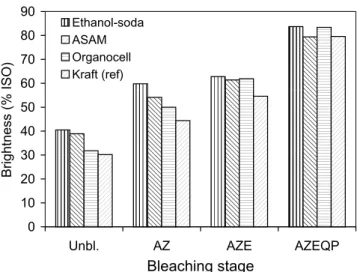
The change in brightness, residual lignin content and vis-cosity of organosolv and kraft pulps with each stage of ZEP bleaching is illustrated in Figs. 1–3.
The brightness improvement of pulps bleached under equal reaction conditions can be assumed as a measure of comparative pulp bleachability. From this standpoint, the organocell pulp showed the highest bleachability (51.6% ISO of the overall brightness improvement after complete ZEP bleaching), followed by kraft (49.4%), ethanol–alkali (43.2%) and ASAM (40.5%) pulps. The contribution of diVerent bleaching stages (or diVerent bleaching chemicals) to total brightness improvement varied for diVerent pulps. The ethanol-soda pulp revealed the best bleachability by ozone, i.e., the AZ-stage bleachability (19.3% ISO of
bright-Table 3
Properties of AZERQP-bleached organosolv and kraft (ref.) pulps from
A. donax
Pulping process
Ethanol-soda ASAM Organocell Kraft (ref.) Bleached yield (% on oven-dry pulp) 93.4 91.0 90.9 92.1 (% on oven-dry reed) 43.7 42.3 41.6 39.8 Lignin (% on oven-dry pulp) 1.65 1.89 1.26 1.66 Klason 0.57 0.96 0.36 0.79 Acid-soluble 1.08 0.93 0.90 0.87 Intrinsic viscosity (ml g¡1) 988 1009 789 852 Brightness (% ISO) 83.7 79.4 83.4 79.6 Yellowness index 7.8 10.1 8.8 12.5 Burst index (kPa m2 g¡1) 1.32 1.30 1.27 1.11
Tensile index (N m g¡1) 15.85 15.28 14.26 12.38
ness improvement), followed by organocell (18.2%), ASAM (15.2%) and kraft (14.2%) pulps. After alkaline extraction (ER-stage), the brightness of organocell pulp was increased somewhat more (by 11.9% ISO) than that of ASAM (7.3%), ethanol–soda (3.0%) and kraft (10.2%) pulps. Finally, the hydrogen peroxide bleachability (QP-stage) of the kraft pulp was higher (25% ISO improvement) in comparison with organosolv pulps (21.5%; 20.9%, and 18.0% for organocell, ethanol–soda and ASAM pulps, respectively).
The relative pulp bleachability can be also assessed through the eYciency in lignin removal during bleaching. The organocell pulp (83.3% of overall lignin removed after complete ZEP bleaching) once again showed the superior-ity over the ethanol-soda (76.6%), ASAM (69.5%) and kraft (69.1%) pulps. Similar to brightness, the eVect of the diVer-ent bleaching chemicals varied for the diVerdiVer-ent tested pulps. The ozone was extremely eVective in degradation and removal of ethanol–soda and organocell residual lignins (61.7% and 53.0% loss, respectively). In contrary, the delig-niWcation of ASAM pulp by ozone was very poor (about 10%) and worse than kraft (27%). The alkaline extraction removed more lignin from ozonated kraft pulp (36.3%), than from ASAM (28.7%), organocell (20.0%) and ethanol– soda (8.8%) organosolv pulps. The hydrogen peroxide was very eVective for deligniWcation of ASAM pulp (lignin loss of 30.8%) and had only moderate eVect on organocell, etha-nol–soda and kraft lignins (10.2%; 6.0% and 5.9% lignin loss, respectively).
The loss in pulp viscosity per unit of lignin removed or per unit of brightness improved during bleaching can also express the relative bleaching selectivity. It was found that the bleaching of ASAM pulp was more selective. The calcu-lated bleaching selectivities in respect to lignin removed and brightness improved are in the ratios of 1:0.75:0.64 for ASAM, ethanol–soda and organocell pulps and 1:0.95:0.90 for ASAM, organocell and ethanol–soda pulps. The selec-tivity of kraft pulp bleaching was substantially poorer (respectively, 0.50 and 0.72).
The main drop in pulp viscosity occurs during the less selective ozone bleaching stage. The viscosity was some-what improved after an alkaline extraction of ozonated pulps, most likely as a result of direct dissolution of low molecular polysaccharide fractions by alkaline solution and limited alkaline degradation of residual carbohydrates in the presence of reducing agent (Lindholm, 1993). The hydrogen peroxide bleaching stage had only a slight nega-tive eVect on viscosity of organosolv pulps, but aVected more substantially the viscosity of kraft pulp.
3.3. Mechanical properties of bleached pulps
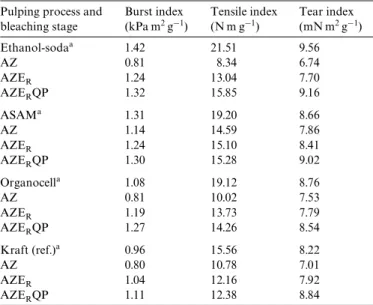
The evolution of strength properties of organosolv and kraft pulps with each bleaching stage is shown in Table 4. Generally, the bursting and tearing strength of all organo-solv as well as kraft pulps after complete ZEP bleaching were close to those of unbleached pulps, while the tensile strength was signiWcantly reduced, similar to multi-stage
Fig. 1. Change in brightness of organosolv and kraft (ref.) giant reed pulps during each bleaching stage.
0 10 20 30 40 50 60 70 80 90
Unbl. AZ AZE AZEQP
Bleaching stage Brightness (% ISO) Ethanol-soda ASAM Organocell Kraft (ref)
Fig. 2. Change in residual lignin content of organosolv and kraft (ref.) giant reed pulps during each bleaching stage.
0.0 0.5 1.0 1.5 2.0 2.5 3.0 3.5 4.0 4.5 5.0
Unbl. AZ AZE AZEQP
Bleaching stage
Residual lignin (% on o.d. pulp)
Ethanol-soda ASAM Organocell Kraft (ref)
Fig. 3. Change in intrinsic viscosity of organosolv and kraft (ref.) giant reed pulps during each bleaching stage.
0 200 400 600 800 1000 1200 1400 1600
Unbl. AZ AZE AZEQP
Bleaching stage Intrinsic viscosity (ml g -1 ) Ethanol-soda ASAM Organocell Kraft (ref)
peroxide bleaching (Shatalov and Pereira, 2005). The etha-nol–soda pulp showed the highest strength after bleaching. Similar to unbleached state, the strength properties of bleached kraft pulp were poorer in comparison with organosolv pulps.
As can be seen from Table 4, the bursting, tensile and tearing strength of all tested pulps was substantially impaired after the ozone-stage. The loss in strength is par-ticularly notable for the ethanol–soda pulp, where the bursting strength was reduced by 43%, the tensile strength by 61% and the tearing strength by 29%. After subsequent alkaline extraction of ozonated pulps the strength proper-ties were substantially improved (following to improvement of pulp viscosity), more appreciably for ethanol–soda pulp (bursting strength by 53%, tensile strength by 56% and tear-ing strength by 14%). The mechanical properties of all pulps were also somewhat improved with further peroxide bleaching.
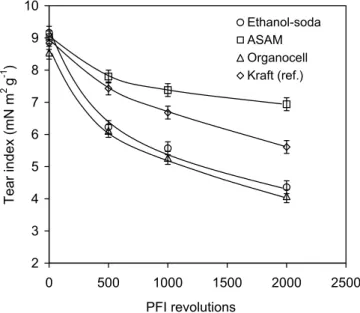
As evident from Figs. 4–7, the strength properties of ozone-bleached reed pulps can be substantially developed by moderate PFI beating with minimal energy requirement. Similar to unbleached (Shatalov and Pereira, 2001) and per-oxide bleached (Shatalov and Pereira, 2005) pulps, the bursting and tensile strength were greatly improved at already 500–1000 PFI revolutions. The improvement was more signiWcant for the ASAM pulp. The maximal bursting strength of ASAM pulp (9.0 kPa m2/g) was reached at 1000 PFI rev. and then decreased with beating extension, while the bursting strength of ethanol-soda and organocell pulps kept growing with beating and showed the respective maximal values of 7.7 and 6.1 kPa m2/g at 2000 PFI rev. The tensile strength of ASAM pulp was sharply increased at already 500 PFI rev. and only slightly improved with further beating extension, showing a maximum value of 59.4 kPa m2/g at 2000 PFI rev. The tensile strength of beaten
organo-cell and ethanol–soda pulps followed generally the ASAM tendency, but giving somewhat lower Wnal values (55.9 and 53.3 kPa m2/g, respectively). The tearing strength of ozone-bleached organosolv pulps was decreased with beating, as it was also noted for unbleached and peroxide-bleached giant reed pulps (Shatalov and Pereira, 2001, 2005). The loss in tearing strength was higher for ethanol–soda and organo-cell pulps and less for ASAM pulp (respectively, 54; 53 and 20% loss at 2000 PFI rev.). The higher response on beating of ASAM pulp is also evident from Fig. 7, where the beaten ASAM pulp showed the maximum tensile strength under the same values of tearing index.
The beating behaviour of the bleached kraft pulp was generally similar to that of organosolv pulps. The strength
Table 4
Physical properties of AZERQP-bleached unbeaten organosolv and kraft
(ref.) pulps from A. donax
a Properties of unbleached pulp are given.
Pulping process and bleaching stage Burst index (kPa m2g¡1) Tensile index (N m g¡1) Tear index (mN m2g¡1) Ethanol-sodaa 1.42 21.51 9.56 AZ 0.81 8.34 6.74 AZER 1.24 13.04 7.70 AZERQP 1.32 15.85 9.16 ASAMa 1.31 19.20 8.66 AZ 1.14 14.59 7.86 AZER 1.24 15.10 8.41 AZERQP 1.30 15.28 9.02 Organocella 1.08 19.12 8.76 AZ 0.81 10.02 7.53 AZER 1.19 13.73 7.79 AZERQP 1.27 14.26 8.54 Kraft (ref.)a 0.96 15.56 8.22 AZ 0.80 10.78 7.01 AZER 1.04 12.16 7.92
AZERQP 1.11 12.38 8.84 Fig. 4. Bursting strength development with PFI beating of bleached
organosolv and kraft (ref.) giant reed pulps.
0 1 2 3 4 5 6 7 8 9 10 0 500 1000 1500 2000 2500 PFI revolutions
Burst index (kPa m
2 g -1 ) Ethanol-soda ASAM Organocell Kraft (ref.)
Fig. 5. Tensile strength development with PFI beating of bleached organo-solv and kraft (ref.) giant reed pulps.
0 10 20 30 40 50 60 70 0 500 1000 1500 2000 2500 PFI revolutions Tensile index (N m g -1 ) Ethanol-soda ASAM Organocell Kraft (ref.)
properties development of kraft pulp was poorer in com-parison with ASAM, but close or somewhat better (as in the case of tearing strength) to ethanol–soda and organo-cell pulps.
4. Conclusions
The ASAM, organocell and ethanol-soda organosolv pulps from giant reed can be bleached to brightness values of 80–83% ISO by a short ozone-based TCF bleaching sequence (ZEP), without any pulp pre-bleaching. The organocell pulp showed the highest bleachability, and the ASAM pulp the highest bleaching selectivity. The optical and strength properties of bleached organosolv pulps are
superior to conventional kraft pulp. Pulp brightness and degree of deligniWcation were substantially improved by the ozone bleaching in comparison with QPPP bleaching with-out aVecting pulp strength and viscosity. In our future stud-ies, we intend to increase the brightness ceiling of bleached reed organosolv pulps (fully bleached pulps) using various pre-treatment and activation technologies.
Acknowledgements
The Wnancial support of Fundação para a Ciência e a Tecnologia (Portugal) within Research Contracts SFRH/ BPD/9376/2002 and POCTI/35161/AGR/2000 is gratefully acknowledged.
References
Bokstrom, M., Tuomi, A., 2001. Interest in applying ozone is growing. Paperi Ja Puu-Paper and Timber 83 (2), 124–127.
Bouchard, J., Morelli, E., Berry, R.M., 2000. Gas-phase addition of solvent to ozone bleaching of kraft pulp. J. Pulp Pap. Sci. 26 (1), 30–35. Byrd Jr., M.V., Gratzl, J.S., Singh, R.P., 1992. DeligniWcation and bleaching
of chemical pulps with ozone: A literature review. TAPPI J. 75 (3), 207–213.
Dalianis, C.D., Sooter, Ch.A., Christou, M.G., 1994. Growth, biomass pro-ductivity and energy potential of giant reed (Arundo donax) and ele-phant grass (Miscanthus sinensis giganteus). In: Chartier, Ph., Beenackers, A.A.C.M., Grassi, G. (Eds.), Proceedings of the Eighth European Biomass Conference, Vienna. Pergamon, UK, pp. 575–582. Homer, G., Muguet, M., Epiney, M., Johnson, S., 1996. Oxygen, ozone and
chlorine dioxide. In: Proceedings of the Eighty-Second Annual Meet-ing, Tech. Sect., CPPA, Montreal, pp. A297.
King, J.E., Van Heiningen, A.R.P., 2003. EVect of pulp species and pre-treatment on the rates of deligniWcation and cellulose degradation dur-ing ozone bleachdur-ing. Pulp and Paper – Canada 104 (10), 38–42. Kishimoto, T., Tsuji, H., Uraki, Y., Sano, Y., 2003. Ozone bleaching of
atmospheric acetic acid hardwood pulp from Betula platyphylla var. japonica Hara. Holzforschung 57 (2), 181–188.
Leminen, A., Johansson, A., Lindholm, J., Gullichsen, J., Yilmaz, Y., 1996. Non-wood Wbres in papermaking. VTT, Finland.
Liebergott, N., Van Lierop, B., Skothos, A., 1992a. A survey of the use of ozone in bleaching pulps, Part 1. TAPPI J. 75 (1), 145–152.
Liebergott, N., Van Lierop, B., Skothos, A., 1992b. A survey of the use of ozone in bleaching pulps, Part 2. TAPPI J. 75 (2), 117–124.
Lindholm, C.-A., 1993. Alkaline extraction of ozone-bleached pulp, Part 4. Comparison of E, (EB), (EO), (EP) and (EOP) treatment. J. Pulp Pap. Sci. 19 (3), 108–113.
Moor, G., 1996. Nonwood Wbre applications in papermaking. Pira Inter-national, UK.
Munro, F., GriYths, J., 2001. Operating experience with ozone-based ECF bleaching sequence – Results have exceeded initial expectations. Pulp and Paper – Canada 102 (9), 35–39.
Perdue, R.E., 1958. Arundo donax – source of musical reeds and industrial cellulose. Econ. Bot. 12, 368–404.
Puthson, P., Kordsachia, O., Odermatt, I., Zimmermann, M., Patt, R., 1997. ASAM pulping of Eucalyptus camaldulensisand TCF bleaching of the resulting pulps. Holzforschung 51 (3), 257–262.
Roncero, M.B., Colom, J.F., Vidal, T., 2002. Increasing the selectivity of ozone bleaching of eucalypt pulp. Part B. APPITA J. 55 (5), 386–391. Roncero, M.B., Torres, A.L., Colom, J.F., Vidal, T., 2003. TCF bleahcing
of wheat straw pulp using ozone and xylanase. Part B: Kinetic studies. Biores. Technol. 87 (3), 315–323.
Saake, B., Lehnen, R., Schmekal, E., Neubauer, A., Nimz, H.H., 1998. Bleaching of Formacell pulp from aspen wood with ozone and perace-tic acid in organic solvents. Holzforschung 52 (6), 643–650.
Fig. 6. Tearing strength development with PFI beating of bleached organosolv and kraft (ref.) giant reed pulps.
2 3 4 5 6 7 8 9 10 0 500 1000 1500 2000 2500 PFI revolutions Tear index (mN m 2 g -1 ) Ethanol-soda ASAM Organocell Kraft (ref.)
Fig. 7. Tear index vs. tensile index for beaten bleached organosolv and kraft (ref.) giant reed pulps.
2 3 4 5 6 7 8 9 10 0 20 40 60 80 Tensile index (N m g-1) Tear index (mN m 2 g -1 ) Ethanol-soda ASAM Organocell Kraft (ref.)
Shatalov, A.A., Pereira, H., 2000. Organosolv pulping of Arundo donax L. as an alternative to the kraft process for production of high quality non-wood Wbres. In: Proceedings of the Sixth European Workshop on Lignocellulosics and Pulp, Bordeaux, France, pp. 571–574.
Shatalov, A.A., Pereira, H., 2001. Arundo donax L. reed: New perspectives for pulping and bleaching-2. Organosolv deligniWcation. TAPPI J. 84 (11), 1–12.
Shatalov, A.A., Pereira, H., 2003. InXuence of organosolv pulping process on TCF bleachability of Arundo donax L. pulps. In: Proceedings of the Twelfth International Symposium on Wood and Pulping Chemistry, Madison, USA, pp. 109–112.
Shatalov, A.A., Pereira, H., 2004. Arundo donax L. reed: New perspectives for pulping and bleaching-3. Ethanol-reinforced alkaline pulping. TAPPI J. 3 (2), 27–31.
Shatalov, A.A., Pereira, H., 2005. Arundo donax L. reed: New perspectives for pulping and bleaching-4. Peroxide bleaching of organosolv pulps. Biores. Technol. 96 (8), 865–872.
Shatalov, A.A., Quilhó, T., Pereira, H., 2001. Arundo donax L. reed: New perspectives for pulping and bleaching-1. Raw material characteriza-tion. TAPPI J. 84 (1), 96–107.
Van Dam, J.E.G., Van Vilsteren, G.E.T., Zomers, F.H.A., Shannon, W.B., Hamilton, I.T., 1994. Industrial Wbre crops. Agro-Industrial Research Division, EC.
Van Lierop, B., Skothos, A., Liebergott, N., 1996. Ozone deligniWcation. In: Dence, C.W., Reeve, D.W. (Eds.), Pulp Bleaching. Principles and Practice. TAPPI Press, Atlanta, pp. 321–345.
Vecchiet, M., Jodice, R., Schenone, G., 1996. Agronomic research on giant reed (Arundo donax L.) Management system and cultivation of two diVerent provenances. In: Chartier, Ph., Ferrero, G.L., Henius, U.M., Hultberg, S., Sachau, J., Wiinblab, M. (Eds.), Biomass for Energy and the Environment. Proceedings of the Ninth European Biomass Confer-ence, Copenhagen. Pergamon, UK, pp. 644–648.
Ververis, C., Georghiou, K., Christodoulakis, N., Santas, P., Santas, R., 2004. Fiber dimensions, lignin and cellulose content of various plant materials and their suitability for paper production. Ind. Crop Prod. 19 (3), 245–254. Zhang, X., Ni, Y., Van Heiningen, A.R.P., 1998. Basic engineering design data for ozone/solvent bleaching of ALCELL®-derived pulp. Pulp and
Paper – Canada 99 (1), 44–48.
Zimmermann, M., Patt, R., Kordsachia, O., 1991. ASAM pulping of Doug-las-Wr followed by a chlorine-free bleaching sequence. TAPPI J., 129–134.