978-1-5090-5727-6/16/$31.00 ©2016 IEEE
The changes in fractal dimension after a maximal
exertion in swimming
Tiago M. Barbosa
Chen Simin
Nanyang Technological University Singapore
Pedro Forte
Jorge E. Morais
Polytechnic Institute of BragançaBragança, Portugal
Research Centre in Sports, Health and Human Development Vila Real, Portugal
Abstract— Quite often linear variables are not sensitive enough to explain the changes in the motor behavior of elite athletes. So, non-linear variables should be selected. The aim was to compare the fractal dimension before and after a maximal bout swimming front-crawl. Twenty-four subjects performed an all-out 100m trial swimming front-crawl. Immediately before (Pre-test) and after the trial (Post-test) a speed-meter cable was attached to the swimmer’s waist to measure the hip speed from which fractal dimension was derived. The fractal dimension showed a significant decrease with a moderate effect size between pre- and post-tests. Twenty-one out of 24 swimmers decreased the fractal dimension. As a conclusion, there is a decrease in the fractal dimension and hence in the swimming behavior complexity being under fatigue after a maximal trial.
Keywords — swimming; non-linear parameters; locomotion; fatigue; system’s complexity
I. INTRODUCTION
In a linear system there is proportionality between input and output. Under this framework it is expected that the amount of change in the performance delivered in sports being proportional to the variations in the inputs. I.e., larger variations in the inputs, should lead likewise to meaningful shifts in the output. This may be reasonably easy to obtain in low-tier competitive athletes, recreational and fitness-oriented counterparts. In these cohort groups it is expected that the odds of a meaningful change in the input having an impact on the main outcome are rather high.
As far as elite performance is concerned, this is not always
the case. Quite often to monitor one’s performance, the
variables selected are not sensitive enough to explain the changes in the motor behavior. These athletes are very close of their maximal limits, having fewer margins to improve a given determinant variable (meaning a component of a complex system) and therefore the main outcome (i.e. performance).
Whereas in lower level athletes one can note a major improvement over time in a given parameter, this becomes more challenging for high-performance counterparts. For
instance, it was reported that the performance of elite swimmers is improved by less than 1% each season [1]. At least in this research it was noted that the performance determinants also improved by 1-3% [1]. Hence, there is some body of knowledge suggesting that the improvements over time by elite athletes are prone to be trivial [2,3].
Hence, research on elite athletes that is underpinned by linear systems may not be insightful enough. Indeed there are a few challenges carrying out research in this population. One of which is the fact that quite often are not obtained significant or meaningful findings. So, one may wonder if non-linear parameters can provide more insight. Indeed there is scarce research on the assessment of non-linear parameter in elite sports. Swimming performance is measured by the time spent to cover the event’s distance. It is measured up to the 0.01s and the difference among competitors it is as little as that. Most elite swimmers are keen to improve the performance determinants so that can set a new personal best by at least the margin of 0.01s. Therefore, the follow-up question is how feasible and insightful non-linear parameters can be assessing the motor behavior of elite athletes. For such a narrow margin of improvement, hopefully non-linear parameters might be more insightful than linear variables.
Non-linear complex systems are characterized by interaction-dominant dynamics. The system features several components that will interact having not only a direct effect on the main outcome but also among them and hence indirectly on the latter one. As far as competitive swimming is concerned, it has also been noted that the performance depends on several factors interplaying among themselves and ultimately affecting the performance [4]. Therefore one may argue that the assessment of non-linear parameter can be a useful approach in this sport.
A very recent paper compared the level of complexity of swimming according to level of expertise. It was noted that swimming does exhibit nonlinear properties but its magnitude differs according to the swim stroke and level of expertise of the performer [6]. The FD was higher with large effect sizes in the group of non-experts than in high-tier swimmers (highly-qualified and expert cohort groups). The FD was 1.84±0.08, 1.85±0.09 and 1.89±0.06 at front-crawl for highly-qualified, expert and non-expert swimmers, respectively [6]. The trials consisted in all-out bouts of 25m not being under the effect of fatigue (i.e. fully rested). Therefore, one may wonder what might be the effect of fatigue on FD.
To the best of our knowledge, it was not yet compared the fractal dimension (and therefore, the level of complexity) before and after a maximal exertion in competitive swimming. This might bring us some insight on the effect of the fatigue in such parameters and in the non-linear properties of the swim stroke. Assessing the swimmer’s fatigue by non-linear parameters might provide valuable details on the fatigue mechanisms. Ultimately can bring some enlighten on how to delay as much as possible the onset of fatigue. At least on land, the fractal dimension decreased over a 120 minutes load carriage march by servicemen [7]. Hence, the complexity of the motor behavior seems to be coupled to fatigue.
The aim was to compare the fractal dimension after an all-out ball-out of 100m swimming front-crawl. It was hypothesized that the fractal dimension would decrease under fatigue.
II. METHODS A. Subjects
A convenience sample of twenty-four subjects (12 males and 12 females; 22.38±1.68 years-old) were recruited for this research. The subjects were fitness-oriented swimmers, healthy and non-pregnant, attending swim sessions twice a week for at least four years.
The participants gave informed written consent for participation in this study. All procedures were in accordance with the Helsinki Declaration regarding human research. The University IRB committee also approved the research design.
B. Procedures
The subjects were invited to perform alone, in one lane, with no one else in the swimming pool at that time a simulated 100m freestyle race. They were advised to perform the trial at their maximal possible pace. Swimmers were by themselves in the pool, to avoid pacing strategies, drafting effects or increases in the resistance acting on them.
Considering the participants’ expertise and fitness level a maximal bout of 100m was expected to onset a significant level of fatigue.
Before (pre-test, i.e. rested) and immediately after (post-test, i.e. under fatigue) the maximal 100m bout, participants performed two all-out swim trials of 25m at front-crawl with push-off start. Once again, each subject performed the trial alone, being no one else in the pool.
Before beginning the 100m bout, a 15 minutes rest was provided so that they could reach a full recovery of the pre-test trial. No rest was allowed between the 100m bout and the post-test trial.
C. Data collection
A speedo-meter cable (Swim speedo-meter, Swimsportec, Hildesheim, Germany) was attached to the swimmer’s hip [8] in both 25m trials. The speedo-meter was set on the forehead-wall of the swimming pool.
A software interface in LabVIEW® (v. 2015) was used to acquire (f=50Hz), display and process speed-time data. Data was transferred from the speedo-meter to the software by a 12-bit acquisition card (USB-6008, National Instruments, Austin, Texas, USA).
D. Data handling
Data was exported to a signal processing software (AcqKnowledge v. 3.9.1, Biopac Systems, Santa Barbara, USA).
The signal was filtered with a 5Hz cut-off low-pass 4th order Butterworth filter after being plotted the residuals vs. cut-off frequency of the raw data. The push-off start and the finish were discarded of the follow-up analysis.
The level of complexity of the stroke cycles was assessed by the Fractal dimension (FD) [5]:
k
d
k
L
N
d
FD
log
log
(1)Where D is the fractal dimension, N is the number of new points from the speed-time series and k is the scaling factor.
In other scientific areas, researchers have been assessing the fractal properties with different algorithms. However, the Higuchi’s algorithm, selected for this research, is the most suitable technique for the analysis of the fractal characteristics in time-series [9].
E. Statistical analysis
Data normality was tested by Shapiro-Wilk test. Data is described as mean ± 1SD (i.e. 68.27% confidence interval) and 95% of confidence interval (95CI).
FD variance. It was also controlled the possible effect of the sex (between-subjects comparison) and the fatigue status (co-variable: the difference in the swim pace between pre- and post-test) for the event that subjects elicit different levels of fatigue. Significance level was set at p ≤ 0.05.
Concurrent to the null-hypothesis testing, it was also run the calculation of the effect sizes by the eta-squared (2). It
was assumed that an analysis would return no effect if 0 < 2 ≤
0.04, minimum effect if 0.04 < 2 ≤ 0.25, moderate effect for
the 0.25 < 2 ≤ 0.64 interval and a strong effect when 2 >
0.64.
III. RESULTS
The speed in the pre-test was 1.44 ± 0.24 m/s and later on, after the 100m bout, in the post-test 1.28 ± 0.23 m/s. There was a significant and strong variation in the swimming speed between pre- and post-test (F = 55.136, p < 0.001) but the sex-effect was not confirmed (F = 0.87, p = 0.77). Therefore, one may argue that this slowdown in speed was imposed by the fatigue. It is also possible to claim that there is no sex effect confounding the findings to be reported.
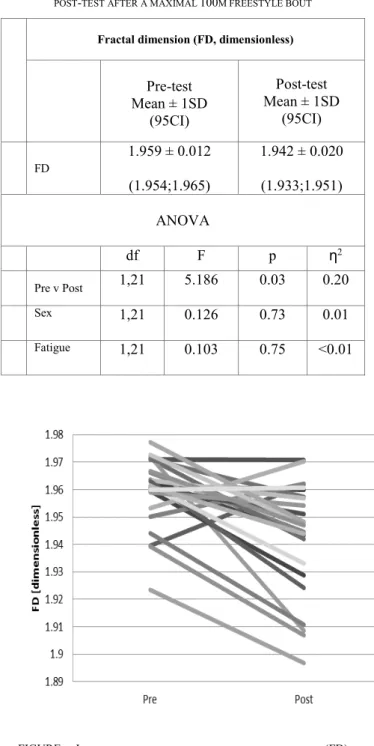
The FD showed a significant variation between pre- and post-test, with a moderate effect size (F = 5.186, p = 0.03, η2 =
0.20). The effect of the sex (F = 0.126, p = 0.73, η2 = 0.01) and
fatigue level (F = 0.103, p = 0.75, η2 < 0.01) were
non-significant (table I). Hence, indeed it was verified an effect of the fatigue in the FD; albeit no differences between men and women. Likewise, the amount of fatigue experienced by the participants did not affect the results.
Altogether, after the 100m maximal bout the 95CI band shifted from 1.954 - 1.965 to 1.933 - 1.951 suggesting an effect of the fatigue on the FD (table I).
An individual analysis was done to have a deeper insight. Twenty-one out of 24 swimmers decreased the FD from pre- to post-test though (figure I).
TABLE I. VARIATION OF THE FRACTAL DIMENSION (FD) FROM PRE- TO POST-TEST AFTER A MAXIMAL 100M FREESTYLE BOUT
Fractal dimension (FD, dimensionless)
Pre-test Mean ± 1SD
(95CI)
Post-test Mean ± 1SD
(95CI)
FD
1.959 ± 0.012 (1.954;1.965)
1.942 ± 0.020 (1.933;1.951) ANOVA
df F p ƞ2
Pre v Post 1,21 5.186 0.03 0.20
Sex 1,21 0.126 0.73 0.01
Fatigue 1,21 0.103 0.75 <0.01
FIGURE I -INDIVIDUAL CHANGES OF THE FRACTAL DIMENSION (FD)
BETWEEN PRE- AND POST-TEST AFTER A MAXIMAL 100M FREESTYLE BOUT.
IV. DISCUSSION
It was found that the FD of front-crawl swimming will range by 1.954 and 1.965 over an all-out trial being rested (i.e. 95CI: 1.954 - 1.965). This first result confirms that indeed competitive swimming does exhibits fractal proprieties. Only a couple of papers have reported yet the FD in human swimming. Barbosa et al. [6] noted a FD of 1.84 ± 0.08, 1.85 ± 0.09 and 1.89 ± 0.06 at front-crawl for highly-qualified, expert and non-expert swimmers, respectively. In this paper it was concluded that the level of expertise will affect the complexity of the motor system. The results reported here are higher than the cited paper. This can be explained by the lower expertise of our participants. Another paper reported a case study for a breaststroker [10]. The FD ranged between 1.75 and 1.45 with increasing swim paces. This suggests that different swim strokes will show variations on their complexity.
Comparing human swimming with other animals more adapted to aquatic environment, it is easy to follow that the fractal properties would be rather different. Gold fish show an FD of 1.62 [11]. Animals that are more adapted to aquatic environment may be prone to have a lower FD.
Benchmarking competitive swimming, or at least front-crawl, with other sports is another alternative. Jogging at the half-marathon pace the FD was reported as 1.70 ± 0.10 [12]. Being humans more adapted to land and to jogging/running as locomotion technique than to aquatic environment and swimming, this will make the FD to be lower in the former conditions though.
As far as aquatic locomotion is concerned, humans can propel themselves in water (i.e. swimming) or on boats/vessels. At least in rowing the FD was 1.22 ± 0.03 for highly-skilled participants, whereas it was 1.30 ± 0.03 for lower-skilled counterparts [13]. It is interesting to note that the FD was much lower than all other locomotion techniques reported under this discussion. There are some comprehensive reviews of the literature comparing the efficiency among different locomotion techniques in water [14]. It is known that rowing efficiency is significantly higher than swimming. This can point out to a possible explanation. However, follow-up studies should be carried out comparing the complexity of different aquatic- and land-based locomotion techniques.
The assessment of subjects under fatigue is a trendy topic in sport sciences for a long time [15]. Academics focused on this topic have two major goals. The first is to understand the
fatigue’s mechanism. Knowing the mechanism established, the second goal is to delay the onset of the fatigue in athletes. The manifestations of fatigue are observed by a reduction in the ability to produce a given force or power [15]. The main reasoning is that if the onset of fatigue happens later in the event, the subjects will be able to deliver higher power output, reach or keep a higher speed and therefore to outperform.
Fatigue is hypothesized as being the result of the complex interaction by multiple components [16]. This may feature the interplay of biomechanical, physiological and neurological
parameters, besides others. Moreover, intensity, time exercising and type of exercise are all variables that cause different effects within the body systems, which in turn create
different types of “sensation” and ultimately fatigue [17]. Added to that, chronic fatigue and underperformance are typical signs and symptoms of overtraining [18]. Being fatigue a complex phenomenon, non-linear parameters should be selected.
The mainstream research design to assess the fatigue is assessing the participants before and after an intense and/or exhaustive and/or unhabitual task. The pre-test is the rested condition whereas the post-test is the condition under fatigue. Alternatively, if feasible it will be collected data in the first few trials or reps of the protocol and in the last ones. In our research the latter protocol it is not feasible because a speedo-meter was used to collect data. A cord must be attached to
participant’s hip and data being collected in one single lap.
Hence, it was decided to selected the former protocol (pre-test; task; post-test). In the literature it is possible to find a solid body of knowledge reporting the changes in linear parameters before and after the intense and/or exhaustive and/or unhabitual task. Notably in biomechanics it is assessed the kinematics (trajectories, speed, stroke rate, stroke length, etc.) [19]. There is a reduction in the stroke rate and hence in the speed by 10% during an all-out 100m bout swimming arms-only front-crawl. It is also possible to have some insight on the power output [19]. The mechanical power may diminish by 24%. Electromyography is also able to provide interesting details on this phenomenon [20]. Time- and spectral-domain variables can be reported. Over a 200m event in swimming it was noted an increase in integrated electromyography (20%–25%) and a decrease in spectral parameters (40%–60%) for all of the upper-limb muscles, indicating the reaching of submaximal fatigue [21].
As far as our understanding goes, even though non-linear parameters may provide very interesting details on fatigue, the literature is scarce. The FD can be used as a proxy of fatigue [22]. However the vast majority of the studies handled neuromuscular signals [23].
It is challenging to find papers reporting the changes in fractal proprieties of kinematic data under fatigue. Nevertheless, it was shared evidence of fractal-like fluctuations in gait on land [24]. On land, the FD decreased marching for 2 hours [7]. The FD decreased from an initial value of 1.43 at the beginning of the march to 1.12 in the end. However it should be noted the sinusoidal pattern of the decrease over the 120 minutes march. I.e., the FD decrease was not as linear as one could have hypothesized. Keeping the this rational it was wondered if the same wouldn’t be true in competitive swimming. Swimming would exibiht fractal proprities and on top of that, under fatigue the FD would decrease.
95CI band shifted from 1.954 - 1.965 (pre-test) to 1.933 - 1.951 (post-test) suggesting an effect of the fatigue on the FD. This was coupled with a significant impairment in the swim speed from 1.44 ± 0.24 m/s to 1.28 ± 0.23 m/s. Potential
confounding factors such as the participant’s sex and level of
fatigue were controlled. In such event, the results kept the same trend. I.e., having both sexes pooled together was not a major concern because the data analysis encompassed a within-subject comparison. The level of fatigue between subjects also returned the same findings. This suggests that all subjects reached the same level of fatigue after the 100m bout. This argument is backed up by the assessment of the data dispersion and coefficient of variability for the swim speed.
All in all, after a maximal bout that onsets fatigue the swim complexity is prone to decrease. Hence, a fatigue effect might affect the non-linear characteristics of the swimming behavior. There are changes in the interactions among several components of the system that will lead to this response. It was reported the increase of the variability in the biomechanics and
limb’s coordination over a swim event [25]. The variability can
be explained by the swimmer’s race strategy but also the onset
of the fatigue. The swimming variability encompasses the balanced interaction between organismic, environmental and task constraints. The interaction of these three constraints can explain the differences in complexity observed. Therefore, the constraints-led approach provides the main theoretical framework [26] to explain the swimmer’s response to fatigue and its complex system.
In teaching settings or coaching young athletes, these findings can also provide important inputs for Non-Linear Pedagogy. Non-Linear Pedagogy is the practical framework of the Constrain-led approach [27]. During skill acquisition in swimming, fatigue is a concern for teachers and coaches. After a few meters or upon swimming some strokes the student-athlete becomes tired. Nonlinear pedagogy addresses the inherent complexity in the learning of movement skills, viewing the learner, the learning environment and the teacher or coach as a complex interacting system, with the constraints of individual practice tasks providing the platform for functional movement behaviors to emerge [28]. For instance, a better manipulation of the three constrains can delay the onset of the fatigue, maximizing the practicing time by the student-athlete.
This is one of the first studies on non-linear adaptations under fatigue in swimming. Follow-up studies should be conducted to understand if the magnitude of the change in the complexity of the system is affected by: (i) the subject’s level of proficiency and; (ii) the swim stroke being performed. It would be also interesting to compare the complexity among different aquatic locomotion techniques, besides swimming.
As a conclusion, swimming does exhibit fractal proprieties. Under fatigue the fractal dimension decreases in comparison to a fully rested condition. Hence, the level of complexity of the motor control system is affected under fatigue.
ACKNOWLEDGMENT
This research was funded by the grant NIE AcRF 11/13 TB.
REFERENCES
[1] M.J. Costa, J.a Bragada, D.A, Marinho, V.P. Lopes, A.J. Silva and T.M. Barbosa, T. M. Longitudinal study in male swimmers: a hierachical modeling of energetics and biomechanical contributions for performance. J Sports Sci Med, 12, 614-623, 2013
[2] M.J. Costa, J.A. Bragada, D.A. Marinho, A.J. Silva, and T.M. Barbosa. Longitudinal interventions in elite swimming: a systematic review based on energetics, biomechanics, and performance. J Strength Cond Res, 26, 2006-2016, 2012
[3] M.J. Costa, G. Balasekaran, J.P. Vilas-Boas, J. P. and T.M. Barbosa. Physiological Adaptations to Training in Competitive Swimming: A Systematic Review. J Human Kin, 49, 179-194, 2015
[4] T.M. Barbosa, J.A. Bragada, V.M. Reis, D.A. Marinho, C.
Carvalho, and A.J. Silva, “Energetics and biomechanics as
determining factors of swimming performance: updating the state
of the art”. J. Sports Sci. Med, 13, pp. 262-269, 2010
[5] H. Higuchi, “Approach to an irregular time series on the basis of
the fractal theory”, Physica, 31, pp. 277-83, 1988
[6] T.M. Barbosa, W.X. Goh, J.E. Morais, and M.J. Costa, M. J. Variation of Linear and Nonlinear Parameters in the Swim Strokes According to the Level of Expertise. Motor Control, 1-27, 2016 [7] J.M. Schiffman, D. Chelidze, D.B. Segala, and L. Hasselquist,
“Nonlinear analysis of gait kinematics to track changes in oxygen
consumption in prolonged load carriage walking: a pilot study”. J.
Biomechs, 18, pp. 2196-2199, 2009
[8] T.M. Barbosa, P.G. Morouço, S. Jesus, W.G. Feitosa, M.J. Costa,
D.A. Marinho, A.J. Silva, and N.D. Garrido, “The interaction
between intra-cyclic variation of the velocity and mean swimming
velocity in young competitive swimmers”. Int. J Sports Med., 34,
pp. 123-130, 2013
[9] P. Castiglioni, M. Di Rienzo, G. Parati, and A. Faini, “Fractal
dimension of mean arterial pressure and heart-rate time series from
ambulatory blood pressure monitoring devices”. IEEE Computing
in Cardiology, September, pp. 593-596, 2011.
[10] K Witte and P. Blaser. Importance of the nonlinear time series analysis in sports in ISBS-conference proceedings, J.R. Blackwell, Ross H. Sanders (ed). S. Francisco: University of S. Francisco, 307-310, 2001
[11] H. Neeumeister, C.J. Cellucci, P.E. Rapp, H. Korn, and D.S Faber. dynamical analysis reveals individuality of locomotion in goldfish. J. Exp. Biol., 207, pp. 697-708, 2004
[12] O. Hoos, T. Boeselt, M. Steiner, K. Hottenrott, and R. Beneke. Long-range correlations and complex regulation of pacing in long-distance road racing. Int J. Sports Physiol. Performance, 9, pp. 544-553, 2014
[13] Den Hartigh, R. J., Cox, R. F., Gernigon, C., Van Yperen, N. W., and Van Geert, P. L. (2015). Pink noise in rowing ergometer performance and the role of skill level. Motor Control, 19, 355-369 [14] D. Pendergast, P.A. Zamparo, P., P. Di Prampero, C. Capelli, P. Cerretelli, A. Termin, A., and J. Mollendorf. Energy balance of human locomotion in water. Eur J Appl Physiol, 90, pp. 377-386, 2003
[15] H.J. Green. Mechanisms of muscle fatigue in intense exercise. J. Sport Sci, 15, pp. 247-256, 1997
[16] E.V. Lambert, A.S.C Gibson, and T.D. Noakes. Complex systems model of fatigue: integrative homoeostatic control of peripheral physiological systems during exercise in humans. British J Sports Med, 39, pp. 52-62, 2005
[18] R. Budgett. Fatigue and underperformance in athletes: the overtraining syndrome. British J Sports Med, 32, pp. 107-110, 1998
[19] H.M. Toussaint, C. Arnoud, K. Hilke, and M.J. Truijens. Effect of fatigue on stroking characteristics in an arms-only 100-m front-crawl race. Med Sci Sports Exerc., 38, pp. 1635, 2006
[20] K,. Wakayoshi, T. Moritani,, Y. Mutoh, and M. Miyashita, M. Electromyographic evidence of selective muscle fatigue during competitive swimming. In Medicine and science in aquatic sports, pp. 16-23, Karger Publishers, 1994
[21] P. Figueiredo, A. Rouard, J.P. Vilas-Boas, and R.J. Fernandes. Upper-and lower-limb muscular fatigue during the 200-m front crawl. Appl Physiol Metab, 38, pp. 716-724, 2013
[22] M. Beretta-Piccoli, G. D’Antona, M. Barbero, B. Fisher, C.M. Dieli-Conwright, R. Clijsen, and C. Cescon, C. Evaluation of central and peripheral fatigue in the quadriceps using fractal dimension and conduction velocity in young females. PloS one, 10, e0123921, 2015
[23] A. Troiano, F. Naddeo, E. Sosso, G. Camarota, R. Merletti, and L. Mesin. Assessment of force and fatigue in isometric contractions
of the upper trapezius muscle by surface EMG signal and perceived exertion scale. Gait & posture, 28, pp. 179-186, 2008 [24] J.M. Hausdorff. Gait dynamics, fractals and falls: finding meaning
in the stride-to-stride fluctuations of human walking. Hum Mov Sci, 26, pp. 555-589, 2007
[25] L. Seifert, D. Chollet, and J.C. Chatard. Kinematic changes during a 100-m front crawl: effects of performance level and gender. Med Sci Sports Exerc, 39, pp. 1784, 2007
[26] K. Davids., R. Hristovski, D. Araùjo, N. Balague Serre., C. Button, and P. Passos. Complex Systems in Sport. New York, NY: Routledge, 2014
[27] J.Y. Chow, K. Davids, C. Button, R. Shuttleworth, I. Renshaw, and D. Araújo. The role of nonlinear pedagogy in physical education. Review of Educational Research, 77, pp. 251-278, 2007