This article was published in Journal of Applied Phycology, 28(3), 1571-1578, 2016
http://dx.doi.org/
10.1007/s10811-015-0683-5
Assessment and comparison of the properties of biodiesel
synthesized from three different types of wet microalgal
biomass
Katkam N. Gangadhar1,2 , Hugo Pereira1 , Hermínio P. Diogo3 , Rui M. Borges dos Santos4,5 , B. L. A. Prabhavathi Devi6 , R. B. N. Prasad6 , Luísa Custódio1 , F. Xavier Malcata7,8 , João Varela1 , Luísa Barreira1
* Luísa Barreira [email protected]
1 Centre of Marine Sciences, University of Algarve, Ed. 7, Campus of Gambelas, 8005-139 Faro, Portugal
2 Institute of Chemical and Biological Technology, New University of Lisbon, Lisbon, Portugal 3 Centro de Química Estrutural, Instituto Superior Técnico, Universidade de Lisboa, Av. Rovisco Pais,
1049-001 Lisbon, Portugal
4 Centro de Química e Bioquímica, Faculdade de Ciências, Universidade de Lisboa, 1749-016 Lisbon, Portugal
5 Institute for Biotechnology and Bioengineering, Centro de Biomedicina Molecular e Estrutural, Universidade do Algarve, Campus de Gambelas, 8005-139 Faro, Portugal
6 Centre for Lipid Research, Indian Institute of Chemical Technology, Hyderabad 500007, India 7 LEPABE—Laboratory of Engineering of Processes, Environment, Biotechnology and Energy, University of Porto, Rua Dr. Roberto Frias s/n, 4200-465 Porto, Portugal
8 Department of Chemical Engineering, University of Porto, Rua Dr. Roberto Frias s/n, 4200-465 Porto, Portugal
Abstract
In recent years, microalgae-based carbon-neutral biofuels (i.e., biodiesel) have gained considerable interest due to high growth rate and higher lipid productivity of microalgae during the whole year, delivering continuous bio-mass production as compared to vegetable-based feedstocks. Therefore, biodiesel was synthesized from three different microalgal species, namely Tetraselmis sp. (Chlorophyta) and Nannochloropsis oculata and Phaeodactylum
tricornutum (Heterokontophyta), and the fuel properties of the biodiesel were analytically
determined, unlike most studies which rely on estimates based on the lipid profile of the microalgae. These include density, kinematic viscosity, total and free glycerol, and high heating value (HHV), while cetane number (CN) and cold filter plugging point (CFPP) were estimated based on the fatty acid methyl ester profile of the biodiesel samples instead of the lipid profile of the microalgae. Most biodiesel properties abide by the ASTM D6751 and the EN 14214 specifications, although none of the biodiesel samples met the minimum CN or the maximum content of poly-unsaturated fatty acids with ≥4 double bonds as required by the EN 14214 reference value. On the other hand, bomb calorimetric experiments revealed that the heat of
combustion of all samples was on the upper limit expected for biodiesel fuels, actually being close to that of petrodiesel. Post-production processing may overcome the aforementioned limitations, enabling the production of biodiesel with high HHV obtained from lipids present in these microalgae.
Introduction
In the last few years, several efforts have been carried out to develop sustainable biofuels, such as biodiesel and biojet fuel, from renewable sources owing to the expected depletion of fossil fuels, their negative effect on global warming, and their impact upon air pollution (Amaro et al. 2012). Approximately 80 % of the commercially produced energy is fossil-based, of which 58 % alone is consumed by the transport sector (Nigam and Singh 2011;Darochetal.2013). As fossil fuels are a finite resource, it is essential to explore alternative, renewable, sustainable, and cost-effective sources of energy for the near future. As a result, EU targets to use at least a share of 10 % renewable biofuels in the transport sector by 2020 (Pacini et al. 2013).
Biodiesel—a mix of fatty acid alkyl esters (FAAE)—has been developed as a viable alternative to fossil fuels and has been exploited from a wide variety of renewable sources (e.g., vegetable oils, animal fats, and waste cooking oils), because it is non-toxic, biodegradable, carbon-neutral, and can be used in existing diesel engines with little or no modification; in addition, it can be easily transported and handled (Daroch et al. 2013). However, the aforementioned feedstocks cannot realistically fulfill the demand for transport fuels in the near future due to high demand, low production, and need to allocate arable land and freshwater for their production. In this context, microalgal biomass has recently emerged as one of the most promising biofuel feedstocks for large-scale production with favorable prospects for commercialization in the medium term (Wijffels and Barbosa 2010;Chisti2013). Several start-up companies are in place for production of microalgae-based biofuels (Chisti and Yan 2011), because these microorganisms can be cultivated in sea- or brackish water using non-arable land unsuitable for the cultivation of land plants and thus not competing with food crops (Hu et al. 2008a, b).
Despite the high potential of microalgae biofuels, its production costs are still too high, and therefore its commercialization is often considered economically unfeasible (Wijffels and Barbosa 2010). These costs may be offset by the use of microalgal strains with high growth and lipid productivities (Chisti 2007). However, a simple assessment of lipid productivity does not necessarily imply that a given microalgal strain is an appropriate feedstock for biodiesel production, since produced biodiesel might not meet international specifications (Knothe 2011). Nonetheless, most reports evaluate the growth and lipid productivities of different microalgal strains without assessing the performance of the produced biodiesel. To ensure a final product of high quality, biodiesel must meet the EN 14214 or ASTM D6751 specifications in Europe or the USA, respectively. Among the properties that should be assessed are ester content, cetane number (CN), density, kinematic viscosity, cold filter plugging point (CFPP), free and total glycerol, and higher heating value (HHV). Although HHV is not regulated by the above specifications, the EN 14213 standard prescribes that biodiesel for heating should have an HHV ≥35 MJ kg−1. HHV is a crucial parameter for a given fuel to be considered as a candidate to replace established fuels with strict specifications, such as the MIL-PRF-83133E specification for the US military JP-8 fuel, which requires an HHV ≥45.9 MJ kg−1 (Levine et al. 2014).
Most studies assessing the properties of biodiesel produced from microalgae have focused on microalgal fatty acid (FA) profiles. Yet, FA profiles obtained using traditional profiling methods, based on derivatization reagents (e.g., acetyl chloride and BF3) unsuitable for industrial applications, are known to differ significantly among each other (Carvalho and Malcata 2005).
reflect the final biodiesel and its properties. A systematic analysis of the FAAE profile and a comparative study of accurately determined biodiesel properties are therefore necessary to select the most appropriate strains and characterize the biodiesel obtained therefrom. Such an approach has been followed by Mandal and Mallick (2012) in Scenedesmus obliquus and by Chenetal. (2012), who investigated the physicochemical properties of biodiesel samples prepared from biomass of Scenedesmus sp. and Nannochloropsis sp. In this work, we report the properties of biodiesel synthesized from the biomass of three commonly produced marine microalgae: Nannochloropsis oculata, Phaeodactylum tricornutum, and Tetraselmis sp. Although these species have been previously studied and proposed for the production of biodiesel (Huerlimann et al. 2010), to our knowledge, the fuel properties and calorific value of the biodiesel produced from their biomass have never been described.
Materials and methods
Growth and water content of microalgal biomass
Biomass of the three strains (Nannochloropsis oculata, Phaeodactylum tricornutum, and
Tetraselmis sp.) was sup-plied by NECTON S.A., Portugal. Cultures were grown outdoors in a
semi-continuous cultivation system of flat panel flow-through and tubular photobioreactors. Laboratory analyses were carried out every week to assess the presence of Vibrio and total marine bacteria. Harvesting of biomass was by centrifugation and resulted in a solid dark green paste, which was frozen at −20 °C until use. Prior to lipid extraction, 1 g of microalgal biomass was incubated in an oven at 60 °C for 72 h (n=3) in order to determine its water content.
Lipid extraction
Lipids were extracted according to the protocol described by Yao et al. (2012) with a few modifications. Briefly, microalgal paste (100 g per replicate) was dispersed in 210 mL of isopropanol (IPA) and stirred at reflux temperature for 90 min. After refluxing, the mixture was centrifuged at 4,000×g for 10 min. The supernatant (IPA-1) was separated from the pellet by decanting. The insoluble matter was further extracted with IPA under reflux conditions for 30 min (IPA-2; 150 mL) and 15 min (IPA-3; 75 mL), followed by centrifugation under the same conditions and filtered through Whatman no. 4 filter paper. IPA and water were removed from the mixture using a rotatory evaporator under reduced pressure.
Preparation and purification of biodiesel
Biodiesel was prepared according to the method reported in Lam and Lee (2013) with modifications. Briefly, crude lipids were mixed with a solution of methanol and tetrahydrofuran (THF, 4:1, v/v) and concentrated sulfuric acid (2 %H2SO4 in methanol) in a 500-mL round bottom flask and stirred at reflux temperature (64–69 °C) for 3 h. The reaction was monitored by thin-layer chromatography (TLC) using hexane and ethyl acetate (95:5 v/v). After reaction completion, solvent was removed up to 1/4 of the volume to reduce/or avoid emulsions and sequentially extracted three times with hexane. Hexane fractions were transferred to a separating funnel and washed with distilled water until the acid was neutralized, followed by a saturated NaCl solution treatment. The hexane fraction was dried over anhydrous sodium sulfate, filtered, and evaporated using a rotatory evaporator under reduced pressure to obtain biodiesel. To remove non-volatile compounds from the mixture, crude biodiesel was distilled under reduced pressure (1 mbar), within the temperature range 170–190 °C.
Determination of fatty acid methyl ester profiles
The fatty acid profiles of the biodiesel samples were deter-mined in an Agilent GC-MS (Agilent 6890 Network GC System, 5973 Inert Mass Selective Detector) equipped with a DB5-MS capillary column (25 m×0.25 mm internal diameter, 0.25 μm film thickness, Agilent). Helium was used as a carrier gas, while the injector and detector were maintained at 300 °C. The oven temperature was programmed for 60 °C (1 min), 30 °C min−1 to 120 °C, 5 °C min−1 to 250 °C, and 20 °C min−1 to 300 °C (2 min). Identification and quantification of fatty acid methyl esters (FAME) (total ion mode) were performed by comparing the retention times of biodiesel samples with an external standard (Supelco 37 Component FAME Mix, Sigma-Aldrich) and further confirmed by comparison of the MS spectra. For quantification purposes, a separate calibration curve was generated for each of the FAME in the standard.
Assessment of biodiesel properties
Physicochemical properties Biodiesel density was measured in accordance with ASTM D4530, using a density meter (Anton-Paar, DMA4500M). Kinematic viscosity was deter-mined as per ASTM D445 method with a viscometer (Cannon, CT-500F). The total ester content was analyzed according to EN 14103 method, as described in the fatty acid profile section. The glycerol and acylglycerol (mono-, di-, and triacylglycerols) content was determined according to the EN 14105 method in the GC-MS described above. The CN was calculated as proposed by Knothe (2014); the equation used, which relies on the CN (CNc) and relative amount (Ac)of each fatty acid methyl ester constituent of the mixture, is as follows:
The CFPP was estimated via the model proposed by Ramos et al. (2009) and involved calculation of the long chain saturated factor (LCSF) using the following equations:
Calorimetric evaluation The HHV was determined via isoperibol combustion calorimetry (LECO
model AC500, equipped with a Parr 1108 oxygen combustion vessel of 350 mL), according to the CEN/TS 15400 method. Briefly, a known amount of liquid sample (1 g) was placed in the bottom of a stainless steel crucible, and 10 cm of cotton fuse thread (LECO, 4.1 Btu cm−1, 10 cm) was positioned with one end under the sample pellet and the other tied to the ignition wire. A volume of 10 mL of distilled and deionized water from a Millipore system was added to the bomb to ensure that all water formed as product of combustion remained in the liquid phase. After purging, the bomb was charged with oxygen at a pressure of 3.04 MPa, and a few minutes were allowed for equilibration before closing the inlet valve. At the end of the experiment, the bomb was inspected for residues and, if found, the experiment was discarded. LECO’s AC500 Windows-based software using the Regnault-Pfaundler meth-od allowed calculating the adiabatic temperature rise and the HHV value. All samples were run in triplicate.
Instrument accuracy was tested for each biodiesel sample by burning pellets of benzoic acid (BCS RM 190T) with a certified heat of combustion (26,439.7±12.2 J g−1).
The lower heating value (LHV) at constant volume was estimated based on the total hydrogen content of the moisture-free sample, as described in CEN/TS 15400 method. The elemental analysis of biodiesel samples was carried out with a Fisons Instruments EA1108 apparatus.
Results and discussion
Lipid extraction and biodiesel production
Lipids were extracted with IPA from microalgal paste contain-ing 65 to 72 % water. N. oculata showed the highest IPA extract yield (42 % of dry weight (DW)), followed by that of P.
tricornutum (37 % of DW) and Tetraselmis sp. (21 % of DW). IPA is a lower alcohol able to
efficiently extract lipids from microalgae. However, it is not selective for triacylglycerols (TAG), co-extracting other molecules such as glycolipids, phospholipids, and pigments, thus explaining the high IPA yields obtained. Nevertheless, the use of aqueous IPA (70 %) has several advantages (Yao et al. 2012, 2013, and the present study): (i) it is an attractive alternative to toxic solvents (e.g., hexane, chloroform, and methanol); (ii) being a food-grade solvent, IPA enables the use of the residual biomass in food/feed applications;(iii) it minimizes drying costs because extraction can be done directly from wet biomass; and (iv) high lipid yields obtained suggest that stirring the biomass at reflux temperature could be sufficient to extract the lipids without any physical pretreatment to induce cell lysis (e.g., sonication or microwaves).
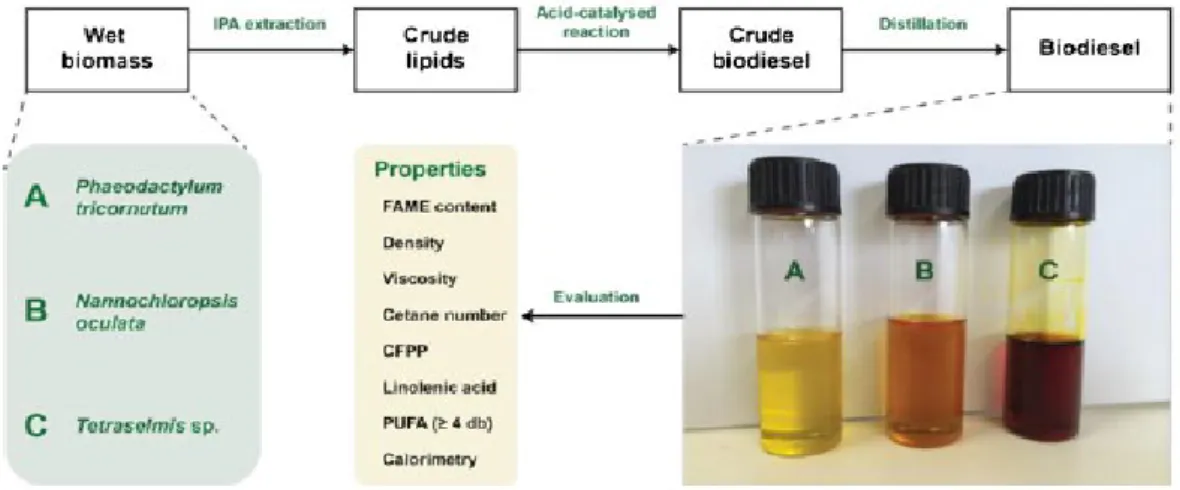
Transesterification was performed using H2SO4, methanol, and THF, and produced biodiesel samples were further distilled under vacuum to remove all non-volatile compounds. THF is an essential component to maintain a monophasic reaction, since TAG are not soluble in methanol, preventing the conversion of TAG to biodiesel, concomitantly decreasing the reaction time from 6 to 3h(Lam andLee2013). Biodiesel production from microalgal oils is additionally challenging due to the presence of high free fatty acids (FFA) and water that prevents the usage of homogeneous base catalysts (e.g., NaOH or KOH). To replace homogeneous base catalysts, homogeneous acid catalysts can be used, since they do not show measurable susceptibility to FFA and can catalyze in situ esterification and transesterification (Lam and Lee 2013). This method resulted in clear amber-yellow, orange, and red liquids (biodiesel) from P. tricornutum,
N. oculata, and Tetraselmis sp., respectively (Fig. 1).
Fig. 1 Process flow. Diagram of process followed to synthesize and evaluate properties of
biodiesel from wet microalgal biomass. The inset photograph depicts the final biodiesel samples obtained
Fatty acid methyl ester profile
FAME composition of the biodiesel samples was calculated in terms of total fatty acids (TFA; Table 1). The main FAME detected in P. tricornutum and N. oculata were palmitic (C16:0), palmitoleic (C16:1), and eicosapentaenoic (EPA, C20:5n-3) acids, which accounted for more than 65 % of the TFA in P. tricornutum and N. oculata. P. tricornutum also exhibited significant amounts of hexadecatetraenoic (C16:4), hexadecatrienoic (C16:3), and hexadecadienoic (C16:2) acids, representing 3.2, 9.3, and 5.6 % of TFA, respectively. Tetraselmis sp. displayed a completely different FAME profile when compared to those described above: although palmitic acid was also a major fatty acid, the high amount of palmitoleic and EPA detected in the previous strains was re-placed by oleic (C18:1; 16.2 %) and linolenic (LA, C18:3; 22.4 %) acids. Hexadecatetraenoic acid (C16:4) was also detected at significant levels (13.0 % of TFA). In all strains, the sum of saturated (SFA) and monounsaturated (MUFA) fatty acids combined together represented approximately 50 % of TFA. This result thus suggests that these strains contain high amounts of polyunsaturated fatty acids (PUFA) in their FA profile (44.2 to 52.0 % of TFA; Table 1).
Table 1 FAME composition of the biodiesel samples synthesized from three different microalgal
Biodiesel properties
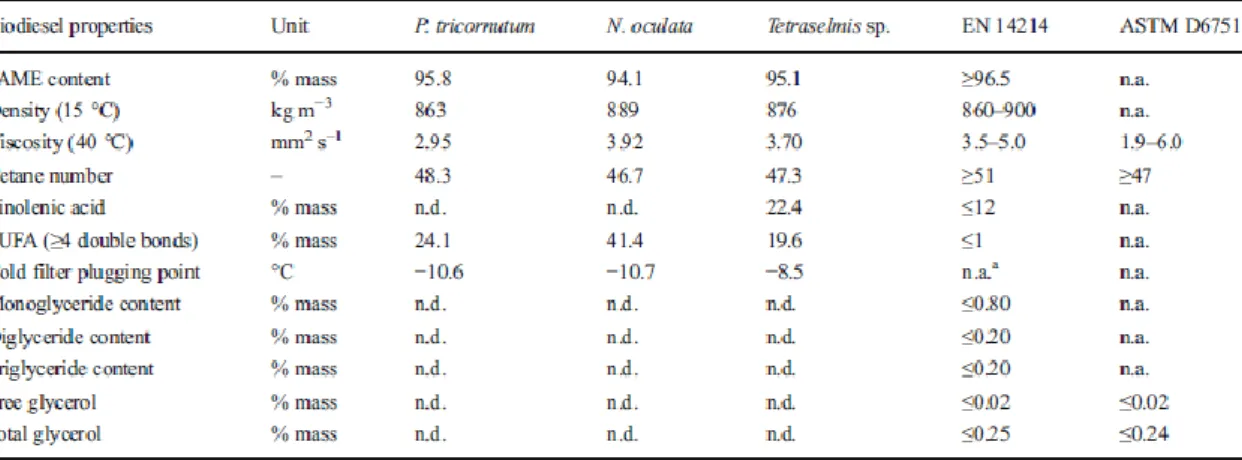
Physicochemical properties of biodiesel samples were assessed according to standard protocols as per EN 14214 and ASTM D6751 specifications (Table 2). The ester contents of the biodiesel produced were 94.1, 95.8, and 95.1 % for N. oculata, P. tricornutum, and Tetraselmis sp., respectively, and were thus close to that of specified by the EN 14214 regulation (≥96.5 %). The densities of the biodiesel from N. oculata, P. tricornutum, and Tetraselmis sp. were similar, 889, 863, and 876 kg m−3, respectively, and can be explained by the similar FA composition of the biodiesel samples in terms of SFA (23.3–27.4 %), MUFA (22.6–29.1 %), and PUFA (44.2–52.0 %; Table 1). These values were in the range of the EN 14214 specifications (860–900 kg m−3) indicating a good conversion rate of feedstock into biodiesel (Knothe 2006). The ASTM D6751 standard does not regulate this parameter.
Kinematic viscosity is an important physical property for any liquid biofuel, being an indication of the ability of a liquid to flow in the engine. The obtained results were 3.9 and 3.7 cSt for N.
oculata and Tetraselmis sp., respectively, which are in agreement with the EN 14214
specifications, stating that kinematic viscosity of the biodiesel should lie in the range of 3.5–5.0 cSt. However, the kinematic viscosity of the biodiesel produced from P. tricornutum was lower than that of the EN 14214 specification (2.95 cSt). Regarding the ASTM specifications, the viscosities determined for all samples were within the recommended values (1.9–6.0 cSt). The content in acylglycerols (referred to as “glycerides” in the standards) of the biodiesel samples was determined (Table 2) and found to be below the detection limit in all the samples. This is a consequence of the procedure used in the production of the biodiesel since the presence of acylglycerols was monitored by TLC, during the conversion process, and the reaction was stopped only when the acylglycerols were depleted. In addition, biodiesel samples were thoroughly washed to remove glycerol and further distilled to remove pigments and other extraneous materials, therefore explaining the absence of free glycerol and acylglycerols. CN represents the ignition quality of biodiesel and was estimated from the FAME profile (Knothe 2014). P. tricornutum, N. oculata, and Tetraselmis sp. displayed a CN of 48.3, 46.7, and 47.3, respectively. According to these estimates, none of the samples met the limit established by the EN 14124 (CN≥ 51), although P. tricornutum and Tetraselmis sp. meet the ASTM D6751 (CN ≥ 47) specifications. The CN of P. tricornutum was very similar to the average value of the Bacillariophyceae (CN=48.5) estimated by Stansell et al.(2012). However, the CN calculated for
N. oculata was lower than the mean value of strains belonging to the Eustigmatophyceae
(CN=52.3), whereas the values calculated for Tetraselmis sp. were higher than the average reported for different Chlorophyceae (CN=42.3). Low CN biodiesel can be enhanced by blending with saturated FAME or through the usage of additives known to improve CN, such as 2-ethylhexyl nitrate, cyclohexyl nitrate, or 2-methoxyethyl ether, which have previously been reported to increase CN values from 45.5 to 63.5 (Knothe 2011; Ruina et al. 2014).
The CFPP is one of the most commonly assessed cold flow properties of liquid fuels, representing the temperature responsible for plugging 0.45 μm filters. Tetraselmis sp. biodiesel presented the highest value (CFPP=−8.5 °C), followed by N. oculata (CFPP=−10.7 °C) and P. tricornutum (CFPP= -10.6 °C). The calculated CFPP for P. tricornutum, N. oculata, and Tetraselmis sp. were lower than the mean values reported for other Eustigmatophyceae (CFPP = 8 °C), Bacillariophyceae (CFPP = 2.9 °C), and Chlorophyceae (CFPP=1.9 °C) species, respectively (Stansell et al. 2012). The CFPP depends on the amount and chain length of the SFA present in biodiesel. SFA with shorter carbon chains possess lower melting points, thus resulting in lower CFPP values. For this reason, Tetraselmis sp. presented a higher CFPP than those of N. oculata and P. tricornutum due to an increased amount of palmitic acid. Although the sum of SFA was similar in all biodiesel samples (23.3–27.4 %), P. tricornutum displayed slightly higher amounts
of myristic acid and similar amounts of palmitic acid that ultimately produced a similar CFPP value with that of N. oculata.
Because PUFAs are prone to oxidation, the contents of LA and PUFAs with ≥4 double bonds are regulated by EN 14214 specification with maximum limits of 12 and 1 %, respectively. The LA contents of biodiesel samples produced from N. oculata and P. tricornutum were in accordance with EN 14214. However, the biodiesel of Tetraselmis sp. had higher values than those established in this standard (22.4 %). Regarding the amount of PUFAs with ≥4 double bonds, all biodiesel samples displayed values far higher (19.6–41.4 %) than those recommended by EN specifications (1 % maxi-mum). It is likely that the high amounts of PUFAs in these biodiesel samples may affect considerably its oxidative stability, which could restrict their commercialization. Several authors have related the oxidative stability with the number of bis-allylic position equivalents (BAPE) of the FAME present in the biodiesel since these are the structural sites most prone to oxidation (Knothe 2002; Bucy and Marchese 2012). Using the equations derived by Knothe (2002), the number of BAPE was 117, 155, and 110 for P.
tricornutum, N. oculata, and Tetraselmis sp., respectively. Therefore, according to the fits
obtained by Bucy and Marchese (2012), relating the oxidative stability with BAPE, oxidative stabilities lower than 3 h should be expected for our biodiesel samples, meaning that none of these would meet either the American or European standards (3 and 6 h, respectively). This problem can be solved by either partial hydrogenation or via antioxidant supplementation (Jang et al. 2005; Knothe2007). However, such manipulations might significantly reduce the economic feasibility of biodiesel. The use of other microalgal strains combining higher saturation profiles with higher lipid productivities might therefore be preferable to other cost-cutting measures in order to turn microalgae-based biodiesel feasible.
Table 2 Physicochemical properties of biodiesel samples synthesized from lipids of three
microalgal strains and specification limits according to EN 14214 and ASTM D6751 standards for biodiesel regulation
Calorimetric evaluation
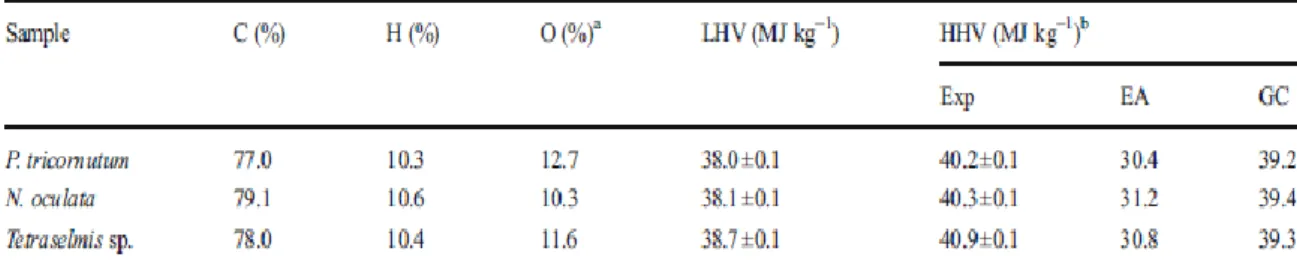
The results of elemental composition (i.e., C, H, and O) and calorimetric values are presented in Table 3; also included are the results of HHV estimation using models recommended in the literature as most accurate. As expected, due to the oxygen content of its components, it is generally accepted that biodiesel from all sources exhibits ca. 10 % lower HHV (per mass) than petroleum diesel (Demirbas 2008; Hoekman et al. 2012), which has an HHV of ca. 45.8 MJ kg−1 (Boundy et al. 2011). When compared with other biomass fuels, HHV of biodiesels are relatively
high, typically in the range of 39–41 MJ kg−1 (Demirbas 2008; Hoekman et al. 2012). Our biodiesel samples HHV lie on the upper boundary of this range. HHV experimental determinations for algal biodiesel are very scarce and could only be found for Scenedesmus sp. (Chen et al. 2012) and S. obliquus (Mandal and Mallick 2012). Mandal and Mallick (2012) reported a “calorific value” in the range of 37.1–38.3 MJ kg−1 for the various samples studied, significantly lower than our values. However, they also described a value of 42 MJ kg−1 for petrodiesel, which is closer to its LHV (42.8 MJ kg−1) than to its HHV (45.8 MJ kg−1) accepted value (Boundy et al. 2011). We therefore conclude that the values reported correspond in fact to LHV, which are now closer to (but still lower than) the values presented in Table 3. Regarding the work by Chen et al.(2012), “gross heating values” (i.e., HHV?) in the range 39.76–39.84 MJ kg−1 are reported without uncertainty intervals and again lower than our experimental results. Once again, the value reported for petrodiesel is 42 MJ kg−1 (closer to its LHV of 42.8 MJ kg−1 as in the above case). As pointed out by Hoekman et al. (2012), both these examples show that great care is needed when interpreting and comparing most calorimetric reports in the biodiesel literature.
Table 3 Elemental analysis, lower heating value (LHV), and higher heating value (HHV) for the
biodiesel samples produced
Table 3 also presents estimates of HHV based on elemental analysis composition (EA; Changdong and Azevedo 2005) and estimated through a group contribution method (GC; Levine et al. 2014). Several methods have been proposed to estimate HHV, including correlations based on elemental analysis composition (Changdong and Azevedo 2005), and correlations based on chemical composition, considering the mass average of the HHV of its constituent FAAE (Fassinou 2012). The latter method presents several limitations and is difficult to implement, mainly due to the fact that there is a general lack of information on the literature regarding FAAE HHV, particularly for FAAE common in algal-derived biodiesel, which are particularly rich in PUFA-derived esters. However, from the results in Table 3, it is evident that general unified correlations, such as the one proposed by Changdong and Azevedo (2005), are also not suitable for estimating the HHV of a specific fuel type, such as biodiesel.
Levine et al. (2014) proposed an extension of a group contribution method to estimate the HHV of FAAE for predicting the HHV of biodiesel fuel (Walters 2001). Group contribution methods are both classical and reliable ways of estimating thermodynamic properties and can easily be extended from the usual enthalpies of formation to HHV estimation. However, such a methodology is still not available, and therefore the procedure described by Levine et al. (2014) was used to produce group contribution estimates (Table 3). This method affords results close to, but systematically lower than, the HHV experimentally determined. This underestimation may be due to lack of accuracy on the calculation of HHV of individual components. On the other
hand, microalgae from different phyla are known to contain hydrocarbons, usually accounting for less than 2 % of the algal biomass DW (Qin 2010). Since the combustion energy of hydrocarbons is higher than the FAAE composing biodiesel (Levine et al. 2014), this is actually highly advantageous for fuel production. In fact, such microalgae as Botryococcus braunii are mainly sought for their production of hydrocarbons rather than lipids (Knothe 2011). Therefore, our algal biodiesel might contain a non-negligible amount of hydrocarbons that may contribute to the larger than predicted biodiesel HHV.
Conclusions
Lipids of microalgae can be easily recovered from wet bio-mass using IPA. The resulting biofuel has favorable energy contents (HHV≈41 MJ kg−1) and meets most requirements of EN 14214 and ASTM D6751 specifications. However, the estimated CN, despite meeting the American standard, is slightly lower than the limit established by the European standard, and the produced biodiesel contains unacceptable levels of PUFA with ≥4 double bonds. In addition, the FAME com-position and particularly the high content of bis-allylic position equivalents of these biodiesel samples foresee a poor oxidative stability. To overcome these limitations, several post-production processing methods can be applied to improve these properties. Alternatively, screening for novel microalgae with more adequate fatty acid profiles may be attempted in order to cut processing costs.
Acknowledgments
K.N.G. (SFRH/BPD/81882/2011) and H.P.(SFRH/BD/105541/2014) are, respectively, a post-doctoral researcher and a PhD student funded by the Portuguese Foundation for Science and Technology (FCT). The work was conducted under projects also funded by FCT and the Portuguese national budget (Projects PEst-OE/QUI/UI0100/2013, PEst-OE/QUI/UI0612/2013, PEst-C/MAR/LA0015/ 2013, and PEst-OE/EQB/LA0023/2013).
The authors would like to acknowledge the NECTON S.A., Portugal, for providing microalgal samples.
References
Amaro HM, Macedo AC, Malcata FX (2012) Microalgae: an alternative as sustainable source of biofuels? Energy 44:158–166
Boundy B, Diegel SW, Wright L, Davis SC (2011) Biomass energy data book, 4th edn. Oak Ridge National Laboratory, US-DOE, Oak Ridge
Bucy H, Marchese AJ (2012) Oxidative stability of algae derived methyl esters. J Eng Gas Turbines Power 134:092805-092805-13. doi:10. 1115/1.4006712
Carvalho AP, Malcata FX (2005) Preparation of fatty acid methyl esters for gas-chromatographic analysis of marine lipids: insight studies. J Agric Food Chem 53:5049–5059
Changdong S, Azevedo JLT (2005) Estimating the higher heating value of biomass fuels from basic analysis data. Biomass Bioenergy 28: 499–507
Chen L, Liu T, Zhang W, Chen X, Wang J (2012) Biodiesel production from algal oil high in free fatty acids by two-step catalytic conversion. Bioresour Technol 111:208–214
Chisti Y (2007) Biodiesel from microalgae. Biotechnol Adv 25:294–306 Chisti Y (2013) Constraints to commercialization of algal fuels. J Biotechnol 167:201–214
Chisti Y, Yan J (2011) Energy from algae: current status and future trends algal biofuels—a status report. Appl Energy 88:3277–3279
Daroch M, Geng S, Wang G (2013) Recent advances in liquid biofuel production from algal feedstocks. Appl Energy 102:1371–1381 Demirbas A (2008) Relationships derived from physical properties of vegetable oil and biodiesel fuels. Fuel 87:1743–1748
Fassinou WF (2012) Higher heating value (HHV) of vegetable oils, fats and biodiesels evaluation based on their pure fatty acids HHV. Energy 45:798–805
Hoekman SK, Broch A, Robbins C, Ceniceros E, Natarajan M (2012) Review of biodiesel composition, properties, and specifications. Renew Sust Energ Rev 16:143–169
Hu C, Li M, Li J, Zhu Q, Liu Z (2008a) Variation of lipid and fatty acid compositions of the marine microalga Pavlova viridis (Prymnesiophyceae) under laboratory and outdoor culture conditions. World J Microbiol Biotechnol 24:1209–1214
Hu Q, Sommerfeld M, Jarvis E, Ghirardi M, Posewitz M, Seibert M, Darzins A (2008b) Microalgal triacylglycerols as feedstocks for bio- fuel production: perspectives and advances. Plant J 54:621–639
Huerlimann R, de Nys R, Heimann K (2010) Growth, lipid content, productivity, and fatty acid composition of tropical microalgae for scale-up production. Biotechnol Bioeng 107:245–257 Jang ES, Jung MY, Min DB (2005) Hydrogenation for low trans and high conjugated fatty acids.
Compens Rev Food Sci Saf 4:22–30
Knothe G (2002) Structure indices in FA chemistry. How relevant is the iodine value? J Am Oil Chem Soc 79:847–854
Knothe G (2006) Analyzing biodiesel: standards and other methods. J Am Oil Chem Soc 83:823– 833
Knothe G (2007) Some aspects of biodiesel oxidative stability. Fuel Process Technol 88:669–677 Knothe G (2011) A technical evaluation of biodiesel from vegetable oils vs. algae. Will
algae-derived biodiesel perform? Green Chem 13: 3048–3065
Knothe G (2014) A comprehensive evaluation of the cetane numbers of fatty acid methyl esters. Fuel 119:6–13
Lam MK, Lee KT (2013) Catalytic transesterification of high viscosity crude microalgae lipid to biodiesel: effect of co-solvent. Fuel Process Technol 110:242–248
Levine F, Kayea RV III, Wexler R, Sadvary DJ, Melick C, Scala JL (2014) Heat of combustion of fatty acids and fatty acid esters. J Am Oil Chem Soc 91:235–249
Mandal S, Mallick N (2012) Biodiesel production by the green microalga Scenedesmus obliquus in a recirculatory aquaculture system. Appl Environ Microbiol 78:5929–5934
Nigam PS, Singh A (2011) Production of liquid biofuels from renewable resources. Prog Energy Combust Sci 37:52–68
Pacini H, Silveira S, da Silva Filho AC (2013) The European Biofuels Policy: from where and where to? Eur Energy J 3:1–36
Qin JG (2010) Hydrocarbons from algae. In: Timmis KN (ed) Handbook of hydrocarbon and lipid microbiology. Springer, Berlin, pp 2817– 2826
Ramos MJ, Fernández CM, Casas A, Rodriguez L, Perez A (2009) Influence of fatty acid composition of raw materials on biodiesel properties. Bioresour Technol 100:261–268 Ruina L, Zhong W, Peiyong N, Yang Z, Mingdi L, Lilin L (2014) Effects of cetane number improvers
on the performance of diesel engine fuelled with methanol/biodiesel blend. Fuel 128:180– 187
Stansell GR, Gray VM, Sym SD (2012) Microalgal fatty acid composi- tion: implications for biodiesel quality. J Appl Phycol 24:791–801
Walters RN (2001) Molar group contributions to the heat of combustion. US-DOT, Springfield, DOT/FAA/AR-TN01/75, FAA
Yao L, Gerde JA, Wang T (2012) Oil extraction from microalga Nannochloropsis sp. with isopropyl alcohol. J Am Oil Chem Soc 89:2279–2287
Yao L, Lee SL, Wang T, Gerde TA (2013) Comparison of lipid extraction from microalgae and soybeans with aqueous isopropanol. J Am Oil Chem Soc 90:571–578