Synthesis and characterization of gold nanoparticles combined with curcumin and its
effects on experimentally induced osteoarthritis
Síntese e caracterização de nanopartículas de ouro conjugadas com curcumina e seus efeitos na osteoartrite experimental induzida
Wilma Neres da Silva Campos1* Ana Elisa Tognoli Leite2 Dábila Araújo Sonego1
Mateus Annicchino de Andrade1 Fábio Dumit Pizzinatto1 Valéria Spolon Marangoni2
Valtencir Zucolotto2 Luciano Nakazato3 Edson Moleta Colodel3 Roberto Lopes de Souza3
ISSNe 1678-4596
INTRODUCTION
Osteoarthritis (OA) is the most common chronic musculoskeletal disease and a major cause of locomotor disability in dogs (INNES,
2010). Analgesics, anti-inflammatory steroids, and steroidal anti-inflammatory drugs (NSAIDs) only
treat symptoms of the disease by reducing pain and
inflammation. For these reasons, alternative OA
treatments are desirable and, recently, nutraceuticals,
1Programa de Pós-graduação em Ciências Veterinárias, Universidade Federal Mato Grosso (UFMT), Av. Fernando Correa da Costa, 2367, Boa
Esperança, 78015-160, Cuiabá, MT, Brasil. E-mail: [email protected]. *Corresponding author.
2Grupo de Nanomedicina e Nanotoxicologia, Instituto de Física de São Carlos, Universidade de São Paulo, São Carlos, SP, Brasil.
3Programa de Pós-graduação em Ciências Veterinárias, Departamento de Clínica Veterinária, Universidade Federal Mato Grosso (UFMT),
Cuiabá, MT, Brasil.
ABSTRACT: Osteoarthritis (OA) is the clinical term for a combination of pathological conditions that involve the progressive degeneration
of articular cartilage and subchondral bone remodelling. Curcumin, a potent anti-inflammatory agent, has been extensively studied; however, it does not provide good systemic bioavailability. Gold nanoparticles (AuNPs) have potential applications in the administration of therapeutic substances in order to increase the transport efficiency of drugs. The objectives of this study were to explore the synthesis and characterization of a system combining AuNPs with curcumin and evaluate its therapeutic potential in an experimental model of OA in mice by the destabilization of the medial meniscus (DMM). The AuNPs were conjugated with curcumin and the systems were characterized by UV-VIS spectroscopy, dynamic light scattering (DLS), and zeta potential. Four groups of eight animals each were formed and labelled A, B, C, and D, which received intra-articular injections of AuNPs, curcumin, AuNP-curcumin, and physiologic solution, respectively. After seven weeks, the cartilage of the stifle joint (SJ) was rated on a scale ranging from 0 to 24. Combination of AuNP-curcumin demonstrated good stability and therapeutic applications, but it did not differ significantly (P>0.05) from groups A and B. However, the control group had a significantly lower score (P<0.001). Results of this study demonstrated the importance of developing new nanodrugs. In this case, the combination of AuNPs and curcumin yielded the nanodrug effects suggestive of a potential for application in the treatment of OA.
Key words: curcumin, mice, nanodrugs, nanotherapy, osteoarthritis.
RESUMO: A Osteoartrite (OA) é uma denominação clínica para uma combinação de condições patológicas que envolvem a degeneração
progressiva da cartilagem articular e remodelação de osso subcondral. A curcumina, um potente agente anti-inflamatório, têm sido extensivamente estudada, no entanto não oferece boa biodisponibilidade sistêmica. Nanopartículas de ouro (AuNPs) apresentam aplicações potenciais na administração de substâncias terapêuticas aumentando a eficiência do transporte de fármacos. O objetivo deste estudo foi realizar a síntese e caracterização de um sistema conjugando as AuNPs à curcumina e avaliar seu potencial terapêutico em um modelo experimental de OA em camundongos por desestabilização do menisco medial (DMM). As AuNPs foram conjugadas com curcumina e os sistemas foram caracterizados por espectroscopia no UV-VIS, espalhamento de luz dinâmico (DLS) e determinação do potencial zeta. Formou-se 4 grupos de oito animais cada, denominados A, B, C, D que receberam injeção intra-articular de AuNPs, curcumina, AuNP-curcumina e solução fisiológica, respectivamente. Após 7 semanas, a cartilagem da articulação-femoro- tibio-patelar (AFTP) foi avaliada em uma variação de escore de 0 a 24. A conjugação de AuNP-curcumina mostrou boa estabilidade e aplicação terapêutica, mas não diferiu significativamente (P>0,05) dos grupos A e B, no entanto, mostrou menor valor de escore e significância (P<0,001) em relação ao grupo controle. Os resultados deste trabalho mostram a importância do desenvolvimento de novos nanofármacos. Neste caso a conjugação de AuNPs com a curcumina permitiu a obtenção de um nanofármaco com sugestivo potencial para aplicação no tratamento da OA.
Palavras-chave: camundongos, curcumina, nanofármacos, nanoterapia, osteoartrite.
such as curcumin, have been proposed for this purpose
(INNES et al., 2010; HENROTIN et al., 2013).
Curcumin is characterized as a chemopreventive agent and is a highly pleiotropic molecule capable of interacting with numerous factors and
mediators involved in inflammation (AGGARWAL
& HARIKUMAR, 2009). Recent studies have demonstrated that curcumin is rapidly metabolized but has limited systemic bioavailability, which has limited its use in clinical cases (IRESON et al., 2011).
The conjugation of drugs and molecules
to metals, especially nanoparticles in aqueous media, can provide enhanced activity, increased half-life
and greater resistance to specific metabolic processes (SINDHU et al., 2014). Advantages in AuNP
conjugation may include controlled and/or prolonged release of the substance therein encapsulated, which reduces adverse effects associated with the substance, compound protection from inactivation before reaching the site of action, increased intracellular penetration, and increased pharmacological activity
(MARANGONI et al., 2013). The aim of this study was
to explore the synthesis and characterization of AuNPs with curcumin and thus evaluate their therapeutic action in an experimental osteoarthritis model in mice.
MATERIALS AND METHODS
Synthesis and characterization of AuNP
10 mL of an aqueous solution of Chloroauric acid (HAuCl4) at 0.001 mol L-1 were
added with magnetic stirring to 10mL of an aqueous solution of polyallylamine hydrochloride (PAH).
Then, 1mL of sodium borohydride at 0.01mol L-1
at approximately 0°C was added to this solution.
The system was stirred for approximately 30min
on a magnetic stirrer, then allowed to stand at room temperature and was protected from light for 24 hours.
Finally, the particles were washed by centrifugation
(12,000rpm 10min-1) to remove excess PAH. A
curcumin solution of 500µL at 1.0mg mL-1 in ethanol
were added to 5mL of AuNP-PAH suspension. The
system was stirred for four hours at room temperature and then washed twice by centrifugation (12,000rpm 10min-1) to remove excess curcumin.
An UV-VIS spectroscopy was used to identify and quantify AuNP-PAH and curcumin as well as to observe their interactions. Measurements were performed on a Hitachi U-2900 using quartz cuvettes with an optical path of 1cm, as proposed by
MARANGONI et al. (2013)
Particle size distribution was obtained by
DLS measurements at 25°C in triplicate using a ZS®
Nano spectrometer (Malvern Instruments, UK). Zeta
potential of suspensions was measured at 25°C in
triplicate using a ZS® Nano spectrometer. All samples
were measured in 10mmol L-1 phosphate buffer.
Animals and surgical induction
Thirty two male C57BL6 strain mice
at 8 weeks of age were used. After trichotomy and antisepsis of the surgical area, the destabilization technique was performed on the medial meniscus
(DMM), as proposed by GLASSON et al. (2007). Four groups were formed, each with eight animals, as follows: A (360mg of AUNP-PAH), B
(20mg of curcumin), C (360mg of
AUNP-PAH-curcumin (20mg)) and D (physiologic solution); they
were distributed in accordance with the administered therapy. All animals were treated by intra-articular
injection every 15 days, with the first treatment given
on day 14 after the induction of OA. Seven weeks after the induction of OA, animals were euthanized.
Histopathological evaluation
All knee joints (KJs) were fixed in 10% buffered formalin for 24 hours and decalcified in EDTA solution monosodium 15% for two weeks. They
were then processed according to routine procedures and the slides were stained with hematoxylin and eosin (H&E) and Safranin O fast green to evaluate the
concentration of proteoglycans. They were assessed
by 2 independent observers in a blind study using the criteria established by MANKIN et al. (1971).
The score for each joint was obtained by calculating
the formula, standardized by the evaluation system of Osteoarthritis Research Society International
(OARSI), and established by BAO et al. (2009) and RUTGERS et al. (2010) thus, each KJ received a
score ranging from 0 to 24.
Statistical analysis
Data were analysed for normal distribution using the Kolmogorov-Smirnov test. Therefore,
normal data were submitted to analysis of variance,
and, in cases of significance, means were compared using Tukey’s test. For all statistical analysis, the 5% significance level was adopted. Values were analysed using GraphPad Prism 4.
RESULTS
The AuNP-PAH-curcumin complex
and its precursors were characterized by UV-VIS
spectroscopy. The formation of AuNPs was detected
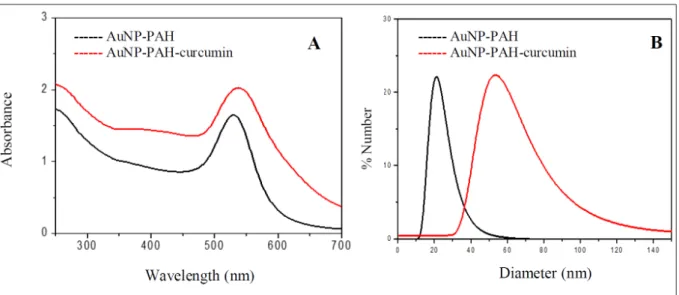
of nano-sized particles. In the spectrum corresponding to AuNP-PAH, a strong absorption band was observed at approximately 530nm. In the spectrum of the AuNP-PAH-curcumin complex, a shift of approximately
15nm was identified (Figure 1A).
Zeta potential values for both systems
presented a highly positive surface charge, +55mV and +35mV in the AuNP-PAH and AuNP-PAH-curcumin suspension, respectively, which indicated
electrostatic stability. Decrease of surface charge
of AuNP-PAH after conjugation with curcumin
suggested that the modification of the surface with curcumin was efficient. The size distributions for the solutions obtained by DLS measurements are shown in figure 1B. The average diameter of AuNP-HAP
was reported to be approximately 20nm while the AuNP-PAH-curcumin complex had a diameter of approximately 60nm.
Histological analyses showed a clear distinction in the joint cartilage lesion between the
different groups (Figure 2). Focal discontinuity
of the cartilage surface area and erosion with loss
were the most superficial lesions reported in groups A and B, as well as the mild loss of proteoglycans as evidenced by decreased Safranin O/Fast Green
staining. In group C, there were milder SJ lesions, of
which edema and fibrillation of the cartilage surface
were the most common changes, emphasized by the greater degree of proteoglycan staining by Safranin
O/Fast Green. In the control group (group D), more
severe lesions were observed such as microfractures
with the presence of fibrocartilage, remodelling, and
bone repair, while the severity and stage of the lesions increased compared to the other groups.
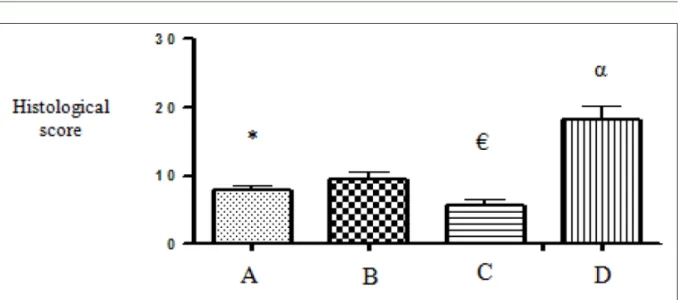
A higher value was reported for group D’s SJ at a mean score of 18.25. In addition, a significant difference (P<0.001) was reported when group D
was compared to all other groups. In contrast, joints
evaluated in groups A and B reached average values
of 7.87 and 9.50, respectively, with no statistically
significant difference (P>0.05) between these groups.
Animals that received the AuNP-PAH-curcumin
complex (group C) showed a significant decrease
(P<0.001) in their mean score values compared to the
control group; however, no significant difference was
found compared with the other groups, as shown in
figure 3.
DISCUSSION
Nanoparticles are thermodynamically unstable and have a natural tendency to aggregate
and grow. Thus, the great challenge today consists
precisely in preparing stable nanomaterials that may be
Figure 1 -Schematic representation of the characterizations of complex AuNP-PAH and AuNP-PAH-curcumin. A) UV-VIS absorption spectra showing the spectrum corresponding to AuNP-PAH a strong absorption band was observed at approximately 530nm.
In the spectrum of the AuNP-PAH-curcumin complex, a shift of approximately 15nm can be identified. B) DLS measurements
showed that the average diameter of AuNP-PAH was approximately 20nm, while the AuNP-PAH-curcumin complex had a diameter of approximately 60nm. AuNP: gold nanoparticles; PAH: polyallylamine hydrochloride; UV-VIS: Ultraviolet visible
handled without losing their characteristics so that they
can be efficiently used in technological and biomedical applications (MARANGONI et al., 2013).
An UV-VIS spectroscopy has been widely used in characterizing the optical properties
of metallic nanoparticles. The red shift observed in
this study for the spectrum of AuNP-PAH-curcumin was related to the changes in their surface due to
modification with curcumin. This is relevant because
large shifts to longer wavelengths may indicate a
system aggregation process (YEN et al., 2009). The strong band of AuNP-PAH complex absorption
observed at approximately 530nm was attributed to the collective oscillations of electrons on the surface of gold nanoparticles called plasmon resonance.
According to BARTH (2007), the absorption
wavelength is directly related to the average diameter of nanoparticles.
Furthermore, the small band at
approximately 400nm in the spectrum of
AuNP-PAH-curcumin corresponded to the characteristic absorption band of curcumin, indicating conjugation.
The increase in diameter reported by DLS for the
AuNP-PAH-curcumin complex was also related to the formation of a curcumin layer around the nanoparticle, as observed by SINDHU et al. (2014),
who compared gold nanoparticles of different
sizes in aqueous solution to experimental data. The
measured value of the zeta potential provides an
indication of the stability of the suspension. This
study observed that the suspensions are highly stable
because, according to BARTH (2007), suspensions
with zeta potential values above +30mV and below -30mV are stable; whereas, those with values above -30mV and below +30mV are unstable and can
flocculate. The decrease of the zeta potential after
conjugation with the curcumin molecules proves
that the functionalization was efficient. As shown,
these properties of the suspensions enable the objective assessment of whether or not they have Figure 2 - Photomicrographs of the joint cartilage of mice after the experimental induction of OA in DMM: A, E), group treated with
AuNP-PAH; A: slight unevenness of the joint surface (arrow) with disorganization of the chondrocyte columns; B, F) group treated with curcumin; C, G) group treated with AuNP-PAH-curcumin; C) Integrity of the joint surface can be seen despite the slight disorganization of chondrocyte columns and cluster formation (arrow); D, H) control group treated with saline solution; D) Intense fibrocartilage formation, disorganization, and bone remodelling; H) intense decrease in proteoglycans shown by the decrease in Safranin O/Fast Green staining. A, B, C, D: H&E staining; E, F, G, H: Safranin O/Fast Green staining. 20X. AuNP-PAH: gold nanoparticles; PAH: polyallylamine hydrochloride; H&E: haematoxylin and eosin; DMM: destabilization of
stable behaviours. A similar result was observed by
SILVA (2015), conjugating AuNPs to a flavonoid,
which exhibited concentrated suspensions measuring
approximately 15nm, consistent with the findings
in this study for the AuNP-PAH-curcumin complex.
The synthesis of AuNPs poses challenges due to the
poor reproducibility and stability of the colloidal system. LIAN et al. (2016) reported the conjugation of curcumin on the surface of AuNPs, which were synthesized by direct reduction using HAuCl4 in the aqueous phase without the use of any other reducing
agents. They observed a good functionalization of
the system while there was a slight aggregation of curcumin particles, making it less available. In the present research, we developed a one step, facile procedure for the synthesis of AuNP-PAH combined with curcumin by using PAH as reducing agente, which led to the production of larger nanoparticles stabilized by various molecules.
As for the histological evaluation of the lesions, it was observed that the articular cartilage
submitted to the DMM procedure showed typical
morphological changes of OA, as described in
the literature by GLASSON et al. (2007). These
demonstrated cartilage and bone lesions, which probably resulted from changes in articular cartilage and
secondary bone involvement (PRITZKER et al., 2006). Although not significantly different among
them, a decrease in the severity of histological lesions
in groups A, B, and C was observed. In the SJ of group A, this was evidenced by the anti-inflammatory and
anti-angiogenic properties of AuNPs, as reported by
HUANG et al. (2012) who reported a reduction in disease
progression by the inhibition of the vascular endothelial
growth factor (VEGF) activity with administration of AuNPs in the early stages of OA in mice. Curcumin’s anti-inflammatory properties have been documented in recent studies by JURENKA (2009) and HENROTIN et al. (2013), and this study confirms its effect on reducing injuries because it inhibits inflammatory mediators such as NF-KB, IL-1β pro-inflammatory genes, COX-2, and VEGF (CSAKI et al., 2009).
The morphological characteristics
of the articular cartilage in group C were less typical of OA than those seen in the other groups.
Degenerative lesions, such as edema, fibrillation, and
hypercellularity, were also reported; however, they
were more discreet and less extensive. These findings
suggested better partial bioavailability of curcumin when conjugated with AuNP-PAH because they can provide an increase in curcumin activity, a longer half-life, greater stability, and possible resistance to metabolic processes (INNES et al., 2010).
CONCLUSION
The results of this study demonstrated the
importance of the study and development of new Figure 3 - Schematic representation of the mean scores in the histological assessment of joint cartilage in mice with experimental OA: A)
The group treated with AuNP-PAH with score of 7.87; B) The group treated with curcumin with score of 9.50; C) The group treated with AuNP-PAH-curcumin with score of 5.75; and D) The control group treated with saline solution with score of
18.25. *: P>0.05 vs. B and C; *€: P>0.05 vs. B; *α: P<0.001 vs. A, B, and C. Means were compared using Tukey’s test.
nanodrugs since the combination of nanoparticles can impart additional properties to such systems. Animals that received an intra-articular application of AuNP-PAH-curcumin showed lower severity of histological lesions. However, the AuNP-PAH-curcumin complex
showed no significant difference compared with groups A and B, differing only compared to the control
group. New studies on the functionalization and characterization of biomolecules may be necessary to continue to develop new approaches and modalities for nanodrugs. In this case, the application of AuNP conjugated with curcumin and added to a nanodrug in animals with OA symptoms demonstrated the potential for the treatment of OA in humans.
ACKNOWLEDGEMENTS
The authors are thankful to Coordenação de
Aperfeiçoamento de Pessoal de Nivel Superior (CAPES) for
granting a scholarship to the first author of this study and to the
Laboratory of Nanomedicine and Nanotoxicity of Universidade de São Paulo (USP) for provision and assistance in carrying out the synthesis and characterization techniques used in this study.
BIOETHICS AND BIOSSECURITY COMMITTEE APPROVAL
This study was approved by the Ethics Committee on Animal Use (CEUA-UFMT) under protocol no. 23108.043951/12-1. 32.
REFERENCES
AGGARWAL, B.B.; HARIKUMAR, K.B. Potential therapeutic effects of curcumin, the anti-inflammatory agent, against
neurodegenerative, cardiovascular, pulmonary, metabolic.
International Journal of Biochemistry & Cell Biology, v.41,
p.40-59, 2009. Available from: <http://www.sciencedirect.com/
science/article/pii/S1357272508002550>. Accessed: Jul. 12, 2016.
doi: 10.1016/j.biocel.2008.06.010.
BAO, J.P. et al. Variation pattern of two degradation enzymes
systems in articular cartilage in different stages of osteoarthritis: regulation by dehydroepiandrosterone. Clinica Chimica Acta, v.408, p.1-7, 2009. Available from: <http://www.sciencedirect.
com/science/article/pii/S0009898109003416>. Accessed: Jul. 12,
2016. doi: 10.1016/j.cca.2009.06.040.
BARTH, A. Infrared spectroscopy of proteins. Biochimica et
Biophysica Acta (BBA) - Bioenergetics, v.1767, p.1073-1102,
2007. Available from: <http://www.sciencedirect.com/science/
article/pii/S0005272807001375>. Accessed: Jul. 14, 2016. doi:
10.1016/j.bbabio.2007.06.004.
CSAKI, C. et al. Synergistic chondroprotective effects of curcumin and resveratrol in human articular chondrocytes: inhibition of IL-1
induced NF-B-mediated inflammation and apoptosis. Arthritis
Research & Rheumatism, v.11, p.160-165. 2009. Available
from: <http://www.ncbi.nlm.nih.gov/pmc/articles/PMC3003513>.
Accessed: Aug. 08, 2016. doi: 10.1186/ar2850.
GLASSON, S.S. et al. The surgical destabilization of the medial meniscus (DMM) model of osteoarthritis in the 129/SvEv
mouse. Osteoarthritis and Cartilage, v.15, p.1061-1069, 2007. Available from:
<http://www.oarsijournal.com/article/S1063-4584(07)00110-0/abstract>. Accessed: Aug. 09, 2016. doi:
10.1016/j.joca.2007.03.006.
HENROTIN, Y. et al. Curcumin: a new paradigm and therapeutic
opportunity for the treatment of osteoarthritis: curcumin for osteoarthritis management. Osteoarthritis and Cartilage, v.12, p.56-69, 2013. Available from: <http://www.ncbi.nlm.nih.gov/ pmc/articles/PMC3591524/>. Accessed: Jun. 09, 2016. doi: 10.1186/2193-1801-2-56.
HUANG, Y.J. et al. Multivalent structure of Galectin-1-nanogold
complex serves as potential therapeutics for rheumatoid arthritis by enhancing receptor clustering. Osteoarthritis and Cartilage, v.23, p.170-181, 2012. Available from: <http://www.ecmjournal.
org/journal/papers/vol023/vol023a13.php>. Accessed: Aug. 09,
2016. doi:10.22203/eCM.
INNES, J.F. et al. Review of the safety and efficacy of long-term NSAID use in the treatment of canine osteoarthritis. Osteoarthritis
and Cartilage, v.166, p.226-230, 2010. Available from: <http://
www.ncbi.nlm.nih.gov/pubmed/20173106>. Accessed: Aug. 09,
2016. doi: 10.1136/vr.c97.
IRESON, C. et al. Characterization of metabolites of the chemopreventive agent curcumin in human and rat hepatocytes and in the rat in vivo. Cancer Research, v.61, p.1058-1064, 2011. Available from: <http://cancerres.aacrjournals.org/
content/61/3/1058.long>. Accessed: Mar. 03, 2016.
JURENKA, J.S. Anti-inflammatory properties of curcumin,
a major constituent of Curcuma longa: review of preclinical and clinical research. Alternative Medicine Review, v.14, p.141-153, 2009. Available from: <http://www.altmedrev.com/ publications/14/2/141.pdf>. Accessed: Feb. 21, 2016.
LIAN, T. Synthesis and characterization of
curcumin-functionalized HP-β-CD-modified goldmag nanoparticles as drug aelivery agents. Journal of Nanoscience and Nanotechnology, v.16, p.6258-6265, 2016. Available from: <https://www.ncbi.nlm. nih.gov/pubmed/?term=gold+nanoparticles+combined+with+curc
umin>. Accessed: Jan. 12, 2017.
MANKIN, H.J. et al. Biochemical and metabolic abnormalities
in articular cartilage from osteoarthritic human hips: correlation of morphology with biochemical and metabolic data. Journal Bone Joint Surgery, v.53, p.523-537, 1971. Available from: <http://jbjs.org/content/53/3/523.long>. Accessed: Sept. 23, 2016.
MARANGONI, V.S. et al. Synthesis and characterization of jacalin-gold nanoparticles conjugates as specific markers for cancer cells.
Colloids and SurfacesB: Biointerfaces, v.112, p.380–386, 2013.
Available from: <http://www.sciencedirect.com/science/article/pii/
S0927776513005316>. Accessed: Aug. 09, 2014. doi: 10.1016/j.
colsurfb.2013.07.070.
PRITZKER, K.P.H. et al. Osteoarthritis cartilage
histopathology: grading and staging. Osteoarthritis. and
Cartilage, v.14, p.13-29, 2006. Available from: <http://
RUTGERS, M. et al. Evaluation of histological scoring
systems for tissue-engineered, repaired and osteoarthritic cartilage. Osteoarthritis. and Cartilage, v.18, p.12-23, 2010. Available from:
<http://www.oarsijournal.com/article/S1063-4584(09)00222-2/abstract>. Accessed: Oct. 18, 2015. doi:
10.1016/j.joca.2009.08.009.
SILVA, I.O. Síntese e imobilização de AuNPs em fibras
regeneradas na exaustão para potencial aplicação biomédica.
2015. 79f. Mestrado (Engenharia mecânica) - Curso de
Pós-graduação em Engenharia mecânica, Universidade Federal do Rio Grande do Norte.
SINDHU, K. et al. Curcumin conjugated gold nanoparticle
synthesis and its biocompatibility. Royal Society of Chemistry, v.4, p.1808-1818, 2014. Available from: <http://pubs.rsc.org/en/
Content/ArticleLanding/2014/RA/C3RA45345F#>. Accessed: Nov. 25, 2015. doi: 10.1039/C3RA45345F.
YEN, H.J. et al. Cytoxicity na immunological response of gold
and silver nanoparticles of different sizes. Small Clinical, v.5, p.53-61, 2009. Available from: <http://onlinelibrary.wiley.com/
doi/10.1002/smll.200900126/abstract;jsessionid=3B51374461C F3CCD16DE7728661872B8.f04t02>. Accessed: Nov. 24, 2015.