INTRODUCTION
Article/Artigo
1. Coordenação do Mestrado em Ciências e Saúde, Universidade Federal do Piauí, Teresina, PI. 2. Departamento de Enfermagem, Universidade Federal do Piauí, Teresina, PI. 3. Departamento de Medicina Comunitária, Universidade Federal do Piauí, Teresina, PI. 4. Departamento de Microbiologia, Universidade Federal do Piauí, Teresina, PI.
Address to: Dr. Anselmo Alves Lustosa. Programa de Pós-Graduação/UFPI. Av. Frei Seraim 2280, Centro,
64001-020 Teresina, PI, Brasil.
Phone: 55 86 3215-5856/1148; 55 86 3233-4385; 55 86 9928-9089 e-mail: [email protected]
Received in 30/03/2011 Accepted in 01/06/2011
he impact of leprosy on health-related quality of life
O impacto da hanseníase na qualidade de vida relacionada à saúde
Anselmo Alves Lustosa
1, Lídya Tolstenko Nogueira
2, José Ivo dos Santos Pedrosa
3, João Batista Mendes Teles
3and Viriato Campelo
4ABSTACT
Introduction: Leprosy is a potentially disabling infectious disease that evolves into emotional issues due to the prejudice that persists about the illness. he endemic has declined substantially with multidrug therapy (MDT) in the 80's; however, new demands associated with the reduction of stigma and the improvement of the afected people’s quality of life have emerged. In Brazil, leprosy is still a public health problem. Piauí is the second state in the Northeast in prevalence and detection, and Teresina is a hyperendemic city. his study aimed to analyze the health-related quality of life (HRQoL) of people in treatment for leprosy in Teresina/PI.
Methods: An observational study was conducted using the SF-36 (a speciic questionnaire for assessing quality of life), which sought the determinants of poor quality of life among people with leprosy, outlining the sociodemographic, clinical, and epidemiological characteristics of the 107 patients interviewed. Results: he correlations between the variables showed ive determinants of HRQoL: late diagnosis, multibacillary forms, reactions, disability diagnosis grade II, and prejudice. he proile of the participants showed that leprosy still afects the lower social classes in historically endemic areas, causing high percentages of secondary injuries that compromise the work capacity and quality of life of the afected people, perpetuating the stigma associated with the disease. Conclusions: he study reinforces the need to implement more efective strategies of disease control, due to the development of severe and disabling forms of leprosy is directly related to poor HRQoL in the same cured patient.
Keywords: Leprosy. Quality of life. Stigma.
RESUMO
Introdução: A hanseníase é uma doença infecto-contagiosa, potencialmente incapacitante, que evolui com elevada carga emocional em função do preconceito que persiste sobre os acometidos. A endemia declinou substancialmente com a poliquimioterapia (PQT), na década de 80; entretanto, surgiram novas demandas associadas à redução do estigma e melhoria da qualidade de vida dos acometidos. No Brasil, a hanseníase ainda é um problema de saúde pública. O Piauí é o 2º estado do nordeste em prevalência e detecção, sendo que Teresina é hiperendêmica. Objetivou-se analisar a qualidade de vida relacionada à saúde (QVRS) de pessoas em tratamento da hanseníase em Teresina/PI. Métodos: Estudo observacional realizado com a aplicação do SF-36 (questionário especíico para avaliação da qualidade de vida) que buscou os determinantes da piora na qualidade de vida das pessoas com hanseníase, delineando o peril sóciodemográico, clínico e epidemiológico dos 107 pacientes entrevistados.
Resultados: A correlação entre as variáveis demonstrou cinco determinantes para QVRS: diagnóstico tardio, formas multibacilares, reações, grau II de incapacidade no diagnóstico e preconceito. O peril dos participantes revelou que a hanseníase continua acometendo as classes sociais menos favorecidas em áreas historicamente endêmicas provocando percentuais elevados de lesões secundárias que comprometem a capacidade de trabalho e a qualidade de vida dos acometidos, perpetuando o estigma associado à doença. Conclusões: O estudo reforça a necessidade de implementação de estratégias mais efetivas de controle da doença, uma vez que o estabelecimento de formas graves e incapacitantes de hanseníase está diretamente relacionada à baixa QVRS mesmo no paciente curado.
Palavras-chaves: Hanseníase. Qualidade de vida. Estigma.
Leprosy is an infectious chronic granulomatous disease that evolves slowly, manifesting itself through dermato-neurological signs and symptoms: skin and peripheral nerve lesions, especially in the eyes, hands, and feet1, 2. Over the millennia, the
coping strategies for the disease have been based on compulsory isolation and social exclusion, leading to an entire process of building stigmas that negatively afect the quality of life of afected people until today3.
In the 80’s the World Health Organization (WHO) introduced multidrug therapy (MDT) for leprosy treatment, bringing the possibility of healing and breaking the chain of transmission of the disease and leading to a substantial improvement in the endemic global indicators4. However, new
demands related to reducing stigma, promoting social reintegration, and improving quality of life have emerged, prompting the consideration of humanitarian questions and the human rights of people afected by leprosy in public policies related to the disease5.
he WHO deines quality of life as an individual's perception of their position in life in the context of the culture and value systems in which they live and in relation to their goals, expectations, standards and concerns; this deinition considers one’s physical and psychological aspects, independence, social relationships, environment, and spirituality/ religion/personal beliefs6, 7.
he term health-related quality of life (HRQoL) also incorporates the multidimensional nature and perception of overall quality of life but oten cites the impact of an illness/injury on the quality of life8. hus, HRQoL represents the value given to
the life span altered by the deiciency, functional status, perception of health, and social opportunity brought about by an illness, accident, treatment, or determined policy9.
METHODS
RESULTS
outlining the sociodemographic, clinical, and epidemiological characteristics of the participants and seeking to identify the major determinants of poor quality of life.
In this context, Brazil has demands related to the improvement of both the indicators and the quality of life of people afected by leprosy. Leprosy is still a public health problem in the country (prevalence of 2.19/10,000 inhabitants in 2007)10, accounting for 92.9% of new
leprosy cases in the Americas in 2009. Brazil is also the only country in the world with a prevalence coeicient greater than two cases per 10,000 inhabitants11.
Piauí, the seventh state in the country, ranks second in the Northeast in terms of prevalence and detection of new cases; the latter had 4.7 cases per 10,000 inhabitants in 200710. In
Teresina the detection rate in children under 15 years was 39 per 100,000 inhabitants in 2008, an indicator that rendered the city hyperendemic12.
he disease control strategies have long prioritized the biomedical aspect of leprosy (curing, breaking the chain of transmission, preventing secondary injuries, etc.); however, in recent years some important measures have been adopted in response to demands that go beyond the biomedical aspect of leprosy5.
These measures aim at reducing stigma, promoting social reintegration, and improving the quality of life of afected people; their highlights include encouraging the political participation of social movements, using media to help reduce stigma and improve public recognition of signs/symptoms of the disease, health education programs, rehabilitation programs, the inclusion of tools to identify diiculties in daily living activities and in social inclusion from the perspective of the people involved (participation and SALSA scales)10.
he political and social movements in the leprosy control global context point to a unique opportunity to break the traditional model of segregation/exclusion in the ight against leprosy and to the emergence of a new, humanized/full model. Moreover, the study of the quality of life of people afected by leprosy is incipient in Brazil and represents a major gap in the construction of policies for the integral care of this clientele, from which the main motivation of this study arose.
his is a cross-sectional observational study that was conducted among 107 people in treatment for leprosy in eight health units in the Northern area of Teresina/PI (the area of highest endemicity in the city). Male and female patients aged 15 years or more who signed the consent form were interviewed. Patients with a cognitive deicit or doubtful diagnosis and those leaving the treatment or having irregular treatment were excluded.
he clinical and epidemiological characteristics of the study participants were collected from the SINAN database and through patient charts. Personal and socioeconomic data were collected through the application of a semi-structured questionnaire. To assess the impact of leprosy on HRQoL, the SF-36 was administered. he patients were approached according to their schedule for receiving the supervised dose of MDT.
Statistical analysis was carried out through the Kolmogorov-Smirnov (K-S) test, rejecting the normality hypothesis and implying
the choice of nonparametric tests to verify the significance of correlations between the study variables. We used the Pearson χ2, Fisher, Mann-Whitney, and Kruskal-Wallis exact tests for qualitative variables and the Spearman correlation coefficient to measure association (dependence). Original data were tabulated and analyzed using the Statistical Package for the Social Sciences (SPSS) for Windows® version 17.0 (Chicago, USA).
he data collection team underwent training and performed calibration of the survey instruments, and the uniformity in the application of interviews was veriied as having strong concordance (90%) by the kappa coeicient.
Ethical considerations
he study was conducted in accordance with Resolution 196/96 of the National Health Council (CNS/MS), which deals with research involving human subjects, and with the 1964 Helsinki Declaration and its revisions as of the year 2000. he study was approved by the Ethics in Research Commitee (CEP) of the Universidade Federal do Piauí (UFPI) (No. 0212.0.045.000-09) on December 14, 2009.
he study consisted of 67 males and 40 females. he average age observed was 46 years (SD = 17.5 years); the minimum age recorded was 15 years, and the maximum was 86 years. he sociodemographic proile was as follows: aged 30 years or older (74.2%), males (62.6%), married/in a stable union (60.7%), with low education (62.6% only inished elementary school), living in urban areas (91.6%), from the lower socioeconomic classes (C1, C2, D, and E = 74.8%), and with a monthly income of up to R$ 1,391.00. Among the respondents, 33.6% reported interference in the work/study routine by leprosy: temporary removal (6.5%), retirement (1.9%), resignation (1.9%), diiculty in working (19.6 %), and permanent disability (3.7%).
he clinical characteristics of the study showed a slight prevalence of multibacillary cases (53.3%), a prevalence of late forms of leprosy (tuberculoid, borderline, and lepromatous = 69.2%), a high percentage of grade II disability at diagnosis (10.3%), recurrence in 9.3% of cases, adverse reactions in 33.6% of participants, and the presence of other pathologies (especially chronic diseases) in 34.6% of participants; only 25.2% were under some form of complementary therapy (physiotherapy, psychology, group therapy, etc.).
The epidemiological characteristics revealed that 44.8% of patients were from hyperendemic/very high/high-endemicity areas; 38.3% of respondents live/have lived with someone afected by leprosy, 68.2% of patients took 1 year or more to be diagnosed with leprosy since the initial symptoms, and leprosy detection in 85.9% of cases was by passive demand. As for the leprosy stigma: 70.1% of respondents indicated prejudice as the most negative aspect of the disease, while 74.8% of patients omited who are afected by leprosy, 27.1% of respondents reported they had sufered discrimination.
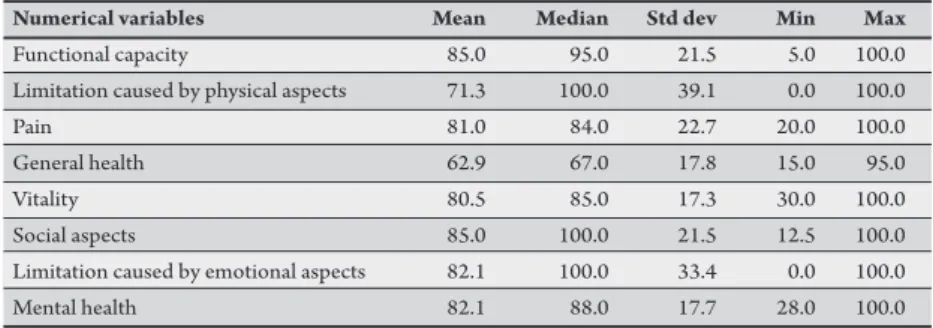
Regarding HRQoL, the SF-36 mean scores showed high scores that are consistent with a low compromise of HRQoL by leprosy
(Table 1). However, further statistical analysis revealed that there are some important determinants of the worsening of HRQoL in some patients.
TABLE 1 - Mean, median, standard deviation, and minimum and maximum scores on the quality of life questionnaire (SF-36) of patients in leprosy treatment in health units in the northern area of Teresina, State of Piauí, Brazil, in 2010.
Numerical variables Mean Median Std dev Min Max
Functional capacity 85.0 95.0 21.5 5.0 100.0
Limitation caused by physical aspects 71.3 100.0 39.1 0.0 100.0
Pain 81.0 84.0 22.7 20.0 100.0
General health 62.9 67.0 17.8 15.0 95.0
Vitality 80.5 85.0 17.3 30.0 100.0
Social aspects 85.0 100.0 21.5 12.5 100.0
Limitation caused by emotional aspects 82.1 100.0 33.4 0.0 100.0
Mental health 82.1 88.0 17.7 28.0 100.0
Source: interview with patients (2010). Std. dev: standard deviation, Min: minimum, Max: maximum.
TABLE 2 - Mean, median, standard deviation, and statistical signiicance of scores on quality of life in the SF-36 domains compared by the occurrence of leprosy reactions.
Reactional episodes Mean Median Std dev p value
Yes
functional capacity* 73.89 87.50 29.47 0.013*
limitation caused by physical aspects* 50.69 50.00 45.70 0.001*
pain* 69.00 70.00 24.89 0.001*
general health* 55.78 62.00 22.32 0.034*
vitality* 70.89 77.50 21.34 0.001*
social aspects* 76.04 81.25 26.62 0.005*
limitation caused by emotional aspects* 64.58 87.50 42.56 0.001*
mental health* 71.78 72.00 21.63 0.001*
No
functional capacity* 90.70 100.00 13.07
limitation caused by physical aspects* 81.69 100.00 30.75
pain* 87.15 100.00 18.94
general health* 66.51 67.00 13.89
vitality* 85.41 90.00 12.48
social aspects* 89.51 100.00 16.81
limitation caused by emotional aspects* 90.96 100.00 23.48
mental health* 87.38 92.00 12.53
Source: Interview with patients (2010). *Mann-Whitney test. Std dev: standard deviation.
TABLE 3 - Mean, median, standard deviation, and statistical signiicance of scores on quality of life in the SF-36 domains compared by the degree of disability at diagnosis.
Degree of disability Mean Median Std dev p value
Zero
functional capacity* 90.00 100.00 15.61 0.001*
limitation caused by physical aspects* 79.23 100.00 34.84 0.018*
pain* 84.63 100.00 19.92 0.002*
general health* 66.55 67.00 14.27 0.015*
vitality* 84.17 90.00 14.16 0.019*
social aspects 88.27 100.00 18.96 0.083
limitation caused by emotional aspects* 88.03 100.00 27.95 0.009*
mental health 84.28 88.00 15.44 0.666
Grade II
functional capacity* 61.36 75.00 34.72
limitation caused by physical aspects* 45.45 25.00 45.85
pain* 57.64 70.00 31.25
general health* 50.36 47.00 23.61
vitality* 66.82 80.00 24.62
social aspects 73.86 87.50 29.29
limitation caused by emotional aspects* 57.58 66.67 44.95
mental health 79.64 92.00 18.02
Source: interview with patients (2010). *Mann-Whitney test; Std dev: standard deviation.
Late diagnosis was signiicantly determinant of the emergence of disability (χ2 test, p = 0.001); it was observed that the degree of disability increased with the delay in detection. Late diagnosis showed a significant difference between sexes (Mann-Whitney test, p = 0.048); it took the women an average of 12.6 months to receive the diagnosis, while the average for men was 26.9 months.
In terms of HRQoL, late diagnosis (performed 2 years ater the early symptoms of leprosy) resulted in a deterioration in SF-36 scores; thus, it was possible to estimate the odds ratio for cases diagnosed within 2 years as follows: functional status (Fisher’s exact test, p = 0.003; odds ratio = 5.0 times; Spearman coeicient, p = 0.010), limitations due to physical aspects (χ2 test, p = 0.041; odds ratio = 2.4 times; Spearman coeicient, p = 0.042); general health status (χ2 test, p = 0.008; odds ratio = 3.5 times; Spearman coeicient, p = 0.008), social aspects (Fisher’s exact test, p = 0.016; odds ratio = 5.0 times; Spearman coeicient, p = 0.010), and pain (Fisher’s exact test, p = 0.007; odds ratio = 6.7 times; Spearman coeicient, p = 0.003). R egarding operational classif ication, multibacillary forms of leprosy were determinants of the occurrence of grade II disability at diagnosis (χ2 test, p = 0.001), which prevailed in males (odds ratio = 4.8 times; χ2 test, p = 0.0001), and the occurrence of reactional episodes (χ2 test, p = 0.017), with odds ratios 2.8 times higher compared to the paucibacillary participants. Patients with paucibacillary forms of leprosy reported feeling discriminated against (χ2 test, p = 0.001; odds ratio = 05 times) and omit who are afected by leprosy the most (χ2 test, p = 0.003; odds ratio = 4.3 times).
With respect to HRQoL, it was observed that multibacillary forms were crucial to the worsening of the SF-36 scores in: functional status (Fisher’s exact test, p = 0.008; odds ratio = 10.4 times; Spearman coeicient, p = 0.008), pain (Mann-Whitney test, p = 0.020), general health (Mann-Whitney test, p = 0.001), and social aspects (χ2 test, p = 0.045; odds ratio = 4.4 times; Spearman coeicient, p = 0.046).
he occurrence of reactional episodes proved to be decisive in making the patient feel discriminated against (χ2 test, p = 0.001); thus, it was possible to estimate odds ratios 4.4 times higher for the occurrence of discrimination among patients that had reactions.
he reactions were shown as a major determinant of the worsening of HRQoL as they resulted in a signiicant drop in scores for all the SF-36 domains
(Table 2).
Sufering discrimination was signiicantly determinant of the worsening of scores for the following SF-63 domains: pain (Fisher’s exact test, p = 0.001; odds ratio = 14.5 times; Spearman coeicient, p = 0.001), general health status (χ2 test, p = 0.001; odds ratio = 5.5 times; Spearman coeicient, p = 0.001), vitality (Fisher’s exact test, p = 0.001; odds ratio = 9.5 times; Spearman coeicient, p = 0.001), and limitations caused by emotional aspects (χ2 test, p = 0.001; odds ratio = 10.3 times; Spearman coeicient, p = 0.001).
DISCUSSION
Sociodemographic, clinical, and epidemiological characteristics of study participants
he sociodemographic proile found in this study is consistent with those in other studies conducted in diferent regions of Brazil, which point out poor socioeconomic conditions as contributing factors to leprosy infection/spread, in addition to biological determinants13-15. hese studies suggest that low educational level
is directly related to low family income, resulting in poor housing conditions, hygiene, nutrition, and access to health, which in turn promote the appropriate environmental conditions for Hansen's bacillus infection or the spread of the disease in genetically vulnerable individuals. his cyclic process is relected in the high levels of disability observed nowadays and the high prevalence in children younger than 15 years, which are indicators of delayed diagnosis and the strength of the disease, respectively.
Considering the potential risk of leprosy to lead to disabling deformities and that the disease mainly afects the economically active population, interference in the work and social life of the patient causes economic losses and psychological trauma, especially when it involves the family provider, who may end up unemployed and without social insurance14-16.
Regarding the clinical characteristics, it is worth noting that the high prevalence of multibacillary cases and late forms of leprosy (tuberculoid, borderline, and lepromatous) associated with the high percentage of grade II disability at diagnosis are indicative elements of late diagnosis and lack of timely detection of the case17. he grade II disability at
diagnosis is an indicator of the strength of the disease and is considered high in percentage when it is greater than 10%, so the study's indings suggest that there is a high risk of infection in the region studied10. he
high percentage of participants with another pathology associated with high leprosy morbidity curiously relects low use of complementary therapies (physiotherapy, psychology, group therapy). In this case, the literature suggests, there is low supply of specialized services; there is a cultural patern of omission of the disease coupled with the involvement of economically active people, especially in informal setlements, resulting in litle provision for this type of treatment15-17.
he epidemiological proile found is associated with an increased risk of contracting leprosy, as the main risk group consists of poor young adults, who reported another leprosy patient in their home with whom they have had intimate and prolonged contact18,19.
he risk of contracting the disease is sorted in decreasing order as follows: contact with family members with multibacillary infection, extradomiciliary contact with multibacillary patients, and contact with paucibacillary patients4. hus, the delayed diagnosis of patients
in endemic areas inluences the maintenance of the transmission chain, resulting in higher disease-related morbidity and indicating the ineiciency of control strategies.
Regarding self-perception of prejudice and stigma, this efect is known to occur in each individual according to similar social behavior paterns. In Brazil, it is suggested that there is a strong tendency to
cover up the disease with the support of the family and even of health services12, 20, 21.
he health-related quality of life of survey participants
he mean SF-36 scores found in this study are consistent with the literature, which has shown high scores consistent with low commitment of HRQoL by leprosy13, 22, 23. It was found that in cases
of early diagnosis, leprosy has a low impact on HRQoL, and as the disease progresses to severe and disabling forms, there is a very serious commitment that afects all dimensions of the quality of life of the person involved in treatment or even cured. he survey results in comparison with the literature resulted in the following discussion on the determinants of HRQoL worsening:
Delayed diagnosis
he worsening of HRQoL is associated with delayed diagnosis due to the chronic and progressive disease that evolves according to the patient’s immune status, the degree of endemicity of the environment, and other genetic components that facilitate/ complicate the relationship between the host and the bacillus24. For
susceptible individuals, the delay in diagnosis allows the development of the initial, more benign form (unspeciied) into the most disabling and polar forms (tuberculoid, borderline, lepromatous)15.
Deformities are rare in patients diagnosed less than 1 year ater the irst symptoms; these increase to 3.9% when the diagnosis is reached between 1 and 3 years ater the irst symptoms, rising to 25% when the diagnosis is delayed (up to 8 years of evolution)25.
hrough the percentage of cases diagnosed with physical disability caused by leprosy, it is possible to evaluate both the operational and epidemiological components since the late diagnosis contributes to the maintenance of the sources of infection26.
In terms of HRQoL, it was found that late diagnosis is an indirect determinant because it is related to the establishment of late forms of leprosy and disabling deformities. hus, the relationship between delayed diagnosis and worse HRQoL is an indirect measure of injuries caused by a prolonged course of the bacillus in the susceptible host, leading to the emergence of reactions and impairments.
Operational classiication
he multibacillary forms of leprosy are related to lower host resistance to the bacillus, and the impact of this type of infection is more severe when there is delayed diagnosis, whereas in paucibacillary cases, there is greater host resistance to the bacillus, resulting in fewer injuries and shorter treatment time27. he multibacillary forms are
correlated with the degree of the observed disability when compared with paucibacillary cases, even for equivalent periods of illness28.
he prevalence of multibacillary forms in males is associated with the delay in seeking medical treatment observed among men, which allows the evolution of paucibacillary forms of the disease29
and explains the signiicantly higher risk of secondary injuries found in the male participants in the study.
he authors declare that there is no conlict of interest.
CONFLICT OF INTEREST
REFERENCES
is a typical immune complication in multibacillary patients, the most frequent clinical manifestation of which is erythema nodosum leprosum, and that it may be associated with injuries of the nerves, eyes, joints, etc23.
he association between multibacillary forms and discrimination occurs because prejudice is historically related to the more pronounced signs of the disease, such as spots on visible parts of the body or physical deformities21. he stigma and prejudice experienced
by leprosy patients are atributed to the disabilities and deformities1.
his same reason explains why those patients with paucibacillary disease omit who are afected by leprosy more oten, revealing a cultural patern of coping with the disease and at the same time exposing a defense mechanism in afected patients.
The multibacillary forms are also indirect determinants of HRQoL worsening because they are related to the occurrence of reactions and impairments. he research indings suggest that reactions and secondary lesions may be directly related to the worsening of the SF-36 physical component, while the prejudice and stigma associated with the lesions, which are more visible in multibacillary forms, may result in the worsening of the social aspects.
Reactional episodes and grade II disability at diagnosis
hese two variables are addressed together because they are closely related, settling in each individual through a complex combination of environmental and biological factors, coupled with delays in diagnosis. he reactions are crucial for the emergence of disability, although they can occur in people who have not sufered from reactions.
hese two conditions have been proven to be decisive in the worsening of HRQoL31. On the other hand, studies of patients with
a lesser degree of disability and a low percentage of responses have shown a low impact on HRQoL of leprosy22.
he following are considered to be two plausible causes of poor HRQoL of patients with disabilities and reactions: 1) lesions actually restrict the physical component of HRQoL and directly undermine this aspect, and 2) a historical-cultural association between the leprosy lesions and stigma directly impacts on the mental health component.
It should be noted that the research indings suggest that the reactive episodes are instrumental in the worsening of the SF-36 mental health component. Conversely, there are studies indicating that the reactions can be triggered by psychological disorders, suggesting that it is mental health that is decisive in the emergence of reactions32. Given this, it is believed that the process occurs in
both directions.
he patient that reported sufering discrimination
his variable was not instrumental in the worsening of the SF-36 scores on the two aspects most strongly associated with motor skill components (functional capacity and limitations caused by physical aspects). hus, this inding suggests that discrimination signiicantly compromises those aspects related to mental health, including changes in pain threshold.
Pain is a sensory and emotional experience that is completely subjective. Emotions delineate the relationships between pain, fear, and behavior so that both the perception and expression of pain can be mediated and modulated by the unique meanings assigned by each patient to their condition, and they are inluenced by sex, gender, beliefs, religion, and culture33.
he association between discrimination and leprosy patients’ quality of life limitations is treated supericially in studies; most authors consider the impressions or reports of patients, especially regarding former hospital interns at colonies. It is believed that mechanisms similar to those applied to the subjectivity of pain can be associated with the deterioration that leads to discrimination in other SF-36 domains. Historical aspects, knowledge about the pathophysiology of leprosy, and stigma and prejudice are limiting aspects in the various life spheres of afected individuals34.
At the end of the survey, it was found that leprosy still afects the lower social classes in historically endemic areas, causing high percentages of secondary injuries that negatively afect the work capacity and quality of life of afected people, thus perpetuating the stigma and the ancient prejudice associated with the disease.
he study of the impact of leprosy on quality of life reinforces the need to implement more efective strategies for early diagnosis and to break the chain of disease transmission since the earliest forms of leprosy showed reduced negative impact on HRQoL. Furthermore, late diagnosis implies the establishment of severe and disabling forms of leprosy, which are associated with a low HRQoL even in a cured patient.
1. Ministério da Saúde. Secretaria de Políticas de Saúde. Departamento de Atenção Básica. Guia para o controle da Hanseníase. Brasília: Ministério da Saúde; 2002. 2. Talhari S, Neves RG, Penna GO, Oliveira MLV. Dermatologia Tropical:
Hanseníase. 4th ed. Manaus: Tropical; 2006.
3. Martelli CMT, Stefani MM, Penna GO, Andrade ALSS. Endemias e epidemias brasileiras, desaios e perspectivas de investigação cientíica: hanseníase. Rev Bras Epidem 2002; 5:273-285.
4. Andrade VLG. Evolução da hanseníase no Brasil e Perspectivas para sua eliminação como um Problema de saúde publica. [Doctoral thesis in public health]. [Rio de Janeiro-RJ]: Escola de Saúde Pública Sergio Arouca-ENSP; 1996. 198 p. 5. Barbosa JC, Ramos Jr NA, Castro CGJ. A aplicação da escala de SALSA em contextos de hanseníase: relatos de experiência no Brasil. Paper presented at: Congresso Brasileiro de Enfermagem; Nov 3-6; Belo Horizonte, MG, Brazil, 2008. 6. Fleck MPA, Leal OF, Louzada S, Xavier M, Chachamovich E, Vieira G, et al. Desenvolvimento da versão em português do instrumento de avaliação de qualidade de vida da OMS (WHOQOL-100). Rev Bras Psiquiatr 1999; 21:19-28. 7. Seidl EME, Zannon CMLC. Qualidade de vida e saúde: aspectos conceituais e
metodológicos.Cad Saude Publica 2004; 20:580-588.
8. Fróes KSSO. Qualidade de vida relacionada à saúde de adultos com seqüelas de acidente vascular cerebral. [Master thesis in Public Health]. [Fortaleza-CE]: Universidade de Fortaleza; 2008. 103 p.
9. Fernández-Concepción O, Fiallo-Sánchez MC, Álvarez-González MA, Roca MA, Concepción-Rojas M, Chávez L. La calidad de vida Del paciente con accidente cerebrovascular: una visión desde sus posibles factores determinantes. Rev Neurol 2001; 32:725-731.
10. Ministério da Saúde. Secretaria de Vigilância em Saúde. Departamento de vigilância epidemiológica: situação epidemiológica da hanseníase no Brasil, 2008. Brasília: Ministério da Saúde; 2008.
11. World Health Organization. Weekely Epidemiological Record: Global leprosy situation [Internet]. World Health Organization. 2010 - [cited 18 Jan 2011]. Available from: htp://www.who.int/lep/resources/wer/en/index.html. 12. Oliveira CAR. Peril epidemiológico da hanseníase em menores de 15 anos no
13. Martins MA. Qualidade de vida em portadores de hanseníase. [Master thesis in Psychology]. [Campo Grande-MS]: Universidade Católica Dom Bosco; 2009. 98 p.
14. Duarte MTC, Ayres JA, Simoneti JP. Consulta de enfermagem ao portador de hanseníase: análise de um instrumento e caracterização da assistência prestada. Paper presented at: Simpósio Internacional de Políticas e Práticas em Saúde Coletiva na Perspectiva da Enfermagem; Sep 3-4. São Paulo-SP, Brazil, 2007. 15. Aquino DMC, Caldas AJM, Silva AAM, Costa JML. Perfil dos pacientes
com hanseníase em área hiperendêmica da Amazônia, Maranhão - Brasil. Rev Soc Bras Med Trop 2003; 36:102-113.
16. Goulart IMB, Arbex GL, Carneiro MH, Rodrigues MS, Gadia R. Efeitos adversos da poliquimioterapia em pacientes com hanseníase: um levantamento de cinco anos em um Centro de Saúde da Universidade Federal de Uberlândia. Rev Soc Bras Med Trop 2002; 35:453-460.
17. Pereira EVE. Avaliação dos resultados das ações do programa de controle da hanseníase desenvolvidas no município de Teresina. [Master thesis in Science and Health]. [Teresina-PI]: Universidade Federal do Piauí; 2010. 72 p. 18. Van Beers SM, Hata M, Klatser PR. Patient contact is the major determinant in
incident leprosy: implications for future control. Int Jorn Lepr 1999; 67:119-128. 19. Lana FCF, Amaral EP, Lanza FM, Lima PL, Carvalho ACN, Diniz LG. Hanseníase em menores de 15 anos no Vale do Jequitinhonha, Minas Gerais, Brasil. Rev Bras Enferm 2007; 60:696-700.
20. Talhari S, Neves RG, Penna GO. Dermatologia Tropical: Hanseníase. 3rd ed. Manaus: Gofman E. Estigma: notas sobre a manipulação da identidade. 4th ed. Rio de Janeiro: Guanabara Koogan; 1988.
21. Queiroz MS, Carrasco MAP. O doente de hanseníase em Campinas: uma perspectiva antropológica. Cad Saude Publica 1995; 11:479-490.
22. Maitto FB, Souza CS. Hanseníase e a repercussão na qualidade de vida. [completion of course work in graduate medical]. [Ribeirão Preto-SP]. Universidade de São Paulo; 2006. 62 p.
23. Orsini MBP. Estudo da função dos nervos periféricos de pacientes com hanseníase, acompanhados por um período médio de 18 anos após o início da poliquimioterapia. [Master thesis in Science and Health]. [Belo Horizonte-MG] Universidade Federal de Minas Gerais; 2008. 124 p.
24. Osugue SM, Osugue JY. Hanseníase. In: TavaresW, Marinho LAC, editors. Rotinas de diagnóstico e tratamento das doenças infecciosas e parasitárias. 1st ed. São Paulo: Atheneu; 2005. p. 488-499.
25. Soares LS, Moreira RO, Vilela VV, Alves MJM, Pimentel AFM, Ferreira AP, et al. he impact of multidrug therapy on the epidemiological patern of leprosy in Juiz de Fora, Brazil. Cad Saude Publica 2000; 16:343-350.
26. Kumar A, Girdhar A, Girdhar BK. Nerve thickening in leprosy patients and risk of paralytic deformities: a field based study in Agra, India. Lepr Rev 2004; 75:135-142.
27. Cotran RS, Kumar V, Robbins SL. Patologia Estrutural e Funcional, 6th ed. Rio de Janeiro: Guanabara Koogan; 2000.
28. Alves CJM, Barreto JA, Fogagnolo L, Contin LA, Nassif PW. Avaliação do grau de incapacidade dos pacientes com diagnóstico de hanseníase em serviço de dermatologia do estado de São Paulo. Rev Soc Bras Med Trop 2010; 43:460-461. 29. Ferreira J. Validade do grau de incapacidades como indicador de diagnóstico
tardio da hanseníase. Hansen Int 1998; (Esp. number):79-84.
30. Mendonça VA, Costa RD, Melo GEBA, Antunes CT, Teixeira AL. Imunologia da hanseníase. An Bras Dermatol 2008; 83:343-350.
31. Martins BDL, Torres FN, Oliveira MLW. Impacto na qualidade de vida em pacientes com hanseníase: correlação do Dermatology Life Quality Index com diversas variáveis relacionadas à doença. An Bras Dermatol 2008; 83:39-43. 32. Opromolla DVA. Noções de Hansenologia. 2nd ed. Bauru: Centro de Estudos
Dr. Reynaldo Quagliato; 2000.
33. Figueiró JAB, Angeloti G, Pimenta CAM. Dor e saúde mental. 1st ed. São Paulo: Atheneu; 2005.