Rev Saúde Pública 2005;39(3) www.fsp.usp.br/rsp
Qualitative and quantitative methods in
health: definitions, differences and research
subjects
Egberto Ribeiro Turato
Laboratório de Pesquisa Clínico-Qualitativa. Faculdade de Ciências Médicas. Universidade Estadual
de Campinas. Campinas, SP, Brasil
Correspondence to:
Egberto Ribeiro Turato
Rua Carlos Guimarães, 230 Apto 82 13024-200 Campinas, SP, Brasil E-mail: [email protected]
Received on 24/11/2004. Approved on 5/4/2005.
Keywords
Biomedical research, methods.
Qualitative research. Research personnel.
Abstract
The interest and accomplishments in qualitative research have been increasing in health. As a consequence, there is a greater demand for both institutional research programs and scientific journal publications. This article has the following purposes: (a) to present some definitions in qualitative methods used in Humanities and Health; (b) to compare them to the usual quantitative methods of health sciences; and, finally, (c) to illustrate the subject with the most important constructs in these methodological fields. Above all, the author’s scope was to provide criteria to evaluate the pertinence of the path taken by qualitative researchers, from research plan elaboration to result interpretation.
INTRODUCTION
There have been increasing interest and
accom-plishments in qualitative research in the health field.
There is thus greater demand by researchers for
in-stitutional research programs as well as academic
meetings and scientific journals in order to carry
out projects and disseminate their work results. In
the last decade, qualitative research has become well
accepted by medical journals. But, in earlier times,
qualitative research manuscripts had been rejected
for being considered nonscientific, as if they
con-sisted of merely curious personal accounts of one’s
life events without systematic concerns, i.e., they
were deemed anecdotal.
2Fortunately nowadays many scientific journals
gen-erally publish qualitative research studies. For
exam-ple, the Journal of Public Health (
Revista de Saúde
Pública
), a renowned periodical, has even guidelines
for evaluating qualitative papers by its referees. It is
now common to find health professionals who not
only give importance to qualitative methods in
medi-cine but also recognize their help for better
under-standing patients’ life. An increasing number of
medi-cal researchers have been using these methods in their
work.
2However, it does not necessarily mean that
qualitative methods are well understood and
prop-erly used as, among other problems, some
investiga-tors present qualitative study reports with common
sense conclusions.
Facing these challenges, there was a need for a
tu-torial article discussing qualitative research
method-ology, bringing to the readers its most relevant
defi-nitions. In addition, such definitions would need to
be compared with both classic concepts of
conven-tional field research, such as epidemiological
re-search, and other procedures of scientific surveys
generally constructed with measurements and other
mathematical tools. And finally, the academic
audi-ence could discriminate better the themes and
con-structs which are currently most explored in these
methodological fields.
con-Rev Saúde Pública 2005;39(3) www.fsp.usp.br/rsp Qualitative and quantitative methods in health...
Turato ER
sumers of these scientific outputs are here targeted to
allow them to have a greater
clarity of criteria
to
critically evaluate the pertinence of the path taken
by qualitative researchers, from research plan
elabo-ration and data collection to result interpretation.
Similarly, this article purpose is to provide
informa-tion to those academics who intend to develop
quali-tative research projects, to allow them to apply the
same accuracy as expected for any generating
knowl-edge in science. Hence, it is presented the
concern-ing definitions and a comparative discussion between
qualitative
and
quantitative
methods and, by the end,
a diversified list of conceptual constructions specific
to each method vocabulary.
HISTORICAL BACKGROUND
The discourses of Natural Sciences – Physics,
Chem-istry, Biology and their numerous related sciences,
among them Medical Sciences – are associated with
the understanding of quantitative or explanatory
methods. In the same way, the discussion on Human
and Culture Sciences is combined with that on
quali-tative or understanding methods. Modern scientific
thought, as it is known, has started almost four
centu-ries ago with Galileo. It is his legacy of giving
au-tonomy to Science, distinguishing it from both
Phi-losophy and Religion, so delimiting which will be
its object, objective and method (observation,
ex-perimentation and induction).
8Science has been
es-tablished since then on the specific object of nature
beings, i.e., on the study of the laws that enunciate
the links of natural phenomena among themselves,
while Philosophy should be concerned with
onto-logical issues (the being as such) and, at last,
Reli-gion would preserve, as its object, the so-called
reli-gious truths.
Qualitative or understanding methods have a more
recent history. They are about a century old and have
started at the time of the first ideas of giving autonomy
to Human Sciences, arising in counterpoint to the
already existing Natural Sciences. From its
qualita-tive methods, the discipline of Anthropology has
developed the so-called ethnography, which has been
revolutionized in 1920s with Malinowski’s
publica-tions.
10The anthropologist Malinowski has spent years
living among Oceania’s natives, participantly
observ-ing their lives. From that, Science’s history has
attrib-uted him the pioneerism in the qualitative scientific
methodology, as he systematically described how he
had obtained his data and his field experience.
However, credit should be given first to Marx and
Freud for having offered important epistemological
cuts for new and thorough understanding of the
hu-man being, which has initiated autonomous
scien-tific studies in human sciences. These thinkers have
built up schools of thought, unveiling the
mecha-nisms of the acting Ideology in social groups and
unmasking the mechanisms of the acting Unconscious
in individuals’ life.
4They have significantly
contrib-uted to support the scientificity of Human Sciences,
where lies the locus of methodological construction
of qualitative research.
COMMON CONCEPTS OF QUALITATIVE
METHODS
From a methodological perspective, if one wants
to scientifically explain, for instance, the
phenom-ena related to drug addiction, this is a subject for
researchers in psychiatry, epidemiology or clinical
pharmacology. But if one wants to understand what
substance dependence means in the life of an addicted
patient, then it is a subject for qualitative researchers,
who can be psychologists, psychoanalysts,
sociolo-gists, anthropologists or educators. However, it would
be very interesting if health professionals could
ac-tually employ qualitative methods. They have the
advantage of, due to their clinical practice, having
inherent clinical and existential attitude,
14which will
allow them to perform rich data collections and to
make authoritative result interpretations.
On the other hand, it is crucial to bear in mind a
clear concept of research qualitative method to avoid
purely reproducing the understanding accrued from
other approaches and assertions such as research
methods where tools like numbers, percentage
calcu-lations, statistical techniques, tables, statistically
rep-resentative samples, random essays, closed
question-naires or evaluation scales are not employed. To
de-fine a concept by denying it does not evidently
con-stitute a definition.
14It is also not the case of saying,
as often is intuitively assumed, that qualitative
meth-ods are for studying the “quality” of an object.
Quali-tative methods applied to health employ the concepts
borrowed from human sciences, according to which
the study focus is not the “thing” itself, but to
under-stand its individual or collective meaning in
peo-ple’s life. It is indispensable to know what the
phe-nomena of both and life generally mean to them,
be-cause the
meaning
has a
structuring function
:
peo-ple will organize their lives around what things mean
to them, including their healthcare.
investi-!
Rev Saúde Pública 2005;39(3) www.fsp.usp.br/rsp
Qualitative and quantitative methods in health... Turato ER
gation object. Nature Sciences researchers often
re-fer to the application of
qualitative methods
while
conducting studies, for example, in biology areas,
specifically in medical parasitology, with the
ob-jective of detecting the presence of protozoans in
collected material for clinical testing. It is used the
term
qualitative
, evidently with a specific meaning
within its epistemological-methodological model.
For that, the researcher will employ techniques such
as sample collection according to well-defined
pro-cedures; storage in adequate containers, careful
sam-ple identification and samsam-ple analysis in a
well-equipped laboratory. In short, the researcher will
study in-depth a particular natural phenomenon and
describe its properties, carrying out a
qualitative
research in Natural Sciences
.
Back to the Human and Health Sciences context, it
is first presented here a generic definition of
qualita-tive methods by the sociologists Denzin & Lincoln,
6usually quoted in the literature: “Qualitative
research-ers study things in their natural setting, attempting to
make sense of, or interpret, phenomena in terms of
the meanings people bring to them”. Reading only
this definition cannot be enough for an accurate
un-derstanding by readers not familiarized with this
re-search approach. It is again underlined that rere-search-
research-ers’ are not directly interested in studying the
phe-nomenon itself, but their actual target is the
meaning
the phenomenon have for those experiencing it.
Similarly, the educators Bogdan & Biklen
1point
out that “qualitative researchers’ goal is to better
un-derstand human behavior and experience. They seek
to grasp the processes by which people construct
meanings and to describe what those meanings are”.
These authors also assume
meaning
as the key
con-cept. It is inferred that qualitative researchers does
not want to explain events in peoples’ life,
individu-ally or collectively, by listing and measuring their
behaviors or quantitatively correlating their life
events. Conversely, their intention is to gain an
in-depth knowledge of people’s life experiences and their
representations of these experiences.
In their attempt to provide a detailed definition
on qualitative methods, the nurses Morse & Field
12characterize them as “inductive, holistic, emic,
sub-jective, and process-oriented research methods used
to understand, interpret, describe, and develop
theory pertaining to a phenomenon or a setting”.
Although these authors aimed at a comprehensive
definition, they left out the terms
meaning/signifi-cation
. In its broad scope, however, the word
theory
gains strength, which implies that qualitative
method is not only a research approach that meets
specific demands, but it has the common purpose of
creating a model for in-depth understanding of the
links among elements, i.e., of exploring an order
that is invisible in the ordinary examination. It is
also underlined the term
process
, particularly
pow-erful here, which characterizes the qualitative
method as designed to understand how the study
object happens or develops; and not to aim at the
product
, that is, mathematically estimated results.
The
inductive
reasoning relates to the fact that these
researchers would ground their work on field data,
further exploring individualities and collecting
in-formation that would gradually help to build up a
plausible and dense
theory
. Emic means that
scien-tists’ interpretations should be made from the
inter-viewees’ perspective and should not be a
discus-sion from the researcher’s or the literature’s view.
Original knowledge should be gained and they
should not focus on corroborating the already
ex-isting theories as this does not contribute to science
advancement.
Favoring a
structural definition
from a
sociologi-cal perspective, Minayo
11identify qualitative
re-search methodologies as “[…] those capable of
in-corporating both the meaning and intentionality as
inherent to acts, relationships and social structures,
the latter considered to be both on their advent and
their transformation as significative human
construc-tions”.
The term
meaning
gains relevance in the
so-cial context in trying to understand the “want to say”
regarding to these structures for the study subjects.
Finally, it is presented here the
clinical-qualita-tive methodology
definition, a particularization and
refinement of the generic qualitative
methodolo-gies from Human Sciences, but addressed
specifi-cally to the life experience in health settings: “It is
the theoretical study – and its corresponding use in
investigation – of a set of scientific methods,
tech-niques and procedures, adequate to both describe
and interpret the senses and the meanings given to
the phenomena and also related to individuals’ life
(patients or any other participating person in the
healthcare setting, such as family members, health
professionals and community people).
13In this
" Rev Saúde Pública 2005;39(3) www.fsp.usp.br/rsp Qualitative and quantitative methods in health...
Turato ER
Conceptual levels in methodologies
More influent paradigm Scientific attitude
Reasoning of the method
Strength of the method
Study object Research objectives
Philosophy and science reference authors
Theoretical reference framework
Common subjects
Main disciplines
Interest for comparisons
Project design Project course Specific instruments
Types of research instruments
Instrument adequacy Sampling
Sample profile
Sample size
Study of variables
Data treatment/ analysis
Presentation of results
Target of the result discussion
Discussion strategy
Comparison in the literature
Finalization of the theoretical conception
Conclusions on the hypotheses
Type of generalization (made/ proposed/ assumed)
Generalization by whom
Experimental and field quantitative methods
Positivism
Search for the explanation of behaviors of things
Attributed to the quality of high reliability/reproducibility of the results Facts (viewed and described) Mathematical establishment of the cause-effect relations
Descartes, Comte, Claude Bernard, Pavlov, Durkheim
More frequent, general and universal occurrences
Medical Sciences, Behavioral Psychology, Positivist Sociology
Occurrences compared between exposed and non-exposed groups to certain variables, phenomena or situations
Pre-established resources Predetermined procedures Surveys and experiments Directed observation, closed questionnaires, scales, nosological classifications, laboratory tests, randomized data of patients records, psychodiagnosis
Pilot essay
Randomized: group of individuals taken by chance, statistically representative of a large population Greater number of subjects;
participants with characteristics of the whole population
Previously and statistically defined; N is required
Need for controlling variables
Application of biostatistical techniques to organize findings; usually tabulated by experts
In mathematical language (tables, pictures); usually apart from the discussion in the scientific report Establishment of correlations among (mathematical) results
Confrontation of findings with results from other quantitative researches
Initial theoretical construction is verified and tested
Confirmation or refutation of previously defined hypotheses
Statistical: from (mathematical) results applied to explain other populations with same variables.
Established/given by the author/ researcher.
Field qualitative methods
Phenomenology
Search for the understanding of the human beings dynamics
Attributed to the quality of high validity of the collected data/findings
Phenomena (grasped)
Interpretation of phenomena meaning relations as reported by people Dilthey, Marx, Freud, Malinowski, Weber
Specific occurrences and in particular settings
Psychoanalysis, Anthropology, Understanding Psychology, Understanding Sociology
Search for intergroup comparisons is useless
Open and flexible resources Adjustable procedures Researcher-as-instrument Researcher and their senses: free observation, semidirected interviews; complementary instruments: intentional collection from patients records, projective psychological tests Acculturation essay
Intentioned: purposive search for individuals experiencing the focused problem and/or have knowledge about it Few subjects; participants with characteristics of certain subpopulation
Concern with a N is impertinent; number of subjects defined in the field Non-control of variables; they need to be free
Application of content analysis (among others): categorization by theoretical relevance or data reiteration; performed by the researcher Use of field observations and
quotations; integrated to the discussion section
Interpretation of categorized data, simultaneously to their presentation
Confrontation of new concepts with those constructed in other qualitative research
Initial theoretical construction is, at least, reinitiated, reformulated, deflected and clarified
Initial and later hypotheses reviewed in a crescendo; constructed concepts Conceptual: from new knowledge and reviewed proposes applied to understand other people or settings with same life experiences.
Verified/validated by research reader/ consumer
Table 1 - Differences and similarities between quantitative and qualitative research methods.
Epistemologically, all methods are deductive a priori (departing from hypotheses formulated by researchers from their life experiences and theoretical studies) and inductive a posteriori (departing from collected data in the field, laboratory or literature)
As in any research, it joins knowledge, schools of thought and authors which give support to both researchers scientific thought and their professional practice
#
Rev Saúde Pública 2005;39(3) www.fsp.usp.br/rsp
Qualitative and quantitative methods in health... Turato ER
the listening and the valuing of mobilized
psy-chodynamic aspects, overall in their affective and
direct relationship with the study subjects. This
method has proved to be adequate for qualitative
research already carried out in the health area.
3,5,7CHARACTERISTICS OF QUALITATIVE
METHODS
1First, the researcher’s interest turns toward the
search for the
meaning
of things because it has an
organizing role
in human beings. What “things”
(phenomena, manifestations, occurrences, facts,
events, life experiences, ideas, feelings, subjects)
represent shape people’s lives. At another level, the
meanings “things” acquire are culturally shared and
so organize the social group around these
represen-tations and symbolisms. In health settings in
par-ticular, knowing the
meanings
of phenomena of the
health-disease process is essential for the
follow-ing: to improve the quality of professional-patient
relationship; to promote better adherence of patients
and general population to individually administered
treatments and collectively implemented preventive
measures; to better understand certain feelings, ideas
and behaviors of patients as well as their family
members and even health professionals.
Second, in this approach, the subjects’
natural
set-ting
is unequivocally the field, where observation,
without variable control, takes place. Third,
research-ers are themselves a
research instrument
as they use
their sensory organs to grasp the study objects,
mir-roring them in their consciousness, where they then
are converted into phenomenological
representa-tions to be interpreted. Fourth, this method has greater
data
validity
strength since the thorough accurate
observation and in-depth interview listening of
sub-jects are likely to lead researchers very close to the
essence of the study issue. Fifth, since
generaliza-tion
does not derive from (mathematically)
esti-mated results because it is not based on either the
quantification of occurrences or the establishment
of cause/effect relationships; it becomes possible
from the review of initial hypotheses, i.e., the
con-structed concepts and the original knowledge
pro-duced. It is up to research readers/consumers to use
them to examine their plausibility and utility in
or-der to unor-derstand new cases and
settings
.
For instructive purposes, it is now relevant to draw
the comparative profiles between the
characteris-tics of both
qualitative
and
quantitative
method-ologies applied to health. Table 1 illustrates the
conceptual levels
of both methodologies. First it
shows the scientif ic attitude one should adopt
when using either one of these methods. It can also
be seen the strengths (
reliability
versus
validity
)
as well as the actual
limits
of the
subject
under
study in each approach; and then the
dissimilari-ties in the different study designs and research
in-struments are identified. The critical point is to
show the differences in
sampling technique
and
subject sample profile
.
Data analysis
shows
dis-tinctive ref ining of collected data in both
meth-ods. Finally, it should be made clear what in fact
the
conclusions
are in each method and the
result-ing work of disentanglresult-ing the knots concernresult-ing
the intended and the possible
generalization
from
both quantitative and qualitative research.
This important chart displaying their
dissimilari-ties
reveal that each method has its own identity
from the moment the authors formulate the
ques-tions (the working hypotheses) up to the writing of
their research final reports. The complexity of each
scientific undertaking and, most of all, the
autono-mous epistemological constructions, which give
them support, disavow most research studies
self-entitled “
quanti-quali
” to continue to be carried out
in the academic environment using this supposedly
mixed model. In fact, many such research studies
are conceived only on quantitative constructions,
since simply embedding subjects’ quotations,
col-lected using previously standardized
question-naires, does not acceptably configure a claimed
si-multaneity of qualitative research.
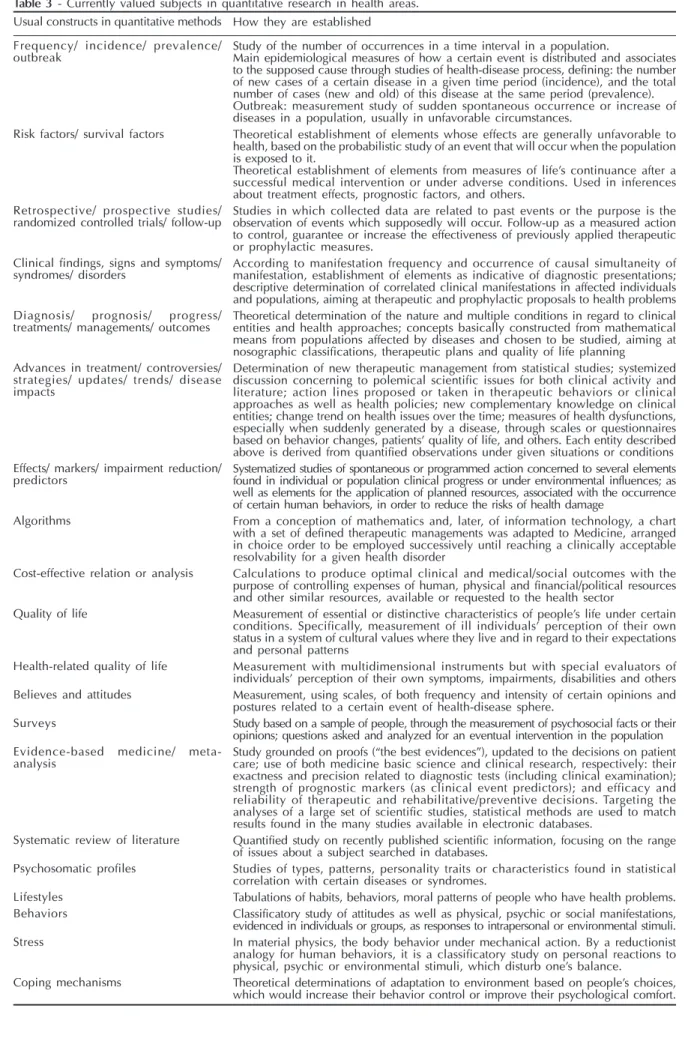
In conclusion, Tables 2 and 3 aim at codifying the
most common used constructs in
qualitative
and
quan-titative
research, respectively. In the right column,
showing how each concept is constituted,
well-estab-lished definitions from epidemiology literature
9and/
or well typified health sciences descriptors
15are
$ Rev Saúde Pública 2005;39(3) www.fsp.usp.br/rsp Qualitative and quantitative methods in health...
Turato ER
Table 2 - Currently valued subjects in qualitative research in health areas. Usual constructs in qualitative methods
Meanings/ significances/ resignificances
Psychic representations/ social representations
Symbolizations, symbolisms
Perceptions/ viewpoints/ perspectives
Life experiences/ realizations
Metaphors/ analogies
[Ego] defense mechanisms/
[psychosocial] adaptation mechanisms
Adherence and non-adherence to both prevention and treatment
Stigmas
Care/ comfort
Reactions and roles of professional and home caregivers/ burn-out
Facilitators/ bridges and barriers of approaches
Narrative review of literature
Metasynthesis
How they are established
In health settings, usual or new phenomena: have a want-to-say, start to represent or symbolize something (psychologically or sociologically) for certain individuals or sociocultural group.
Study of reality elements: grasped by the perception, represented in consciousness, and so constructed in images; respectively, characterized in the personal history (psychological world) or collective history (social world).
Study of unconscious mental or underlying sociocultural processes, in which objects in general and ideas come from other elements due to specific qualities or general aspects in common, then arising symbols that carry elements invested in those initial objects and ideas.
Identification and understanding of what is apprehended through the sensory organs immediately or intuitively having as object the phenomena in their qualities.
Representations on both the perceived and the remembered of what was lived (experienced, thought); occult senses of life experience; not-said meanings about the knowledge historically acquired and accrued by people.
Study of the accomplishments: interpretation of conceived inner elements, brought vividly to mind, and understood clearly by the subjects.
Interpretation of semantic translations and sense similarities, respectively; found in the subjects discourses and crucial for the meanings discussion in regard to the matter under study.
Psychoanalytic study of defenses in unconscious processes (repression, denial, etc.), protectors for the subject (for their ego) against their impulses and ideas unacceptable to their consciousness.
Psychological study of adaptations in psychosocial processes that allow the subject to organize themselves facing inner (psychic) and/or outer (social, cultural, environmental) demands.
Understandings of psychological-psychoanalytical and/or socioanthropological motives/reasons according to which people fulfill - correctly or not - clinical indications, recommendations, requirements and plans set by health professionals.
Psychosociological study of the impact of an individual condition, which prevent them from full social acceptance; interpretation of peoples life experiences seen in their external signals, which exclude them from groups that follow the biological, psychological or sociological norm.
Studies on attention and protection needs of ill people living in unfavorable conditions and situations, aiming at improving their physical, psychic and social being.
Study on how problems are experienced by health professionals, relatives or related people due to care of sick or disabled people.
In particular, the dynamics of fatigue syndrome with the representation study of both the exhaustion phenomenon of providing care and the psychological management of overwork with ill people.
Dynamics study of factors determining better or worse outcomes of diagnostic, therapeutic or preventive approaches, from the viewpoint of people affected by health problems or of their caregivers.
Examination of published scientific studies with qualitative approaches, equivalent to systematic literature review (common in quantitative approaches); discussion of several conclusions of studies conducted with methodological rigor, including subsequent content analysis of the examined and selected material.
%
Rev Saúde Pública 2005;39(3) www.fsp.usp.br/rsp
Qualitative and quantitative methods in health... Turato ER
Table 3 - Currently valued subjects in quantitative research in health areas. Usual constructs in quantitative methods
Frequency/ incidence/ prevalence/ outbreak
Risk factors/ survival factors
Retrospective/ prospective studies/ randomized controlled trials/ follow-up
Clinical findings, signs and symptoms/ syndromes/ disorders
Diagnosis/ prognosis/ progress/ treatments/ managements/ outcomes
Advances in treatment/ controversies/ strategies/ updates/ trends/ disease impacts
Effects/ markers/ impairment reduction/ predictors
Algorithms
Cost-effective relation or analysis
Quality of life
Health-related quality of life
Believes and attitudes
Surveys
Evidence-based medicine/ meta-analysis
Systematic review of literature
Psychosomatic profiles
Lifestyles Behaviors
Stress
Coping mechanisms
How they are established
Study of the number of occurrences in a time interval in a population.
Main epidemiological measures of how a certain event is distributed and associates to the supposed cause through studies of health-disease process, defining: the number of new cases of a certain disease in a given time period (incidence), and the total number of cases (new and old) of this disease at the same period (prevalence). Outbreak: measurement study of sudden spontaneous occurrence or increase of diseases in a population, usually in unfavorable circumstances.
Theoretical establishment of elements whose effects are generally unfavorable to health, based on the probabilistic study of an event that will occur when the population is exposed to it.
Theoretical establishment of elements from measures of lifes continuance after a successful medical intervention or under adverse conditions. Used in inferences about treatment effects, prognostic factors, and others.
Studies in which collected data are related to past events or the purpose is the observation of events which supposedly will occur. Follow-up as a measured action to control, guarantee or increase the effectiveness of previously applied therapeutic or prophylactic measures.
According to manifestation frequency and occurrence of causal simultaneity of manifestation, establishment of elements as indicative of diagnostic presentations; descriptive determination of correlated clinical manifestations in affected individuals and populations, aiming at therapeutic and prophylactic proposals to health problems Theoretical determination of the nature and multiple conditions in regard to clinical entities and health approaches; concepts basically constructed from mathematical means from populations affected by diseases and chosen to be studied, aiming at nosographic classifications, therapeutic plans and quality of life planning
Determination of new therapeutic management from statistical studies; systemized discussion concerning to polemical scientific issues for both clinical activity and literature; action lines proposed or taken in therapeutic behaviors or clinical approaches as well as health policies; new complementary knowledge on clinical entities; change trend on health issues over the time; measures of health dysfunctions, especially when suddenly generated by a disease, through scales or questionnaires based on behavior changes, patients quality of life, and others. Each entity described above is derived from quantified observations under given situations or conditions Systematized studies of spontaneous or programmed action concerned to several elements found in individual or population clinical progress or under environmental influences; as well as elements for the application of planned resources, associated with the occurrence of certain human behaviors, in order to reduce the risks of health damage
From a conception of mathematics and, later, of information technology, a chart with a set of defined therapeutic managements was adapted to Medicine, arranged in choice order to be employed successively until reaching a clinically acceptable resolvability for a given health disorder
Calculations to produce optimal clinical and medical/social outcomes with the purpose of controlling expenses of human, physical and financial/political resources and other similar resources, available or requested to the health sector
Measurement of essential or distinctive characteristics of peoples life under certain conditions. Specifically, measurement of ill individuals perception of their own status in a system of cultural values where they live and in regard to their expectations and personal patterns
Measurement with multidimensional instruments but with special evaluators of individuals perception of their own symptoms, impairments, disabilities and others Measurement, using scales, of both frequency and intensity of certain opinions and postures related to a certain event of health-disease sphere.
Study based on a sample of people, through the measurement of psychosocial facts or their opinions; questions asked and analyzed for an eventual intervention in the population Study grounded on proofs (the best evidences), updated to the decisions on patient care; use of both medicine basic science and clinical research, respectively: their exactness and precision related to diagnostic tests (including clinical examination); strength of prognostic markers (as clinical event predictors); and efficacy and reliability of therapeutic and rehabilitative/preventive decisions. Targeting the analyses of a large set of scientific studies, statistical methods are used to match results found in the many studies available in electronic databases.
Quantified study on recently published scientific information, focusing on the range of issues about a subject searched in databases.
Studies of types, patterns, personality traits or characteristics found in statistical correlation with certain diseases or syndromes.
Tabulations of habits, behaviors, moral patterns of people who have health problems. Classificatory study of attitudes as well as physical, psychic or social manifestations, evidenced in individuals or groups, as responses to intrapersonal or environmental stimuli. In material physics, the body behavior under mechanical action. By a reductionist analogy for human behaviors, it is a classificatory study on personal reactions to physical, psychic or environmental stimuli, which disturb ones balance.
& Rev Saúde Pública 2005;39(3) www.fsp.usp.br/rsp Qualitative and quantitative methods in health...
Turato ER
REFERENCES
1. Bogdan RC, Biklen SK. Qualitative research for education: an introduction for theory and methods. 3th
ed. Boston: Allyn and Bacon; 1998.
2. Britten N. Making sense of qualitative research: a new series [editorials]. Med Educ 2005;39(1):5-6.
3. Campos CJG, Turato ER. [The health professionals team, the patient with renal disease in hemodialysis, and interpersonal relations]. Rev Bras Enferm 2003;56:508-12.
4. Chauí MS. Convite à filosofia. 3a ed. São Paulo:
Ática; 1995.
5. de Figueiredo RM, Turato ER. Needs for assistance and emotional aspects of caregiving reported by AIDS patient caregivers in a day-care unit in Brazil. Issues Ment Health Nurs 2001;22(6):633-43.
6. Denzin NK, Lincoln YS. Handbook of qualitative research. Thousand Oaks, Sage; 1994.
7. Fontanella BJB, Turato ER. [Doctor-patient
relationship barriers to substance dependents seeking treatment]. Rev Saúde Pública 2002;36:439-47.
8. Galilei G. O ensaiador. São Paulo: Nova Cultural; 2000.
9. Jekel JF, Elmore JG, Katz DL. Epidemiologia, bioesta-tística e medicina preventiva. 2a ed. Porto Alegre:
ARTMED; 2005.
10. Malinowski BK. Argonautas do Pacífico Ocidental: um relato do empreendimento e da aventura dos nativos nos arquipélagos da Nova Guiné Melanésia. 3a ed. São Paulo: Abril Cultural; 1984.
11. Minayo MCS. O desafio do conhecimento: pesquisa qualitativa em saúde. 8a ed. São Paulo: Hucitec/ Rio
de Janeiro: Abrasco; 2004.
12. Morse JM, Field PA. Qualitative research methods for health professionals. 2nd ed. Thousand Oaks,
Sage; 1995.
13. Turato ER. [Introduction to the clinical-qualitative research methodology: definition and main
characteristics]. Rev Portug Psicossomática [Portug J Psychosomatics] 2000;2(1):93-108.
14. Turato ER. Tratado da metodologia da pesquisa clínico-qualitativa: construção teórico-epistemológi-ca, discussão comparada e aplicação nas áreas da saúde e humanas. 2a ed. Petrópolis: Vozes; 2003.