Renato Veras
Universidade Aberta da Terceira Idade. Universidade do Estado do Rio de Janeiro. Rio de Janeiro, RJ, Brasil
Correspondence:
Renato Veras
R. São Francisco Xavier, 524/10º andar, Bloco F – Maracanã
20559- 900 Rio de Janeiro, RJ, Brasil E-mail: [email protected]
Received: 05/09/2008 Approved: 11/30/2008
Population aging today:
demands, challenges and
innovations
ABSTRACT
The paper discusses the social and, particularly, the health consequences resulting from the expansion of the numbers of elderly people in Brazil over a short period. The data used were from the 1998 and 2003 Pesquisa Nacional por Amostra de Domicílios (PNAD, the national household sampling survey), and they express an improvement in elderly people’s health conditions and similar distribution of chronic diseases across all income groups. If, on the one hand, elderly people present greater disease burden and incapacities and they use healthcare services more, on the other hand, the current models for healthcare for the elderly are shown to be ineffi cient and high-cost. Creative and innovative structures are required, such as social centers with health assessments and treatment. Foremost on the agenda for Brazilian public policy, priority should be given to maintaining elderly people’s functional capacity, with monitoring of their health conditions; preventive and differentiated actions relating to health and education; and qualifi ed care and multidimensional comprehensive attendance.
DESCRIPTORS: Demographic Aging. Old Age Assistance. Health of the Elderly. Social Conditions. Delivery of Health Care. Preventive Health Services. Brazil.
INTRODUCTION
Prolongation of life is an aspiration of any society. However, it can only be considered to be a real achievement to the extent that quality is aggregated to the additional years of life. Thus, any policy aimed towards elderly people must take into account their functional capacity and their need for autonomy, partici-pation, care and self-satisfaction. It must also make room for the possibility of acting within a variety of social contexts and constructing new meanings for life at advanced ages. Furthermore, fundamentally, it must encourage preven-tive healthcare and comprehensive healthcare.
Today, reaching old age is a reality for populations, even in poorer countries. Even though the substantial improvement in the health parameters of popula-tions seen over the twentieth century is far from being equitably distributed in different countries and socioeconomic contexts, aging is no longer the privilege of the few.
The speed of the process of demographic and epide-miological transition experienced by Brazil over recent decades has brought out a series of crucial questions for managers and researchers within the healthcare system. These questions have repercussions for all of society, especially within a context of great social inequality, poverty and institutional fragility.
The scenario becomes more complex when it is noted that, simultaneously with the general lack of resources, there are two age groups, the elderly and the young, that require specifi c programs and public resources. Mana-gerial skill and creativity and a capacity to innovate are required in order to administrate these shortages.
Brazil today is a “young country with white hair”. Every year, 650,000 new elderly people are incorporated into the Brazilian population. Most of them have chronic diseases and some have functional limitations. Over a period of less than 40 years, Brazil has gone from a mortality scenario that was particular for a young population to a situation of complex and burdensome illnesses typical of long-living countries, characterized by multiple chronic diseases that last for years, with requirements for constant care, continual medication and periodic examinations.
The number of elderly people in Brazil went from three million in 1960 to seven million in 1975 and 20 million in 2008: an increase of almost 700% in less than 50 years. Consequently, diseases particular to old age have come to have greater expression throughout society.
One of the results from this dynamic is the greater demand from elderly people for health services. Hos-pitalization and length of bed occupancy are greater for them than for other age groups. Thus, aging of the population translates into greater disease burden in the population, more incapacities and increased use of the health services.
Recent studies12,20 have shown that chronic diseases,
along with their incapacities, are not inevitable conse-quences of aging. Prevention is effective at any level, even at later stages of life. Therefore, an emphasis on prevention is the key to changing the present situation.
In their daily lives, elderly Brazilians live with the fear of violence, lack of medical and hospital attendance and scarcity of leisure activities, along with the low amounts of their retirement and other pensions. Despite the substantial increases in their value over recent years, the amounts are still recognized to be small. On the other hand, the national household sampling survey (Pesquisa Nacional de Amostra de Domicílio, PNAD) has already shown some positive repercussions from these increases.11,18,19
a Brasil. Lei 10.741, de 1º de outubro de 2003. Dispõe sobre o Estatuto do Idoso e dá outras providências. Diário Ofi cial da União, 3 out. 2003. b Ministério da Saúde. Portaria nº 2.528, de 19 de Outubro de 2006. Aprova a Política Nacional de Saúde da Pessoa Idosa. Diário Ofi cial da União, 20 out. 2006.
In addition to the lack of information, prejudice and disrespect for third-age citizens, there is the precarious-ness of public investments and even of human resources for meeting the specifi c needs of the elderly population, in terms of both quantity and quality.
The facts and the evidence indicate that changes to the care provided for the elderly population are urgently needed. The prevailing models have been shown to be ineffi cient and expensive. Thus, new planning and man-agement methods become necessary, since the provision of care demands creative and innovative structures, with proposals for differentiated actions. In this way, the sys-tem can gain in effi ciency and elderly people can fully enjoy the years provided by advances in science.7
In Brazil, the efforts are still sporadic and disjointed. Recently, the Ministry of Health included elderly people’s health as a priority item on the country’s healthcare agenda. A new national healthcare policy was proclaimed,a which had the aim within the scope
of the Brazilian National Health System (SUS) of en-suring comprehensive health attendance for the elderly population. It emphasized healthy and active aging based on the paradigm of functional capacity, dealt with multidimensionally.b
However, the practical effect has still not been observed. The burden of care is still preponderant and the notable degree of disjointedness within the healthcare system makes it diffi cult to put into operation any logic based on evaluations capable of covering the multiple aspects of elderly peoples’ lives (Veras & Caldas, 2004).17
The theoretical reference for this multidimensional approach bears the seal of the World Health Organiza-tion (WHO), which has taken on the document “Ac-tive aging: a reference point for drawing up policies.” This text presents the main challenges that need to be faced around the world in relation to the aging of the population. It highlights the fact that health can only be created and maintained with the participation of several sectors.
Furthermore, WHO recommends that health policies relating to aging should take into consideration the determinants of health over the whole course of life (social, economic, behavioral, personal and cultural, along with the physical environment and access to services), with particular emphasis on the questions of gender and social inequality.
a The term “prevention” is no guarantee of an effective program. There are many ineffi cient primary prevention and health promotion programs and actions.
b Ottawa Charter: health promotion in industrialized countries. In: First International Conference on Health Promotion, 1986; Ottawa, Canada. [cited 2009 Mar 10]. Available from: http://www.saudepublica.web.pt/05-PromocaoSaude/Dec_Ottawa.htm
The present paper aims to stimulate the discussion regarding the need for effective public policies to maintain elderly people’s functional capacity, for new prevention and comprehensive care strategies, and for innovative focus on care for the elderly.
FUNCTIONAL CAPACITY AND PREVENTION
The concept of functional capacity takes on funda-mental importance in thinking of new care policies for elderly people based on quality of life. In other words, the capacity to maintain the physical and mental abili-ties needed for an independent and autonomous life is fundamental. The main risk factor in most chronic dis-eases among elderly people is age itself. However, this longevity does not stop elderly people from conducting their own lives autonomously and making decisions regarding their interests. Elderly people like this, who maintain their independence and self-determination (individuals’ capacity to exercise their autonomy), should be considered healthy, even if they present one or more chronic diseases.
The basic guidelines of the National Policy for Elderly People’s Health are good examples of the concern for promoting healthy aging, with maintenance and as much improvement as possible of elderly people’s functional capacity, with disease prevention, recovery of the health of those who become ill, and rehabilitation of those whose functional capacity becomes restricted.4 The
guidelines of this National Policy are as follows: a) pro-motion of active and healthy aging; b) comprehensive, integrated healthcare for elderly people; c) stimulation of intersectoral actions aimed at comprehensiveness of care; d) provision of resources capable of ensuring quality of healthcare for elderly people; e) stimulation of participation and strengthening of social control; f) continuing training and education for SUS health profes-sionals within the fi eld of elderly peoples’ healthcare; g) publicity and information about the National Policy for Elderly People’s Health. For healthcare professionals, managers and users of SUS; h) promotion of national and international cooperation regarding experiences of healthcare for elderly people; and i) support for the development of studies and research.
From the public health point of view, this way of con-ceptualizing a policy for elderly people’s healthcare is the most appropriate means for structuring it and making it viable. Therefore, all initiatives for health promotion, assistance and health rehabilitation must have the target of improving, maintaining or recovering individuals’ functional capacity for as long a time as possible, thus giving value to autonomy and physical
and mental independence. This goes beyond a simple diagnosis and treatment of specifi c diseases.8
Physical or mental dependence is a signifi cant risk fac-tor for mortality. Its risk is greater event than the risk in the diseases than lead to this dependence, given that not everyone with such diseases becomes dependent. Thus, new priorities and health actions to guide present-day health policies need to be established.5,9,10
PUTTING A PREVENTIVE MODEL INTO OPERATION
Although the main concepts of preventive healthcare have already been assimilated by the professionals within this fi eld, great diffi culty in putting them into operation are perceived, particularly with regard to the age group of elderly people. Despite the presence of the discourse of prevention,a most health services
are curative and traditional and argue that it would be diffi cult to measure the effectiveness of such programs from a fi nancial point of view.
Since 1986, there has been concern for showing the effectiveness of the preventive model and character-izing effective practices that would lead to changes in health determinants.b Despite the continuing dichotomy
between the discourse (widely incorporated) and its implementation (little accomplished), some steps have already been taken.
EARLY DIAGNOSIS AND HEALTH MONITORING
Within the fi eld of public health, epidemiological in-formation should be valued because of its capacity to predict events and enable early diagnosis, especially in relation to chronic diseases, thereby delaying the appearance of such complaints and improving quality of life and the therapeutic approach.17
Monitoring of the health conditions of a given popula-tion, along with the factors associated with these condi-tions, is a key instrument for guiding prevention strate-gies, which should have the following objectives:
• favorably infl uencing the natural history of the disease;
• anticipating the emergence of complications;
• preventing the exacerbations and complications of chronic diseases;
• increasing patients’ involvement in self-care;
The classical prevention model that is systematized in the book “Preventive Medicine”, by Leavell & Clark,6
has not been completely applied, since only one dimen-sion for each of the three prevention levels (primary, secondary and tertiary) proposed by these authors has been given value. Leavell & Clark recommended two levels for primary prevention and two levels for secon-dary prevention. For elderly people, the ideal would be to advance this concept and work in the three preventi-ve lepreventi-vels, with two distinct degrees of interpreventi-vention.22 To
begin with, the terminology needs to be updated. For example, for a fi rst level of secondary prevention, “ear-ly diagnosis and treatment” is used, directed towards elderly people whose functional capacity is preserved. These individuals may be attended at medical services by clinicians or non-geriatric generalists, provided that they are trained and qualifi ed.
With regard to a greater degree of complexity, such as individuals who are already frail and at a more advanced stage, care should be centered on the presence of a ge-riatrician and health professionals with problem-solving capacity regarding care for frail elderly individuals, with multiple geriatric syndromes and loss of functio-nal capacity, by means of treatment and rehabilitation actions. Evaluation of the degree of functional capacity is done by means of multidimensional instruments.
For effective healthcare planning, adequate prognosis and clinical verdicts for obtaining precise diagnoses are essential. Medical practice has shown that dimi-nished functional capacity among elderly people is what makes them dependent on more complex levels of care provision. This may be caused by evolution of the underlying disease, poor administration and its sequelae, or through inadequate care received, of family, social or institutional nature.
ERRORS AND CHANGES NEEDED
Many elderly people present several coexisting proble-ms and frequently seek large numbers of specialists, thereby overloading the healthcare system. In addition to increasing the cost of care, these do not necessarily represent cost-effective interventions, since signifi cant iatrogenic effects may occur. To avoid excessive num-bers of unnecessary consultations at health services, it is therefore necessary to organize a structure differing from what already exists for other age groups.
One of the “bottlenecks” of the care model is that the clientele is insuffi ciently identifi ed and poorly held. Criteria of severity need to be used.25 The lack of a
structured system generally means that the fi rst atten-dance occurs when a disease is at an advanced stage.
This increases the costs and reduces the possibilities for a better prognosis.17
Another obstacle is in the traditional medical approach focused on a principal complaint. The habit of bringing together all the signs and symptoms into a single diag-nosis certainly does not apply to elderly people, who generally present multiple chronic diseases.
Therefore, a healthcare model for elderly people that has the aim of being effective and effi cient needs to apply all the levels of prevention and have a well-designed fl ow of actions relating to education, health promotion, avoidable disease prevention, postponement of diseases and rehabilitation from illnesses. Thus, the model should have a stage subsequent to picking up and identifying risks among elderly clients, in which the possibility of treating non-geriatric diseases and referral for geriatric care is included, when there is a need for specialized treatment.18
The growth in the numbers of elderly people and gre-ater use of the healthcare system consequent to longer lifespans and multiple chronic diseases thus constitutes a major bottleneck and challenge for the healthcare system.15,16,21
COMMENTS
Health promotion and preventive healthcare policies have proven their effectiveness around the world. Re-cent international studies have confi rmed these trends and indicated reductions in dysfunctional states among elderly people.15
There is thus a scenario of a healthier elderly popula-tion, despite the consequences that the aging process causes, with regard to increased numbers of chronic diseases and the greater need for healthcare attendance among aging populations that are increasingly living until greater ages.
Since 1998, the Brazilian Institute for Geography and Statistic (Instituto Brasileiro de Geografi a e Estatísti-ca, IBGE) has been including a health supplement in PNAD, every fi ve years. The sample for this survey was designed to be representative of the Brazilian po-pulation and constitutes the most wide-ranging source of information on health available in this country.The samples relating to the years 1998 and 2003 were composed, respectively of 28,943 and 35,042 individuals
aged 60 years or over.
The PNAD dataa show that the number of consultations
expands (Figure 1) as the population ages and elderly people get more chronic diseases. More consultations lead to greater consumption of medications, more
complementary tests and more hospitalization. Health-care needs according to age have a distribution pattern that follows a “J” curve. In other words, individuals at the beginning and, particularly at the end of life present more health problems. The big difference is that diseases at young ages are acute and therefore of lower cost, while those of elderly people are chronic and have high cost.18
The PNAD survey on the health of the elderly popu-lation in Brazil indicates that between 1998 and 2003, there was an improvement in the health conditions of in-dividuals aged 60 years or over.13 The causes explaining
this reduction are multifactorial, such as improvements in medical technology, greater access to health services, behavioral changes, increased educational level and increase social status of elderly people. This would be consequent to the social programs for income transfer focused on the poorest sectors, such as the expansion of the Family Grant program, the benefi t of continued contributions,rural retirement pensions and the increase in the value of the minimum monthly salary.11,14 The
Continued Contribution Benefi t consists of payment of one minimum monthly salary to elderly people whose proven per capita family income is not more than ¼ of
the minimum salary.
The information from PNAD show that there was a drastic reduction in the proportion of elderly people in the lowest income group (elderly people with family income of up to half a minimum monthly salary per capita), from 21.5% in 1993 to 12.5% in 2003.14
The PNAD surveys also demystify the idea of dissatis-faction among SUS users. In evaluating the attendance received, a signifi cant majority of the elderly people approved of the service provided. Only 2.9% in 1998 and 3% in 2003 thought it functioned poorly or very poorly (Figure 2).
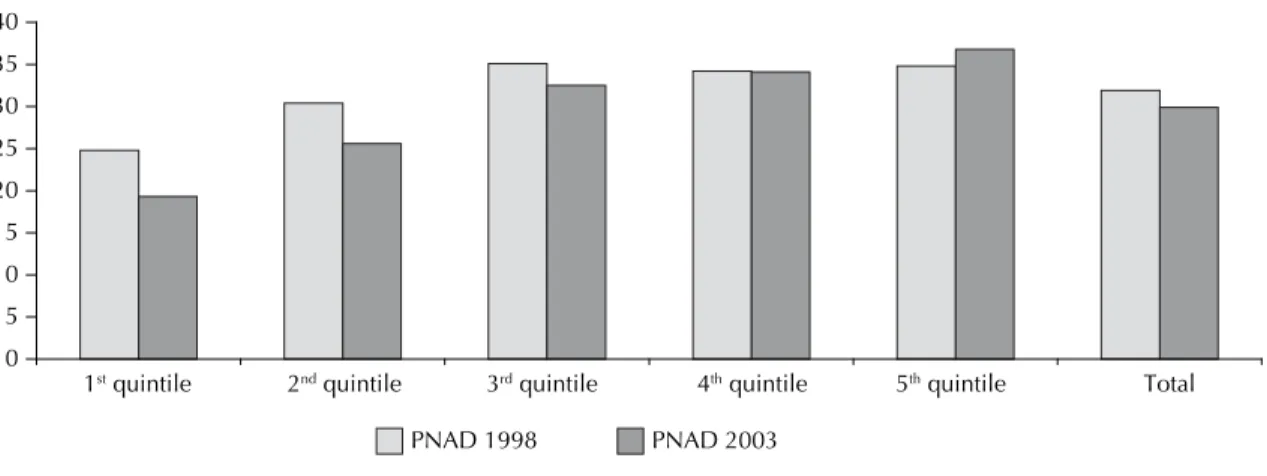
Another observation from PNAD that has been little disseminated relates to the similar proportions of indi-viduals with chronic diseases in all income groups of the population (Figure 3). Thus, poor and risk individuals have similar numbers of chronic diseases. Among the population, out of every three individuals, one has a chronic disease and, among the elderly, eight out of ten have at least one chronic disease.
The comparative data from PNAD ought to stimulate the health sector to design more up-to-date models and/or expand the models, in order to provide greater problem-solving capability and more appropriate costs than in the models currently available.
It is known that the proportion of elderly people who are not frail, and therefore in a good state of health, is large. Most of these individuals of advanced age have mean incomes greater than the general population. A policy focusing on maintaining functional capacity through preventive programs, investments in method-ologies for early detection of diseases, monitoring of chronic diseases and personalized medical systems, among other measures, could be proposed. This could be instead of the spontaneous demand model, in which hospitals are the centerpiece of the system.
One emblematic example of the practices in the private sector can be seen in the United Kingdom. The clients of one of the largest insurers receive fi nancial benefi ts to leave their cars unused, walk and use a pedometer as a heart monitor. They also obtain discounts when buying fruit and vegetables at a supermarket that is associated with the healthcare company, and there is a fi nancial incentive to practice physical exercises in gyms. Figure 1. Proportion of individuals who had medical
con-sultations over the last 12 months, according to age groups. Brazil, 1998-2003.
Source: IBGE/ COREN/ PNTOD 1998 and 2003. 0.0
10.0 20.0 30.0 40.0 50.0 60.0 70.0 80.0 90.0 100.0
1998 68.5 43.3 52.8 59.3 64.9 72.2 2003 77.7 52.8 59.7 66.7 73.2 78.0
0
to 4 to 195 to 3920 to 4940 to 5950 or over60
Figure 2. Elderly population’s evaluation of the attendance provided by the Brazilian National Health System. Brazil, 1998- 2003.
0.0 20.0 40.0 60.0 80.0 100.0
1998 81.2 15.9 2.9
2003 83.9 13.2 3.0
very good
and good regular very poorpoor and
All these positive factors may lead to up to a fi vefold reduction in the cost of health insurance policies. This British experience has not arrived in Brazil, and it is not known whether it would have a positive effect or would be accepted by society. In any event, the message is that health plans operate using a type of mutualism, in which the less healthy consume more medical services and infl ate the amount paid by those whose functional capacity is preserved and are in good form. For many years, the health sector in Brazil has had diffi culty in accepting fi nancial stimuli aimed at getting individu-als to take greater care of their health. On the other
hand, the current practice in other parts of the private sector, such as among car insurance companies, is to use such stimuli.
Therefore, the emphasis must be on maintaining func-tional capacity while seeking to “compress morbidity”, using a term coined by Fries.2,3 This means developing
strategies aimed at postponing death as much as possi-ble through delaying the evolution of diseases, in order to take life towards the threshold of the maximum limit for the existence of the human species, while maintain-ing quality of life, with autonomy and independence, or in other words, with functional capacity.
Figure 3. Proportion of elderly people who reported chronic diseases, according to mean family income, divided into quintiles of per capita income. Brazil, 1998-2003.
0 5 10 15 20 25 30 35 40
1st quintile 2nd quintile 3rd quintile 4th quintile 5th quintile Total
1. Carvalho JAM, Garcia RA. O envelhecimento da
população brasileira: um enfoque demográfi co. Cad
Saude Publica. 2003;19(3):725-33. DOI: 10.1590/ S0102-311X2003000300005
2. Fries JF. Aging, natural death and the compression of
mortality. N Engl J Med. 1980;303(3):130-5.
3. Fries JF, Crapo LM. Vitality and aging: implications of the rectangular curve. San Francisco: WH Freeman; 1981.
4. Gordilho A, Nascimento JS, Ramos LR, Freire MPA, Espindola N, Maia R, et al. Desafi os a serem enfrentados no terceiro milênio pelo setor saúde na atenção integral ao idoso. Rio de Janeiro: UnATI/ UERJ; 2000.
5. Katz S, Ford AB, Moskowitz RW, Jackson BA, Jaffe MW. The index of ADL: a standardized measure
of biological and psychossocial function. JAMA.
1963;185:914-9.
6. Leavell S, Clark EG. Medicina preventiva. São Paulo: McGraw-Hill; 1976.
7. Lima-Costa MF, Veras RP. Saúde pública
e envelhecimento. Cad Saude Publica.
2003;19(3):700-1.
8. Lourenço RA, Martins CSF, Sanchez MAS, Veras RP. Assistência ambulatorial geriátrica: hierarquização da
demanda. Rev Saude Publica. 2005;39(2):311-8.
9. Minayo MCS, Hartz ZMA, Buss PM. Qualidade de
vida e saúde: um debate necessário. Cien Saude
Coletiva. 2000;5(1):7-18. DOI: 10.1590/S1413-81232000000100002
10. Mittelmark MB. The epidemiology of aging. In: Hazzard WR, Bierman EL, Blass JP, Ettinger WH, Halter JB, editors. Principles of geriatric medicine and gerontology. New York: McGraw-Hil; 1994. v. 11:135-51.
11. Neri MC, Soares WL. Estimando o impacto da renda na saúde através de programas de transferência de
renda aos idosos de baixa renda no Brasil. Cad Saude
Publica. 2007;23(8):1845-56. DOI: 10.1590/S0102-311X2007000800011
12. Parahyba MI, Veras RP, Melzer D. Incapacidade
funcional entre as mulheres idosas no Brasil. Rev
Saude Publica. 2005;39(3):383-91. DOI: 10.1590/ S0034-89102005000300008
13. Parahyba MI, Simões CCS. A prevalência de
incapacidade funcional em idosos no Brasil. Cien
Saude Coletiva. 2006;11(4):967-74. DOI: 10.1590/ S1413-81232006000400018
14. Parahyba MICA, Veras RP. Diferenciais sociodemográfi cos no declínio funcional em
mobilidade física entre os idosos no Brasil. Cienc
Saude Coletiva. 2008;13(4):1257-64. DOI: 10.1590/ S1413-81232008000400022
15. Schoeni RF, Martin LG, Andreski PM, Freedman VA. Persistent and growing socioeconomic disparities
in disability among the elderly: 1982-2002. Am J
Public Health. 2005;95(11):2065-70. DOI: 10.2105/ AJPH.2004.048744
16. Veras RP. Em busca de uma assistência adequada à saúde do idoso: revisão da literatura e aplicação de um instrumento de detecção precoce e de
previsibilidade de agravos. Cad Saude Publica.
2003;19(3):705-15. DOI: 10.1590/S0102-311X2003000300003
17. Veras RP, Caldas CP. Promovendo a saúde e a cidadania do idoso: o movimento das universidades da
terceira idade. Cien Saude Coletiva. 2004;9(2):423-32.
DOI: 10.1590/S1413-81232004000200018
18. Veras RP, Parahyba MICA. O anacronismo dos modelos assistenciais para os idosos na área da
saúde: desafi os para o setor privado. Cad Saude
Publica. 2007;23(10):2479-89. DOI: 10.1590/S0102-311X2007001000022
19. Veras RP. Fórum. Envelhecimento populacional e as informações de saúde do PNAD: demandas e
desafi os contemporâneos. Introdução. Cad Saude
Publica. 2007;23(10):2463-66. DOI: 10.1590/S0102-311X2007001000020
20. Veras RP, Caldas CP, Coelho FD, Sanchez MA. Promovendo a saúde e prevenindo a dependência: identifi cando indicadores de fragilidade em
idosos independentes. Rev Bras Geriat Geront.
2007;10(3):355-70.
21. Veras RP, Caldas CP, Araújo DV, Kuschnir R, Mendes W. Características demográfi cas dos idosos vinculados
ao sistema suplementar de saúde no Brasil. Rev Saude
Publica. 2008;42(3):497-502. DOI: 10.1590/S0034-89102008005000024
22. Veras RP, Caldas CP, Araújo DV, Mendes RKW. A assistência suplementar de saúde e seus projetos de
cuidado para com o idoso.Cienc Saude Coletiva.
2008;13(4):1119-26.