FREE THEMES
Reduced functional capacity of community-dwelling elderly:
a longitudinal study
Abstract This study aimed to identify the inci-dence and risk factors for the reduced functional capacity of community-dwelling elderly. A pros-pective, two-stage cohort study was conducted in 2011 and 2014. The study population consisted of 202 initially independent older adults for the ba-sic activities of daily living. The relative risk (RR) and its respective 95% confidence intervals (CI) were used as a measure of association and were estimated by log-binomial regression with robust variance. The incidence of lower functional capa-city was 15.3%. The risk factors for the functional decline were unmarried status (RRadj = 2.75; 95%CI: 1.15–6.57) and depressive symptoms (RRadj = 2.41; 95%CI: 1.15–5.06), even after ad-justing for gender, age group, per capita household income, diabetes, use of medication and level of physical activity. The high incidence of reduced functional capacity and its association with ma-rital status and mental health aspects reveals the need to consider such factors in the planning of health actions aimed at maintaining and resto-ring the functional capacity of the seniors. Key words Elderly health, Aging, Daily activities, Functional disaos bility
Fernanda Souza Matos 1
Cleber Souza de Jesus 1
José Ailton Oliveira Carneiro 1
Raildo da Silva Coqueiro 1
Marcos Henrique Fernandes 1
Thais Alves Brito 1
1 Núcleo de Estudos
M
at
Introduction
Aging is characterized by several changes in the human body and metabolism, which potential-ly produce reduced individual ability to adapt to the environment1. People’s capacity to decide and act on their activities of daily living inde-pendently has been considered as functional ca-pacity2. Thus, the basic activities of daily living (BADL) of self-care such as bathing, dressing, using the toilet, feeding, moving and continence have been deemed an essential indicator of the elderly’s functioning3. Lower functional capacity and its implications for the older adults’ health, relatives, and the health system should be taken as an essential issue to be addressed with the ad-vancement of the aging population. According to a study by López et al.4 with individuals 65 years of age or older, reduced functional capacity was observed in 11.9% of the elderly. Functional de-cline is associated with health conditions, such as poor self-perception of health, stroke, diabe-tes mellitus and heart disease; sociodemograph-ic characteristsociodemograph-ics, such as being female, age ≥ 80 years, living alone, being widowed, low level of schooling or illiteracy; as well as factors such as sedentary lifestyle and reduced daily activities5,6.
Reduced functional capacity consists of the lack of abilities to provide self-care by the old-er adults, who, by becoming dependent on rel-atives or caregivers, produces social, family and health costs that must be investigated. The study of risk factors for impaired functional capacity may contribute to the proposal of policies and interventions that aim at minimizing the impacts caused by the loss of the seniors’ functionality. Thus, this study aimed to identify the incidence and risk factors for lower functional capacity of community-dwelling elderly.
Methods
This prospective cohort study was conducted us-ing data from a population-based epidemiological survey entitled “Nutritional status, risk behaviors and health conditions of the elderly in Lafaiete Coutinho, Bahia”. The study was conducted with older adults living in the municipality of Lafaiete Coutinho, Brazilian State of Bahia, located 356 km off the State capital, with 3,901 inhabitants, spread over urban (53.9%) and rural (46%) areas, all reg-istered under the Family Health Strategy (ESF)7.
The study population consisted of all non-in-stitutionalized individuals aged 60 years and over,
of both genders and living in the urban area. The baseline study was conducted in 2011 (Phase I) with the census of the 355 elderly enrolled in the Family Health Strategy (ESF). Of these, only 260 were considered independent in performing the BADL and were eligible for follow-up. In phase II, in 2014, 202 elderly individuals with responses to the BADL scale were identified, thus resulting in 58 losses (22.3%), which were due to death, moving to another city and not found even after three attempts.
Data were collected through a home inter-view, and the anthropometric measurements were scheduled and performed at the munic-ipal health facility. A cognitive screening was conducted through the modified and validated version of the Mini-Mental State Examination (MMSE) before the interview, seeking to evaluate the preservation of recent memory to respond to the questionnaires8. The cut-off point was ≥ 13 points (not compromised) and ≤ 12 points (compromised)9. The research was continued with the assistance of an informant for those el-derly individuals who scored less than or equal to 12 points. Informants were people residing in the same household and who knew how to provide information about the elderly respondent. Pfef-fer’s Functional Activities Questionnaire (FAQ) was applied to informants, continuing the inter-view with them if the sum of the questionnaire was six or more, and with the elderly, if the sum was five or less10. Thus, the combination of these two instruments, the MMSE and FAQ sought to ensure a higher specificity in the identification of the elderly with a more severe cognitive decline, given the bias produced by low schooling11.
The questionnaire of the “Health, Welfare and Aging” (SABE)12 survey was applied along with the International Physical Activity Ques-tionnaire (IPAQ)13, Brazilian extended version. The interview process consisted of a home visit made to search for aspects such as sociodemo-graphic characteristics, health conditions, and behavioral factors. Elderly’s weight and height measurements were performed in two Municipal Family Health Facilities, with prior scheduling. Interviews and direct measurements were per-formed by trained interviewers and submitted to a calibration process.
aúd e C ole tiv a, 23(10):3393-3401, 2018
dressing up. The elderly were asked about the dif-ficulty or need for assistance in each basic activity. Independent people are those reporting no need for help to perform any BADL, and dependent people those reporting requiring help in at least one of the BADLs. Sociodemographic charac-teristics were considered independent variables: gender (female and male); age group (≥ 60 to ≤ 79, ≥ 80); reads and writes a message (yes, no); marital status (married, unmarried); per capita household income (> 510.00, ≤ 510.00) referring to the minimum wage in 2011 and participation in religious activity (participates, does not par-ticipate). Behavioral factors were level of physical activity assessed by IPAQ, long version13 (≥ 150 minutes of weekly moderate or vigorous physi-cal activity = active and < 150 weekly minutes = insufficiently active)15; alcohol consumption (yes, no); tobacco use (smoker, former smoker, never smoked) and working (yes, no). Previous health conditions were evaluated by depressive symp-toms through the 15-item Geriatric Depression Scale (GDS), short version, lack of depressive symptoms (≤ 5 points), and presence of depres-sive symptoms (> 5 points)16; a modified and val-idated version8 was used to assess cognitive status by the Mini-Mental State Examination (MMSE), not compromised (≥ 13 points) and compro-mised (≤ 12 points)9; self-perception of health was classified as positive (excellent, very good, good) or negative (fair, poor); hospitalization in the last 12 months (none, one or more); diseases referred by some health professional were hyper-tension, diabetes, and osteoporosis (no, yes); falls in the last 12 months (yes, no); use of medicines (none or one, two or more); (BMI <22 kg/m2 = underweight, 22 kg/m2≤ BMI ≤ 27 kg/m2 = ade-quate and BMI > 27 kg/m2 = overweight)17.
Statistical analysis
The sociodemographic, behavioral charac-teristics and health conditions by functional ca-pacity were distributed by the Pearson chi-square test. The incidence of lower functional capacity was estimated using as numerator new cases of dependents for functional capacity, and the to-tal number of elderly was the denominator. The measure of association was the relative risk esti-mated by log-binomial regression with a robust covariance matrix, and for statistical inference, the 95% confidence interval was estimated by the Newton-Raphson method. We inserted the sta-tistically significant variables, those with a level of significance equal to or lower than 20% in the
bivariate analyses and those of theoretical rele-vance for the exploratory model in the final mul-tivariate model. The statistical significance level was 5%, and the analyses were performed using the IBM SPSS program (IBM SPSS, 21.0, 2012, Armonk, NY: IBM Corp.). The Research Ethics Committee of the State University of Southwest of Bahia approved the research project. Partici-pation was voluntary, and all study participants signed the Informed Consent Form.
Results
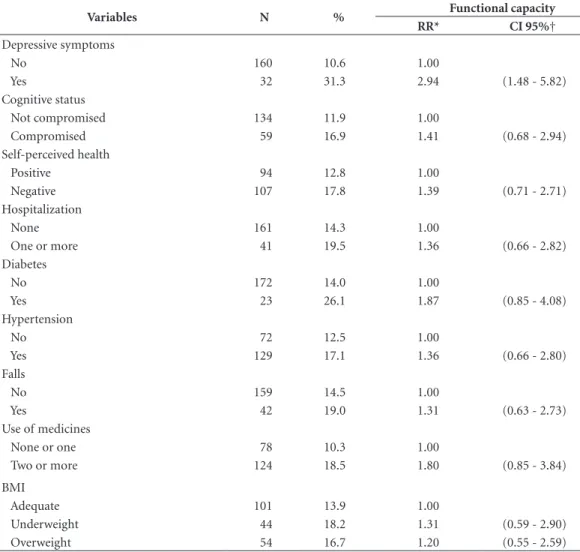
Thirty-one new cases of dependent elderly for functional capacity were identified in a popula-tion of 202 follow-up elderly. Thus, the incidence of older adults’ lower functional capacity was 15.3%. Among those who became dependent at the end of follow-up, a higher proportion of unmarried women aged over 80 years who could not read and write, with a per capita income low-er than one minimum wage and insufficiently active (Table 1) was observed. According to the elderly’s previous health conditions, we found a higher proportion of dependents among those with depressive symptoms, diagnosed with di-abetes and using two or more medicines (Table 2). The incidence of reduced functional capacity was statistically higher among elderly individ-uals aged 80 years or over (RR = 2.57; 95% CI: 1.37-4.82) and unmarried (RR = 2.71; 95% CI: 1.37-5.36) (Table 3). Among the previous health conditions, a statistically higher decline in func-tional capacity was observed in the elderly with a history of depressive symptoms (RR = 2.94; 95% CI: 1.48 - 5.82) (Table 4). The multivariate ex-ploratory analysis of the sociodemographic, be-havioral and previous health conditions associ-ated with lower functional capacity of the elderly revealed that unmarried elderly individuals with previous depressive symptoms were at higher risk of becoming dependent for daily living ac-tivities, regardless of gender, age group, per capi-ta household income, diabetes, use of medicines and level of physical activity (Table 5).
Discussion
inhab-M
at
itants is 13.8%, higher than the national rate of 10.8%18. Thus, this study aims to ensure the rep-resentativeness of older adults living and residing in similar conditions in the Brazilian northeast.
In this context, the results of this study reveal an incidence of a 15.3% decline in functional capacity in community-dwelling elderly be-tween 2011 and 2014. Seniors without a spouse or partner were at a higher risk of becoming de-pendent compared to those with a relationship, as well as those with previous history of depres-sive symptoms when compared to those without
symptoms, regardless of factors such as gender, age group, income, diabetes, use of medicines and level of physical activity.A study conducted in Spain with individuals aged 65 years and over found an incidence of functional loss of 11.9%4. Despite the regional, social and cultural differenc-es among the studied populations, similar rdifferenc-esults were also found in Brazil, in studies by Figueredo et al.19, with an incidence of 12.3%, and Morei-ra et al.20 with 21.35%. However, a study carried out in São Paulo estimated a lower functional ca-pacity in 27.47% of the elderly, and this higher
Table 1. Distribution of sociodemographic and behavioral characteristics according to the functional capacity of
the elderly. Lafaiete Coutinho, Bahia, Brazil. 2011-2014.
Variables Functional capacity
p-value
Independent Dependent
N % N %
Gender 0.989
Male 77 45.0 14 45.2
Female 94 55.0 17 54.8
Age group 0.003*
≥ 60 to ≤ 79 136 79.5 17 54.8
≥ 80 35 20.5 14 45.2
Schooling 0.513
Reads and writes 60 35.1 9 29.0
Doesn’t read/write 111 64.9 22 71.0
Marital status 0.003*
Married 110 64.3 11 35.5
Unmarried 61 35.7 20 64.5
Religious activity 0.820
Participates 164 95.9 30 96.8
Does not participate 7 4.1 1 3.2
Per capita household income (R$)†† 0.182
> 510.00 100 59.9 13 46.4
≤ 510.00 67 40.1 15 53.6
Physical activity 0.204
Active 103 60.6 15 48.4
Insufficiently active 67 39.4 16 51.6
Alcohol use 0.964
No 154 90.1 28 90.3
Yes 17 9.9 3 9.7
Tobacco use
Never smoke 80 46.8 13 41.9 0.542
Former smoker 72 42.1 16 51.6
Currently smokes 19 11.1 2 6.5
Working 0.462
Yes 20 11.8 5 16.7
No 149 88.2 25 83.3
aúd
e C
ole
tiv
a,
23(10):3393-3401,
2018
incidence can be explained by the methods used, since the latter included institutionalized elderly, as well as a modified Katz scale21.
The elderly without a spouse or partner had a lower functional capacity incidence about 2.7 times higher than the elderly with some relation-ship, married or living with a partner. Some stud-ies have identified a greater functional decline in single, unmarried and widowed elderly individ-uals22,23. The marital status may be related to the care provided by the partner in the most diverse aspects of life, such as health, food, leisure and occupational activities so that these realms of care can contribute to better functional capacity, or even contribute to its maintenance over time.
Older adults with depressive symptoms were approximately 2.4 times at higher risk of func-tional capacity impairment than those without such symptoms. Similar results were found by Tomita and Burns24 with seniors in South Africa. Depressive symptoms are often accompanied by other symptoms, such as fatigue, physical weari-ness, loss of vitality, and unwillingness to perform daily activities25, thus directly interfering with functional capacity over time and compromising the effort required to maintain functionality as well as the willingness to perform an activity.
The relationship between mental disorders such as depression, neuronal, hormonal and immune system disorders has been shown as a
Table 2. Distribution of preconditions of health by level of functional capacity of the elderly. Lafaiete Coutinho,
Bahia, Brazil. 2011-2014.
Variables
Functional capacity
p-value
Independent Dependent
N % N %
Depressive symptoms 0.002*
No 143 86.7 17 63.0
Yes 22 13.3 10 37.0
Cognitive status 0.348
Not compromised 118 70.7 16 61.5
Compromised 49 29.3 10 38.5
Self-perceived health 0.328
Positive 82 48.2 12 38.7
Negative 88 51.8 19 61.3
Hospitalization 0.407
None 138 80.7 23 74.2
One or more 33 19.3 8 25.8
Diabetes 0.130
No 148 89.7 24 80.0
Yes 17 10.3 6 20.0
Hypertension 0.391
No 63 37.1 9 29.0
Yes 107 62.9 22 71.0
Falls 0.465
No 136 80.0 23 74.2
Yes 34 20.0 8 25.8
Use of medicines 0.111
None or one 70 40.9 8 25.8
Two or more 101 59.1 23 74.2
BMI 0.778
Adequate 87 51.8 14 45.2
Underweight 36 21.4 8 25.8
Overweight 45 26.8 9 29.0
M
at
causal mechanism that may predispose the elder-ly to other illnesses and even to declining physical health26. As an example, the relationship between depression and reduced neurotransmitters such as serotonin, noradrenaline, and dopamine has been identified27. Lower dopamine levels may lead to decreased motor performance and emo-tional modulation28. Loss of interest or pleasure for almost all activities interferes with the social relationships of the older adults. Thus, social isolation, common in people with depressive symptoms, causes the elderly to participate less in community and religious events, reducing the frequency of making or receiving visits.
Decreas-ing these social relationships compromises the functional performance to perform the basic ac-tivities of daily living3,29. The lack of motivation for social relationships leads to less health care, such as not seeking appropriate treatment and physical inactivity30. Thus, several mechanisms related to the mental health of the elderly may explain lower functional capacity. It is necessary to detail the relative contribution of each of these possible causal ways so that public policies and interventions directed to a better functional ca-pacity of the elderly can be improved.
Longitudinal studies addressing other risk factors for reduced functional capacity should
Table 3. Relative risk (RR) of sociodemographic and behavioral risk factors and reduced functional capacity in
community-dwelling elderly. Lafaiete Coutinho, Bahia, Brazil. 2011-2014.
Variables N Functional capacity
RR* CI 95%†
Gender
Male 91 15.4 1.00
Female 111 15.3 0.99 (0.51 - 1.90)
Age group
≥ 60 to ≤ 79 153 11.1 1.00
≥ 80 49 28.6 2.57 (1.37 - 4.82)
Schooling
Reads and writes 69 13.0 1.00
Doesn't read/write 133 16.5 1.26 (0.61 - 2.60)
Marital status
Married 121 9.1 1.00
Unmarried 81 24.7 2.71 (1.37 - 5.36)
Religious activity
Participates 194 15.5 1.00
Does not participate 8 12.5 0.80 (0.12 - 5.20)
Per capita household income (R$) ‡
> 510.00 113 11.5 1.00
≤ 510.00 82 18.3 1.59 (0.80 - 3.15)
Physical activity
Active 118 12.7 1.00
Insufficiently active 83 19.3 1.51 (0.79-2.89)
Alcohol use
No 182 15.4 1.00
Yes 20 15.0 0.97 (0.32-2.92)
Tobacco use
Never smoke 93 14.0 1.00
Former smoker 88 18.2 1.30 (0.66 - 2.54)
Currently smokes 21 9.5 0.68 (0.16 - 2.79)
Working
Yes 25 20.0 1.00
No 174 14.4 0.71 (0.30 - 1.70)
aúd
e C
ole
tiv
a,
23(10):3393-3401,
2018
be conducted, especially with a larger popula-tion and with a more extended follow-up period. The identification of potentially modifiable risk factors may become a fundamental element for the maintenance and recovery of the functional capacity of the elderly. Thus, actions of the health promotion services should seek the autonomy and independence of the elderly, primarily to perform the basic activities of daily living.
Conclusion
The results of this study indicate that the inci-dence of lower functional capacity in elderly people living in a community in the Northeast of Brazil was 15.3%, and the main risk factors
Table 4. Preconditions for health and reduced functional capacity in community-dwelling elderly. Lafaiete
Coutinho, Bahia, Brazil. 2011-2014.
Variables N % Functional capacity
RR* CI 95%†
Depressive symptoms
No 160 10.6 1.00
Yes 32 31.3 2.94 (1.48 - 5.82)
Cognitive status
Not compromised 134 11.9 1.00
Compromised 59 16.9 1.41 (0.68 - 2.94)
Self-perceived health
Positive 94 12.8 1.00
Negative 107 17.8 1.39 (0.71 - 2.71)
Hospitalization
None 161 14.3 1.00
One or more 41 19.5 1.36 (0.66 - 2.82)
Diabetes
No 172 14.0 1.00
Yes 23 26.1 1.87 (0.85 - 4.08)
Hypertension
No 72 12.5 1.00
Yes 129 17.1 1.36 (0.66 - 2.80)
Falls
No 159 14.5 1.00
Yes 42 19.0 1.31 (0.63 - 2.73)
Use of medicines
None or one 78 10.3 1.00
Two or more 124 18.5 1.80 (0.85 - 3.84)
BMI
Adequate 101 13.9 1.00
Underweight 44 18.2 1.31 (0.59 - 2.90)
Overweight 54 16.7 1.20 (0.55 - 2.59)
* Relative Risk; † Confidence interval.
Table 5. Risk factors for the reduced functional
capacity of community-dwelling elderly. (N = 178) Lafaiete Coutinho, Bahia, Brazil, 2011-2014.
Model* RR† CI 95% ‡
Female 0.67 (0.31 - 1.41)
Age group ≥ 80 1.61 (0.75 - 3.43)
Marital status unmarried 2.75 (1.15 - 6.57)
Per capita household income ≤
510.00 (R$) §
1.24 (0.56 - 2.72)
With depressive symptoms 2.41 (1.15 - 5.06)
With diabetes 1.88 (0.75 - 4.70)
Use of two or more medicines 1.96 (0.61 - 6.32)
Inactive for physical activity 0.70 (0.33 - 1.49)
M
at
found were being unmarried and having depres-sive symptoms, regardless of gender, age group, income, diabetes, use of medicines and level of physical activity.
Collaborations
FS Matos, CS Jesus, JAO Carneiro, RA Coqueiro, MH Fernandes and TA Brito contributed sub-stantially to the design and planning, data anal-ysis and interpretation, and participated in the approval of the final version of the manuscript.
Acknowledgments
aúd e C ole tiv a, 23(10):3393-3401, 2018 References
1. Ferreira OG, Maciel SC, Silva AO, Santos WS, Morei-ra MA. O envelhecimento ativo sob o olhar de idosos funcionalmente independentes. Rev. Esc. Enferm. 2010; 44(4):1065-1069.
2. Avlund K, Lund R, Holstein BE, Due P. Social relations as determinant of onset of disability in aging. Arch Ge-rontol Geriatr. 2004; 38(1):85-99.
3. Buurman BM, Van Munster BC, Korevaar JC, de Haan RJ, de Rooij SE. Variability in measuring activities of daily living functioning and functional decline in hos-pitalized older medical patientes: a systematic review. J Clinc Epidemiol 2011; 64(6):619-627.
4. López SR, Montero P, Carmenate M, Avendano M. Functional decline over two years in older Spanish adults: Evidence from SHARE. Geriatr Gerontol Int
2014; 14(2):403-412.
5. Barbosa BR, Almeida JM, Rossi BM, Barbosa LAR. Avaliação da capacidade funcional dos idosos e fato-res associados à incapacidade. Cien Saude Colet 2014; 19(8):3317-3325.
6. Nunes MC, Ribeiro RCL, Rosado EFPL, Franceschini SC. Influência das características sociodemográficas e epidemiológicas na capacidade funcional de idosos res-identes em Ubá, Minas Gerais. Rev. Bras. Fisioter. 2009; 3(5):376-382.
7. Instituto Brasileiro de Geografia e Estatística (IBGE).
Resultados do Censo 2010. IBGE. 2010. [acessado 2015 Maio 15]. Disponível: http://www.ibge.gov.br/home/ estatistica/populacao/censo2010/tabelas_pdf/total_ populacao_bahia.pdf
8. Icaza MC, Albala C. Projeto SABE. Mini mental state examination (MMSE) del estudio de dementia em Chile: análisis estísticos. Brasília: Organização Pan-Americana de Saúde (OPAS); 1999.
9. Bertolucci PHF, Brucki SMD, Capacci SR, Juliano Y. The Mini-Mental State Examination in anout patient population: influence of literacy. Arq Neuro-Psiquiatr
1994; 52(1):1-7.
10. Pfeffer RI, Kurosaki TT, Harrah Junior CH, Chance JM, Filos S. Measurement of functional activities in older adults in the community. J Gerontol 1987; 37(3):323-329.
11. Brasil. Ministério da saúde (MS). Envelhecimento e saú-de da pessoa idosa. Brasília: MS; 2007. (Série A. Normas e Manuais Técnicos).
12. Albala C, Lebrão ML, León DEM, Ham-Chande R, Hennis AJ, Palloni A, Peláez M, Pratts O. Encuesta Sa-lud, Bien estar y Envejecimiento (SABE):metodología de la encuesta y perfil de la población estudiada. Rev Panam Salud Publica 2005; 17(5/6):307-322.
13. Benedetti TRB, Antunes PC, Rodriguez-Añez CR, Mazo GZ, Petroski EL. Reprodutibilidade e validade do Questionário Internacional de Atividade Física (IPAQ) em homens idosos. Rev. Bras. Med. Esporte. 2007; 13(1):11-16.
14. Katz S, Ford AB, Moskowitz RW, Jackson BA, Jaffe MW. The index of ADL: a standardized measure of biological and psychosocial function. JAMA. 1963; 185(12):914-1 15. Hallal PC, Victora CG, Wells JC, Lima RC. Physical in-activity: Prevalence and associated variables in Brazil-ian adults. Med. Sci. Sports Exerc. 2003; 35(11):894-900. 16. Almeida OP, Almeida SA. Confiabilidade da versão bra-sileira da escala de depressão em geriatria (GDS) versão reduzida. Arq. Neuro. psiquiatr. 1999; 57(2B):421-426.
17. American Academy of Family Physicians, American Dietetic Association, National Councilon the Aging. Nutrition screening e intervention resources for health care professionals working with older adults. Nutrition Screening Initiative. Washington: American Dietetic Association; 2002. [acessado2015 Maio 15]. Disponível em: <http://www.eatright.org/cps/rde/xchg/ada/hs.xsl/ nutrition_nsi_ENU_HTML.htm>.
18. Instituto Brasileiro de Geografia e Estatística (IBGE). Síntese de Indicadores Sociais, Rio de Janeiro, Estudos e pesquisas. 2010. Disponível em: http://www.ibge.gov. br/home/estatistica/populacao/condicaodevida/indi-cadoresminimos/sinteseindicsociais2010/SIS_2010.pdf 19. Figueiredo CS, Assis MG, Silva SLA, Dias RC, Manci-ni MC. Functional and cogManci-nitive changes in commu-nity-dwelling elderly: Longitudinal study. Brazilian Journal of Physical Therapy 2013; 17(3):297-306. 20. Moreira LP, Correa CR, Corrente JE, Martin LC, Boas
PJFV, Ferreira ALA. Antropométrica, capacidade fun-cional, e as mudanças de estresse oxidativo em indi-víduos idosos de estar da comunidade brasileira. Um estudo longitudinal. Archives of Gerontology Geriatria
2016; 66:140-146.
21. Alexandre TS, Corona LP, Nunes DP, Santos JLF, Du-arte YAO, Lebrão ML. Gender differences in incidence and determinants of disability in activities of daily li-ving among elderly individuals: SABE study. Archives of Gerontology and Geriatrics 2012; 55(2):431-443. 22. Wang D, Jianmin Z, Kurosawa M, Inaba Y, Kato N.
Changes in activities of daily living (ADL) among el-derly Chinese by marital status, living arrangement, and availability of health care over a 3-year period. En-viron Health Prev Med 2009; 14(2):128-141.
23. Costa SMD. Fatores associados à perda funcional em idosos residentes no município de Maceió, Alagoas.
Rev Saude Publica 2011; 45(6):1137-1144.
24. Tomita A, Burns JK. Depression, disability and functio-nal status among community-dwelling older adults in South Africa: evidence from the first South African Na-tional Income Dynamics Study. IntJ Geriatr Psychiatry
2013; 28(12):1270-1279.
25. American Psychiatric Association. Diagnostic and sta-tistical manual of mental disorders. 5th ed. Arlington:
American Psychiatric Association; 2013.
26. Turner RJ, Noh S. Deficiência física e depressão: uma análise longitudinal. J Soc Saúde Behav 1988; 29:23-37. 27. Hasler G. Pathophysiology of depression: do we have
any solid evidence of interest to clinicians? World Psy-chiatry 2010; 9(3):155-161.
28. Ingram DK. Arelated decline in physical activity: ge-neralization ton on humans. Med Sci Sports Exerc 2000; 32(9):1623-1629.
29. Kawamoto R, Yoshida O, Oka Y. Factors related to func-tional capacity in community-dwelling elderly. Geria-trics Gerontol Int 2004; 4:105-110.
30. Armenian HK, Pratt LA, Gallo J, Eaton WW. Psychopa-thology as a predictor of disability: a population-based follow-up study in Baltimore, Maryland. Am J Epide-miol 1998; 148(3):269-275.
Article submitted 12/05/2016 Approved 10/10/2016
Final version submitted 12/10/2016
This is an Open Access article distributed under the terms of the Creative Commons Attribution License BY