545
R
ev
ie
w
A
Rt
ic
le
Prevalence of functional incapacity by gender in elderly people in
Brazil: a systematic review with meta-analysis
Ana Cristina Viana Campos1 Maria Helena Morgani de Almeida2 Gisele Viana Campos3 Tania Fernandes Bogutchi4
1 Universidade Federal do Sul e Sudeste do Pará, Instituto de Estudos em Saúde e Biológicas. Marabá, Pará, Brasil.
2 Universidade de São Paulo, Faculdade de Medicina, Departamento de Fisioterapia, Fonoaudiologia e Terapia Ocupacional. São Paulo, São Paulo, Brasil.
3 Associação de Pais e Amigos dos Excepcionais, Setor de Terapia Ocupacional. Lavras, Minas Gerais, Brasil.
4 Pontifícia Universidade Católica de Minas Gerais, Instituto de Ciências Exatas e Informática, Departamento de Matemática. Belo Horizonte, Minas Gerais, Brasil.
Correspondence
Ana Cristina Viana Campos E-mail: [email protected]
Abstract
Considering that functional capacity is an important indicator of health in aging, the present study aimed to describe the prevalence of disability by gender among elderly people in Brazil through a systematic review and meta-analysis of articles about this subject. Articles published up to June 2013 were included, and a search was performed of the MEDLINE, SciELO, LILACS, Scopus, Web of Science and Science Direct electronic databases. The inclusion of articles in the systematic review was guided by the Strengthening the Reporting of Observational Studies in Epidemiology (STROBE) and by the Preferred Reporting Items for Systematic Reviews and Meta-Analyses (PRISMA) guidelines. A descriptive analysis of the selected articles was performed and expressed in a forest-plot type graph. Of 3,656 articles initially identified in all the databases, 2,585 duplicates were excluded and 23 articles were deemed eligible for review. Prevalence rates ranged from 12.3% to 94.1% for men and from 14.9% to 84.6% for women. The methods used to assess functional capacity in elderly people in Brazil also differed between the articles. This variation complicates the comparison of results between the articles, demonstrating the need for standardized methods of measuring functional capacity.
Key words: Aging; Health of the Elderly; Gender; Functional Disability.
546 Rev. BRAs. GeRiAtR. GeRontol., Riode JAneiRo, 2016; 19(3):545-559
INTRODUCTION
Maintaining functional capacity is considered to be the main parameter for the assessment of health and quality of life during the aging process.1
From this perspective, the promotion of healthy aging can involve the adoption and consolidation of active lifestyles that include frequent physical activity, the diversification of one’s daily routine, and active participation in groups as possible ways of exercising functional capacity.2 As a result,
measures to promote health and the prevention of disease, along with the appropriate management of existing comorbidities, are aimed at maintaining this capacity and preventing disabilities.
According to the World Health Organization (WHO),3 functional incapacity can be understood
as the process of losing the ability to perform the daily tasks necessary for an independent and autonomous life. From a practical standpoint, this ability can be measured by the performance of daily activities, which are didactically divided into basic activities of daily living (BADL) such as bathing, eating, using the toilet and walking through the rooms of the house, and instrumental activities of daily living (IADL), such as shopping, performing housework and preparing meals. It has been shown that there is a dose-response type association between age and the prevalence of functional incapacity, and that aging is different for men and women.5,6 However, most such studies involve
representative samples of municipal districts or states, and not nationwide research.
Considering the importance of functional capacity as a health indicator for the elderly and the scattered information on the topic in Brazilian research, the present study aimed to describe the prevalence of functional incapacity by gender among elderly Brazilian individuals through a systematic review and meta-analysis of articles on the topic.
METHOD
In this systematic review and meta-analysis, we sought to answer the following question: Are there differences by gender in the prevalence of functional incapacity among elderly Brazilians?
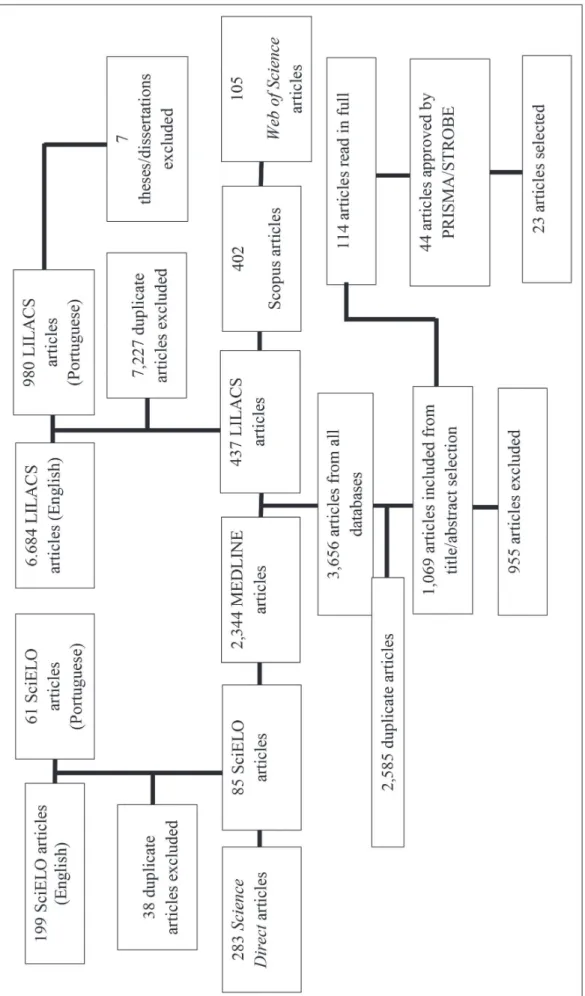
A search for articles published up to June 2013 was performed in the MEDLINE, SciELO,
LILACS, Scopus, Web of Science and Science
Directelectronic databases.
The descriptors used in the review process were selected after consulting the Bireme DeCS Health Sciences Descriptors. The search was conducted in English using concepts grouped into three blocks. The first included terms related to functional capacity ("functional assessment", "functionality", "daily activities") the second with terms related to aging ("old" and "old age") and the third with terms related to Brazil ("Brazil"). To combine these descriptors, we used the logical operator "OR" within each block and the logical operator "AND" to combine the blocks. The same search strategy was used in all the databases surveyed.
We chose not to employ any restrictions related to the size of the data, language, type of study or sample or publication period. Although the studies did not cover the same time periods, we did not exclude articles based on publication period to ensure that all the studies of potential relevance to the review were included.
Functional incapacity by gender in elderly people in Brazil 547
and monographs, as systematic research on this topic for these works would not be viable.
Articles were firstly selected by title and abstract and then through a full reading. Each article was reviewed and selected by two reviewers. Where there was disagreement, a third person was consulted. Duplicate articles, with identical results published in different magazines, were checked to allow the exclusion of one of the studies. In the case of the duplication of articles from more than one database, the version with the widest scope was maintained.
In addition to prevalence of functional incapacity, the articles selected were mapped in relation to type of study, location, sample size, age of participants, type of statistical analysis and the method of evaluation and classification of functional capacity.
In the case of items with incomplete information, three attempts were made to contact the corresponding author via e-mail, between the months of August and September 2013, in order to seek additional information. A standard e-mail was sent to the authors, requesting the following information: n total of statistical analysis, percentage of men in the sample and prevalence of functional incapacity by gender.
T he i nst r u ments used to assess t he methodological quality of the observational articles to be included in the systematic review were Strengthening the Reporting of Observational Studies in Epidemiology (STROBE) and Preferred Reporting Items for Systematic Reviews and
Meta-Analyses (PRISMA). STROBE contains 22 items that deal with recommendations on what should be contained in a precise and complete description in an observational study.7 PRISMA
is a list of specific checks for systematic review studies. It contains 27 topics and is designed to increase the quality of systematic reviews and meta-analyzes of randomized controlled trials and nonrandomized studies.8
Analysis of the selected articles was carried out descriptively and in two stages. The first included: year; authorship; location; type of study; target population; study design and statistical analysis of data. The second stage comprised an analysis of the prevalence of functional incapacity by gender data with the Mantel-Haenszel test and presentation via a forest-plot graph using the BioEstat 3.0 program.
RESULTS
548 Rev. BRAs. GeRiAtR. GeRontol., Riode JAneiRo, 2016; 19(3):545-559
Functional incapacity by gender in elderly people in Brazil 549
All articles present in the review defined a minimum age for inclusion in the study. A total of 19 (82.0%) studies included individuals aged 60 years of age or older; two (8.7%) included persons aged 65 or more, and the same number included individuals aged 80 or older.
In terms of study location, nine9-17 (39.0%)
studies were exclusively conducted in urban areas, one18 (4.3%) was carried out in a rural
region, two19,20 (8.7%) were performed in both
and seven21-27 (30.0%) did not specify whether the
study was conducted in an urban or rural area. The four (17.4%)28-31 remaining studies involved elderly
persons in long term care facilities (LTCFs), users of health plans, those admitted to gerontology-geriatric nursing care and elderly persons treated in public rehabilitation services, respectively.
Only eight(35.0%) studies12,15,18,19,21,27-29 explicitly
described one or more exclusion criteria for participation in the studies. These included: be aged under 60 or not registered in the LTCFs studied (4.3%); be a private health care plan user or reside outside the coverage area (4.3%); could not respond to the questionnaire (13.0%); was not found at home for data collection (8.7%); was bedridden (4.3%); presented cognitive and/ or mobility impairment (4.3%).
The characteristics of the articles are shown in Table 1. In relation to the databases, 13 (56.5%) articles9,10,13,17-21,23,24,28-30 were published in LILACS,
eight (34.7%) in PUBMED11,12,14,16,25-27,30 and only
two (8.7%) articles15,22 were selected from the
55 0 R ev . B RA s . G eR iA tR . G eR on to l ., R io de J An eiR o , 2 01 6; 19 (3 ):5 45 -5 59
Table 1. Characteristics of articles included in the review.Belo Horizonte, Minas Gerais, 2014.
Authors Location Database Type of
study
Data collection
Measure of functional incapacity Age range Sample Men (%) Losses (%)
Type of statistical analysis
Aires et al. 201019 Three regions (RS) LILACS Cross-sectional Secondary
data BOMFAQ ≥80 years Probabilistic 36.1 27.5
Multiple logistic regression
Araújo et al.
200728 Taubaté (SP) LILACS
Cross-sectional LTCF Katz Scale ≥60 years Census 25.6
Not described
Descriptive analysis
Cardoso & Costa, 201029
Porto Alegre
(RS) LILACS
Cross-sectional Domiciliary
Need for assistance with activities of
daily living
≥60 years Probabilistic 44.5 Not
described Chi-squared test
Cardoso et al. 201221
São Leopoldo
(RS) LILACS
Cross-sectional Domiciliary Barthel Index ≥60 years Census 28.2 3.7
Poisson Regression
d’Orsi et al. 201122
São Paulo
(SP) SciELO Longitudinal Domiciliary BOMFAQ ≥60 years Probabilistic 38.0 38.7
Poisson Regression
Fiedler &
Peres, 20089 Joaçaba (SC) LILACS
Cross-sectional Domiciliary Functional fitness test ≥60 years Probabilistic 34.8 7.3
Multiple logistic regression
Freitas et al. 201210
Lafaiete Coutinho
(BA)
LILACS
Cross-sectional Domiciliary Katz Scale and LBI ≥60 years Census 45.3
Not described
Multiple logistic regression
Giacomin et al. 200811
RMBH
(MG) PUBMED
Cross-sectional Domiciliary
Difficulty in performing at
least one IADL ≥60 years Probabilistic 41.1 3.1
Multiple logistic regression Lebrão & Laurenti 200512 São Paulo
(SP) PUBMED Longitudinal Domiciliary
Pfeffer functional activities
questionnaire ≥60 years Probabilistic 41.4
Not described
Descriptive analysis
Lima-Costa
et al. 200323 PNAD 1998 LILACS
Cross-sectional Domiciliary
Difficulty in feeding oneself, bathing or going to the
bathroom
≥60 years Probabilistic 44.47 1.1 Descriptive
analysis
Maciel & Guerra 200713
Santa Cruz
(RN) LILACS
Cross-sectional Domiciliary Katz Scale and LBI ≥60 years Probabilistic 36.5 11.0
Logistic Regression
Fu nc tio na l in ca pa cit y b y g en de r in eld erl y p eo ple in Bra zil 55 1
Continuation of Table 1
Medeiros et al. 201214
Florianópolis
(SC) PUBMED
Cross-sectional Domiciliary Katz Scale and LBI ≥60 years Probabilistic 36.1 10.8
Poisson Regression
Nogueira et al. 201024
São Geraldo
(MG) LILACS
Cross-sectional Domiciliary
Andreotti and Okuma scale of self-assessed performance
of IADL
≥80 years Non-
Probabilistic 47.0
Not described
Multiple logistic regression
Nunes et al. 200925
Ubá
(MG) SciELO
Cross-sectional Domiciliary
Andreotti and Okuma scale of self-assessed performance
of IADL
≥60 years Probabilistic 41.5 0 Multiple logistic
regression
Nunes et al.
201015 Goiânia (GO) PUBMED
Cross-sectional Domiciliary BADL and IADL ≥60 years Probabilistic 40.3 4.6
Chi-squared test and Fisher`s
Exact Test
Ramos et al. 199816
São Paulo
(SP) PUBMED Longitudinal Domiciliary BOMFAQ ≥60 years Probabilistic 35.0
Not
described Chi-squared test
Rigo et al. 201018
Nova Roma
do Sul (RS) LILACS
Cross-sectional Domiciliary OARS IADL Scale ≥60 years Census 44.1 12.8
Descriptive analysis
Rosa et al. 200317
São Paulo
(SP) LILACS
Cross-sectional Domiciliary OARS IADL Scale ≥60 years Probabilistic 35.5 29.2
Multiple logistic regression
Rossi et al. 201330 São Paulo (SP) PUBMED Cross-sectional Rehabilitation
Center BOMFAQ ≥60 years
Non-
Probabilistic 36.1 7.1 Chi-squared test
Santos et al. 200726
GUATAMBU
(SC) LILACS
Cross-sectional Domiciliary Barthel Index ≥60 years Census 29.0 5.1
Poisson Regression
Santos et al. 200820
São Paulo
(SP) PUBMED Longitudinal Domiciliary
Difficulty in performing
IADLs ≥60 years Probabilistic 47.5 30.9
Logistic Regression
Santos & Griep, 201327
Belém
(PA) PUBMED
Cross-sectional Laboratory MPPT ≥60 years
Non-
Probabilistic 52.6 1.5
Logistic Regression
Siqueira et al. 200431
São Paulo
(SP) LILACS Clinical Hospital
BOMFAQ and OARS IADL
Scale ≥60 years
Non-Probabilistic 43.8
Not
described Chi-squared test
552 Rev. BRAs. GeRiAtR. GeRontol., Riode JAneiRo, 2016; 19(3):545-559
Most of the research was carried out between the years 2009 and 2013, and 11 (47.8%)11,12,16,17,20,22 ,24,25,28,30,31 studies were conducted in the southeast
of Brazil. Of the total of 23 studies, only four (17.3%)12,16,22,26 were of the longitudinal type carried
out in the homes of elderly people and provided prevalence data for a given year (table 1).
Functional incapacity was measured indirectly, or in other words, based on information provided by individuals. In all the studies included in this review the BADL and IADL measurement scales were the most commonly used instruments. Five (21.7%) studies16,19,22,30,31 used the Brazilian Multidimensional
Function Assessment Questionnaire (BOMFAQ), three (13.0%) studies10,13,14 used the Katz scale
combined with the Lawton-Brody Index (LBI) and three (13.0%) studies17,18,31 used the ABVD
scale from Older American Resources and Services (OARS). Although most studies used previously validated questionnaires that provided scores, four (17.3%)11,21,23,26 inquired about the functional
capacity of older people through open questions regarding the presence of difficulty in performing one or more BADL or IADL (table 1).
With respect to the sampling process, there was significant gender variation in the composition
of the samples, with only one study27 mainly
comprising men. Five studies (21.7%) used census data10,18,20,28,29 and 14 (60.8%)9,11-17,19,20-23,25 used a
probabilistic sampling process based on selecting the number of participants through a draw and/ or the number of households sampled. Seven (30.4%) studies10,12,16,21,24,28,31 did not describe the
loss percentage of the sample (Table 1).
In terms of data analysis, comparisons between prevalence and frequency data were mixed, with logistic regression the most used statistical test (ten studies).9-11,13,15,17,19,24,26,27 Only four (17.3%)
studies14,20,22,29 used Poisson Regression for the
analysis of prevalence data (table 1).
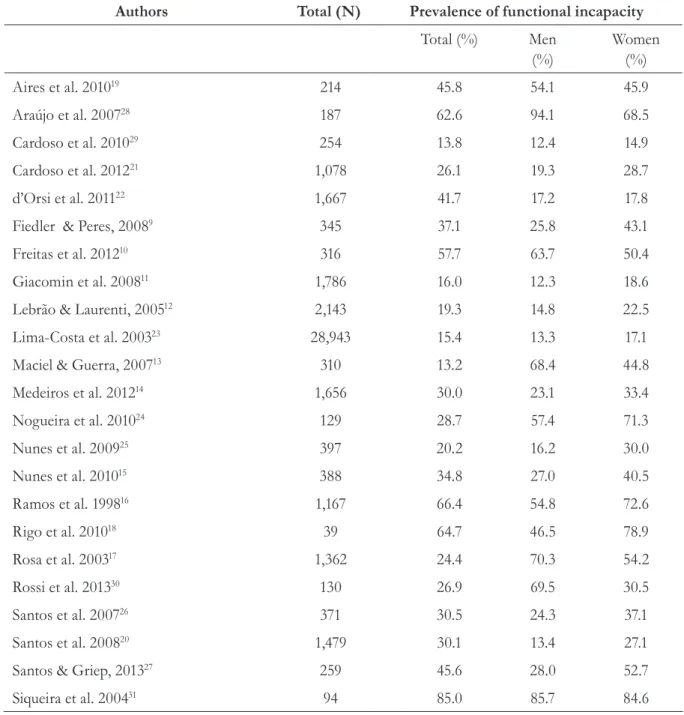
Data relating to the prevalence of functional incapacity in each study and prevalence stratified by gender is shown in Table 2. There was considerable variability in the overall prevalence results, which ranged from 13.2% to 85.0%. Prevalence rates by gender ranged from 12.3% to 94.1% for men and from 14.9% to 84.6% for women.
Functional incapacity by gender in elderly people in Brazil 553
Taking into account the samples of all the studies, 44,714 elderly persons were interviewed. The result of the Chi-squared and Mantel-Haenszel tests are shown in Figure 2. There was a significant statistical difference between men and women in relation to the prevalence of functional incapacity.
The proportion of functional incapacity among women was 1.51 times greater than among men (p<0.001), with a confidence interval of between 1.43 and 1.59. This effect was not significant in only five studies (21.7%)16,24,26-28, where the horizontal line
of the Forest-plot graph crossed the vertical line. Table 2. Prevalence of functional incapacity among elderly Brazilians (total and by gender). Belo Horizonte, Minas Gerais, 2014.
Authors Total (N) Prevalence of functional incapacity
Total (%) Men
(%)
Women (%)
Aires et al. 201019 214 45.8 54.1 45.9
Araújo et al. 200728 187 62.6 94.1 68.5
Cardoso et al. 201029 254 13.8 12.4 14.9
Cardoso et al. 201221 1,078 26.1 19.3 28.7
d’Orsi et al. 201122 1,667 41.7 17.2 17.8
Fiedler & Peres, 20089 345 37.1 25.8 43.1
Freitas et al. 201210 316 57.7 63.7 50.4
Giacomin et al. 200811 1,786 16.0 12.3 18.6
Lebrão & Laurenti, 200512 2,143 19.3 14.8 22.5
Lima-Costa et al. 200323 28,943 15.4 13.3 17.1
Maciel & Guerra, 200713 310 13.2 68.4 44.8
Medeiros et al. 201214 1,656 30.0 23.1 33.4
Nogueira et al. 201024 129 28.7 57.4 71.3
Nunes et al. 200925 397 20.2 16.2 30.0
Nunes et al. 201015 388 34.8 27.0 40.5
Ramos et al. 199816 1,167 66.4 54.8 72.6
Rigo et al. 201018 39 64.7 46.5 78.9
Rosa et al. 200317 1,362 24.4 70.3 54.2
Rossi et al. 201330 130 26.9 69.5 30.5
Santos et al. 200726 371 30.5 24.3 37.1
Santos et al. 200820 1,479 30.1 13.4 27.1
Santos & Griep, 201327 259 45.6 28.0 52.7
554 Rev. BRAs. GeRiAtR. GeRontol., Riode JAneiRo, 2016; 19(3):545-559
Functional incapacity by gender in elderly people in Brazil 555
DISCUSSION
The vast majority of studies included in this systematic review were conducted in the south and southeast of Brazil. A possible explanation for this finding would be the significant regional differences in the rate of aging, which has an effect on the scientific production of each area. A study based on 2010 census data found that population aging in Brazil is increasing rapidly, with an increase of 268.0% in the aging rate between 1970 and 2010. In terms of regional variation, in 2010 the highest rates were found in the south (54.9%) and southeast (54.5%) and the lowest rate was found in the north (21.8%).32
The samples of the selected studies were mainly composed of women, corroborating official Brazilian data. The aforementioned census results found that the gender ratio, which had been 99.8 men for every 100 women in 1960, was 96 men for every 100 women in 2010.33
This study confirmed the high prevalence of functional incapacity among elderly Brazilians and the wide variability between genders. The average prevalence was 42.8% (±21.0) among women and 39.6% (±26.2) among men. These results are similar to other Brazilian studies.34,35
In eight of t he st ud ies selected for review,11,12,15,19,21,22,24,31 the prevalence of functional
incapacity among women was higher than 50.0%. Differences in the prevalence of functional incapacity between genders were also identified in other articles.23,36
Few studies have been published in Brazil that attempt to assess possible explanations for gender differences in functional incapacity, or the more accentuated loss of functional capacity among women.14
Some hypotheses to explain this gender difference include the fact that women tend to report greater functional difficulties than men;2
there are higher initial levels of incapacity among
older women;36 and greater longevity among
women, which combined with limitations, may
lead to dependency on care.2 An additional
hypothesis for explaining these differences is based on higher levels of widowhood among women in comparison to men.34,35 The resulting weakening
of an individual’s support network associated with greater life expectancy and a higher prevalence of chronic diseases increase the vulnerability of women to incapacitating conditions.
In the case of the present study, variations in prevalence can also be explained by the lack of standardization in the measures of functional capacity used and the differences in sample size between the studies.
Two of the selected studies19,24 involved
octogenarians. The variability of the cutoff points used to analyze the data made it impossible to establish a relationship between age and functional capacity by gender during meta-analysis. However, age has been considered an important risk factor for functional incapacity, and elderly persons aged over 75 years of age are less likely to recover.36-38
The initial results of the Rede de Estudos sobre a Fragilidade em Idosos Brasileiros (Frailty among Elderly Brazilians Study Network) (FIBRA) found a statistically significant reduction in the performance of BADL and IADL over a six-month period in a sample of 167 elderly persons in Belo Horizonte in the state of Minas Gerais.39
Although important indicators have been established to define the functional incapacity of older elderly persons that hinders the performance of daily activities, Brazilian scientific production related to the functionality of this population is recent.40
The instruments used to assess functional incapacity among elderly Brazilians in literature and in this systematic review are mostly indirect and self-reported methods of evaluation, and refer to how the elderly individuals perform their daily activities, most specifically ADLs and IADLs. The advantage of using self-reported or subjective measures is that it provides information on the severity and type of limitations experienced in different situations and contexts.41 Furthermore,
556 Rev. BRAs. GeRiAtR. GeRontol., Riode JAneiRo, 2016; 19(3):545-559
and/or limitations in the physical functioning and mental health of the elderly caused by disease and other conditions associated with aging.42 The
disadvantages of using these instruments include the fact that information collected through self-reporting may be influenced by the physiological, cognitive and emotional changes that occur during aging. Furthermore, for elderly individuals living in the community, some of these instruments do not have the necessary discriminatory power for all ADLs and IADLs, as the majority of such individuals are considered functionally independent.
The scales adopted in the selected studies include the BOMFAQ,43 the Katz scale44 and the
Lawton-Brody index.45
The BOMFAQ is used to evaluate the difficulty involved in performing 15 daily activities, of which eight are classified as BADLs and seven are considered IADLs. The reported presence of difficulty or dependence involved in each of these activities is recorded, regardless of the degree of such difficulty or dependence.43
The Katz scale evaluates independence in six ADLs on three levels, through which the elderly person is classified into one of eight possible categories.44 In Brazil, the cross-cultural adaptation
and validation of the Katz scale into Portuguese was performed by Lino et al.46
The Lawton-Brody scale, assessed for reliability by Santos & Virtuoso47 and validated by Araújo et
al.,48 was also adopted in some of the studies, and
evaluates independence in six BADLs, described by the authors as the physical activities of daily living, eight IADL for women and five for men, in three to five levels. There are two score possibilities, one of which considers the score for each activity and one that considers the total score.
The limitations of this systematic review are related to the variability in the research types and the contexts in which data collection was performed, as well as the small number of characteristics analyzed. This may explain, at least in part, the heterogeneity
of the prevalence of functional incapacity observed in the articles selected.
Considering that Brazilian scientific literature is relatively recent in relation to the calculation of prevalence of incapacity among the elderly, it was decided not to adopt a strict delimitation in the search strategy. The main selection criteria for this review were age and the absence of specific health conditions among the elderly individuals, which did not allow a full comparison between the populations.
Moreover, although all the selected studies used questionnaires and scales to measure functional capacity, the cutoff point for failure differed among the studies. These variations demonstrate the need to use standardized methods in the cross-cultural adaptation process to objectively calculate the functionality of the elderly, and investigate risk and protective factors between the genders.
Despite its limitations, this review can serve as a basis for studying the influence of the clinical situation of elderly persons, and of possible associations between diseases and morbidities that can compromise the functional capacity of the elderly and therefore directly influence the prevalence of functional incapacity.
CONCLUSION
Functional incapacity by gender in elderly people in Brazil 557
measures for the realization of meta-regression and the testing of associations between disability and possible risk factors.
It is suggested that further studies should include, as well as a rigorous design, a sample of sufficient size to allow statistical comparison between men and women, and the application of standardized instruments for monitoring long-term results.
Despite the challenges observed, it is believed that the present study represents an initial effort to systematize information about functional capacity, a major health indicator for elderly persons. Further studies of this nature will allow the identification of specific groups for intervention and health promotion strategies, aimed primarily at maintaining and improving the functional capacity and autonomy of the elderly as long as possible.
REFERENCES
1. Ramos LR. Fatores determinantes do envelhecimento saudável em idosos residentes em centro urbano: Projeto Epidoso, São Paulo. Cad Saúde Pública 2003;19(3):793-8.
2. Barros APM, Machado VB. Revisão sistemática da produção científica sobre os benefícios adquiridos na promoção do envelhecimento saudável. Rev Eletr Gest Saúde [Internet] 2012 [acesso em 10 Nov 2014];3(2):692-703. Disponível em: http:// gestaoesaude.unb.br/index.php/gestaoesaude/article/ view/181/pdf.
3. World Health Organization. Disability prevention and rehabilitation [Internet]. Geneva: WHO; 1981 [acesso em 10 nov. 2014]. Disponível em: http://whqlibdoc. who.int/trs/WHO_TRS_668.pdf
4. Ribeiro PCC, Neri AL, Cupertino APFB, Yassuda MS. Variabilidade no envelhecimento ativo segundo gênero, idade e saúde. Psicol Estud 2009;14(3):501-9.
5. Paskulin LMG, Aires M, Goncalves AV, Kottwitz CCB, Morais EP, Brondani MA. Aging, diversity, and health: the brazilian and the canadian context. Acta Paul Enferm 2011;24(6):851-6.
6. Flores VB, Benvegnú LA. Perfil de utilização de medicamentos em idosos da zona urbana de Santa Rosa, Rio Grande do Sul, Brasil. Cad Saúde Pública 2008;24(6):1439-46.
7. Moher D, Liberati A, Tetzlaff J, Altman DG; PRISMA Group. Preferred reporting items for systematic reviews and meta-analyses: the PRISMA Statement. PLoS Med [Internet] 2009 [acesso em 10 nov. 2014];6(7):1-7. Disponível em: http://journals. plos.org/plosmedicine/article?id=10.1371/journal. pmed.1000097
8. Malta M, Cardoso LO, Bastos FI, Magnanini MMF, Silva CMFP. Iniciativa STROBE: subsídios para a comunicação de estudos observacionais. Rev Saúde Pública 2010;44(3):559-65.
9. Fiedler MM, Peres KG. Capacidade funcional e fatores associados em idosos do Sul do Brasil: um estudo de base populacional. Cad Saúde Pública 2008;24(2):409-15.
10. Freitas RS, Fernandes MH, Coqueiro RS, Reis WM Júnior, Rocha SV, Brito TA. Capacidade funcional e fatores associados em idosos: estudo populacional. Acta Paul Enferm 2012;25(6):933-9.
11. Giacomin KC, Peixoto SV, Uchoa E, Lima-Costa MF. Estudo de base populacional dos fatores associados à incapacidade funcional entre idosos na Região Metropolitana de Belo Horizonte, Minas Gerais, Brasil. Cad Saúde Pública 2008;24(6):1260-70.
12. Lebrão ML, Laurenti R. Saúde, bem-estar e
envelhecimento: o estudo SABE no Município de São Paulo. Rev Bras Epidemiol 2005;8(2):127-41.
13. Maciel ACC, Guerra RO. Influência dos fatores biopsicossociais sobre a capacidade funcional de idosos residentes no nordeste do Brasil. Rev Bras Epidemiol 2007;10(2):178-89.
14. Medeiros FL, Xavier AJ, Schneider IJC, Ramos LR, Sigulem D, D'Orsi E. Inclusão digital e capacidade funcional de idosos residentes em Florianópolis, Santa Catarina, Brasil, (EpiFloripa 2009-2010). Rev Bras Epidemiol 2012;15(1):106-22.
558 Rev. BRAs. GeRiAtR. GeRontol., Riode JAneiRo, 2016; 19(3):545-559
16. Ramos LR, Toniolo JN, Cendoroglo MS, Garcia JT, Najas MS, Perracini M, et al. Two-year follow-up study of elderly: methodology and preliminary results. Rev Saúde Pública 1998;32(5):397-407.
17. Rosa TEC, Benício MHA, Latorre MRDO, Ramos LR. Fatores determinantes da capacidade funcional entre idosos. Rev Saúde Pública 2003;37(1):40-8.
18. Rigo II, Paskulin LMG, Morais EP. Capacidade funcional de idosos de uma comunidade rural do Rio Grande do Sul. Rev Gaúcha Enferm 2010;31(2):254-61.
19. Aires M, Paskulin LMG, Morais EP. Functional capacity of elder elderly: comparative study in three regions of Rio Grande do Sul. Rev Latinoam Enferm 2010;18(1):11-7.
20. Santos KA, Koszuoski R, Dias-da-Costa JS, Pattussi MP. Fatores associados com a incapacidade funcional em idosos do Município de Guatambu, Santa Catarina, Brasil. Cad Saúde Pública 2007;23(11):2781-8.
21. Cardoso MC, Marquesan FM, Lindôso ZCL, Schneider R, Gomes I, De Carli GA. Análise da capacidade funcional dos idosos de Porto Alegre e sua associação com autopercepção de saúde. Estud Interdiscip Envelhec 2012;17(1):111-24.
22. D’ Orsi E, Xavier AJ, Ramos LR. Work, social support and leisure protect the elderly from functional loss: epidoso study. Rev Saúde Pública 2011;45(4):685-92.
23. Lima-Costa MF, Barreto SM, Giatti L. Condições de saúde, capacidade funcional, uso de serviços de saúde e gastos com medicamentos da população idosa brasileira: um estudo descritivo baseado na Pesquisa Nacional por Amostra de Domicílios. Cad Saúde Pública 2003;19(3):735-43.
24. Nogueira SL, Ribeiro RCL, Rosado LEFPL, Franceschini SCC, Ribeiro AQ, Pereira ET. Fatores determinantes da capacidade funcional em idosos longevos. Braz J Phys Ther 2010;14(4):322-9.
25. Nunes DP, Nakatani AYK, Silveira EA, Bachion MM, Souza MR. Capacidade funcional, condições socioeconômicas e de saúde de idosos atendidos por equipes de Saúde da Família de Goiânia, GO, Brasil. Ciênc Saúde Coletiva 2010;5(6):2887-98.
26. Santos JLF, Lebrão ML, Duarte YAO, Lima FD. Functional performance of the elderly in instrumental activities of daily living: an analysis in the
municipality of São Paulo, Brazil. Cad Saúde Pública 2008;24(4):879-86.
27. Santos MIPO, Griep RH. Capacidade funcional de idosos atendidos em um programa do SUS em Belém (PA). Ciênc Saúde Coletiva 2013;18(3):753-61.
28. Araújo MLM, Fló CM, Muchale SM. Efeitos dos exercícios resistidos sobre o equilíbrio e a funcionalidade de idosos saudáveis: artigo de atualização. Fisioter Pesqui 2010;17(3):277-83.
29. Cardoso JH, Costa JSD. Características epidemiológicas, capacidade funcional e fatores associados em idosos de um plano de saúde. Ciênc Saúde Coletiva 2010;15(6):2871-8.
30. Rossi AL, Pereira VS, Driusso P, Rebelatto JR, Ricci NA. Profile of the elderly in physical therapy and its relation to functional disability. Braz J Phys Ther 2013;17(1):77-85.
31. Siqueira AB, Cordeiro RC, Perracini MR, Ramos LR. Impacto funcional da internação hospitalar de pacientes idosos. Rev Saúde Pública 2004;38(5):687-94.
32. Closs VE, Schwanke CHA. A evolução do índice de envelhecimento no Brasil, nas suas regiões e unidades federativas no período de 1970 a 2010. Rev Bras Geriatr Gerontol 2012;15(3):443-58.
33. Instituto Brasileiro de Geografia e Estatística. Atlas do censo demográfico 2010 [Internet]. Rio de Janeiro: IBGE; 2013 [acesso em 12 dez. 2014]. Disponível em: http://censo2010.ibge.gov.br/apps/atlas/
34. Alexandre TS, Corona LP, Nunes DP, Santos JL, Duarte YA, Lebrão ML. Gender differences in incidence and determinants of disability in activities of daily living among elderly individuals: SABE study. Arch Gerontol Geriatr 2012;55:431-7.
35. Drumond AFC, Guevara PE, Lebrão ML, Duarte YAO, Santos JL. Gender differences in life
expectancy and disability-free life expectancy among older people in São Paulo, Brazil. J Womens Health 2011;21:64-70.
36. Parahyba MI, Veras R. Diferenciais
sociodemográficos no declínio funcional em mobilidade física entre os idosos no Brasil. Ciênc Saúde Coletiva 2008;13(4):1257-64.
37. Parahyba MI, Simões CCS. A prevalência de incapacidade funcional em idosos no Brasil. Ciênc Saúde Coletiva 2006;11(4):967-74.
38. Organização Mundial da Saúde. Envelhecimento ativo: uma política de saúde [Internet]. Brasília, DF: Organização Pan- Americana de Saúde; 2005 [acesso em 12 dez 2014]. Disponível em: http://bvsms.saude. gov.br/bvs/publicacoes/envelhecimento_ativo.pdf
Functional incapacity by gender in elderly people in Brazil 559
40. Lourenço TM, Lenardt MH, Kletemberg DF, Seima MD, Tallmann AEC, Neu DKM. Capacidade funcional no idoso longevo: uma revisão integrativa. Rev Gaúcha Enferm 2012;33(2):176-85.
41. Paixão CM Júnior, Reichenheim ME. Uma revisão sobre instrumentos de avaliação do estado funcional do idoso. Cad Saúde Pública 2005;21(1):7-19.
42. Ramos LR, Rosa TEC, Oliveira ZM, Medina MCG, Santos FR. Perfil do idoso em área metropolitana na região sudeste do Brasil: resultados de inquérito domiciliar. Rev Saúde Pública 1993;27(2):87-94.
43. Ramos LR. Family support for the elderly in São Paulo, Brazil. In: Kendig H, Hashimoto A, Coppard L, org. Family support for the elderly: the international experience. Oxford: Oxford University Press; 1992.
44. Katz S, Ford AB, Moskowitz RW, Jackson BA, Jaffe MW. Studies of illness in the aged. The index of ADL: a standardized measure of biological and psychosocial function. JAMA 1963;185:94-9.
45. Lawton MP, Brody E. Assessment of older people: self maintaining and instrumental activities of daily living. Gerontologist 1969;9(3):179-86.
46. Lino VRS, Pereira SEM, Camacho LAB, Ribeiro ST Filho, Buksman S. Adaptação transcultural da Escala de Independência em Atividades da Vida Diária, (Escala de Katz). Cad Saúde Pública 2008;24(1):103-12.
47. Santos RL, Virtuoso JS Júnior. Confiabilidade da versão brasileira da escala de atividades instrumentais da vida diária. Rev Bras Promoç Saúde 2008; 21(4):290-6.
48. Araújo F, Pais-Ribeiro J, Oliveira A, Pinto C, Martins T. Validação da escala de Lawton e Brody numa amostra de idosos não institucionalizados. In: Leal I, Pais-Ribeiro J, Silva I, Marques S. (Edts.). Actas do 7º Congresso Nacional de Psicologia da Saúde [Internet]. Lisboa: ISPA. 2008 [acesso em 10 nov. 2014];217-20. Disponível em: https://www.cdi.ensp. unl.pt/docbweb/multimedia/rpsp2007-2/05.pdf.