Identiication of
Staphylococcus aureus
in nursing professionals
who provide care to people with HIV/AIDS*
Identiicação de
Staphylococcus aureus
em proissionais de enfermagem que cuidam de
pessoas com HIV/AIDS
Identiicación de
Staphylococcus aureus
en profesionales de enfermería que atienden a
personas con VIH/SIDA
Leícia Pimenta Lopes1
Lílian Andreia Fleck Reinato1
Silvia Rita Marin da Silva Canini1
Silmara Elaine Malagui-Tofano2
João Paulo de Freitas1
Elucir Gir1
1. Universidade de São Paulo. Ribeirão Preto, SP, Brazil.
2. Universidade Federal do Triangulo Mineiro. Uberaba, MG, Brazil.
Corresponding author:
Leícia Pimenta Lopes. E-mail: [email protected]
Submited on 04/11/2016. Accepted on 08/22/2016.
DOI: 10.5935/1414-8145.20160106
A
bstrActObjective: Evaluate the prevalence of colonization by Staphylococcus aureus in saliva and nasal secretion of nursing professionals who provide care to people with HIV/AIDS and identify measures of association between colonized and non-colonized professionals with demographic and professional variables. Methods: This is a cross-sectional study with nursing professionals from ive health centers. Samples of saliva and nasal secretions were obtained in three stages. Results: The prevalence of Staphylococcus aureus was 43.0%. Storing the toothbrush in a closed/protected compartment was a risk factor for colonization. Knowledge of standard precautions and participation in training were a protective factor for non-colonization. Conclusion: The prevalence
of Staphylococcus aureus in saliva and nasal secretions of the nursing staf was high. The adoption of standard precautions measures and control of pathogens are essential for the practice of nursing and patient safety.
Keywords: Staphylococcus aureus; Methicillin resistance; Nursing staf.
r
esumoObjetivo: Avaliar a prevalência de colonização por Staphylococcus aureus na saliva e secreção nasal de proissionais de enfermagem que cuidam de pessoas com HIV/aids e identiicar medidas de associação entre os colonizados e não colonizados com as variáveis demográicas e proissionais. Métodos: Estudo transversal com proissionais de enfermagem de cinco unidades. Amostras de saliva e secreção nasal foram obtidas em três momentos. Resultados: A prevalência de Staphylococcus aureus foi de 43,0%. Armazenamento da escova dental em compartimento fechado foi fator de risco para a colonização. Conhecimento sobre as precauções-padrão e participação em treinamento apresentaram-se como um fator de proteção para a não colonização. Conclusão: A prevalência de Staphylococus aureus na saliva e secreção nasal da equipe de enfermagem foi elevada. A adoção de medidas de prevenção e controle de microrganismos patogênicos são essenciais para a prática da
enfermagem e segurança do paciente.
Palavras-chave: Staphylococcus aureus; Resistência à meticilina; Recursos humanos de enfermagem.
r
esumenObjetivo: Evaluar la prevalencia de colonización por Staphylococcus aureus en la saliva y secreciones nasales de los profesionales de enfermería que atienden a personas con VIH/SIDA e identiicar las medidas de asociación entre colonizados y no colonizados con las variables demográicas y profesionales. Métodos: Estudio transversal realizado con profesionales de enfermería de cinco unidades. Muestras de saliva y secreción nasal fueron obtenidas en tres momentos. Resultados: La
prevalencia de Staphylococcus aureus fue del 43,0%. Almacenar el cepillo de dientes en un espacio cerrado/protegido fue un factor de riesgo para la colonización. Conocer las precauciones-estándares y participar en la formación se presentan como factores de protección para la no-colonización. Conclusión: La prevalencia de Staphylococcus aureus en la saliva y secreciones nasales del personal de enfermería fue alta. La adopción de medidas de prevención y control de patógenos son esenciales para la práctica de la enfermería y la seguridad del paciente.
INTRODUCTION
Microorganisms with resistance to multiple antimicrobial agents have been a global threat to public health and are a concern to both developed and developing countries1.
Human beings are natural reservoirs of several microor-ganisms, including Staphylococcus aureus, considered an important human pathogen that causes several infections in health services. While this microorganism is a member of human microbiota, it can cause a number of infections, from supericial skin diseases to lethal systemic infections2,3.
Although it was irst described over 50 years ago, methicillin-resistant Staphylococcus aureus (MRSA) keeps disseminating globally, and it accounts for a signiicant number of infections acquired in hospitals and the community4.
The anterior nare is considered the primary reservoir of
Staphylococcus aureus in people colonized by this microorgan-ism, which makes it the best site for screening5. However, the oral cavity may also have a variety of microorganisms, which are often potentially pathogenic6.
Considering the nursing work characteristics, which involve physical contact with patients, combined with non-adherence to standard precautions (SP), health professionals, in particular the nursing staf, can become vulnerable to colonization and poten -tial disseminators of these microorganisms in health settings7.
A study8 showed that providing care to patients with resistant
microorganisms has been a challenge to health professionals, due to the risk of becoming infected and disseminating these resistant bacteria among patients and the community.
The national and international literature has studies that consider health professionals, and particularly the nursing staf, as a group that is susceptible to colonization by Staphylococcus aureus and potential disseminators of these microorganisms in their work-related activities9-14.
Given the considerations above and the absence of national studies published on this theme, speciically with this nursing population, this study was developed to assess the prevalence of colonization by Staphylococcus aureus in the saliva and nasal secretion of nursing professionals that provide care to patients with HIV/AIDS and identify measures of association between professionals colonized and not colonized by Staphylococcus aureus with demographic and professional variables. In addition, this study may provide important considerations regarding educational strategies for better adherence to microorganism control and prevention measures among nursing professionals.
METHODS
This is a cross-sectional study with nursing professionals from ive hospitalization units of a teaching hospital located in
the municipality of Ribeirão Preto, of which three units are for general medicine and two for the provision of care to adults with HIV/AIDS. This study included the institution's general medicine units because they have patients of high and medium complexity for long hospitalization periods, including people with HIV/AIDS. This study observed the guidelines and standards for research involving human subjects from Resolution Nº 466, 12 of December 2012, issued by the National Health Council.
The project was submitted to the research ethics committee of the Ribeirão Preto College of Nursing, at the University of São Paulo, and approved according to protocol nº 603.228/2013. Approval was also obtained from the research ethics committee of the Clinics Hospital of the Ribeirão Preto School of Medicine, at the University of São Paulo.
The study population was made up of nursing professionals (nurses, nursing technicians and nursing aides) belonging to the sectors defined above and who met the inclusion criteria - providing direct care to patients, working in any of the hospitalization units selected for this study, being fully active in the position during the data collection period.
A list of 142 nursing professionals from the hospitalization units was obtained with the institution's personnel department. Of these, 14 refused to participate in the study and seven were on medical leave for indeinite periods. In total, 121 nursing professionals were contacted in the irst collection period, but during the study, other 21 professionals were excluded due to medical leaves, dismissals, transfers to other units or dropout.
Data were collected from April 2014 to February 2015 by the researcher and four study assistants, during the work shifts and in the workplace (a private room) of the nursing staf, and using a semi-structured instrument. Each collection procedure lasted 15 to 20 minutes on average.
In the irst data collection period, an instrument with open- and closed-ended questions was applied by three experts in the theme to collect demographic and professional data of every participant (sex, age, professional category, work shift and division, time of nursing practice, weekly working hours, habits or characteristics of healthcare, and knowledge of standard precautions).
Samples of saliva and nasal secretion were obtained from the participants at three times (months zero, four and eight). Each professional was asked to place three to ive milliliters of saliva into a graduated, dry, sterile, capped sample tube. Samples of nasal secretion were obtained with a dry nasal swab introduced in each anterior nare, and rotating it clockwise.
After the sample collection, the material was immediately sent to the hospital's Microbiology and Serology Laboratory. The recommended biosafety standards were observed in all stages of material collection and transportation. After that, the material was placed on agar blood and mannitol plates, and the collected samples were processed. The automated system Vitek®
2 (BioMérieux(tm)), with cards GP Test Kit Vitek® 2, was used for
the identiication of gram-positive bacteria.
In this study, a participant was considered colonized when at least one saliva and/or nasal secretion sample was positive to
Staphylococcus aureus.
Data were organized on spreadsheets produced with Microsoft Oice Excel for Windows 2013 and analyzed with software IBM® SPSS, version 20.0.
Data analysis used descriptive statistics with measures of central tendency (mean and median) and dispersion (standard deviation), and prevalence ratio (PR) was calculated to test the association between colonized and non-colonized professionals with demographic and professional variables.
RESULTS
Of 100 nursing professionals who participated in all research stages, 59 (59.0%) were nursing aides, 22 (22.0%) were nursing technicians and 19 (19.0%) were nurses. Female professionals were predominant (79.0%); aged 23.5 to 61.8 years; median 41.4 years (SD = 8.6); 39 (39.0%) were aged 40 to 49 years.
Considering the three collection times (months zero, four and eight), 57 (57.0%) nursing professionals were not colonized by Staphylococcus aureus in any sample, 43 (43.0%) presented at least one saliva and/or nasal secretion sample positive to this microorganism.
In nasal secretion samples from nursing professionals, the prevalence was 32.0% and in saliva, 1.0%, whereas in combined samples of nasal secretion and saliva, 10.0%. The prevalence of
Staphylococcus aureus in the nasal site was 42.0% (42/100), and in the oral cavity, 11.0% (11/100).
Table 1 shows the demographic and professional character-istics of the groups of nursing professionals colonized and not colonized by Staphylococcus aureus.
The prevalence of Staphylococcus aureus was higher in nursing technicians (50.0%), male (47.6%), aged 20 to 29 years (88.9%), with complete higher education (54.5%), from day work shift (56.8%), with over ive years of nursing practice (53.3%), only one job (43.0%) and working 30 to 36 hours a week (51.2%). All colonized professionals reported knowledge of and prior training on SP. This training was provided in the same institution to 90.7% of the colonized professionals. In addition, only 9.3% mentioned it was provided in the last 12 months. Of the other colonized professionals, 51.2% reported the training was provided
1 to 5 years before, 7.0% more than 5 years before and 32.5% did not know when the training on SP was provided.
Regarding the use of antimicrobials, eight (8.0%) professionals reported they were using it, or they had used it in the last 30 days before the irst collection. Of these, three (37.5%) were colonized by methicillin-sensitive Staphylococcus aureus (MSSA).
Of 43 professionals colonized by Staphylococcus aureus, four (9.3%) were smokers; of these, three (75.0%) were colonized by MSSA and one (25.0%) by MRSA.
Regarding dental prostheses and orthodontic brackets among colonized professionals, four (9.3%) professionals reported having dental prostheses and two (4.7%) reported orthodontic brackets.
When describing the place where they used to keep their toothbrush at home, 65.1% of the colonized professionals reported they kept it in a closed/protected compartment in the bathroom.
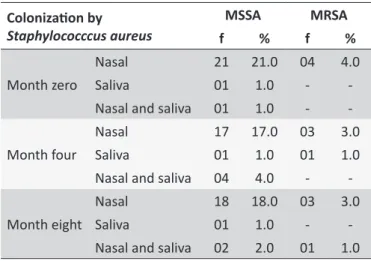
The total professionals colonized by MSSA and MRSA were similar at three collection times, that is, 27 (27.0%), 26 (26.0%) and 25 (25.0%), respectively, considering the samples of saliva and/or nasal secretion (Table 2).
The prevalence of colonization by MSSA at months zero, four and eight, in samples of saliva and/or nasal secretion was 23.0%, 22.0% and 21.0%, respectively, whereas the prevalence of MRSA was 4.0% at all three times.
The prevalence of colonization by Staphylococcus aureus
in the samples of saliva and/or nasal secretion was 43.0%, at all three times - 36.0% for MSSA and 7.0% for MRSA.
In this study, a risk factor for colonization by Staphylococcus aureus was the toothpaste storage in a closed/protected compartment in the bathroom. On the other hand, knowledge of standard precautions and prior participation in training were a protective factor for non-colonization (Table 3).
DISCUSSION
Staphylococcus aureus is a microorganism that has gained importance in the global scenario, not only due to its resistance to antibiotics, but also because of its potential to develop serious infections in people and increase morbi-mortality rates15.
Usual therapies do not present a satisfactory response in most cases of infections caused by Staphylococcus aureus. It happens because these pathogens can easily develop resistance to a variety of medications, increasingly limiting the therapeutic options in clinical practice16.
Table 1.
Distribuion of nursing professionals not colonized (n = 57) and colonized (n = 43) by
Staphylococcus aureus
,
according to demographic and professional characterisics. Ribeirão Preto, SP, 2014-2015
Variables
Not colonized
(n = 57)
Colonized
(n = 43)
Total
(n = 100)
f
%
f
%
f
%
Professional category
Nurse
10
52.6
09
47.4
19
100
Nursing technician
11
50.0
11
50.0
22
100
Nursing aide
36
61.0
23
39.0
59
100
Sex
Female
46
58.2
33
41.8
79
100
Male
11
52.4
10
47.6
21
100
Age (years)
20 to 29
01
11.1
08
88.9
09
100
30 to 39
24
61.5
15
38.5
39
100
40 to 49
25
69.4
11
30.6
36
100
≥ 50
07
43.8
09
56.2
16
100
Educaional level
Complete high school
42
61.8
26
38.2
68
100
Complete higher educaion
10
45.5
12
54.5
22
100
Complete graduate educaion
05
50.0
05
50.0
10
100
Work shit
Day
16
43.2
21
56.8
37
100
Night
22
78.6
06
21.4
28
100
Taking turns
19
54.3
16
45.7
35
100
Years of nursing pracice
< 5
07
46.7
08
53.3
15
100
5 to 14
27
62.8
16
37.2
43
100
≥ 15
23
54.8
19
45.2
42
100
Work in another insituion?
Yes
08
57.1
06
42.9
14
100
No
49
57.0
37
43.0
86
100
Weekly working hours
30 to 36
21
48.8
22
51.2
43
100
> 36
36
63.1
21
36.9
57
100
Knowledge of SP?*
Yes
49
53.3
43
46.7
92
100
No
08
100
-
-
08
100
Prior training on SP?*
Yes
48
52.7
43
47.3
91
100
No
09
100
-
-
09
100
Table 2.
Distribuion of nursing professionals (N = 100)
colonized by
Staphylococcus aureus
sensiive or resistant
to methicillin in saliva and/or nasal secreion, at three
collecion imes. Ribeirão Preto, SP, Brazil, 2014-2015
Colonizaion by
Staphylococccus aureus
MSSA
MRSA
f
%
f
%
Month zero
Nasal
21
21.0
04
4.0
Saliva
01
1.0
-
-Nasal and saliva
01
1.0
-
-Month four
Nasal
17
17.0
03
3.0
Saliva
01
1.0
01
1.0
Nasal and saliva
04
4.0
-
-Month eight
Nasal
18
18.0
03
3.0
Saliva
01
1.0
-
-Nasal and saliva
02
2.0
01
1.0
Individuals with HIV/AIDS, for having an immunological deiciency, are more susceptible to colonization and infection by
Staphylococcus aureus17. Nursing professionals in direct contact
with these patients are vulnerable to colonization in case of poor adherence to SP. Once colonized, these professionals become potential disseminators of microorganisms in healthcare settings, which may lead to an outbreak of infection and aggravate the patient's health status.
An investigation conducted to identify the presence of microorganisms in nostrils of nursing professionals from HIV/AIDS units showed six types of microorganisms were isolated in nasal secretion samples from these professionals, with Staphylococcus aureus being the most prevalent microorganism, identiied in
23.0% of positive cultures13.
A study conducted with 270 health professionals from five university hospitals in Iran showed the prevalence of
Staphylococcus aureus in nostrils of these professionals of 14.4% (39/270), of which 6.3% (17/270) were MRSA11.
In this study, the prevalence of Staphylococcus aureus in saliva and nasal secretion samples from nursing professionals was 43.0%; the prevalence of MSSA and MRSA was 36.0% and 7.0%, respectively. These indings are consistent with data found in the literature7, in which 41.0% of nursing professionals were colonized by the microorganism, 29.6% were MSSA and 7.1% were MRSA.
A study13 showed 6.6% of Staphylococcus aureus isolated
in the nasal cavity of nursing professionals working in HIV/AIDS units were MRSA, in agreement with the results obtained in this study. An investigation conducted with 120 health professionals in the state of Pernambuco, Brazil, showed 22.5% were colonized by MRSA and 74.1% of these professionals belonged to the nursing team18.
In agreement with the results from this study, an investiga-tion18 reported a higher prevalence of MRSA among nursing
technicians (48.1%). In addition, it also indicated the individuals with higher colonization were younger (20 to 28 years old) and with less professional experience (< 5 years).
In this study, 78.0% of nursing professionals store their toothbrush in a protected compartment. This attitude is a risk factor for colonization by Staphylococcus aureus (PR = 2.07; CI95% = 1.07-3.80).
The literature19 indicates microorganisms from the mouth and
the environment can remain alive on the toothbrush bristles for 24 hours, up to seven days. These bacteria remain active when only water is used in tooth brushing, and especially if the brush is stored in a closed and damp space, such as plastic cases and bathroom storage units.
In this study, more than one site was used to investigate colonization by Staphylococcus aureus, considering the literature20 recommends screening at diferent anatomic sites.
Individuals may present negative cultures in certain sites, but positive cultures in others.
Although studies5,7,9 also consider the oral cavity as a poten-tial reservoir and a source of dissemination of Staphylococcus aureus, this investigation observed higher microorganism colo-nization in the nasal cavity, with prevalence of 42.0% in this site
versus 11.0% in the oral cavity. In addition, if the identiication of Staphylococcus aureus had been only through samples of saliva, 31.0% of the cases would not have been detected.
A study21 conducted with nursing professionals from the city
of São Paulo associated the adherence to SP with the level of knowledge of this theme. The authors22 mentioned, in a study with
health professionals, that speciic training on SP provided by the institution has a positive impact on the adherence to personal protection equipment (PPE).
In this study, knowledge of SP (PR = 0.53; CI95% = 0.44-0.64) and prior training on SP (PR = 0.52; CI95% = 0.43-0.64) were a protective factor for non-colonization of nursing professionals.
Providing care to a patient colonized by MRSA without knowing how to protect oneself and the patient may cause anxiety in the nursing professional. However, it is important for health professionals to feel conident in their role of caretakers, considering all patients have the right to receive the same quality of care, regardless of their diagnosis8.
Nursing professionals, when learning about their condition of colonization by MRSA, relect and analyze their practices to prevent occupational risks, leading to changes in attitudes and higher adherence to preventive measures9.
Table 3.
Prevalence raio (PR) and respecive conidence intervals (CI95%) of the associaion between demographic
and professional characterisics with colonizaion by
Staphylococcus aureus
in nursing professionals. Ribeirão Preto,
SP, Brazil, 2014-2015
Variables
Not colonized
(n = 57)
Colonized
(n = 43)
PR
(CI95%)
f
%
f
%
Professional category
Nurse
10
17.5
09
20.9
0.90 (0.57-1.44)
Non-nurse
47
82.5
34
79.1
1
Sex
Female
46
80.7
33
76.7
1.11 (0.71-1.74)
Male
11
19.3
10
23.3
1
Age (years)
20 to 39
22
38.6
23
53.5
0.76 (0.54-1.10)
≥ 40
35
61.4
20
46.5
1
Educaional level
Complete high school
42
73.7
26
60.5
1.31 (0.87-1.99)
Complete higher educaion
15
26.3
17
39.5
1
Taking turns in work shit
Yes
19
33.3
16
37.2
1.07 (0.64-1.34)
No
38
66.7
27
62.8
1
Years of nursing pracice
≤ 9
17
29.8
19
44.2
1.32 (0.51-1.12)
≥ 10
40
70.2
24
55.8
1
Work in another insituion?
Yes
08
14.0
06
14.0
1.00 (0.61-1.64)
No
49
86.0
37
86.0
1
Weekly working hours
30 to 36
21
36.8
22
51.2
0.77 (0.54-1.11)
> 36
36
63.2
21
48.8
1
Toothbrush storage place
Protected compartment
50
87.7
28
65.1
2.07 (1.07-3.80)**
Unprotected compartment
07
12.3
15
34.9
1
Knowledge of SP*
Yes
49
86.0
43
100
0.53 (0.44-0.64)**
No
08
14.0
0
0
1
Prior training on SP*
Yes
48
84.2
43
100
0.52 (0.43-0.64)**
No
09
15.8
0
0
1
One of the limitations of this study refers to the study site and population. This study was conducted in a large teaching hospital of high complexity, with population comprising nursing professionals only, which may limit the generation of results to other institutions and professional categories.
CONCLUSION
This study showed the prevalence of colonization by
Staphylococcus aureus in saliva and/or nasal secretion samples from nursing professionals was high (43.0%), that is, 36.0% by MSSA and 7.0% by MRSA. A higher prevalence was observed in young nursing professionals (aged 20 to 29 years) with less professional experience (less than ive years in nursing practice). In addition, storing the toothbrush in a closed compartment was a risk factor for colonization, and knowledge of and prior training on standard precautions were a protective factor for non-colonization. Adoption of standard precautions is critical for nursing practice, because it helps reduce the risk of acquir-ing pathogenic microorganisms and it is an efective way to protect health professionals from risks they are exposed to in the workplace.
ACKNOWLEDGEMENTS
The authors thank the National Council for Scientiic and Technological Development (CNPq) for the inancial support provided to this study.
REFERENCES
1. World Health Organization [Internet]. Global strategy for containment of antimicrobial resistance. [Cited Mar 28, 2016]. Available from: http:// www.who.int/drugresistance/WHO_Global_Strategy_English.pdf 2. Ahmad MK, Asrar A. Prevalence of methicillin resistant Staphylococcus
aureus in pyogenic community and hospital acquired skin and soft tissues infections. J Pak Med Assoc. [Internet]. 2014 aug. [Cited Oct 10,
2016]; 64(8):892-5. Available from: http://jpma.org.pk/full_article_text.
php?article_id=6881
3. Bassetti M, Trecarichi EM, Mesini A, Spanu T, Giacobbe DR, Rossi M et al. Risk factors and mortality of healthcare-associated and community-acquired Staphylococcus aureus bacteraemia. Clin Microbiol Infect. [Internet]. 2012 sept. [Cited Oct 10, 2016]; 18(9):862-9. Available from: http://www.clinicalmicrobiologyandinfection.com/article/S1198-743X(14)61063-6/pdf. doi: 10.1111/j.1469-0691.2011.03679.x.
4. Moellering RC Jr. MRSA: the irst half century. J Antimicrob Chemother.
[Internet]. 2012 jan. [Cited Oct 10, 2016]; 67(1):4-11. Available from: http://jac.oxfordjournals.org/content/67/1/4.long. doi: 10.1093/jac/ dkr437
5. Kluytmans J, Belkum A, Verbrugh H. Nasal carriage of Staphylococcus
aureus: epidemiology, underlying mechanisms, and associated risks.
Clin Microbiol Rev. [Internet]. 1997 jul. [Cited Oct 10, 2016]; 10(3):505-20. Available from: http://cmr.asm.org/content/10/3/505.long
6. Ankola AV, Hebbal M, Eshwar S. How clean is the toothbrush that cleans your tooth? Int J Dent Hyg. [Internet]. 2009 nov. [Cited Oct 10, 2016]; 7(4):237-40. Available from: http://onlinelibrary.wiley.com/doi/10.1111/
j.1601-5037.2009.00384.x/pdf. doi: 10.1111/j.1601-5037.2009.00384.x.
7. Moura JP, Pimenta FC, Hayashida M, Cruz EDA, Canini SRMS, Gir E. Colonization of nursing professionals by Staphylococcus aureus. Rev. Latino-Am. Enfermagem. [Internet]. 2011 mar/apr. [Cited Oct
10, 2016]; 19(2):325-31. Available from: http://www.scielo.br/scielo.
php?script=sci_arttext&pid=S0104-11692011000200014. doi: http://
dx.doi.org/10.1590/S0104-11692011000200014
8. Andersson H, Andreassen-Gleissman S, Lindholm C, Fossum B.
Experiences of nursing staf caring for patients with methicillin-resistant
Staphylococcus aureus. Int Nurs Rev. [Internet]. 2016 jun. [Cited Oct 10, 2016]; 63(2):233-41. Available from: http://onlinelibrary.wiley.com/
doi/10.1111/inr.12245/pdf. doi: 10.1111/inr.12245.
9. Cruz EDA, Pimenta FC, Palazzo ICV, Darini ALC, Gir E. Prevalência de Staphylococcus aureus na saliva de trabalhadores de saúde. Colomb Med. [Internet]. 2011. [citado 2016 out 10]; 42(Supl 1):10-6. Disponível
em: http://www.bioline.org.br/pdf?rc11035
10. Gebreyesus A, Gebre-Selassie S, Mihert A. Nasal and hand carriage rate of methicillin resistant Staphylococcus aureus (MRSA) among health care workers in Mekelle Hospital, North Ethiopia. Ethiop Med J. [Internet].
2013 jan. [Cited Oct 10, 2016]; 51(1):41-7. Available from: https://www. researchgate.net/publication/255731782_Nasal_and_hand_carriage_
rate_of_Metiiicillin_Resistant_Staphylococcus_Aureus_MRSA_ among_health_care_workers_in_Mekelle_Hospital_North_Ethiopia 11. Moghadam SO, Pourmand MR, Davoodabadi A. The detection
of mupirocin resistance and nasal carriage of methicillin resistant Staphylococcus aureus among healthcare workers at University
Hospitals of Tehran, Iran. Iran J Public Health. [Internet]. 2015 mar. [Cited
Oct 10, 2016]; 44(3):361-8. Available from: https://www.ncbi.nlm.nih. gov/pmc/articles/PMC4402414/
12. Moura JP, Gir E, Rosa JO, Belíssimo-Rodrigues F, Cruz EDA, Oliveira ACA et al. Resistência à mupirocina entre isolados de Staphylococcus aureus
de proissionais de enfermagem. Acta Paul. Enferm. [Internet]. 2010 jun.
[citado 2016 out 10]; 23(3):399-403. Disponível em: http://www.scielo. br/scielo.php?script=sci_arttext&pid=S0103-21002010000300014. doi:
http://dx.doi.org/10.1590/S0103-21002010000300014
13. Reinato LAF, Pereira FMV, Lopes LP, Pio DPM, Gir E. Nasal colonization in nursing professionals from units specialized in HIV/AIDS. Rev. Bras. Enferm.
[Internet]. 2015 mar/apr. [Cited Oct 10, 2016]; 68(2):320-4. Available from:
http://www.scielo.br/pdf/reben/v68n2/en_0034-7167-reben-68-02-0320.
pdf. doi: http://dx.doi.org/10.1590/0034-7167.2015680119i
14. Silva ECBF, Samico TM, Cardoso RR, Rabelo MA, Bezerra-Neto AM, Melo FL et al. Colonization by Staphylococcus aureus among the
nursing staf of a teaching hospital in Pernambuco. Rev. Esc. Enferm.
USP. [Internet]. 2012 feb. [Cited Oct 10, 2016]; 46(1):132-7. Available from: http://www.scielo.br/pdf/reeusp/v46n1/en_v46n1a18.pdf. doi:
http://dx.doi.org/10.1590/S0080-62342012000100018
15. Centers for Disease Control and Prevention. [Internet]. Active bacterial
core surveillance (ABCs) report emerging infections program network methicillin-resistant Staphylococcus aureus, 2011. [Cited Mar 28, 2016].
Available from: http://www.cdc.gov/abcs/reports-indings/survreports/
mrsa11.pdf
16. Boucher HW, Talbot GH, Bradley JS, Edwards JE, Gilbert D, Rice LB et al. Bad bugs, no drugs: no ESKAPE! An update from the Infectious Diseases Society of America. Clin Infect Dis. [Internet]. 2009 jan. [Cited Oct 10, 2016]; 48(1):1-12. Available from: http://cid.oxfordjournals.org/
content/48/1/1.long. doi: 10.1086/595011.
17. Saeed NK, Farid E, Jamsheer AE. Prevalence of opportunistic infections in HIV-positive patients in Bahrain: a four-year review
(2009-2013). J Infect Dev Ctries. [Internet]. 2015 jan. [Cited Oct 10, 2016];
9(1):60-9. Available from: http://www.jidc.org/index.php/journal/article/
view/25596573. doi: 10.3855/jidc.4997.
18. Rabelo MA, Bezerra-Neto AM, Loibman SO, Lima JL, Ferreira EL, Leal NC et al. The occurrence and dissemination of methicillin and vancomycin-resistant Staphylococcus in samples from patients and health professionals of a university hospital in Recife, State of Pernambuco, Brazil. Rev Soc Bras Med Trop. [Internet]. 2014 jul/aug. [Cited Oct 10, 2016]; 47(4):437-46. Available from: http://www.scielo. br/scielo.php?script=sci_arttext&pid=S0037-86822014000400437. doi:
19. Gonçalo CS, Mialhe FL. Contaminação das escovas dentais: uma revisão crítica da literatura. Rev Periodontia. [Internet]. 2009. [citado
2016 out 10]; 19(3):56-63. Disponível em: http://www.revistasobrape.
com.br/arquivos/set_2009/artigo8.pdf
20. Farley JE, Hayat MJ, Sacamano PL, Ross T, Carroll K. Prevalence and risk factors for methicillin-resistant Staphylococcus aureus in an
HIV-positive cohort. Am J Infect Control. [Internet]. 2015 apr. [Cited Oct 10, 2016]; 43(4):329/35. Available from: https://www.ncbi.nlm.nih.gov/
pmc/articles/PMC4386874/. doi: 10.1016/j.ajic.2014.12.024.
21. Felix AMS, Victor E, Tofano-Malaguti SE, Gir E. Individual,
work-related and institutional factors associated with adherence to standard precautions. J Infect Control. [Internet]. 2013. [Cited Oct 10, 2016];
2(2):106-11. Available from: http://jic.abih.net.br/index.php/jic/article/ view/34/pdf_1
22. Brevidelli MM, Cianciarullo TI. Psychosocial and organizational factors relating to adherence to standard precautions. Rev. Saúde Pública. [Internet]. 2009 dec. [Cited Oct 10, 2016]; 43(6):907-16. Available from: http://www.scielo.br/pdf/rsp/v43n6/en_01.pdf. doi: http://dx.doi.
org/10.1590/S0034-89102009005000065
23. Lopes AER, Canini SRMS, Reinato LAF, Lopes LP, Gir E. Prevalence of gram-positive bacteria in patients with HIV in specialized services. Acta
Paul. Enferm. [Internet]. 2015 may/jun. [Cited Oct 10, 2016];
28(3):281-6. Available from:
http://www.scielo.br/pdf/ape/v28n3/en_1982-0194-ape-28-03-0281.pdf. doi: http://dx.doi.org/10.1590/1982-0194201500047
* This study was extracted from the thesis: “Staphylococcus aureus em proissionais de enfermagem e as interfaces com a adesão às precauções-padrão”, submitted to the Graduate Program in Fundamental Nursing, Ribeirão Preto College of Nursing, University of São Paulo. Year: 2015. This thesis is part of the project: “Prevalência de microrganismos sensíveis e resistentes em indivíduos com HIV/aids e proissionais de enfermagem”. CNPq process: 476480/2012.