www.reumatologia.com.br
REVISTA BRASILEIRA DE
REUMATOLOGIA
* Corresponding author.
E-mail: [email protected] (H.L. Mesquita).
0482-5004/$ - see front matter. © 2013 Elsevier Editora Ltda. All rights reserved.
Original article
Evaluation of platelet aggregation in the presence of
antiphospholipid antibodies: anti-
β
2GP1 and anticardiolipin
Harleson Lopes de Mesquita
a,*, Giuliano Reder de Carvalho
a, Fernando Monteiro Aarestrup
b,
José Otávio do Amaral Corrêa
c, Maria Regina Andrade Azevedo
da Department of Clinical Analyses, Universidade de Santo Amaro, São Paulo, SP, Brazil
b Center in Biology of Reproduction, Universidade Federal de Juiz de Fora, Juiz de Fora, MG, Brazil
c Faculty of Pharmacology, Universidade Federal de Juiz de Fora, Juiz de Fora, MG, Brazil
d Department of Clinical Analyses, Universidade de São Paulo, São Paulo, SP, Brazil
a r t i c l e i n f o
Article history:
Received 23 July 2012 Accepted 14 May 2013
Keywords:
Antiphospholipid syndrome Antiphospholipid antibodies Platelet agreggation
a b s t r a c t
Introduction: The antiphospholipid syndrome (APS) is an autoimmune condition charac-terized by recurrent arterial and venous thrombosis, besides obstetric complications. The pathogenesis is associated with the presence of antiphospholipid and/or anti-b2-glicopro-tein I (anti-b2GPI) antibodies that appear to change the anticoagulant activity of b2GPI. Antibody-induced dimerization of b2GPI seems to be related to the induction of platelet aggregation, contributing to the development of thrombosis in APS.
Objectives: The objective of the present study is to demonstrate the inl uence of antiphos-pholipid antibodies in platelet aggregation tests with different agonists (ADP, collagen, and adrenaline).
Methods: We analyzed platelet aggregation tests with different agonists (ADP, collagen, adrenalin) when normal platelets were exposed to serum with different concentrations of antiphospholipid antibodies.
Results: Results demonstrated a signii cant inhibition in adrenalin- and ADP-induced plate-let aggregation curves (P < 0.05) in all antibody concentrations tested when compared to the control. The paradox between the prothrombotic state and the presence of autoantibodies that show anticoagulant activity in vitro was demonstrated in the literature, making it dif-i cult to understand the pathophysdif-iologdif-ic mechandif-ism of the antdif-iphospholdif-ipdif-id syndrome.
Conclusion: Results showed that anticardiolipin and anti-b2GPI antibodies-rich serum, both of which belonging to the IgG class, can interfere with platelet aggregation curves.
Avaliação da agregação plaquetária em presença de anticorpos antifosfolípides: anti-β2GP1 e anticardiolipina
Palavras-chave:
Síndrome antifosfolípide Anticorpos antifosfolípides Agregação plaquetária
r e s u m o
Introdução: A síndrome antifosfolípide (SAF) é uma condição autoimune que apresenta fe-nômenos trombóticos arteriais e venosos de repetição além de complicações obstétricas.
Sua patogênese está associada à presença de anticorpos antifosfolípides e/ou anti-β2
glico-proteína I (β2GPI) que aparentemente modii cam o efeito anticoagulante da β2GPI. A
dime-rização da β2GPI induzida por anticorpos parece estar relacionada à indução da agregação
plaquetária contribuindo para o estado trombofílico na SAF.
Objetivos: O presente trabalho objetiva demonstrar a inl uencia dos anticorpos antifosfolí-pides em testes de agregação plaquetária com diferentes agonistas (ADP, colágeno e adre-nalina).
Métodos: Foram analisados testes de agregação de plaquetas normais com diferentes ago-nistas (ADP, colágeno, adrenalina) na presença de soro contendo anticorpos antifosfolípi-des em diferentes concentrações.
Resultados: As análises obtidas mostraram uma inibição signii cativa (P < 0,05) nas curvas de agregação plaquetária induzidas por ADP e adrenalina quando comparadas ao controle. O
paradoxo entre o estado protrombótico e a presença de autoanticorpos que in vitro
apresen-tam atividade anticoagulante foi demonstrado na literatura, dii cultando o entendimento patoi siológico da síndrome antifosfolípide.
Conclusão: Os resultados obtidos demonstraram que o soro rico em anticorpos
anticardio-lipina e anti-β2GPI, ambas da classe IgG, interferem em testes de curvas de agregação
pla-quetária.
© 2013 Elsevier Editora Ltda. Todos os direitos reservados.
Introduction
Primary antiphospholipid syndrome (APS) is a clinical condi-tion characterized by recurrent venous and arterial thrombo-sis and fetal mortality with recurrent miscarriage associated with the presence of antiphospholipid antibodies (aPL).1,2
Laboratorial tests to characterize APS include immunoas-say for anticardiolipin (aCL) IgM and IgG antibodies, anti-β 2-glycoprotein-I antibodies, and coagulation tests to determine the presence of lupus anticoagulant (LA). Coni rmation of the presence of these antibodies 12 weeks after they are i rst identii ed in the patient’s serum allows the exclusion of tran-sitory cases and the classii cation of patients according to the criteria of the XI International Congress on antiphospholipid antibodies in Sydney, Australia, 2006.3,4,5
β2-glycoprotein-I, also known as apolipoprotein H, is a phospholipid cofactor with anticoagulant characteristics. It has an important role in the preservation of vascular endo-thelial surface, forming a complex with phospholipids and prothrombin. It inhibits the activation of coagulation factor XII and it seems to contribute with the activation of protein C. On platelet surfaces, β2GPI inhibits the generation of factor Xa, besides blocking platelet aggregation and conversion of prothrombin to thrombin.6
The pathogenesis of APS is uncertain, but it is believed that the interaction of autoantibodies against anionic phos-pholipids or against β2GPI present on platelets would be associated with the release of thrombogenic components. Antiphospholipid antibodies would occupy spaces on the β2GPI-prothrombin complex, with the consequent endothe-lial and platelet activation.7
To understand the pathophysiology of this syndrome, one should analyze the different clinical types of APS and the elements considered to participate of the pathophysiologi-cal process of the disease, such as platelets, thrombin, and β2GPI. The search for the main reasons of this phenomenon will provide better therapeutic choices for these patients in the future. Therefore, the study of laboratory tests used in the diagnosis of this syndrome is paramount.
Material and methods
Female patient with APS
A female patient with APS, according to the criteria of the XI International Congress on antiphospholipid antibodies in Sydney, Australia, 2006,3 was selected to obtain the serum
with aPL. The study was approved by the ethics on research committee of the Universidade Santo Amaro with registry number 069/2011, and the patient signed an informed con-sent.
A 24-year old female patient who lived in Volta Redonda, RJ, experienced a miscarriage in November 2000, in the 12th
week of pregnancy, and again in March 2002, in her second pregnancy, approximately in the 18th week. The
Table 2 – Results of anti-β2GPI antibodies in samples A1, A2, and A3.
β2 GPI, IgM antibodies
β2 GPI, IgG antibodies
A1 Lower than 5 U/mL Greater than 100 U/mL
A2 Lower than 5 U/mL Greater than 100 U/mL
A3 Lower than 5 U/mL Greater than 100 U/mL
Reference values IgM:
Negative ĺ Lower than 5 U/mL Undetermined ĺ 5-8
U/mL
Positive ĺ Above 8 U mL
IgG:
Negative ĺ Lower than 5 U/mL Undetermined ĺ
5-8 U/mL Positive ĺ Above 8
U/mL
Table 1 – Results of aPL antibodies in samples A1, A2, and A3.
ACL, IgM antibodies
ACL, IgG antibodies
A1 12.3 MPL 71.1 GPL
A2 10.5 MPL 71.9 GPL
A3 10.8 MPL 72.4 GPL
Reference values* IgM:
Negative ĺ Lower than 10 MPL Undetermined
ĺ 10-19 MPL Moderate reactivity
ĺ20-80 MPL Strong reactivity ĺ
Above 80 MPL
IgG:
Negative ĺ Lower than 10 GPL Undetermined ĺ
10-19 GPL Moderate reactivity
ĺ 20-80 GPL Strong reactivity ĺ
Above 80 GPL
*Reference value for EliA IgG/IgM (ImmunoCAP 250, Phadia, Pharmacia Diagnostics®).
Laboratory tests requested by her clinician in May 2002 showed: aPTT 28 sec. with normal values ranging from 25-35 sec., and INR 1.0; antinuclear factor (ANF) and rheumatoid factor non reactive; positive VDRL titers 1:4; FTA-ABS IgM and IgG negative; positive direct Coombs; IgG aCL antibodies 65 GPL (negative < 10 GPL); IgM aCL antibodies 15 MPL (normal < 10 MPL). Complete blood count showed 6,500 leukocytes/ mm3 (normal = 4,500-11,000) without left shift; mild anemia
with hematocrit of 35% (normal = 37-47%); hemoglobin 11.8 g/dL (normal = 12-16 g/dL); RBC = 3.5 million/mm3 (normal =
4-5.5 million/mm3), and mild thrombocytopenia, with 135,000
platelets/mm3 (normal = 150,00-400,000/mm3). Biochemistry
showed normal glucose and liver function tests (AST, ALT, and bilirubin), but the patient had mild change in creatinine clear-ance, at 85 mL/min (normal = 97-130 mL/min).
Anticardiolipin antibodies were positive two other times in routine tests, in September 2002 (IgG aCL 73 GPL and IgM aCL 13.5 MPL) and October 2002 (IgG aCL 63 GPL and IgM aCL 11.5 MPL). Positive aCL at intervals greater than 12 weeks (May, September, and October), associated with clinical crite-ria of recurrent miscarcrite-riages allowed her characterization as having primary antiphospholipid syndrome, according to the criteria established in Sydney, in 2006.3 Treatment with
anti-coagulants was instituted with periodic PT and INR.
aPL antibodies
During three months, one blood sample a month was collected from the patient in a tube without anticoagulant. Blood sam-ples were centrifuged at 3,000 rotations per minute (rpms) for 10 minutes, and the serum was labeled sample 1 (A1), sample 2 (A2), and sample 3 (A3), as it was collected. Since the patient was on oral anticoagulant, under close supervision of her cli-nician and strict evaluation of possible risks, those medica-tions were discontinued 7 days prior to the collection date to avoid interference with the procedure.8
Lupus anticoagulant testing, performed through the Russell viper venom test (Dade Behring®) was negative (integrated au-tomated test which includes the screening and coni rmation testing) and coni rmed by aPTT testing with silica activator.9
Quantii cation of aPL for aCL and anti-β2GPI antibodies was done using the IgG/IgM EliA immunoassay (ImmunoCAP 250, Phadia, Pharmacia Diagnostics®), with sensitivity and speci-i cspeci-ity sspeci-imspeci-ilar to other speci-immunoassay testspeci-ing, such as ELISA, for antiphospholipid antibodies.10 Results were reported in IgG
phospholipid units (GPL) and IgM phospholipid units (MPL) where 1 unit is equal to 1 mg/mL of IgG or IgM (Tables 1 and 2).
Platelet aggregation test
The pool of platelet-rich plasma (PRP) was obtained from 20 healthy volunteers, ages 28-43 years, without a history of co-agulation disorders, and with normal PT and aPTT. After the pool was obtained, it underwent aPL testing (IgM and IgG an-ticardiolipin antibodies and IgM and IgG anti-β2GPI antibod-ies), using the same method used in the aPL-rich serum, with negative results (less than 10 MPL, for IgM aCL, and less than 10 GPL, for IgG aCL). Blood samples were collected in tubes with sodium citrate at a rate of 1:9 and centrifuged at 1,000 rpm for 15 minutes. The pool of plasma obtained was used as
control for aggregation curves. Platelet-poor plasma (PPP) was obtained from these patients for calibration of the aggregom-eter after centrifugation at 2,500 rpm for 10 minutes. Agonists used included: ADP (1 μL-1nM), collagen (0,5 μL-1 mg/mL), and adrenaline (0,5 μL-1 mg/mL) (Chrono-par®, Chrono-log Cor-poration, USA) and platelet aggregation tests were performed in a Chrono-log aggregometer model 530 (Biomédica S/C Ltda).
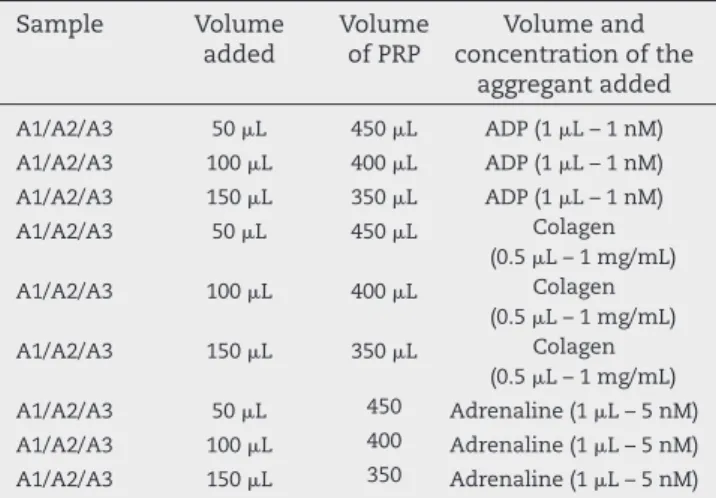
aPL-containing serum samples, A1, A2, and A3, were added to the PRP with a i nal volume of 500 μL (Table 3) and un-derwent aggregation. The number of platelets in the samples was verii ed and standardized in 300,000/mm3 in all samples,
an adequate number for the aggregation tests performed in the equipment used.11 The Mann-Whitney test was used to
analyze the results, adopting a signii cance level of P < 0.05.
Results
Table 3 – Volume of addition of samples A1, A2, and A3 in platelet-rich plasma for platelet aggregation.
Sample Volume added
Volume of PRP
Volume and concentration of the
aggregant added
A1/A2/A3 50 μL 450 μL ADP (1 μL – 1 nM) A1/A2/A3 100 μL 400 μL ADP (1 μL – 1 nM) A1/A2/A3 150 μL 350 μL ADP (1 μL – 1 nM) A1/A2/A3 50 μL 450 μL Colagen
(0.5 μL – 1 mg/mL) A1/A2/A3 100 μL 400 μL Colagen
(0.5 μL – 1 mg/mL) A1/A2/A3 150 μL 350 μL Colagen
(0.5 μL – 1 mg/mL) A1/A2/A3 50 μL 450 Adrenaline (1 μL – 5 nM) A1/A2/A3 100 μL 400 Adrenaline (1 μL – 5 nM) A1/A2/A3 150 μL 350 Adrenaline (1 μL – 5 nM)
Table 4 – Mean aggregation % of samples A1, A2, and A3 after 5 minutes of aggregation with adrenaline.
Control 50 μL 100 μL 150 μL
A1 = 70% A1 = 59% A1 = 56% A1 = 53% A2 = 70% A2 = 61% A2 = 60% A2 = 57% A3 = 70% A3 = 56 % A3 = 52% A3 = 50% Mean = 70% Mean = 59% Mean = 56% Mean = 53%
P = 0.016 P = 0.026 P = 0.014
According to the Mann-Whitney test, a signii cant inhibition (P < 0.05) was observed in samples A1, A2, and A3 for the agonist adrenaline.
Table 5 – Mean aggregation % of samples A1, A2, and A3 after 5 minutes of aggregation with ADP.
Control 50 μL 100 μL 150 μL
A1 = 74% A1 = 74% A1 = 59% A1 = 58% A2 = 74% A2 = 58% A2 = 63% A2 = 56% A3 = 74% A3 = 58% A3 = 58% A3 = 51% Mean = 74% Mean = 63% Mean = 60% Mean = 55%
P = 0.184 P = 0.012 P = 0.012
According to the Mann-Whitney test, a signii cant inhibition (P < 0.05) was observed for samples A1, A2, and A3 for the agonist ADP in the volumes of 100 μL and 150 μL.
Table 6 – Mean aggregation % of samples A1, A2, and A3 after 5 minutes of aggregation with collagen.
Control 50 μL 100 μL 150 μL
A1 = 70% A1 = 69% A1 = 69% A1 = 68% A2 = 67% A2 = 65% A2 = 63% A2 = 62% A3 = 67% A3 = 65% A3 = 60% A3 = 53% Mean = 68% Mean = 66% Mean = 64% Mean = 61%
P = 0.378 P = 0.267 P = 0.246
According to the Mann-Whitney, test, signii cant inhibition was not observed (P > 0.05) for samples A1, A2, and A3 for the agonist collagen.
Table 4, for the aggregant adrenaline, shows a statistically signii cant fall (P < 0.05) in the values of platelet aggregation in the presence of anti-β2GPI IgG- and aCL IgG-rich serum.
Regarding the agonist ADP, shown in Table 5, a statistically signii cant fall was also observed with the two higher concen-trations of anti-β2GPI IgG and aCL IgG (P < 0.05).
As for the agonist collagen, whose values are shown in table 6, a statistically signii cant inl uence was not observed with anti-β2GPI IgG and aCL IgG (P > 0.05).
Discussion
The characteristic of APS is the association of several clinical aspects, including arterial or venous thrombosis and morbid-ity during pregnancy (recurring fetal loss, preeclampsia,
ec-lampsia, and spontaneous miscarriages) associated with the presence of aPL.12
The name APS seems to be incorrect due to the discovery that some forms of aPL are not directed against phospholip-ids, but against proteins with phospholipid complexes, such as β2GPI, prothrombin, and annexin V.5,13-15 Prior studies
sug-gest that anti-β2GPI in complexes with β2GPI activates plate-lets, potentially contributing for the thrombotic tendency of patients with APS. However, the presence of aPL does not im-plicates in the development of APS, as they can be present in up to 1% of the normal population and in 3% of elderly individuals.16-18
To verify whether evidence of in vivo platelet hyperac-tivity would be reproduced in vitro, analysis of platelet ag-gregation curves with different agonists in the presence of aPL-rich human serum of a patient with primary APS diag-nosed according to the criteria of the XI International Con-gress on antiphospholipid antibodies held in Sydney, in 2006, was performed. Samples collected from the patient at vary-ing intervals showed elevated IgG aCL, which the literature has indicated to be more relevant than the IgM aCL regarding thrombotic phenomena.19 The titers of anti-β
2GPI IgG
antibod-ies were also elevated in all three samples (> 100 U/mL). These antibodies are fundamental for the clinical aspects of APS, since the β2GPI plasma protein to which they bind has a great afi nity for anionic phospholipids, working as a cofactor for the development of APS.20
The results showed a statistically signii cant (P < 0.05) in-hibition of platelet aggregation for adrenaline, in all antibody concentrations, and ADP, in the two highest antibody concen-trations. As for collagen, the inhibition was non-signii cant.
This apparent paradox between aPL and the inhibition of platelet aggregation was also demonstrated in a recent study in which elevated levels of anti-β2GPI antibodies reduced sig-nii cantly platelet aggregation (this inhibition was propor-tional to the concentration of said antibodies) in the presence of the aggregants, ADP and collagen.21
that anti-β2GPI antibodies may inhibit the release of platelet dense granules and inhibit the arachidonic acid metabolic pathway.21
In a selection of clinical studies performed with aPL, only LA was consistently related as a risk factor for clinical throm-botic phenomena. However, studies with aCL and anti-β2GPI antibodies were inconclusive and partly controversial. aCL IgG and anti-β2GPI IgG demonstrated greater relationship with thrombotic processes (aCL related to more specii c situ-ations of stroke and myocardial lesions) than the respective IgM antibodies, but they did not show the close relationship that LA has with those phenomena.23
The aforementioned data seem important for the interpre-tation of our results of inhibition of platelet aggregation, since the level of LA of the patient with primary APS was negative in the samples used for the testing, and these antibodies are more closely related to clinical thrombosis.
Besides, other authors have demonstrated, in patients with thromboembolic complications, the presence of autoan-tibodies that, in vitro, showed to have anticoagulant activity and caused prolongation of coagulation tests.20
The results of the present study suggest that the in vivo thrombotic effect of aPL can be associated to the type of anti-bodies present in the patient with APS and other factors that were not detected in the in vitro aggregation test. The use of these aggregation tests for diagnosis can cause misinterpre-tation and failure to refer the patient to test for the presence of aPL even in the presence of symptomatology compatible with APS.
Acknowledgements
We are grateful to the professionals of the Clinical Analysis Laboratory of the Universidade Federal the Juiz de Fora (UFJF), of Hospital Samaritano (SP), and Universidade de Santo Amaro (SP).
Confl icts of interest
The authors declare no conl icts of interest.
R E F E R E N C E S
1. Visseaux B, Masliah-Planchon J, Fischer AM, Darnige L. Antiphospholipid syndrome diagnosis: an update. Annales de Biologie Clinique. 2011;69(4):411-8.
2. Sá EB, Passos AS, Cecconi M, Barbo MLP, Martinez JE, Novaes GS. Gangrene of the auricle as the i rst signo f antiphospholipid antibody syndrome. Rev Bras Reumatol. 2011;51(6):655-61.
3. Miyakis S, Lockshin MD, Atsumi T, Branch DW, Brey RL, Cervera R, et al. Internacional consensus statement on an update of the classii cation criteria for dei nite
antiphospholipid sindrome (APS). J Thromb Haemost. 2006;4:295-306.
4. Sangle NA, Smock KJ. Antiphospholipid antibody syndrome. Arch Pathol Lab Med. 2011;135(9):1092-6.
5. Perches PG, Domingues DP, Gomes AL, Ribeiro AM, Pereira FMT, Rassi IE, et al. Avaliação da pesquisa de anticorpos antifosfolipídios para o diagnóstico da síndrome antifosfolípide. Rev Bras Reumatol. 2011;51(6):236-45. 6. Ranzolin A, Lotterman A, Bohn J, Von Mühlen CA, Staub, HL.
Anticorpos contra beta2-glicoproteína I, autoimunidade e
aterosclerose.Rev Bras Reumatol. 2004;44(2):139-49.
7. Santos MRF, Costa CRT, Tavares RM, Souza MVM. Síndrome antifosfolípide:uma causa de neuropaita periférica? Rev Bras Reumatol. 2007;47(4):281-5.
8. Rizzatti EG, Franco, RF. Tratamento do tromboembolismo venoso. Medicina, Ribeirão Preto. 2001;34:269-75.
9. Pengo V, Tripodi A, Reber G, Rand JH, Ortel TL, Galli M, et al. Update of the guidelines for lupus anticoagulant detection. J Thromb Haemost. 2009;7:1737-40.
10. Villalta D, Alessio MG, Tampoia M, Da Re A, Stella S, Da Re M, et al. Accuracy of the First Fully Automated Method for Anti-cardiolipin and Anti-β2 Glycoprotein I Antibody Detection for the Diagnosis of Antiphospholipid Syndrome. Ann NY Acad Sci. 2009;1173:21-7.
11. Cavalcante JWS, Santos PRM, Menezes MGF, Marques HO, Cavalcante LP, Pacheco WS. Inl uência da cafeína no comportamento da pressão arterial e da agregação plaquetária. Arq Bras Cardiol. 2000;75(2):97-101. 12. Erkan D, Lockshin MD. Antiphospholipid syndrome. Curr
Opin Rheumatol. 2006;18(3):242-8.
13. Arnout J, Vermylen J. Current status and implications of autoimmune antiphospholipid antibodies in relation to thrombotic disease. J Thromb Haemost. 2003;1:931-42. 14. Nimmo MC, Carter CJ. The antiphospholipid antibody
syndrome a riddle wrapped in a mystery inside an enigma. Clinical and Applied Immunology Rev. 2003;4(2):125-40. 15. Santamaria JR, Badziak D, Barros MF, Mandelli FL, Cavalin
LC, Sato MS. Síndrome antifosfolípide. An Bras Dermatol. 2005;3:225-39.
16. Shi T, Giannakopoulos B, Yan X, Yu P, Berndt MC, Andrews RK, et al. Anti-β2-glycoproteína I antibodies in complex with
β2-glycoproteína I can activate platelets in a dysregulated manner via glycoprotein Ib-IX-V. Arthritis Rheum. 2006;54:2558-67.
17. Cabral AR, Cabiedes J, Segovia DA. Heterogeneity of antibodies to β2-glycoprotein 1 from patients with systemic lupus erithematosus. Lupus. 2004;13(3):182-7.
18. Cuadrado MJ, Pedrera CL. Antiphospholipid syndrome. Clin Exp Med. 2003;3(3):129-39.
19. Levine JS, Branch DW, Rauch J. The Antiphospholipid syndrome. N Engl J Med. 2002;346:752-63.
20. Bas De Laat H, Derksen RHWM, De Groot PG. β2-glicoproteína I, the playmaker of the antiphospholipid syndrome. Clinical Immunology. 2004;112:161-8.
21. Palatinus AA, Ahuja KD, Adams MJ. Effects of
antiphospholipid antibodieson in vitro platelet aggregation. Clin Appl Thromb Hemost. 2012;18:59-65.
22. Marai I, Goddard GZ, Shoenfeld Y. The systemic nature of the antiphospholipid syndrome. Scand j Rheumatol. 2004;33(6):365-72.