
Evaluation of extracurricular internships
in adult intensive care units
Avaliação dos estágios extracurriculares de medicina
em unidade de terapia intensiva adulto
INTRODUCTION
he trend to include medical knowledge in practical activities that go be-yond the oicial university curriculum is known as a “parallel curriculum”. As such, a parallel curriculum would be the extracurricular activities that medical students do for the purpose of gaining clinical and practical experience by ac-companying services and/or professionals.(1-2)
he learning of intensive care medicine (ICM) in the academic environment has essentially taken place by means of the parallel curriculum. his is because current growth of ICM, as a medical specialty, has not been suitably included in the oicial curriculum of most medical schools3-5. herefore, medical students
Diego Teixeira Nascimento1, Maria
Almeida Dias2, Rodrigo de Sousa
Mota1, Luciana Barberino2, Larissa
Durães2, Paulo André Jesuino dos
Santos3
1. Physician, Member of the Intensive Medicine Academic League from Bahia – LAMB– Salvador (BA), Brazil. 2. Medical Student from Escola Bahiana de Medicina e Saúde Pública – EBMSP – Salvador (BA), Brazil. Member of the Intensive Medicine Academic League from Bahia – LAMB– Salvador (BA), Brazil.
3. Master, Assistant Professor from Faculdade de Medicina da Bahia da Universidade Federal da Bahia - UFBA and from the “Escola Bahiana de Medicina e Saúde Pública - EBMSP – Salvador (BA), Brazil. Member of the Intensive Medicine Academic League from Bahia – LAMB– Salvador (BA), Brazil.
ABSTRACT
Objectives: Students of Salvador – BA, Brazil were trained in critical care medicine by accomplishing extracur-ricular internships. his study aims to detect changes in attitude and interest of students who concluded these intern-ships as well as the most frequent activi-ties developed.
Methods:Descriptive cross-section-al survey conducted with students who did extracurricular internships in adult intensive care units during the second semester of 2006. A self-administered questionnaire was given using objective questions.
Results: We evaluated 49 students. Interest in becoming an intensivist was classiied as high/very high by 32.7% before internship, after which 61.2% reported increased interest. Before in-ternship, students on a 1 to 5 scale rat-ed the importance of critical care mrat-ed- med-icine as 4.55 ± 0.70. After internship, 98% felt more conident to refer a pa-tient to the intensive care unit, 95.9%
to evaluate with supervision, patients admitted to intensive care units and 89.8% to attend patients in the emer-gency room. he most common pro-cedures observed were: central venous access (100%), peripheral venous ac-cess (91.8%) and orotracheal intuba-tion (91.8%). Topics ranked in terms of interest from 1 to 5 were: systemic inlammatory response syndrome/sep-sis (4.82 ± 0.48), shock (4.81 ± 0.44) and cardiopulmonary resuscitation (4.77 ± 0.55).
Conclusions: his study showed that internships in adult intensive care units of Salvador (BA), Brazil provided students with greater assurance to evalu-ate critical patients, increased their inter-est to follow an intensivist physician ca-reer and allowed contact with the main procedures and topics related to critical care medicine.
Keywords: Education, medical; Fel-lowships and internships; Clinical clerk-ship; Intensive care units; Students, medical; Questionnaires
Received from Liga Acadêmica de Medicina Intensiva da Bahia – Salvador (BA), Brazil.
Submitted on May 30, 2008 Accepted on October 20, 2008
Author for correspondence:
Diego Teixeira Nascimento
Rua Icó, s/n, bl. 11, apto. 204, Conj. Clériston Andrade
Engenho Velho de Brotas.
usually graduate without the required basic knowledge and with no qualiication to care for patients ready for admission in intensive care units (ICU).(6) here are other factors that also weigh on the interest for such activities, such as the idea of adding to a “good curriculum” and increasing the number of academic intensive medicine groups in the country7-8 that therefore must also be taken into account in this type of analysis.
Once it becomes evident that the clinical course of a severe patient changes when treated by an intensivist phy-sician, the importance of amending the oicial curriculum of medical schools, to qualify students to deal with severe and unstable patients must be recognized.(4-5) Emphasis on an improved education in ICM must have an early start, as it is an extremely specialized activity, from a technological point of view as well as that of human resources.(4,9) Medi-cal schools are therefore responsible for the availability of curricular clerkships encompassing ICM in the graduate preparation of general practitioners, following the guide-lines of amending the medical curriculum, to reduce the search for extracurricular activities without teaching su-pervision.(4,10)
In this respect new clerkships have proliferated in the ICU of public and private hospitals in Salvador (BA) and other Brazilian cities. his relects the interest of critical care physicians to disseminate scientiic, technical, and managerial and research knowledge involving this special-ty, as well as the interest of students to participate in these clerkships.(8,11)
he objective of this study was to detect changes in the attitude and interest of students after these clerkships, in addition to describing the more common activities de-veloped (procedures, assistance to patients, contact with topics related to ICM).
METHODS
A cross sectional descriptive study was carried out us-ing a self-administered questionnaire for medical students of two of the more traditional schools of medicine of Ba-hia, one public “Faculdade de Medicina da Bahia” of the “Universidade Federal da Bahia” and one private “Escola Bahiana de Medicina e Saúde Pública”. Candidates were selected after an active search for students that had com-pleted ICM extracurricular clerkships in a public and/or private hospital of Salvador during the second semester of 2006. Initially, all ICU with extracurricular clerkships at that time were listed. Next, all respective supervisions were contacted for the list of students that had completed clerkship in the period mentioned. here were no
refus-als. hen, the names were crossed to form a single list, because of name repetition from diferent ICU. An active search for the students listed was carried out from Febru-ary to June 2007 and the questionnaire was submitted. he questionnaire was divided into four parts: free and informed consent, general characteristics of the students and of the ICU, changes of attitude after clerkship and questions on academic and/or professional interest regard-ing ICM, procedures and main topics of ICM.
he questionnaire was based upon a previous one used by the Intensive Care Medicine Leagues in a study that evaluated student’s perspectives about ICM in the medical schools of Salvador. It was adapted to suit the new study and questions of the previous questionnaire were main-tained, removed, modiied and included. hen, it was administered to eight students that had completed extra-curricular clerkships in ICM during the irst semester of 2006, for validation. With these results, the questionnaire of the study was inalized. Questions with illegible replies or with erasures were not computed.
After collection of the questionnaires a data bank was built in EPIINFO 3.3.2 for Windows software. Descrip-tive statistics parameters were used, adopting the usual measures of central tendency and dispersion as well as es-timates of simple and relative frequencies.
RESULTS
curric-ulum with 30.6, 24.5 and 22.4% respectively. At the end of clerkship 77.6% of the students reported a higher academic interest for intensive care medicine and 61.2% in becom-ing a critical care physician. he main reasons of the 38.8% that reported a lesser interest in becoming an intensivist were that it was very tiresome to always work in shifts dur-ing most of the week. And not be tuned to the life style of a critical care physician, both with 36.8%. Mean of the rating given by the students on a scale of 1 to 5 to the importance of intensive care for current medical students was of 4.55 ± 0.70 and this is the same value found when asked about the importance in academic life of extracurricular clerkship in an adult ICU. Of the interviewed students 75.5% stated that their school does not ofer any curricular activity in the ICU and all stated that the subjects related to intensive care must be better addressed in their school. Only 51% of the students had participated in some situation of indication of ICU treatment prior to the clerkship. Afterwards, 98% felt more conident to refer patients to the ICU, 95.9% in a supervised evaluation of patients admitted to the ICU and 89.8% in caring for patients in emergencies.
Table 3 presents information on the observation and performance of procedures. Procedures more often observed were: central venous access (100%), periph-eral venous access (91.8%) and orotracheal intubation (91.8%). hose most often performed under supervision were: punction for arterial blood gas analysis (89.8%),
Table 3 – Observation and performance of procedures during clerkship and assurance to carry out alone after extracurricular clerkship in intensive care units
Procedures Observation Performance Assurance [ ]*
Peripheral venous access 91.8 (45) 63.3 (31) 96.6 (28) [29]
Central venous access 100.0 (49) 65.3 (32) 46.4 (13) [28]
Pulmonary artery catheter 38.8 (19) 6.1 (03) 0 (0) [02]
Arterial line 89.8 (44) 53.1 (26) 73.9 (17) [23]
Punction for aterial blood gas analysis 89.8 (44) 83.7 (41) 94.1 (32) [34]
Oorotracheal intubation 91.8 (45) 32.7 (16) 30.8 (04) [13]
horacocentesis 53.1 (26) 14.3 (07) 20.0 (01) [05]
Tracheostomy 53.1 (26) 6.1 (03) 0 (0) [03]
Bag-mask ventilation 83.7 (41) 67.3 (33) 96.3 (26) [27]
horacic drainage 53.1 (26) 20.4 (10) 11.1 (01) [09]
Cricothyroidostomy 10.2 (05) 6.1 (03) 0 (0) [02]
Gallbladder probe 87.8 (43) 49.0 (24) 94.7 (18) [19]
Nasogastric tube introducion NGT 83.7 (41) 51.0 (25) 100.0 (22) [22]
CPR 91.8 (45) 49.0 (24) 57.9 (11) [19]
Introduction of intra-aortic balloon IAB 14.3 (07) 2.0 (01) 0 (0) [01]
Pericardiocentesis 4.1 (02) 2.0 (01) 0 (0) [01]
NGT – nasogastric tube; CPR –cardiopulmonary ressuscitation; IAB- Intra-aortic balloon. Results expressed in %(N); *[ ] – total number of indivi-duals that carried out the procedure and replied regarding assurance in each of the presented items
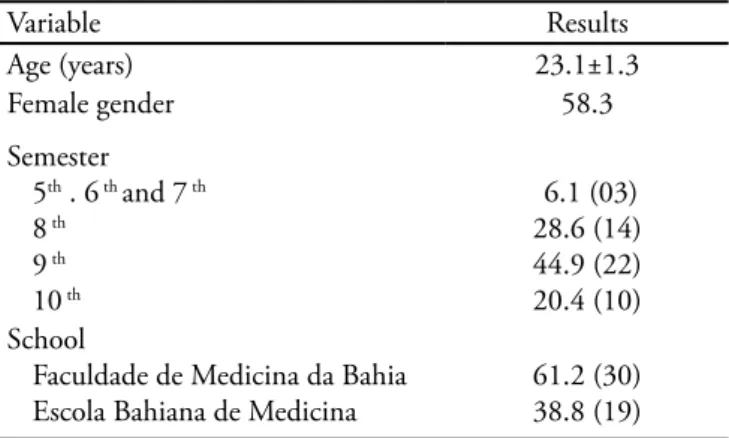
Table 1 – Demographic characteristics of the population
Variable Results
Age (years) 23.1±1.3
Female gender 58.3
Semester 5th . 6 th and 7 th
8 th
9 th
10 th
6.1 (03) 28.6 (14) 44.9 (22) 20.4 (10) School
Faculdade de Medicina da Bahia Escola Bahiana de Medicina
61.2 (30) 38.8 (19)
Results are expressed in mean ± standard deviation or %(N)
Table 2 – General characteristics of the intensive care units
Variables Results
Hours on duty* 11.6 ± 1.2 - [12]
Number of beds** 12
Number of on duty physicians*** 1
2 3 4
73.9 (34) 15.2 (07) 6.5 (03) 4.3 (02)
Patients evaluated per shift *** 7.6 ± 5.2
bag-valmask ventilation (67.3%) and central ve-nous access (65.3%). When reporting performance of some procedure the student had the option to inform his assurance or not to carry out the same procedure alone, after clerkship. he students reported that they felt greater assurance to perform by themselves nasogas-tric tube insertion (100%), bag-valve-mask ventilation (96.3%) and peripheral venous access (96.6%). he
interest and the theoretical and practical experiences related to ICM topics are shown on table 4. On a 1 to 5 scale the topics rated as those of greater interest were: systemic inlammatory response syndrome (SIRS)/ sep-sis (4.82 ± 0.48), shock (4.81 ± 0.44) and cardiopul-monary resuscitation (4.77 ± 0.55) and those of lesser interest were multidisciplinary care (3.91 ± 1.14) and nutrition (3.87 ± 1.14). Table 5 shows the opportunity
Table 4 – Interest and theoretical and practical experience with the main topics related to iintensive care medicine at extra-curricular clerkships in adult intensive care units
Topics in intensive care medicine Interest heoretical Practical
Shock 4.81±0.44 95.9 (47) 93.9 (45)
Cardiop pulmonary resuscitation 4.77±0.55 85.7 (42) 91.8 (46)
SIRS/Sepsis 4.82±0.48 91.8 (45) 85.7 (42)
Renal failure and dialysis 4.38±0.78 59.2 (29) 73.5 (36)
Respiratory failure and MV 4.57±0.70 89.8 (44) 91.8 (46)
Politrauma 4.46±0.89 59.2 (29) 46.9 (23)
Hydroelectrolytic and metabolic disorders 4.59±0.76 69.4 (34) 87.8 (43)
Infections in severe patients 4.46±0.71 63.3 (31) 73.5 (36)
Sedation and analgesia 4.34±0.83 55.1 (27) 75.5 (37)
Ethics and humanization 4.32±0.82 51.0 (25) 46.9 (25)
Hemodynamic monitoring 4.61±0.63 91.8 (45) 91.8 (45)
Encephalic death and transplants 4.48±0.80 44.9 (22) 34.7 (17)
Multidisciplinary Care 3.91±1.14 40.8 (20) 63.3 (31)
Nutrition in severe patients 3.87±1.14 38.8 (19) 46.9 (23)
S -Stroke/ neurological monitoring 4.65±0.66 73.5 (36) 83.7 (41)
Hepatic Decompensation/DH 4.40±0.91 44.9 (22) 38.8 (19)
SIRS – systemic inlammatory response syndrome; S – stroke; HD – digestive hemorrhages; MV - mechanical ventilation. Results expressed in %(N), except the interest (score 1 to 5), expressed in mean ± standard deviation
Table 5 – Opportunity to treat under supervision and assurance to treat alone, diseases common in the intensive care units
Topics in intensive care medicine Opportunity to treat under supervision Assurance to treat alone [ ]*
Cardiorespiratory arrest 63.3 (31) 48.3 (14) [29]
Shock 67.3 (33) 48.5 (16) [33]
Circulatory failure 24.5 (12) 30.8 (04) [12]
Politrauma 28.6 (14) 35.7 (05) [14]
SIRS/sepsis 59.2 (29) 39.3 (11) [28]
Respiratory failure 63.3 (31) 35.5 (11) [31]
Stroke 51.0 (25) 34.8 (08) [23]
Intoxications 24.5 (12) 36.4 (04) [11]
Cranioencephalic trauma 38.8 (19) 18.8 (03) [16]
Acid-base disorders 69.4 (34) 38.7 (12) [31]
Burns 26.5 (13) 62.5 (05) [08]
Metabolic disorders 28.6 (14) 38.5 (05) [13]
Acute renal failure 55.1 (27) 33.3 (08) [24]
Convulsion 34.7 (17) 69.2 (09) [13]
Hydroelectrolytic disorder 61.2 (30) 40.7 (11) [27]
that students had to treat, under supervision, typical pathologies found in ICU and their assurance when in-dicating treatment by themselves, after clerkship. Stu-dents had more opportunity to treat under supervision the following pathologies: acid-base disorders (69.4%), shock (67.3%) and cardiovascular arrest/respiratory failure (both with 63.3%). Students stated that after clerkship they felt greater assurance to indicate treat-ment by themselves for convulsion (69.2%), burns (62.5%) and shock (48.5%).
DISCUSSION
ICU clerkships are among the more often prac-ticed extracurricular activities by medical students. Despite the high load of hours of the medical course and the intense demand of time for medicine, surveys point out that some 80 to 90% of students take on some extra-school activity related in most cases with a high level of satisfaction.(1, 11-13) To include ICM in the oicial curriculum of medical schools has been sug-gested in other works and by specialists in the ield.(4-5,7) Some of our data substantiate this fact. After clerkship 98% of the interviewees reported feeling more coni-dent to indicate intensive care treatment; 95.9% in the evaluation under supervision of patients admitted in the ICU and 89.8% in care for patients in emergen-cies. Before clerkship, only 51% had participated in the indication of intensive care treatment. As such, the inluence of the practical experience in intensive care goes beyond the activity in closed units, because the experience gained translates into greater assurance to also act in emergencies. Furthermore, 75.5% state that their school does not ofer any curricular activity in ICU and every subject related to intensive care must be better addressed in school. Considering that the stud-ied population has had practical experience in intensive care, medicine these conclusions merit closer attention when assessing how important it is to include ICM in the medical curriculum of the more traditional schools of medicine in Salvador (BA).
Intensive care medicine is a new specialty which still presents a shortage of professionals to meet the current requirement and the increasing number of ICU in the country.(14) he main reason disclosed by the students to seek a clerkship was the interest for ICM as future specialty. Furthermore, after the clerkship there was an increase in the academic, as well as professional interest for intensive care medicine (77.6% and 61.2%, respec-tively). hese data point out that experience in the
spe-cialty during medical graduation is important, because in the medium term it may bring returns in the number of critical care professionals in the country, considering that not only is there a shortage of specialized profes-sionals, but also often the openings for ICM residence are not illed in the greatest part of Brazil.(14) It must be also highlighted that to work in a shift routine and to be at odds with the life style of intensive care physicians were the irst reasons mentioned by those that reported a lesser interest in specializing in ICM after clerkship (38.8%). Recent studies with internal medicine, general surgery and anesthesiology resident physicians in Sal-vador (BA) revealed similar data on the subject(14). Al-though the quality of life of critical care physicians is sometimes questioned, this aspect is quite subjective and open to criticism. However, this aspect should not be overlooked. Another survey also carried out in Salvador (BA) disclosed a high prevalence of the Burnout syndrome among the adult ICU intensivist physicians in the city, a syndrome associated to the quality of life.(15) herefore, when considering a future improvements of medical work in closed units, it would be prudent to take this aspect into account.
Presence of the medical student in the ICU orients him on how to manage emotions when in contact with death and sufering, topics that mobilize extreme emotion in the relatives and in society in general. Furthermore, there is contact with subjects that medical students know very little about during undergraduate studies, such as en-cephalic death.(11,16)
assistant physician that of teacher, as no inancial gains are accrued.(11,17) his is another important role played by inclusion of ICM in the oicial curriculum of the medical schools, in an efort to balance these subjects within the academic environment, as well as to ofer schooling supervised by teachers.
CONCLUSIONS
his study disclosed that students who completed extracurricular clerkships in adult ICU in Salvador (BA) associated it to a high level of importance, academic as well as for their future professional life. Further it increased their interest to follow the career of intensiv-ist physician. hey also reported greater assurance when indicating and assessing critically ill patients and caring for patients in emergencies. Clerkships ofer students contact with the procedures and the most common topics in the day-by- day of the ICU. All the inter-viewees reported that ICM must be better addressed in their schools. Nevertheless, it should be emphasized that such data were assessed in a cross sectional form, therefore follow-up studies regarding students’ perfor-mance will require further inputs related to their assur-ance in the procedures and inluence in the choice of ICM as future specialty.
ACKNOWLEDGMENTS
he authors wish to thank Dr. Almir Galvão Vieira Bi-tencourt and Dr. Luiz Fernando dos Reis Falcão for their careful revision and important suggestions.
RESUMO
Objetivos: A formação em medicina intensiva pelos estudantes de Salvador (BA) tem acontecido através de estágios extracurricula-res. Este estudo visou detectar mudanças na postura e no interesse dos acadêmicos que concluíram estes estágios e os tipos mais co-muns de atividades desenvolvidas.
Métodos: Estudo transversal descritivo realizado com estudan-tes que izeram estágios extracurriculares em unidades de terapia intensiva adulto no segundo semestre de 2006. Utilizou-se um questionário auto-aplicável com questões objetivas.
Resultados: Foram entrevistados 49 estudantes. O interesse em se tornar intensivista foi classiicado como alto/muito alto por 32,7% antes do estágio, ao inal 61,2% referiram aumento do inte-resse. A média de 1 a 5, sobre a importância da medicina intensiva para o acadêmico atualmente foi de 4,55±0,70. Após o estágio 98% sentem-se mais seguros em indicar um paciente para unidades de terapia intensiva e 95,9% em avaliar, sob supervisão, os pacientes internados em unidades de terapia intensiva e 89,8% em atender pacientes nas emergências. Os procedimentos mais observados foram: acesso venoso central (100%), acesso venoso periférico (91,8%) e a intubação orotraqueal (91,8%). Numa escala de 1 a 5, os tópicos classiicados como de maior interesse foram: síndrome de resposta inlamatória sistêmica e sepse (4,82±0,48), choque (4,81 ± 0,44) e reanimação cardiopulmonar (4,77 ± 0,55).
Conclusões: O presente estudo mostrou que os estágios extra-curriculares em unidades de terapia intensiva adulto de Salvador (BA) fornecem ao estudante maior segurança em avaliar pacientes graves, aumenta o interesse do mesmo pela carreira de intensivista e permite o contato com os principais procedimentos e tópicos rela-cionados à MI no dia-a-dia das unidades de terapia intensiva.
Descritores:Educação médica; Bolsas e estágios; Estágio clíni-co; Unidades de terapia intensiva; Estudantes de medicina; Ques-tionários
REFERENCES
1. Taquette SR, Costa-Macedo LM, Alvarenga FB. Currículo
paralelo: uma realidade na formação dos estudantes de me-dicina da UERJ. Rev Bras Educ Méd. 2003;27(3):171-6.
2. Lampert JB. Currículo de graduação e o contexto da
for-mação do médico. Rev Bras Educ Méd. 2001;25(1):7-19.
3. Moraes APP. Terapia intensiva na graduação médica:
nova abordagem, antigas relexões. Rev Bras Educ Méd. 2004;28:81.
4. Goldwasser R. Como está a medicina intensiva na
gradu-ação médica? Atualidades AMIB. 2003;27:2.
5. Goldwasser R. Educação em Medicina Intensiva.
Atuali-dades AMIB. 2003; 27:1.
6. Rogers PL, Grenvik A, Willenkin RL. Teaching medical
students complex cognitive skills in the intensive care unit.
Crit Care Med. 1995;23(3):575-81. Comment in: 7. Almeida AM, Albuquerque LC, Bitencourt AGV, Rolim
CEC, Godinho TM, Liberato MV, et al. Medicina
inten-siva na graduação médica: perspectiva do estudante. Rev Bras Ter Intensiva. 2007;19(4):456-62.
8. Neves FBCS, Vieira PS, Cravo EA, Dias M, Bitencourt A, Guimarães HP, et al. Inquérito nacional sobre as ligas acadêmicas de Medicina Intensiva. Rev Bras Ter Intensiva. 2008; 20(1):43-8.
9. Croley WC, Rothenberg DM. Education of trainees in the intensive care unit. Crit Care Med. 2007;35(2 Suppl):S117-21.
4, de 7 de Novembro de 2001. Boletim ABEM. 2001: 9-11.
11. Menezes RA. Etnograia do ensino médico em um CTI. Interface Comum Saúde Educ. 2001; 5(9):117-30. 12. Peres CM. Atividades extracurriculares: percepções e
vivências durante a formação médica. [tese]. Faculdade de Filosoia Ciências e Letras da Universidade de São Paulo; 2006.
13. Valença OAA. Currículo paralelo em Medicina: o caso da Faculdade de Ciências Médicas de Pernambuco [disserta-ção]. São Paulo: Universidade de São Paulo; 1999. 14. Neves FBC, Almeida M, Portugal TS, et al. Fatores
Asso-ciados à escolha da Medicina Intensiva como especialidade por médicos residentes de Salvador-BA. Rev Bras Ter
In-tensiva. 2008;20(2 Supl 1):16.
15. Souza Barros D, Tironi MOS, Sobrinho CLN, Borges dos Reis EJF, Filho ESM, Almeida A, et al. Burnout syndrome and quality of life in intensivists [abstract]. Crit Care. 2007;11(Suppl 3):P95.
16. Bitencourt AGV, Neves FBCS, Durães L, Nascimento DT, Neves NMBC, Torreão LA, Agareno S. Avaliação do con-hecimento de estudantes de medicina sobre morte encefáli-ca. Rev Bras Ter Intensiva. 2007;19(2):144-50.
![Table 5 – Opportunity to treat under supervision and assurance to treat alone, diseases common in the intensive care units Topics in intensive care medicine Opportunity to treat under supervision Assurance to treat alone [ ]*](https://thumb-eu.123doks.com/thumbv2/123dok_br/19075533.491744/4.892.71.836.316.647/opportunity-supervision-assurance-intensive-intensive-opportunity-supervision-assurance.webp)
