(1) Universidade Federal de Santa Maria, UFSM, Santa Maria – RS, Brasil. Source: Coordenação de Aperfeiçoamento de Pessoal de Nível Superior – CAPES
Conlict of interest: non-existent
Development of the minimal contrasts perception in the
Brazilian sign language by a group of Coda
O desenvolvimento da percepção dos contrastes mínimos
na língua brasileira de sinais em um grupo de Codas
Diéssica Zacarias Vargas(1)
Carolina Lisbôa Mezzomo(1)
Themis Maria Kessler(1)
Received on: March 10, 2016 Accepted on: June 09, 2016
Mailing address: Diéssica Zacarias Vargas Avenida Roraima, 1000 – Cidade Universitária
Bairro Camobi/Santa Maria – RS CEP: 97105-900
E-mail: [email protected]
ABSTRACT
Purpose: to verify the emergence and acquisition of the minimal contrasts perception in the Brazilian Sign
Language, by Children of Deaf Adults.
Methods: nine collections of Brazilian Sign Language perception skills of normal hearing children with
deaf parents, from two to nine years old, during their language development period, were performed and analyzed. The applied test consisted of 35 minimal pairs, signs which varied in only one parameter, which could be: hand coniguration, location, movement or orientation. The signs were graphically represented through pictures. It was performed statistical analysis with signiicance level of 5%. The used tests were the comparison tests by Friedman and Wilcoxon, and also the Spearman correlation.
Results: the parameter movement is more easily perceived than the other contrasts, followed by the
parameters location and hand coniguration, which act in a similar way in the perception of these learners. The most dificult contrasts to be perceived was orientation. Another relevant inding refers to age group, because as more contact with sign language the children had, better was the Coda performance in the perception test of the minimal contrasts.
Conclusion: it was perceived that through the perception test it was possible to detect which parameters
are irst acquired. The most easily perceived movement parameter, followed by location and hand conigu-ration, while orientation was the last to be acquired.
Keywords: Sign Language; Deafness; Child; Language; Multilingualism
RESUMO
Objetivo: veriicar o surgimento e a estabilização da percepção dos contrastes mínimos da Língua
Brasileira de Sinais, crianças ouvintes ilhas de pais surdos.
Métodos: foram analisadas nove coletas das habilidades perceptuais em Língua Brasileira de Sinais de crianças ouvintes, ilhas de pais surdos com idades entre dois e nove anos. O instrumento aplicado foi composto de 35 pares mínimos, sinais que variavam em somente um parâmetro, podendo esse ser: coniguração de mão, locação, movimento ou orientação. Realizou-se análise estatística com nível de signiicância de 5%, e foram utilizados o teste de comparação de Friedman e Wilcoxon, além da correla-ção de Spearman.
Resultados: o parâmetro movimento é percebido mais facilmente do que os demais contrastes. Seguido
dos parâmetros locação e coniguração de mão, que atuam de maneira semelhante na percepção dos aprendizes desta língua. O contraste mais difícil de ser percebido refere-se à orientação. Quanto mais tempo de contato com a língua, melhor o desempenho das Codas na percepção dos contrastes mínimos.
Conclusão: por meio do instrumento de percepção constatou-se quais os parâmetros são percebidos
primeiramente pelos aprendizes. O parâmetro movimento foi mais facilmente percebido, seguido da loca-ção e coniguraloca-ção de mão, já a orientaloca-ção foi o último a ser adquirido.
INTRODUCTION
In the oral language, the perception and production of the speech are closely related and integrated. In order to enable speech production, comprehension must be present previously to this step. Still, regarding the oral language, factors such as memory, attention and auditory processing are also part of speech perception 1.
While oral languages are perceived through hearing and transmitted through sound by articulators, sign languages are received through vision, employing the hand, face and body movements as expression. Thereby, sign and oral languages do not share the same physical medium for perception and expression. While in the second the perceptual systems activated
are auditory and the productive are oral, in the irst the
perception occurs through visuospatial skills 2.
This process, although occurring in a short period of time, is a complex task, since the child must be capable of perceiving not only the sounds that are part of the language, but to discover which of these phonemes compose the slightest contrast of the linguistic system. In sign language, the process does not seem to be different. In order for the individual to develop the sign language in a satisfactory way, it is fundamental that the visuospatial perception is adequate. Besides, it is important that the child is exposed to the language precociously, for in the same way as a listener child needs auditory input, the child in contact with sign
language also needs an input suficiently frequent of
exposure, either through deaf adults or native listeners in LIBRAS – Brazilian Sign Language, in Brazil’s case. Deaf adults are competent users of visuospatial language, responsible for providing a model to this apprentice, so the child may develop LIBRAS. This is necessary because, in the deaf child’s case, sometimes, the contact do not occur with the parents, since in 95% of the cases, they are hearing adults’ children 3.
Hearing children from deaf parents are called Codas (children of deaf adults), and are native learners of the sign language being, therefore, bilingual. They are capable of naturally developing either spoken Portuguese or LIBRAS, since they are in contact with both languages since an early age 4-6.
Studies show that, just like in oral language, when a sign language is acquired in early childhood, there is facilitation in the learning process of the language, favoring syntax, comprehension and narrative skills, as well as reception and production skills in sign language1,4,7,8.
In a phonological level, it is necessary that the perception of contrasts occurs, and that the domain in production of minimal units or parameters which constitute a sign are established, such as: handshape
(the shape and coniguration of the hand), location
(space where the sign is done), movement (a sign may or may not have movement), orientation (signs may have a direction and the opposite direction may represent and opposite idea) and facial-body expression (many sign also possess facial and/or body expressions)5,9. Minimal pairs are signs which differ
in meaning when only one phonological parameter varies 9.
In order for the production of a sign to occur, the phonological perception must precede this process, since it is believed that they are entangled, that is to say, related. In this way, in order to obtain production, it is necessary that the perception is established properly, as the integrity of many linguistic structures and abilities
1. For this reason, the importance of studying the way
this perception is happening is highlighted, under sign that slightly contrast. To check if the apprentices of that language can distinguish similar signs, different in only one parameter, a minimal pair is a fundamental element of this investigation.
The non-manual expressions, or in other words, the facial-body expressions have the function of setting of
syntactic constructions and speciic signs, and also,
marking interrogative sentences 9. For this reason, this
parameter will not be considered in this study.
Thus, the objective of this study was to verify the emergence and stabilization in the perception of minimal contrasts of LIBRAS in Codas.
METHODS
This article is part of a project approved by the research ethics committee in the Federal University of Santa Maria, under the CAAE number 14236513.7.0000.5346. This research is characterized for being quantitative, prospective and transversal, developed by the application of an instrument elabo-rated especially to this study, in a sense of being capable to investigate the perception of minimal contrasts in LIBRAS.
the sign language, since they are in contact with their deaf parents and friends.
As an inclusion criteria in this research, only children with typical development in all aspects participated, that is to say, they could not have any evident sensorial, neurological, cognitive or emotional disabilities. The research sample was selected by convenience, after a meeting with the president of the municipal deaf association and a survey of the number of children of deaf parents in this community. The selected subjects only took part on the research after the parents’ clearance under an informed consent form (Termo de Consentimento Livre e Esclarecido - TCLE) and oral consent from the children.
The instrument consists in 35 word/signs, with meaning, containing minimal contrasts and differing only by one parameter. Regarding the parameters, the pairs varied in handshape (14 items), location (6 items), movement (8 items) or orientation (7 items). The pictures are accompanied by a video, in which the interpreter makes the signs, which can be the same or different.
The pictures which represent the signs of the instrument were organized in displays that represented them graphically, with three columns of two pictures for each contrast. In two columns the pictures were the same and in the third it was different, not necessarily in this order.
The shape proposed in this instrument has as a base the application and disposition of the pictures according to the Boston University Speech Sound Discrimination Picture Test10. In a similar way, a test of
phonemic discrimination pictures for oral language11
also utilizes this organization and picture layout.
Initially, there was interaction with the children in order to check their comprehension and expression in LIBRAS, and this observational evaluation was carried out through playful interaction with toys, and the child should report in sign language and answer some questions asked by the researcher, also in LIBRAS. Subsequently, the children watched the video, which already had the instrument. Afterwards, they observed
the interpreter’s sign production and inally they
should choose which pictures represented the minimal pair presented. During the video presentation it was possible to have a break so the child could choose the answer and show in the display the signs perceived in the video. It was possible to watch the item again, if necessary.
Each child answer was noted in a protocol with the following options: correct, incorrect or no answer. The results were submitted to statistical analysis which
considered the signiicance level in 5%. The statistic
tests used were the comparison test by Friedman and Wilcoxon and the correlation test by Spearman. The Spearman correlation levels were considered as: from 0 to 0.25 – very weak; from 0.25 to 0.50 – weak; from 0.50 to 0.75 – moderate; from 0.75 to 0.9 – strong and; from 0.9 to 1 – very strong.
It is important to highlight that the instrument’s appli-cation in the entire sample corpus was performed only
by the researcher and author of this study, who is luent
in sign language. This standardization in the gathering of data was taken with the purpose of avoiding bias in the results and so the evaluation process was carried effectively.
RESULTS
The children that participated in the sample were between two and nine years and 11 months old. The subjects in LIBRAS developing phase were followed each four months, thus, a new collection was performed with these subjects throughout a one year period. Subjects older than seven years old were collected only once, since they had already had developed LIBRAS 5.
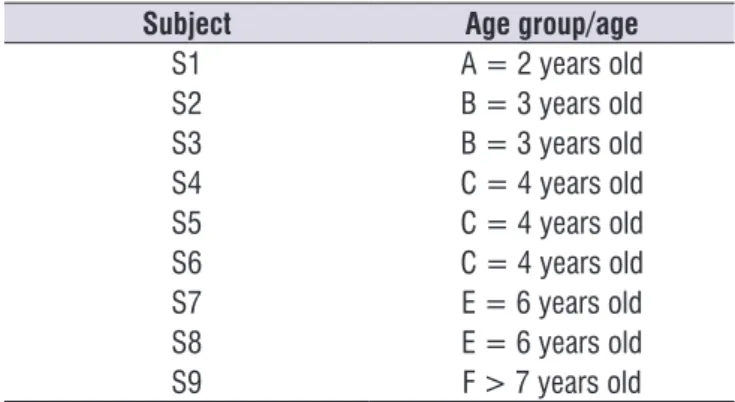
Table 1. Subjects organization according to the number of
collections performed by age.
Subject Age group/age
S1 A = 2 years old
S2 B = 3 years old
S3 B = 3 years old
S4 C = 4 years old
S5 C = 4 years old
S6 C = 4 years old
S7 E = 6 years old
S8 E = 6 years old
S9 F > 7 years old
*Subjects in age group D (5 years old) were excluded from the simple, since the data was collcted before the addition of the orientation parameter.
After the preparation of the perception instrument, it was applied in nine subjects, in a total of 28 transversal
collections. However, in the inal samples only nine inal
the perception instrument utilization, just as well as the median, standard deviation and minimum and maximum correct answers.
After collecting the data the results were found, as shown on Table 2, regarding the average of correct answers in each evaluated parameter under
Table 2. Descriptive analysis of the parameters considering the standard deviation, the average of correct guesses, minimum correct
guesses, maximum correct guesses and median.
Variable N Average Total items
per parameter % S.D. Minimum Median Maximum
Handshape 9 7.22 14 51,6 3.60 3.00 6.00 14.00
Location 9 3.22 6 53,7 1.92 1.00 3.00 6.00
Moviment 9 5.22 8 65,3 2.49 2.00 5.00 8.00
Orientation 9 2.67 7 38,1 1.73 1.00 2.00 6.00
*Where: N = sample number; S.D.= standard deviation; Value-P < 0.001 regarding the Friedman test with signiicance level of 5% (p<0.05); with signiicant differences by the Wilcoxon test to the related samples.
Parameters Hand Location Moviment Orientation
Hand Comparison impossibility p = 0.001* Non-signiicant results p = 0.001*
Location p = 0.001* Comparison impossibility p = 0.001* Non-signiicant results
Moviment Non-signiicant results p = 0.001* Comparison impossibility p = 0.001*
Orientation p = 0.001* Non-signiicant results p = 0.001* Comparison impossibility *Where: Value -P reffering to the Friedman test with signiicance level of 5% (p<0.05); with signiicant differences by the Wilcoxon test to the related samples.
Figure 1. Results from the parameter comparative analysis.
As it is possible to see on Table 2, the higher average of correct answers was for the handshape parameter, however, when observing the percentage according to the total of items per parameter, movement obtained a higher average of correct answers, followed by location and handshape, which obtained similar results regarding the percentage. On the contrary, for the orientation parameter, the toughest one to be
perceived, showed the worst general performance from the children.
During the application of the instrument, it was possible to repeat the item. However, generally the children did not need the repetition. It was also observed that two year old children were less attentive to the instrument’s use.
According to the performed analysis, the handshape
parameter presented signiicant results when compared
to the location and orientation parameters. In the same
way, the movement parameter also showed signiicant
results when compared to the location and orientation parameters.
The results obtained in the correlation between the
parameters indicate if they were signiicantly directly
proportional. In that way, according with what was
Table 3. Correlation analysis of each parameter between each other.
Hand Location Moviment
Moviment r = 0.57260
p = <0.0015*
r = 0.79160
p = <0.0001* Correlation impossibility
Location r = 0.60857
p = <0.0006* Correlation impossibility
r = 0.79160
p = <0.0001*
Orientation Non-signiicant result Non-signiicant result p = <0.0394*r = 0.69076
*Where: Value-P with signiicance level of 5% (p<0.05); r=Spearman correlation coeficient.
Table 4. Análise da correlação de cada parâmetro e do total de acertos dos pares mínimos com a variável faixa etária
Hand Location Moviment Orientation Total of correct minimal pairs
Age group r = 0.73217
p = <0.0001*
r = 0.49411
p = 0.0075*
r = 0.52912
p = 0.0038*
r = 0.82981
p = 0.0056*
r = 0.65274
p = 0.0002*
*Where:Value-P with signiicance level of 5% (p<0.05); r=Spearman correlation coeficient.
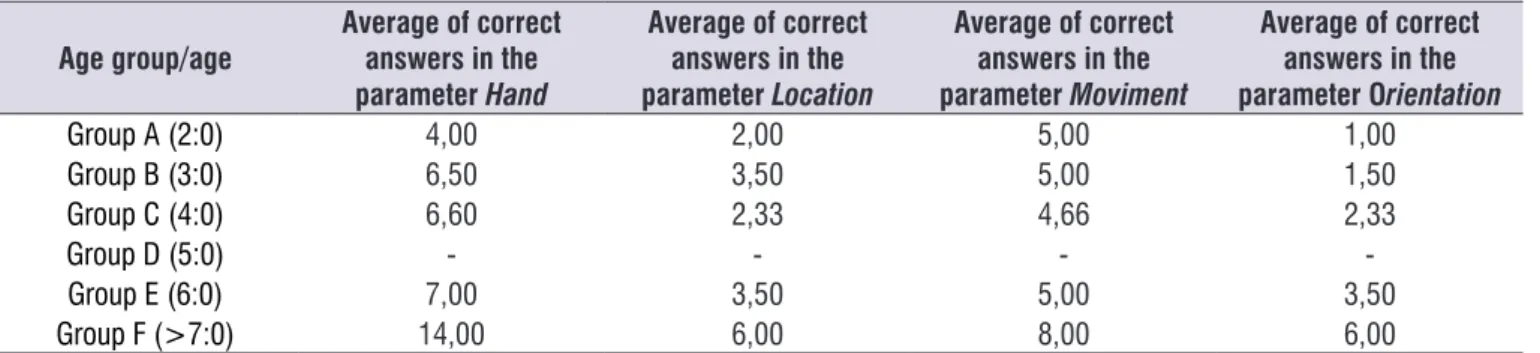
Table 5. Average of correct answers when comparing age group and parameters.
Age group/age
Average of correct answers in the parameter Hand
Average of correct answers in the parameter Location
Average of correct answers in the parameter Moviment
Average of correct answers in the parameter Orientation
Group A (2:0) 4,00 2,00 5,00 1,00
Group B (3:0) 6,50 3,50 5,00 1,50
Group C (4:0) 6,60 2,33 4,66 2,33
Group D (5:0) - - -
-Group E (6:0) 7,00 3,50 5,00 3,50
Group F (>7:0) 14,00 6,00 8,00 6,00
Where: - Subjects from the age group D were excluded from the simple since they were collected before the addition of the orientation parameter. The results found in the correlation of correct
answers of each parameter with the age group were
signiicant, showing correlation between the number of
correct answers and the ageing. Therefore, the bigger the exposure to sign language, the bigger the number
of correct answers in each parameter. These indings
indicate a moderate correlation in the handshape and movement parameters (values from 0.5 to 0.75). For orientation the correlation was strong. Finally, the location parameter and the age group indicate a weak correlation (values from 0.25 to 0.5), and still this result
was signiicant.
According to the results on Table 5, it was deter-mined that the older the subjects, the bigger the
number of correct answers. This inding is even more
evident in the orientation parameter, since this item presented values of strong correlation with r=0.82981 (values from 0.75 to 0.9), as it shows on Table 4.
DISCUSSION
According to the indings of this research, it was
determined through the results on Table 2 that the
movement parameter is the most easily perceived contrast noticed by children in sign language devel-opment stage. Other studies that have investigated the perception in deaf people have not evaluated neither movement nor orientation12,13. The result obtained in this
research disagrees with a study in which handshape was the most easily perceived parameter for the deaf subjects evaluated 13.
handshape and orientation are compared, where the
signiicant results obtained were also obtained, deter -mining that the values for handshape are higher than the ones found for orientation.
A positive and moderate correlation was deter-mined for the results on Table 3 for movement versus handshape. This means that the parameters are directly
proportional. This inding corroborates with a study that justiies that the perceptive system best receives
and distinguishes the parameters distinctions when they are articulated in regions where the interlocutor
ixes his sight, for it is possible to infer that while the
subject keeps focus on movement, he will receive the handshape being performed by the same 9. For
param-eters of movement and orientation a moderate corre-lation was also observed. Therefore, as the subject’s performance increases regarding movement, it also improves orientation perception. The cited studies carried out with perception did not investigate these parameters12,13.
Regarding the movement versus location param-eters, it was determined a strong correlation (values from 0.75 to 0.9) as described on Table 3. This result indicates that as the subject understands movement, he can also perceive the sign location, determining that these parameters are directly proportional. Again, it is highlighted that the studies which investigated perception did not analyze these parameters12,13.
According to the indings on Table 3, it was deter
-mined a signiicant positive moderate correlation
(values from 0.5 to 0.75) between the parameters location and handshape. In this way, the results indicate that these parameters are directly proportional, so as the performance regarding location increases, it also
increases the handshape performance. This inding
corroborates with a study of perception that determined that handshape acts like a continuum for the location parameter 12.
On Table 4 it was possible to verify the statistical
signiicance for the correlation between the learner’s
age-group with the number of correct answers in each parameter. Thus, as the learner’s age increases, the performance in perceiving minimal contrast also
increases. This inding corroborates with studies4,7,16
which determined that the bigger the time in contact with sign language, the better the performance in perception skills and production of ASL.
The fact that these children are native LIBRAS speakers favors the performance in activities in this language1,5,7,8, since once they are children of deaf
way corroborates with a study in which handshape
worked as a continuum to the identiication of the
location parameter 12. Another research highlighted that
in native deaf subjects were better than non-natives in sign language in task that involved the perception of handshape 8. However, in other researches which
investigated production, handshape is the last to be mastered, either in LIBRAS or in ASL (American Sign Language)14,15. These indings may differ, since a higher
movement precision is necessary, in the production, to accomplish all 46 handshape possibilities present in LIBRAS. This precision of movement in production occurs by the limitation of the articulation system, that is to say, hand physiology.
Regarding the location parameter, a study in LIBRAS14 and other in ASL15, indicate that this is the irst parameter to be produced more precisely. These indings may differ, since it is possible that, in
production, the location parameter is more easily performed, considering that it requires less from the articulation system, that is to say, less coordination to perform it 9.
On the other hand, the orientation parameter was the contrast with the worst average and percentage of
correct answers, indicating that it is the most dificult
contrast to be perceived by LIBRAS learners. Again, it is highlighted that studies which have investigated perception did not take this parameter in consid-eration12,13. Nonetheless, it is supposed that this parameter is the most dificult to be noticed because it modiies the pairs subtly, as in, for example, the
minimal pair ‘piada’ (joke) and ‘remédio’ (medicine) or ‘limpar’ (to clean) and ‘livro’ (book).
Regarding the indings indicated on Figure 1, the movement parameter differs signiicantly when
compared with location, determining that the values for movement are higher than the values found for location. This result disagrees from the data proposed in a study carried with deaf subjects, which did not perceive the location parameter 13. In this research, it was deter-mined signiicant results when comparing movement
with orientation, indicating that the movement values were higher.
Still regarding Figure 1, it was observed that the handshape parameter, when compared to the location
parameter, obtained statistically signiicant results,
which indicates that the values for location are higher than the ones for handshape. These data disagree with a study in which the subjects perceived only handshape
bottleneck of normative sign language processing. Memory and Cognition. 1989;17(1):740-54.
5. Quadros RM, Cruz CR. Língua de Sinais: Instrumentos de Avaliação. Artmed: Porto Alegre, 2011.
6. Quadros RM, Cruz CR, Pizzio AL. Memória fonológica em crianças bilíngues bimodais e crianças com implante coclear. ReVEL. 2012;10(19):185-212.
7. Mayberry RI. First-language acquisition after childhood differs from secondlanguage acquisition: the case of American Sign Language. JSLHR. 1993;36(1):1258-70.
8. Morford JP, Grieve-smith AB, Macfarlane J, Staley J, Waters G. Effects of language experience on the perception of American Sign Language. Cognition. 2008;109(1):41-53.
9. Quadros RM, Karnopp LB. Língua de Sinais Brasileira: estudos linguísticos. Porto Alegre: Artes Médicas, 2004.
10. Kaplan E, Goodglass H, Weintraub S. The Boston naming test. Philadelphia: Lippincott Williams & Wilkins, 2001.
11. Santos-Carvalho B, Mota HB, Keske-Soares M. Teste de Figuras para Discriminação Fonêmica: uma proposta. Rev Soc Bras Fonoaudiol. 2008;13(3):207-17.
12. Baker AS, IdsardI WJ, Golinkoff RM, Petitto LA. The perception of handshapes in American Sign Language. Memory & cognition. 2005;33(5):887-904.
13. Emmorey K, Mccullough S, Brentari D. Categorical perception in American Sign Language. Language & Cognitive Processes. 2003;18(1):21-45.
14. Karnopp LB. Aquisição Fonológica na Língua Brasileira de Sinais: estudo longitudinal de uma criança surda. [Tese]. Porto Alegre (RS): PUCRS; 1999.
15. Siedlecki JT, Bonvillian J. Location, handshape and movement: Young children’s acquisition of the formational aspects of American Sign Language. Sign Language Studies. 1993;1(78):31-52.
16. Mayberry RI, Eichen EB. The long-lasting advantage of learning sign language in childhood: Another look at the critical period for language acquisition. Journal of Memory and Language. 1991;30(1):486-512.
parents, they are in contact with LIBRAS since birth. Thus, with ageing, that is to say, with the increase of time spent in contact with the language, more correct answers are found in all parameters. This is made evident with the moderate correlation in the movement and handshape parameters (values from 0.5 to 0.75), while for orientation it was determined a strong corre-lation (values from 0.75 to 0.9), as it is displayed on Table 4.
CONCLUSION
According to the results found on this research, the initial objective was reached, which was to verify how the perception of minimal contrasts in LIBRAS occurred in children since the early age. For this reason, the study involving CODAs was chosen, since the listener children from deaf parents are exposed to LIBRAS
since the early ages, with a suficiently frequent input.
Besides, 90% of children from deaf parents are not deaf.
Regarding the objective of this research, it was determined that the movement parameter is the most easily perceived by the LIBRAS learners, followed by the location and handshape parameters, which were perceived similarly by the evaluated children. Orientation was the parameter that CODA children had
most dificulty in perceiving.
It was also determined that age group was signiicant
for the performance in perception, since the longer the exposure time to LIBRAS (with the ageing), the better the CODAs perception in the instrument application in perceiving minimal contrasts.
REFERENCES
1. Macsweeney M, Waters D, Brammer MJ, Woll B, Goswami U. Phonological processing in deaf
signers and the impact of age of irst language
acquisition. NeuroImage. 2008;40(1):1369-79. 2. Cruz CR, Finger I. Aquisição fonológica do
português brasileiro por crianças ouvintes bilíngues bimodais e surdas usuárias de implante coclear. Letras de Hoje. 2013;48(3):389-98.
3. Guarinello AC, Claudio DP, Festa PSV, Paciornik
R. Relexões sobre as interações linguísticas entre familiares ouvintes – ilhos surdos. Tuiuti: Ciência e
Cultura. 2013;46(1):151-68.