LI VER TRANSPLANTATI ON: EVI DENCE FOR NURSI NG CARE
1Kar ina Dal Sasso Mendes2 Cr ist ina Mar ia Galv ão3
Mendes KDS, Galvão CM. Liver t ransplant at ion: evidence for nursing care. Rev Lat ino- am Enferm agem 2008 set em bro- out ubro; 16( 5) : 915- 22.
Evidence- based pract ice is t he adopt ed t heoret ical and m et hodological fram ew ork and t he int egrat ive lit erat ure r ev iew w as t h e r esear ch m et h od u sed f or t h is st u d y . Th is st u d y aim ed t o sear ch an d ev alu at e ev id en ce available in lit erat ure about scient ific knowledge on nursing care t o adult pat ient s subm it t ed t o liver t ransplant at ion during t he perioperat ive period. Lilacs, Medline and Cinahl were used for t he search, which result ed in a sam ple of 2 0 scien t if ic paper s. Th e r esu lt s ev iden ced pu blicat ion s on n u r sin g car e t o pr epar e t h e pat ien t , pr ev en t inj ur ies, on t he im por t ance of a docum ent at ion sy st em , pr ev ent ion and ear ly det ect ion of com plicat ions, as w ell as educat ion on im m unosuppressive t herapeut ics, pat ient educat ion and nursing act ivit ies in t he pre, int ra and post oper at iv e per iods, and t he nur ses’ r ole in pr ov iding nut r it ional and em ot ional suppor t t o pat ient s and f am ily m em b er s.
DESCRI PTORS: per ioper at iv e nur sing; nur sing car e; liv er t r ansplant at ion
TRANSPLANTE DE HÍ GADO: EVI DENCI AS PARA EL CUI DADO DE ENFERMERÍ A
La pr áct ica basada en ev idencias consist e en el m ar co t eór icom et odológico adopt ado y la r ev isión int egr ador a de la lit erat ura fue el m ét odo de invest igación seleccionado. El est udio t uvo com o obj et ivo buscar y evaluar las ev iden cias dispon ibles en la lit er at u r a sobr e el con ocim ien t o cien t ífico pr odu cido, r elacion ado al cu idado de enfer m er ía pr est ado al pacient e adult o som et ido al t r ansplant e de hígado, en el per íodo per ioper at or io. Las bases de dat os Lilacs, Medlin e y Cin ah l fu er on u t ilizadas par a bu scar los est u dios, cu y a m u est r a fu e de 2 0 ar t ícu los. Los r esu lt ad os colocar on en ev id en cia p u b licacion es sob r e los cu id ad os d e en f er m er ía p ar a la pr epar ación del pacient e, pr ev ención de lesiones, im por t ancia de un sist em a de docum ent ación, pr ev ención y det ección pr ecoz de com plicaciones, enseñanza de la t er apéut ica inm unosupr esor a, enseñanza del pacient e y la act uación del enferm ero en el pre, t rans y post operat orio, así com o sobre el papel de est e profesional en el sopor t e nut r icional y em ocional de pacient es y fam iliar es.
DESCRI PTORES: enfer m er ía per ioper at ór ia; at ención de enfer m er ía; t r asplant e de hígado
TRANSPLANTE DE FÍ GADO: EVI DÊNCI AS PARA O CUI DADO DE ENFERMAGEM
A pr át ica baseada em ev idências consist e no r efer encial t eór ico- m et odológico adot ado e a r ev isão int egr at iv a da lit erat ura foi o m ét odo de pesquisa selecionado. O est udo t eve com o obj et ivo buscar e avaliar as evidências dispon ív eis n a lit er at u r a sobr e o con h ecim en t o cien t ífico pr odu zido, r elacion ado ao cu idado de en fer m agem prest ado ao pacient e adult o subm et ido ao t ransplant e de fígado, no período perioperat ório. As bases de dados Lilacs, Medline e Cinahl foram ut ilizadas para a busca dos est udos, cuj a am ost ra foi de 20 art igos. Os result ados evidenciar am publicações sobr e os cuidados de enfer m agem par a o pr epar o do pacient e, pr evenção de lesões, im p or t ân cia d e u m sist em a d e d ocu m en t ação, p r ev en ção e d et ecção p r ecoce d e com p licações, en sin o d a t er apêut ica im unossupr essor a, ensino ao pacient e e a at uação do enfer m eir o no pr é, int r a e pós- oper at ór io, bem com o sobr e o papel desse pr ofissional no supor t e nut r icional e em ocional de pacient es e fam iliar es.
DESCRI TORES: enfer m agem per ioper at ór ia; cuidados de enfer m agem ; t r ansplant e de fígado
University of Sao Paulo at Ribeirao Preto College of Nursing, WHO Collaborating Center for Nursing Research Developm ent, Brazil:
1 Article extracted from Master Dissertation; 2 RN, M.Sc. in Nursing, e- m ail: [email protected]; 3 RN, Associat e Professor, e- m ail: [email protected].
I NTRODUCTI ON
L
iver transplantation is considered one of the m ost com p lex p r oced u r es in m od er n su r g er y. I t s p r o ce ss d e p e n d s o n a co m p l e t e h o sp i t a l i n f r a st r u ct u r e , i n a d d i t i o n t o a co m p e t e n t m u l t i -professional t eam in t he delivery of care t o severely debilitated and im m unodepressed patients( 1). I t is usedas a r esour ce t o guar ant ee t he sur vival of pat ient s with irreversible hepatic failure, when there is no other form of t reat m ent available( 2).
The preparat ion of t he pat ient is essent ial in t he perioperat ive period, and t he role of t he nursing team is determ inant for treatm ent success. Therefore, t h e n u r se i s r e sp o n si b l e f o r t h e p l a n n i n g a n d im p lem en t at ion of car e d eliv er ed t o p at ien t s an d fam ilies during t he liver t ransplant at ion process.
Evidence- based pract ice ( EBP) was select ed as the theoretical fram ework for this study. I t consists i n d e f i n i n g a p r o b l e m , se a r ch i n g a n d cr i t i ca l l y evaluat ing t he obt ained result s, in order t o provide suppor t for t he im pr ovem ent of healt h car e qualit y and t o decrease cost s( 3).
The integrative literature review is a research m ethod used to gather and analyze available evidence. I t aids in t he decision m aking process by providing int ervent ions t hat can perm it a m ore effect ive care and better cost/ benefit( 4). An advantage of this m ethod
is t he abilit y t o gat her dat a from different t ypes of research designs, including t heoret ical and em pirical lit erat ure( 4).
Aim ing at providing support for nursing care, t he goal of t his st udy w as t o sear ch and ev aluat e ev i d en ce av ai l ab l e i n t h e l i t er at u r e o n sci en t i f i c k now ledge r elat ed t o t he nur sing car e deliv er ed t o adult patients subm itted to liver transplantation in the per ioper at iv e per iod.
METHOD
Th e f ollow in g st ages w er e f ollow ed in t h e elaborat ion of t he int egrat ive review: ident ificat ion of t h e t o p i c, sa m p l i n g o r sea r ch i n t h e l i t er a t u r e, extraction of data from the included studies, evaluation of st udies, int erpret at ion of result s and synt hesis of knowledge or present at ion of int egrat ive review( 4- 5).
The quest ion guiding t he review w as: w hat scien t if ic k n ow led g e, r elat ed t o t h e n u r sin g car e
d e l i v e r e d t o a d u l t p a t i e n t s su b m i t t e d t o l i v e r transplantation in the perioperative period, has already been pr oduced?
The selection of articles included in the review w as per for m ed in t he follow ing dat abases: Medical Lit er at u r e An aly sis an d Ret r iev al Sy st em on - lin e ( MEDLI NE) , Cum ulat ive I ndex t o Nursing and Allied Healt h Lit erat ure ( CI NAHL) and Lat in Am erican and Car ib b ean Healt h Scien ces ( LI LACS) , t h r ou g h t h e k e y w o r d s: n u r si n g ca r e , p e r i o p e r a t i v e n u r si n g , p e r i o p e r a t i v e ca r e , n u r si n g , p r e o p e r a t i v e ca r e , p r e o p e r a t i v e p e r i o d , i n t r a o p e r a t i v e ca r e , i n t r a o p e r a t i v e p e r i o d , p o st o p e r a t i v e ca r e , post oper at iv e per iod an d liv er t r an splan t at ion . To reduce bias during the search, the keywords included in the Medical Subj ect Headings ( MeSH) , in the List of Topical Subheadings of CI NAHL I nform at ion Syst em s, and those included in the Virtual Health Library – Health Sciences Descr ipt or s w er e used.
Th e i n cl u si o n cr i t er i a w er e: ar t i cl es t h at address the nursing care delivered to the adult patient subm itted to liver transplantation in the perioperative period, published between 1994 and 2004 in English, Spanish or Portuguese. The researchers read the title and abstract of each identified article, with the guiding quest ion and adopt ed inclusion cr it er ia in m ind, t o select a final sam ple of 20 art icles, which were fully an aly zed.
The ext ract ion of dat a from t he art icles was perform ed with the aid of an instrum ent proposed by a p er i o p er at i v e n u r se( 6 ). Fo r t h e an al y si s o f t h e
r esear ch d esig n an d lev el of ev id en ce, con cep t s proposed by nursing scholars( 7- 8) were used.
To facilit at e t he underst anding of evidenced r esu lt s, t h e ar t icles in clu d ed in t h e r ev iew w er e dist ribut ed in cat egories as follow s: nursing care in t he preoperat ive ( t hree art icles) , int raoperat ive ( t wo art icles) , and post operat ive ( seven art icles) periods, patient education ( one article) , the role of nurses ( one a r t i cl e ) , n u t r i t i o n a l su p p o r t ( f o u r a r t i cl e s) , a n d em ot ional support ( t wo art icles) .
RESULTS
a nutritionist, one had the collaboration of nutritionists and nurses, and one of physicians and nurses.
Regarding the j ournals’ country of origin, ten studies were published in the United States of Am erica ( USA) , five were published in Spain, t wo in I reland, t wo in Brazil, and one in England. Thus, 13 st udies w er e w r it t en in English, five in Spanish and t w o in Por t uguese.
On l y t h r e e st u d i e s f r o m t h o se a n a l y ze d w e r e o f e v i d e n c e l e v e l I I ( s t r o n g ) , t h a t i s , r an d o m i zed co n t r o l l ed cl i n i cal t r i al s; si x st u d i es w e r e o f e v i d e n c e l e v e l I V, w h i l e f o u r w e r e
descr ipt iv e ex plor at or y st udies, and t w o w er e case st u d ies; f iv e st u d ies p r esen t ed ev id en ce lev el VI ( e x p e r i e n c e r e p o r t s ) ; a n d s i x s t u d i e s w e r e lit er at u r e r ev iew s, w h ich h av e n o ev id en ce lev el av ailable accor ding t o t he adopt ed fr am ew or k ; t he k n ow led g e p r od u ced b y t h ese lat t er ar t icles w as con sid er ed im p or t an t , h ow ev er, f or t h e p lan n in g of car e deliv er ed in liv er t r an splan t at ion .
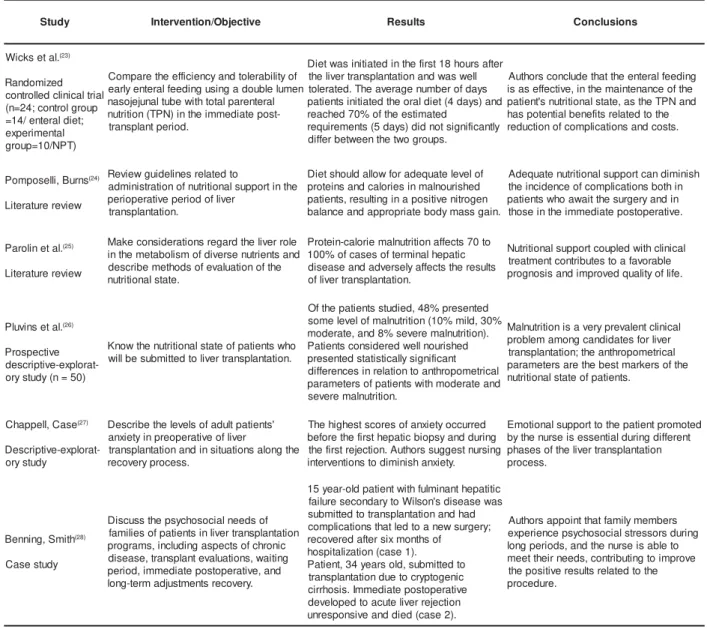
A sy nt hesis of t he ar t icles included in t he int egr at ive r ev iew, dist r ibut ed in Tables 1, 2, 3, 4 a n d 5 a c c o r d i n g t o t h e e s t a b l i s h e d t h e m a t i c cat egor ies, is pr esen t ed below .
Table 1 – Synt hesis of st udies relat ed t o nursing care in t he preoperat ive period of liver t ransplant at ion
Table 2 – Synt hesis of st udies relat ed t o t he nursing care in t he int raoperat ive period of liver t ransplant at ion
y d u t
S Intervention/Objective Results Conclusions
l a t e r e z l e m h c
S .(9)
d e ll o r t n o c d e z i m o d n a R ) 5 2 = n ( l a i r t l a c i n il c d n a g n i n a e l c c i n o l o c e h t e r a p m o C n o it a r t s i n i m d a e h t n i s d i u lf f o n o it p r o s b a ) p u o r g l o r t n o c ( r e t a w p a t h t i w a m e n e f o l a t n e m i r e p x e ( a m e n e s d u s p a o s d n a d e t r o p e r t r o f m o c s i d e b i r c s e d d n a ) p u o r g . s t n e it a p y b n i d e tl u s e r a m e n e s d u s p a o s f o e s u e h T n e h w s t n e it a p y b d e t e r c x e t u p t u o r e t a e r g s t n e it a p n i d e n i a t b o s tl u s e r o t d e r a p m o c h t o b n i , s a w e r e h T . p u o r g l o r t n o c e h t n i e c n a l a b e v it a g e n a , a m e n e f o s e p y t f o t i x e d n a e c n a r t n e e h t n e e w t e b y b d i u lf f o n o it p r o s b a s a ll e w s a s n o it u l o s . n o l o c e h t r e t a e r g d e c u d o r p a m e n e s d u s p a o s e h T e n o e h t n a h t t n e t n o c l a n it s e t n i f o t u p t u o r a li m i s d e t n e s e r p h t o B . r e t a w p a t h t i w y ll a u q e e r e w d n a n o it p r o s b a f o s e t a r . s t n e it a p f o s p u o r g h t o b y b d e t a r e l o t h c i v o d a R (10)
y d u t s e s a C r a l u g u j s n a r t f o e s u e h t y f it n e d I ) S P I T ( t n u h s c i m e t s y s o t r o p c it a p e h a r t n i s t n e it a p n i e r a c g n i s r u n r o f s n o it a c il p m i y r o t c a r f e r p o l e v e d o h w , s i s o h r r i c h t i w l a n it s e t n i o r t s a g t n e r r u c e r d n a s e t i c s a . e g a h r r o m e h e h t g n i h s i n i m i d , s e t i c s a s e c u d e r S P I T f o s e c n a h c d n a s c it e r u i d r o f d e e n e h T . g n i d e e l b s e c i r a v l a e g a h p o s e c it a p e h o t d a e l n a c e r u d e c o r p g n i s r u n e h t g n i r i u q e r , y h t a p o l a h p e c n e . e c n a ll i e v r u s t n a t s n o c s ' m a e t ' s t n e it a p s e t o m o r p S P I T f o e s u e h T s e h c a e t m a e t g n i s r u n e h T . e f il f o y t il a u q r o f s w o ll a h c i h w , s e il i m a f d n a s t n e it a p d e t a l e r s n o it a c il p m o c f o n o it c e t e d y l r a e . e r u d e c o r p e h t o t r e g r e b m u r
K (11)
w e i v e r e r u t a r e t i L r o f e r a c o t e r u t a r e t il e h t n i t r o p p u s k e e S e r u li a f c it a p e h t n a n i m l u f h t i w s t n e it a p e v o r p m i o t e r a c y r a s s e c e n d n a ) F H F ( r e v il a g n it i a w a s t n e it a p f o l a v i v r u s . n o it a t n a l p s n a r t d l u o h s e s r u n e h t , F H F l a it n e t o p f o e s a c n I k s a , y r o t s i h d e li a t e d s 't n e it a p e h t t c e ll o c , s n o it a c i d e m f o n o it s e g n i e h t t u o b a f o e s u , s e c n a t s b u s c i x o t a p e h y ll a i c e p s e l a n o it a p u c c o , e n i a c o c r o l o h o c l a n i , s d i u lf y d o b d n a d o o l b o t e r u s o p x e a g n it s e g g u s s d r a z a h r e h t o o t n o it i d d a . n i x o t l a r i v e v i s n e t n i s ' m a e t l a n o i s s e f o r p it l u m e h T t s a f d n a g n i r o t i n o m d e li a t e d , e r a c n a c n o it a t n a l p s n a r t r e v il o t g n i d r a w r o f e h t f o l a v i v r u s f o s e c n a h c e h t e v o r p m i . F H F h t i w t n e it a p y d u t
S Intervention/Objective Results Conclusions
n n y l F , y b o o
L (12)
t r o p e r e c n e i r e p x E f o n o it c u r t s n o c e h t n i s e g a t s e h t t r o p e R e h t f o m e t s y s n o it a t n e m u c o d d e t a r g e t n i t n e it a p o t d e r e v il e d e r a c g n i s r u n . n o it a t n a l p s n a r t r e v il o t d e t t i m b u s e w n o it a m r o f n i d e r e t s i g e r e h t g n o m A , t s o l d o o l b , e r u d e c o r p l a c i g r u s : t h g il h g i h -d o o lf , g n i s s e r d , s e r u s o l c d n u o w l a c i g r u s r a l u c s a v , s n o it i d n o c n i k s ,l e n n a h c s s a p y b s g u r d , s y a w r i a f o e c n a n e t n i a m , s s e c c a , d e r e t s i n i m d a s d i u lf f o l a t o t , n o i s u f n i t n e c e r e r o m d n a d o o l b f o y t il i b a li a v a . s m a x e y r o t a r o b a l f o n o it a t n e m u c o d e h t t a h t t n i o p p a s r o h t u A s i d o i r e p e v it a r e p o i r e p e h t n i e r a c g n i s r u n o t d e r e v il e d e r a c e h t y f it n e d i o t y r a s s e c e n e h t e t a u l a v e o t a t a d e d i v o r p d n a s t n e it a p . s tl u s e r y b o o L (13)
Table 3 – Synt hesis of st udies relat ed t o nursing care in t he post operat ive period of liver t ransplant at ion
y d u t
S Intervention/Objective Results Conclusions
.l a t e z e n é m i
J (14)
w e i v e r e r u t a r e t i L t n e u q e r f t s o m e h t e b i r c s e D t n e it a p e h t y b d e c n e i r e p x e s n o it a c il p m o c e h t n i n o it a t n a l p s n a r t r e v il o t d e t t i m b u s s ' e s r u n e h t d n a e v it a r e p o t s o p e t a i d e m m i . e l o r e h t n o d e s u c o f s i k r o w s ' e s r u n e h T f o n o it c e t e d y l r a e r o n o it n e v e r p l a n i m r e t e h t , t a h t r o F . s n o it a c il p m o c l a c i g r u s -c it e h t s e n a d n a y h t a p o t a p e h a t a h t o s n w o n k e b t s u m s e c n e r r u c r e t n i f o k s i r e h t n o n o it a u l a v e t s a f . e l b i s s o p s i s n o it a c il p m o c f o e g d e l w o n k e v a h o t d e e n s e s r u N o t s e it il i b a p o l e v e d d n a s n o it a c il p m o c . y r a s s e c e n n e h w m e h t h t i w k r o w .l a t e n a m e t i h
W (15)
d e ll o r t n o c d e z i m o d n a R ) 9 6 = n ( l a i r t l a c i n il c s u o u n it n o c f o y c a c if f e e h t e t a g it s e v n I º 0 6 n i ) T R L C ( y p a r e h t n o it a t o r l a r e t a l c i m a n y D e u c t s e R f o e s u e h t h t i w e l g n a y r a n o m l u p e c u d e r o t ® d e B y p a r e h T r i A h t i w g n i r a p m o c , s n o it a c il p m o c g n i g n a h c f o y p a r e h t l a n o it n e v n o c a n i s r u o h o w t y r e v e n o it i s o p t n e b m u c e d . d e b d r a d n a t s t c a r t y r o t a r i p s e r r e w o l f o e c n e d i c n i e h T e h t d n a , r e w o l y lt n a c if i n g i s s a w n o it c e f n i s a w d e r r u c c o n o it c e f n i e h t e r o f e b e m it d e s u o h w p u o r g e h t n i r e g n o l y lt n a c if i n g i s a g n i s u p u o r g e h t o t d e r a p m o c R T L C c i n a h c e m f o n o it a r u d e h T . d e b d r a d n a t s s a , s p u o r g h t o b n i r a li m i s s a w n o it a li t n e v f o e c n e d i c n i d n a n o it u l o s e r s a ll e w . s i s a t c e l e t a s a w T R L C e h t t a h t e d u l c n o c s r o h t u A d n a e c n e d i c n i g n i h s i n i m i d n i t n e i c if f e f o e c n a r a e p p a e h t r o f y r a s s e c e n e m it . t c a r t y r o t a r i p s e r r e w o l e h t n i s n o it c e f n i .l a t e a z n u c a
L (16)
e v it c e p s o r t e R y r o t a r o l p x e -e v it p i r c s e d ) 3 8 = n ( y d u t s e h t n i s e c n e r e f f i d g n it s i x e e r u s a e M o w t n i e r a c g n i s r u n f o t n e m p o l e v e d d e t t i m b u s s t n e it a p f o s p u o r g e v it u c e s n o c ) II G d n a I G ( n o it a t n a l p s n a r t r e v il o t e h t y b d e h s il b a t s e n a l p o t g n i d r o c c a . ) U C I ( t i n U e r a C e v i s n e t n I r e t r o h s a d a h II G e h t n i s t n e it a P e h t n a h t ) s y a d 5 . 3 ( U C I e h t n i e c n e n a m r e p ll e w s a w t e i d l a r o e h T . ) s y a d 4 . 4 ( I G s a w t i h g u o h t , s t n e it a p ll a n i d e t a r e l o t e h T .I I G e h t n i r e il r a e d e t r a t s d e m r o f r e p e r e w s l o r t n o c l a c i g o l o i r e t c a b I G e h t n i n a h t ) 5 ( II G e h t n i y lt n e u q e r f s s e l . ) 9 1 ( d e c u d e r e h t t a h t e d u l c n o c s r o h t u A s a , U C I e h t n i s t n e it a p f o e c n e n a m r e p l a c i n il c f o r e b m u n d e c u d e r e h t s a ll e w , s r a e y e h t r e v o s m a x e l a i r o t a r o b a l d n a e r a c f o t n e m e v o r p m i t n e s e r p e r s d e b e r o m d n a s t s o c d e c u d e r , d e r e v il e d . U C I e h t n i e l b a li a v a .l a t e e u g a
Y (17)
l a n i d u t i g n o L e v it c e p s o r t e r y r o t a r o l p x e -e v it p i r c s e d ) 7 4 = n ( y d u t s d n a e r a c f o y c n e i c if f e e h t e t a u l a v E f o e t a r e h t g n i d r a g e r n a l p l a n o it a c u d e f o d n u o w l a c i g r u s d n a s n o it c e f n i h t u o m g n i r u d t n a l p s n a r t r e v il a h t i w t n e it a p e h t d n a l a t i p s o h e h t n i y r t n e s 't n e it a p e h t . e g r a h c s i d r e t f a % 8 7 . 9 2 , s e s a c d e z y l a n a 7 4 e h t f O n i g i r o l a r i v f o s n o it c e f n i h t u o m d e t n e s e r p e h t f o n o it c e f n i d e t n e s e r p % 2 0 . 7 1 d n a s n o it c e f n i h t u o m n e T . d n u o w l a c i g r u s f o ) % 2 0 . 7 1 ( s n o it c e f n i t h g i e d n a ) % 7 2 . 1 2 ( e h t n i d e v r e s b o e r e w d n u o w l a c i g r u s e h t d n o c e s e h t n I . g n it f a r g e h t r e t f a h t n o m t s r if ) % 8 3 . 6 ( s n o it c e f n i h t u o m e e r h t , d o i r e p n o it c e f n i d n u o w l a c i g r u s ) % 2 1 . 2 ( e n o d n a n o it c e f n i h t u o m e n o y l n O . d e t c e t e d e r e w . d o i r e p d r i h t e h t n i d e v r e s b o s a w ) % 2 1 . 2 ( f o e c n a t r o p m i e h t e z i s a h p m e s r o h t u A n o n o it a c u d e ' s t n e it a p n i e l o r ' s e s r u n e h t y ll a i c e p s e , s n o it c e f n i f o n o it n e v e r p e h t . e m o h t a e r a c -fl e s g n i d r a g e r .l a t e o n a m o l o
P (18)
w e i v e r e r u t a r e t i L e r a c g n i s r u n e h t n o s n o it a r e d i s n o c e k a M y ll a i c e p s e d n a s t n e it a p r e c n a c o t r a l u ll e c o t a p e h f o t n e m t a e r t l a c i g r u s d n a s n o it c e s e r r e v il c it a p e h ( s a m o n i c r a c . ) n o it a t n a l p s n a r t r e v il n a l p e r a c g n i s r u n e h t e b i r c s e d s r o h t u A d n a s e s o n g a i d g n i s r u n , s l a o g g n i d u l c n i s ' e s r u n e h t e z i s a h p m e y e h T . s n o it n e v r e t n i ll e w s a d e r e v il e d e r a c e h t n i y t il i b i s n o p s e r d n a e g d e l w o n k f o t n e m p o l e v e d e h t s a f o t n e m t a e r t d n a n o it n e v e r p e h t n i s e it il i b a . s t n e it a p e s e h t r o f s n o it a c il p m o c n o m m o c e r a c l a c it i r c n i g n i s r u n f o e c n a t r o p m i e h T r e v il o t d e t t i m b u s s t n e it a p o t e v o r p m i o t d e e n e h t d n a n o it a t n a l p s n a r t o t y r a s s e c e n s e it il i b a d n a e g d e l w o n k e r a s e i p a r e h t x e l p m o c h t i w k r o w . d e t h g il h g i h .l a t e i u g e d l a
Z (19)
t r o p e r e c n e i r e p x E y r a il i c i m o d n i k r o w s ' e s r u n e h t e b i r c s e D n o it a t n a l p s n a r t r e v il a n i n o it a z il a t i p s o h . m a r g o r p e h t , n a l p e r a c a f o s e g a t n a v d a e h t g n o m A e h t f o n o it a r e tl a l a m i n i m : s s e r t s s r o h t u a , e l y t s e f il s ' y li m a f d n a s 't n e it a p , e r a c l a r g e t n i d n a d e z il a u d i v i d n i n i s i s o n g a i d l a n o it a u t i s , y t e i x n a d e z i m i n i m d e g a r u o c n e d n a e p o c s y li m a f e h t . y m o n o t u a s ' e s r u n e h t f o t n e m p o l e v e d e h t t a e r a c g n i s r u n f o y t i u n it n o c e h T o t l o o t t n e i c if f e n a s i e m o h ' s t n e it a p e t o m o r p , n o it a z il a t i p s o h e c u d e r , t n e m n o r i v n e y li m a f e h t n i n o it a r g e t n i d e v o r p m i s 't n e it a p e h t o t d a e l h c i h w . e f il f o y t il a u q y e n i r e M , z tl u h
S (20)
Table 4 – Synt hesis of st udies on pat ient s’ educat ion and nurses’ role regarding liver t ransplant at ion
y d u t
S Intervention/Objective Results Conclusions
.l a t e o c n a r
F (21)
t r o p e r e c n e i r e p x E ' s t n e it a p f o t n e m p o l e v e d e h t t n e s e r P f o s m a r g o r p n i e t a p i c it r a p o h w , n o it a c u d e r i e h t s s u c s i d d n a , n o it a t n a l p s n a r t s n a g r o . s d e e n l a n o it a c u d e s a n o o s s a d e t a it i n i e b d l u o h s n o it a c u d E d n a d o i r e p t n a l p s n a r t -e r p e h t n i e l b i s s o p . e g r a h c s i d l a t i p s o h r e t f a e u n it n o c s e g a t s n o it a t n a l p s n a r t e h t g n i d n a t s r e d n U d l u o h s t a h t n o it a m r o f n i t n a t s n o c s e r i u q e r s y a l p n o it a c u d E . d e c r o f n i e r y ll a c i d o i r e p e b d n a s 't n e it a p e h t n i e l o r t n a t r o p m i n a e h t e m o c r e v o o t n o it a r a p e r p s ' y li m a f g n o l e h t o t d e t a i c o s s a s e g n e ll a h c . t n e m t a e r t e r a c e v it a r e p o o c f o n o it a t n e m e l p m i e h T d n a s e g n e ll a h c y n a m o t s d a e l d n a n o it a t n e m e l p m i , s e it i n u t r o p p o l a n o it a c u d e g n it a v o n n i f o n o it a u l a v e f o s d e e n l a e r e h t t e e m o t e l b a s e i g e t a r t s s i h t o g r e d n u o h w s e il i m a f d n a s t n e it a p . t n e m t a e r t f o d n i k o d e v e z A , o s s a
S (22)
t r o p e r e c n e i r e p x E g n it n e m e l p m i f o e c n e i r e p x e e h t n o t r o p e R e h t d n a m a r g o r p n o it a t n a l p s n a r t r e v il a . d o i r e p e v it a r e p o i r e p e h t n i e l o r s ' e s r u n t n a l p s n a r t e h t w o h e b i r c s e d s r o h t u A e h t d n a m a e t y r a n il p i c s i d it l u m s ' r e t n e c e v it a r e p o i r e p e h t n i s e it i v it c a s ' e s r u n d n a n o it a n i d r o o C . d e m r o f e r e w d o i r e p r e t n e C y p a r e h T e v i s n e t n I e h t n i n o it a t n e i r o e h t e r a t i n u n o it a z il a t i p s o h e h t n i d n a o t n o it i d d a n i h g u o h t , y t il i b i s n o p s e r s ' e s r u n d n a c i n il c t n e it a p t u o e h t n i s e it i v it c a e s e h t s r e v il e d l a n o i s s e f o r p s i h t , r e t n e c l a c i g r u s . s e il i m a f d n a s t n e it a p o t e r a c t c e r i d n o it n e v e r p e h t n o k r o w d l u o h s e s r u n e h T , s n o it a c il p m o c f o n o it a c if it n e d i d n a e h t r o f w o ll a t a h t s n o it c a t n e m e l p m i s 't n e it a p e h t f o t n e m e v o r p m i d n a y r e v o c e r e h t t n i o p p a s r o h t u a e h T . e f il f o y t il a u q r o f s e n il e d i u g e d i v o r p o t d e e n s i h t n i e r a c g n i s r u n f o n o it a z it a m e t s y s . a e r a y d u t
S Intervention/Objective Results Conclusions
.l a t e s k c i
W (23)
d e z i m o d n a R l a i r t l a c i n il c d e ll o r t n o c p u o r g l o r t n o c ; 4 2 = n ( ; t e i d l a r e t n e / 4 1 = l a t n e m i r e p x e ) T P N / 0 1 = p u o r g f o y t il i b a r e l o t d n a y c n e i c if f e e h t e r a p m o C n e m u l e l b u o d a g n i s u g n i d e e f l a r e t n e y l r a e l a r e t n e r a p l a t o t h t i w e b u t l a n u j e j o s a n -t s o p e t a i d e m m i e h t n i ) N P T ( n o it i r t u n . d o i r e p t n a l p s n a r t r e t f a s r u o h 8 1 t s r if e h t n i d e t a it i n i s a w t e i D ll e w s a w d n a n o it a t n a l p s n a r t r e v il e h t s y a d f o r e b m u n e g a r e v a e h T . d e t a r e l o t d n a ) s y a d 4 ( t e i d l a r o e h t d e t a it i n i s t n e it a p d e t a m it s e e h t f o % 0 7 d e h c a e r y lt n a c if i n g i s t o n d i d ) s y a d 5 ( s t n e m e r i u q e r . s p u o r g o w t e h t n e e w t e b r e f f i d g n i d e e f l a r e t n e e h t t a h t e d u l c n o c s r o h t u A e h t f o e c n a n e t n i a m e h t n i , e v it c e f f e s a s i d n a N P T e h t s a , e t a t s l a n o it i r t u n s 't n e it a p e h t o t d e t a l e r s t if e n e b l a it n e t o p s a h . s t s o c d n a s n o it a c il p m o c f o n o it c u d e r s n r u B , il l e s o p m o
P (24)
w e i v e r e r u t a r e t i L o t d e t a l e r s e n il e d i u g w e i v e R e h t n i t r o p p u s l a n o it i r t u n f o n o it a r t s i n i m d a r e v il f o d o i r e p e v it a r e p o i r e p . n o it a t n a l p s n a r t f o l e v e l e t a u q e d a r o f w o ll a d l u o h s t e i D d e h s i r u o n l a m n i s e i r o l a c d n a s n i e t o r p n e g o r t i n e v it i s o p a n i g n it l u s e r , s t n e it a p . n i a g s s a m y d o b e t a i r p o r p p a d n a e c n a l a b h s i n i m i d n a c t r o p p u s l a n o it i r t u n e t a u q e d A n i h t o b s n o it a c il p m o c f o e c n e d i c n i e h t n i d n a y r e g r u s e h t t i a w a o h w s t n e it a p . e v it a r e p o t s o p e t a i d e m m i e h t n i e s o h t .l a t e n il o r a
P (25)
w e i v e r e r u t a r e t i L e l o r r e v il e h t d r a g e r s n o it a r e d i s n o c e k a M d n a s t n e i r t u n e s r e v i d f o m s il o b a t e m e h t n i e h t f o n o it a u l a v e f o s d o h t e m e b i r c s e d . e t a t s l a n o it i r t u n o t 0 7 s t c e f f a n o it i r t u n l a m e i r o l a c -n i e t o r P c it a p e h l a n i m r e t f o s e s a c f o % 0 0 1 s tl u s e r e h t s t c e f f a y l e s r e v d a d n a e s a e s i d . n o it a t n a l p s n a r t r e v il f o l a c i n il c h t i w d e l p u o c t r o p p u s l a n o it i r t u N e l b a r o v a f a o t s e t u b i r t n o c t n e m t a e r t . e f il f o y t il a u q d e v o r p m i d n a s i s o n g o r p .l a t e s n i v u l
P (26)
e v it c e p s o r P -t a r o l p x e -e v it p i r c s e d ) 0 5 = n ( y d u t s y r o o h w s t n e it a p f o e t a t s l a n o it i r t u n e h t w o n K . n o it a t n a l p s n a r t r e v il o t d e t t i m b u s e b ll i w d e t n e s e r p % 8 4 , d e i d u t s s t n e it a p e h t f O % 0 3 , d li m % 0 1 ( n o it i r t u n l a m f o l e v e l e m o s . ) n o it i r t u n l a m e r e v e s % 8 d n a , e t a r e d o m d e h s i r u o n ll e w d e r e d i s n o c s t n e it a P t n a c if i n g i s y ll a c it s it a t s d e t n e s e r p l a c i r t e m o p o r h t n a o t n o it a l e r n i s e c n e r e f f i d d n a e t a r e d o m h t i w s t n e it a p f o s r e t e m a r a p . n o it i r t u n l a m e r e v e s l a c i n il c t n e l a v e r p y r e v a s i n o it i r t u n l a M r e v il r o f s e t a d i d n a c g n o m a m e l b o r p l a c i r t e m o p o r h t n a e h t ; n o it a t n a l p s n a r t e h t f o s r e k r a m t s e b e h t e r a s r e t e m a r a p . s t n e it a p f o e t a t s l a n o it i r t u n e s a C ,l l e p p a h
C (27)
-t a r o l p x e -e v it p i r c s e D y d u t s y r o ' s t n e it a p tl u d a f o s l e v e l e h t e b i r c s e D r e v il f o e v it a r e p o e r p n i y t e i x n a e h t g n o l a s n o it a u t i s n i d n a n o it a t n a l p s n a r t . s s e c o r p y r e v o c e r d e r r u c c o y t e i x n a f o s e r o c s t s e h g i h e h T g n i r u d d n a y s p o i b c it a p e h t s r if e h t e r o f e b g n i s r u n t s e g g u s s r o h t u A . n o it c e j e r t s r if e h t . y t e i x n a h s i n i m i d o t s n o it n e v r e t n i d e t o m o r p t n e it a p e h t o t t r o p p u s l a n o it o m E t n e r e f f i d g n i r u d l a it n e s s e s i e s r u n e h t y b n o it a t n a l p s n a r t r e v il e h t f o s e s a h p . s s e c o r p h t i m S , g n i n n e
B (28)
y d u t s e s a C f o s d e e n l a i c o s o h c y s p e h t s s u c s i D n o it a t n a l p s n a r t r e v il n i s t n e it a p f o s e il i m a f c i n o r h c f o s t c e p s a g n i d u l c n i , s m a r g o r p g n it i a w , s n o it a u l a v e t n a l p s n a r t , e s a e s i d d n a , e v it a r e p o t s o p e t a i d e m m i , d o i r e p . y r e v o c e r s t n e m t s u j d a m r e t -g n o l c it it a p e h t n a n i m l u f h t i w t n e it a p d l o -r a e y 5 1 s a w e s a e s i d s ' n o s li W o t y r a d n o c e s e r u li a f d a h d n a n o it a t n a l p s n a r t o t d e t t i m b u s ; y r e g r u s w e n a o t d e l t a h t s n o it a c il p m o c f o s h t n o m x i s r e t f a d e r e v o c e r . ) 1 e s a c ( n o it a z il a t i p s o h o t d e t t i m b u s , d l o s r a e y 4 3 , t n e it a P c i n e g o t p y r c o t e u d n o it a t n a l p s n a r t e v it a r e p o t s o p e t a i d e m m I . s i s o h r r i c n o it c e j e r r e v il e t u c a o t d e p o l e v e d . ) 2 e s a c ( d e i d d n a e v i s n o p s e r n u s r e b m e m y li m a f t a h t t n i o p p a s r o h t u A g n i r u d s r o s s e r t s l a i c o s o h c y s p e c n e i r e p x e o t e l b a s i e s r u n e h t d n a , s d o i r e p g n o l e v o r p m i o t g n it u b i r t n o c , s d e e n r i e h t t e e m e h t o t d e t a l e r s tl u s e r e v it i s o p e h t . e r u d e c o r p
DI SCUSSI ON
Th e p r e o p e r a t i v e p e r i o d o f l i v e r t ransplant at ion ranges from t he m om ent t he pat ient en t er s t h e w ait in g list of t h e Healt h Secr et ar y t o receive a liver from a diseased donor to the m om ent the patient is called to receive the graft in the hospital. I n Br azil, t his per iod is long and cur r ent ly t akes around t hree years. The pat ient wit h a severe hepat ic disease can dev elop sev er al com plicat ions, since such disease can com pr om ise sever al or ganic sy st em s. I n t his per iod, t he pat ient is per iodically supervised by a physician in the outpatient clinic and ev aluat ed by a nur se and ot her pr ofessionals fr om t he m ult idisciplinar y t eam , such as social w or k er s, nut rit ionist s, psychologist s and physiot herapist s.
Th e i n t r a o p e r a t i v e p e r i o d o f l i v e r transplantation is considered one of the m ost com plex m om ent s in t he process because, m ost of t he t im es, t he r eceiv er alr eady pr esent s sev er al com plicat ions d u e t o t h e p r im ar y d isease. Ad d it ion ally, sev er al fact ors influence success in t his period, am ong t hem t he condit ions of t he donat ed liver, t im e of ischem ia until the new liver im plantation, intense hem orrhages that accom pany the procedure, and other anesthetic-su r g i ca l i n t e r cu r r e n ce s( 1 2 - 1 3 ). I n t h i s sce n a r i o ,
int er v ent ions im plem ent ed by t he nur se t o pr ev ent lesions ar e r elev ant , such as t he use of dev ices t o assure adequate surgical positioning and to avoid the occurrence of pressure ulcers.
Af t e r t h e r e co v e r y o f v i t a l a n d h e p a t i c functions, patients are kept in a special hospitalization unit for a few day s unt il t hey ar e in condit ions for dischar ge. Thus, nur sing car e in t he post oper at iv e period focuses on the im plem entation of interventions direct ed at t he prevent ion or early det ect ion of t he m o r e f r e q u e n t co m p l i ca t i o n s, su ch a s su r g i ca l ( Hem operitoneum , biliary and vascular com plications) , g r af t ( p r im ar y g r af t f ailu r e, acu t e r ej ect ion ) an d gen eral com plicat ion s ( r espir at or y, car diovascu lar, r e n a l , h e m a t o l o g i ca l , m e t a b o l i c, d i g e st i v e , a n d infect ious)( 14- 17). These com plicat ions part ially depend
o n t h e p a t i e n t ’ s co n d i t i o n s b e f o r e t h e l i v e r t r ansplant at ion.
Th e a d m i n i st r a t i o n o f m e d i ca t i o n i s a n essen t ial act iv it y for t h e n u r se in v olv ed in a liv er t ransplant at ion program . This act ivit y perm eat es t he p e r i o p e r a t i v e p e r i o d a n d i n v o l v e s n o t o n l y t h e adm inist rat ion of drugs per se, but also a process of education in health, which provides patients, and their
fam ilies, inform ation to correctly use the m edicam ent t h er ap y at h om e w it h t h e sm allest r isk p ossib le, especially in relation to the im m unosuppressive drugs. The em ergence of im m unosuppressive drugs ( such as cyclospor ineand t acr olim us) is one of t he factors perm itting increased life expectancy after liver t r a n sp l a n t a t i o n , b y f i g h t i n g r e j e ct i o n o f t h e transplanted organ. The nursing team needs to know the indication, m echanism s of action, advantages and disadvantages, adm inistration routes, side effects and necessary care regarding t he use of t his t herapy( 20).
Teaching pat ient s is a nur se’s difficult t ask b e ca u se i t d e m a n d s t h e i m p l e m e n t a t i o n o f int ervent ions t hat cause changes in t he pat ient s’ life st yle, affect ing t heir personal values and beliefs. For t he pat ient t o achieve an independent life st yle aft er t h e t r a n sp l a n t a t i o n , t h e n u r se sh o u l d p r o v i d e knowledge related to nutrition, m edication, m onitoring of v it al signs, and r egist r at ion of infor m at ion. The educat ion pr om ot es t he dev elopm ent of cognit iv e, p sy ch om ot or an d at t it u d in al ab ilit ies, w it h w h ich pat ient s and fam ilies can guarant ee t he cont inuit y of care and an act ive part icipat ion in t he t reat m ent( 21).
Nu r se s w o r k o n t h e p r e , i n t r a a n d post oper at iv e per iods of liv er t r ansplant at ion, w it h specific act ivit ies, whet her in t he out pat ient clinic, in t he hospit alizat ion unit , in t he surgical unit or in t he int ensive t herapy unit . The planning, im plem ent at ion and ev aluat ion of car e in t r ansplant ed pat ient s ar e part of the coordinating nurse’s role. This professional a ct s a s a l i n k i n t h e m u l t i d i sci p l i n a r y t e a m ’ s co m m u n i ca t i o n , a n d ef f ect i v e co m m u n i ca t i o n i s essent ial in care delivery t o pat ient s and fam ilies( 22).
Al t h ou g h t h e n u r se i s on l y on e of t h e m em b er s co n t r i b u t i n g t o t h e ca r e f o r p a t i e n t s w i t h l i v e r t r ansplant at ion, his r ole is essent ial for t r eat m ent su ccess.
Ma l n u t r i t i o n h a s t o b e t r e a t e d b e f o r e t ransplant at ion, so t hat chances of a posit ive result ar e i n cr eased an d ch an ces of an y p ost op er at i v e co m p l i cat i o n s ar e d ecr eased( 2 3 ). Th i s p r o b l em i s
t reat ed by t he m ult idisciplinary t eam : t he nut rit ionist evaluat es t he m inim um nut rit ional condit ions for t he pat ient t o bear t he sur gical st r ess, w hile t he social w o r k e r e v a l u a t e s t h e p a t i e n t ’ s so ci o - e co n o m i c con dit ion s t o assu r e t h e f am ily h as t h e m ean s t o acquire adequate food. The psychologist, on the other h an d, ev alu at es t h e pat ien t ’s em ot ion al st at e an d f a ct o r s t h a t ca n l e a d t o n o n - a d h e r e n ce t o a n appropriate diet; it is the physician’s role to prescribe m edication, or even the use of an enteral or parenteral d i et . Fi n al l y, t h e n u r se f r eq u en t l y ev al u at es t h e d e v e l o p m e n t o f t h e p a t i e n t ’ s n u t r i t i o n a l st a t e , o b ser v i n g an d r eco r d i n g p h y si o l o g i cal f u n ct i o n s, verifying weight and waist circum ference, accept ance of t he diet and preferences( 24- 26).
Th e n u r se , a s a m e m b e r o f t h e m ultidisciplinary team , spends m ost tim e with patients and is t he elem ent capable of k eeping an affect iv e bond wit h pat ient s and fam ilies, especially in a liver t ransplant at ion program in which t he whole process involves a long period of tim e. Thus, patients establish w it h n u r ses a r elat ion sh ip of t r u st , r esp ect , an d fr eedom t o shar e t heir anx iet y and fear s. Many of them experience m om ents of anguish, anxiety, fantasy and doubts, because they do not know how the whole
t r an splan t pr ocess w ill dev elop. My t h s an d beliefs relat ed t o t he organ t hat will be im plant ed, gender, age, t he donor origin, a pot ent ial rej ect ion t hat can en d t h e d r eam of h av in g a n or m al lif e, all t h ese elem ent s and ot hers influence t he em ot ional st at e of t hose await ing a liver t ransplant at ion. Therefore, t he m u lt id iscip lin ar y t eam p lay s an essen t ial r ole in cl a r i f y i n g a l l p a t i en t s’ a n d f a m i l i es’ d o u b t s a n d quest ions. The psychologist ’s role in t his process is essent ial, as well as t hat of t he nurse, because t he nur se can, t hr ough ex change of infor m at ion, br ing new elem ents for the psychological and, m any tim es, psychiatric treatm ent, because som e patients develop disorders t hat require specialized t reat m ent( 27- 29).
CONCLUSI ON
Aft er t his int egrat ive review was carried out , the relevance of the nurse’s role in liver transplantation p r o g r a m s b e ca m e cl e a r. Th i s p r o f e ssi o n a l i s responsible for t he m anagem ent of care delivered t o p a t i e n t s a n d f a m i l i e s a n d p e r f o r m s ca r e , adm inist rat ive, educat ional and r esear ch act iv it ies, w h i c h a r e o f f u n d a m e n t a l i m p o r t a n c e f o r t h e s u c c e s s o f l i v e r t r a n s p l a n t a t i o n . T h u s , t h e r esear ch er s con sider t h e f u n dam en t al im por t an ce o f r e se a r ch d e v e l o p m e n t a n d / o r t h e u se o f i t s r e su l t s t o su p p o r t cl i n i ca l p r a ct i ce a n d , i n t h i s scenar io, ev idence- based pract ice has a lot t o offer.
REFERENCES
1 . Mi es S. Tr a n sp l a n t e d e f íg a d o. Rev Ass Med Br a si l . 1 9 9 8 ; 4 4 ( 2 ) : 1 2 7 - 3 4 .
2. Massar ollo MC, Kur cgant P. O v iv encial dos enfer m eir os no program a de t ransplant e de fígado de um hospit al público. Rev Lat - am Enfer m agem 2000; 8( 4) : 66- 72.
3. Galv ão CM, Saw ada NO, Rossi LA. Pr át ica baseada em evidências: considerações t eóricas para sua im plem ent ação n a en f er m ag em p er iop er at ór ia. Rev Lat - am En f er m ag em 2 0 0 2 ; 1 0 ( 5 ) : 6 9 0 - 5 .
4 . Br o o m e ME. I n t e g r a t i v e l i t e r a t u r e r e v i e w s f o r t h e developm ent of concept s. I n: Rodgers BL, Knafl KA. Concept d e v e l o p m e n t i n n u r si n g : f o u n d a t i o n s, t e ch n i q u e s a n d ap p licat ion s. Ph ilad elp h ia: WB Sau n d er s Com p an y 2 0 0 0 . p . 2 3 1 - 5 0 .
5. Whit t em ore R, Knafl K. The int egrat ive review : updat ed m et hodology. J Adv Nur s. 2005; 52( 5) : 546- 53.
6 . Ur si ES, Galv ão CM. Pr ev en ção d e lesões d e p ele n o perioperat ório: revisão int egrat iva da lit erat ura. Rev Lat - am En fer m agem 2 0 0 6 ; 1 4 ( 1 ) : 1 2 4 - 3 1 .
7. Polit DF, Beck CT, Hungler BF. Fundam ent os de pesquisa em enferm agem : m ét odos, avaliação e ut ilização. 5a ed. Port o
Alegr e ( RGS) : Ar t m ed, 2004.
8. St et ler CB, Mor si D, Ruck i S, Br ought on S, Cor r igan B, Fit zgerald J et al. Ut ilizat ion- focused int egrat ive reviews in a nur sing ser v ice. Appl Nur s Res. 1998; 11( 4) : 195- 206. 9. Schm elzer M, Case P, Chappell SM, Wr ight KB. Colonic cleansing, fluid absorpt ion, and discom fort following t ap wat er and soapsuds enem as. Appl Nur s Res. 2000; 13( 2) : 83- 91. 1 0 . Ra d o v i ch PA. Use o f t r a n sj u g u l a r i n t r a h e p a t i c por t osy st em ic sh u n t in liv er disease. J Vasc Nu r s. 2 0 0 0 ; 1 8 ( 3 ) : 8 3 - 7 .
11. Krum berger J. When the liver fails. RN 2002; 65(2): 26-9. 1 2 . L o o b y M , Fl y n n M . Pe r i o p e r a t i v e n u r s i n g docum ent at ion in liv er t r ansplant at ion. Br J Theat r e Nur s. 1 9 9 8 Ju l ; 8 ( 4 ) : 2 5 - 3 0 .
13. Looby M. Transplant surgery: organ procurem ent and liver t ransplant at ion. World I r Nurs. 1995; 3( 3) : 13- 5.
1 4 . Jim én ez AC, Roch er a CU, Álv ar ez MJS, Del- Real A. Com plicaciones pot enciales em el t rasplant e hepát ico. Met as En f er m . 1 9 9 8 ; 1 ( 1 0 ) : 8 - 1 4 .
16. Lacunza MM, Arm endariz AC, Del- Barrio M, Margall MA, Asiain MC. Evolución en la at ención post operat oria en UCI al p a ci e n t e co n t r a sp l a n t e h e p á t i co . En f e r m I n t e n si v a 1 9 9 9 ; 1 0 ( 4 ) : 1 6 2 - 7 3 .
17. Yague LV, Cerezo MCM, Agust i I T, Munoz MP, Calvo CM. La infección en el enferm o con t rasplant e hepát ico: evaluación de los cuidados de prevención y educación. Enferm Clin.1998; 8 ( 2 ) : 6 4 - 7 0 .
18. Polom ano R, Weint raub FN, Wurst er A. Surgical crit ical care for cancer pat ient s. Sem in Oncol Nurs. 1994; 10 ( 3) : 165-7 6 .
19. Zaldegui JCP, Dom ínguez MVG, Oleaga MI T. Trasplant e hepát ico: enfer m er ía en la hospit alización a dom icilio. Rev Enfer m . 2003; 26( 6) : 51- 6.
20. Shult z SL, Meriney DK. Cyclosporine and t acrolim us: a co m p a r i so n o f i m m u n o su p p r e ssa n t s u se d f o r l i v e r t r an splan t at ion . Dim en s Cr it Car e Nu r s. 1 9 9 6 ; 1 5 ( 4 ) : 1 8 7 -9 7 .
21. Franco T, War r en JJ, Menke KL, Craft BJ, Cushing KA, Gou ld DA et al. Dev elopin g pat ien t an d f am ily edu cat ion program s for a t ransplant cent er. Pat ient Educ Couns. 1996; 2 7 ( 1 ) : 1 1 3 - 2 0 .
22. Sasso KD, Azevedo MAJ. Assist ência de enferm agem no
Recebido em : 27.12.2007 Aprovado em : 8.8.2008
t r ansplant e de fígado: a im por t ância do enfer m eir o nessa m odalidade t er apêut ica. Rev Nur sing 2003; 60( 6) : 16- 20. 2 3 . Wick s C, Som asundar am S, Bj ar nason I , Menzies I S, Rout ley D, Pott er D, et al. Com parison of ent eral feeding and t ot al parent eral nut rit ion aft er liver t ransplant at ion. Lancet 1 9 9 4 ; 3 4 4 ( 8 9 2 6 ) : 8 3 7 - 4 0 .
24. Pom poselli JJ, Bur ns DL. Nut r it ion suppor t in t he liv er t r ansplant pat ient . Nut r Clin Pr act . 2002; 17( 6) : 341- 9. 25. Par olin MB, Zaina FE, Lopes R. Terapia nut r icional no t ransplant e hepát ico. Arq Gast roent erol. 2002 ; 39( 2) : 114-2 114-2 .
2 6 . Pl u v i n s CC, Ba r b e r o MJT, Si l l e r o ED . Va l o r a ci ó n nut r icional de pacient es candidat os a t r asplant e hepát ico. Enfer m Clin. 1999; 9( 2) : 61- 4.
27. Chappell SM, Case P. Anxiety in liver t ransplant pat ient s. Medsur g Nur s. 1 9 9 7 ; 6 ( 2 ) : 9 8 - 1 0 3 .
2 8 . Ben n in g CR, Sm it h A. Psy ch osocial n eed s of f am ily m em bers of liver t ransplant pat ient s. Clin Nurse Spec. 1994; 8 ( 5 ) : 2 8 0 - 8 .