Copyright © 2015 Revista Latino-Americana de Enfermagem This is an Open Access article distributed under the terms of the Creative Commons Attribution Non-Commercial License (CC BY-NC).
This license lets others distribute, remix, tweak, and build upon your work non-commercially, and although their new works must also acknowledge you and be non-commercial, they don’t have to license their derivative works on the same terms.
Corresponding Author: Gabriela Lisieux Lima Gomes
Rua Dr. Damasquins Ramos Maciel, 687, Apto. 302 Bairro: Bessa
CEP: 58035-090, João Pessoa, PB, Brasil E-mail: [email protected]
1 Paper extracted from master’s thesis “Anxiety of children in hospital: Conceptual analysis”, presented to Universidade Federal da Paraíba, João
Pessoa, PB, Brazil.
2 Doctoral student, Centro de Ciências da Saúde, Universidade Federal da Paraíba, João Pessoa, PB, Brazil. Professor, Departamento de
Enfermagem, Universidade Estadual da Paraíba, Campina Grande, PB, Brazil.
3 PhD, Full Professor, Departamento de Enfermagem, Universidade Federal da Paraíba, João Pessoa, PB, Brazil.
Anxiety in children following hospitalization: a proposal for a nursing
diagnosis
1Gabriela Lisieux Lima Gomes
2Maria Miriam Lima da Nóbrega
3Objective: to describe the process of developing a nursing diagnosis regarding child anxiety
following hospitalization, which is to be submitted to the international classification for nursing
practice, in accordance with the guidelines set out by the International Council of Nurses and
the ISO standard 18104:2014. Method: this methodological study includes a conceptual analysis
that bases itself on analyzing the phenomena of anxiety and hospitalization, while identifying
the critical attributes of the concept and developing an operational definition. Results: all the
criteria for including a new nursing concept were followed and there was no violation of the
framework of the International Classification for Nursing Practice with the proposed inclusion,
since the concept of anxiety already exists in this classification system and the concept of anxiety
from hospitalization would be considered a species or subclass of this concept. Conclusion: this
analysis of the concept of hospitalization anxiety in children allowed its meaning to be clarified
and, consequently, understanding to be constructed regarding its practical applicability. This
achievement contributed in terms of providing incentive to develop new proposals for nursing
diagnoses to be included in the International Classification for Nursing Practice.
Descriptors: Nursing; Nursing Diagnosis; Child, Hospitalized; Anxiety; Concept Formation.
Rev. Latino-Am. Enfermagem
2015 Sept.-Oct.;23(5):963-70
DOI: 10.1590/0104-1169.0372.2637
www.eerp.usp.br/rlae
Introduction
In a study conducted with the objective of
buil-ding diagnostics statements, results and nursing
inter-ventions for children in a pediatric clinic, using the
In-ternational Classiication for Nursing Practice (ICNP®),
42 diagnostic concepts were developed, with the most
frequent being anxiety from hospitalization in children,
with 88.5%, ability to sleep and rest, with 74.2%, skin
discoloration, with 68.5%, and normal child
develop-ment, with 65.7%(1).
Identifying child anxiety by nurses following their
hospitalization, as referred to in the aforementioned
stu-dy, underlines the need for nursing staff to give special
attention whenever hospitalized children are involved.
Therefore, given the high prevalence of anxiety in the 0
to 5 year-old age group, this study was developed with
a view to deepen knowledge on this topic, while placing
emphasis on a proposal for a new nursing diagnosis to
be included in the ICNP®, the objective of which, among
other things, being to make a contribution in terms of
the care provided.
Because anxiety disorders are among the most
predominant psychiatric disorders during childhood and
adolescence, and that these remain undiagnosed and
largely undertreated,(2-3) means that the necessity for
professional pediatric caregivers to understand such
is-sues is critical, since identifying child anxiety following
hospitalization requires critical thinking, which in turn
requires deeper theoretical and practical knowledge.
These aspects, combined with the perception that there
is a lack of understanding regarding this concept,
espe-cially when it is referred to as a possible consequence of
hospitalization, indicate that clarifying this concept is
vi-tal. A thorough analysis is required in order to overcome
this shortcoming that can then enable its understanding
and be useful for the working systems that are involved
in pediatric nursing.
Building understanding in nursing is known to
need a structure of concepts, which makes it possible
to develop research and contribute to the building of
theories. Thus, studying the concept of child anxiety
following hospitalization makes analyzing unusual
phe-nomena in pediatric nursing care possible, such as
an-xiety and hospitalization, in addition to enabling
con-cepts that are essential for nursing development to be
continuously improved.
Based on the understanding that conceptual
analy-sis is directly linked to the development and expansion
of knowledge in nursing, its operation aims to clarify the
concepts that are useful in its practice, since these
con-cepts may contribute to suitable care being applied in
different scenarios of this profession. Another relevant
fact is that there needs to be new relection and updates
in relation to conceptual analysis methodologies, since
these type of studies make exchanges between nursing
knowledge and knowledge from different disciplinary
ields possible, which in turn enables the nature of nur
-sing to be explained and is helpful in deining its speciic ield and scientiic methodology(4).
The consensual and suitable deinition of the con -cept of child anxiety following hospitalization will give
rise to its speciic characteristics, which include attribu -tes that are background and consequential to this
con-cept, and will therefore provide the necessary foundation
to build a nursing diagnosis. From another perspective,
it can assist in relation to clinical reasoning being used,
for its identiication and planning and for implementing
quality nursing care. With this notion in mind,
explo-ring this concept is extremely important as doing so can
provide solutions to problems regarding the
terminolo-gy/words and expressions used, particularly in nursing,
which are essential for proper communication and can
contribute to constructing knowledge in this ield(5).
Thus, the objective of this article was to describe
the process of developing a proposal for a nursing
diag-nosis regarding child anxiety following hospitalization.
This proposal shall then be submitted to the
Internatio-nal Classiication for Nursing Practice (ICNP®). The
pro-posal will be based on analysis of the concepts of anxiety
and hospitalization and guidelines from the International
Council of Nurses and the ISO standard 18104:2014.
Method
Walker and Avant’s framework for concept analysis
was the methodology employed in this study, the aim of
which was to clarify the meaning of the terms anxiety
and hospitalization, to identify the attributes of these
concepts and to structure a nursing diagnosis(6).
The concept of child anxiety following
hospitaliza-tion was selected based on it being identiied, as a diag -nosis, in the practice of nursing care by the researcher.
The frequency of this diagnosis in a pediatric clinic was
what aroused the interest to conduct this study, and
made it possible for the following question to be arrived
at: why perform an analysis of the concept of anxiety in
children following their hospitalization? The sole purpose
of answering this answer was to clarify this phenomenon
-ding of such, reach consensus regar-ding its deinition
and structure a nursing diagnosis according to the rules
set out by the ICNP®.
A literature review was conducted, using the ield
of health as a foundation, in order to identify possible
uses of the concept with a view to structure the literary
corpus for analysis in the study. During this step, the
widest possible range of applications of the concept of
child anxiety following hospitalization was selected,
whi-ch was designed to consider all of its uses in the ield’s
literature. To achieve this, various uses of the concept in
study from the literary corpus were analyzed, namely:
theses and master’s dissertations, scientiic articles that
had been published in the seven years previous to this
study (2006 to 2013, a period selected given the
increa-se in the number of publications in the last decade) that
dealt with the subject, chapters from books and
dictio-naries that revolved around the different methods and
approaches of the concept.
The theses and dissertations were extracted by
con-sulting a database of theses from the Coordenação de
Aperfeiçoamento de Pessoal de Nível Superior - CAPES
(Coordination for the Improvement of Higher Education
Personnel). The scientiic articles were obtained by per -forming searches in the Virtual Health Library (VHL). In
order to identify the literature indexed in the Medical
Lite-rature Analysis and Retrieval System Online(MEDLINE),
the Scientiic Electronic Library Online (SciELO) and the
Latin American and Caribbean Health Sciences Literature
(Literatura Latino-Americana e do Caribe em Ciências da
Saúde - LILACS) databases, in Portuguese, English and
Spanish, the key words anxiety,hospitalization andchild
were used. The chapters from the books and dictionaries
were obtained by searching the collections at the BIREME
(Latin American and Caribbean Center on Health
Scien-ces Information) library, the Central Library at the Federal
University of Paraíba and the sectoral library of the Health
Sciences Center at that same institution.
A previously structured instrument was used for
the data collection, which contained characterization of
the literature (type of literature, year of publication,
au-thor, language, and area/discipline) and concept-speciic data (deinitions, backgrounds, attributes, consequen -ces and other relevant information). It is worth noting
that this same instrument was used for determining the
critical, essential or deining attributes and for identi -fying the antecedents and consequences of the concept,
since these steps happened at the same time.
The search of the indexed literature made it
possi-ble to extract 190 scientiic papers in total, with 19 of
these being from the LILACS database and 171 from the
MEDLINE database. Published articles that were
consi-dered for inclusion in the study were those that
cove-red the subject from 2008 to 2012, however, due to an
insuficient number of articles being extracted for this
period, it was extended to eight years, i.e. from 2006
to 2013. The exclusion criterion regarding articles that
were not suitable to be used in this study included
ar-ticles that speciied anxiety related to that given by the
mother or guardian following hospitalization, or those in
which the researcher could not access the piece, namely
in terms of him/her inding it dificult to obtain some scientiic articles for reading in full.
Given the large number of articles that were
iden-tiied in the databases, only publications that were re -levant to the research were selected. In order to reach
this objective, while taking the aforementioned inclusion
and exclusion criteria into account, the published
arti-cles were thoroughly read to identify instances of the
anxiety phenomena and/or hospitalization in children.
This was done in order to highlight their particularities
and thus extract the characteristics of the concepts:
de-initions, attributes, antecedents and consequences. At
the end of this process, there were 10 articles from the
LILACS database and 9 relevant articles remaining for
analysis from the MEDLINE database. No publications
were identiied from the SciELO database that had the
proposed descriptors for this study, which is not
unex-pected given the absence of methodological descriptions
in this databases’ search function.
As regards the collection of theses and
disserta-tions, 24 abstracts were identiied that were based on
discussion related to hospitalization anxiety in
chil-dren. For the analysis, the material identiied was read
and data extracted referring to those relating to the
study theme, in the 17 pieces. The other publications
did not meet the established inclusion criterion in the
corpus analysis.
For the search performed in non-indexed
databa-ses, such as in chapters of books and dictionaries, a
survey was performed of data that is inherent to the
concept of child hospitalization anxiety, highlighting the
greater frequency of deinitions for the term anxiety and
isolated forms of hospitalization. This fact did not mean
it was impossible to analyze the characteristics of the
concept, it mainly allowed deinitions of this concept to
be extracted, as well as other factors that made the
cla-riication of its meaning possible.
Regarding the source from where the data were
dissertations (37%), ive book chapters and ive dictio -naries (11% for both) were used, resulting in a corpus
of 46 pieces for analysis. In relation to the year of
pu-blication for these pieces, most were published between
2009 and 2011, which accounted for 39% of the total,
which may be related to the increased interest of
resear-chers, from that period, to enhance their knowledge on
this subject. In contrast, there was only one publication
made in 2012, which may be related to a decrease in the
number of publications made in this area. As regards the
language, Portuguese was the most common, with it
being used in 37 of the pieces (80%), since most of the
analyzed material originated from Portuguese language
theses, chapters of books and dictionaries. With regard
to the knowledge aspect, most of the studies were in the
area of nursing (56%); this is because it is nursing
pro-fessionals who are closest to children who may develop
anxiety in the provision and continuity of care.
Deining attributes, which are also known as criti -cal attributes, are characteristics that act as elements
for differential diagnosis, i.e., to distinguish an
expres-sion that is from the concept from one that is not(6).
Considering that the attributes can vary according to
the context in which they are inserted, at this stage,
the attributes were identiied that are most often asso -ciated with the concept of child anxiety following
hos-pitalization in the most distinct contexts in which it is
inserted. In order to reach this aim, there was a cut in
the analyzed reading material, which was considered
necessary so as to determine the essential
characte-ristics of those that were used with more frequency in
the literature. Based on the identiication of the attribu
-tes, a deinition was developed regarding the concept
of hospitalization anxiety and a proposal was
structu-red for a nursing diagnosis of hospitalization anxiety in
children, which was performed in accordance with the
guidelines set out by the ICNP®.
Results and discussion
Due to there being no descriptor on record for
an-xiety from hospitalization, the concepts of anan-xiety and
hospitalization were analyzed separately, taking the
di-fferent perspectives of the same deinition into account
and considering the Health Sciences Descriptors (
Descri-tores em Ciências da Saúde - DeCS) from the BIREME(7). The term anxiety is therefore deined as a “feeling or
emotion of fear, apprehension and impending disaster,
albeit not as crippling as in conditions of anxiety
disor-ders”. However, there are additional terms found in the
library that to refer to anxiety, such as anxiety to dental
treatment, performance anxiety and separation anxiety.
Based on the deinitions found in the literature on the subject, anxiety can be deined as “an emotional sta -te that involves physiological and psychological behaviors
that include feelings of fear, insecurity and apprehensive
anticipation, an inability to escape ideas of disasters or
personal incompetence, an increased state of vigilance,
tension and muscle pain, sensation of respiratory dificul -ty, shaking and uneasiness”(8). The condition is one
orien-ted towards the future, characterized by apprehension
referring to the perception of not being able to control or
predict potentially aversive events; bodily symptoms of
physical tension; and diverting the focus of attention
to-wards these potentially aversive events or affective
res-ponses that are elicited by them(9).
Other responses that are considered representative
of a condition of anxiety can be listed using
descrip-tions found in the Manual Diagnóstico e Estatístico de
Transtornos Mentais - (Diagnostic and Statistical Manual
of Mental Disorders) (DSM V)(10),such as: increased
he-artbeat rate, changes in breathing and blood pressure,
sweating, tremors, shortness of breath or choking, chest
pain or discomfort, nausea, abdominal discomfort,
dizzi-ness, feeling faint and tingling sensations.
A study performed with a view to clinically validate
the nursing diagnosis of anxiety corroborate such
fea-tures in patients with chronic heart failure, which
evi-denced the following characteristics as deining aspects
of this diagnosis, namely the affective areas
(irritabili-ty, apprehension, worry and uncertainty), the cognitive
areas (confusion and dificulty concentrating), the beha -vioral areas (agitation, insomnia and nervousness), the
physiological areas (increased stress), the
parasympa-thetic areas (fatigue and tingling of the extremities) and
the sympathetic areas (palpitation, breathing dificulties
and anorexia)(11).
However, in some cases an individual may show
anxiety and/or fear that is disproportionately elevated
relative to the situation or in situations to which such
individual’s fear or anxiety are not capable of
adap-ting. The individual often continues in this state and
thereby lose the ability to function, which is a
condi-tion that characterizes Anxiety Disorders (AD)(9).
The-refore, pathological anxiety occurs when the limits of
normality are exceeded and there is interference in
the individual’s physical, psychological and social
well--being. This individual may occasionally be confused
with feelings of fear and generate a feeling of constant
Based on the aforementioned, given that its dei -nition favors the concept’s understanding, in order that
there is an proper judgment of anxiety, clinical
profes-sionals and academics have to have instruments
avai-lable that are suitable for evaluating anxiety, both for
measuring the symptoms, and for screening and
diag-nosing AD. It is worth noting that when it is previously
diagnosed, evaluated and properly treated, the better
the prognosis and the lesser the damage is for children
with AD. Proper diagnosis of AD improves the prognosis,
by providing further information about its course,
preva-lence and treatment possibilities(13).
AD are therefore recognized as a public health
pro-blem, which have harmful effects on human
develop-ment, at all stages of life. In Brazil, there is no record
of there being any review studies that focus on AD
pre-vention at the universal level. These studies would be
important not only in order to understand a way to
pre-vent nationally this highly prevalent problem, but also to
expand knowledge regarding the use of evidence-based
interventions and verify the existence of possible gaps in
national action to be illed on the subject(14).
Given the high prevalence of anxiety disorders in
childhood and their signiicant social consequences, the -re is clearly a necessity to study the etiology of anxiety
disorders(15). It is vital that nurses’ understand the risk
and management factors of anxiety disorders, which is
fundamental in order to develop effective prevention
and intervention strategies.
Nursing staff are faced with the most varied
situa-tions of anxiety when caring for children who have been
hospitalized. It is therefore important that the family
play an active role in the care process, working with the
health team to reduce the levels of anxiety that result
from hospitalization and, consequently, to prevent
an-xiety disorders that are triggered by this process.
Based on this idea, it should be emphasized that
pediatric care must value and recognize the family as an
integral part of the multidisciplinary health team; this
is because every single hospitalization experience is
di-fferent for every child, which modiies the family dyna -mics and those of all its members. Thus, it is the nurse’s
responsibility to acquire speciic knowledge about child
development and to provide holistic care that is
custo-mized to each child, while involving the family in the
entire process of treatment and cure(16).
During the process of pediatric nursing there are
many events the can be described by children or their
guardians regarding some kind of anxiety. However, the
term ‘anxiety’ can refer to a wide variety of events, both
in relation to internal aspects of the child, and the
beha-vioral processes that they produce. Therefore, it is still
necessary that nursing professionals possess knowledge
on how to identify this diagnosis, since there is a close
relationship between the peculiarities of this with
emo-tional and characteristic aspects that are also identiied
in other health care situations.
The term hospitalization is included as a descriptor
in the BIREME, with its deinition written as “Being in a
hospital or being placed in a hospital”(7),without
con-fusing this with patient admission or readmission, with
these instances being listed as different descriptors at
this library.
Considering children’s greater susceptibility to
ill-ness, it should be noted that there are many risk
fac-tors mentioned in the literature that are associated with
child hospitalization in the early stages of their lives,
such as: being male; low socioeconomic status; high
number of children under 5 years of age living in the
same household; exposure to smoke, cold and
humi-dity; malnutrition; early weaning; having a young
mo-ther; low education level of the momo-ther; and high
num-ber of people living in the same household. There are
other risk factors that are associated with the point of
interest; these are referring to the child’s health
condi-tions at birth, such as being underweight and having a
low Apgar score(17).
One study, which evaluated the risk factors present
when children are hospitalized, pointed to prematurity,
severe asphyxia and the presence of congenital
anoma-lies, suggesting children to be a population at risk for
problems at birth. The results did show that there are
other factors associated with the risk of hospitalization
for children during their second year of life, such as: lack
of exclusive breastfeeding up to the sixth month of life,
maternal morbidity reported in the previous year and a
hospitalization event in the irst year of life(18).
In the midst of a pathological condition that
requi-res hospitalization, it is understood that children and
their family are affected, due to family life being distant
and having to stay in hospitals. Hospitalization tends to
be a traumatic and exhaustive experience, which is a
fact related to including the child and his/her companion
in a situation that is different from their routine, the
experience is also traumatic as a result of the lack of
knowledge regarding the child’s health, treatment and
how long recovery will take.
These aspects mean that relecting on the quality
of health promotion practices and disease prevention is
very expensive for health systems and tend to be even
more expensive when it is young people and children
under 5 years of age whom are hospitalized. It is
the-refore vital that there be investment in primary health
actions with a view to reduce the necessity of hospital
cases, and thus improve the quality of care offered to
this vulnerable population(19).
The process of hospitalization can mean that there
are consequences suffered for child development, these
include feelings of anguish, apprehension, fear,
impul-siveness, agitation, dread, sadness and anxiety. It is
known that the longer the length of time spent
hospita-lized, the greater the chances there is of characteristics
appearing that can negatively affect the normal course
of development, the result of which being the need for
special attention by health professionals in order to
re-duce the levels of stress to which these children are
subjected, which can mitigate the negative
consequen-ces suffered following hospitalization and contribute to
the recovery process(1).
The data collected during this study allowed the
phenomena that surrounds the concept of anxiety in
children following hospitalization to be discussed, which
is made possible through theoretical analysis of its
at-tributes, and which helped the concept’s meaning to be
understood and consolidated.
The attributes, which make up the essential
cha-racteristics of the concept, allowed the conceptual
de-inition of child anxiety following hospitalization to be
constructed, namely: a multidimensional phenomenon,
characterized by biological and psychological aspects,
triggered by a stressful and threatening process of being
inserted in a hospital environment, where the child stays
away from their normal family and social environment
and goes to live with strangers, whilst being subjected
to invasive and painful procedures, in addition to their
recreational activities being partially interrupted.
Structuring the anxiety diagnosis of
hospitalization in children
Based on guidelines from the International
Coun-cil of Nurses (ICN), participation in the incorporation of
terms and concepts for the ICNP® classiication system
is open to academics and clinical professionals in the
ield of nursing and health communities. The objective of this is to achieve a clinically relevant classiication
that is valid and useful in the practice of nursing, which
produces data that is sensitive to cultural variation and
local circumstances. For this incorporation to happen,
it is necessary to take the criteria, presented by ICN,
for including a new nursing concept into consideration:
The concept must 1) be within the nursing domain; 2)
be usable and useful in professional practice; 3) not be
redundant with other ICNP® concepts; 4) be supported
by scientiic evidence found in literature or validation studies; and 5) have a deinition(20).
In the ICNP®, in order to formulate deinitions of terms, the method of deinition by class and difference was used, which deines a concept, while specifying the main class of objects to which it belongs, and deines the
characteristics that distinguish it from all other members
of the class. This deinition method also implies placing
the terms in ascending order – class as a superior term
and species as an inferior, subordinate term. When the
terms are placed in superior and subordinate positions, it
creates a hierarchical relationship between the concepts.
The results of this study show that all the criteria
for inclusion of a new concept of nursing were obeyed
and the proposal for a new concept with its deinition
does not violate the ICNP® structure, since the concept of anxiety (class) already exists in this classiication
system and the concept of anxiety following
hospita-lization would be considered a species or subclass of
this concept.
For developing the nursing diagnosis statement for
child anxiety following hospitalization, based on the
con-cept of hospitalization anxiety, the guidelines contained
in the ICNP®, in line with ISO 18104 were taken into
account: integration of a nursing reference terminology
model that emphasizes the obligation to include a term
from the focus axis, which is an area that is relevant to
nursing, and a term of the judgment axis, which is an
opinion or clinical determination that is related to the
focus of the practice of nursing, and may include
additio-nal terms wherever necessary, from the focus, judgment
or other axes.
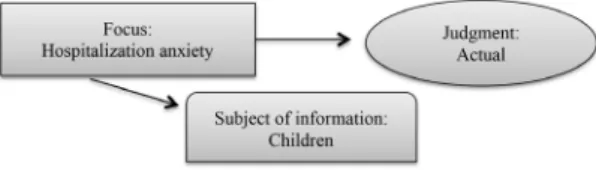
Using the ISO reference terminology model for
nur-sing diagnoses, the diagnosis would be built in
accor-dance with Figure 1:
Figure 1 - Schematic representing the construction of
the nursing diagnosis of child anxiety following
hospita-lization, according to ISO reference 18104. João Pessoa,
The deining or critical attributes of the concept constitute its deinition within the ICNP®,which would be
as follows: hospitalization anxiety: anxiety with the
follo-wing speciic characteristics: sympathetic stimulation (supericial vasoconstriction, pupil dilation)/tachycar -dia; tremors; changes in appetite; dyspnoea; insomnia;
fear/distress; hyperactivity/impulsiveness/agitation;
insecurity/powerlessness; feeling of guilt, bodily harm
or aggression; apprehension; feeling of abandonment/
loneliness; tension; nervousness; preoccupation;
irrita-bility; sadness; crying; and lack of concentration.
Given that the theoretical survey of the listed data
used only literature as a reference, it is worth
highli-ghting the importance of empirically testing the data
as a way to bring the knowledge extracted in the
the-ory together with practice. In this design, synthesizing
the elements of the concept, the inal product of this
study, can serve as a guiding instrument for measuring
anxiety of hospitalization in children in a health care
context. Complementing this knowledge with empirical
data is required so as to support the use of the
con-cepts in the formulation of theories as foundations to
guide the profession’s activities, both in its practice,
research or teaching.
Conclusion
Analyzing the concept of anxiety from
hospitaliza-tion allowed essential characteristics of the phenomenon
(attributes) to be surveyed, which enabled the
structu-ring of a conceptual deinition in order to expand the me -aning of this concept. The objectives that were proposed
for the research are considered to have been achieved,
since the presented theoretical analysis obeyed the
me-thodological principles as listed by the Walker and Avant
model, which highlights the need for progressive study
of concepts, given the dynamic quality modifying their
ideas and words, as well as the relevance of making a
contribution to the understanding of the phenomenon in
its practical applicability.
As regards the aspects surrounding child
hospita-lization, it is known that the anxiety triggered by this
is characterized by a series of stress and threatening
factors that make the child psychologically imbalanced;
these in turn tend to result in negative consequences for
his/her development. As for the conceptual deinition,
it was possible to identify the appearance of anxiety as
being a result of the child’s entry into unfamiliar
sur-roundings, where the child stays away from their
nor-mal family and social environment and goes to live with
strangers, whilst being subjected to invasive and painful
procedures, in addition to their recreational activities
being partially interrupted.
The results from the conceptual analysis allowed a
proposal for a nursing diagnosis to be developed, which
met the criteria for including a new nursing concept in
the ICNP®. It is necessary that this concept be tested in
practical nursing, which is a way to bring the knowledge
found during the concept’s analysis together with
pro-fessional practice.
It is hoped that this study will play a role in clarifying
of the concept of anxiety in hospitalized children in such a
way that its component interfaces can be easily identiied
in child health care and, consequently, promote quality
in the process of developing pediatric care. The need to
continue this study it a point that deserves highlighting,
with such study possessing the scope to clinically assess
the data collected in this theoretical analysis, while
me-eting the criteria set out by the ICN and including a new
nursing diagnosis in the ICNP®. Effectively, should this
be achieved, it is hoped that a contribution will be made
to the understanding of the concept’s meaning and its
applicability in various areas of pediatric nursing, as well
as knowledge be added to the profession as a science.
References
1. Lima de Souza GL, Silva KL, Medeiros ACT, Nóbrega
MML. Nursing diagnoses and interventions using ICNP®
in hospitalized children. Rev Rev Enferm UFPE on line.
2013;7(1):111-8.
2. Beesdo K, Knappe S, Pine DS. Anxiety and anxiety
disorders in children and adolescents: developmental
issues and implications for DSM-V. Psychiatr Clin N Am.
2009;32:483-524.
3. Connolly SD, Bernstein GA, Work Group on
Qua-lity Issues. Practice parameter for the assessment
and treatment of children and adolescents with
an-xiety disorders. J Am Acad Child Adolesc Psychiatry.
2007;46:267-83.
4. Fernandes MGM, Garcia LG. The aged body:
percep-tion and experience of elderly women. Interface
(Botu-catu). 2010;14(35):879-90.
5. Rodgers BL. Concepts, analysis and the development
of nursing knowledge: the volutionary cycle. J Adv Nurs.
1989;14(4):330-5.
6. Walker LO. Avant KC. Strategy for theory construction
in nursing. 4ed. Norwalk, CT: Appleton & Lange; 2005.
7. BIREME - Centro Latino-Americano e do Caribe de
Disponível em: http://decs.bvs.br/cgi-bin/wxis1660.
exe/decsserver/
8. Guidolin BL. Célia SAH. Depressive symptoms
and of anxiety among mothers of pediatric inpatients
at a university hospital. Rev Psiquiatr Rio Gd Sul.
2011;33(2):80-6.
9. Craske MG. Rauch SL. Ursano R. Prenoveau J. Pine
DS. Zinbarg RE. What is an anxiety disorder? Depression
Anxiety. 2009;26(12):1066-85.
10. Associação Psiquiátrica Americana. Manual
Diagnós-tico e EstatísDiagnós-tico de Transtornos Mentais - DSM-V. 5ª ed.
Porto Alegre: Artmed; 2014.
11. Cavalcanti ACD. Pereira JMV. Santos ROM. Vieira
GCA. Santana RF. Correia DMS. Et al. Observational
stu-dy of validation of nursing diagnosis anxiety in patients
with chronic heart failure. Enferm Global. [Internet].
2013 [acesso 18 dez 2014];12(30):28-40. Mayo 04]
Disponível em:
http://scielo.isciii.es/scielo.php?script=-sci_arttext&pid=S1695-61412013000200003&lng=es.
12. Klein RG. Anxiety Disorders. J Child Psychol
Psychia-try. 2009;50:153-62.
13. Sousa DA. Moreno AL. Gauer G. Manfro GG.
Kol-ler SH. Systematic review of instruments to
evalu-ate anxiety in Brazilian population. Avaliação Psicol.
2013;12(3):397-410.
14. Fernandes LFB. Alckmin-Carvalho F. Izbicki S. Melo
MHS. Universal prevention of anxiety in children and
adolescents: a systematic review. Rev Psicol Teoria e
Prática. 2014;16(3):83-99.
15. Pereira AIF. Barrosa L. Mendonça D. Cognitive Errors
and Anxiety in School Aged Children. Psicologia:
Refle-xão e Crítica. 2012;25(4):817-23.
16. Santos TSP. Nursing interventions to reduce
preo-perative anxiety in school-age children: an integrative
review. Rev Enferm Referência. 2014;4(3):149-55.
17. O’Reilly CE. Jaron P. Ochieng B. Nyaguara A. Tate JE.
Parsons MB. et al. Risk factors for death among children
less than 5 years old hospitalized with diarrhea in rural
western Kenya, 2005-2007: a cohort study. PLOS Med.
[Internet]. 2012[acesso 18 dez 2013];9(7): e1001256.
Disponível em:
http://www.ncbi.nlm.nih.gov/pmc/arti-cles/PMC3389023/doi: 10.1371/journal.pmed.1001256.
Epub 2012 Jul 3
18. Barreto MS. Marcon SS. Hospitalization in the
se-cond year of life in children considered at risk at birth.
Esc Anna Nery. 2014;18(2):227-33.
19. Santos ILF. Gaíva MAM. Abud SM. Ferreira SMB.
Child hospitalization due to primary Care sensitive
con-ditions. Cogitare Enferm. 2015;20(1):171-9.
20. International Council of Nurses. ICN Accredited
Cen-tres for ICNP Research & Development. Geneva:
Inter-national Council of Nurses; 2013.
Received: Aug 8th 2014