INVESTIGATION OF AN ALIMENTATION SYSTEM IN
PREMATURE NEWBORNS FROM GUSTATORY STIMULATION
Investigação de um sistema de alimentação em recém-nascidos
prematuros a partir de estimulação gustativa
Andréa Monteiro Correia Medeiros(1), Conceição Lima Alvelos(2), Thalyta Prata Leite de Sá(3),
Alana Dantas Barros(4), Oscar Felipe Falcão Raposo(5)
(1) Núcleo de Fonoaudiologia da Universidade Federal de
Ser-gipe, São Cristóvão, SE, Brasil.
(2) Núcleo de Fonoaudiologia da Universidade Federal de
Ser-gipe, São Cristóvão, SE, Brasil.
(3) Núcleo de Fonoaudiologia da Universidade Federal de
Ser-gipe, São Cristóvão, SE, Brasil.
(4) Núcleo de Fonoaudiologia da Universidade Federal de
Ser-gipe, São Cristóvão, SE, Brasil.
(5) Departamento de Estatística e Ciências Atuariais da
Uni-versidade Federal de Sergipe, São Cristóvão, SE, Brasil.
behavior, brought with them to design the newborn as a being without skills or abilities. In this sense,
refers to the existence of Thoman1 some myths about
childhood, including newborn (NB) human being
deemed deicient at birth, incomplete, immature and uninished being seen essentially relection mode
and no ability to learn and socializing.
In contrast, when the holistic, humanistic, researches2,3 assumptions are adopted studies on
the development began to seek to understand the
organization of social and biological behavior of human beings, from a variety of events, where the
RN responds to environmental and social stimuli,
being inluenced and inluencing the environment ABSTRACT
Purpose: to investigate the existence of the alimentation system in premature newborns in response to
gustatory stimulation. Methods: experimental, analytical, double-blind study. 90 premature newborns of a public maternity in Sergipe took part in the test which was ilmed and divided into three parts of ive minutes. In the irst and last, there was no stimulus; in the second, the gustatory stimulation was
applied and the newborn children were divided into two groups (water or sucrose). We studied the
speciic behaviors suction right and left hands, tongue protrusion and suction movements in behavioral states deep sleep, light sleep, drowsy, restless / irritable and crying. In the statistical analysis of the population, average, standard deviation and prevalence studies were performed. We used the
non-parametric Mann-Whitney test to compare averages. The Spearman test observed correlation between
behavioral states at each time of the test. The p value was signiicant when less than 0.05. Results: independent of the given stimulus, the correlation increased in all speciic behaviors. Comparing the groups separately, after stimulation, we observed an increase in correlation in right hand suction and tongue protrusion for both. The same happened in suction, except for the agitated/irritated state. After stimulation, there was a higher correlation to the behavior of left hand suction in the sucrose group
when compared to water. The results show that gustatory stimuli may contribute to the readiness to
feed this population. Conclusions: it was found in premature newborns an increased in correlation for the speciic behaviors related to the alimentation system after oral stimulation, which envisions the possibility of gustatory stimulation be used for activating a alimentation system in premature newborns.
KEYWORDS: Speech, Language and Hearing Sciences; Feeding; Infant, Newborn; Infant, Premature;
Sucrose
INTRODUCTION
Some authors25,26 describe premature birth as
a risk factor for abnormal neurodevelopment and functional capabilities. In this sense, considering that
the ability to supply is achieved concurrently with the
development of the central nervous system (CNS)27,
the changes that occur in preterm newborns could
even disrupt the normal course of development of feeding.
The literature28 indicates that the introduction
of oral feeding in premature newborns may be performed from 34 weeks on the gestational age,
when the sucking pattern matches with these babies
of term. Thus, it is necessary to investigate whether there is a feeding system developed in such an
early age already.
Thus, the aim of this study was to investigate the existence of the feeding system in preterm infants from the gustatory stimulation (sucrose for analysis
- PA 12% or water).
METHODS
This is an experimental, analytical, double-blind study performed in a public hospital in Aracaju (SE) of 90 preterm infants of both sexes, hospitalized in rooming. The inclusion criteria for this study were: clinically stable at the time of the test, Corrected Gestational Age (CGA) of up to 36 weeks and one day old, with an average of 34.92 days (Standard Deviaton of 1.05 days) and intrauterine growth curve Suitable for Gestational Age (SGA). Subjects who used respiratory support, were excluded from this study, showed signiicant clinical history of neuro
-logical or cardiac complications and were suffering from syndromes and / or diagnosed malformations or still to be clariied.
Initially we had to select the RN and then the
signing of the consent form. Each newborn was
placed in carry-cot, in the supine position, with naked torso and upper limbs. The newborns were divided
into two groups (water or sucrose for analysis 12%), being ilmed in the crib by attached digital camera on a tripod, so the face and upper limbs stay framed
in the video.
It is important to mention that this study followed
the same methodological design conducted in
the thesis of doctoral degree of Medeiros2 with
newborns terms, particularly in relation to the testing
procedure as well as the characterization of behav
-ioral states and speciic behaviors studied.
One of the researchers was responsible for the
double-blind procedure, randomly distributing the substances water or sucrose in vials, which were
numbered. For female newborns were used even
bottles and males, the odd vials. The administration
of sucrose solution or water was taken by other
has learning abilities and social interaction in an
extremely early age.
From this perspective scholars4 started to defend
the speciic behaviors evidenced in the newborn, are part of speciic functional systems that make explicit certain skills and abilities of the human being, in a period of extremely early life.
These same authors4 still consider that behaviors
can be identiied as ‘actions’ much more than ‘answers’ or mechanical ‘relexes’, requiring a more complete understanding of the functional speciicity of child behavior. These behaviors are seen as belonging to a group of ‘action systems’, which are deined by the hypothetical function as intended, fulilling certain functions of survival for humans, such as food and protection2.
The system related to food action would be
demonstrated by the ability to recognize the given taste stimulus given to the RN, put his hand to his mouth and still coordinate sucking movements and breathing, to suck it2,5. These behaviors, relating to
“feeding system”, in turn, are related to the devel
-opment of speech structures and coordinate the functions of swallowing, sucking and breathing and can be inluenced by internal and / or external5
factors, such as the gustatory stimuli.
The gustatory stimulation has been used with newborns, since the assumption that the gustatory
capacity already got their start in the early experi
-ences of intrauterine life, since the development of taste buds occurs in early stages6, allowing that
the fetus already has the ability to feel the taste of amniotic luid.
In this sense, Medeiros2 used sucrose as
gustatory stimuli in newborn terms to discuss the
existence of a feeding system from the moment of
birth.
The knowledge on the supply system could increase the basis in speech therapy in
breast-feeding promotion, from the differentiated inter
-pretation of behaviors of readiness to breastfeed
presented by RN.
Strategies to promote breastfeeding are important to ensure the survival of the human species, since this favors immunity, digestion and absorption of
nutrients7-20, but above all, in the speech area, this
promotion may aid the development of the structures of the sensorial system motor oral (lips, tongue, cheeks, hard and soft palate), providing a better functioning of the functions stomatognatics21-24.
The feeding system has already been evidenced
in newborns terms by Medeiros2, as related to
2. Speciic Behaviors2
a. Right hand suction, right (RHS) and left (LHS): Contact one of the hands or both on oral region
along with sucking movements; there may or may
not tongue protrusion; frequent rhythmic movements
in the oral region (cheeks) and the protrusion and
retraction of the mandible.
b. Tong Protrusion (TP): not necessarily occluded
lips; visualization of the apex of the tongue between the upper and lower lips; existence of movement of
the tongue in the posterior-anterior direction.
c. Suction movements (SU): occluded or
narrowed (rounded) lips; viewing retraction of the angle of the mouth, the region corresponding to the action of the muscle; rhythmic movements are often
observed in the oral region (cheeks); there may or
may not protrusion and retraction movements of the jaw.
It is understood by oral region2 for the purpose of
recording and analysis: lips, oral cavity, tongue, and
loor of the mouth cavity.
Frequencies of behavioral states and speciic
behaviors were recorded in SPSS (version 18,
2008, Chicago, Illinois, USA) software. Counted up each behavioral state and each speciic behavior, second by second, the exact time of occurrence, the total amount of times being calculated as these
behaviors appeared.
For CGA fractions of the week were used to
calculate the sundry days (1 week = 0.14 days).
The project in question was approved by the Ethics Committee on Human Research from
the origin Institution under paragraph CAAE 0027.0.107.000-11.
Correlations in statistical treatment of all RNs were made, regardless of the stimulus adminis -tered, and in the two groups separately. Measures
of central tendency (average), variability (standard
deviation) and prevalence (absolute and relative)
form used to characterize the population. To test the normality of the data was made the Shapiro-Wilk test. Due to lack of normality nonparametric Mann-Whitney test for comparison of average was
used. The Spearman correlation test was used to
verify the correlation between behavioral states and speciic behaviors in each time of testing. Values
between 0.1 and 0.3 was considered poor corre-lation; moderate between 0.4 and 0.6; strong above
0.7, and ideal when equal to 1,030. The p values less
than 5% (p <0.05) was considered signiicant. researchers who were unaware of the solution
administered (double-blind procedure). The vials
were randomly selected at the moment of the shooting. Randomization was performed in the draw of bottles for their newborns until all vials had been
selected.
Besides the procedure (test itself) for data
collection, the researchers studied the medical
records of infants and mothers, recording on a speciic protocol the following data: RN gender,
Gestational Age at Birth (GAB), Corrected
Gestational Age (CGA), birth weight, lifetime, Apgar
scores (1stand 5thminutes), full name and age of
mother, type of birth, date and time of the test.
It is noteworthy that there was previously a
conduction of a pilot study so that the researchers would train the execution of the procedure, provided being the judges themselves would also analyze the videos (behavioral states and speciic behaviors) reliably. Thus, the calibration procedure of the judges, which were analyzed together some videos of the pilot was conducted.
To analyze the videos of the 90 infants who partic -ipated in this research, each video was watched by
three different and independent judges, establishing to themselves as a criterion of agreement between
them, only the behaviors displayed by at least two
judges.
The observation of the variables was based on the following classiication:
1. Behavioral States2,29
a. Deep Sleep (DS): regular breathing; eyes
closed without the presence of nystagmus; absence of spontaneous motor activity.
b. Light Sleeper (LS): irregular breathing; eyes
closed with movement; possible occurrence of eye opening; low level of motor activity.
c. Sleepy (SL): generally open eyes (blurry) with heavy lids, trembling and / or closed eyelid; level variable and mild spontaneous motor activity.
d. Alertness (AL) eyes open (look shiny) or
closed with sharp activity concentration; low level of
overall motor activity.
e. Agitated / irritated (AG / IR): open or closed
(tight) eyes; high level of motor activity, with impulsive movements of the extremities. Possible occurrence of grunts and vocalizations.
sucrose group together), or separately, group water and sucrose group.
No newborn behavioral state was in deep sleep
(1), then there is no correlation for this state.
When RNs were analyzed together, regardless
of the given stimulus (water or sucrose), the speciic
behavior right hand suction (RHS) showed a strong correlation only in sleepy (3) and poor behavioral
state in alertness (4) before stimulation in BL1. After
stimulation, the BL2, this behavior showed a strong
correlation in the behavioral states of light sleep (2)
and agitated/irritated (5) and moderate correlation
in sleepy states (3) and alertness (4). As for the speciic behavior left hand suction (LHS), it was
noted weaker correlation values in BL1 than BL2 (TABLE1).
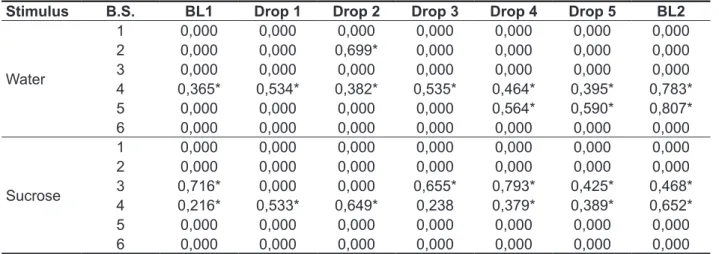
Treating the groups separately, the speciic behavior of suction right hand (SMD) in the water
group showed only a weak correlation in the alert
RESULTS
Were studied 90 preterm infants, whose charac -teristics were observed: 48.9% male and 51.1%
female, birth weight average of 2.11 grams with Reliability Index 95% (R.I.95%) ranging from [2.02, 2.21], CGA average of 34.91 weeks with R.I 95% ranging from [34.69, 35.14] and GAB (physical examination) of 34.10 weeks with R.I. 95% ranging from [33.73, 34.49]. According to the types of stimuli
that were given, the newborns were divided into
two groups: water (46 subjects) and sucrose (44 subjects).
The speciic behaviors studied were observed in each behavioral state and in every moment of the
test.
The following results refer to the most signiicant indings, it is considering the RNs in total (water and
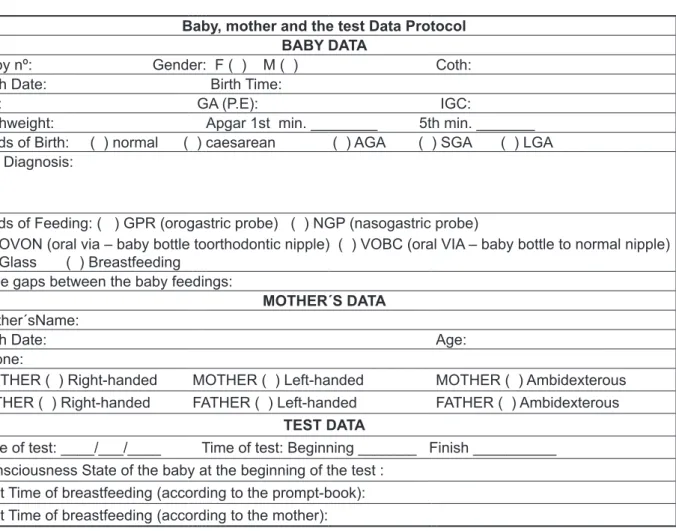
Baby, mother and the test Data Protocol BABY DATA
Baby nº: Gender: F ( ) M ( ) Coth:
Birth Date: Birth Time:
GA: GA (P.E): IGC:
Birthweight: Apgar 1st min. ________ 5th min. _______
Kinds of Birth: ( ) normal ( ) caesarean ( ) AGA ( ) SGA ( ) LGA MD Diagnosis:
Kinds of Feeding: ( ) GPR (orogastric probe) ( ) NGP (nasogastric probe)
( ) OVON (oral via – baby bottle toorthodontic nipple) ( ) VOBC (oral VIA – baby bottle to normal nipple) ( ) Glass ( ) Breastfeeding
Time gaps between the baby feedings:
MOTHER´S DATA
Mother´sName:
Birth Date: Age:
Phone:
MOTHER ( ) Right-handed MOTHER ( ) Left-handed MOTHER ( ) Ambidexterous
FATHER ( ) Right-handed FATHER ( ) Left-handed FATHER ( ) Ambidexterous
TEST DATA
Date of test: ____/___/____ Time of test: Beginning _______ Finish __________ Consciousness State of the baby at the beginning of the test :
Last Time of breastfeeding (according to the prompt-book): Last Time of breastfeeding (according to the mother):
Caption: GA: Gestational Age; GA (P.E): Gestational Age at the physical exam; CGA: Corrected Gestational Age; AGA: Adequate to Gestational Age; SGA: Small to Gestational Age; LGA: Large to Gestational Age.
behavior of the left hand suction (LHS) observed
the group sucrose strong correlation in BL2 on 2, 3 and 4. Already in the water group, the correlations
of these behavioral states dropped in BL2 (TABLES
2 and 3). state BL1 (4) and strong correlation in BL2, the alert
states (4) and agitated/irritated (5). In the sucrose group, there were strong correlation in BL1 in Sleepy (3) behavioral state and weak in the alert (4), but the
BL2 moderate correlation in 3 and 4. The speciic
Table 1 - Correlation between speciic behaviors of RHS and LHS and behavioral states at each time of testing, regardless of the stimulus
Stimulus B.S. BL1 Drop 1 Drop 2 Drop 3 Drop 4 Drop 5 BL2
RHS (Water And Sucrose)
1 0,000 0,000 0,000 0,000 0,000 0,000 0,000
2 0,000 0,000 0,703* 0,000 0,000 0,000 0,703*
3 0,747* 0,000 0,000 0,643* 0,783* 0,437* 0,457*
4 0,294* 0,530* 0,561* 0,386* 0,414* 0,393* 0,695*
5 0,000 0,000 0,000 0,000 0,571* 0,584* 0,812*
6 0,000 0,000 0,000 0,000 0,000 0,000 0,000
LHS (Water And Sucrose)
1 0,000 0,000 0,000 0,000 0,000 0,000 0,000
2 0,000 0,000 0,584* 0,584* 0,000 0,584* 0,802*
3 0,000 0,000 0,000 0,000 0,711* 0,711* 1,000*
4 0,663* 0,344* 0,478* 0,633* 0,736* 0,478* 0,607*
5 1,000* 0,000 0,000 0,000 0,000 0,000 0,000
6 0,000 0,000 0,000 0,000 0,000 0,000 0,000
*Statistically signiicant values for the Spearman correlation test (p<0,05)
Caption: B.S= behavioral states; 1= deep sleep; 2= light sleep; 3= sleepy; 4= alertness; 5= agitated/irritated; 6= crying; BL1= initial
base line; BL2= inal base line.
Table 2 - Correlation between the speciic behavior of RHS and behavioral states at each time of testing, stimulated with water or sucrose
Stimulus B.S. BL1 Drop 1 Drop 2 Drop 3 Drop 4 Drop 5 BL2
Water
1 0,000 0,000 0,000 0,000 0,000 0,000 0,000
2 0,000 0,000 0,699* 0,000 0,000 0,000 0,000
3 0,000 0,000 0,000 0,000 0,000 0,000 0,000
4 0,365* 0,534* 0,382* 0,535* 0,464* 0,395* 0,783*
5 0,000 0,000 0,000 0,000 0,564* 0,590* 0,807*
6 0,000 0,000 0,000 0,000 0,000 0,000 0,000
Sucrose
1 0,000 0,000 0,000 0,000 0,000 0,000 0,000
2 0,000 0,000 0,000 0,000 0,000 0,000 0,000
3 0,716* 0,000 0,000 0,655* 0,793* 0,425* 0,468*
4 0,216* 0,533* 0,649* 0,238 0,379* 0,389* 0,652*
5 0,000 0,000 0,000 0,000 0,000 0,000 0,000
6 0,000 0,000 0,000 0,000 0,000 0,000 0,000
* Statistically signiicant values for the Spearman correlation test (p<0,05)
Caption:B.S= behavioral states; 1= deep sleep; 2= light sleep; 3= sleepy; 4= alertness; 5= agitated/irritated; 6= crying; BL1= initial
in BL1. However, this correlation is even stronger
during and after stimulation (BL2) in alertness (4)
(TABLE 4).
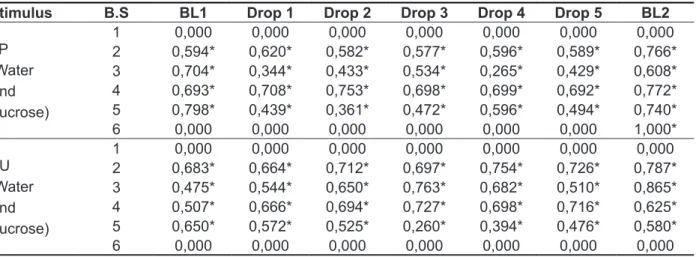
Considering the RNs in full, ie, independent of
the stimulus have been given water or sucrose, the
speciic behavior of tongue protrusion (TP) observed that already exists moderate and strong correlation
Table 3 - Correlation between the speciic behavior of LHS and behavioral states at each time of testing, stimulated with water or sucrose
Stimulus B.S. BL1 Drop 1 Drop 2 Drop 3 Drop 4 Drop 5 BL2
Water
1 0,000 0,000 0,000 0,000 0,000 0,000 0,000
2 0,000 0,000 1,000* 1,000* 0,000 1,000* 0,000
3 0,000 0,000 0,000 0,000 0,000 0,000 0,000
4 0,535* 0,000 0,659* 0,462* 0,491* 0,493* 0,340*
5 1,000* 0,000 0,000 0,000 0,000 0,000 0,000
6 0,000 0,000 0,000 0,000 0,000 0,000 0,000
Sucrose
1 0,000 0,000 0,000 0,000 0,000 0,000 0,000
2 0,000 0,000 0,000 0,000 0,000 0,000 1,000*
3 0,000 0,000 0,000 0,000 0,715* 0,715* 1,000*
4 0,741* 0,438* 0,315* 0,752* 0,882* 0,488* 0,759*
5 1,000* 0,000 0,000 0,000 0,000 0,000 0,000
6 0,000 0,000 0,000 0,000 0,000 0,000 0,000
* Statistically signiicant values for the Spearman correlation (p<0,05)
Caption:B.S= behavioral states; 1= deep sleep; 2= light sleep; 3= sleepy; 4= alertness; 5= agitated/irritated; 6= crying; BL1= initial
base line; BL2= inal base line.
Table 4 - Correlation between the speciic behaviors of TP and SU and behavioral states at each time of testing, regardless of the stimulus
Stimulus B.S BL1 Drop 1 Drop 2 Drop 3 Drop 4 Drop 5 BL2
TP (Water And Sucrose)
1 0,000 0,000 0,000 0,000 0,000 0,000 0,000
2 0,594* 0,620* 0,582* 0,577* 0,596* 0,589* 0,766*
3 0,704* 0,344* 0,433* 0,534* 0,265* 0,429* 0,608*
4 0,693* 0,708* 0,753* 0,698* 0,699* 0,692* 0,772*
5 0,798* 0,439* 0,361* 0,472* 0,596* 0,494* 0,740*
6 0,000 0,000 0,000 0,000 0,000 0,000 1,000*
SU (Water And Sucrose)
1 0,000 0,000 0,000 0,000 0,000 0,000 0,000
2 0,683* 0,664* 0,712* 0,697* 0,754* 0,726* 0,787*
3 0,475* 0,544* 0,650* 0,763* 0,682* 0,510* 0,865*
4 0,507* 0,666* 0,694* 0,727* 0,698* 0,716* 0,625*
5 0,650* 0,572* 0,525* 0,260* 0,394* 0,476* 0,580*
6 0,000 0,000 0,000 0,000 0,000 0,000 0,000
*Statistically signiicant values for the Spearman correlation(p<0,05)
Caption:B.S= behavioral states; 1= deep sleep; 2= light sleep; 3= sleepy; 4= alertness; 5= agitated/irritated; 6= crying; BL1= initial
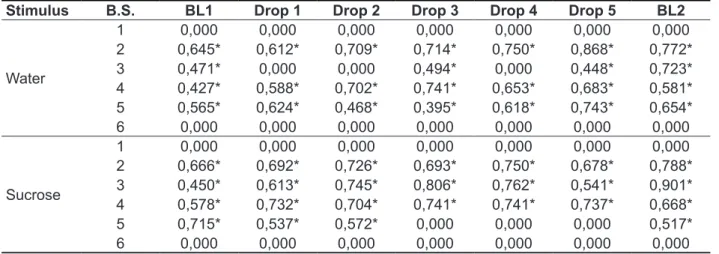
In the analysis of the two groups separately
(water and sucrose), was observed in behavioral states light sleep (2) sleepy (3) that the SU behavior both in water and in the sucrose group, showed a
change from moderate to strong correlation in BL1
in BL2. In the sucrose group BL2 in behavioral alertness (4), this behavior reached higher value than in the water group, however, the busy / angry behavioral state (5) came out strong to moderate correlation in the BL1 BL2 (TABLE 5).
When the water and sucrose groups were
analyzed separately for the TP behavior in sucrose
correlation became stronger in B2 in most behav-ioral states. In the Water group this also occurred,
with the exception of drowsy state (3) in BL2 had a
lower correlation than in BL1.
Considering the total RNs, stimulated with water
or sucrose, for the speciic suction behavior (SU), the behavioral states of light sleep (2) sleepy (3) the correlation was changed from moderate to strong in
the BL1to BL2 (TABLE 4).
Table 5 - Correlation between the speciic behavior of SU and behavioral states at each time of testing, stimulated with water or sucrose
Stimulus B.S. BL1 Drop 1 Drop 2 Drop 3 Drop 4 Drop 5 BL2
Water
1 0,000 0,000 0,000 0,000 0,000 0,000 0,000
2 0,645* 0,612* 0,709* 0,714* 0,750* 0,868* 0,772*
3 0,471* 0,000 0,000 0,494* 0,000 0,448* 0,723*
4 0,427* 0,588* 0,702* 0,741* 0,653* 0,683* 0,581*
5 0,565* 0,624* 0,468* 0,395* 0,618* 0,743* 0,654*
6 0,000 0,000 0,000 0,000 0,000 0,000 0,000
Sucrose
1 0,000 0,000 0,000 0,000 0,000 0,000 0,000
2 0,666* 0,692* 0,726* 0,693* 0,750* 0,678* 0,788*
3 0,450* 0,613* 0,745* 0,806* 0,762* 0,541* 0,901*
4 0,578* 0,732* 0,704* 0,741* 0,741* 0,737* 0,668*
5 0,715* 0,537* 0,572* 0,000 0,000 0,000 0,517*
6 0,000 0,000 0,000 0,000 0,000 0,000 0,000
* Statistically signiicant values for the Spearman correlation(p<0,05)
Caption:B.S= behavioral states; 1= deep sleep; 2= light sleep; 3= sleepy; 4= alertness; 5= agitated/irritated; 6= crying; BL1= initial
base line; BL2= inal base line.
DISCUSSION
The data presented here will be discussed
considering that the feeding system can be evidenced by some speciic behaviors performed by
the newborn (hands suction, tongue protrusion and
sucking movements) from gustatory stimulation, as
proposed by Medeiros2 in newborn born healthy and
terms.
Regarding the ability of discrimination of
gustatory stimuli, it aims to be discussed according
to the analysis of speciic behaviors displayed by newborns against different lavors (water and
sucrose). Moreover, the answers provided should
also be understood as inluenced by behavioral state that the baby was at the time of stimulation.
Sucrose is widely used as non-pharmacological measure to control pain9-11 and although this is not
the purpose of this study, it is worth mentioning the fact that the Ministry of Health7 propose the use
of this substance in its protocols, somehow could facilitate the indication the pleasurable gustatory
securely, since we already were attested to in the statement characterized population.
However, the interest in this work is to highlight
aspects of gustatory stimulation as a means of observing the feeding system at an early age,
contributing even to elicit responses more readily to
the situation of breastfeeding.
However, given the scarcity of studies on the subject, the results obtained with premature newborns are discussed here, especially from the indings obtained with newborns terms studied by
Medeiros2, which investigated the existence of a
contributes to these premature newborns reach and
remain at more favorable behavioral states for the feeding situation, contributing to the success of the offer of oral diet, and especially breastfeeding.
The fact of having been an increased suction speciic behavior (SU), regardless of the taste
stimulus received, points in the direction that the
population of premature infants studied did not have the same ability to gustatory discrimination of healthy
and term newborns researched by Medeiros2.
Furthermore, when analyzing the water and sucrose groups separately also increased
corre-lation of sucking behavior was observed in behav -ioral states light sleep (2) sleepy (3) in both groups.
This increase of correlation seems to show that the intraoral stimulation contributes effectively so
that there was sucking movements, which are also
considered important for the feeding situation of the
newborn.
The same was observed in the research2
performed with newborn terms, in which stimulation,
both in water and in sucrose group, triggered the
action of the buccinator muscles, and consequently
suction then swallowing. Importantly, this synchrony
of movements associated with breathing is essential for effective breastfeeding.
However, it is noteworthy that in the sucrose
group in behavioral alertness (4), the behavior of SU
reached higher value than in the water group, this
response may be from the suction effect of sucrose on the behavioral state considered more effective
in the presence related behavior and readiness to
breastfeeding7-8. The same may have occurred in
the reduction of moderate to strong correlation in
irritated/agitated (5) behavioral state, since this state
is not considered favorable, unlike the behavioral state of alertness29.
These data seem to indicate that sucrose in the
speciic behavior of suction provided soothing, as the effects of analgesic and calming obtained in
non-pharmacological measurements in newborns
undergoing painful procedures7-16. The use of
sucrose, in turn, should also be discussed with more
coverage in speech therapy ield as a likely strategy for stimulating infants with feeding dificulties.
Sucrose was a stimulus capable of increasing the correlation of hand suction behaviors and sucking
movements in alertness, which are considered
ideal for the occurrence of readiness behavior to feeding7,8. Besides, in the speciic behavior tongue
protrusion independently from the RN have been
stimulated with water or sucrose, gustatory
stimu-lation favored the presence of the same, showing that the different taste stimuli used here in readiness for feeding contributed in this population.
By observing the results found in this study, from the administration of the taste stimulus, whether
this be water or sucrose, it is perceived that there
is clearly stronger correlations in BL2 for speciic behaviors: right hand and left hand suction (RHS and LHS, respectively). This inding corroborates
the literature2, which states that the taste stimulus
in the oral region triggers the execution of sucking
movements.
The correlations in speciic behavior right hand
suction (RHS) showed increasing when water and sucrose groups were considered separately. Thus, unlike the data presented in literature2 with
newborns terms, the population studied here
(premature) water also signiicantly increased the correlation of this behavior, although not one taste stimulus considered as effective as sucrose.
For the behavior of suckling the mothers, the fact that there were no signiicant differences that occur between groups of stimuli (water and sucrose) in this population born with GA average of 34.10 weeks and tested with an CGA average of 34.91
weeks makes that the data do not corroborate with that studies6 indicate that the intrauterine period
the fetus already has gustatory discrimination and preference.
On the other hand, the correlations increased
after gustatory stimulation in both groups, which may demonstrate that independent from stimuli, gustatory stimulation is an important conduit for readiness to activate the feeding behavior, such as suction movements, which are fundamental for the effectiveness of feeding, especially within the breastfeeding31.
Considering the behavior of hand suction as indicative of readiness to feed and related to a feeding system, the sucrose group, the correlation increased sucking behavior of the right hand in
alertness and reduced in drowsy state, as well as
increasing correlation of speciic behavior of left
hand suction, also in alertness, corroborates the literature2,32,33 which states that the sucrose elicits
speciic behaviors of readiness for food, especially
in behavioral state considered ideal (alert) to
occur-rence of behaviors readiness to breastfeeding7,8.
By analyzing the behavior of tongue protrusion (TP), independent of the administered stimulus
(water or sucrose) was more evident in alertness
(4) after stimulation, as occurred in the behavior of
hand suction, actually evidenced that the conduct
of readiness to breastfeeding7,8 are more incidents
in alertness.
Thus, one could envisage the importance of stimuli being held in readiness for favorable feeding
behavioral states. On the other hand, the very
and especially on the alert, they show that the use of gustatory stimuli in hospital routine preterm infants, could contribute to elicit behaviors of readiness to breastfeed collaborate in the activation of a feeding system, contributing to the baby can be fed orally earlier in life.
Thus, the main contribution of the present study was about the effect of gustatory stimuli evident in the age range studied (GAB average of 34,14 and 34,91 weeks of CGA) for speciic behaviors of readiness to breastfeed, especially in behavioral
alertness , pointing out that gustatory stimuli can be
used in procedures to elicit behaviors of readiness to breastfeed in order to contribute to the nutrition of preterm infants and breastfeeding promotion at an
early age.
Points up the need for further research that envisage effective conduits of gustatory stimulation, from speech therapy, allowing the activation of the feeding system, bringing beneits to newborns, especially in the situation of breastfeeding.
In summary, we found in preterm infants, increased correlation for the speciic behaviors related to the feeding system after oral stimulation, which envisions the possibility of gustatory stimu
-lation be used to interfere with the activation of a feeding system.
CONCLUSION
In this study about population of premature infants, there was evidence of the existence of speciic behaviors related to the feeding system,
as demonstrated by Medeiros2 in newborns terms
and healthy. However newborns in this study did not
show the same ability to discriminate taste of terms
NBs, not corroborating the literature7 which states
that capacity been developed further at 32 gesta -tional weeks.
However, it is noteworthy that both stimuli
(water and sucrose) to encourage the behaviors of readiness to breastfeed in different behavioral states,
RESUMO
Objetivo: investigar a existência do sistema de alimentação em recém-nascidos prematuros a par
-tir da estimulação gustativa. Métodos: estudo experimental, analítico, duplo-cego. Participaram 90 recém-nascidos prematuros, de uma maternidade pública de Sergipe. O teste foi ilmado, consti -tuindo-se por três momentos de cinco minutos. O primeiro e último momento sem realizar estímulo,
o segundo momento com estimulação gustativa, sendo que os recém-nascidos foram divididos em dois grupos (água ou sacarose). Foram estudados os comportamentos especíicos sucção de mão direita e esquerda, protrusão de língua e movimentos de sucção nos estados comportamentais sono profundo, sono leve, sonolento, agitado/irritado e choro. Para caracterizar a população foram utiliza
-das média, desvio-padrão e prevalências. Foi utilizado o teste não paramétrico Mann-Whitney para comparação de médias. O teste de Spearman veriicou correlação entre estados comportamentais e comportamentos especíicos em cada momento do teste. O valor de p foi signiicante quando menor que 0,05. Resultados: independente do estímulo administrado, a correlação aumentou em todos os comportamentos especíicos. Comparando os grupos separadamente, após a estimulação, obser
-vou-se aumento de correlação em sucção de mão direita e protrusão de língua para ambos os grupos. O mesmo aconteceu em sucção, com exceção do estado agitado/irritado. Após a estimulação, houve maior correlação para o comportamento de sucção de mão esquerda no grupo sacarose quando comparado ao grupo água. Os resultados evidenciam que estímulos gustativos podem contribuir na prontidão para alimentação nesta população. Conclusões: evidenciou-se nos recém-nascidos prematuros aumento de correlação para os comportamentos especíicos relacionados ao sistema de alimentação, após estimulação oral, o que vislumbra a possibilidade da estimulação gustativa ser utilizada para ativação de um sistema de alimentação em recém-nascidos prematuros.
sucrose for procedural pain relief in preterm and
term neonates. Nur Res. 2002;51:375-82.
14. Gibbins S, Stevens B. The inluence of gestational age on the eficacy and short-term safety of sucrose for procedural pain relief. Adv Neonatal
Care. 2003;3:241-9.
15. Allen KD, White DD, Walburn JN. (1996).
Sucrose as an Analgesic Agent for Infants During Immunization Injections. Archives of Pediatrics
Adolescent Medicine, 1996;150: 270-4.
16. Acharya AB, Annamali S, Taub NA, Field D.
(2004). Oral sucrose analgesia for preterm infant venepuncture. Archives of Disease in Childhood -
Fetal and Neonatal Edition, 89, F17-F8.
17. Gorgulho FR, Pacheco STA. Amamentação
de prematuros em uma unidade neonatal: a
vivência materna. Esc Anna Nery Rev Enferm.
2008;12(1):19- 24.
18. Pedras CTPA, Pinto EALC, Mezzacappa MA. Uso do copo e da mamadeira e o aleitamento
materno em recém-nascidos prematuros e a termo:
uma revisão sistemática. Rev. Bras. Saude Mater.
Infant. 2008;8(2):163-9.
19. Hernandez AM, Giordan CR, Shiguematsu RA.
A intervenção fonoaudiológica em recém-nascidos de risco para distúrbios da deglutição e sua inluência no aleitamento materno. Rev Bras Nutr
Clin 2007;22(1):41-4.
20. Fujinaga CI, Scochi CGS, Santos CB, Zamberlan NE, Leite AM. Validação do conteúdo de um instrumento de avaliação de prontidão do prematuro para início da alimentação oral. Rev. Bras. Saúde Matern. Infant. 2008;8(4):391-9. 21. Marques MCS, Melo AM. Amamentação no alojamento conjunto. Revista CEFAC.
2008;10(2):261-71.
22. Medeiros AMC, Olivieira ARM, Fernandes
AM, Guardachoni GAS, Aquino JPSP, Rubinick ML et al. Caracterização da técnica de transição da alimentação por sonda enteral para seio materno em recém-nascidos prematuros. J. Soc. Bras. Fonoaudiol. [online]. 2011;23(1):57-65. ISSN 2179-6491. http://dx.doi.org/10.1590/
S2179-64912011000100013.
23. Medeiros AMC, Bernardi AT. Alimentação do recém-nascido prematuro: aleitamento materno,
copo e mamadeira. Rev. Soc. Bras. Fonoaudiol. 2011;16(1):73-9.
24. Rocha MS, Delgado SE. Intervenção fonoaudiológica em recém-nascido pré-termo com Gastrosquise. Rev Soc Bras Fonoaudiol.
2007;12(1):55-62.
25. Zomignani AP, Zambelli HJL, Antonio MARGM.
Desenvolvimento cerebral em recém-nascidos
prematuros. Rev. Paul. Pediatr. 2009;27(2):198-203.
REFERENCES
1. Thoman EB. Changing views of the being and becoming of infant. In: Thoman EB (ed.), Origins of the infant’s social responsivenes. Cap 17. Hillsdale,
New Jersey U.S.A: Lawrense Erlbaum Associates, publishers, 1979.
2. Medeiros AMC. Contato das mãos com a região oral, protrusão de língua e movimentos
de sucção em recém-nascidos humanos, a partir da estimulação oro gustativa [tese]. São Paulo: Instituto de Psicologia. NEC – Neurociências e
Comportamento. Universidade de São Paulo; 2002.
3. Brazelton TB. Bebês e mamães. Tradução de
Álvaro Cabral. Rio de Janeiro: Campus, 1981. P. 299.
4. Rochat P., Senders SJ. Active touch in infancy:
action systems in development. In: Weiss MJS, Zelaro PR. Newborn attention: biological constraints
and the inluence of experience. NJ: Ablez
Publishers, 1992. Cap 14, p. 412-42.
5. Medeiros, AMC. A existência de “Sistema Sensório-Motor Integrado” em Recém-nascidos
humanos. Psicologia USP. 2007;18(2):11-33.
6. Douglas CR. Fisiologia da gustação. In: Douglas
CR. Tratado de Fisiologia aplicada à ciência da saúde. 4. Ed. São Paulo: Robe, 1999. Cap 11, p. 197-204.
7. Brasil, Ministério da Saúde, Secretaria de Atenção à Saúde. Departamento de Ações Programáticas Estratégicas. Atenção humanizada ao recém-nascido de baixo peso: Método Canguru. 2ª. ed. Brasília, Ministério da Saúde, 2011. 203p.
8. Fernandes AM. The eficacy of kangaroo mother care, sucrose and paciier to reduce responses of preterm infants to procedural pain
(tese). Universidade de Lisboa/Escola Superior de
Enfermagem de Lisboa. Lisboa, 2010.
9. Aquino, FM, Christoffel, MM. Dor neonatal: Medidas não-farmacológicas utilizadas pela equipe de enfermagem. Rev. Rene, vol. 11, Número
Especial, 2010. p. 169-77.
10. Blasco, PG, Levites, MR, Mônaco, C. Açúcar reduz sinais de dor na vacinação de bebês. Diagn
Tratamento. 2009;14(1):31.
11. Gaspardo CM, Linhares MBM, Martinez FE. A
eicácia da sacarose no alívio de dor em neonatos:
revisão sistemática da literatura. J. Pediatr. (Rio J.) 2005; 81(6).
12. Gaspardo CM, Miyase CI, Chimello JT, Martinez
FE, Linhares MBM. Is pain relief equally eficacious and free of side effects with repeated doses of oral sucrose in preterm neonates? PAIN [online],
2008;137(1):16-25. ISSN 03043959.
13. Gibbins S, Stevens B, Hodnett E, Pinelli J,
30. Dancey, CP, Reidy, J. Estatística sem matemática: usando SPSS para Windows. 3 ed. Porto Alegre: Artmed. 2006.
31. Yamamoto RCC, Bauer MA, Häeffner LSB, Weinmann ARM, Keske-Soares M. Os efeitos da estimulação sensório motora oral na sucção nutritiva na mamadeira de recém-nascidos pré-termo. Rev
CEFAC. 2010;12(2):272-9.
32. Medeiros, AMC. A existência de “Sistema Sensório-Motor Integrado” em Recém-nascidos
humanos. Psicologia USP. 2007;18(2):11-33.
33. Andrade ISN, Guedes ZCF. Sucção do recém-nascido prematuro: comparação do método
Mãe-Canguru com os cuidados tradicionais.
Revista Brasileira de Saúde Materno Infantil, Recife,
2005;5(1):61-9. 26. Ferreira AM, Bergamasco NHP. Análise
comportamental de recém-nascidos pré-termos incluídos em um programa de estimulação tátil-cinestésica durante a internação hospitalar. Rev
Bras Fisioter. 2010;14(2):141-8.
27. Telles MS, Macedo CS. Relação entre desenvolvimento motor corporal e aquisição de
habilidades orais. Rev. Pró-Fono. 2008;20(2):117-22. 28. Moura LTL, Tolentino GM, Costa TLS, Aline A.
Atuação Fonoaudiológica na estimulação precoce da sucção Não-Nutritiva em Recém-Nascidos
Prematuro. Revista CEFAC. 2009;11(Supl3):448-56. 29. Csillag S. Os três primeiros dias de vida: uma
observação dos estados comportamentais do bebê recém-nascido [tese]. São Paulo: Instituto de
Psicologia. Universidade de São Paulo, 1997.
Received on: July 12,2012 Accepted on: January 29, 2013
Mailing address:
Andréa Monteiro Correia Medeiros
Universidade Federal de Sergipe - Núcleo de Fonoaudiologia
Rua Marechal Rondon s/n, Cidade Universitária
Prof. José Aloísio de Campos, Jardim Rosa Elze São Cristovão – SE – Brasil