RBCCV 44205-1482 DOI: 10.5935/1678-9741.20130056
Factors associated to hypoxemia in patients
undergoing coronary artery bypass grafting
Fatores associados à ocorrência de hipoxemia em pacientes submetidos à revascularização miocárdica
Natália Pereira dos Santos
1, PT; Rodrigo Martins Mitsunaga
1; Daniel Lago Borges
1, PT, MsC;
Marina de Albuquerque Gonçalves Costa
1, PT; Thiago Eduardo Pereira Baldez
1,
PT; Ilka Mendes
Lima
1,
PT; Karol Cristina Fonseca Moura
1,
PT; Josimary Lima da Silva Lula
21 Universidade Federal do Maranhão, Hospital Universitário, São Luís, MA,
Brazil.
2Hospital São Domingos, São Luís, MA, Brazil.
Research carried out at Hospital Universitário Presidente Dutra, São Luís, MA, Brazil.
Correspondence address: Daniel Lago Borges
Rua Barão de Itapary, 227 – Centro – São Luís, MA, Brazil Zip code: 65020-070
E-mail: [email protected]
Article received on September 12th, 2012
Article accepted on June 10th, 2013 Abstract
Introduction:Hypoxemia is a frequent pulmonary compli-cation in the postoperative coronary artery bypass graft. De-tection of factors associated with their occurrence may indi-cate patients at risk for this complication, which allows tracing
speciic therapeutic and consequently reduce morbidity and
mortality.
Objective: To identify related factors to hypoxemia occur-rence in immediate coronary artery bypass graft postoperative.
Methods: In this retrospective cohort study, we studied 100 patients submitted to elective om-pump artery bypass graft , between April 2010 and December 2011, at a reference university hospital for cardiac surgery in the state of Mara-nhão. It was considered hypoxemia gas exchange ratio less than or equal to 300 mmHg. Associated variables with
periop-erative hypoxemia were deined by the Student T test, G or
Mann-Whitney tests, Chi-square, or Fisher’s exact test and multiple linear regression.
Results: Among studied variables, high body mass index (P=0.036) and smoking (P=0.024) were signiicantly associated
with hypoxemia in the immediate coronary artery bypass graft postoperative. Hypoxemia incidence in this period was 55% and
did not affects mechanical ventilation duration and Intensive Care Unit lengh of stay.
Conclusion:In this sample, body mass index and smoking were associated to hypoxemia. These data reinforce the impor-tance of clinical assessment to identify patients at risk for this complication, considering its high incidence in immediate post-operative period.
Descriptors: Oxygen level. Postoperative period. Myocardial revascularization.
Resumo
Introdução:A hipoxemia é uma complicação pulmonar fre-quente no pós-operatório de revascularização miocárdica. A detecção de fatores associados a sua ocorrência pode indicar pa-cientes de risco para essa complicação, o que possibilita traçar
terapêuticas especíicas e, consequentemente, diminuir a
morbi-mortalidade.
Objetivo:Identiicar fatores relacionados à ocorrência de hipo -xemia no pós-operatório imediato de revascularização miocárdica.
According to a recent study [7], predictor factors detection may indicate patients at high risk for postoperative hypoxemia that demand mechanical ventilation strategies, in order to prevent and treat pulmonary collapse during intra-operatory period, to minimize hypoxemia impact on mechanical ventilation duration, to reduce mobidity and mortality related to cardiac intervention, to reduce length of stay at Intensive Care Unit (ICU), and hospital costs.
This study is designed to analyze factors related to hypoxemia in a speciic population of patients undergoing CABG surgery, to determine its incidence in immediate post-operative period, and to evaluate if hypoxemia interfered on mechanical ventilation duration and lengh of stay in ICU.
METHODS
It is a retrospective descriptive cohort study conducted in a reference university hospital for cardiac surgery in São Luis, MA, Brazil, after Research Ethics Committee approval (Protocol N° 0051/2012), as required by Resolution N° 196/96 of the National Health Council.
Patients who underwent CABG between April 2010 and December 2011 and were admitted to the Cardio ICU in the referred hospital were included in research.
Adult patients (> 18 years old) from both genders were included in the study, with no prior cardiac surgery,
Abbreviations, acronyms & symbols
AMI Acute myocardial infarction ARF Acute renal failure BMI Body mass index
CABG Coronary artery bypass graft CAD Coronary atherosclerotic disease COPD Chronic obstructive pulmonary disease CPB Cardiopulmonary bypass
CTA Previous angioplasty DLP Dyslipidemia DM Diabetes mellitus FiO2 Inspired oxygen fraction ICU Intensive care unit IPO Immediate postoperative LITA Left internal thoracic artery LV Left ventricular
PaO2 Pressure of oxygen in the arterial blood PEEP Positive end-expiratory pressure RR Respiratory rate
VT Volume tidal
WHO World Health Organization
INTRODUCTION
Coronary artery bypass grafting (CABG) surgery, despite all the advances in clinical treatment and percutaneous interventions, is still used in coronary heart disease treatment [1].Pulmonary complications in cardiac surgery postoperative period are very frequent and represent signiicant morbidity and mortality cause [2].
Hypoxemia is one of the main causes of pulmonary complications characterized by decrease of arterial oxygen partial pressure (PaO2) [3,4]. Measuring severity of the pulmonary injury in mechanically ventilated patients is performed by PaO2 and inspired oxygen fraction (FiO2)
ratio [5].
Diverse mechanisms have been accounted for its development on cardiac surgery postoperative, especially atelectasis, shunt increase, respiratory and thoracic mechanics alterations, capillary and pulmonary parenchyma changes secondary to the left ventricular (LV) dysfunction or pulmonary endothelium injury [3,6].
Elderly, obeses and patients with left ventricular dysfunction (ejection fraction of the left ventricle < 55%) and prolonged cardiopulmonary bypass (CPB) time (> 120 minutes) had higher risks to postoperative surgery hypoxemia [7]. Pulmonary chronicle diseases, diabetes and preoperative acute myocardial infarction are independent risk factors for hypoxemia after CABG [8].
pacientes que se submeteram à cirurgia eletiva de revascula -rização miocárdica com uso de circulação extracorpórea, no período de abril de 2010 a dezembro de 2011, no Hospital
Uni-versitário de referência para cirurgia cardíaca no estado do Maranhão. Considerou-se hipoxemia índice de troca gasosa me-nor ou igual a 300 mmHg. A associação das variáveis
periopera-tórias com a ocorrência de hipoxemia foi deinida por meio dos testes t de Student ou Mann Whitney, Qui-quadrado, teste G, ou
Exato de Fisher, além de regressão linear múltipla.
Resultados: Dentre as variáveis estudadas, o índice de massa corpórea elevado (P=0,036) e o tabagismo (P=0,024)
apresenta-ram associação estatisticamente signiicante com a ocorrência
de hipoxemia no pós-operatório imediato de revascularização miocárdica. A incidência de hipoxemia no pós-operatório ime-diato foi 55%. A ocorrência de hipoxemia não interferiu nos tempos de ventilação mecânica e de estadia na Unidade de Te-rapia Intensiva.
Conclusão: Nesta amostra, houve associação entre o índice de massa corpórea e o tabagismo com a ocorrência de hipoxe-mia. Esses dados reforçam a importância da avaliação clínica
para identiicação do paciente de risco para ocorrência dessa
complicação, já que esta apresenta elevada incidência no pós--operatório imediato.
submitted to elective on-pump CABG not associated to other procedures and ventilated in assisted/controlled volume mode, with PEEP (positive end-expiratory pressure) 8 cmH20 and FiO2 40%.
Missing data related to PaO2/FiO2 ratio, perioperative death and returning to operation room were exclusion criteria to this study.
Data were collected from Physical Therapy Evaluation form – divided in pre, intra and postoperative periods, illed with information from medical records – and registered in a speciically form designed for this study.
During study period, two hundred and ifty-ive patients were admitted to Cardiovascular ICU after CABG (Figure 1). Among them, 100 patients fulilled all criteria and general characteristics are described in Table 1.
Preoperative data
Preoperative variables were: age, considering as advanced age ≥ 60 years old; gender; nutritional status, determined by Body Mass Index (BMI) calculated by weight/height2 ratio,
considered as eutrophic = 20 to 24.9 kg/m2, overweight = 25
to 29.9 kg/m2 and obese ≥ 30 kg/m2, established by the World
Health Organization (WHO)[9].
Other studied variables were risk factors to coronary diseases registered in anesthesiologist assessment available in medical records: diabetes mellitus (DM), hypertension, dyslipidemia (DLP), smoking (also were considered former smokers) and associative diseases: chronic obstructive pulmonary disease (COPD), acute renal failure (ARF), acute myocardial infarction (AMI) and prior angioplasty.
It was not possible to correlate left ventricular ejection fraction (left ventricular dysfunction evaluation) due lack of data, cause it is not a routine service to have an echocardiogram in all preoperative patients.
Intraoperative data
For CABG patients underwent general anesthesia, tracheal intubation, controlled mechanical ventilation, surgical access via median sternotomy and CPB, performed with graphs of the left internal thoracic artery (LITA) and/or saphenous vein and the placement of mediastinal and pleural drains.
Intraoperative analyzed variables were numbers of graphs, LITA use, number of drains, surgery time, considering a prolonged intervention ≥ 210 minutes; pump time, considering prolonged when above 120 minutes; aortic clamping time, considering prolonged when above 90 minutes; and mechanical circulatory assistance use (intra-aortic balloon pump).
Postoperative data
After surgery, patients were admitted to the Cardiovascular ICU still under anesthesia. They were intubated and mechanically ventilated (Evita 2 Dura® - Dräger Medical,
Lübeck, Germany) in assisted/controlled volume mode,
Fig 1 - Patients admitted to the Cardiovascular Intensive Care Unit after coronary artery bypass graft
Table 1. Univariate analysis of preoperative variables. (n = 100).
Variables
Age (years) BMI (kg/m2) Gender (%) Female Male Hypertension Absent Present DM Absent Present Dyslipidemia Absent Present AMI Absent Present ARF Absent Present Smoking Absent Present COPD Absent Present Angioplasty Absent Present
No (n = 45) 62,6 ± 7,3 24,9 ± 3,4
26,7 73,3 26,7 73,3 55,6 44,4 77,8 22,2 82,2 17,8 93,3 6,7 73,3 26,7 97,8 2,2 97,8 2,2
Yes (n = 55) 61,1 ± 11,5
27,2 ± 3,8
21,8 78,2 18,2 81,8 56,4 43.6 83,6 16,4 87,3 12,7 89,1 10,9 49,1 50,9 94,5 5,5 96,4 3,6 P 0,453a 0,002a 0,742b 0,437b 0,903b 0,626b 0,673b 0,354c 0,024b 0,388c 0,575c Hypoxemia
according to Unit protocol [volume tidal (VT) 8 to 10 ml/kg; respiratory rate (RR) 12 to 16 bpm; inspitatory low from 8 to 10 times minute volume (VT x RR); inspiratory time 1.0 second; FiO2: 40%; PEEP: 8 cmH2O].
Twenty minutes after admission, arterial blood was collected for a blood gas analysis (ABL 800 FLEX® -
Radiometer, Bronshoj, Denmark), in which PaO2 was analyzed and, consequently, gas exchange ratio (PaO2/FiO2). Other postoperative variables studied were mechanical ventilation duration and lengh of stay in the ICU.
According to 3rd Brazilian Consensus Conference on
Mechanical Ventilation Consensus [5], normal PaO2/FiO2 ratio is above 300 mmHg; as gas exchange deterioration value equal or lower than 300 mmHg; and extreme severity of respiratory condition below 200 mmHg.
Current Berlin definition [10] classifies hypoxemia according to its level: Mild Hypoxemia (PaO2/FiO2 ≤ 300 and > 200 mmHg), Moderate Hypoxemia (PaO2/FiO2 ≤ 200 and >100 mmHg) and Severe Hypoxemia (PaO2/FiO2 ≤100 mmHg).
To determine the presence of gas exchange deterioration in researched subjects, it was considered hypoxemia a PaO2/FiO2 ratio ≤ 300, being classiied according to Berlin deinition[10].
Statistical analysis
Quantitative variables are described as mean and standard deviation or median (minimum, maximum), according to data distribution. Qualitative variables are presented by frequency and percentage. To normality test of the quantitative variables, D’Agostino-Pearson’s test was used.
To test the relation between normally distributed quantitative variables and severe hypoxia occurence, non-paired Student’s t test was used. For quantitative variables of non-normal distribution, Mann-Whitney’s test was used. Association between categorical and outcome variables was done using Chi-square test or Fisher Exact test. Quantitative variables whose statistic univariate tests presented P<0.25 were selected to enter the multivaried analysis by a multiple linear regression.
A 95%-conidence interval was set. To process and data analysis was used the software Bioestat version 5.3 (Instituto Mamirauá, Belém, Pará, Brazil).
RESULTS
The incidence of hypoxemia, i.e., in the presence of PaO2/ FiO2 ≤300, in this study, was 55%.
About gender, most patients were male (76%). Mean age was 61.8±9.8 years (33-84 years) and 57% of them were elderly (≥ 60 years). There was no association between hypoxemia and these variables.
Mean BMI was 26.1±3.8 kg/m2. Sixty percent of the
sample were dystrophic. Among patients with hypoxemia in immediate postoperative period, 50.9% were overweight and
20% obese. This variable presented association to hypoxemia in this population (P=0.002).
Smoking was observed in 40% of patients. Among the patients who presented hypoxemia, 50.9% were smokers or former smokers. Mild level of COPD was prevalent in 4%. Hypertension prevailed in 78% of population and diabetes mellitus in 44%. Among comorbities, smoking presents statistically association (P=0.024) for hypoxemia occurence. Others variables were not statistically associated with development of hypoxemia in immediate postoperative period.
The univariate analysis of hypoxemia occurrence and preoperative variable of the study group are presented in Table 1.
Assessed intraoperative characteristics are shown in Table 2. Among studied patients, seven percent used only one graph, 40% two graphs and 53% three or more. Mean graphs number was 2.5±0.7, and LITA was used as graph in 91 patients. Remaining patients have received only venous graph. Average number of drains was 1.8±0.5. Twenty three percent used just one drain, seventy percent used two drains and 7% three drains. Mechanical circulatory assistance with intra-aortic balloon pump was used in only 3% of the subjects. None of these variables presented statistically association with hypoxemia in immediate postoperative period.
Mean surgery time was 3 hours and 45 minutes which was considered prolonged. Average pump time was 82.9±29 minutes. In 92% of the patients, pump time was shorter than 120 minutes. Mean aortic clamp time was 59.1±22.7, and 93% less than 90 minutes. These variables did not have any association with hypoxemia during CABG immediate postoperative.
For multiple regression, BMI and surgery time were considered. F value (regression) was significant (P=0.02), accepting the hypothesis that at least one of analyzed variables inluenced hypoxemia occurence. Among partial regression coeficients, only BMI was statistically signiicant (t=-2.66, P=0.009).
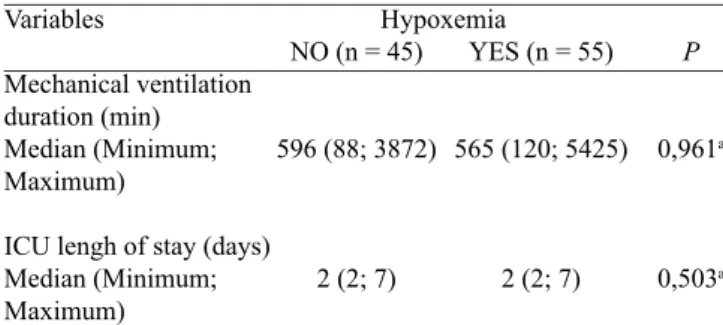
The median of time for interruption of ventilation device for the studied group lasted around 9 hours and 54 minutes and the ICU admission, two days. The presence of hypoxemia did not interfere with time of mechanical ventilation and ICU admission, as observed in Table 3.
Table 2. Univariate Analysis of the intra-operative variables (n = 100).
Variables
Number of grafts LITA grafts (%) Yes
No
Number of drains Surgery time (min) Pump time (min) Aortic clamp time (min)
NO (n = 45) 2.5 ± 0.8
6.7 93.3 1.8 ± 0.5 217.1 ± 48.1
81.4 ± 29.8 56.7 ± 23.2
YES (n = 55) 2.6 ± 0,7
10.9 89.1 1.8 ± 0.5 231.6 ± 46.7
84.1 ± 28.5 61 ± 22.2
P
0.537a 0.354b
0.934a 0.129a 0.649a 0.348a Hypoxemia
Mean PaO2 quantiied after ICU admission was 117.7±35.3 mmHg; in no hypoxemia patients was 150.6±22.2 mmHg; and in patients with hypoxemia was 72.1±3.9 mmHg. Average PaO2/FiO2 ratio was 294.2±88.2, ranging 165.3 to 510 mmHg.
When hypoxemia severity [10] was evaluated, 45% of 100 patients in the study had PaO2/FiO2 ratio classiied as normal (> 300 mmHg). PaO2/FiO2 ratio greater than 200 mmHg and lower or equal to 300 mmHg (mild hypoxemia) was observed in 37% and 18% of them had moderate hypoxemia (100 mmHg<PaO2/FiO2<200 mmHg). None of the patients presented severe hypoxemia (PaO2/FiO2<100 mmHg).
DISCUSSION
Hypoxemia in CABG immediate postoperative is strictly related to risk factors associated to prior comorbidies and surgical procedure [11]. Among these comorbidities, advanced age, overweight, left ventricular dysfunction were associated to hypoxemia according to Szeles et al. [7], which analyzed risk factors to hypoxemia in CABG immediate postoperative in 481 patients with no relevant respiratory medical history.
In other studies [3,7,12], age was also mentioned as a risk factor related to hypoxemia after CABG. For Szeles et al. [7], age was an independent risk factor for hypoxemia and each year after age 34 increased their risk in 0.32% [7].
In our study we did not observe a signiicant association between advanced age and hypoxemia. However, considering physiological aspects, pulmonary function deteriorates with aging and the primary modiication that happens in healthy person lungs due to aging is a gradual elastic retraction loss, reducing expiratory low and increasing ventilation-perfusion ineficiency [13].
Divergent outcome from previous studies may be related to cut-off point of advanced age in this research, equal or above 60 years.
About weight, signiicant association was veriied between high BMI and hypoxemia. This result is corroborated other studies in which obesity is described as a risk factor for hypoxemia [3,7].
Proposed mechanism to explain this result is obese patients’ abdominal wall, in general, being thicker due to adipose panicle, contributing to increasing abdominal pressure over diaphragm and collapsed parenchyma volume in caudal and dependent lung areas [7].
Another associated factor with hypoxemia occurrence in this study was smoking. Ambrozin et al. [14] analyzed some pulmonary function aspects after CABG related to preoperative risks and veriied that half of the cases presented decreased gas exchange ratio, inluenced by comorbidies such as pre-existing lung disease, respiratory symptoms and smoking.
Smokers present higher respiratory complications risk during postoperative period, due not enough respiratory system integrity to maintain alveolar ventilation[15]. This data reinforces preoperative assessment importance to identify those patients[14].
According to Morsch et al. [16], damages in pulmonary function and respiratory muscle strength after CABG are associated to transoperative factors, such as sternotomy, CPB, and general anesthesia.
CPB has been considered important cause of hypoxemia in immediate postoperative CABG [3,7]. Szeles et al. [7] showed that CPB was an associated factor to severe hypoxemia in univariate analysis. Hypoxemia ocurred in 37.9% of patients with pump time higher than 120 minutes; in 29.3% with pump time less than 120 minutes; and 20% in off-pump CABG.
In our research we did not observe an association between hypoxemia and CPB. This result may be related to lower pump time (less than 120 minutes) in 92% of patients, with mean time 82.9 minutes. According to Nozawa et al. [17], is highly probable that inlammatory aggression due longer pump time causes higher interstitial alveolar injury and edema.
However when Cox et al. [18]investigated effects of on and off-pump CABG on pulmonary function by an alveolar-arterial oxygen gradient in patients with adequate ventricular function and no pre-existing pulmonary disease, it was observed a similar level of pulmonary dysfunction in both groups. It suggests that pulmonary gas exchange deterioration associated with cardiac surgery is due to other factors, not only CPB. We highlight that in these patients, mean pump time was low (74.36 minutes), closer to our study time.
Szeles et al. [7] also demonstrated high incidence of hypoxemia (54.2%), even considering gas exchange lower than 200 mmHg. Among these, 27.3% presented PaO2/FiO2 ratio lower to 150, demonstrating higher hypoxemia severity in this group of patients when compared to our research, in which no one presented this ratio lower than 150 mmHg.
Some strategies to prevent hypoxemia have been used after cardio surgery, as alveolar recruitment with PEEP, showing gas exchange ratio improvement [19]. Almost half of patients needed some therapy to reverse hypoxemia such as alveolar recruitment, PEEP level elevation or oxygen therapy[20]. Table 3. Correlation between mechanical ventilation and
permanence in the ICU, and hypoxemia time (N=100). Variables
Mechanical ventilation duration (min) Median (Minimum; Maximum)
ICU lengh of stay (days) Median (Minimum; Maximum)
NO (n = 45)
596 (88; 3872)
2 (2; 7)
YES (n = 55)
565 (120; 5425)
2 (2; 7)
P
0,961a
0,503a Hypoxemia
REFERENCES
1. Piegas LS, Bittar OJNV, Haddad N. Cirurgia de revascularização miocárdica. Resultados do Sistema Único de Saúde. Arq Bras Cardiol. 2009;93(5):555-60.
2. Borghi-Silva A, Mendes RG, Costa FS, Di Lorenzo VA, Oliveira
CR, Luzzi S. The inluences of positive end expiratory pressure
(PEEP) associated with physiotherapy intervention in phase I cardiac rehabilitation. Clinics (Sao Paulo). 2005;60(6):465-72.
3. Weiss YG, Merin G, Koganov E, Ribo A, Oppenheim-Eden A, Medalion B, et al. Postcardiopulmonary bypass hypoxemia: a prospective study on incidence, risk factors and clinical
signiicance. J Cardioth Vasc Anesth. 2000;14(5):506-13.
4. Scanlan CL, Wilkins RL, Stoller JK. Fundamentos da terapia respiratória de Egan. 7a ed. Barueri:Manole;2000.
5. Carvalho RRC, Toufen Júnior C, Franca AS. III Consenso de Ventilação Mecânica. Ventilação Mecânica: princípios,
análise gráica e modalidades ventilatórias. J Bras Pneumol.
2007;33(Suppl 2):S54-70.
6. Garutti I, Martinez G, Cruz P, Piñeiro P, Olmedilla L, la Gala F. The impact of lung recruitment on hemodynamics during one-lung ventilation. J Cardiothorac Vasc Anesth. 2009;23(4):506-8.
7. Szeles TF, Yoshinaga EM, Alencar W, Brudniewski M, Ferreira FS, Auler JO, et al. Hypoxemia after myocardial revascularization: analysis of risk factors. Rev Bras Anestesiol. 2008;58(2):124-36.
8. Ji Q, Mei Y, Wang X, Feng J, Cai J, Sun Y, et al. Study on the risk factors of postoperative hypoxemia in patients undergoing coronary artery bypass grafting. Circ J. 2008;72(12):1975-80.
9. Organização Mundial da Saúde (OMS). Obesity: preventing and managing the global epidemic. Report of a WHO consultation on obesity. Geneva: WHO;1998.
10. The ARDS Deinition Task Force. Acute respiratory distress syndrome: the Berlin deinition. JAMA. 2012;307(23):2526-33.
11. Guizilini S, Gomes WJ, Faresin SM, Bolzan DW, Alves FA, Catani R, et al. Avaliação da função pulmonar em pacientes submetidos à cirurgia de revascularização do miocárdio com e sem circulação extracorpórea. Rev Bras Cir Cardiovasc. 2005;20(3):310-6.
12. Canver CC, Chanda J. Intraoperative and postoperative risk factors for respiratory failure after coronary bypass. Ann Thorac Surg. 2003;75(3):853-7.
13. Beliveau MM, Multach M. Perioperative care for the elderly patient. Med Clin North Am. 2003;87(1):273-89.
14. Ambrozin ARP, Caetano AJM. Aspectos da função pulmonar após revascularização do miocárdio relacionados com risco pré-operatório. Rev Bras Cir Cardiovasc. 2005;20(4):408-15. Author’s roles & responsibilities
NPS Study design, data collection and manuscript writing RMM Study design and manuscript writing
DLB Study design and manuscript writing MAGC Data collection
TEPB Data collection IML Data collection KCFM Data collection
JLSL Statistical analysis and text revision
Laizo et al. [21] analyzed complications that increased ICU lengh of stay and found as cause those related to pulmonary function (COPD and smoking, pulmonary congestion, prolonged mechanical ventilation), besides infections, kidney failure, stroke and hemodynamic instability (as arterial hypotension, arrhythmia and AMI).
Weiss et al. [3] pointed hypoxemia as responsible for increase mechanical ventilation duration, ICU lengh of stay and hospital cost in CABG postoperative patients. This association was not observed in our research. Perhaps this result is explained by transitory hypoxemia in the irst few hours after ICU admission presented by a lot of patients, with no implication in those times, besides PEEP level applied in admission.
Limitations of this study are related to its design, since retrospective studies may present selection and measurement biases. Regarding data collection from medical chart, with no direct patient’s evolution follow-up may also be characterized as a limitation factor. In some included patients, variables related to lifestyle such as smoking habit and intensity, pre-existing diseases, and left ventricular function were only cited in a qualitative manner. While inevitable data fail, available variables were categorized in the best way possible.
CONCLUSION
15. Ferreira Júnior FH, Boas AGV, Gonnelli CA, Puig LB, Stolf N. Assistência ventilatória mecânica em pós-operatório de cirurgia cardíaca. An Paul Med Cir. 2003;130(1):22-30.
16. Morsch KT, Leguisamo CP, Camargo MD, Coronel CC, Mattos
W, Ortiz LDN, et al. Peril ventilatório dos pacientes submetidos
a cirurgia de revascularização do miocárdio. Rev Bras Cir Cardiovasc. 2009;24(2):180-7.
17. Nozawa E, Kobayashi E, Matsumoto ME, Feltrim MI, Carmona
MJ, Auler JJ. Assessment of factors that inluence weaning from
long-term mechanical ventilation after cardiac surgery. Arq Bras Cardiol. 2003;80(3):301-10.
18. Cox CM, Ascione R, Cohen AM, Davies IM, Ryder IG, Angelini GD.
Effect of cardiopulmonary bypass on pulmonary gas exchange: a prospective randomized study. Ann Thorac Surg. 2000;69(1):140-5.
19. Auler JO Jr, Carmona MJ, Barbas CV, Saldiva PH, Malbouisson LM. The effects of positive end-expiratory pressure on respiratory system mechanics and hemodynamic in postoperative cardiac surgery patients. Braz J Med Biol Res. 2000;33(1):31-42.
20. Vieira JE, Silva BAR, Garcia Júnior D. Padrões de ventilação em anestesia: estudo retrospectivo. Rev Bras Anestesiol. 2002;52(6):756-63.