Guilherme Machado Alvares de Lima(a)
Mário Sérgio Soares(b) Sibele Sarti Penha(b)
Marcelo Munhóes Romano(b)
(a)School of Dentistry, University of São Paulo, São Paulo, SP, Brazil.
(b)Department of Stomatology, Integrated Clinic, School of Dentistry, University of São Paulo, São Paulo, SP, Brazil.
Corresponding author:
Guilherme Machado Alvares de Lima Av. Nossa Senhora da Assunção, 675, apto. 134E - Butantã
São Paulo - SP - Brazil CEP: 05359-900
E-mail: [email protected]
Received for publication on Sep 13, 2010 Accepted for publication on Nov 22, 2010
Comparison of the fracture torque of
different Brazilian mini-implants
Abstract: This study evaluated fracture torque by torsion, in relation to the length and diameter of orthodontic mini-implants, to demonstrate their viability for clinical and experimental use based on the torque rec-ommended by the manufacturers. The fractures at the moment of in-sertion, whose incidence in the literature is around 4%, are principally due to excessive force and the inability of the implant to resist rotational forces. Thirty orthodontic mini-implants of three commercial brands available in Brazil (Neodent 1.6 x 9 mm, Dentolex 1.6 x 9 mm and Kopp 1.6 x 9 mm) were attached to a device made speciically for this research, leaving the implants with suficient stability. The mini-implants were submitted to torsion torque, using a digital torque wrench, until their breaking point. The values obtained with the test were sub-mitted to analysis of variance and the Tukey test. The mean values of mini-implant ruptures were 26 N.cm for group A (Dentolex), 25.4 N. cm for group B (Kopp) and 32.8 N.cm for group C (Neodent). From the Tukey test we could observe that the relationships between the means of the Dentolex and Neodent groups, and between the Kopp and Neodent groups, were signiicant. Between the Dentolex and Kopp groups, signif-icance was nonexistent. All the values found in our research for fracture torque were higher than the limits recommended by the manufacturers for clinical use in orthodontics. The highest values were found in the Neodent group.
Descriptors: Dental Implantation; Torque; Orthodontics; Stress, Mechanical.
Introduction
The use of mini-implants for orthodontic anchoring in static mode is indicated in several situations, such as: anterior retraction, intrusion, ver-ticalization, small orthodontic movements, among others. Therefore, the interaction between the implantodontist and the orthodontist is essential for planning. The shape of the mini-implant may be cylindrical or coni-cal, and the active end may be self-drilling. Its installation is simple and quick, and it may be transmucosal or with lap under local iniltration anesthesia. The activation may be immediate or delayed, using typical orthodontic forces of 150 to 200 grams.1 The removal of implants may frequently be done without need of anesthesia, using removal torque in the opposite direction to its thread.
de-veloped, show success between 60-85%.2 Currently, this rate is around 90%.3 The general contra-indi-cation for its use is the same for patients with re-strictions against surgical interventions in general (systemic problems, patients too weak for surgery); with insuficient space and/or bone volume between the roots of the teeth; heavy smokers; patients with poor oral hygiene; pathologies of the oral mucosa; as well as unmotivated or uncooperative patients.4
Mini-implant fracture can occur due to several factors, such as: diameter, length, macrogeome-try, surgical technique, implantation and removal torque,2,5,6,7 since the main concentration of stress is in the area of the neck of the mini-implant.5 There-fore, it is necessary to know the working system and its technical characteristics in order to avoid over-torquing. If a fracture occurs, removal of the frag-ment requires a surgical procedure. Depending on its location, preserving by taking clinical and radio-graphic controls of the fragment, or substituting the fractured mini-implant with another of larger diam-eter, or selecting a new point of implantation, are options that may be pursued.
Mini-implants may vary according to density, length and size of the transmucosal proile, and may have diameters between 1.0 and 2.0 mm, lengths between 4 and 15 mm, and transmucosal proiles measuring between 1 and 3 mm.8 However, the clin-ical preference among orthodontists who use mini-implants, according to Brandão et al.,7 falls on the shorter and less thick. The option for smaller screws decreases the risk of accidents during the surgical placement; but, it also brings possible technical dis-advantages, such as less mechanical resistance by the device.7
In this way, as an experimental study, the maxi-mum torques for torsion fracture in mini-implants from three different, commercially available Brazil-ian manufacturers, and their correlation with the manufacturers and recommended torque, were eval-uated.
Materials and methods
Thirty orthodontic, self-drilling, titanium mini-implants, ASTM F-136 grade V, Ti-6Al-4V, com-mercially available from three different Brazilian
companies, were used. Their assignment to the study groups is shown in Table 1.
An aluminum ixture similar to a capsule was made to evaluate the torque necessary to cause a fracture. This had a channel, into which the mini-im-plant was inserted, to prevent lateral tension (Figure 1).
The mini-implants were positioned irmly into the ixture, leaving 1.5 mm of the screw, measured with a stainless-steel thickness gauge, ref. P.156 (Temper. Inox Instrumentos cirúrgicos e odon-tológicos Ltda., São Paulo, Brazil), not inserted into the aluminum capsule, since the thickness of the attached gingiva varies between 1 and 1.5 mm.9 Following, the capsule was screwed such that the mini-implant was stabilized, preventing rotational movement. The combined mini-implant/ixture was secured in a vise-grip (Mini vise 40 mm West-ern mod. F-40, E.I.C., New Delhi, India), leaving the head of the screw immovable. Next, the head of the mini-implant was placed into its speciic inser-tion guide, according to its commercial brand. The
Table 1 - Characteristics and group assignment of the orth-odontic mini-implants.
Group A
Ten Dentoflex mini-implants, 1.6 x 9 mm, short-waist, 0.2 mm (Dentoflex Com. e Ind. de Mat. Odont. Ltda., São Paulo, Brazil)
Group B Ten Kopp mini-implants, 1.6 x 9 mm (Kopp Produtos Odontológicos, Curitiba, Brazil)
Group C Ten Neodent mini-implants, 1.6 x 9 mm, medium-waist, (Neodent, Curitiba, Brazil)
digital torque wrench TQ-680 (Instrutherm Ltda., São Paulo, Brazil), attached to the head of the mini-implant, measured the torque necessary to fracture it, noting the control of the installation torque ac-cording to manufacturer’s instructions. The torque wrench was adjusted to the PEAK function, so we could know the maximum torque attained, and was reset to zero after being attached to the head of the mini-implant. The torque wrench was activated un-til the rupture torque was reached, thus representing the value obtained at the exact moment at which the fracture of the mini-implant occurred. This evalu-ation determines the resistance of the mini-implant to the torsion motion, by means of the maximum torque that can be applied to the specimen.
The maximum rupture torque was expressed ac-cording to the scale in N.cm.
Statistical analysis was done using the Biostat 5.0 software (Sociedade Civil Mamirauá, Belém, Brazil).10 The values obtained for the rupture torque were submitted to analysis of variance (ANOVA) and the Tukey test, in order to determine possible statistical differences between the groups. Descrip-tive statistical analyses, including mean, standard deviation, median, minimum and maximum values, were calculated for the three groups.
Results
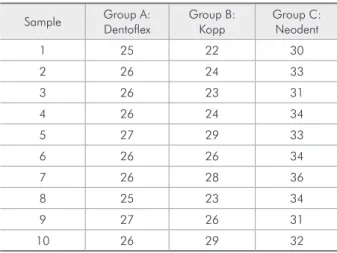
The thirty fractured samples and the results, in N.cm, are shown in Table 2, numbered according to the sequence in which the tests were performed.
From the descriptive statistics shown in Table 3, it is observed that the means of the groups were: 26 N.cm for group A (Dentolex), 25.4 N.cm for group B (Kopp), and 32.8 N.cm for group C (Neo-dent).
Group B showed the greatest variance among the rupture torques, with 6.7111; and the least occurred in group A, with 0.4444. The Coeficient of Varia-tion shows the variance in percent, making the devi-ation more visual. Thus, among the rupture torques found, we observed that the greatest variation was observed for Kopp, with 10.20%; followed by Neo-dent, with 5.53%; and Dentolex, with 2.56%.
According to Table 4 (ANOVA), there were sta-tistically signiicant differences for one criterion among both the Dentolex and Neodent, and the Kopp and Neodent, groups. The highest values were for the Neodent group.
Table 2 - Fracture torque of the thirty samples tested (N.cm).
Sample Group A:
Dentoflex
Group B: Kopp
Group C: Neodent
1 25 22 30
2 26 24 33
3 26 23 31
4 26 24 34
5 27 29 33
6 26 26 34
7 26 28 36
8 25 23 34
9 27 26 31
10 26 29 32
Table 3 - Descriptive statistics.
Group A: Dentoflex
Group B: Kopp
Group C: Neodent
Sample size 10 10 10
Minimum 25 22 30
Maximum 27 29 36
Arithmetic mean 26 25.4 32.8
Variance 0.4444 6.7111 3.2889
Standard deviation 0.6667 2.5906 1.8135
Standard error 0.2108 0.8192 0.5735
Coefficient of variation 2.56% 10.2% 5.53%
Table 4 - ANOVA.
Sources of
variation DF SS MS F p
Treatments 2 337.867 168.933
485.234 < 0.0001
Error 27 94 3.481
Table 5 - Tukey test.
Group pairs Difference Test statistic p
Dentoflex X Kopp 0.6 1.0169 NS
Dentoflex X Neodent 6.8 11.5246 < 0.01
Discussion
Knowledge of the biomechanical performance of orthodontic mini-implants can provide less failure and better guidelines for clinical use, as they show the most varied shapes and dimensions.
The use of orthodontic mini-implants has some advantages in relation to other methods, such as: providing absolute anchoring; reduction of the risk of root injury; ease of handling, installation and re-moval; minimal irritation of adjacent tissues; con-trolled distribution of orthodontic mechanics; sta-bility after installation.11 Among the disadvantages are trans-operative problems, including fractures at the moment of insertion (whose incidence in the literature is around 4%5), due mainly to excessive force and the inability to resist rotational forces.12
To determine the mechanical resistance of any material, such as ductility, hardness and tenacity, mechanical tests that can evaluate their functional performance must be done. This is how the mini-im-plants used in this study were evaluated, in the state in which they are marketed. The insertion torque is proportional to the area of contact of the mini-implant with the bone. Thus, the larger the diam-eter, the greater the torque necessary, and this varies according to such characteristics as: external diam-eter, length and body of the mini-implants. Implants with a large cutting edge are easier to insert.13
A study conducted with the objective of deter-mining the variability of the rotational forces applied to the prosthetic keys, for digital (with the ingers) use, aimed at tightening the implant components, pointed out average measurements of 26.58 N.cm (± 6.52 percent).14 Fractures of the mini-implants may, thus, occur during digital insertion.
Self-drilling mini-implants have greater advan-tages than mini-implants that require surgical pro-cedures that rely on the use of earlier surgical drills; however, the torque necessary to install the self-drilling ones may bring forth other problems.15
Knowledge of the information relevant to the maximum torque tolerated by the screws should be made evident to dentists, in order to avoid operat-ing failures; often, such information is not easily available in the packaging or lealets. The businesses contacted stated that the maximum insertion torque
for the mini-implants of 1.6 mm should be 20 N.cm for Neodent, 20 N.cm for Dentolex, and 15 N.cm for Kopp.
The values found in this study exceeded the rec-ommended values for maximum insertion torque (20 N.cm for Dentolex and Neodent), and were much higher than the mean insertion force observed for mini-implants, which would be between 5 and 10 N.cm, and could reach 15 N.cm.15
We selected three Brazilian mini-implants, 1.6 mm in diameter. It is agreed that this diameter has a high success rate for primary stability.15,16 To avoid lateral movement, a metallurgical device was created to hold the mini-implants during the tests, such that there was no movement which would com-promise the results obtained.
In Table 3, it is observed that the means of the groups were: 26 N.cm for group A (Dentolex), 25.4 N.cm for group B (Kopp), and 32.8 N.cm for group C (Neodent). Thus, Group 1 (Dentolex) pre-sented very similar values (less variance between the rupture torques = 0.4444), while group B (Kopp) was discrepant within itself (greater variance among the rupture torques = 6.7111). The Coeficient of Variation indicates the variance in percent, making the deviation more visible. Thus, the group with the greatest variation in rupture torque was Kopp, with 10.20%; followed by Neodent, with 5.53%; and Dentolex, with 2.56%.
From the Tukey test we could observe that the re-lationship between the means of the Dentolex and Neodent groups, and between the Kopp and Neo-dent groups, was signiicant. There was no signii-cance between the Dentolex and Kopp groups.
Although the three commercial brands of mini-implants evaluated were produced using the same type of material and following the same norms, some factors may interfere with the result. Possibly the best performance, by Group C (Neodent), may be explained by the presence of the transmucosal proile.
the torque necessary for insertion varies from 20 to 40 N.cm. In these situations, it would be advisable to use pilot drills in order to decrease bone resis-tance, reducing the possibility of fracture.19
The excessive use of torque may result in fracture of the mini-implant and instability at the interface between the implant and the bone. Whenever pos-sible, the insertion should be done using the torque wrench offered by the implant system to be used, and following the conditions suggested by the man-ufacturers.
Good surgical-orthodontic planning avoids the occurrence of occasional failures.
Conclusion
Within the limitations of this study, the fracture torque values found in our research are superior to those limits recommended by the manufacturers for clinical use in orthodontics. The highest values were found for the Neodent group.
9. Muller, HP, Schaller N, Eger T, Heinecke A. Thickness of masticatory mucosa. J Clin Periodontol. 2000;27(6):431-6. 10. Sociedade Civil Mamirauá. Bioestat 5.0: aplicações estatísticas
nas áreas das ciências biológicas e médicas. Belém: Sociedade Civil Mamirauá; 2007.
11. Bae S, Park H, Kyung H, Kwon O, Sung J. Clinical appli-cation of micro-implant anchorage. J Clin Orthod. 2002 May;36(5):298-302.
12. Jardim FL, Utilização de mini-implantes na ortodontia. Rev Saude Pesqui. 2009 Jan;2(3):417-26.
13. Srinok V, Nisalak P, Verayangkura P, Charoenying H, Kyung H. Association between insertion torque and the success of mini-screws used as orthodontic anchorage. Mahidol Dent J. 2008 Aug;28(2):202-214
14. Aziz, C. Avaliaçäo da variabilidade na aplicação de torque através de chaves digitais (com os dedos). Rev Bras Implant. 2001Jul-Set;7(3):18-20.
15. Miyawaki S, Koyama I, Inoue M, Mishima K, Sugahara T, Takano-Yamamoto T. Factors associated with the stability of titanium screws placed in the posterior region for orth-odontic anchorage. Am J Orthod Dentofacial Orthop. 2003 Oct;124(4):373-8.
16. Motoyoshi M, Hirabayashi M, Miwa Uemura M, Shimizu N. Recommended placement torque when tightening an and 1.53 g/cm³). For Neodent implants of 1.6 mm
x 7 mm, a mean of 49.8 N.cm and a minimum of 47.8 N.cm were observed. The other brands used in this study were SIN (mean of 99.5 N.cm), Tita-nium Fix (mean of 54.85 N.cm), and INP (mean of 54.3N.cm). The values found in a similar test were less than the ones found by those researchers; one explanation for this may be the use of cortical bone by that group.17
Nova et al.18 showed no signiicant difference between SIN and Neodent mini-implants, with mean values of 35.14 N.cm for the SIN group and 27.42 N.cm for Neodent. The authors state that torques between 35 and 50 N.cm may cause frac-ture in the mini-implant, and recommend limiting the insertion torque to 20 N.cm.18 Given our results, there are evident differences between manufacturers and researchers.
Care must be taken when the cortical bone measures are greater than 2 mm because, depend-ing on the different formats of the mini-implants,
References
1. Josgribert LFV, Henriques JFC, Henriques RP, Tirloni P, Kayatt FE, Godoy HT. A utilização dos mini-implantes na mecânica ortodôntica contemporânea. Rev Clin Ortod Dental Press. 2008 Ago-Set;7(4): 76-90.
2. Mah JBF. Temporary Anchorage devices: a status report. J Clin Orthod. 2005 Mar;39(3):132-6.
3. Park HS, Lee SK, Kwon OW. Group distal movement of teeth using microscrew implant anchorage. Angle Orthod. 2005 Jan-Jun;75(4):602-9.
4. Wuo AV, Horliana ACRT, Horliana RF, Soares MS, Tortamano A. Microimplantes ortodônticos: em que casos podem ser uti-lizados? Rev Assoc Paul Cir Dent. 2005;59(4):275.
5. Bucheter A, Wiechmann D, Koerdt S, Wiesmann HP, Pifko J, Meyer U. Load related implant reaction of mini-implants used for orthodontic anchorage. Clin Oral Implants Res. 2005 Ago;16(4):473-9.
6. Melsen B. Mini-implants: Where are we? J Clin Orthod. 2005 Sep;39(9):539-47.
7. Brandão FGT, Loureiro FL, Oliveira Junior HB, Carvalho PEG, Cotrim-Ferreira FA. Mini-implantes ortodônticos: quais os tamanhos mais vendidos? Rev Odontol UNICID. 2008 Set-Dez;20(3):254-60.
orthodontic mini-implant. Clin Oral Implants Res. 2006 Feb;17(1):109-14.
17. Pithon M, Nojima L, Nojima N, Ruellas AC. Comparative study of fracture torque for orthodontic mini-implants of different trademarks .Oral Surg. 2008 May;1(2):84-7. 18. Nova MFP, Carvalho FR, Elias CN, Artese F. Avaliação dos
torques para inserção,remoção e fratura de diferentes
mini-implantes ortodônticos. Rev Dental Press Ortod Ortop Facial. 2008 Set-Out;13(5):76-87.