Antimicrobial agents used in the control
of periodontal biofilms: effective adjuncts
to mechanical plaque control?
§Abstract: The control of bioilm accumulation on teeth has been the cornerstone of periodontal disease prevention for decades. However, the widespread prevalence of gingivitis suggests the ineficiency of self-performed mechanical plaque control in preventing gingival inlamma-tion. This is particularly relevant in light of recent evidence suggesting that long standing gingivitis increases the risk of loss of attachment and that prevention of gingival inlammation might reduce the prevalence of mild to moderate periodontitis. Several antimicrobials have been tested as adjuncts to mechanical plaque control in order to improve the results obtained with oral home care. Recent studies, including meta-analy-ses, have indicated that home care products containing chemical anti-microbials can provide gingivitis reduction beyond what can be accom-plished with brushing and lossing. Particularly, formulations containing chlorhexidine, mouthrinses containing essential oils and triclosan/copo-lymer dentifrices have well documented clinical antiplaque and antigin-givitis effects. In vivo microbiological tests have demonstrated the ability of these antimicrobial agents to penetrate the bioilm mass and to kill bacteria growing within bioilms. In addition, chemical antimicrobials can reach dificult-to-clean areas such as interproximal surfaces and can also impact the growth of bioilms on soft tissue. These agents have a positive track record of safety and their use does not seem to increase the levels of resistant species. Further, no study has been able to establish a correlation between mouthrinses containing alcohol and oral cancer. In summary, the adjunct use of chemical plaque control should be recom-mended to subjects with well documented dificulties in achieving proper bioilm control using only mechanical means.
Descriptors: Dental plaque; Gingivitis; Oils, essential; Triclosan. Ricardo Palmier Teles(a)
Flavia Rocha Fonseca Teles(b)
(a) DMSc, Associate Member of the Staff; (b)DMSc, Post-doctoral Researcher
– Department of Periodontology, The Forsyth Institute, Boston, MA, USA.
Corresponding author:
Ricardo Palmier Teles Department of Periodontology, The Forsyth Institute 140 The Fenway Boston - MA - USA ZIP: 02115
E-mail: [email protected]
Received for publication on Nov 24, 2008 Accepted for publication on Dec 08, 2008
§ Paper presented at the “Oral Health
Introduction
Since the 1960s when Löe and coworkers1 estab-lished the unequivocal role of dental plaque as the etiological agent of gingivitis, mechanical plaque control has become the cornerstone of periodontal therapy. However, the almost ubiquitous prevalence of gingivitis would suggest that control of periodon-tal bioilms through mechanical means is ineficient. The dificulty in achieving an “ideal” mechanical plaque control has led scientists and clinicians to seek chemical antimicrobial agents that could help inhibit bioilm formation on tooth surfaces. The current review will concentrate on antimicrobial agents present in formulations of self-care oral hy-giene products commercially available in the Brazil-ian market. The goal is to critically review products available to the Brazilian public regarding their an-tiplaque and antigingivitis effects. In addition, the effects of these chemical agents on the oral micro-biota will be discussed. Important considerations such as the long-term safety of oral antimicrobial agents and the impact of control of gingivitis in the development and progression of more severe forms of periodontal diseases will also be addressed.
Current understanding of the pathogenesis of periodontal diseases indicates that the presence of gingivitis is a pre-requisite for the development of periodontitis.2 However, it is also well recognized that even long standing severe gingivitis will not nec-essarily lead to loss of attachment.3 These observa-tions have led some authors to question the relevance of mild to moderate forms of gingivitis as a public health problem, and if efforts to control this disease at a populational level would be justiiable.4 Recent data from a 26-year longitudinal study of 565 Nor-wegian males indicated that sites that bled on prob-ing on every examination (gprob-ingival index [GI] = 2) had approximately 70% more attachment loss than non-inlamed sites (GI = 0 at all visits).5 This study supports the pivotal role of gingivitis as a risk fac-tor for attachment loss and emphasizes the chronic nature of periodontitis, requiring time to progress. Epidemiological data from a Swedish study follow-ing randomly selected individuals in different age groups (20-80 years of age) over a 30-year period (1973-2003) suggest that plaque control on a
popu-lation level might reduce not only the prevalence of gingivitis but also the prevalence of moderate forms of periodontitis.6 Subjects were classiied according to the severity of their periodontal disease into: 1) periodontal health; 2) gingivitis; 3) moderate peri-odontitis and 4) and 5) severe or advanced periodon-titis. In all age groups the proportion of periodontal-ly healthy subjects increased, while the prevalence of gingivitis and moderate periodontitis decreased. The percentage of individuals in category 4 also tended to decrease, while their number of remaining teeth increased over time. This 30-year cohort study dem-onstrates that strategies aiming at the control of gin-givitis at a populational level could reduce the preva-lence of mild to moderate forms of periodontitis.
Limitations of mechanical
plaque control
Despite its essential role in the prevention of gin-givitis and periodontitis, mechanical plaque control is not properly practiced by most individuals. A sur-vey conducted in the United Kingdom concluded that an average of one-third of teeth in 72% of all dentate adults examined had visible plaque.7 Brush-ing techniques are particularly limited in their ac-cess to interproximal plaque of pre-molars and mo-lars, and control of bioilm accumulation on these areas requires additional devices such as dental loss.8 Surveys conducted in developed countries re-veal that the percentage of individuals who claim to use interproximal cleaning devices on a daily basis range from 11 to 51%.9 A systematic review of the effectiveness of self-performed mechanical plaque removal in adults with gingivitis concluded that the quality of the mechanical plaque control was not suficiently effective in reducing gingivitis.10 Taken together, these studies indicate that consistently ef-fective brushing is uncommon, leaving room for improvement. Therefore, the adjunct use of antimi-crobial agents might be beneicial for the adjunct control of supragingival bioilms.
bioilms, they represent a relatively small percent-age of the total area of the oral cavity (21-23%).11 Recent studies have demonstrated that microorgan-isms involved in the etiology of gingivitis and peri-odontitis accumulate on several soft tissue surfaces of the mouth, which serve as a source of bacteria for the colonization of tooth surfaces.12 Chemical anti-plaque agents present in mouthrinses or dentifrices could reach these soft tissue surfaces, improving the control of bioilm growth on these surfaces and de-laying microbial accumulation on teeth. This mech-anism was illustrated in a study that examined the rate of bioilm accumulation on teeth after a 3-week preparatory phase that included oral hygiene in-structions and frequent professional cleanings.13 In the last week of this preparatory phase, the experi-mental group rinsed and gargled twice a day with a 0.2% chlorhexidine digluconate (CHX) solution and brushed their tongue with a 1% CHX gel once a day. This intensive protocol of control of the soft tissue bioilm resulted in a lower mean plaque index (Turesky modiied Quigley-Hein index [QHI]14,15) at days 1, 2 and 4 of undisturbed plaque re-accumu-lation. Data from checkerboard DNA-DNA hybrid-ization also revealed that the mean total DNA probe count was statistically signiicantly higher in the control group compared to the experimental group at days 2 and 4 of plaque re-growth. These indings suggest that the daily use of chemical antimicrobial agents that affect the soft tissue bioilms could re-tard plaque accumulation on tooth surfaces.
Meta-analysis of antiplaque and
antigingivitis agents
A recently published meta-analysis of antiplaque and antigingivitis agents provided strong evidence in favor of the use of antimicrobial agents as adjuncts to mechanical plaque control.16 A total of 50 manu-scripts including 70 active groups met the inclusion criteria and were analyzed. Of the dentifrices ex-amined only formulations containing triclosan/co-polymer demonstrated a clinically and statistically signiicant antiplaque effect. Fourteen of the 18 ac-tive groups using triclosan/copolymer had signii-cant decreases in plaque accumulation. The author highlighted two mouthrinses with consistent
anti-plaque effects: 0.12% CHX and essential oils-con-taining formulations (menthol [0.042%], thymol [0.064%], methyl salicylate [0.060%], and euca-lyptol [0.092%]). CHX resulted in statistically sig-niicant reduction in plaque in all studies reviewed. Only 1 active group out of 25 that used essential oils did not show statistically signiicant reductions in plaque. The results of studies employing GI to assess gingivitis were statistically and clinically signiicant for 0.12% CHX mouthrinses (5/6 active groups), dentifrices containing triclosan/copolymer (12/16 ac-tive groups) and mouthrinses with essential oils (3/8 active groups). Of the trials using MGI (Modiied Gingival Index), 13/17 active groups demonstrated statistically signiicantly less gingivitis in the groups using essential oils compared to controls. Based on these results we will focus our review on studies examining the clinical and microbiological effects of triclosan/copolymer dentifrices and essential oil mouthrinses. CHX will not be reviewed extensively due to its well known side effects, which preclude its use as a long term adjunct to oral hygiene.
Effects of essential oil
mouthrinses on periodontal
biofilms and gingivitis
Essential oils have a broad antimicrobial spec-trum, affecting Gram-positive and Gram-negative bacteria and yeasts. The eficacy of oral antisep-tics is usually attributed to their bactericidal activ-ity, but essential oils also work by interfering with bacterial colonization of the tooth surface. Essential oils stop bacteria from aggregating with Gram-posi-tive pioneer species, slows bacterial multiplication, and extract endotoxins from Gram-negative patho-gens.17 This can lead to a reduced bacterial load, slow plaque maturation, and decreased plaque mass and pathogenicity. The bactericidal mechanisms of essential oils involve the rupture of the cell wall and enzymatic inhibition.17
pen-etration of a mouthrinse containing essential oils in dental plaque was tested in vivo using luorescent dyes that differentiate live and dead bacteria.19 Thir-ty minutes after a rinse with essential oils, 78.7% of bacteria in plaque samples were dead compared to 27.9% following rinsing with a placebo. The re-sults clearly demonstrated that the essential oils were capable of penetrating the plaque mass and exert their antimicrobial effect on bacteria growing within bioilms. These indings were conirmed by additional studies that demonstrated in vivo antimi-crobial effects of mouthrinses containing essential oils on preexisting plaque.20,21,22 Fourteen days of twice-daily rinsing with an essential oils-contain-ing mouthrinse resulted in statistically signiicant reductions compared to a placebo mouthrinse in su-pragingival levels of Veillonella sp. (52.3%), Capno-cytophaga sp. (74.1%), Fusobacterium nucleatum
(81.5%) and total anaerobes (88.5%).21 Moreover, this regimen also resulted in statistically signiicant reductions in subgingival plaque samples of target microorganisms ranging from 54.1 to 69.1%, sug-gesting that rinsing with essential oils could also impact the subgingival microbiota. Using a similar design, the same group reported on the impact that rinsing for 14 days with an essential oil mouthrinse had on the subgingival levels of Porphyromonas gingivalis, Veillonella sp., F. nucleatum and total anaerobes.22 Thirty seven subjects with a minimum of 4 sites with probing depth of 4 to 7 mm were en-rolled in the study. The results demonstrated statisti-cally signiicant reductions in all target microorgan-isms in the essential oils group compared with the placebo group: P. gingivalis (64.5%), Veillonella sp. (56.6%), F. nucleatum (76.6%) and total anaerobes (74.9%). The authors suggested that the subgingival antimicrobial effect of the mouthrinse was mediated primarily by disruption of the contiguous supragin-gival bioilm. In addition, a regimen of twice daily rinsing with essential oils for 14 days can reduce the levels of total anaerobes, Gram-negative anaerobes and volatile sulphur compound-producing organ-isms in plaque and on the dorsum of the tongue up to 12 hours after the inal rinse, indicating a certain level of substantivity.21
Several studies with a minimum of 6 months
of follow-up using a double-blind, controlled, ran-domized design have reported on the adjunctive effects of essential oil mouthrinses on decreasing plaque accumulation and development of gingivi-tis.23-29 These reports have described an average re-duction of 32.9% in plaque accumulation (QHI), and of 22.1% in gingivitis (MGI) (Table 1) in the groups using essential oils. However, measures of total plaque reductions do not address the effects of these agents on speciic areas of the oral cavity more prone to plaque accumulation and gingivitis such as the interproximal surfaces of posterior teeth. Some of the studies listed in Table 1 have addressed the ef-icacy of essential oils-containing mouthrinses in re-ducing plaque and gingivitis in interproximal areas. One study compared brushing plus the use of an essential oil mouthrinse (BEO) with brushing and lossing (BF) and brushing and rinsing with a pla-cebo mouthrinse (B).28 After six months, the BEO and BF groups had statistically signiicantly lower mean interproximal MGI compared to the B group. The authors concluded that rinsing twice daily with an essential oils-containing mouthrinse was as ef-icient as daily lossing in reducing interproximal plaque and gingivitis. Another study examined the adjunctive beneit of essential oils in reducing plaque and gingivitis in subjects who brush and loss regularly.29 After six months the group that in addi-tion to brushing and lossing used the essential oil mouthrinse had statistically and clinically signii-cantly lower mean MGI and PI (Sillness-Löe Plaque
Table 1 - Antiplaque and antigingivitis effects of essential oil mouthrinses.
Study Year N Duration *Plaque QHI
*Gingivitis MGI Gordon et al.23 1985 85 9 months 19.5% 23.9%
DePaola et al.24 1989 107 6 months 34.4% 33.7%
Overholser et al.25 1990 124 6 months 36.1% 35.9%
Charles et al.26 2001 316 6 months 56.1% 22.9%
Sharma et al.27 2002 301 6 months 37.5% 7.9%
Bauroth et al.28 2003 314 6 months 20.0% 11.1%
Sharma et al.29 2004 237 6 months 51.9% 21.0%
Index) than individuals in the placebo group (21.0 and 51.9%, respectively), suggesting that essential oils could be an effective adjunct to regular brush-ing and lossbrush-ing.
In these studies, visual assessment of plaque re-moval and gingivitis reduction was performed to determine antiplaque and antigingivitis effects in interproximal areas. Due to the wide area of inter-proximal surfaces of premolars and molars, it is dif-icult to visually determine if plaque was completely removed from the interproximal area. Likewise, gingivitis might have been reduced in the vestibular and lingual/palatal portion of the interdental papilla but not in the col area. In order to demonstrate the antimicrobial eficacy of essential oil mouthrinses in the interproximal area, the effect of 11 days of twice daily rinse with an essential oils-containing mouthrinse on the interproximal levels of Strepto-coccus mutans was assessed.30 The results demon-strated a reduction of 75.4% in total recoverable S. mutans from interproximal spaces in the essential oils group. Another study evaluating the effects of essential oils in the total viable bacteria in the inter-proximal spaces demonstrated a statistically signii-cant reduction of 43.8% in interproximal bacteria 5 minutes after a single 30-second rinse.31
Effects of Triclosan/copolymer
dentifrices on periodontal
biofilms and gingivitis
Dentifrices containing 0.3% triclosan and 2% polyvinyl methyl ether maleic acid copolymer (co-polymer) have demonstrated signiicant antiplaque and antigingivitis properties. Triclosan is a broad-spectrum antimicrobial agent, which acts on the bacterial cytoplasmic membrane. It prevents essen-tial amino acid uptake at bacteriostatic concentra-tions, while at bactericidal concentrations it causes disorganization of the bacterial membrane leading to leakage of cellular contents.32 The copolymer acts by increasing the retention of triclosan on tooth and oral soft tissue surfaces.33 A greater uptake of triclo-san to plaque and saliva was observed when copoly-mer was added to triclosan-containing dentifrices.34 Tests of the substantivity of toothpaste slurries dem-onstrated that dentifrices containing
triclosan/copo-lymer reduced the proportions of vital bacteria in plaque for up to 24 hours.35 The effects of one-week, twice-daily use of triclosan/copolymer dentifrice on the levels of Veillonella sp., Fusobacteria sp., total anaerobes and hydrogen sulide-producing bacteria were tested on samples of plaque, saliva and tongue scrapings 6 and 12 hours after the inal brushing.36 Signiicant reductions (88 to 96%) in total anaerobes were reported for the triclosan/copolymer group in the 3 sites at both time points compared with the control group. In plaque samples, Fusobacteria sp. decreased by 77 and 92% and Veillonella sp. de-creased by 90 and 85% in the triclosan/copolymer group versus the control group 6 and 12 hours after brushing, respectively.
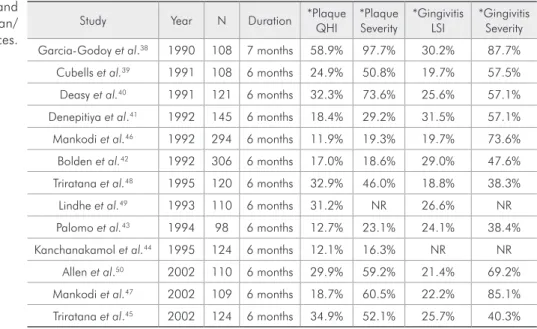
The effectiveness of dentifrices containing triclo-san/copolymer in reducing plaque accumulation and gingivitis was examined in a systematic review.37 Only randomized clinical trials with at least 6 months of follow-up were included. A meta-analysis was performed on the results of 16 studies involving 1,150 control and 1,176 test subjects. The results demonstrated that the triclosan/copolymer tooth-paste was capable of reducing plaque (23% using the QHI and 49% using the plaque severity index) and gingivitis (23% using the GI and 49% using the gingivitis severity index). Table 2 presents the per-centage reduction in plaque and gingivitis obtained in several studies examining the effectiveness of a triclosan/copolymer dentifrice. Most studies dem-onstrated statistically signiicant improvements in both parameters after 6 months of use of the prod-uct.38-50 In a few studies, however, differences be-tween control and test groups were only signiicant at 3 months but not at 6 months (Table 3).44,51,52 The clinical effect of a triclosan/copolymer dentifrice on preexisting plaque and gingivitis has also been ex-amined.45 After six months, the experimental group had a 34.9% reduction in the levels of preexisting plaque and a 25.7% reduction in gingivitis, com-pared with the placebo group.
toothpaste over the use of a manual toothbrush and a luoride-containing dentifrice.53 Microbiological samples were collected at baseline and after 1, 2 and 3 years and individually analyzed using the check-erboard DNA-DNA hybridization technique. Both groups resulted in similar reductions in mean total DNA probe count (x 105). The levels of the 40 spe-cies tested were reduced by both preventive regimens to similar levels. In this study both groups were part of comprehensive prevention programs involving recall visits every 6 months for reinforcement of homecare procedures and professional cleaning. In addition, subjects were provided with the appropri-ate toothbrush, dentifrice and interdental devices on every visit. A possible interpretation of the failure of this study in demonstrating an adjunctive antiplaque and antigingivitis effect of the triclosan/copolymer toothpaste is that when meticulous mechanical
plaque control is performed, any additional beneit of an antimicrobial agent is minimal.
Effects of Triclosan/copolymer
dentifrices on periodontitis
progression
A 3-year double-blind, controlled, random-ized trial examined the effects of twice daily use of triclosan/copolymer toothpaste on the preven-tion of attachment loss in adolescents (11-13 years old).54 The study demonstrated that for individu-als with high mean pocket depths at baseline (2.92 - 4.19 mm), the use of triclosan/copolymer resulted in lower mean attachment loss at the end of the study. The effects of triclosan/copolymer in the pre-vention of periodontitis in maintenance patients have also been examined. In one study the use of triclosan/copolymer dentifrice was capable of
slow-Study Year N Duration *Plaque PI
*Gingivitis BI Svatun et al.51 1993 94 7 months 19.0% 25.5%
Kanchanakamol et al.44 1995 124 6 months 7.2% 25.0%
Renvert, Birkhed52 1995 60 6 months 25.0% 18.2%
*Reduction in the Index. PI - Silness-Löe Plaque Index. BI - Ainamo and Bay Bleeding Index. Adapted from Panagakos et al.32 (2005).
Table 3 - Antiplaque and antigingivitis effects of triclosan/ copolymer dentifrices. The studies
presented statistically significant differences only at 3 months.
Study Year N Duration *Plaque QHI
*Plaque Severity
*Gingivitis LSI
*Gingivitis Severity Garcia-Godoy et al.38 1990 108 7 months 58.9% 97.7% 30.2% 87.7%
Cubells et al.39 1991 108 6 months 24.9% 50.8% 19.7% 57.5%
Deasy et al.40 1991 121 6 months 32.3% 73.6% 25.6% 57.1%
Denepitiya et al.41 1992 145 6 months 18.4% 29.2% 31.5% 57.1%
Mankodi et al.46 1992 294 6 months 11.9% 19.3% 19.7% 73.6%
Bolden et al.42 1992 306 6 months 17.0% 18.6% 29.0% 47.6%
Triratana et al.48 1995 120 6 months 32.9% 46.0% 18.8% 38.3%
Lindhe et al.49 1993 110 6 months 31.2% NR 26.6% NR
Palomo et al.43 1994 98 6 months 12.7% 23.1% 24.1% 38.4%
Kanchanakamol et al.44 1995 124 6 months 12.1% 16.3% NR NR
Allen et al.50 2002 110 6 months 29.9% 59.2% 21.4% 69.2%
Mankodi et al.47 2002 109 6 months 18.7% 60.5% 22.2% 85.1%
Triratana et al.45 2002 124 6 months 34.9% 52.1% 25.7% 40.3%
*Reduction in the Index. QHI - Turesky modified Quigley-Hein index. LSI - Löe-Silness Gingival Index. Plaque Severity - Plaque Severity Index of Palomo and co-workers. Gingivitis Severity - Gingivitis Severity Index of Palomo and co-workers. Adapted from Panagakos et al.32 (2005). NR: Not reported.
Table 2 - Antiplaque and antigingivitis effects of triclosan/
ing the progression of periodontitis in maintenance subjects during the 3 years of the trial.55 The daily use of triclosan/copolymer toothpaste resulted in a lower frequency of deep periodontal pockets and a lower number of sites with additional attachment and bone loss by the end of the study. Conversely, a trial examining the 3-year effect of the combined use of powered toothbrush and triclosan dentifrice in periodontal maintenance subjects failed to dem-onstrated superior clinical and microbial outcomes for the test group compared with a control group using manual toothbrush and a standard luoride toothpaste.56 The discrepancy in the outcome of the two studies can be justiied by differences in study design. In the former study no professional subgingi-val therapy was provided, while in the latter subgin-gival debridement was performed every 6 months. It seems that when meticulous subgingival mechanical debridement is performed, the beneits of the use of antimicrobial toothpaste cannot be demonstrated. In the absence of such supportive maintenance ther-apy, it is possible that the use of the triclosan/copo-lymer dentifrice resulted in a reduction in the levels of subgingival species, leading to additional clinical beneits. In fact, it has been demonstrated that care-ful supragingival plaque control with the adjunct use of triclosan/copolymer toothpaste can affect the subgingival microbiota.57
Safety of oral antimicrobial
agents
The prolonged use of antimicrobial agents as ad-juncts to mechanical plaque control raises two main concerns regarding safety: the development of re-sistant microorganisms and the risk of oral cancer associated with the alcohol content of mouthrinse formulations. Oral antiseptics affect a broad spec-trum of microorganisms and have non-speciic an-timicrobial mechanisms, which affect a number of different targets in the microbial cell, inhibiting a variety of cellular processes.58 This is probably the main reason for the lack of development of bacte-rial resistance to antiseptics. Point mutations in the microorganism might affect one of the mechanisms of action of a given antiseptic, but rarely would re-sult in resistance to all mechanisms. In fact, several
studies have examined the long-term microbiologi-cal safety of dentifrices and mouthrinses containing antiplaque agents and none of them have reported the development of opportunistic infections, over-growth of pathogenic bacteria or the development of resistant species.58
Concerns about the high content of alcohol in certain mouthwash formulations are justiied based on the well established association between alcohol consumption and an elevated risk to develop oro-pharyngeal cancer. However, a review of studies that suggested a correlation between mouthrinses containing alcohol and oral cancer by the Ameri-can Dental Association (ADA) and by the Food and Drug Administration (FDA) concluded that these studies presented several deiciencies.59 Among the problems detected in the studies there were the non-exclusion of subjects due to the consumption of al-coholic beverages or smoking and the inclusion of pharyngeal cancer in the analysis, while oral expo-sure to mouthrinses should not affect the pharynx. Two recent reviews on the topic concluded that there was no support in the literature for an association between mouthrinses containing alcohol and oro-pharyngeal cancer.60,61
Concluding remarks
The adjunct use of essential oil mouthrinses and
•
triclosan/copolymer dentifrices can result in ad-ditional reductions in plaque and gingivitis, particularly in hard-to-reach areas such as inter-proximal spaces.
The use of chemical agents might help reduce the
•
accumulation of bioilms on soft tissue surfaces of the oral cavity, potentially delaying plaque ac-cumulation on teeth.
Antimicrobial agents such as essential oils are
•
capable of affecting bacteria growing in suprag-ingival bioilms and disrupt preexisting plaque. The use of essential oil mouthrinses and
denti-•
frices containing triclosan/copolymer might af-fect the subgingival microbiota through the dis-ruption of the contiguous supragingival plaque. The use of a dentifrice containing
triclosan/co-•
devel-oping “early periodontitis”.
The use of a dentifrice containing
triclosan/copo-•
lymer might prevent further loss of attachment in patients with a history of periodontitis, particu-larly in the absence of a supportive periodontal therapy that includes subgingival debridement. Despite its limitations, meticulous mechanical
su-•
pragingival plaque control is capable of reducing plaque accumulation and preventing gingivitis even without the adjunct use of antimicrobials. Well executed supra and subgingival mechanical
•
plaque control is capable of preventing further loss of attachment in subjects under periodontal maintenance even without the adjunct use of an-timicrobials.
The long term use of oral antimicrobials does
•
not seem to lead to undesirable microbiological side effects such as the development of resistant species.
The use of mouthrinses containing alcohol does
•
not seem to increase the risk of oral cancer.
References
1. Loe H, Theilade E, Jensen SB. Experimental Gingivitis in man. J Periodontol. 1965;36:177-87.
2. Lang NP, Karring T. Proceedings of the 1st European Workshop
on Periodontology. Chicago: Quintessence Publishing; 1994. 3. Loe H, Anerud A, Boysen H, Smith M. The natural history of
periodontal disease in man. Study design and baseline data. J Periodontal Res. 1978;13(6):550-62.
4. Sheiham A. Is the chemical prevention of gingivitis necessary to prevent severe periodontitis? Periodontol 2000. 1997;15:15-24.
5. Schatzle M, Loe H, Burgin W, Anerud A, Boysen H, Lang NP. Clinical course of chronic periodontitis. I. Role of gingivitis. J Clin Periodontol. 2003;30(10):887-901.
6. Hugoson A, Sjodin B, Norderyd O. Trends over 30 years, 1973-2003, in the prevalence and severity of periodontal dis-ease. J Clin Periodontol. 2008;35(5):405-14.
7. Morris AJ, Steele J, White DA. The oral cleanliness and periodontal health of UK adults in 1998. Br Dent J. 2001;191(4):186-92.
8. Axelsson P, Albandar JM, Rams TE. Prevention and control of periodontal diseases in developing and industrialized nations. Periodontol 2000. 2002;29:235-46.
9. Bakdash B. Current patterns of oral hygiene product use and practices. Periodontol 2000. 1995;8:11-4.
10. van der Weijden GA, Hioe KP. A systematic review of the effectiveness of self-performed mechanical plaque removal in adults with gingivitis using a manual toothbrush. J Clin Periodontol. 2005;32(S):6214-28.
11. Kerr WJ, Kelly J, Geddes DA. The areas of various surfaces in the human mouth from nine years to adulthood. J Dent Res. 1991;70(12):1528-30.
12. Socransky SS, Haffajee AD. Periodontal microbial ecology. Periodontol 2000. 2005;38:135-87.
13. Sekino S, Ramberg P, Uzel NG, Socransky S, Lindhe J. The effect of a chlorhexidine regimen on de novo plaque formation. J Clin Periodontol. 2004;31(8):609-14.
14. Quigley GA, Hein JW. Comparative cleansing efficiency of manual and power brushing. J Am Dent Assoc. 1962;65:26-9.
15. Turesky S, Gilmore ND, Glickman I. Reduced plaque forma-tion by the chloromethyl analogue of victamine C. J Periodon-tol. 1970;41(1):41-3.
16. Gunsolley JC. A meta-analysis of six-month studies of antiplaque and antigingivitis agents. J Am Dent Assoc. 2006;137(12):1649-57.
17. Fine DH, Furgang D, Lieb R, Korik I, Vincent JW, Barnett ML. Effects of sublethal exposure to an antiseptic mouth-rinse on representative plaque bacteria. J Clin Periodontol. 1996;23(5):444-51.
18. Marsh PD. Dental plaque: biological significance of a biofilm and community life-style. J Clin Periodontol. 2005;32 Suppl 6:7-15.
19. Pan P, Barnett ML, Coelho J, Brogdon C, Finnegan MB. De-termination of the in situ bactericidal activity of an essential oil mouthrinse using a vital stain method. J Clin Periodontol. 2000;27(4):256-61.
20. Fine DH, Markowitz K, Furgang D, Goldsmith D, Charles CH, Lisante TA et al. Effect of an essential oil-containing antimicrobial mouthrinse on specific plaque bacteria in vivo. J Clin Periodontol. 2007;34(8):652-7.
21. Fine DH, Furgang D, Sinatra K, Charles C, McGuire A, Ku-mar LD. In vivo antimicrobial effectiveness of an essential oil-containing mouth rinse 12 h after a single use and 14 days’ use. J Clin Periodontol. 2005;32(4):335-40.
22. Fine DH, Markowitz K, Furgang D, Goldsmith D, Ricci-Nittel D, Charles CH et al. Effect of rinsing with an essential oil-containing mouthrinse on subgingival periodontopathogens. J Periodontol. 2007;78(10):1935-42.
23. Gordon JM, Lamster IB, Seiger MC. Efficacy of Listerine an-tiseptic in inhibiting the development of plaque and gingivitis. J Clin Periodontol. 1985;12(8):697-704.
den-tal plaque and gingivitis development. J Clin Periodontol. 1989;16(5):311-5.
25. Overholser CD, Meiller TF, DePaola LG, Minah GE, Niehaus C. Comparative effects of 2 chemotherapeutic mouthrinses on the development of supragingival dental plaque and gingivitis. J Clin Periodontol. 1990;17(8):575-9.
26. Charles CH, Sharma NC, Galustians HJ, Qaqish J, McGuire JA, Vincent JW. Comparative efficacy of an antiseptic mouth-rinse and an antiplaque/antigingivitis dentifrice. A six-month clinical trial. J Am Dent Assoc. 2001;132(5):670-5.
27. Sharma NC, Charles CH, Qaqish JG, Galustians HJ, Zhao Q, Kumar LD. Comparative effectiveness of an essential oil mouthrinse and dental floss in controlling interproximal gin-givitis and plaque. Am J Dent. 2002;15(6):351-5.
28. Bauroth K, Charles CH, Mankodi SM, Simmons K, Zhao Q, Kumar LD. The efficacy of an essential oil antiseptic mouth-rinse vs. dental floss in controlling interproximal gingivitis: a comparative study. J Am Dent Assoc. 2003;134(3):359-65. 29. Sharma N, Charles CH, Lynch MC, Qaqish J, McGuire JA,
Galustians JG et al. Adjunctive benefit of an essential oil-containing mouthrinse in reducing plaque and gingivitis in patients who brush and floss regularly: a six-month study. J Am Dent Assoc. 2004;135(4):496-504.
30. Fine DH, Furgang D, Barnett ML, Drew C, Steinberg L, Charles CH et al. Effect of an essential oil-containing antisep-tic mouthrinse on plaque and salivary Streptococcus mutans levels. J Clin Periodontol. 2000;27(3):157-61.
31. Charles CH, Pan PC, Sturdivant L, Vincent JW. In vivo anti-microbial activity of an essential oil-containing mouthrinse on interproximal plaque bacteria. J Clin Dent. 2000;11(4):94-7. 32. Panagakos FS, Volpe AR, Petrone ME, DeVizio W, Davies
RM, Proskin HM. Advanced oral antibacterial/anti-inflam-matory technology: A comprehensive review of the clinical benefits of a triclosan/copolymer/fluoride dentifrice. J Clin Dent. 2005;16(S):1-19.
33. Afflitto J, Fakhry-Smith S, Gaffar A. Salivary and plaque triclosan levels after brushing with a 0.3% triclosan/copoly-mer/NaF dentifrice. Am J Dent. 1989;2(S):207-10.
34. Gaffar A, Nabi N, Kashuba B, Williams M, Herles S, Olsen S et al. Antiplaque effects of dentifrices containing triclosan/ copolymer/NaF system versus triclosan dentifrices without the copolymer. Am J Dent. 1990;3(S):7-14.
35. Arweiler NB, Auschill TM, Reich E, Netuschil L. Substantiv-ity of toothpaste slurries and their effect on reestablishment of the dental biofilm. J Clin Periodontol. 2002;29(7):615-21. 36. Fine DH, Furgang D, Markowitz K, Sreenivasan PK, Klimpel
K, De Vizio W. The antimicrobial effect of a triclosan/co-polymer dentifrice on oral microorganisms in vivo. J Am Dent Assoc. 2006;137(10):1406-13.
37. Davies RM, Ellwood RP, Davies GM. The effectiveness of a toothpaste containing triclosan and polyvinyl-methyl ether maleic acid copolymer in improving plaque control
and gingival health: a systematic review. J Clin Periodontol. 2004;31(12):1029-33.
38. Garcia-Godoy F, Garcia-Godoy F, DeVizio W, Volpe AR, Fer-lauto RJ, Miller JM. Effect of a triclosan/copolymer/ fluoride dentifrice on plaque formation and gingivitis: a 7-month clini-cal study. Am J Dent. 1990;3 Spec No:S15-S26.
39. Cubells AB, Dalmau LB, Petrone ME, Chaknis P, Volpe AR. The effect of A Triclosan/copolymer/fluoride dentifrice on plaque formation and gingivitis: a six-month clinical study. J Clin Dent. 1991;2(3):63-9.
40. Deasy MJ, Singh SM, Rustogi KN, Petrone DM, Battista G, Petrone ME et al. Effect of a dentifrice containing triclosan and a copolymer on plaque formation and gingivitis. Clin Prev Dent. 1991;13(6):12-9.
41. Denepitiya JL, Fine D, Singh S, DeVizio W, Volpe AR, Person P. Effect upon plaque formation and gingivitis of a triclosan/ copolymer/fluoride dentifrice: a 6-month clinical study. Am J Dent. 1992;5(6):307-11.
42. Bolden TE, Zambon JJ, Sowinski J, Ayad F, McCool JJ, Volpe AR et al. The clinical effect of a dentifrice containing triclosan and a copolymer in a sodium fluoride/silica base on plaque formation and gingivitis: a six-month clinical study. J Clin Dent. 1992;3(4):125-31.
43. Palomo F, Wantland L, Sanchez A, Volpe AR, McCool J, DeVizio W. The effect of three commercially available den-tifrices containing triclosan on supragingival plaque forma-tion and gingivitis: a six month clinical study. Int Dent J. 1994;44(S):75-81.
44. Kanchanakamol U, Umpriwan R, Jotikasthira N, Srisilapanan P, Tuongratanaphan S, Sholitkul W et al. Reduction of plaque formation and gingivitis by a dentifrice containing triclosan and copolymer. J Periodontol. 1995;66(2):109-12.
45. Triratana T, Rustogi KN, Volpe AR, DeVizio W, Petrone M, Giniger M. Clinical effect of a new liquid dentifrice containing triclosan/copolymer on existing plaque and gingivitis. J Am Dent Assoc. 2002;133(2):219-25.
46. Mankodi S, Walker C, Conforti N, DeVizio W, McCool JJ, Volpe AR. Clinical effect of a triclosan-containing dentifrice on plaque and gingivitis: a six-month study. Clin Prev Dent. 1992;14(6):4-10.
47. Mankodi S, Lopez M, Smith I, Petrone DM, Petrone ME, Chaknis P et al. Comparison of two dentifrices with respect to efficacy for the control of plaque and gingivitis, and with respect to extrinsic tooth staining: a six-month clinical study on adults. J Clin Dent. 2002;13(6):228-33.
48. Triratana T, Kraivaphan P, Amornchat C, Rustogi K, Petrone MP, Volpe AR. Effect of a triclosan/copolymer pre-brush mouthrinse on established plaque formation and gingi-vitis: a six-month clinical study in Thailand. J Clin Dent. 1995;6(2):142-7.
50. Allen DR, Battista GW, Petrone DM, Petrone ME, Chaknis P, DeVizio W et al. The clinical efficacy of Colgate Total Plus Whitening Toothpaste containing a special grade of silica and Colgate Total Fresh Stripe Toothpaste in the control of plaque and gingivitis: a six-month clinical study. J Clin Dent. 2002;13(2):59-64.
51. Svatun B, Sadxton CA, Huntington E, Cummins D. The ef-fects of three silica dentifrices containing Triclosan on supra-gingival plaque and calculus formation and on gingivitis. Int Dent J. 1993;43(4 Suppl 1):441-52.
52. Renvert S, Birkhed D. Comparison between 3 triclosan den-tifrices on plaque, gingivitis and salivary microflora. J Clin Periodontol. 1995;22(1):63-70.
53. Bogren A, Teles RP, Torresyap G, Haffajee AD, Socransky SS, Wennstrom JL. Clinical and microbiologic changes as-sociated with the combined use of a powered toothbrush and a triclosan/copolymer dentifrice: a 3-year prospective study. J Periodontol. 2007;78(9):1708-17.
54. Ellwood RP, Worthington HV, Blinkhorn AS, Volpe AR, Davies RM. Effect of a triclosan/copolymer dentifrice on the incidence of periodontal attachment loss in adolescents. J Clin Periodontol. 1998;25(5):363-7.
55. Rosling B, Wannfors B, Volpe AR, Furuichi Y, Ramberg P, Lindhe J. The use of a triclosan/copolymer dentifrice may retard the progression of periodontitis. J Clin Periodontol. 1997;24(12):873-80.
56. Bogren A, Teles RP, Torresyap G, Haffajee AD, Socransky SS, Jonsson K et al. Long-term effect of the combined use of powered toothbrush and triclosan dentifrice in periodontal maintenance patients. J Clin Periodontol. 2008;35(2):157-64.
57. Rosling B, Dahlen G, Volpe A, Furuichi Y, Ramberg P, Lindhe J. Effect of triclosan on the subgingival microbiota of periodontitis-susceptible subjects. J Clin Periodontol. 1997;24(12):881-7.
58. Sreenivasan P, Gaffar A. Antiplaque biocides and bacterial re-sistance: a review. J Clin Periodontol. 2002;29(11):965-74. 59. Claffey N. Essential oil mouthwashes: a key component in oral
health management. J Clin Periodontol. 2003;30(S):522-4. 60. Cole P, Rodu B, Mathisen A. Alcohol-containing mouthwash
and oropharyngeal cancer: a review of the epidemiology. J Am Dent Assoc. 2003;134(8):1079-87.