Bond strength of a resin cement to dentin
using the resin coating technique
Abstract: The aim of this study was to evaluate the bond strength of a resin cement to dentin using different adhesive systems (AS) in the pres-ence or abspres-ence of a low-viscosity composite liner (Protect Liner F - PLF) applied over the bonded dentin. The adhesive systems selected were: Ad-heSE/Vivadent (AD); Clearil Protect Bond/Kuraray (CP); One-Up Bond F/Tokuyama (OU); Single Bond/3M ESPE (SB); Tyrian SPE/One-Step Plus/Bisco (TY); Xeno III/Dentsply (XE) and Uniil Bond/GC (UN). Af-ter removing the labial and lingual enamel surfaces of bovine incisors, dentin fragments were prepared and randomly divided into 15 groups (n = 8). The dentin substrates were bonded with the AS and the PLF was applied or not before application of the resin cement (Panavia F, Kur-aray). In the control group, the ED Primer (ED) and the resin cement without PLF were used. The AS, PLF and resin cement tested were used according to the manufacturers’ instructions, and all treated dentin sur-faces were temporized. After water storage for one week, three cylinders of resin cement were applied to each bonded dentin surface, using tygon tubing molds. The specimens were subjected to micro-shear testing and the data were statistically analyzed (two-way ANOVA, Tukey and Dun-nett tests, p < 0.05). The observed mean shear bond strengths in MPa were: ED: 20.2 ± 2.3; AD: 30.3 ± 6.5; CP: 25.3 ± 4.4; OU: 28.3 ± 6.6; SB: 25.6 ± 6.9; TY: 24.5 ± 2.5; XE: 17.3 ± 3.4; UN: 28.4 ± 6.2; AD+PLF: 32.8 ± 4.1; CP+PLF: 29.9 ± 3.9; OU+PLF: 34.1 ± 4.1; SB+PLF: 29.5 ± 8.2; TY+PLF: 29.2 ± 3.9; XE+PLF: 32.8 ± 6.7; UN+PLF: 32.2 ± 4.5. The bond strength of the resin cement to dentin using the tested AS was in-creased when the low-viscosity composite liner was applied.
Descriptors: Dentin-bonding agents; Dentin; Shear strength; Composite resins.
Claudia Batitucci dos Santos-Daroz(a)
Marcelo Tavares Oliveira(b)
Mário Fernando de Góes(c)
Toru Nikaido(d)
Junji Tagami(e)
Marcelo Giannini(f)
(a) Graduate Student (Master’s degree); (b)Graduate Student (Doctorate degree); (c)Professor; (f)Associate Professor
– Department of Restorative Dentistry, Piracicaba Dental School, State University of Campinas, Piracicaba, SP, Brazil.
(d) Lecturer; (e)Professor – Department of
Restorative Sciences, Graduate School, Tokyo Medical and Dental University, Tokyo, Japan.
Corresponding author:
Marcelo Giannini Av. Limeira, 901 - Areião Piracicaba - SP - Brazil CEP: 13414-018
E-mail: [email protected]
Introduction
Resin cement materials are commonly recom-mended for the cementation of metal-free inlays, onlays, laminates and full crowns, because of their adhesion properties to both tooth structures and re-storative materials, as well as their low solubility (if well polymerized), longer work time and aesthetic characteristics.1 Nevertheless, the high
polymer-ization shrinkage of resin cements may disrupt the bond between cement and tooth surface or restor-ative material, which can be responsible for mar-ginal iniltration, post-operative pain and premature debonding of the restoration.2,3 Furthermore, the
selection of the adhesive system may contribute to a cementation failure because of some chemical in-compatibilities between acidic monomers and chem-ically- or dual-cured resin based materials.4,5
The resin coating technique was initially devel-oped to protect the exposed, intact dentin after tooth preparation from saliva contamination.6 Moreover,
this technique can overcome the incompatibility problems during cementation, improving the bond strength of dual-cured resin cements to dentin and the interfacial adaptation of indirect restorations.1,2,4
The technique consists of a hybridization of dental substrates with the application of a bonding agent followed by a low viscosity micro-illed resin over bonded surfaces.7 Speciic adhesive systems have been
tested with a resin coating technique,1,2,4,7 however,
other commercially available systems can also be used with this restorative technique and need to be evaluated. These systems are adhesive resin solutions of different pHs and monomeric compositions, which can be incompatible with the dual-cured characteris-tics of resin cements or with low-viscosity resins.6,8
The purpose of this study was to evaluate the bond strength of a dual-cured resin cement to den-tin using different adhesive systems in the absence or presence of a low-viscosity composite liner, simu-lating the resin coating technique. The hypothesis tested was that the low-viscosity composite applica-tion would inluence the bond strength of the differ-ent adhesive systems to ddiffer-entin.
Material and Methods
Sixty freshly extracted, bovine incisors stored at
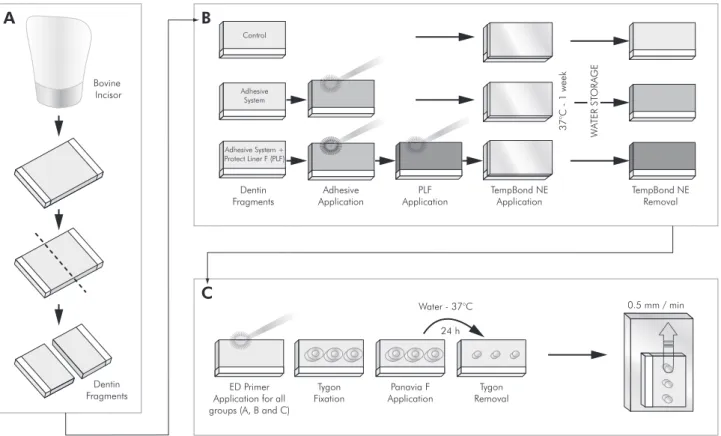
6°C were used in this study. The roots, and lingual and labial enamel were removed using a diamond disk (Isomet, Buehler, Evanstone, IL, USA) under water-cooling. Each lat buccal dentin surface of the crown was sectioned longitudinally and divided into two parts with similar size (12 mm in length x 5 mm in width x 1.5 mm in thickness) (Figure 1A). The dentin surfaces were wet-abraded with 600-grit SiC paper (Carburundum, Vinhedo, SP, Brazil) to create a standardized smear layer and then the dentin frag-ments were randomly divided into 15 groups (n = 8). Eight adhesive systems (Table 1): an etch & rinse simpliied system (Single Bond, 3M ESPE, St. Paul, MN, USA), three one-step self-etching systems (ED Primer, Kuraray Medical Inc., Kurashiki, Japan; One-Up Bond F, Tokuyama Dental Corp., Tokyo, Japan; Xeno III, Dentsply DeTrey, Konstanz, Ger-many) and four 2-step self-etching systems (Ad-heSE, Ivoclar Vivadent, Schaan, Liechtenstein; Clearil Protect Bond, Kuraray Medical Inc., Kura-shiki, Japan; Tyrian SPE/One-Step Plus SPE, Bisco Inc., Schaumburg, IL, USA; Uniil Bond, GC Corp., Tokyo, Japan); a dual-cured resin cement (Panavia F, Kuraray Medical Inc., Kurashiki, Japan); and a low-viscosity microilled composite (Protect Liner F, Kuraray Medical Inc., Kurashiki, Japan) were evaluated. Adhesive systems, resin cement and low-viscosity resin were applied according to the manu-facturers’ instructions.
For group 1 (control group), the dentin surfac-es were kept untreated. In groups 2 (AdheSE), 4 (Clearil Protect Bond), 6 (One-Up Bond F), 8 (Sin-gle Bond), 10 (Tyrian SPE/One-Step Plus), 12 (Uniil Bond) and 14 (Xeno III), the dentin surfaces were only treated with the adhesive systems. For groups 3 (AdheSE), 5 (Clearil Protect Bond), 7 (One-Up Bond F), 9 (Single Bond), 11 (Tyrian SPE/One-Step Plus SPE), 13 (Uniil Bond) and 15 (Xeno III), the low-viscosity resin was applied as a thin coat over the adhesive resin layer and light-cured for 20 sec-onds. The methodology developed by Shimada et al.9 (2002) and modiied by Giannini et al.4 (2004)
650 mW/cm². Untreated surfaces from group 1 and bonded dentin surfaces were temporized with non-eugenol zinc oxide material (Temp Bond NE, Kerr Corp., Orange, CA, USA) and the samples were stored in water at 37°C (Figure 1B).
After one week of storage, the temporary material was removed and the ED Primer was applied in den-tin (group 1), over bonded denden-tin (groups 2, 4, 6, 8, 10, 12 and 14) and over resin coated dentin (groups 3, 5, 7, 9, 11, 13 and 15). Three cylindrical translu-cent molds (Tygon tubing, TYG-030, Saint-Gobain Performance Plastic, Maime Lakes, FL, USA) were positioned over the treated dentin of each dentinal sample, and a freshly mixed dual-cure resin cement (Panavia F, Kuraray Medical Inc., Kurashiki, Japan) was placed in the molds to i ll their internal volume, using a modii ed composite spatula (Dul ex # 3, SS White, Juiz de Fora, MG, Brazil).
The restored dental fragments were stored in water at 37°C for 24 h. The tube molds were removed to expose the resin cement cylinders (0.75 mm in diameter by 0.5 mm in height)
bond-ed to the dentin surface, thus, three bondbond-ed small resin cement cylinders were obtained for each den-tinal sample. Before the test, all resin cylinders were checked under an optical microscope (30 X, EMZ-TR, Meiji Techno Co., Saitama, Japan) for bonding defects.
Each dentinal sample was attached to the test-ing device with cyanoacrylate glue (Super Bonder, Loctite, Itapevi, SP, Brazil) and tested in a univer-sal testing machine (4411, Instron Corp., Canton, MA, USA). A shear load was applied to the base of the resin cement cylinder with a thin wire (0.20 mm in diameter) at a crosshead speed of 0.5 mm/min until failure (Figure 1C). The shear bond strengths were calculated and expressed in MPa. Three bond strength measurements were recorded for each den-tal fragment and the mean bond strength was deter-mined for each experimental unit. The results were analyzed statistically by two-way analysis of vari-ance (ANOVA) and Tukey test at the 5% level of signii cance (adhesive system X resin coating). Ad-ditional treatment with Dunnett’s test was applied
Figure 1 - Schematic representation of specimen preparation.
Tygon Fixation ED Primer
Application for all groups (A, B and C)
Tygon Removal
0.5 mm / min
Panavia F Application
Water - 37°C
24 h Bovine
Incisor
Dentin Fragments
Dentin Fragments
Adhesive Application Adhesive
System
Adhesive System + Protect Liner F (PLF)
PLF Application Control
TempBond NE Application
W
A
TE
R
ST
OR
A
G
E
3
7
°C
1
week
TempBond NE Removal
C
for the control group.
After testing, the debonded dentin samples were mounted on aluminum stubs, gold-sputter coated (SCD 050, Baltec, Vaduz, Liechtenstein) and exam-ined using a scanning electron microscope (JSM-5600LV, Jeol, Tokyo, Japan). Photomicrographs of representative areas of the fractured surfaces were
taken at 100 X to 300 X magniications and the failure mode was classiied into one of the following types:
Type 1: adhesive failure between bonding agent and dentin and between bonding agent and resin cement;
Type 2: mixed failure, involving adhesive failure and cohesive failure in resin cement;
Type 3: mixed failure, involving adhesive failure and cohesive failure in low-viscosity resin; Type 4: mixed failure, involving cohesive failure in dentin.
Results
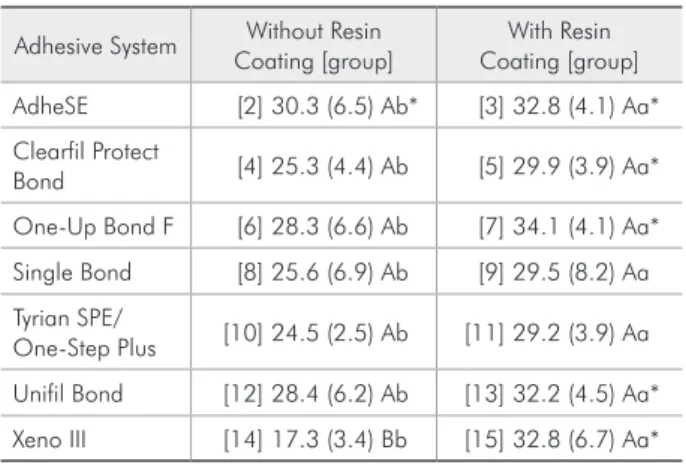
The mean shear bond strength and standard deviation values are shown in Table 2. Two-way ANOVA indicated that there was at least a statis-tically signiicant difference among the mean bond strength values of the experimental groups evalu-ated (F = 16.33 and p < 0.0001). However, ANOVA failed to identify any factor interactions (F = 0.49; p = 0.8450). Tukey’s test showed that the bond strength of all adhesive systems/resin cement to den-tin were signiicantly higher with the application of a low-viscosity resin layer over the bonded dentin than without the resin coating technique. The adhe-sive Xeno III had the lowest bond strength without application of the resin coating technique, while no
•
•
•
•
Table 2 - Mean bond strength (SD) values for the experi-mental groups (MPa).
Adhesive System Without Resin Coating [group]
With Resin Coating [group] AdheSE [2] 30.3 (6.5) Ab* [3] 32.8 (4.1) Aa* Clearfil Protect
Bond [4] 25.3 (4.4) Ab [5] 29.9 (3.9) Aa* One-Up Bond F [6] 28.3 (6.6) Ab [7] 34.1 (4.1) Aa* Single Bond [8] 25.6 (6.9) Ab [9] 29.5 (8.2) Aa Tyrian SPE/
One-Step Plus [10] 24.5 (2.5) Ab [11] 29.2 (3.9) Aa Unifil Bond [12] 28.4 (6.2) Ab [13] 32.2 (4.5) Aa* Xeno III [14] 17.3 (3.4) Bb [15] 32.8 (6.7) Aa*
Control group [group 1]: 20.2 (2.3). *Significant differences from the control group by Dunnett’s test (p < 0.05). Means followed by different letters (lower case – row; upper case – column) are significantly different by Tukey’s test (p < 0.05).
Table 1 - Compositions of the adhesive systems used in this study.
Adhesive
System Composition
AdheSE (pH 1.7)
Primer: dimethacrylate, phosphonic acid acrylate, initiators and stabilizer, water. Bonding resin: HEMA, dimethacrylates, silicon dioxide, initiators and stabilizer.
• •
Clearfil Protect Bond (pH 2.5)
Primer: Water, MDPB, HEMA, dimethacrylates, photoinitiator.
Bonding resin: MDP, HEMA, dimethacrylates, silanated colloidal silica, NaF.
• •
ED Primer (pH 2.4)
Primer A: 10-Methacryloyloxydecyl Dihydrogen Phosphate; HEMA, Ethylene Glycol Methacrylate; N,
N-Di-(2-Hydroxyethyl)-P-Toluidine; 5-NMSA; Water. Primer B: Benzenesulfinic Acid, Sodium Salt; N, N-Di-(2-Hydroxyethyl)-P-Toluidine; 5-NMSA; Water • • One-Up Bond F (pH 2.6)
Bonding A: Water, MMA, HEMA, coumarin dye, metacryloyloxyalkyl acid phosphate, MAC- 10.
Bonding B: multifunctional methacrylic monomer, fluoraluminosilicate glass, photoinitiator (arylborate catalyst)
•
•
Single Bond (pH 4.3)
Etchant: 35% phosphoric acid.
Primer & Bonding resin: Bis-GMA, HEMA, ethanol, water, UDMA, Bisphenol A glycerolate, polyalkenoic acid copolymer, dimethacrylate, camphorquinone. • • Tyrian SPE/ One-Step Plus (pH 0.5) Primer: 2-Acrylamido-2-methyl
propanesulfonic acid, Bis [2-(methacryloyloxy) ethyl] phosphate, ethanol.
Primer & Bonding resin: Biphenyl dimethacrylate, hydroxyethyl methacrylate, acetone, glass frit.
•
•
UniFil Bond (pH 2.2)
Primer: HEMA, 4-MET, ethanol, water. Bonding resin: UDMA, HEMA, TEGDMA, silanated colloidal silica.
• •
Xeno III (pH 1.4)
Liquid A: HEMA, purified water, ethanol, butylated hydroxy toluene, highly dispersed silicon dioxide.
Liquid B: phosphoric acid functionalised polymethacrylate resins, di- and polyfunctionalised methacrylate resins, butylated hidroxy toluene, camphorquinone, 4-dimethylamino-ethyl-benzoate.
•
difference among adhesive systems were observed using the resin coating. Dunnett’s test indicated that the shear bond strength of ED primer/resin cement to dentin (group 1) was similar to that of all the ad-hesive systems tested without resin coating, except for AdheSE. Tyrian SPE/One-Step Plus and Single Bond with resin coating were also similar to the ED Primer/Panavia F cementing system (group 1).
SEM examination of the fractured interfaces showed variations among groups (Table 3). Fracto-graphic analysis of the dentin bonded with the ED Primer only (group 1) showed that the most fre-quent failure pattern observed was type 1 (Figure 2). Without the low-viscosity resin, fractures involved adhesive failure and partial cohesive failure in the resin cement (Figure 3). The use of the resin coating technique modiied the failure pattern of the tested specimens, and the observed fractures involved a cohesive failure in the low-viscosity resin (Figure 4). All groups presented cohesive failures in dentin. Type 4 (Figure 5), however, was the most predomi-nantly observed failure mode in the groups without
application of the low-viscosity resin.
Discussion
The bond strength of a dual-cured resin cement to dentin using different adhesive systems in the presence of a low-viscosity composite liner was sig-niicantly higher than that obtained with the use of the dentin bonding systems alone. The resin coating technique has been shown to be eficient. The addi-tional application of a low-viscosity microilled res-in can protect and promote an improvement of the polymerization of the underlying adhesive, resulting in an increase in bond strength.2,10
Table 3 - Failure modes (%) of the tested specimens.
Group Type 1 Type 2 Type 3 Type 4
1 65 25 0 10
2 30 30 0 40
3 0 0 90 10
4 55 10 0 35
5 0 0 85 15
6 20 30 0 50
7 0 0 90 10
8 30 50 0 20
9 0 15 70 15
10 40 10 0 50
11 5 10 80 5
12 20 10 0 70
13 0 0 100 0
14 20 35 0 45
15 5 0 90 5
Type 1: adhesive failure between bonding agent and dentin and between bonding agent and resin cement; Type 2: mixed failure, involving adhesive failure and cohesive failure in the resin cement; Type 3: mixed failure, in-volving adhesive failure and cohesive failure in the low-viscosity resin and Type 4: mixed failure, involving cohesive failure in dentin.
Figure 2 - Adhesive failure between bonding agent and
resin cement [Dentin (D)].
D
Figure 3 - Mixed failure, involving adhesive failure
[Adhe-sive Layer (AL), Dentin (D)] and partial cohesive failure in the
resin cement (RC).
D RC
Current one-step self-etching adhesive systems present highly acidic and hydrophilic resin mono-mers that simultaneously demineralize and iniltrate the dentin surface to form the hybrid layer.6 These
acidic monomers do not completely convert to poly-mers as the oxygen and water may impair their total conversion.10 The presence of acidic monomers can
prevent the proper polymerization of chemically or dual cured resin materials by the deactivation of the basic amines, affecting their bonding to the adhesive layer.4,5 Thus, the liner application eliminates the
in-compatibility area between resin-based materials, thus avoiding the formation of a weakened bonded interface.11 Moreover, the acidic monomers are more
prone to attract water; therefore the adhesive layer formed by modern single bottle total-etch and one-step self-etching adhesive systems may work as a permeable membrane that allows luids from the dentinal tubules to rise to the adhesive surface, thus affecting their accurate coupling to chemically or dual cured resin cements.6,8
The Panavia F resin cement used in this study presents in its chemical composition sodium ben-zene sulphinate, and the ED Primer solution con-tains sodium aromatic sulphinate to ensure that the polymerization reaction of the cementing system occurs even without light exposure.1,3 However, the
low bond strength that was observed when this resin cement was applied to dentin without resin coating may be explained by the formed hybridization
pro-cess and the increase in permeability associated with the one-step self-etching ED Primer.6,8,11 The tested
specimens presented predominantly adhesive failure between bonding agent and dentin, demonstrating the weakness of the bonded interface created with the ED Primer (Figure 2).
Other one-step self-etching systems (One-Up Bond F and Xeno III) had a higher percentage of bond strength increase among the adhesives tested (20.5% and 89.6%, respectively), showing the im-portance of hydrophobic resin application over primed dentin, such as that used by the 2-step self-etching systems tested (AdheSE, Clearil Pro-tect Bond and Uniil Bond). However, the Xeno III single-step self-etching adhesive presents a low pH (1.4) and it is more hydrophilic than One-Up Bond F (pH 2.6). Both characteristics are responsible for the poor results of bond strength without applica-tion of the low-viscosity resin.6,11 The Tyrian SPE/
One-Step Plus system is considered a two-step self-etching primer adhesive. However, the SPE primer is a strong self-etching solution with a very low pH (0.5) and the primer’s hydrophilicity is increased by the application of the One-Step Plus bonding agent, which contains HEMA, BPDM and acetone, instead of purely hydrophobic adhesive resin. For the Ad-heSE, Clearil Protect Bond and Uniil Bond sys-tems, the hydrophilicity of the primers is reduced with the hydrophobic adhesive resin application, forming a combination of components from primer Figure 4 - Mixed failure, showing the low-viscosity resin
(LV) and the adhesive Layer (AL).
AL LV
Figure 5 - Mixed failure, involving cohesive failure in dentin
(D) and bonded dentin (BD).
and hydrophobic resin to be copolymerized with the light-curing unit. However, a signiicant increase in bond strength was observed when the low-viscosity resin was applied over the bonded dentin for all cat-egories of adhesive systems tested (etch & rinse sim-pliied; one-step self-etching and 2-step self-etching systems).
The resin coating may reduce the permeability and improve the long term durability of the hybrid layer.2,7,11 The additional application of a
hydropho-bic low viscosity resin over the hybridized dentin may improve the polymerization process of the adhe-sive system. The uncured resin or acidic monomers from the oxygen inhibition layer may subsequently polymerize with the diffusion of free radicals from the low viscosity resin.10 Also, the low-viscosity
composite liner can act as an absorbing layer pro-tecting the adhesive layer against the contraction stress generated during the resin cement polymeriza-tion12 and can modify the failure pattern (Figure 4)
as previously described.10,12 Due to the formation of
a stronger hybridization process, the fracture tends to preserve the bonded interface area. Conversely, for groups without the low-viscosity resin, the frac-tures involved adhesive failure and partial cohesive failure in resin cement (Figure 3) or partial in dentin (Figure 5). Cohesive failures in dentin were observed in all groups, since bonded specimens develop non-uniform stress distributions during shear bond test-ing, leading to failures of the dentin substrate at stresses far below its ultimate strength.13
Conclusion
The results of the present study suggest that the bond strength of resin cements to dentin using adhe-sive systems can be improved if a low-viscosity com-posite liner and the resin coating technique are used.
Acknowledgments
This study was partially supported by grants n. 301769/2004-4 from CNPq and n. 03/08090-7 from FAPESP, Brazil.
References
1. Jayasooriya PR, Pereira PN, Nikaido T, Burrow MF, Tagami J. The effect of a “resin coating” on the interfacial adaptation of composite inlays. Oper Dent. 2003;28(1):28-35.
2. Jayasooriya PR, Pereira PN, Nikaido T, Tagami J. Efficacy of a resin coating on bond strengths of resin cement to dentin. J Esthet Restor Dent. 2003;15(2):105-13.
3. Markus BB. Long-term clinical success of all-ceramic poste-rior restorations. Quintessence Int. 2002;33(3):415-26. 4. Giannini M, de Goes MF, Nikaido T, Shimada Y, Tagami J.
Influence of activation mode of dual-cured resin composite cores and low-viscosity composite liners on bond strength to dentin treated with self-etching adhesives. J Adhes Dent. 2004;6(4):301-6.
5. Sanares AME, Itthagarun A, King NM, Tay FR, Pashley DH. Adverse surface interactions between one-bottle light-cured adhesives and chemical-light-cured composites. Dent Mater. 2001;17(6):542-56.
6. Tay FR, Pashley DH. Have dentin adhesives become too hy-drophilic? J Can Dent Assoc. 2003;69(11):726-31.
7. Nikaido T, Cho E, Nakajima M, Tashiro H, Toba S, Burrow MF
et al. Tensile bond strengths of resin cements to bovine dentin
using resin coating. Am J Dent. 2003;16(Spec No):41A-46A.
8. Reis AF, Arrais CA, Novaes PD, Carvalho RM, De Goes MF, Giannini M. Ultramorphological analysis of resdentin in-terfaces produced with water-based single-step and two-step adhesives: nanoleakage expression. J Biomed Mater Res B Appl Biomater. 2004;71(1):90-8.
9. Shimada Y, Yamaguchi S, Tagami J. Micro-shear bond strength of dual-cured resin cement to glass ceramics. Dent Mater. 2002;18(5):380-8.
10. De Goes MF, Giannini M, Rueggeberg FA. Conversion of dentin bonding agents mixed with composite [abstract]. J Dent Res. 2004;83:556.
11. Carvalho RM, Pegoraro TA, Tay FR, Pegoraro LF, Silva NRFA, Pashley DH. Adhesive permeability affects coupling of resin cements that utilise self-etching primers to dentine. J Dent. 2004;32(1):55-65.
12. Reis AF, Giannini M, Ambrosano GMB, Chan DCN. The ef-fects of filling techniques and a low-viscosity composite liner on bond strength to class II cavities. J Dent. 2003;31(1):59-66.
![Figure 2 - Adhesive failure between bonding agent and resin cement [Dentin (D)].](https://thumb-eu.123doks.com/thumbv2/123dok_br/15410442.585944/5.892.62.404.624.998/figure-adhesive-failure-bonding-agent-resin-cement-dentin.webp)