HEREDITARY ESSENTIAL TREMOR
IN BUENOS AIRES (ARGENTINA)
E. HERSKOVITS — E. FIGUEROA — C. MANGONE
SUMMARY — A descriptive trial of essential tremor in Buenos Aires city is proposed. I t may be considered a s the first one like this in Latin America. During a 15 years period, sixteen families with essential tremor diagnosis have been examined, making a total of 39 patients (20 males and 19 females). T h e disease was basically studied from its semiological, clinico-evolutive and therapeutical view point, following a protocol. Our results indicate — a. T h e clinico-evolutive characteristics: its frequency (according to race, sex, social status, age of beginning and physiopathological type), morbility and mortality, evolution, prognosis, triggering factors, longevity and multiparity. b. The different treatment given to our patients with discussion of their pharmacokinetic and pharmacodynamic basis and evaluation of the best responses. I n this matter, it is concluded that both primidone (750 mg/daily) a n d / o r propranolol (160-240 mg/daily) are undeniably the drugs of first choice for the treatment of this disease. A comparison of the clinico-therapeutic features of this tremor in Buenos
Aires and other cities is done. The study of this syndrome in Buenos Aires does not give different results from those obtained in Europe and USA.
Temblor esencial hereditario en Buenos Aires (Argentina).
R E S U M E N — Consideramos esta publicación como la primera sobre Temblor Esencial en América Latina. Todos nuestros pacientes eran inmigrantes o hijos de inmigrantes de los orígenes más comunes en nuestro país (España, Italia, F r a n c i a y P o l o n i a ) . No se incluyeron pacientes indoamericanos. E l reducido número de indoamericanos puros en Buenos Aires y sus alrededores debe tenerse en cuenta. E l temblor hereditario esencial es entidad monosin-¬ tomática, conocida durante más de cien años. Sus elementos más importantes se describen progresivamente aquí y también, las dificultades terapéuticas que presenta. Durante un período de quince años, los autores pudieron seleccionar un total de 16 familias, con 39 casos de temblor esencial, estudiados básicamente desde el punto de vista clínico. E s t o nos permitió confirmar el carácter del temblor, de tipo rítmico (4 a 10 c / s e g ) , preponderante en manos, especialmente en los dedos pulgar e índice, extensión del temblor a la boca, cabeza y even-tualmente, a todo el cuerpo. L a característica dominante y autosómica de la herencia también se demostró en nuestros pacientes. L a edad de comienzo de esta entidad oscila entre los 20 y los 40 años, con una exacerbación en la quinta década de la vida. No hubo predominancia de ninguno de los sexos, ni de longevidad ni multiparidad. E s t a enfermedad no produce la muerte y la incapacidad que acarrea no es muy importante. No parece existir una asociación entre esta entidad y otras enfermedades, excepto aquellas patologías desen-cadenantes como la tensión emocional y eventualmente, el alcoholismo como tratamiento aparente propuesto por el propio paciente para aliviar su sintomatologia. L a ubicación nosológica de esta enfermedad debe estar junto con los trastornos extrapiramidales, a pesar de los 5 casos existentes en la bibliografía mundial sobre anatomía patológica, los que no presentaron alteraciones tales que justificaran el temblor en el sistema nervioso central. E l diagnóstico diferencial más importante debe hacerse en relación a l a enfermedad de Parkinson o parkinsonismos. E s t e es un hecho simple y a que el temblor esencial no presenta los otros signos presentes en Parkinson excepto el temblor; además, esta enfermedad es hereditaria. E l temblor esencial en manos responde mejor al manejo farmacológico que el temblor de
Hospital J u a n A. Fernández, Unidad de Neurología Cerviño y Bulnes — Buenos Aires. Callao 563, 1o
cabeza, piernas o tronco. Los pacientes con temblor esencial tipo I I responden mejor a la terapia con propranolol (4080 mg t.i.d.) que los dtl tipo I, pero ambos tipos de pacientes tienen respuesta similar a la primidona (250 mg t.i.d.). Concluimos que estas drogas son indudablemente la elección alternativa para el actual tratamiento de esta patología. El estudio de esta enfermedad en la ciudad de Buenos Aires no da resultados diferentes de los obtenidos en Europa y en los Estados Unidos.
The Argentine Republic is, together with Chile, the most austral country in South America; its surface is 2,800,000 Km2
, with a population of 30,000,000 inhabi-tants. Buenos Aires Province has an area of 300,000 Km2
, with a total population of 14,500,000 inhabitants, from them, approximately 10 millions belong to Buenos Aires City and environs ( 4 0 Km radio) and they are the population which is focused in the present study.
The appearance of tremor in a patient is a known fact; but what is not so clear is when tremor is the only symptomatology presented by the patient and has a clear family origin. This neurological entity mainly consists of a tremor starting in youth or in the middle age, stationary during a period, but slowly progressing as year pass. It is common to find several members of a family with tremor. European literature and also American literature has taken into account these facts and a great number of papers related with this subject have appeared. During the last years, there were publications on this respect in all continents. Sir James Parkinson, in his publication of 1817 says that the expression 'agitating paralysis' has been vaguely used by physicians in general and that there was a disease corresponding to tremor of the members, previously observed by Galeno (A.D. 138-201) and by Sylvius de Laboe (A.D. 1614-72). He also mentions that Sylvius de Laboe distinguished between that tremor produced during a voluntary movement and that occurred when patient was at rest. This last kind of tremor was also named 'tremor coactus' by Voisser De Sauvages (A.D. 1763). Parkinson also refers to Gaupius as the first in mentioning the anteroflexion and the festinating walking, to which Sauvages called 'scellotrybe'. The term 'agitating paralysis' was firstly introduced in literature by Parkinson in his essay. It is fairly clear that all these references are related to a tremor having additional characteristics, and they are: difficulty in mobility and in walking and all the other symptoms that evidently make us to think of Parkinsin's disease and not other kind of tremors.
Perhaps one of the first mentions of a type of family tremor has been done by Most in 1836?. Sanders in 1872 6 described a patient with 'agitating paralysis' whose tremor began at 12 years old and persisted until his death at 66 years old. Trousseau in 1 8 8 56
pointed out that it is not necessary to confine the 'senile tremor' exclusively to elderly people and it may appear in the middle age or in adolescence. This is a conception which would let us think of an essential tremor, much more than a senile tremor. From the end of last century, a lot of authors have worked on this problem. Many of them should be appointed in our bibliography, some by their historical value, others by their relevant contributions to the subject. Therefore, we can sum up that since one hundred years ago, abundant titles from the semio-logical and physiosemio-logical-anatomic point of view started to appear although not exhaustively. During the last years, major papers have not appeared and this is brought about by the few contributions to this disease, except for its treatment, where interesting facts can be observed. Nevertheless, as a general synthesis of this problem on essential tremor, we can say: 1. it is a mono-symptomatic entity where the tremor occupies the dominant picture; 2 . effectively, it has a genetic transmission and a slow progress; 3 . the pathological anatomy was not able to reveal which is the lesional site; 4 . most of therapeutic improvements on tremor are obtained with mean doses of beta-blockers and/or primidone.
MATERIAL AND METHODS
suggesting' Parkinson's disease, secondary parkinsonism or late cerebellum degeneration. A family tree was framed for each family and most of their members were personally examined by the authors. A neurological and clinical examination and routine laboratory determinations (including hepatogram and proteinogram) were performed. KayserPleischer's ring was searched in all the individuals. Also, associated diseases were taken into account. The results have not decisive value for studying the frequency by three reasons: 1. many patients with family essential tremor do not attend the medical consultation or are not sent to the Neurological Service due to its mild symptomatology; 2. our special interest in this problem made us look for cases in the families of patients with tremor and also some patients were referred from other hospitals of Buenos Aires City; 3. patients without members of their family suffering from tremor were not included in our casuistic.
Semiology — Semiology of essential tremor was mentioned in some of its partial aspects by several authors ( 7 , 1 4 , 2 2 ) . However, we should mention the exhaustive monography by Mac Donald Critchley ('/) in which he describes all its characteristics. In our experience we found that this disease is monosymptomatic, habitually in hands and specially in the first and second finger; it is observed not so unfrequently in mouth, tongue, inferior maxilla and head; exceptionally in the whole body. This tremor is of the action and postural variety,
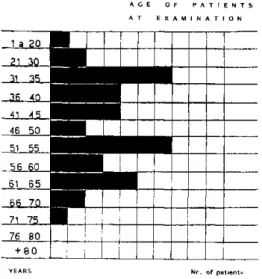
A C E O F P A T I E N T S A T E X A M I N A T I O N
YEARS N r . of patients
D E A T H A G E OF P A T I E N T S ' P A R E N T S
A C E W I T H T R E M O R ( * ) W I T H O U T T R E M O R ( # )
«1 50 •
51 55
56 60 ' *
6 1 6 5 »
66 70 »
71 75
76 80
81 85 *
86 90
. . .
91 95
S I G N I F I C A N T D I F F E R E N C E S B E T W E E N B O T H C R O U P S
A R E N O T O B S E R V E D
Fiy. S — Comparative table of death age of patient's pa-rents with and without tremor.
J 2 8
FAMILIA 1 ( BOR... ) CASOS 1 2 3 4 5 FAMILIA 2 (AMA...) CASOS 12
" 3 5 " 4 8 °7 Í ó ;
»26
9
Jf
ó'd* í
1*
í l*
1 8 16 4
• PERSONALLY EXAMINED V S T U D I E D
AFFECTED
• O NON AFFECTED • • MALE
• O FEMALE DEAD N r . on r i g h t : ACE
n .
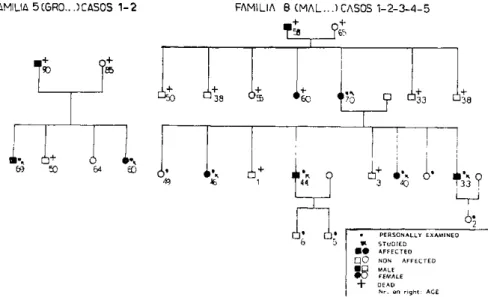
M y . 4 — Family tree of some of our patients.
FAMIUA 5C6R0...5CAS0S 12 FAMILIA 8 (MAI ) CASOS 12345
AFFECTED
f j O NON AFFECTED
V3 MALE
• O FEMALE
+ DEAD N r . on r i g h t : ACE
Fig. 5 — Family tree of some o/ our patients.
tremor of Marsden et al. in 4 types (is): I. Really and enhanced physiological tremor, characterized by high frequency (812 Hz) and low amplitude; pathophysiological^, there seem to be an alteration in the fine regulatory mechanisms of intra or extra fusal muscle fibers and the adrenoceptor has an important role in it; I I . Characterized by a low frequency (57 Hz) and a high amplitude tremor; perhaps, central mechanisms are pathophysiologically involved and are uninfluenced by the manipulation of peripheral reflex systems; most of the familial tremor belong to this group; this one usually responds to Betablocking agents; III. I t is a severe pathological essential tremor, of slow frequency (46 Hz) and large amplitude; these patients have not family history; IV. I t is a symptomatic essential tremor, associated to other neurologic diseases, as for instance torsion dystonia, Parkinson's disease, and peripheral neuropathy.
We examined our patients systematically with a protocol: a. Tremor in upper extremities: hold arms outstretched horizontally, with fingers extended; hand writing (a word, a sentence); drawing a spiral; drinking liquids, b. Tremor in head: yesyes pattern; nono pattern, c. Tremor in trunk and lower extremities (orthostatic tremor): standing; sitting (with legs at rest; with legs outstretched). W e evaluate the deficits with a disability scale: 0, normal (no tremor); 1, mild; 2, moderate; 3, severe. When making forefingernose, forefinger ear, polish of dorsum of hands and speedy counting of finger tests, a slight final tremor with attenuated dysmetry — reminding in some way a minimal neocerebellum syndrome — was observed. Other aspects of the neurological examination were completely normal.
R E S U L T S AND COMMENTS
Our intention is to divide our results into several sections, always considered interesting in this disease, since there were old controversies regarding longevity, multiparity, association with other diseases, race, onset age and therapeutic approaches.
Most of published cases correspond to Western Europe and a minority to Eastern Europe and (North America. From the study of published cases, racial predominance was not observed. Sex: There is a slight predominance of males in most of publi-cations with a moderately numerous casuistic 6,16,22,23. in our cases, 20 were males
and 19 females. Social status: Our patients are distributed in the usual way in all sonal groups. Age of beginning: Considering our casuistic, the beginning of symptoms in most of patients is before 20 years old diminishing up to 45 years old. It is worth observing that in 2 5 % of cases, the beginning date of tremor cannot be established
(F gs. 1 and 2 ) . D a n a7
and Amore-Bonelli i postulated that essential tremor starts at middle age. P i n t u s2
3 and Critchley6 consider two beginning periods: at 20 and
at 40 years old.
Mortality, evolution and prognosis — Mortality: It was not proved that the essential hereditary tremor provokes death in patients suffering from it nor it indi-rectly induces death, nor it produces some special discapacity, except the disturbance itself produced by tremor. Evolution: It is a slowly progressive disorder that is gene-rally exacerbated in the middle age of life, with abrupt aggravation of symptoma-tology; afterwards, it continues in slow progression. However, CritchleyS postulated that it was not progressive and Denny-Brown that it was a stationary disease. Thirty ( 7 7 % ) of our patients present a slowly progressive form, increasing amplitude or spreading tremor to other parts of the body. Prognosis: Although no author referred specially to this item, we can establish according to our casuistic, that it is good quad vitam, in spite of being the tremor slowly progressive.
Triggering factors, longevity, multiparity, associated conditions — Triggering factors: Cheylard4 does not associate the tremor to triggering factors while other authors do 8,12> with whom agree. It is believed that it can be triggered by: stress,
alcohol, coldness, fatigue, and fear, as it happens with other types of tremor which can also be triggered by these factors (for example, the adrenalynic tremor and the tiroioxic tremor). Longevity and multiparity: From our cases we proved that there are no evidences of these items, since longevity and multiparity of the patients do not differ from the group without tremor. Multiparity is not observed among the patients and their first degree relatives who have had children. The children average per fertile couple is 2 . 9 . Both items were postulated by Charcots and others, while P i n t u s2 2
^ and other authors refused them. Association with other syndromes and diseases: According to several authors 7,20 the more frequent associations with the essential hereditary tremor are: neurosis, psychosis, drunkness, epilepsy and Charcot--Marie-Tooth disease. Some authors suggest that these patients have more chances to develop Parkinson's disease. We have found it associated with two cases of epilepsy and six cases of alcoholism. We have not found any special association of this disease with Parkinson's disease.
Frequency, genetics, pathologic anatomy — Frequency: T h e family essential tremor is an old disease at such extent that for example, there was not any publi-cation on it in Latin America, except one from one of the authors of this paper 24. This lack of publications is partly a consequence of an appreciation mistake, since many essential tremor are erroneously included into other conditions, as for instance: parkinsonian syndromes, states of emotional tension, and alcoholic tremors. On the other hand, the lack of interest in a disease of so slow course and not very injuring may be another cause of the absence of publications on this subject. There are isolated works that do not allow us to have an idea on the frequency and morbility of the affection. The only publications with a detailed genetic study, which permit to draw some conclusions from the subject, are those from Pintus 22,23; Larsson and
S j o r g e n i e and Rautakorpi et a l .2 5
244 Arq. Neuro-Puiquiat. (São Paulo) 46(3) 19HH
transmission is probable and it is a dominant autosomal heredity. Mendelian analysis confirms these conclusions: this heredity is dominant, mono hydrid, autosomal, with no differences between symptoms of heterozygotic and dominant homozygotic groups. Taking into account all conclusions on genetics of these authors, these are the most important and are well demonstrated in the difficult and complex study performed by them. However, other authors previously arrived to similar conclusions.
In the families studied by us we found the same situation, so we confirm previous authors' statement. We include the family tree of four of our patients (Figs. 4 and 5 ) . Pathologic anatomy: Pathological changes underlying this condition are uncertain and there are only few published cases with morbid pathology analysis. However, the structure abnormalities found here are not different from those in patients without tremor. One of us (E.H.) published 13 a case on a patient presenting
small softenings in putamen, moderate atheroma in vessels and arteriosclerosis.
Differential diagnosis — Undoubtedly, the first diseases from which family hereditary tremor should be differentiated is Parkinson's disease and parkinsonism. In typical cases of Parkinson's disease, there is no difficulty because, besides tremor, this disease presents rigidity, hypokinesia, neurovegetative disturbances, postural and and walking disturbances, endogenous and exogenous depression and ocasionally, psychic deterioration. These signs are not present in the family hereditary tremor. Some few parkinsonian patients may have family origin. This would make us think of a family hereditary tremor, but this fact is put aside through the neurological examination. Some greater difficulty may be found in Parkinson's disease or parkin-sonisms whose onset is the predominantly trembling form and where the remaining extrapyramidal signs have not appeared yet or are scarcely manifest. In these cases, the beginning age, later in Parkinson, can determine the diagnosis, perhaps, obser-vations of patients during some time is the most convenient in order to see the appearance or not of other symptoms or signs. From a therapeutic point of view, drugs improving Parkinson's disease or parkinsonisms, except propranolol have no effect on essential tremor 2,26. The adrenaline-induced tremor, such as those produced by anxiety and by fatigue, have the same clinical appearance than the physiological tremor. With respect to alcoholic tremor, anamnesis and alcoholic intake antecedents are evidently very important to aid diagnosis. However, great diagnostic difficulties can arise in a group of patients who like to take alcoholic drinks, justly because they mitigate tremor. The question is if the patient takes the alcoholic drink to mitigate tremor, if he drinks to mitigate his alcoholic thirst or if both kinds of tremors are already simultaneously present. It is a known fact that a significant number of patients with essential hereditary tremor are prone to drink, justly because they mitigate this tremor. When there are non-alcoholic relatives with tremor, diag-nosis is oriented to Essential Tremor.
Therapeutic approaches — As essential tremor progresses slowly, we prefer a systematic and periodical control of our patients beginning drug therapy only when the tremor acquires considerable magnitude or is demanded by the patient. About 5 5 % of our casuistic observed a reduction in amplitude of tremor with small quan-tities of ethanol, phenomenon that we never use as diagnostic or therapeutic method.
We have done different clinical trials with our patients prefering the mana-gement of essential tremor with: ( a ) basic therapeutic drugs (beta-blockers, primi-done, clonazepam), and occasionally ( b ) coadjuvant therapy (psychological assessment; sedatives: benzodiazepine drugs that decrease anxiety and agitation reducing adre-nergic enhancement during stress. They are useful drugs in chronic anxiety neurotic patients). Beta-blocking drugs: Today propranolol is the drug of first choice in the management of essential tremor. It was introduced in 1960's supporting the idea of blocking tremorgenic action of the endogenous adrenergic derivatives during stress. Then, it was necessary to recognize whether the action was at a central or peripheral level and which adrenergic receptor was involved in this tremorgenic response. Although the different clinical trials and the basic experiments done up till now, too many controversies persist. It is undeniable that the beta-adrenoreceptor is involved in the tremorgenic action of catechol derivates (nevertheless alpha adrenoreceptor by probable central pathways can influence also, as it was demonstrated by Mai et al.1
^ with an alpha blocking drug: thymoxamine). The beta-adrenoreceptor can be located within the central nervous system ( C N S ) or in the periphery and classified according to its pharmacodynamic characteristics in b e t at and beta2 subtypes. In the
sympatomimetic drug like adrenaline would induce tremor or would exagérate essen-tial tremor by a direct effect on these receptors producing an increase in muscle spindle sensitivity and alterations in muscle contractility5
. Propranolol and derivates drugs are able to have tremorlytic action inhibiting that phenomenon by blocking beta2 receptors. In spite of this, it cannot be affirmed that the beta2 receptor sites
are the only locus of tremorlytic action of propranolol K>. The beta-blockers have the following pharmacologic characteristics: 1. Selectivity — non selective beta blockers (antagonism at betax and beta2 receptor sites); selective beta-blockers
(antagonism at betax or beta2 receptor sites); betax selective blockers: metoprolol;
beta2 selective blockers: ICI 118551, LI 32468. 2 . Lipid solubility — high lipid
solubility: rapid absorption across blood brain barrier, so rapid penetration in CNS: propranolol, sotalol; poor lipid solubility: poor passage of the drug across the blood brain barrier, and so a slow penetration in CNS: atenolol, ICI 118551. 3 . Intrinsic sympatomimetic action (I.S.M.A.) — without I.S.M.A.: total antagonism - propranolol; with I.S.M.A.: partial agonism - pindolol. According to these pharmacological charac-teristics we can make the following considerations: a. Even if non selective adrenergic beta-blocking drugs and selective betaj reduce essential tremor amplitude to some degree, there is strong clinical evidence that beta., blocking drugs are the most effective in tremorlytic action 27. b . Only in chronic administration is important the CNS penetration because an additional central action appears. When we administrate a beta-blocker there is an acute response 15 days later mediated by a central a c t i o n1 5
; so, additional effect of the drug at central receptor sites may result in greater thera-peutic gain. c. Intrinsic sympathomimetic activity is a disadvantage in terms of drug therapy in essential tremor, specially in chronic administration because it gains beta2
agonism 10. In our personal experience, we use propranolol because no other drug was yet described in prolonged trials to be more efficient. There is a great variability in the doses (40-300mg) by day, that may be due to the first pass metabolism of propranolol (although we know that there is no correlation between plasma concen-tration of propranolol and the therapeutic control of the symptomatology). We obser-ved better response between 40-80mg t.i.d.; we verified a reduction in the amplitude of tremor being the type II essential tremor patients (high amplitude, low frequency) the best responders. We are able to say that about 7 5 % of our patients (30 cases) have a positive response with clear reduction in the amplitude of tremor. We have similar clinical responses with the long-acting propranolol which was preferred by most of our patients because of its once daily dose. Primidone: Since O'Brien r e p o r t s2 1
primidone is an alternative useful drug in essential tremor treatment. Its efficacy is similar to that of propranolol and better in some patients in whom tremor was able to be supressed, phenomenon never seen with beta-blockers 10. Tremor in hands responses better than tremor in head and trunk where it is almost unresponsive. Its mechanism of action is unknown but primidone acts by itself in essential tremor and not by its metabolites PEMA and phenobarbital because previously to have significant concentration of them, the drug has tremorlytic action 15
Conclusions — 1. We consider this publication as the first one on Essential Tremor in Latin-America. All of our patients were inmigrants or sons of inmigrants from the most common origins in our country (Spain, Italy, Syria, France and Poland). There were no indoamerican patients included. The very small number of pure indo-americans in Buenos Aires should be pointed out. Basically, inmigration in Buenos Aires and surroundings is composed by a third from Spanish origin, another third from Italian origin and the remaining third from the other European countries and Middle East countries. 2. The essential hereditary tremor is a monosymptomatic entity, known for more than one hundred years ago. Its more important elements were progressively described here and also, the therapeutic difficulties it presented. 3 . During a fifteen years period, the authors were able to select a total of 16 families, with 19 cases of essential tremor, studied basically from the clinical point of view. This allowed us to confirm the character of the tremor, of rhythmic type (4 to 1 0 c / s e c ) , preponderant in hands, specially in thumb and index finger, extension of tremor to mouth, head and eventually, to the whole body. The dominant and auto-somal characteristic of heredity was also demonstrated in our patients. 4 . The beginning age of this entity ranges between 20 to 4 0 years, with an exacerbation in the fifth life decade. There was no predominance of either of both sexes nor longevity nor multiparity. Mortality is not produced by this disease and the incapacity brought about is not very important. 5 . There not seem to be an association between this entity and other diseases except those triggering pathologies, like emotional tension and eventually, the alcoholism as apparent treatment proposed by the own patient to mitigate his symptomatology. 6 . The nosologic placement of this disease should be together with the extrapyramidal disorders, in spite of the five cases existing in the world bibliography on pathological anatomy, which were not able to present alterations justifying tremor in the CNS. 7. The more important differential diagnosis should be made in relation to Parkinson or parkinsonisms. This is a simple fact since essential tremor does not present any of the other signs present in Parkinson except tremor; besides, this disease is hereditary. 8. Essential tremor of hands responds better to pharmacological management than tremor of head, legs or trunk. Type II essential tremor patients correspond better to propranolol (40-80mg t.i.d.) therapy than Type I do, but both types tremor patients have similar responses to primidone (250mg t.i.d.). We conclude that these drugs are undoubtedly the alternative choice for the actual treatment of this pathology. 9. The study of this disease in Buenos Aires city does not give different results from those obtained in Europe and United States.
R E F E R E N C E S
1. Amore-Bonelli G — Contributo alla conoscenza del tremore essenziale ereditario. Riv Sper Preniat 23 : 58 (Abst: R e v Neurol 6 : 372, 1898).
2. Balla J — Treatment of essential tremor with propranolol. Lancet 1 : 205, 1973.
3. Charcot J M — Quelques remarques ŕ ce propos: sur le. tremblement héreditaire et le tremblement senile. Leçons du Mardi. I. Policlinique du Mardi 24 J u l l i e t 1888, Paris, pg 563.
4. Cheylard M — Contribution a l'étude du tremblement essential héreditaire. These de Montpellier no
26, 1909. (Abst: Rev Neurol 19 : 368, 1910).
5. Cleeves L, Findley L — Beta-adrenoreceptor mechanism in essential tremor: a comparative single case study of the effect of a non-selective and a beta-2 selective adrenoceptor antagonist. J Neurol Neurosurg Psychiat 47 : 976, 1984.
6. Critchley E — Observations on essential (heredofamilial) tremor. Brain 72(2) : 113, 1949. 7. Dana C — Hereditary tremor, a hitherto undescribed form of motor neurosis. Amer J
Med Sci 94 : 386, 1887.
8. Davis CH J r , K i n k l e EC — Benign essential (heredofamilial) tremor. Arch I n t Med 87 : 808, 1951.
9. Denny-Brown D — A case of rubral tremor. P r o c Roy Soc Med 31 : 718, 1938.
11. Findley L, Cleeves L, Calzetti S — Primidone in essential tremor of hands and head : a double blind controlled study. J Neurol Neurosurg Psychiat 48 :911, 1985. 12. Flatau G — Uber hereditären essentiellen Tremor. Arch Psych Nervenkr 44 : 106 (Abst:
Rev Neurol 17 : 417, 1908).
13. Herskovits E , Blackwood W — Essential (heredofamilial) tremor: a case report. J Neurol Neurosurg Psychiat 32 : 509, 1969.
14. Hehrer F — Uber das erbliche Zittern, Zittern und die Bedeutung von Langlebigkeit, Kinderreichtum und Zwillingsgeburten in Sippen mit heredodegenerativen Nervenleiden. Dtsch Ztschr Nervenh 114 : 165, 1930.
15. Koller W, Royce V — Efficacy of primidone in essential tremor. Neurology 36 : 121, 1986. 16. Larsson T, Sjörgen T — Essential tremor: a clinical and genetic population study. Acta
Psychiat Neurol Scand 36 (suppl 144), 1960.
17. Mai J , Olsen R B — Depression of essential tremor by alpha adrenergic blockage. J Neurol Neurosurg Psychiat 44 : 1171, 1981.
18. Marsden CD, Obeso J , Rothwell J C — Benign essential tremor is not a single entity. In Yahr M (ed) : Current Concepts in Parkinson Disease. Excerpta Medica, Amsterdam 1983, pg 31.
19. Minor L — Uber das erbliche Zittern. Ztschr ges Neurol Psychiat 99 : 586, 1925.
20. Myle G, Van Bogaert L — Du tremblement essential non-familial. Mschr Psychiat Neurol 115 : 80, 1948.
21. O'Brien M, Upton AR, Toselanal T A — Benign familial tremor treated with primidone. B r Med J 281 :178, 1981.
22. Pintus G — Sulla transmissione ereditaria dell tremor essentiale. Riv Patol Nerv Ment 39 : 1, 1931.
23. Pintus G — Sul tippo «macrobioticus multiparus» del tremor essenziale. Riv Patol Nerv Ment 51 : 114, 1938.
24. P o c h GF, Herskovits E — Temblor esencial. In Poch G (ed) : Errores Genéticos del Metabolismo. López Libreros, Buenos Aires, 1971.
25. Rautakorpi I, T a k a l a J , Martila R J , Sievers K , Rinne U — Essential tremor in a Finnish population. Acta Neurol Scand 66 : 58, 1982.
26. Sweet R D , Blumerg J , Lee J E , Mc Dowell F H — Propranolol treatment of essential tremor. Neurology 24 : 64, 1974.
27. Teravainen H, Hutunen J , Larsen T — Selective adrenergic beta 2 receptor blocking drug ICI 118551 is effective in essential tremor. Acta Neurol Scand 74 : 34, 1986.