PERCEPTIONS AND ATTITUDES OF RURAL RESIDENTS TOWARDS
CAPUCHIN MONKEYS, IN THE AREA OF INFLUENCE OF THE DONA
FRANCISCA HYDROELECTRIC POWER PLANT,
SOUTH BRAZIL
1
LARA CRISTIANI ROCHA2
VANESSA BARBISAN FORTES3
Introduction
The systematic alteration and destruction promoted by man over originally pristine habitats has led to an increased competition between humans and wild animals for space and resources. In this context, human-wildlife conflicts such as crop raiding, predation on domestic livestock, or attacks to humans by wild animals are becoming increasingly common (Distefano, 2005). Crop raiding has received particular attention from
resear-chers, because farmers from various parts of the world need to reduce or eliminate the damage caused by the animals (Hill, 2005; Patterson, 2005; siex, 2005; Wanget al.,
2006; agetsuma, 2007; linkieet al., 2007; fungo, 2011, Barangaet al., 2012).
Nonhuman primates are involved in human-wildlife conflicts in several regions (sillero-ZuBiri & sWitZer, 2001; CHHangani & moHnot, 2004; gumert & Jones-engel,
2008; HoCkins & Humle, 2009; marCHal & Hill, 2009; mikiCH $ lieBsCH, 2009; War -ren, 2008; CamPBell-smitH et al., 2010; Baranga et al., 2012). The African primates
of the genera Macaca, Papio and Cercopithecus include the species most often cited as pests (Hill, 2005), but there are animals in almost all families of nonhuman primates
that consume cultivated plants as part of their diet (crop-raiders; lee & Priston, 2005).
This behavior occurs, in part, due to food scarcity, or change in spatial patterns of food availability associated with habitat destruction and modification, but also due to the great learning ability of some primate species, and the ability to tolerate, and even benefit from coexistence with humans (strum, 1994, strumet al., 2010). Conflicts between humans
and nonhuman primates (hereinafter referred to as “primates” only) threaten to disrupt ecological relationships that were previously neutral or positive (commensalism, sensu strum, 1994), endangering the preservation of primates.
In order to better understand and assist in conflict resolution, the measure of damage extent and/or the estimation of financial losses caused by primates can be a valuable tool (CarvalHo, 2007; Priston, 2008; Warren, 2008; mikiCH & lieBsCH, 2009; engemanet
al., 2010). The extent and intensity of crop consumption may vary depending on crop-ping types and patterns (agetsuma, 2007; engemanet al., 2010), the species involved,
its population density and behavior (osBorn & Hill, 2005; CHauHan & Pirta, 2010;
strum, 2010; mCkinney, 2011), or the availability of food in the natural environment
(naugHton-treveset al., 1998; sekHar, 1998; siex & struHsaker, 1999), and focusing
studies on those relationships will help us to explain the scenario of human-primate conflicts.
However, biological studies alone do not provide a complete understanding of the solutions to conflicts. Although studies based on ecology, behavior and ecosystems offer greater long-term protection for many species from a biological perspective, conservation efforts may eventually fail and lack the support of local communities unless there is an appropriate approach on the human aspects involved in conflicts with wildlife (maDDen,
2004). Not all farmers are exposed to situations of conflict with primates in the same manner; factors such as age, gender, location and type of activity undertaken, ethnicity, cultural norms, and behavioral and ecological characteristics of the species involved, may influence the willingness of individuals to take action as well as the type of action taken to reduce the problems caused by the animals (Hill, 2000, 2004; Hill &WeBer,
2010). Thus, much of the challenge of facing conflicts lies in understanding the human dimension within its social, cultural, political and economic context, and the related legal complexities.
Capuchin and caiarara monkeys (Cebus spp. and Sapajus spp.) are among the pri-mate species described in reports on human-wildlife conflict in the Neotropics. Featuring remarkable ecological flexibility and behavioral variability, as well as great learning ability (fragasZyet al., 1990), groups living in the vicinity of farms may start to opportunistically
raiding crops (maize, cassava, potato), orchards (citrus, banana, cocoa) and even forest plantations (American pine) in areas bordering the forest (galetti & PeDroni, 1994;
koeHler & firkoWski, 1996; luDWiget al., 2005; CarvalHo, 2007; oliveira & fialHo,
2007; freitaset al., 2008). Nearly ten years after the fulfillment of the Dona Francisca
Hydroelectric Power Plant (UHEDF), located in the central region of the state of Rio Grande do Sul, some people inhabiting small properties bordering the dam started to complain about losses in their subsistence crops due to crop raiding by black-horned ca-puchin monkeys (Sapajus nigritus). The properties where conflicts seem to be occurring are contiguous to the boundaries of a conservation unit (Quarta Colônia State Park) created as a compensatory measure for the power plant and whose purposes include providing refuge and protection to wildlife. Landowners will probably try to eliminate the problem since they perceive it as intolerable from their own point of view (lee, 2010), threatening
the conservation of the capuchin monkeys.
help conservationists to propose appropriate measures for mitigation and prevention of human-monkey conflicts, as well as to select the best strategies to raise the awareness and engagement of local people (lee & Priston, 2005) in the conservation of capuchin
monkeys and their habitat.
Methods
Study area
The Dona Francisca Hydroelectric power plant (UHEDF) was built in the middle section of the Jacuí River between the municipalities of Agudo and Nova Palma, in the state of Rio Grande do Sul (29°26’50”S and 53°16’50”W). This study included the rural villages of Cerro Preto and Boa Esperança, both located on the left bank of the reservoir in the municipality of Ibarama. Ibarama lost an area of 556.10 ha due to the construction of the reservoir (CEEE, 1992), but these were mainly occupied by human settlements and crops, whereas the forested areas were located mainly on hilltops and steep slopes above the flood level of the reservoir.
Currently, the forest cover in the region is severely degraded as a result of domestic use, use in kilns for drying tobacco, and mowing that is typical of shifting cultivation. Forests in better condition are restricted to small areas, especially in inaccessible places and on steep slopes that do not allow human activities (BiDone, 1989).
Data Collection
Data were collected through semi-structured interviews with landowners. Thirty--one interviews were conducted in the rural villages of Cerro Preto and Boa Esperança, in the municipality of Ibarama, RS, between September 2010 and January 2012. The interviews had both quantitative and qualitative questions, focusing on the presence or absence of conflicts with capuchin monkeys, the types of conflicts, their spatial extent, frequency and intensity. Moreover, some questions aimed at analyzing the perceptions and attitudes (positive or negative) of the residents towards monkeys.
Results
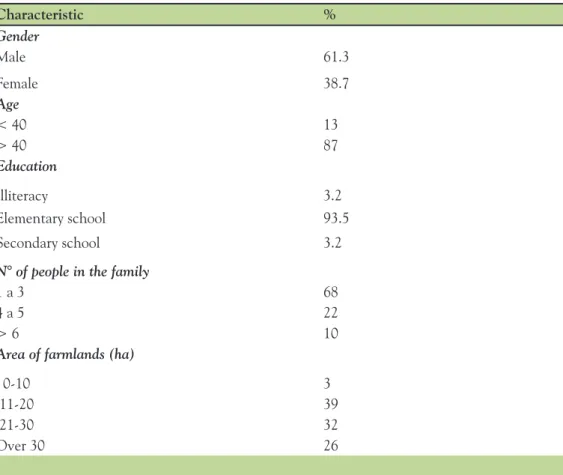
Table 1. Socioeconomic profile of the 31 farmers interviewed in the study area.
Characteristic %
Gender
Male 61.3
Female 38.7
Age
< 40 13
> 40 87
Education
Illiteracy 3.2
Elementary school 93.5
Secondary school 3.2
N° of people in the family
1 a 3 68
4 a 5 22
> 6 10
Area of farmlands (ha)
0-10 3
11-20 39
21-30 32
Over 30 26
The presence of capuchin monkeys was reported in 21 properties, and they raid maize crops in 71% of them. Most part of the conflicts with capuchin monkeys take place in farmlands located near the steeper areas, with well-preserved forest vegetation on the banks of the reservoir. These areas are located contiguously or in close proximity to the Quarta Colônia State Park.
Groups of monkeys are often seen by residents in the plantations, near the edges of the forest (35% of answers), especially in times when the maize is ripe (57% of answers). For 22% of the respondents capuchin monkeys come to the plantations in large groups (20 to 30 individuals), but 35% did not know the number of normally sighted monkeys (group size). In a similar manner, a significant proportion of the respondents (39%) stated that the monkeys cause damage to their farmlands, but most of them (66%) were not able to specify the losses in quantitative or financial terms. They know that capuchin monkeys are not the only animals which raid maize crops; however, they cannot differentiate de damage caused by each kind of animal. One third of the respondents who claimed to have suffered damage consider that their properties incurred substantial financial losses, especially because they depend on the harvested maize to feed the animals and also to plant in the following year.
On farms where maize consumption is more intense, the residents are extremely worried about the losses that have been occurring. Nevertheless, the statements of most of the respondents betray a relative empathy with the monkeys, and no sense of resentment or anger over the situation was noticed. In most interviews (87%), the respondents were the head of the family (man), but for the remaining interviews only the wife was found at home at the time of our visit, so she was the respondent. Thus, it is clear that women were the ones who more frequently had feelings of affection for the monkeys because they thought the monkeys were “beautiful” or “resembled humans,” or for their fondness of infant monkeys or their desire to have a monkey in captivity.
For 31% of the respondents primates are important because they are part of natu-re; others (19%) answered that primates are important because they resemble humans. Following we transcribed two statements related to the importance of primates:
“I think that the capuchin monkey is important in nature. It is an animal that has always existed, right? If we don’t take care it will soon disappear, as occurred to the howler monkeys which used to live here but no more exist. And the capuchin monkey is a creature of nature, and then they have to exist. “
Francisco, 51 years old
“I think the animals are the owners of nature, because they are here since well before the man. Then we have to give attention to them also.”
Antonio, 51 years old.
The respondents considered the monkeys to be “funny” (8%) and “smart” (5%), especially because they can easily reach the crops to catch food or escape from the farmers when they are sighted.
In the properties where there were school-aged children, who sometimes partici-pated in the interview, the responses showed greater knowledge about the ecological im-portance of the monkeys (8%). We presumed that this answers may have been influenced by the children’s schooling, since they mentioned elements that we defined as “ecological balance” or “seed dispersal”.
“I do not have much knowledge on this subject, I’m not sure if they do anything, maybe they plant some seed ...”
Pedro, 31 years old.
“It may be importante, may have any role… I consider it principally as a problem, but they possibly plant forests, spread some seeds.”
Carlos, 46 years old.
“If the monkeys are there (in the forest) it’s because it is balanced” Fernando, 21 years old.
Despite the conflicts, 80% of the respondents believe that it is possible to conciliate the persistence of monkeys with human survival in that area. However, most of the inter-viewed were pessimistic about the possibility of reducing maize consumption by monkeys. They don’t believe in an efficient solution for this problem, and few of them suggested alternatives (9% propose that they should be financially compensated for such losses).
Most respondents (84%) declared a positive attitude towards monkeys. In general (39%), farmers do not use any strategy to scare the monkeys. Some (16%) use traditional strategies, such as stones, noise or dogs. But only one resident said that the presence of dogs on the property was a good strategy to fend off monkeys. Most respondents state that these are not useful strategies, because the monkeys soon get habituated to them. None of the residents admitted using shotguns to scare the monkeys. Some farmers (10%) are trying to mitigate the maize consumption by monkeys keeping cultivated areas away from steeper slopes (from where monkeys use to access the plantations), or planting the maize earlier than normal.
All but two of the respondents claimed that they have never captured monkeys because this action would be illegal. One respondent reported that he had captured “several infant monkeys for sale, but it were about 20 or 30 years ago, when this practice was common in the region”. Nevertheless, in several interviews there was mention of persecution and hunting of capuchin monkeys “by neighbors”, and two monkeys were found in captivity, possibly (although not admitted) captured when they were still infants, after their mothers had been killed.
Discussion
their populations, or outside such areas, along with human populations that exploit their habitat (estraDa, 2006; lee, 2010). The second option - sharing space - necessarily
re-quires that humans recognize the needs of primates, even if the latter impact their lives or well-being negatively. In our study area the capuchin monkeys may survive inside the limits of the Quarta Colônia State Park, however, the small size of this Conservation Unit (1.847 ha; SEMA, 2015) added to the availability of cultivated fields in the surrounding properties favor the proximity among monkeys and landowners. We could perceive some proneness to share the space with the capuchin monkeys among the landowners of the rural districts that we studied, however, this scenario can change if the crop raiding persists or increase by the capuchin monkeys.
The majority of the landowners tolerated the presence of capuchin monkeys in the region, except for those farmers who own a smaller area, where even small losses can have a very significant impact on the economy of the property. This tolerance can be associated with the fact that the product raided by the monkeys does not have commercial value in the region, on the contrary of what have been reported in pine plantations in south Brazil (roCHa, 2000; CarvalHo & viDolin, 2009; mikiCH & lieBsCH, 2009. In areas of
cocoa plantations crop raiding by capuchin monkeys have also deserved attention of the researchers, who aimed at finding alternatives to avoid it (oliveira & fialHo, 2007). In
the properties sampled in this study, maize cultivation is mainly aimed at feeding the farm animals, i.e., it is not a source of income for the property. Only small farmers are involved and economic interests are less significant, then little progress has been achieved in terms of diagnosis and prospects for the solution of conflicts.
The economic value of the products consumed by the monkeys has a strong in-fluence on the perception of the problem, the tolerance level and the actions taken by those who are directly affected (lee & Priston, 2005). A similar study also conducted in
the surroundings of a hydroelectric power plant and involving small properties showed that those who engage in commercial cultivation of American pine have problems with capuchin monkeys. The residents’ perceptions about these animals are more negative than in properties dedicated to other economic activities such as poultry farming, in which there is no interference from the monkeys (Barros, 2011). In the study conducted by riley &
Priston (2005) in Sulawesi, Indonesia, farmers tolerate commensal monkeys (Macaca
spp.) in cocoa plantations in situations where they “help” in the harvest of chestnuts, knocking them to the ground as they eat the fruits (cashew).
Besides, individuals’ understanding and perceptions of risk are socially and culturally constructed (Douglas, 1992), and influenced by individual’s previous experience (lee,
2010). They may be more influenced by rare and extraordinary or extreme events (i.e., “worst case” scenarios) than by less extreme, more frequent events (naugHton-treves,
2001; sCHerer & CHo, 2003). But this is not the case in the study area, since the crop
raiding seems to be frequent and normally occurs in a small scale, restricted to the borders between plantations and the forest. Additionally, negative impressions may be intensi-fied when people believe they have little control over the situation of conflict, such as in cases where hunting as a preventative measure is not allowed (naugHton-treves &
also relevant. But capuchin monkeys are not dangerous or feared animals, and besides, they are even “protected” in a certain way, by the feelings elicited in the landowners by their “close resemblance to humans”.
On the other hand, perceptions of risk are more influenced by more “visible” species, if species are diurnal or nocturnal and the degree of control that the individuals feel they have on those animals (Hill, 2004). Thus, the fact that the residents cannot completely
differentiate the damage caused by capuchin monkeys from damage caused by other ani-mals can increase the feeling of dislike for those primates (riley, 2007; riley & Priston,
2010), whose daytime behavior makes them more frequently sighted in plantations than nocturnal animals that also cause damage such as rodents, coatis or porcupines.
The way farmers see the problem and, consequently, the decisions they make about how to behave towards wildlife, have a direct influence on local conservation programs (Hill, 2005). In the study area, a preliminary survey of the population of Sapajus nigritus
showed low density (soBroZa, 2011), suggesting that the intensification of conflicts after
the construction of the plant cannot be attributed to a population increase of this species. Still, residents may believe this is the problem, or feel that their demands are not met by the local authorities, and choose to take their own measures to control the situation. By the time this project started, conflicts with capuchin monkeys had been occurring for four years, and the first interviews showed that the residents did not believe it was possible to find a solution to the problem. It is believed that the residents themselves may have taken actions to eliminate the problem animals during that period, so maybe the situation reported by soBroZa (2011) may no longer match the reality observed four years before,
and this can have serious implications for the permanence of this species in the study area. Regarding the measures taken by the residents to minimize crop raiding by wild animals, changing the planting season of maize seemed to be somewhat effective, becau-se farmers who reported adopting this practice affirmed they have not had any conflict with monkeys. However, the use of this strategy is possible only when problems happen in a particular culture and time of year (Hill, 2000), and for those who do not cultivate
tobacco for sale in the same lots (whose timing of cultivation is defined by the purchasing companies). The distance between the crops and forest edge or steep areas also proved effective according to the respondents, because it hinders the approach of capuchin monkeys, but it is only possible in properties that have greater cultivable area. Clearly, there will be advantages and disadvantages associated with the use of different growing seasons, or even different cultures, so any action that is taken requires a careful and thorough cost/benefit analysis to identify the most efficient short and long term alterna-tives to protect crops. For example, studies have shown that winter maize (grown during autumn / winter) has a higher energy value as fodder for domestic animals (PeDó, 2009)
and a change in planting season may have nutritional consequences for these animals, a factor that must be considered in strategic decision-making.
Implications for conservation
Developing strategies to reduce conflicts between humans and primates is not an easy activity. Nevertheless, positive perceptions can be used as a basis for the development of conservation and education projects, which do not solve the conflict immediately, but are long-term measures that can promote a better understanding of the function and importance of this primate species in the ecological local context (CamPBell-smitH et
al., 2010).
However, ownership of monkeys in cages was confirmed during visits to the proper-ties, and the occurrence of hunting was mentioned in a subjective way. If not combated, such attitudes could jeopardize the survival of capuchin monkeys in that area. Illegal hunting can also make farmers believe they are in competition against wildlife, feeding back their predisposition to negative attitudes (Hill, 2004).
Furthermore, it should be noted that the mere presence of the researchers in the area can have a transformative effect on the perceptions and attitudes of local commu-nities, either by showing the researchers’ interest in and appreciation of wildlife, or by restraining (even if indirectly) negative attitudes.
References
AGETSUMA, N. Ecological function losses caused by monotonous land use induce crop raiding by wildlife on the island of Yakushima, southern Japan. Ecological Research
22(3): 390-402, 2007.
BARANGA, D.; BASUTA, G. I.; JULIE A.; TEICHROEB, J.A.; COLIN, A. C. Crop raiding patterns of solitary and social groups of red-tailed monkeys on cocoa pods in Uganda. Tropical Conservation Science5(1), p.104-111, 2012.
BARROS, T. B. Conflitos entre a população humana e macacos-prego (Cebus nigritus)
na área de influência da PCH alto Irani, Santa Catarina. Dissertação de mestrado do
programa de Mestrado em Ciências Ambientais, Universidade Comunitária da Região de Chapecó – UNOCHAPECÓ. Chapecó, SC, 51 p. 2011.
BIDONE, F.R.A. (Coord.). Relatório de Impacto Ambiental - UHE Dona Francisca.
Santa Maria, Companhia Estadual de Energia Elétrica, 64 p. 1989.
CAMPBELL-SMITH, G.; SIMANJORANG, H.V.; LEADER-WILLIAMS, N.; LINKIE, M. Local attitudes and perceptions towards crop-raiding by Sumatran orangutans (Pongo abelii) and other non-human primates in Northern Sumatra, Indonesia. American Journal
of Primatology 72(10): 866-876, 2010.
CARVALHO, D.R.J. Predação em Pinus spp. por Cebus nigritus (Goldfuss, 1809)
(Primates; Cebidae) na região nordeste do Paraná - Brasil. 2007. Dissertação de
CARVALHO, D.R.J.; VIDOLIN, G.P. Delineamentos para o manejo do macaco-prego (Cebus nigritus) no Paraná. Governo do Estado do Paraná/SEMA/IAP/ Projeto Paraná Biodiversidade. 32 p. 2009.
CHAUHAN, A.; PIRTA, R. S. Socio-ecology of two species of non-human primates, Rhesus Monkey (Macaca mulatta) and Hanuman Langur (Semnopithecus entellus) in Shimla, Himachal Pradesh. Journal of Human Ecology 30(3), p.171-177, 2010.
CHHANGANI, A.K.; MOHNOT, S.M. Crop Raid By Hanuman Langur Semnopithecus Entellus In And Around Aravallis, (India) And Its Management. PrimateReport 69, p.35- 47, 2004.
DISTEFANO, E. 2005. Human–wildlife conflict worldwide: a collection of case
stu-dies, analysis of management strategies and good practices. Sustainable Agriculture
and Rural Development (SARD), Food and Agricultural Organization of the United Nations (FAO), Rome, Italy. Disponível em: http://www.fao.org/3/a-au241e.pdf. Con-sultado em 23/12/2015.
DOUGLAS, M. Risk and Blame. Essays in Cultural Theory. London: Routledge, 1992.
ENGEMAN, R.M.; LABORDE, J.E.; CONSTANTIN, B.U.; SHWIFF, P.H.; DUFFINEY, A.; LUCIANO, F. The economic impacts to commercial farms from invasive monkeys in Puerto Rico. Crop Protection 29, p. 401-405, 2010.
ESTRADA, A. Human and non-human primate co-existence in the Neotropics: a pre-liminary view of some agricultural practices as a complement for primate conservation.
Ecological and Environment Anthropology 2(2): 17-29, 2006.
FUNGO, B. A Review Crop Raiding Around Protected Areas: Nature, Control and Research Gaps. Environmental Research Journal 5(2): 87-92, 2011.
FRAGASZY, D.; VISALBERGHI, E.; ROBINSON, J.G. Variability and adaptability in the genus Cebus. Folia Primatologica, 54(3-4): 114-118, 1990.
FREITAS, C. H.; SETZ, E. Z. F.; ARAÚJO, A. R. B.; GOBBI, N. Agricultural crops in the diet of bearded capuchin monkeys, Cebus libidinosus Spix (Primates: Cebidae), in forest fragments in southeast Brazil. Revista Brasileira de Zoologia 25(1): 32-39, 2008.
GALETTI, M.; PEDRONI, F. Seasonal diet of capuchin monkeys (Cebus apella) in a se-mideciduous forest in south-east Brazil. Journal of Tropical Ecology, 10(1): 27-39, 1994.
GUMERT, M.D.; JONES-ENGEL, L. (Orgs.). Macaca fascicularis workshop: unders-tanding and managing macaque-human commensalism. 22nd Congress of the
Inter-national Primatological Society. Edinburgh, Scotland, UK. p.11, 2008.Disponível em
HILL, C.M. People, crops and primates: a conflict of interests. In: Paterson JD, Wallis J, editors. Commensalism and conflict: the human-primate interface. Norman, Oklahama:
American Society of Primatology, p. 40-59, 2005.
HILL, C. Conflict of interest between people and baboons: crop raiding in Uganda.
In-ternational Journal of Primatology. 21(2): 299-315, 2000.
HILL, C. Farmers’ perspectives of conflict at the wildlife-agriculture boundary: some lessons learned from African subsistence farmers. Human Dimension Wildlife.9: 279-286, 2004.
HILL, C.; WEBER, A. Perceptions of Nonhuman Primates in Human–Wildlife Conflict Scenarios. American Journal of Primatology 72(10): 919-924, 2010.
HOCKINGS, K. J.; HUMLE, T. Best practice guidelines for the prevention and mitiga-tion of conflict between humans and great apes. Gland, Switzerland: IUCN/SSC Primate
Specialist Group (PSG). 40 p., 2009.
KOEHLER, A.; FIRKOWSKI, C. Descascamento de pinus por Macaco-prego (Cebus
apella). Floresta, Curitiba, 24(1-2): 61-75, 1996.
LEE, P.C.; PRISTON, N.E.C. Human attitudes to primates: perceptions of pests, conflict and consequences for primate conservation. In: Paterson JD, Wallis J, editors.
Com-mensalism and conflict: the human-primate interface. Norman, Oklahama: American
Society of Primatology. p. 1-23, 2005.
LEE, P. C. Sharing space: can Ethnoprimatology contribute to the survival of nonhuman primates in human-dominated globalized landscapes? American Journal of Primatology
72(10): 925-931, 2010.
LINKIE, M. DINATA, Y.; NOFRIANTO, A.; LEADER-WILLIAMS, M.. Patterns and perceptions of wildlife crop raiding in and around Kerinci Seblat National Park, Sumatra.
Animal Conservation 10(1): 127-135, 2007.
LUDWIG, G.; AGUIAR, L. M.; ROCHA, V. J. Uma avaliação da dieta, da área de vida e das estimativas populacionais de Cebus nigritus (Goldfuss, 1809) em um fragmento florestal no norte do estado do Paraná. Neotropical Primates 13(3): 12-18, 2005.
MADDEN, F. Creating coexistence between humans and wildlife: Global perspectives on local efforts to address human-wildlife conflict. Human Dimensions of Wildlife. 9: 247-257, 2004.
MARCHAL, V.; Hill, C. Primate Crop-raiding: A Study of Local Perceptions in Four Villages in North Sumatra, Indonesia. Primate Conservation (24): 107-116, 2009.
MCKINNEY, T. The effects of provisioning and crop raiding on the diet and foraging activities of human-commensal white-faced capuchins (Cebus capucinus). American
Journal of Primatology 73(5): 439-448, 2011.
NAUGHTON-TREVES, L.; TREVES, A.; CHAPMAN, C.E.; WRANGHAM, R. Temporal patterns of crop-raiding by primates: linking food availability in croplands and adjacent forest. Journal of Applied Ecology 35(4): 596-606, 1998.
NAUGHTON-TREVES, L. Farmers, Wildlife and the Forest Fringe. In: African Rain
Forest Ecology and Conservation, L. Naughton-Treves, Editor. Yale University Press
Yale. p. 369-384, 2001.
OLIVEIRA, M. M.; FIALHO, M. de S. Instalação de cercas para evitar a predação de frutos de cacau por macacos-prego em Rondônia, Brasil. Neotropical Primates 14(1): 34, 2007.
OSBORN, F.V.; HILL, C.M. Techniques to reduce crop-loss: human and technical dimen-sions in Africa. Pp. 72-85. In: Woodroffe, S. T. & Rabinowitz, A. People and Wildlife:
conflict or coexistence? Cambridge: Cambridge University Press, 2005.
PATERSON, J. D. Residents and immigrants: reactions and perceptions of crop raiding in Masindi District, Uganda. In: PATERSON, J. D.; WALLIS, J. (Org.) Commensalism
and Conflict: The Human-Primate Interface. Oklahoma: American Society of
Prima-tologists, 2005, p. 76-89.
PEDÓ, L. F. B. Fracionamento dos carboidratos de silagens de milho safrinha colhidas em diferentes alturas de corte. Ciencia. Rural, 2009, 39(1): 188-194, 2009.
PRISTON, N. Modelling Primate Crop-Raiding - Perceptions of Risk, Actual Risk and the Implications for Conservation. Final Report, 2008.
PRISTON, N. E. C. Crop-raiding by Macaca ochreata brunnescens in Sulawesi:
reality, perceptions and outcomes for conservation [PhD]. University of Cambridge,
Cambridge. 369 p., 2005.
RILEY, E.P. The human-macaque interface: conservation implications of current and future overlap and conflict in Lore Lindu National Park, Sulawesi, Indonesia. American
Anthropology, 109(3): 473-484, 2007.
RILEY, E.P.; PRISTON, N.E.C. Macaques in farms and folklore: exploring the human-nonhuman primate interface in Sulawesi, Indonesia. American Journal of Primatology,
72(3): 848-854, 2010.
ROCHA, V.J. Macaco-prego: como controlar esta nova praga florestal? Floresta, 30 (1-2): 95-99, 2000.
SCHERER, C.; CHO, H. A social network contagion theory of risk perception. Risk
Analysis, 23(2): 261-267, 2003.
SEKHAR, N.U. Crop and livestock depredation caused by wild animals in protected areas: the case of Sariska Tiger Reserve, Rajasthan, India. Environmental Conservation
25(2): 160-171, 1998.
and conflict: the human-primate interface. Norman, Oklahama: American Society of Primatology. p. 295-337, 2005.
SIEX, K.S.; STRUHSAKER, T.T. Colobus monkeys and coconuts: a study of perceived human-wildlife conflicts. Journal of Applied Ecology, British, 36(6): 1009-1020, 1999.
SILLERO-ZUBIRI, C.E.; SWITZER, D. Crop raiding primates: Searching for
alter-native, humane ways to resolve conflict with farmers in Africa. People and Wildlife
Initiative. Wildlife Conservation Research Unit, Oxford University. p.19, 2001. Dispo-nível em: www.peopleandwildlife.org.uk/crmanuals/CropRaidingPrimatesP&W Manual. Consultado em 01/03/2012.
SOBROZA, T. Censo populacional de Cebus nigritus (Goldfuss, 1809) com uso de
playback em área de floresta estacional decidual, Rio Grande do Sul. Anais do III
Simpósio de Biodiversidade (UFSM), 2011. Pag,300 – ISSN 2237-6100. Disponível em: http://w3.ufsm.br/isbio/III_Simposio/Anais_IIISBIO.pdf
STRUM, S.C. Prospects for management of primate pests. Revue d’Ecologie (Terre Vie)
49(3): 295-306, 1994.
STRUM, S.C. The developing of primate raiding: implications of management and con-servation. International Journal of Primatology 31(1): 133-156, 2010.
WANG, W. S.; CURTIS, D. P.; LASSOIE, P. J. Farmer perceptions of crop damage by wildlife in Jigme Singye Wangchuck National Park, Bhutan. Wildlife Society Bulletin
34(2): 359-365, 2006.
WARREN, Y. Crop-raiding baboons (Papio anubis) and defensive farmers: a West African perspective. West African Journal of Applied Ecology, vol. 14, p.1-11, 2008.
Submitted on: 15/10/2013 Accepted on: 20/03/2015
Resumo: As frequentes alterações dos habitats naturais promovidas pelo ser humano aumentam a proximidade com a fauna silvestre e favorecem o surgimento de conflitos. Nos últimos anos, moradores de comunidades rurais na área de influência da Usina Hi-drelétrica Dona Francisca (UHEDF), na região central do Rio Grande do Sul, têm recla-mado de um suposto aumento na população de macacos-prego, que estariam causando danos aos cultivos agrícolas. Visando fornecer subsídios para a mitigação dos conflitos, este estudo investigou as percepções e atitudes dos moradores dessas comunidades em relação ao macaco-prego. Foram aplicadas entrevistas semi-estruturadas a 31 proprietários rurais nas referidas localidades. Uma parcela significativa dos entrevistados afirma que os macacos causam prejuízo em sua propriedade. Embora esses prejuízos comprometam financeiramente algumas propriedades, é possível observar um cenário geral favorável à adoção de práticas educativas e conservacionistas que visem à proteção do macaco-prego e de seu hábitat.
Palavras-chave: etnoprimatologia, conflitos com humanos, conservação
Abstract: The frequent changes of natural habitats promoted by humans increase proximity to wildlife and favor the emergence of conflicts. In recent years, residents of rural commu-nities in the area of influence of the Dona Francisca Hydroelectric Plant (UHEDF), in the central region of Rio Grande do Sul, have complained about a supposed increase in the population of capuchin monkeys, which were causing damage to some crops. Aiming to provide subsidies for the mitigation of conflicts, this study investigated the perceptions and attitudes of those rural residents regarding the capuchin monkeys. Semi-structured inter-views were applied to 31 landowners in those localities. A significant portion of respondents said that the monkeys cause injury on their properties. Although the crop losses financially commit some properties, we can see a favorable scenario for the adoption of educational and conservation practices aimed at the protection of monkeys and of their habitat.
PERCEPTIONS AND ATTITUDES OF RURAL RESIDENTS TOWARDS
CAPUCHIN MONKEYS, IN THE AREA OF INFLUENCE OF THE DONA
FRANCISCA HYDROELECTRIC POWER PLANT,
SOUTH BRAZIL
Resumen: Cambios de los hábitats naturales promovidos por los seres humanos aumentan la proximidad a la vida silvestre y favorecen la aparición de conflictos. En los últimos años, residentes de las comunidades rurales de la zona de influencia de la Central Hidroeléctrica de Dona Francisca (UHEDF), en Rio Grande do Sul, se han quejado de un supuesto au-mento de la población de monos capuchinos, que supuestamente están causando daños en algunos cultivos. Este estudio investigó las percepciones y actitudes de los residentes rurales con respecto a los monos capuchinos. Las entrevistas semiestructuradas se aplicaron a 31 propietarios de tierras. Una parte significativa de los entrevistados ha dicho que los monos hacen daño en sus propiedades. Aunque las pérdidas de cosechas se comprometen financie-ramente, por lo general podemos ver un escenario favorable para la adopción de prácticas de educación y conservación destinadas a la protección de los monos y de su hábitat.