Ambient particulate air pollution from
vehicles promotes lipid peroxidation
and inflammatory responses in rat lung
1Curso de Pós-graduação em Ciências Médicas e Laboratório de Estresse Oxidativo e
Poluição Atmosférica, Fundação Faculdade Federal de Ciências Médicas de Porto Alegre, Porto Alegre, RS, Brasil
2Laboratório de Poluição Atmosférica Experimental, Departamento de Patologia
(LIM05), Faculdade de Medicina, Universidade de São Paulo, São Paulo, SP, Brasil C.E.L. Pereira1,
T.G. Heck1,
P.H.N. Saldiva2
and C.R. Rhoden1
Abstract
Oxidative stress plays a major role in the pathogenesis of particle-dependent lung injury. Ambient particle levels from vehicles have not been previously shown to cause oxidative stress to the lungs. The present study was conducted to a) determine whether short-term exposure to ambient levels of particulate air pollution from vehicles elicits inflammatory responses and lipid peroxidation in rat lungs, and b) determine if intermittent short-term exposures (every 4 days) induce some degree of tolerance. Three-month-old male Wistar rats were exposed to ambient particulate matter (PM) from vehicles (N = 30) for 6 or 20 continuous hours, or for intermittent (5 h) periods during 20 h for 4 consecutive days or to filtered air (PM <10 µm; N = 30). Rats continuously breathing polluted air for 20 h (P-20) showed a significant increase in the total number of leukocytes in bronchoal-veolar lavage compared to control (C-20: 2.61 x 10⁵ ± 0.51;P-20: 5.01
x 105 ± 0.81; P < 0.05) and in lipid peroxidation ([MDA] nmol/mg
protein: C-20: 0.148 ± 0.01; P-20: 0.226 ± 0.02; P < 0.05). Shorter exposure (6 h) and intermittent 5-h exposures over a period of 4 days did not cause significant changes in leukocytes. Lipid damage result-ing from 20-h exposure to particulate air pollution did not cause a significant increase in lung water content. These data suggest oxida-tive stress as one of the mechanisms responsible for the acute adverse respiratory effects of particles, and suggest that short-term inhalation of ambient particulate air pollution from street with high automobile traffic represents a biological hazard.
Correspondence C.R. Rhoden Rua Jaraguá, 370/302 90450-140 Porto Alegre, RS Brasil
Fax: +55-51-338-810 E-mail: [email protected]
Research supported by Fundação Faculdade Federal de Ciências Médicas de Porto Alegre, Brazil. C.E.L. Pereira was supported by a fellowship from CAPES, C.R. Rhoden and P.H.N. Saldiva were supported by CNPq.
Publication supported by FAPESP.
Received December 12, 2006 Accepted June 25, 2007
Key words
•Oxidative stress •Reactive oxygen species
Lipid peroxidation
•Particulate air pollution •Lung inflammation •Acute effects
Introduction
Epidemiological studies have shown that exposure to particulate matter is associated with increased cardiopulmonary morbidity and mortality (1-9), hospital admissions
spe-cies in target cells. Gurgueira et al. (14) reported that short-term exposure to concen-trated ambient particles (CAPs) leads to a significant increase in oxidant levels in the heart and lung of rats which was associated with edema in these tissues. Rhoden et al. (15) showed that previous treatment with a general antioxidant (N-acetylcysteine) pre-vented lung inflammation induced by short-term CAP exposure.
The data cited above suggest that oxida-tive stress to the pulmonary parenchyma plays a major role in the pathogenesis of particle-dependent lung injury. However, it is important to note that the oxidative stress induced by particles in experimental animal studies was obtained with concentrated am-bient particles or with tracheal instillation (14,15). Particles in the ambient from ve-hicles have not been shown to cause oxida-tive stress to the lungs. The present study was conducted in order to address this ques-tion, with two main objectives: a) to deter-mine whether short-term exposure (6 or 20 h) to ambient levels of urban aerosols from a street with high automobile traffic elicits oxidative damage to membrane lipids in the lung, and b) to determine if intermittent short-term exposures (5 h per day) every 4 days induce some degree of tolerance.
Material and Methods
Site of exposure
Porto Alegre has a population of ap-proximately 1.5 million inhabitants; it is the central city of an industrialized metropolitan area of 3.2 million inhabitants. The vehicle fleet was 522,555 vehicles in March 2004 (16), or about 1 vehicle for every 2.7 indi-viduals, and an increase of 4.5% vehicles occurs every year. Vehicle traffic is the main source of air pollution in the larger cities of Brazil, being responsible for approximately 90% of carbon monoxide and particulate matter10 emissions, with air pollution
repre-senting a serious problem in many regions (17,18). The total area of Porto Alegre is 496,827 km2 with 40% of the urban area
being occupied by the transportation struc-ture (16). This city presents frequent thermal inversions and defined climate seasons. Av-erage temperature ranges from 18 to 25ºC, and average rainfall days range from 3 to 6 per month (based on 8 years of historical weather readings; climate zone http://www. climate-zone.com/climate/brazil/fahrenheit/ porto-alegre.htm).
Animals
Adult 3-month-old male Wistar rats from the Animal Facility of Fundação Faculdade Federal de Ciências Médicas de Porto Ale-gre were used. Animals were kept under 12-h lig12-ht-dark periods and 12-had free access to a standard laboratory diet (Supra-lab, Alisul Alimentos S/A., São Leopoldo, RS, Brazil) and water before and during the exposure.
Exposure chambers
of ambient particles, whereas the other re-ceived atmospheric air without the filtering system (designated as polluted). The tem-perature in the room and in the chamber was 22 ± 2ºC.
Experimental protocol
Continuous short-term exposure to par-ticulate matter. Rats were exposed to ambi-ent particles from vehicles (polluted group) or filtered air (control group) for periods of 6 h (on August 4, 2004) or 20 h (on August 17, 2004), as described above. The animals were allowed to move freely in the cage during the exposure and both groups were exposed and tested simultaneously. Immediately af-ter the exposure, animals were anesthetized
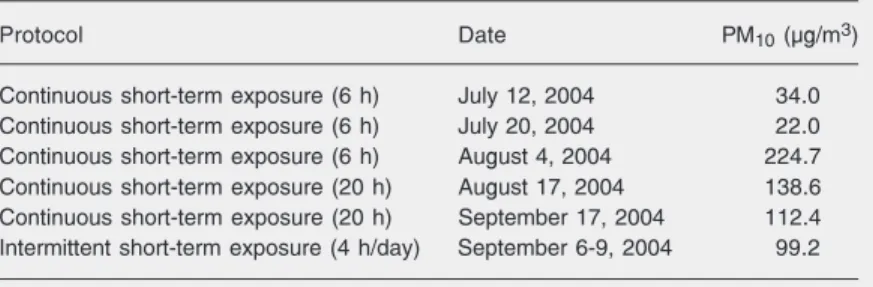
ip with 50 mg/kg pentobarbital and killed by exsanguination. The right lung of each ani-mal from both groups was excised and quickly frozen in liquid nitrogen for lipid peroxidation evaluation and the left lung of each animal was excised and used to deter-mine lung edema. Another group of animals was submitted to the same protocol and to bronchoalveolar lavage 24 h later to deter-mine the inflammatory parameters. The pro-tocol of bronchoalveolar lavage for the 6-h exposure was performed on two different days (July 12 and July 20, 2004), whereas the 20-h exposure was performed on Sep-tember 17, 2004. The ambient levels of par-ticulate matter from vehicles on the days of exposure varied from 22 to 224.7 µg/m3
(Table 1).
The times of exposure were based on experimental studies in which animals were exposed to concentrated ambient particles for 3 and 5 h, with an increase in oxidant levels being detected in the lungs and heart (14,19).
Intermittent short-term exposure to am-bient particulate matter from vehicles. Rats were exposed to consecutive particulate matter inhalations (polluted group) or fil-tered air (control group) during periods of 20
h (5 h/day, 4 consecutive days, from Sep-tember 6 to 9, 2004), as described above. The ambient particulate matter concentra-tions on the days of exposure are listed in Table 1. The animals were awake and move-ment was unrestricted during exposure. Both groups were exposed and tested simulta-neously. Immediately after the last exposure the animals were submitted to the same pro-cedure as described above for the collection of lung samples for lipid peroxidation and edema determination.
Tissue preparation
The lungs were excised, washed in saline solution and quickly frozen in liquid nitro-gen. For the determination of thiobarbituric acid reactive substances (TBARS), tissue samples were homogenized in 5 volumes of 120 mM KCl and 30 mM sodium phosphate buffer, pH 7.4, containing 0.5 mM phenyl-methanesulfonyl fluoride as a protease in-hibitor, at 0-4ºC. The suspensions were cen-trifuged at 600 g for 10 min at 0-4ºC to remove nuclei and cell debris. The pellets were discarded and the supernatant solu-tions were used as homogenates.
Determination of thiobarbituric acid reactive substances - lipid peroxidation
Lung homogenates were precipitated with 10% TCA, centrifuged, and incubated with thiobarbituric acid (Sigma, St. Louis, MO, USA) for 15 min at 100ºC and TBARS were
Table 1. Concentration of particulate matter (PM10) in the air to which rats were exposed.
Protocol Date PM10 (µg/m3)
Continuous short-term exposure (6 h) July 12, 2004 34.0
Continuous short-term exposure (6 h) July 20, 2004 22.0
Continuous short-term exposure (6 h) August 4, 2004 224.7
Continuous short-term exposure (20 h) August 17, 2004 138.6
Continuous short-term exposure (20 h) September 17, 2004 112.4
extracted with butanol (1:1 v/v). After cen-trifugation, the absorbance of the butanol was measured at 535 nm (20). The amount of TBARS formed is reported as nmol/mg protein. Malondialdehyde standards were prepared from 1,1,3,3,-tetramethoxypropane. Protein concentration in the homogenates was measured by the Bradford protein assay (21) using bovine serum albumin as stand-ard. Measurements were carried out in a Perkin Elmer Lambda 40 spectrophotometer (Shelton, CT, USA).
Lung edema
The severity of pulmonary edema was determined by the wet/dry ratio. Lung samples (about 200 mg) taken from the same animals as used for TBARS determination were weighed and dried in a conventional oven (at 90ºC) until they reached constant weight. The results are reported as wet/dry ratios (g/g).
Bronchoalveolar lavage
Rats exposed to polluted or filtered air were anesthetized with sodium pentobar-bital (50 mg/kg body weight) 24 h after exposure and euthanized by exsanguination. The trachea was sectioned, a fine catheter was introduced and fixed with cotton thread, and 21 mL sterile saline solution was in-jected in three series of 7 mL, followed by aspiration. The rate of recovery of the injected solution was approximately 80%. Each aliquot represents one injected and one drawn in recovery of fluid. The recovered fluid was centrifuged at 400 g at 6ºC and the supernatant from the first lavage was saved for the measurement of protein level. Total cell counts were determined af-ter Trypan blue staining using a Neubauer chamber. Total protein levels, as a measure of vascular permeability, were determined in the supernatant of the first lavage aliquot by the Bradford protein assay (21) using
a Perkin Elmer Lambda 40 spectrophotom-eter.
Animal care
Animals were handled humanely through-out the study to minimize their discomfort and to prevent distress. All protocols were approved by the Research Ethics Committee of Fundação Faculdade Federal de Ciências Médicas de Porto Alegre (CPA 085/03).
Statistical analysis
Data are reported as means ± SEM. Sta-tistical analyses were performed by the un-paired Student t-test using the Sigma-Stat 2.0 Software (Jandel Corporation, 1992-1995, San Jose, CA, USA), with the level of significance set at 5%.
Results
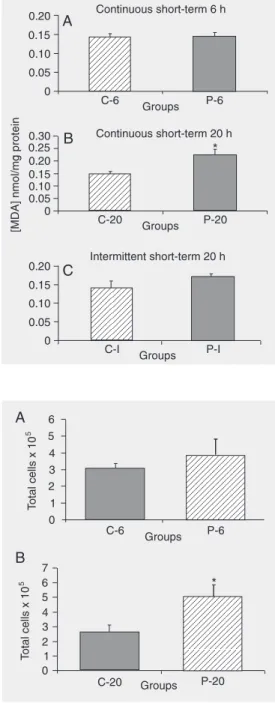
Rats breathing ambient particulate mat-ter from vehicles for 6 h did not show in-creased lipid peroxidation in the lungs (Fig-ure 1A). However, when the animals were continuously exposed for 20 h a statistically significant increase in this parameter was detected in their lungs (Figure 1B), but not in the lungs of rats exposed intermittently to particulate matter for 20 h (Figure 1C).
P = 0.763). Finally, the wet/dry ratio, a meas-urement of global tissue damage, was not changed by exposure to pollution (continu-ous short-term 6 h: control = 4.87 ± 0.09 vs
polluted = 4.85 ± 0.18 g/g, P = 0.924; con-tinuous short-term 20 h: control = 5.25 ± 0.08 vs polluted = 5.20 ± 0.09 g/g, P = 0.688; intermittent short-term - total 20 h: control = 4.86 ± 0.13 vs polluted = 5.20 ± 0.18 g/g, P = 0.167).
Discussion
In the present study, rats were exposed to vehicle polluted (urban) or clean (filtered) ambient air on a short-term basis. Their lungs were evaluated for lipid damage and showed a time-dependent increase of lipid peroxida-tion. Rats exposed to particulate matter for 20 h presented an almost 2-fold higher lipid peroxidation when compared to rats exposed for 6 h. Our results agree with previous studies with animals breathing CAPs for 5 h, which presented an increase in oxidant lev-els in the lung and heart (14,19). Both obser-vations would be compatible with Fenton-type reactions catalyzed by transition met-als, redox-cycling processes, or biochemical changes triggered by non-covalent binding to membrane receptors. It is also important to point out that particulate matter concen-trations in studies using the CAP model were 300-400 µg/m3 (total mass - on average)
while in our study they were 110-140 µg/m3.
In addition, our findings showed that even a lower concentration of particulate matter, considered safe, was able to promote dam-age to membrane lipid in the lung.
Pro-inflammatory and toxic effects of particulate matter have been reproduced in the laboratory in studies on humans (22), on animal models (23,24) and on cells in cul-ture (25). Pulmonary oxidative stress is re-lated to polymorphonuclear neutrophil (PMN) count in BAL and to PMN infiltra-tion (26-29), and these biological effects were prevented by N-acetylcysteine
treat-Figure 1. Effect of ambient par-ticulate air pollution from ve-hicles on rat lung lipid peroxida-tion. Data are reported as the mean ± SEM of 4-8 independ-ent determinations. A, Continu-ous short-term - 6 h (C-6, P-6); P = 0.950. B, Continuous short-term - 20 h (C-20, P-20); *P = 0.040 compared to control (un-paired Student t-test). C, Inter-mittent short-term - total 20 h (C-I, P-I); P = 0.272. MDA = malondialdehyde.
Figure 2. Effect of ambient par-ticulate air pollution from ve-hicles on rat total cell number in bronchoalveolar lavage. Data are reported as the mean ± SEM of 5-6 independent deter-minations. A, Continuous short-term - 6 h (C-6, P6); P = 0.195. B, Continuous short-term - 20 h (C-20, P-20); *P = 0.041 com-pared to control (unpaired Stu-dent t-test).
associ-ated with the development of lung inflam-mation and tissue damage (27,30,31). How-ever, the wet/dry ratio, a measurement of global tissue damage, did not show a signifi-cant increase as a function of exposure time in the present study, in contrast to results reported by other investigators that showed significant development of lung edema in animals exposed to CAPs for 5 h (14). One limitation of the present study was that we did not determine the composition of par-ticulate matter. Particularly important in this respect is the fact that experimental studies with CAPs have been performed with higher doses of particulate matter, resulting in dif-ferent levels of lung inflammatory effects. However, our experimental design had the advantage of reproducing the real concen-tration of particulate matter for which ef-fects have been detected in epidemiological studies (1-9) and the results observed offer
important evidence regarding inflammation and the oxidant effects of particulate matter at sites with acceptable pollution indexes.
The experimental model employed in this study indicates that combining animal stud-ies with “real world exposures” may be of use to understand the pathogenesis of lung injury promoted by urban particles, as well as to devise strategies of pollution control for the minimization of health effects.
Acknowledgments
Special thanks are due to the staff of Laboratory of Experimental Air Pollution of the Medical School, University of São Paulo, São Paulo, SP, Brazil, for technical assis-tance. We also thank the Porto Alegre Ambi-ent Protection State Foundation (FEPAM) for the atmospheric data.
References
1. Dockery DW, Pope CA III, Xu X, Spengler JD, Ware JH, Fay ME, et al. An association between air pollution and mortality in six U.S. cities. N Engl J Med 1993; 329: 1753-1759.
2. Saldiva PH, Lichtenfels AJ, Paiva PS, Barone IA, Martins MA, Massad E, et al. Association between air pollution and mortality due to respiratory diseases in children in São Paulo, Brazil: a preliminary report. Environ Res 1994; 65: 218-225.
3. Saldiva PH, Pope CA III, Schwartz J, Dockery DW, Lichtenfels AJ, Salge JM, et al. Air pollution and mortality in elderly people: a time-series study in São Paulo, Brazil. Arch Environ Health 1995; 50: 159-163.
4. Dockery DW. Epidemiologic evidence of cardiovascular effects of particulate air pollution. Environ Health Perspect 2001; 109 (Suppl 4): 483-486.
5. Schwartz J, Slater D, Larson TV, Pierson WE, Koenig JQ. Particu-late air pollution and hospital emergency room visits for asthma in Seattle. Am Rev Respir Dis 1993; 147: 826-831.
6. Schwartz J. Air pollution and blood markers of cardiovascular risk. Environ Health Perspect 2001; 109 (Suppl 3): 405-409.
7. Donaldson K, Stone V, Seaton A, MacNee W. Ambient particle inhalation and the cardiovascular system: potential mechanisms. Environ Health Perspect 2001; 109 (Suppl 4): 523-527.
8. Zareba W, Nomura A, Couderc JP. Cardiovascular effects of air pollution: what to measure in ECG? Environ Health Perspect 2001; 109 (Suppl 4): 533-538.
9. Pope CA III. Epidemiology of fine particulate air pollution and human health: biologic mechanisms and who’s at risk? Environ Health Perspect 2000; 108 (Suppl 4): 713-723.
10. Braga AL, Saldiva PH, Pereira LA, Menezes JJ, Conceicao GM, Lin CA, et al. Health effects of air pollution exposure on children and adolescents in São Paulo, Brazil. Pediatr Pulmonol 2001; 31: 106-113.
11. Farhat SC, Paulo RL, Shimoda TM, Conceicao GM, Lin CA, Braga AL, et al. Effect of air pollution on pediatric respiratory emergency room visits and hospital admissions. Braz J Med Biol Res 2005; 38: 227-235.
12. Kaiser R, Romieu I, Medina S, Schwartz J, Krzyzanowski M, Kunzli N. Air pollution attributable postneonatal infant mortality in U.S. metropolitan areas: a risk assessment study. Environ Health 2004; 3: 4.
13. Stringer B, Kobzik L. Environmental particulate-mediated cytokine production in lung epithelial cells (A549): role of preexisting inflam-mation and oxidant stress. J Toxicol Environ Health A 1998; 55: 31-44.
14. Gurgueira SA, Lawrence J, Coull B, Murthy GGK, Gonzalez-Flecha B. Rapid increases in the steady-state concentration of reactive oxygen species in the lungs and heart after particulate air pollution inhalation. Environ Health Perspect 2002; 110: 749-755.
15. Rhoden CR, Lawrence J, Godleski JJ, Gonzalez-Flecha B. N-ace-tylcysteine prevents lung inflammation after short-term inhalation exposure to concentrated ambient particles. Toxicol Sci 2004; 79: 296-303.
17. Massad E, Saldiva CD, Cardoso LM, da Silva R, Saldiva PH, Bohm GM. Acute toxicity of gasoline and ethanol automobile engine ex-haust gases. Toxicol Lett 1985; 26: 187-192.
18. Saldiva PH. Air pollution in urban areas: the role of automotive emissions as a public health problem. Int J Tuberc Lung Dis 1998; 2: 868.
19. Rhoden CR, Wellenius GA, Ghelfi E, Lawrence J, Gonzalez-Flecha B. PM-induced cardiac oxidative stress and dysfunction are medi-ated by autonomic stimulation. Biochim Biophys Acta 2005; 1725: 305-313.
20. Buege JA, Aust SD. Microsomal lipid peroxidation. Methods Enzymol 1978; 52: 302-310.
21. Schleicher E, Wieland OH. Evaluation of the Bradford method for protein determination in body fluids. J Clin Chem Clin Biochem 1978; 16: 533-534.
22. Ghio AJ, Kim C, Devlin RB. Concentrated ambient air particles induce mild pulmonary inflammation in healthy human volunteers. Am J Respir Crit Care Med 2000; 162: 981-988.
23. Clarke RW, Catalano PJ, Coull B, Koutrakis P, Murthy GGK, Rice T, et al. Age-related responses in rats to concentrated urban air par-ticles (CAPs). Inhal Toxicol 2000; 12 (Suppl 1): 73-84.
24. Clarke RW, Coull B, Reinisch U, Catalano P, Killingsworth CR, Koutrakis P, et al. Inhaled concentrated ambient particles are asso-ciated with hematologic and bronchoalveolar lavage changes in canines. Environ Health Perspect 2000; 108: 1179-1187.
25. Dagher Z, Garcon G, Gosset P, Ledoux F, Surpateanu G, Courcot D, et al. Pro-inflammatory effects of Dunkerque city air pollution particulate matter 2.5 in human epithelial lung cells (L132) in culture. J Appl Toxicol 2005; 25: 166-175.
26. Ferin J, Oberdorster G, Penney DP. Pulmonary retention of ultrafine and fine particles in rats. Am J Respir Cell Mol Biol 1992; 6: 535-542. 27. Kennedy T, Ghio AJ, Reed W, Samet J, Zagorski J, Quay J, et al. Copper-dependent inflammation and nuclear factor-kappaB activa-tion by particulate air polluactiva-tion. Am J Respir Cell Mol Biol 1998; 19: 366-378.
28. Li XY, Gilmour PS, Donaldson K, MacNee W. Free radical activity and pro-inflammatory effects of particulate air pollution (PM10) in vivo and in vitro. Thorax 1996; 51: 1216-1222.
29. Li XY, Gilmour PS, Donaldson K, MacNee W. In vivo and in vitro proinflammatory effects of particulate air pollution (PM10). Environ Health Perspect 1997; 105 (Suppl 5): 1279-1283.
30. Shukla A, Timblin C, BeruBe K, Gordon T, McKinney W, Driscoll K, et al. Inhaled particulate matter causes expression of nuclear factor (NF)-kappaB-related genes and oxidant-dependent NF-kappaB ac-tivation in vitro. Am J Respir Cell Mol Biol 2000; 23: 182-187. 31. Jimenez LA, Thompson J, Brown DA, Rahman I, Antonicelli F,